
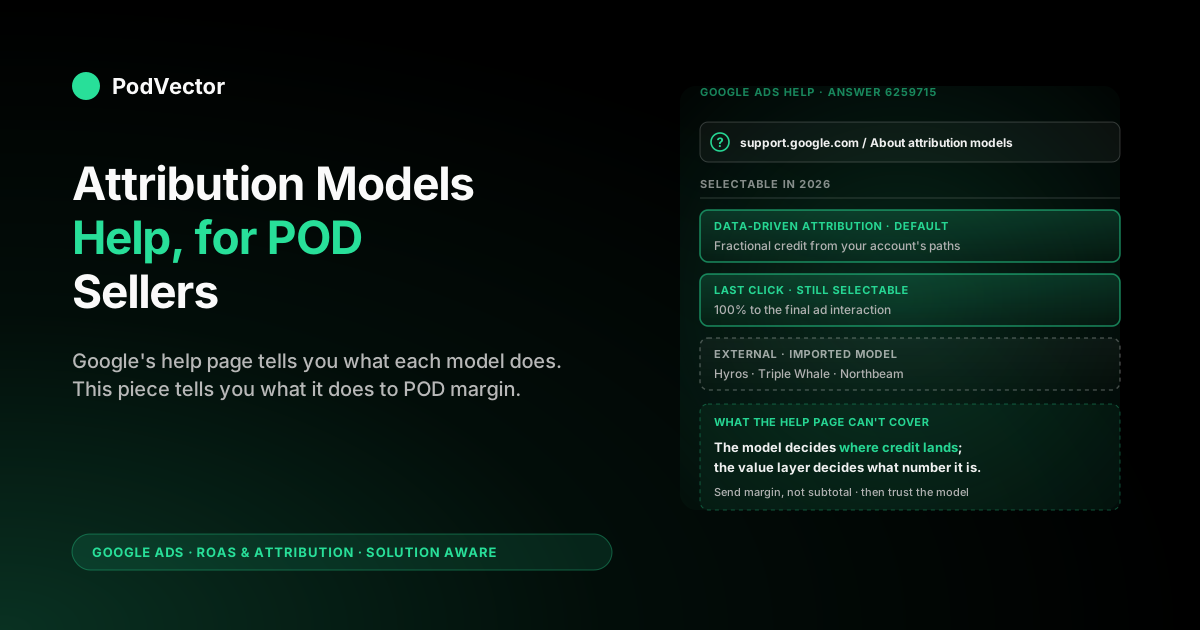
Quick Answer: Google's official "About attribution models" help page tells you that as of 2026 only two attribution models remain selectable in Google Ads — data-driven attribution (DDA) and last-click — and that external (third-party) attribution can be imported in place of either. What that help page doesn't tell you, because it isn't its job, is how the model choice maps onto Print-on-Demand economics.
For a POD store running a $34 hoodie at roughly $9 of true margin, the model decides where credit lands across PMax, branded Search, Demand Gen, and YouTube — and that, in turn, decides which campaigns Smart Bidding scales. The right operating answer for almost every independent POD store is: pick DDA, send margin (not subtotal) as conversion value, hold scaling decisions for the 14-day stabilisation window, and reconcile against bank-deposited revenue rather than another platform's dashboard. The rest of this article is a POD-specific reading of Google's help content — what each line of the doc actually means in a POD account.
What "Google Ads attribution models help" actually points to
The query "Google Ads attribution models help" almost always lands on Google's own About attribution models support article — the canonical Google Ads Help entry on this topic. That doc covers the two currently-available models, the four retired models, and the procedure to find and set the model on a conversion action. It is correct, comprehensive, and platform-neutral.
"Platform-neutral" is exactly its limitation for Print-on-Demand operators. Google's help page tells you what each model does; it cannot tell you what each model means for a $34 hoodie with $14 of supplier cost, $4 of fulfilment, $2 of Shopify and gateway fees, and $5 of Google Ads spend baked in before you ever see margin. This article is the POD reading of the same help content — a section-by-section translation of "what the doc says" into "what to actually do on a POD account."
If you want the structural overview of attribution in a POD context first, our Google Ads attribution explained for POD sellers piece sets the foundations this article assumes. The cluster hub at Google Ads ROAS and attribution for POD indexes every related deep-dive, and it sits inside the broader topic hub at Google Ads for POD.
The two models the help page covers in 2026
As of 2026, the Google Ads help page lists exactly two selectable attribution models for new conversion actions — and a third path (external) for advertisers who measure attribution outside Google Ads entirely.
- Data-driven attribution (DDA) — Google's machine-learning model that assigns fractional credit across the ad interactions on a conversion path, based on observed conversion patterns in your account (or, when your account is below the historical volume threshold, in similar accounts). DDA has been the default for new conversion actions since November 2025.
- Last-click — 100% of credit goes to the final ad interaction before conversion. Still selectable, still useful for diagnostics, increasingly the wrong default.
- External attribution — Conversion data imported from a third-party attribution tool (Triple Whale, Northbeam, Rockerbox, Hyros, Wicked Reports, etc.) replaces Google's own model. Google Ads exposes this as a separate conversion-source setting rather than a fourth selectable model; the help content documents it without editorialising on it.
The full taxonomy and how each model walks credit across a multi-touch path lives in our deep-dive on Google Ads attribution models explained for POD sellers. The historical context for why the choice narrowed to two is in Google Ads attribution news explained for POD sellers.
Data-driven attribution, read for POD
What the help page says. DDA uses your account's data — conversion paths, ad interactions, time-to-conversion — to assign fractional credit to each touchpoint on the path. It runs on Google's machine-learning models and updates continuously. The 300-conversion / 3,000-interaction minimum that historically gated account-specific DDA models was removed in late 2025; smaller accounts now get DDA backed by similar-account modelling.
What it means for POD. Most independent POD stores generate fewer than 300 conversions per month and historically didn't qualify for fully account-specific DDA models. With the threshold gone, DDA is available to every account — but the underlying signal driving credit allocation is still partly modelled rather than fully observed. That is fine when:
- Your conversion path is genuinely multi-channel (Shopping, branded Search, YouTube, Demand Gen mixed in) — DDA earns its keep on multi-touch paths.
- You are sending margin (not subtotal) as conversion value — the model needs to be optimising the right number.
- You are willing to hold scaling decisions for ~14 days after switching, while DDA's credit allocation stabilises against your account's specific paths.
It works less well on a POD account that runs only branded Search with a single touchpoint per conversion — DDA and last-click effectively converge on those paths because there's nothing for DDA to redistribute. Detailed mechanics live at data-driven attribution Google Ads help explained for POD sellers; the migrate-or-not decision tree is in about data-driven attribution Google Ads help explained for POD sellers.
Last-click, read for POD
What the help page says. Last-click assigns 100% of conversion credit to the last ad interaction (click, engaged view) before the conversion. Simple, deterministic, the historical default before DDA took over.
What it means for POD. Last-click systematically over-credits the bottom of the funnel and under-credits the top. On a POD account where YouTube and Demand Gen are doing the work of building demand for a graphic-tee design that ends up being purchased after a branded search, last-click hands all the credit to the branded Search click. Smart Bidding then sees branded Search as your hero campaign and starves YouTube of budget — even though YouTube is what made the demand exist in the first place.
That said, last-click still has two legitimate uses on a POD account:
- Diagnostic. Switching a single conversion action to last-click in a separate, parallel conversion action lets you compare DDA vs. last-click side-by-side in the Model Comparison report. Useful when DDA is producing surprising credit distribution and you want to see the underlying touch order without leaving the platform.
- Single-touch accounts. If your conversion paths are genuinely 1-touch (almost all branded, almost all Shopping, no YouTube layer), last-click and DDA produce nearly identical credit allocation and last-click's simplicity is an asset.
The standalone walkthrough at attribution model Google Ads explained for POD sellers covers the side-by-side reading; the broader Settings UI is in Google Ads attribution settings explained for POD sellers.
External attribution: when to import another tool's verdict
What the help page says. External attribution allows the conversion data ingested into Google Ads to come from a third-party attribution platform rather than from Google's own model. Smart Bidding then optimises against the imported numbers as if they were native conversions.
What it means for POD. External attribution is a real option for larger POD operators running Triple Whale, Northbeam, or similar — and a trap for most independent stores. Three things to know before importing:
- Smart Bidding inherits whatever model the third party uses. If the imported tool is over-crediting Meta and under-crediting Google, Google Ads will respond to that distortion. The platform doesn't second-guess imported numbers.
- Reconciliation gets harder, not easier. You now have three numbers to disagree with each other: Google Ads (running on imported attribution), the third-party platform (the source), and the bank deposit (the only number that actually pays you). For most POD operators this is a step backwards in clarity.
- Hyros, Triple Whale, and Northbeam each price by ad spend or revenue tier. A POD store under $20K monthly spend usually doesn't generate enough decision-value to justify the platform fee plus the integration overhead.
The Hyros-specific evaluation for POD is in Hyros Google Ads attribution reviews: honest breakdown for POD sellers. Amazon-specific external attribution is covered in Amazon attribution Google Ads explained for POD sellers.
The four retired models (and why the help page still mentions them)
Google's help page still references first-click, linear, time-decay, and position-based attribution because those models existed in older accounts and may still appear in legacy documentation. None of them is selectable for new conversion actions, and any conversion actions still configured on those models were auto-migrated to data-driven attribution in September 2023.
For POD operators, the only practical reason to know what each retired model did is reading older blog posts and agency proposals — both still routinely reference linear or position-based attribution as if they were live options. They aren't. The deep-dive on the deprecation and what each retired model meant for POD lives at linear attribution model Google Ads explained for POD sellers.
Why the model choice matters for Smart Bidding
The line on Google's help page that POD sellers should reread three times: "If you use an automated bid strategy that optimizes for conversions … the attribution model you select will affect how your bids are optimized."
That sentence is doing a lot of work. Translated for POD: the attribution model is not just a reporting choice.
It is a bidding signal. When DDA reweights credit from branded Search to YouTube, target-ROAS bidding sees YouTube as a more valuable surface and bids accordingly. When you switch to last-click, the same campaign reads as a branded-Search hero and gets aggressive bids on terms a customer was already going to type anyway.
That coupling is why the model choice cannot be made on reporting preference alone. Three POD-specific consequences:
- Switching the model is a bidding event, not a reporting event. Expect 14 days of noisy daily ROAS while Smart Bidding recalibrates. Hold scaling decisions during that window. Plan switches for low-stakes weeks, not Black Friday-adjacent sprints.
- Conversion value matters more than attribution model. If you are sending subtotal as conversion value, no attribution model recovers the truth. DDA on subtotal still optimises bids against gross revenue, not margin. The model is the second-order question; the value layer is the first-order one.
- Attribution windows compound the model effect. The model decides how credit is distributed; the window decides which touches are even on the path in the first place. Both inputs feed Smart Bidding. Coverage on the window side is in Google Ads attribution window explained for POD sellers.
Privacy, signal loss, and what DDA is actually modelling
The current crop of attribution guides all land on the same point Google's help page understates: the attribution model only ever sees the conversions that get measured in the first place. On a 2026 POD account, a meaningful slice of conversions arrive partially or fully unobserved — Safari/iOS tracking restrictions, ad blockers, and consent-mode denials routinely drop 15–30% of the raw signal before any model touches it. DDA doesn't choose to ignore that gap; it models it, filling unobserved paths with patterns learned from similar accounts.
That changes how a POD operator should read the model choice:
- DDA's "data-driven" credit is part-observed, part-modelled — and the lower your measured signal, the more it leans on modelling. A store with weak conversion tracking gets a DDA output that's mostly inference. The fix isn't switching to last-click; it's repairing the signal underneath both models.
- Enhanced conversions are the highest-leverage repair. Hashed first-party data (email, phone) sent from the Shopify checkout recovers conversions that cookie-based tracking loses, which feeds both the attribution model and Smart Bidding a cleaner number. For most POD stores this matters more than the DDA-vs-last-click decision. Setup-side context is in Google Ads conversion tracking Shopify setup guide for POD sellers.
- Consent mode shapes what DDA can model. If you run Google's consent mode on the Shopify storefront, denied-consent traffic is conversion-modelled rather than directly measured — another layer of estimation stacked on top of the attribution model. Worth knowing before you treat any single campaign's DDA credit as ground truth.
None of this is an argument against DDA — it's the reason the only number that fully escapes the measurement gap is the bank deposit. Reconcile the platform's attributed revenue against margin-after-spend on real orders, and the modelling uncertainty stops being a reporting problem you can't close.
How to find and set the model (the help page's procedure, with POD notes)
Google's help page walks the procedure for finding and setting an attribution model on a conversion action. It is correct as platform documentation. The notes below are the POD-side commentary.
- Open the Goals menu. Tools & settings → Measurement → Conversions. POD note: if you are using Shopify's native Google Ads conversion tracking integration, your conversion actions live here even though they were created from the Shopify side. Setup-side context is in Google Ads conversion tracking Shopify setup guide for POD sellers.
- Pick the conversion action. Click into the conversion action whose attribution model you want to change (typically "Purchase"). POD note: if you have multiple Purchase actions — one from Shopify's native integration, one from a Google tag deployed via GTM, one from enhanced conversions — pick the one that is set as the primary conversion for bidding. The others can stay on their existing model without affecting Smart Bidding.
- Click Edit settings → Attribution model. Choose Data-driven, Last click, or External. POD note: External requires the importing-platform integration to be live first. If you are not running a third-party attribution tool, the choice is between DDA and last-click.
- Check the conversion window in the same panel. The same Edit settings screen exposes the click-through (and, for some conversion types, engaged-view) lookback window — typically a 30, 60, or 90-day selection. POD note: the model decides how credit is split; the window decides which touches are eligible to be split at all, so the two settings have to be read together. POD purchase paths that lean on a YouTube or Demand Gen demand-building touch weeks before a branded-search close need a window wide enough to keep that opening touch on the path. The full window logic is in Google Ads attribution window explained for POD sellers.
- Save. Google immediately applies the new model to future conversions. Past conversions are not retroactively re-attributed in your reports — only the forward-looking distribution changes. POD note: this is the moment the 14-day stabilisation window starts. Document the date.
The mechanics-only walkthrough is in about data-driven attribution Google Ads help explained for POD sellers. The full conversion-tracking setup chain (Shopify-side → Google tag → enhanced conversions → attribution model) is laid out in the complete guide to Google Ads + Shopify integration for POD.
Reading the Model Comparison report on a POD account
Google's help page covers the Model Comparison report briefly: a side-by-side view that shows what each conversion would have been credited under different attribution models. On a POD account, this is the single most useful reporting surface for sanity-checking your DDA choice.
What to look for, specifically:
- Branded vs. non-branded Search. If branded Search loses 30%+ of its credit when switching from last-click to DDA, that's signal — most of branded Search's previously-credited conversions had a YouTube or Demand Gen touch earlier on the path. Don't reflexively defend the branded number; investigate the upstream surface.
- Performance Max. PMax tends to gain credit under DDA because it serves across multiple surfaces (Shopping, Display, YouTube, Discover) and last-click crams all of that into the final touch's surface. The credit gain is usually real signal, not artefact, on POD accounts where PMax is doing the multi-surface work.
- Generic non-brand Search. The most common surprise: non-brand Search either gains a lot or loses a lot, rarely stays flat. If it gains, it's earning more credit as a path-opener than its previous last-click credit suggested. If it loses, it was getting credit for closing conversions that started elsewhere.
The report comparison should never be the basis for a campaign-level scaling decision on its own. Combine it with a true-margin reading. The reporting-side coverage is in Google Ads attribution reports explained for POD sellers.
Five places POD sellers misread the help page
Mistake 1: treating "default = best" as a literal claim. The help page says DDA is the default. That doesn't mean DDA is correct for every POD account — it means Google believes it's correct for the average advertiser. POD accounts with single-touch paths are not the average advertiser; for them, last-click and DDA converge.
Mistake 2: assuming the attribution model fixes the conversion value. No attribution model corrects subtotal-as-value. If your "Purchase" conversion sends $34 instead of $9 (true margin), Smart Bidding optimises against $34. The model decides where the $34 lands, not what number it is in the first place.
Mistake 3: switching models in a high-stakes period. The help page notes that the new model applies to forward-looking conversions. It doesn't editorialise on when to switch. Don't switch in the week before a launch or during a holiday push — Smart Bidding's 14-day stabilisation will collide with your scaling decisions.
Mistake 4: importing external attribution to "fix" Google's number. External attribution doesn't fix Google's number; it replaces it. The third-party tool's number then has to be defended on its own merits. Most POD operators end up running both views in parallel and reconciling against the bank deposit anyway.
Mistake 5: ignoring the help page's bidding-impact line. "The attribution model you select will affect how your bids are optimized." That line decides whether the model conversation is reporting nuance or operational risk. It is the latter. Treat every model switch as a bidding event.
How Victor turns the model choice into a margin answer
Google's help page is one half of the answer. The other half is what the model means against your live POD margin — and that's not in any help doc, because Google can't see your Printify or Printful supplier costs, your Shopify and gateway fees, or the per-SKU margin of the hoodie you're scaling.
PodVector AI's agent Victor sits on top of a unified live data warehouse — Shopify orders, Printify or Printful supplier costs, Shopify and gateway fees, Google Ads and Meta spend — and answers margin-after-spend questions against the current state of the world rather than a stale dashboard. Concretely:
- When DDA reweights credit from branded Search to YouTube, Victor doesn't ask whether YouTube's reported ROAS rose. It asks whether the orders YouTube is now getting credit for are still margin-positive after Printify supplier cost, Shopify fees, and the actual Google Ads spend in the same period.
- When you switch a primary Purchase action from last-click to DDA, Victor flags the 14-day stabilisation window and holds scaling recommendations until the window closes — not because the model is wrong, but because the bidding signal hasn't settled yet.
- When the Model Comparison report shows generic Search gaining 40% of branded Search's credit, Victor surfaces the underlying SKU-level margin contribution of each campaign, so the credit reallocation question becomes a margin question instead of an attribution one.
Victor answers — "what's my true ROAS on PMax this week, after Printify cost?" — in seconds against live data. Tomorrow's roadmap is agentic: pause campaigns whose margin-after-spend slips below threshold without waiting for you to ask.
Google's attribution-models help page tells you what each model does. Victor tells you what each model is doing to your margin. For wider context on how this slot fits the broader playbook, see the complete Google Ads playbook for POD sellers, and for the cross-platform view including Meta Ads see the complete guide to Meta Ads ROAS and attribution for POD.
FAQs
Where does the official "Google Ads attribution models help" page live?
The canonical Google Ads Help entry is support.google.com/google-ads/answer/6259715. It covers the two currently-available models, the four retired ones, the bidding-impact note, and the procedure to find and set the model on a conversion action. This article is the POD-specific reading of that doc.
Which attribution model should a POD store pick by default?
Data-driven attribution, paired with margin (not subtotal) as conversion value. The exception is single-touch accounts (almost all branded Search, no YouTube layer) where DDA and last-click converge — for those, last-click's simplicity is fine. The decision tree is in about data-driven attribution Google Ads help explained for POD sellers.
How long does Smart Bidding take to stabilise after I switch attribution models?
About 14 days. During that window, daily ROAS is noisier than usual because the bidding signal is recalibrating against the new credit distribution. Hold scaling decisions until the window closes.
Can I run different attribution models on different conversion actions in the same account?
Yes. Google's help page allows per-conversion-action model selection. POD operators sometimes use this to keep one Purchase action on last-click for diagnostic comparison while running the primary Purchase action on DDA. Only the primary conversion action drives Smart Bidding.
Does the attribution model affect what's in my GA4 reports?
No. Google Ads attribution models govern Google Ads reporting and Smart Bidding. GA4 has its own attribution model setting (defaulting to DDA in 2026) on the Analytics side.
The GA4 vs. Google Ads gap on multi-channel POD accounts is structural and runs 25–40% — don't reconcile at the campaign level. Background in Google Ads attribution models explained for POD sellers.
Should I use external attribution from a tool like Hyros or Triple Whale?
Only if your POD spend is high enough to amortise the platform fee and you trust the third party's underlying model more than DDA. For independent POD stores under ~$20K monthly ad spend, the operational complexity usually outweighs the reporting clarity. The Hyros-specific evaluation is at Hyros Google Ads attribution reviews: honest breakdown for POD sellers.
Does iOS and privacy-driven signal loss change which attribution model I should use?
Not directly — but it changes how much you should trust either model's output. With 15–30% of conversions arriving unobserved on a typical 2026 POD account, DDA fills the gap with modelling and last-click simply under-counts. The higher-leverage move is repairing the signal: turn on enhanced conversions from the Shopify checkout and confirm consent mode is configured, so both the attribution model and Smart Bidding optimise against a cleaner number. Then reconcile against bank-deposited revenue.
Why does Google's help page still mention retired models like linear and time-decay?
Legacy documentation continuity. Older accounts had those models configured before September 2023, and older third-party blog posts still reference them as live options. They aren't selectable for new conversion actions and were auto-migrated to DDA in 2023. Background in linear attribution model Google Ads explained for POD sellers.
Read every attribution-model choice against live POD margin
Google's help page tells you what each attribution model does in the platform. Victor tells you what each one is doing to your margin. Connect Shopify, Printify or Printful, and Google Ads to PodVector AI and ask "what's my true ROAS by campaign, after supplier cost and fees?" against your live data.
Try Victor free