
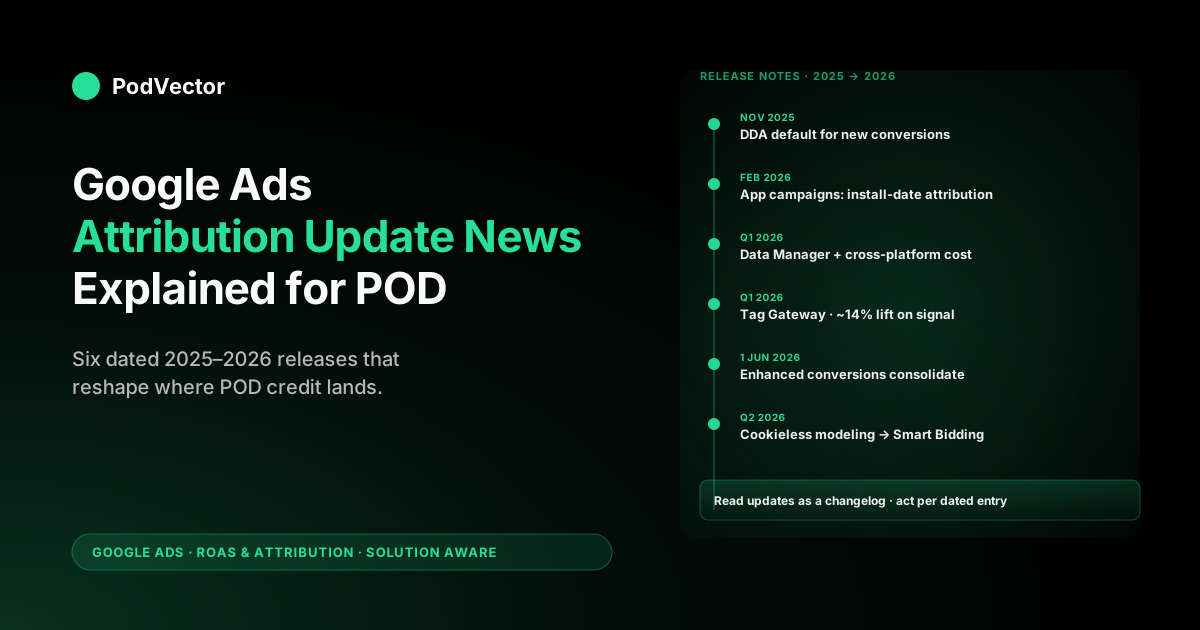
Quick Answer: Read Google Ads attribution update news as a release-notes feed, not a stream of headlines. Between November 2025 and July 2026, Google has shipped eight updates that change how credit is assigned across Print-on-Demand campaigns: data-driven attribution as the default for new conversion actions (Nov 2025), app campaign install-date attribution (Feb 2026), Data Manager-based cross-platform cost import (Q1 2026), the Google Tag Gateway rollout (Q1 2026), the consolidation of enhanced conversions for web and leads (1 Jun 2026), the GA4 consent split that made ad_storage the sole gate for Ads data (15 Jun 2026), a GA4 attribution-model restructure that adjusted upper-funnel credit weighting (Apr 2026), and — most urgent as of mid-July 2026 — the formal removal of first-click, linear, time-decay, and position-based models, which will force-migrate any surviving legacy conversion actions to data-driven attribution by September 2026.
For a POD seller, none of these updates change the underlying economics, but every one of them shifts where credit lands across PMax, Search, Demand Gen, and YouTube — which decides which campaigns get scaled and which get cut. The fix is keeping a thin checklist tied to each rollout date, sending margin (not subtotal) as conversion value, and judging campaigns on margin-after-spend rather than reported ROAS.
Why "update news" is the right frame, not "news"
Most attribution coverage treats Google Ads updates as a stream of headlines: "DDA is the new default," "install date now wins," "the GA4 gap keeps widening." Headlines are fine for awareness but useless for operations. A Print-on-Demand seller doesn't need to be told that data-driven attribution shipped — they need a release-notes-style answer to one question: what specifically changed in my account on which date, and what did I have to do about it?
That is what this article is. It walks through Google Ads attribution update news as a changelog, dated entry by dated entry, with the POD-specific consequence and the action item attached to each release.
One piece of context grounds everything below. Google has now formally removed the four rules-based attribution models — first-click, linear, time-decay, and position-based — from Google Ads. Starting mid-July 2026, those four models stopped being available for any new conversion action. By September 2026, they disappear entirely, including for conversion actions that were still using them. That leaves exactly two models standing: last-click and data-driven attribution (DDA).
Every 2025–2026 update in this changelog is a change inside that two-model world. There is no menu of six models to pick from anymore. The only choice a POD seller makes is last-click vs. DDA — and the November 2025 update quietly made DDA the default for anything new you create, while the July 2026 update removes the choice entirely for legacy conversion actions by September.
It is the operational counterpart to our broader 5-update summary at Google Ads attribution news explained for POD sellers — that piece tells you the structural shape of what is changing; this one tells you the dates, the toggles, and the diagnostics. Both tie back to the cluster hub at Google Ads ROAS and attribution for POD, which sits inside the broader topic at Google Ads for POD.
Three constants matter when reading any 2026 attribution update through a POD lens:
- POD margin is variable per SKU. A $24 mug and a $48 hoodie carry different supplier costs, different shipping, and different gross margins. Every update that moves where credit lands has to be evaluated against that variability — not against an account-wide average.
- POD paths are short but multi-channel. Most POD purchases involve 1–3 ad touches, but those touches frequently mix Shopping, branded Search, and YouTube. That is precisely the mix where every attribution-model update produces visibly different credit allocation week-over-week.
- POD volume is usually modest. Most independent POD stores run relatively low monthly conversion volumes, which means most attribution updates land in an account that is operating under modeled rather than fully account-specific signal. Reading update news without that context overstates how clean the new defaults will feel.
The 2025–2026 attribution update timeline at a glance
Eight attribution updates between November 2025 and July 2026 collectively redefine how a POD account sees credit. Holding them in your head as a timeline is the difference between reacting to each one in isolation — which is how most accounts are running them — and treating them as a sequenced rollout that ends, by September 2026, in a fundamentally different account configuration than it started in.
- Nov 2025 — DDA becomes the default for newly-created conversion actions; the minimum conversion threshold is removed.
- Feb 2026 — App campaigns shift from click-date to install-date attribution.
- Q1 2026 — Data Manager rolls out as a single ingest layer for first-party data and cross-platform cost from Meta, TikTok, Snap, Reddit, and Pinterest.
- Q1 2026 — Google Tag Gateway delivers an uplift in conversion signal for accounts that configure it.
- Apr 2026 — GA4 attribution-model restructure adjusts upper-funnel credit weighting and makes conversion settings more granular per conversion action.
- 1 Jun 2026 — Enhanced conversions for web and leads consolidate into a single configuration.
- 15 Jun 2026 — Google Signals retired as a control over GA4-to-Ads data flow;
ad_storagein Consent Mode becomes the sole gate. - Mid-Jul 2026 — First-click, linear, time-decay, and position-based models removed from new conversion actions; all remaining legacy conversion actions force-migrate to DDA by September 2026.
- Q2 2026 (rolling) — Cookieless modeling moves from a measurement-only signal to an explicit Smart Bidding input.
The rest of this article walks the same list update by update, with a POD-specific consequence and a concrete action for each. For the deeper "what is this update doing to my campaigns" framing, our companion piece on the Google Ads attribution model basics for POD sets the foundations these releases are built on. For a step-by-step guide on connecting Google Ads to your Shopify store, see how to add Google Ads to Shopify step by step.
November 2025: DDA becomes the default for new conversion actions
What changed. Any newly-created conversion action in Google Ads — Purchase, Add to Cart, Lead, Sign-up — is now created with data-driven attribution as the default model. The historical minimum conversion threshold that used to gate account-specific DDA models has been removed. Existing conversion actions are not auto-migrated; the change applies to anything new you create.
POD consequence. A POD account that creates a new "Purchase (true margin)" conversion action — exactly the action you should be creating to send margin instead of subtotal as value — is now opting into DDA whether they intended to or not. That is fine if you understood that, surprising if you didn't. Smart Bidding's optimisation behaviour will shift inside the first 14 days post-creation as DDA reweights credit across Shopping, branded Search, and YouTube touches.
Action item. If you are about to create a margin-based conversion action, expect a short stabilisation window during which daily ROAS will be noisy. Hold scaling decisions during that window. The mechanics of how DDA actually distributes credit are walked through in data-driven attribution Google Ads help explained for POD sellers; the decision tree for whether to migrate existing conversion actions is in about data-driven attribution Google Ads help explained for POD sellers.
February 2026: App campaigns attribute to install date
What changed. App campaigns now attribute conversions to the actual app install date rather than the original ad-click date. The change addresses a long-standing reconciliation gap with Mobile Measurement Partners (AppsFlyer, Adjust, Branch, Kochava, Singular) that historically saw click-date attribution backdate conversions by days or weeks, breaking the Smart Bidding feedback loop in mobile-heavy verticals.
POD consequence. Most independent POD sellers run no app campaigns and can skip this update entirely — but the framing matters even for web-only POD. Google has publicly committed to the principle that conversion signal arrival time matters as much as conversion attribution accuracy. That principle is the underlying logic behind several of the other 2026 updates, including the cookieless modeling changes shipping through Q2.
Action item. If you are running app installs (some larger POD brands have companion apps for repeat customers), expect MMP-reported numbers and Google Ads-reported numbers to converge; reset any internal benchmarks that were tuned to the old discrepancy. If you don't run app campaigns, file the update under "principle that informs the rest of the timeline."
Q1 2026: Data Manager and cross-platform cost import
What changed. Google rolled out Data Manager as a unified configuration surface for first-party data ingestion (websites, apps, physical stores, CRMs) and added the ability to directly import campaign cost data from Meta, TikTok, Snap, Reddit, and Pinterest. The new "Conversions (Platform Comparable)" column allows POD sellers running Demand Gen alongside Meta to compare per-platform performance on a normalised basis.
POD consequence. The cross-platform cost import is the most under-discussed update of the cycle for POD specifically. Most POD sellers run Meta and Google in parallel, and the previously cumbersome reconciliation between the two platforms is now a configuration step rather than a custom ETL job. Combined with sending margin as conversion value, this gives a POD account a shot at a cross-platform margin-ROAS view that was effectively impossible to maintain a year ago. For a broader look at how Google and Meta compare for POD, see Google Ads vs. Facebook Ads: which is best for POD sellers.
Action item. Configure Data Manager and connect Meta as a cost source if you run both. Then verify that the conversion value being compared across platforms is true margin, not subtotal — otherwise the comparable column compares revenue numbers that overstate POD economics by a wide margin on a hoodie. For more on aligning attribution with multi-channel POD reality, see Google Ads attribution: email and organic integration for POD sellers.
Q1 2026: Google Tag Gateway lifts measured conversion signal
What changed. The Google Tag Gateway is a server-side delivery layer for the Google tag that bypasses many client-side blockers (ad blockers, ITP, ETP, cookie clears). Accounts that configure it see an uplift in measured conversion signal, with the exact amount varying by browser population — accounts with higher Safari and Firefox share typically see larger lifts because those browsers are more aggressive about blocking client-side tags.
POD consequence. POD audiences skew young and mobile, with meaningful Safari share and ad-blocker penetration above the e-commerce average. The new conversions recovered are not new sales — they are previously-lost signal becoming visible. That changes reported ROAS, Smart Bidding inputs, and the calibration of any POD-margin model you have layered on top.
Action item. Configure the Tag Gateway, but pre-register the expected uplift internally so it isn't read as a step-change in real performance. The account did not suddenly get more profitable; it got better instrumented. Recalibrate any margin-after-spend benchmarks that were trained on the previous, lower measured conversion count. For implementation patterns on the conversion-tracking side, our Google Ads conversion tracking on Shopify setup guide covers the Shopify-side touchpoints.
April 2026: GA4 attribution-model restructure
What changed. The GA4 update in April 2026 introduced changes that directly impact how Google Ads performance is measured and reported. The most significant change is a restructured attribution model that adjusts how credit is assigned across touchpoints in multi-channel conversion paths — specifically, Google shifted the default attribution model further toward data-driven attribution, with updated logic that weights upper-funnel interactions differently than prior versions.
Google also documented more flexible conversion management, stating that conversion attribution settings could be adjusted independently for every conversion in eligible properties. Google also expanded cross-channel conversion reporting in the advertising workspace, including model comparison and path-based analysis.
POD consequence. For advertisers, the April GA4 update means that conversion values and ROAS calculations may shift — even on campaigns where nothing operationally changed. Upper-funnel YouTube or Display touches now receive more credit in multi-touch paths than they did before. For a POD account running PMax, this means the internal credit split between Shopping and YouTube placements will look different in GA4 reports relative to earlier in the year.
Action item. Run a model-comparison report in GA4 (Advertising workspace → Attribution → Model Comparison) and note the pre/post-April credit distribution across your campaign types. If PMax is your primary campaign, check whether the YouTube component is receiving more credit than it was — and whether that credit is backed by actual margin contribution from Shopify orders, not just attributed ROAS. The reason this topic matters is that Google's 2026 GA4 product updates made attribution more operational and less abstract. Previously, many teams treated attribution as a reporting preference they revisited occasionally. In 2026, Google pushed attribution closer to campaign management and conversion administration.
1 June 2026: Enhanced conversions consolidate into one feature
What changed. On 1 June 2026, enhanced conversions for web and enhanced conversions for leads merged into a single unified feature. Until then, advertisers had to set up two parallel pipelines depending on whether the conversion happened on the website (purchase) or off it (lead form, CRM-recorded sale). After consolidation, both flow through one configuration in Data Manager, with the platform routing the user-provided data to the right model server-side.
POD consequence. Pure POD ecommerce — purchase happens on Shopify, no lead-gen step — sees a simplification rather than a behaviour change. The signal sent to Google is the same: hashed email, hashed phone, hashed name/zip from Shopify checkout, sent through the Google tag. POD sellers running B2B bulk-order flows, licensed-design programmes, or custom-printing services see a more meaningful change: the lead-gen conversions previously living in offline conversion imports now ride on the same first-party-data pipeline as the purchase conversions.
Action item. Now that the consolidation has landed, run three checks: (1) verify your Google tag is firing first-party identifiers (hashed email at minimum) on Shopify checkout; (2) verify Data Manager has the right consent-mode signals wired up; (3) compare current enhanced-conversions volume against your pre-June baseline to confirm parity. The unified pipeline is more powerful but also a single point of failure — a mis-configured rollout can drop signal across both purchase and lead conversions simultaneously, so a silent drop right after 1 June is the failure mode to watch for.
15 June 2026: Google Signals retired — ad_storage becomes the sole gate
What changed. Starting June 15, 2026, Google Analytics transitions to using Consent Mode — specifically the controls within Google Ads — as the single control for the data GA4 shares with linked Google Ads accounts. Up to that date, two settings jointly governed Google Ads cookie and identifier collection from GA4: the Google Signals setting in GA4 Admin, and the ad_storage parameter in Consent Mode. After the date, only ad_storage governs that flow.
Later in 2026, ads personalization settings will also move from GA4 to Google Ads, where Consent Mode's ad_personalization parameter exclusively controls personalization for linked Ads accounts.
POD consequence. For most independent POD Shopify stores that don't serve heavy EU/EEA traffic, this update is low-stakes — but the failure mode is silent. Google is removing Google Signals as a control over how GA4 shares data with Google Ads, and handing that authority to a single Consent Mode parameter: ad_storage. If your consent banner fires that signal wrong, the failure is silent — no error, no warning, just a slow erosion of conversions and audiences.
The POD-specific concern is Smart Bidding signal quality. If your consent banner does not fire ad_storage correctly, conversions, audiences, and Smart Bidding signals can go dark — with no Signals fallback to catch the gap. For a POD store where monthly conversion volume is already modest, losing even a fraction of the Smart Bidding signal pool is disproportionately harmful.
Action item. Audit your consent banner for Consent Mode v2 compliance. Verify the ad_storage parameter fires correctly on both "accept all" and "reject all" user scenarios using Tag Assistant. On June 11, Google also launched a new Source Group dimension in GA4 that cleans up messy traffic source names, and on June 15, Google split the consent controls between GA4 and Google Ads — so if your numbers look different since mid-June, both changes may be contributing. Capture a post-June baseline and compare against the period before June 11 to separate the two effects.
Mid-July 2026: Four attribution models removed — September deadline incoming
What changed. This is the most urgent update in the timeline as of the date this article was refreshed. As of mid-July 2026, the first-click, linear, time-decay, and position-based attribution models are no longer available. Two remain: data-driven attribution and last click. The way Google decides which campaign gets credit for each sale has changed, and your numbers will change with it — even if your operation stays identical.
By September 2026, every conversion action still running on one of those four models gets force-migrated to data-driven attribution, whether the account owner asked for it or not.
POD consequence. If your account was created before November 2025 and you never migrated your conversion actions, you may still be running on linear, time-decay, or position-based. Those conversion actions will be silently moved to DDA in September. If your Google Ads or GA4 reports show different numbers than last month and you did not touch anything, this is why. For a POD account, the practical risk is that DDA's first forced migration lands mid-Q3 2026 — directly inside back-to-school and early-holiday season, when performance baselines matter most.
Action item. Choose deliberately between data-driven or last click. With low monthly conversion volume, last click is less elegant but more stable and explainable. With higher volume, keep data-driven and monitor the first weeks. Whatever you choose, do it before September rather than letting Google choose for you. Annotate the change for your team or your clients the same way you would any platform update: note the date, note that the model changed, and give performance a few weeks to settle before drawing conclusions. For broader context on how DDA mechanics work for POD, see data-driven attribution Google Ads help explained for POD sellers.
Q2 2026: Cookieless modeling becomes a Smart Bidding input
What changed. Cookieless modeling — the modeled conversions that fill the gap when third-party identifiers aren't available — has been rolled into Smart Bidding's training inputs rather than appearing only as a measurement-layer adjustment. Said differently: Smart Bidding now optimises against a conversion stream that includes modeled cookieless conversions as a first-class signal.
POD consequence. POD accounts will see a portion of reported conversions modeled rather than directly observed, with the higher share concentrated in Safari- and Firefox-heavy audiences (which is to say: the typical POD store). Smart Bidding's behaviour is now partially shaped by those modeled conversions. That is fine when the modeling is well-calibrated for your audience and dangerous when it isn't. The June 15 consent update compounds this: modelling will become increasingly central to ROAS for advertisers, but if you aren't using Advanced Consent Mode, a 'Denied' click becomes a total data blackout.
Action item. Stop trying to reconcile Google Ads and GA4 conversion totals at the campaign level — the GA4 vs. Google Ads gap is structural and expected on multi-channel POD accounts, not an error. Reconcile only at the account-monthly level, and against bank-deposited revenue rather than a third platform.
Detailed coverage of the gap mechanics lives at Google Ads attribution models explained for POD sellers. For the underlying model definitions, see also attribution model Google Ads explained for POD sellers.
The stack effect on a POD account
Each of the eight updates is manageable in isolation. The stack effect is not. A POD account that started 2025 on last-click attribution, no enhanced conversions, no Tag Gateway, and a single platform reading exits Q3 2026 with DDA on every conversion action (by force if not by choice), enhanced conversions through Data Manager, Tag Gateway lifting measured conversions, cross-platform cost imported from Meta, ad_storage as the sole consent gate feeding Smart Bidding, and modeled cookieless conversions inside the bidding signal.
The reported ROAS at the end of that journey is not the same number as the starting ROAS, even if the actual sales held flat. The composition has changed: more attributed conversions, different credit distribution across PMax/Search/YouTube, a different consent architecture feeding the signal pool, and a different model feeding Smart Bidding's auction-time decisions.
POD margin economics amplify any miscalibration that survives the migration. A credit reallocation that's a rounding error for a high-margin SaaS company is the difference between a profitable and unprofitable PMax campaign for a print-on-demand hoodie at thin true margin. The single most important defensive move across all eight updates is sending margin (not subtotal) as conversion value — that removes the largest source of stack-effect distortion.
For a deeper dive on Google's attribution-window mechanics that interact with each of these updates, see Google Ads attribution window explained for POD sellers. For how Google Shopping specifically sits inside the broader campaign mix that these updates are reweighting, see Google Shopping Ads on Shopify strategy for POD. For a side-by-side look at how Google and Meta attribution compare for POD, see Google Ads vs. Facebook Ads: features, benefits, and which is best for POD sellers.
A POD seller's release-notes checklist
The simplest way to absorb a year of attribution updates without losing operational control is to keep a one-page checklist tied to the rollout dates. The version that has worked for the POD accounts we see:
- By end of Nov 2025 — Decide whether existing last-click conversion actions get migrated to DDA or whether you wait for the natural attrition as new conversion actions inherit DDA by default. Document the decision.
- By end of Feb 2026 — If running app campaigns, recalibrate MMP benchmarks. If not, no action.
- By end of Q1 2026 — Configure Data Manager. Connect Meta and any other paid platform you run. Verify that conversion value being compared across platforms is true margin, not subtotal.
- By end of Q1 2026 — Configure Google Tag Gateway. Pre-register the expected measured-conversion uplift internally so the step-change isn't misread as new revenue.
- Post Apr 2026 — Run a GA4 model-comparison report. Note the new upper-funnel credit split across Shopping vs. YouTube inside PMax. Verify it aligns with actual margin contribution from Shopify orders.
- Post 1 Jun 2026 — Confirm enhanced-conversions volume matches your pre-June baseline. Verify Shopify-side first-party identifiers are still firing. Verify consent mode in Data Manager.
- Post 15 Jun 2026 — Audit Consent Mode v2: verify
ad_storagefires correctly for both accept and reject scenarios. Capture a post-June-15 baseline to separate the consent-split effect from the Source Group dimension effect. Check for silent erosion of Smart Bidding signal. - Before September 2026 (URGENT) — Audit every conversion action still on first-click, linear, time-decay, or position-based. Migrate deliberately to DDA or last-click before Google force-migrates them to DDA in September. Do not let the migration land during peak season without annotation.
- Through Q2–Q3 2026 — Stop reconciling Google Ads and GA4 at campaign level. Reconcile monthly against bank-deposited revenue.
- Always — Send margin, not subtotal, as conversion value. Judge campaigns on margin-after-spend.
Plan and run that checklist alongside the broader playbook in the complete Google Ads playbook for POD sellers.
Three update-news mistakes POD sellers keep making
Mistake 1: reading each update in isolation. The DDA default change is small. The Tag Gateway lift is small. The June 15 consent-gate change is small. The July model removal is not small, but even it becomes manageable when you hold the eight-update sequence in view. Stacked, they reshape what your reported ROAS even means. The release-notes frame above is the antidote — sequence the updates, not the headlines.
Mistake 2: treating a measured-conversion uplift as a real-performance uplift. The Tag Gateway lift is recovered signal, not new sales. Treating it as new performance overstates true ROAS by exactly that amount. If your bidding strategy is target-ROAS, the new measured number relative to the old target effectively loosens the strategy unless you re-set the target.
Mistake 3: reconciling Google Ads to GA4 to a third platform. Many marketers will see attribution shifts, audience changes, and reporting discrepancies even when nothing changed in the market. The gap between Google Ads and GA4 is structural and widening through 2026. Triangulating to a third tool just adds a third number to disagree with. Reconcile to the bank — that's the only number that decides whether you have a business — and treat the platform numbers as bidding inputs, not ground truth. This is a good moment to build, or lean harder on, an attribution number that does not depend on which model a platform prefers this quarter. An attribution model change inside Google Ads should not be able to move your reported performance overnight if you already have an independent number sitting next to it.
How Victor reads each update against live POD margin
The hard part of attribution update news isn't the news. It is keeping a live, SKU-level picture of margin-after-spend that survives every credit reallocation Google rolls out. PodVector's AI employee Victor sits on top of a unified live data warehouse — Shopify orders, Printify or Printful supplier costs, Shopify and gateway fees, Google Ads and Meta spend — and answers margin questions against the current state of the world rather than a stale dashboard.
Concretely: when DDA reweights credit from branded Search to YouTube, Victor doesn't ask whether YouTube's reported ROAS went up. It asks whether the campaigns YouTube is now getting credit for are still margin-positive after Printify supplier cost, after Shopify fees, after the actual Google Ads spend in the same period.
When the Tag Gateway lifts your measured conversions, Victor recalibrates the margin-after-spend benchmark accordingly so the step-change isn't read as new performance. When the gap between Google Ads-reported conversions and actual Shopify orders widens — because of the April GA4 restructure, the June consent split, or the September DDA migration — Victor reconciles against Shopify-deposited revenue on the schedule that matches your actual reporting cadence.
Victor also reads your Google Ads data to surface proposals like which campaigns are margin-positive and which are not, so you can act on the ad platform with confidence. Ad-platform writes — pausing campaigns, changing budgets or bids — are executed by you on the ad platform; Victor reads the data, proposes the move with rationale, and you approve or reject.
On the Shopify side, Victor can execute approved actions today: repricing a product to a target margin, bulk repricing across your store, setting up a BOGO or free-shipping discount, raising your free-shipping threshold, creating a customer-specific discount, organising products into a collection, and reverting a price change. For the full picture of what Shopify-side automation looks like with AI, see Shopify Admin API store modifications and automation for POD.
The attribution updates above all change where credit lands; Victor's job is to make sure your decisions are still being made on margin, not on whichever reported ROAS the latest Google Ads release notes happened to ship. For the wider context, our pieces on Meta Ads ROAS and attribution for POD and the complete Google Ads playbook for POD show how this slot fits the broader paid-media stack. For more on integrating attribution tools across your POD stack, see Ask Bosco integrations: Shopify, GA4, and Meta Ads setup guide for POD sellers.
For independent context on the underlying Google updates, the AdBeacon piece on Google removing the four attribution models documents the July 2026 removal and September deadline in detail, and the Boostify post on Google Ads attribution changes in July 2026 covers the practical decision between DDA and last-click for lower-volume accounts.
FAQs
Is "Google Ads attribution update news" different from "Google Ads attribution news"?
Practically, yes. "News" tends to mean the headlines — what shipped, what's structurally different. "Update news" is more useful operationally: the dated list of releases, what each one changed, and what to do about it. This article is the changelog version; the structural-news view lives at Google Ads attribution news explained for POD sellers.
Do I need to migrate my existing conversion actions to DDA after the November 2025 default change?
Yes — and now the answer is more urgent than it was six months ago. By September 2026, every conversion action still running on one of the four removed models gets force-migrated to data-driven attribution, whether the account owner asked for it or not. For a POD account, migrating deliberately before September — rather than letting it happen automatically mid-holiday ramp — gives you a controlled annotation window and prevents the migration from being confused with a real performance shift. The decision tree is in about data-driven attribution Google Ads help explained for POD sellers.
How many attribution models can I even choose from in 2026?
Two: last-click and data-driven attribution (DDA). As of mid-July 2026, the first-click, linear, time-decay, and position-based attribution models are no longer available. Two remain: data-driven attribution and last click. Every update in this changelog is a change inside that two-model world, and the practical default for a POD account is DDA with margin sent as conversion value.
What happened on June 15, 2026 with Google Signals?
On June 15, 2026, Google Signals stopped controlling Google Ads data collection. Consent Mode's ad_storage parameter became the sole authority. For most POD stores not serving heavy EU traffic, the day-to-day impact is low — but if your consent banner misfires, there is now no Signals fallback. Check that ad_storage fires correctly in both accept and reject scenarios using Tag Assistant.
Will the Google Tag Gateway uplift my real revenue?
No. It uplifts measured conversions. Real revenue is unchanged; previously-lost signal is now visible. The risk is reading the lift as new performance instead of recovered measurement, which silently loosens any target-ROAS strategy unless you re-set the target.
Does the 1 June 2026 enhanced-conversions consolidation require any work for a Shopify-only POD store?
Minimal — verify your Google tag fires first-party identifiers at checkout, verify consent mode is configured in Data Manager, and document the pre-consolidation setup so you can confirm post-consolidation parity. If you also run lead-gen flows (B2B bulk, licensed-design programmes), the work is bigger and warrants a dedicated test plan.
How wide will the GA4 vs. Google Ads conversion gap get?
The gap is structural and expected on multi-channel POD accounts. It is not an error to fix. The April 2026 GA4 restructure, the June 2026 consent split, and the rolling cookieless modeling changes all add separate reasons for the platforms to disagree. Reconcile monthly against bank-deposited revenue rather than at the campaign level against a third platform.
What's the single highest-leverage thing to do across all eight updates?
Send margin, not subtotal, as conversion value, and judge campaigns on margin-after-spend instead of reported ROAS. That single change neutralises most of the stack-effect distortion the 2025–2026 updates introduce, regardless of which model is winning credit in any given week. The September 2026 forced migration is the most time-sensitive item — act on that before the holiday season arrives.
Read attribution updates against live POD margin
Stop tracking Google Ads attribution update news on screenshots and stale dashboards. Connect your Shopify, Printify or Printful, and Google Ads accounts to PodVector and let Victor answer margin-after-spend questions against your live data — every time the platform ships a release.
Try Victor free