
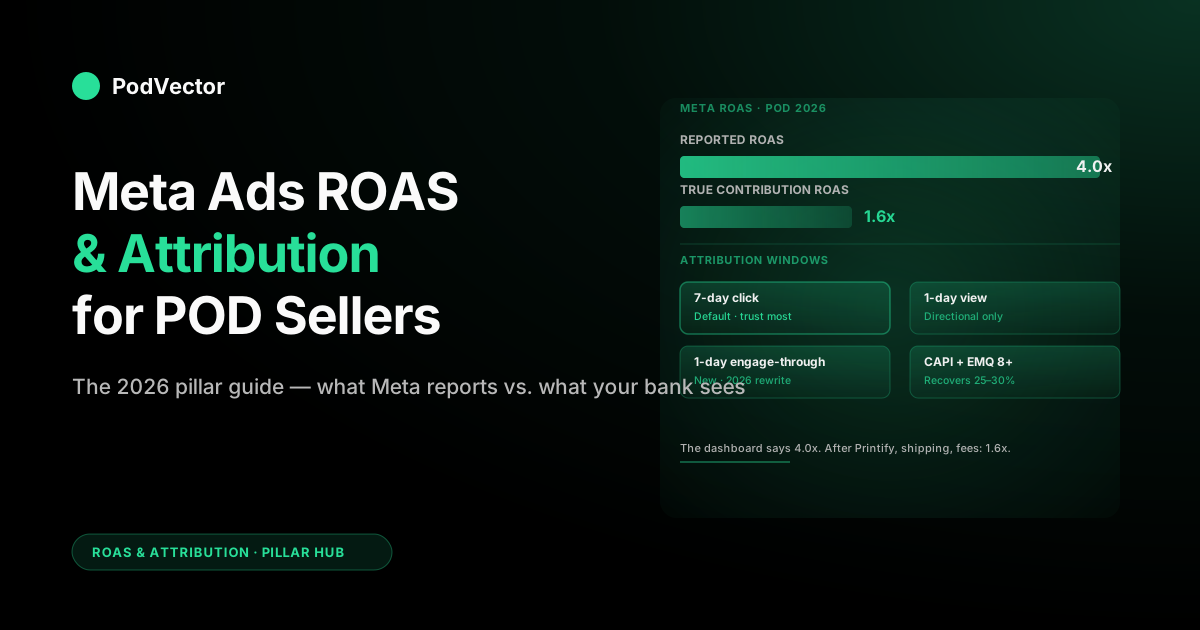
Quick Answer: Meta Ads ROAS is revenue divided by ad spend as Meta attributes it, and for print-on-demand sellers that dashboard number routinely overstates true, contribution-margin profitability because it never sees your Printify or Printful supplier costs, shipping, payment fees, or post-iOS attribution drift. Attribution is the rule that decides which click, view, or engagement gets credit for a sale — and the default window changed in 2026.
The right POD setup in 2026: Shopify + Meta native integration (Pixel and the Conversions API both on, deduplicated), a 7-day-click / 1-day-view reporting window held constant, Event Match Quality pushed to 8+/10, and decisions made on MER and per-SKU contribution margin rather than the platform ROAS line.
This guide walks every mechanism behind the number — how Meta credits conversions, what each attribution window captures, how the Conversions API rebuilds the events the iOS pixel silently drops, what "good" POD ROAS actually looks like after supplier line items, and how to reconcile the reported figure against the math that decides whether your store makes money.
Why POD changes the Meta ROAS conversation
Almost every Meta Ads ROAS and attribution guide on the first page of Google is written for a direct-to-consumer brand that looks structurally nothing like a print-on-demand store. The template audience in those guides has fixed cost of goods sitting inside Shopify as a single COGS number, warehouse inventory, high gross margins, and a product catalog small enough that per-SKU profitability can be eyeballed.
When that audience sees a healthy reported ROAS on Meta, their contribution math works even if the reported number drifts, because their margin cushion is substantial. Print-on-demand is the opposite shape on every dimension that matters for ROAS interpretation.
POD cost of goods is itemized per order. Every Printify or Printful line item has a different supplier price depending on garment, print method, size, color, and ship-to country.
Shipping is a separate per-order charge that no ad platform knows about. Payment processing is 2.9% + $0.30 per Shopify sale, platform fees are variable, and returns — while lower than DTC — still happen and eat into the number.
Contribution margin on a typical POD order is thin. That margin is too narrow for attribution drift that a DTC brand with much higher gross margins absorbs without noticing.
If your Meta dashboard shows a strong ROAS and the real contribution number is far lower, a DTC brand with deep gross margin is still profitable. A POD seller at the same dashboard number may be breakeven at best and losing money at worst — and they will not know until they reconcile the data manually.
The second structural difference is SKU count. Most POD stores have hundreds of active design-product combinations, and the ad-platform view of ROAS aggregates all of them into one number per ad set.
That averaging hides the hoodies losing money per sale inside the t-shirts generating real margin, and it guarantees that every campaign's reported ROAS is the wrong number for every individual SKU inside it. Attribution at the platform level gives you a fleet-average that none of your actual orders match.
The third structural difference is creative velocity. POD sellers test designs, not just angles or ad copy, which means every ad account has a much higher creative turnover rate than a typical DTC setup.
That higher velocity puts more of every month's spend into cold-launch learning phases, where Meta's attribution is noisiest and where the delta between reported and true ROAS is widest. The result is that POD sellers running many active creatives a month face a structurally larger attribution gap than a DTC brand running a handful.
All three of those structural differences compound. Thin margins plus per-order supplier variance plus high creative velocity means that "good enough" ROAS interpretation is not good enough for POD.
You need the full picture — how Meta actually assigns conversions, what each attribution window captures, which defaults you should override, and how to reconcile the reported number against your actual per-order contribution — before you can reliably run Meta Ads at scale. That is the job of this guide.
What Meta Ads ROAS actually measures
ROAS stands for return on ad spend, and Meta's definition is straightforward arithmetic: total attributed conversion value divided by total ad spend, reported at the account, campaign, ad set, and ad level. A campaign that spent $1,000 and drove $4,000 in attributed purchase conversion value shows a 4.0x ROAS. Meta labels the metric "Purchase ROAS (return on ad spend)" in the default column set, and the underlying value is populated by the purchase events your Pixel, CAPI, or offline conversion upload sends back with a value parameter.
The important word in that sentence is attributed. Meta's reported ROAS is not "revenue that your ad caused." It is "revenue that Meta's attribution model credits to your ad within the attribution window you selected." The gap between those two phrasings is where every POD seller loses money they don't realize they are losing.
As AnyTrack notes, platform-reported ROAS is biased toward what each platform's pixel saw — not what actually happened in your store's backend. Three inputs determine what Meta puts on the ROAS line of your dashboard:
- The event signal. Meta counts only the purchases it knows about. If your Shopify Pixel fires cleanly, Meta sees the event. If the buyer is on iOS with Advanced Tracking Protection on, the Pixel may not fire at all, and Meta will credit no revenue to the ad that actually drove the sale. CAPI, discussed later, closes most of that gap.
- The attribution window. Meta assigns credit for a conversion to whichever ad the user clicked or viewed within the selected window. In 2026 the default is 7-day click, 1-day engage-through, 1-day view. A purchase that happens nine days after a click is not credited to that ad.
- The conversion value. Meta reports the value your Pixel or CAPI passed in, which is normally the order subtotal (before tax, shipping, and discount) in your base currency. If you are not deduplicating between Pixel and CAPI correctly, you can double-count revenue and inflate ROAS significantly.
For POD sellers the conversion value question gets sharper still. A hoodie sale sends the retail price back to Meta. The supplier cost, shipping, and payment processing fees — which together consume the majority of that retail price on Printify's Express fulfillment — are invisible to the platform. A high "reported ROAS" for a campaign selling hoodies does not know that each sale contributes only a fraction of the retail price to your actual bottom line.
Meta is not lying. Meta is answering a different question than the one that keeps your store alive. This is the same dynamic we cover in our explainer on ROAS for print-on-demand, and it sits at the root of every Meta attribution problem a POD seller faces.
What attribution means inside Meta Ads Manager
Attribution is the assignment of credit. When a user sees three ads, clicks one, goes away, searches for your brand on Google two days later, clicks an email link the day after that, and finally buys on day five, some system has to decide which of those five touchpoints gets the conversion credit.
In Meta's walled-garden view, only the ads Meta served are eligible for credit, and only within the attribution window Meta measures. Every other touchpoint is either invisible to Meta or explicitly deprioritized by the model.
As Madgicx's 2026 breakdown of Meta ROAS tools points out, the multi-touchpoint journey between first ad exposure and purchase is exactly why different attribution models produce such different ROAS numbers. There are four main attribution approaches a POD seller will encounter, and Meta Ads Manager defaults to the first:
- Last-click within the Meta window. The most recent Meta ad a user clicked inside the attribution window gets all of the credit for the conversion. This is Meta's default model for the Purchase ROAS column and is what most sellers mean when they say "Meta's reported ROAS."
- Multi-touch / data-driven attribution. Meta's Advanced Analytics distributed credit across touchpoints. This is not reflected in Ads Manager's default ROAS column and must be read separately. It tends to give Meta less credit than last-click does.
- Incremental attribution. Meta's newer incrementality reporting attempts to estimate how many conversions would not have happened without the ad — i.e., the true lift, not the correlated total. Incremental ROAS is almost always lower than reported ROAS.
- Blended / platform-agnostic attribution. Total store revenue divided by total marketing spend across all channels. This is the MER (media efficiency ratio) approach, which we go deep on in the MER section below. It is the one number no platform can lie about because it's the same arithmetic you already do to pay yourself.
The reason these four give different answers for the same month of ad spend is that each one is asking a different question. Last-click asks "which ad did the user see last before buying?" Multi-touch asks "which combination of ads contributed to the decision?" Incremental asks "would the sale have happened anyway?" MER asks "did total spend produce total revenue?" A POD seller running a single Meta campaign will see all four answers diverge.
None of them is wrong in isolation. All of them are wrong as a decision metric in isolation. The goal of an attribution setup is to pick a stable number and optimize against it while sanity-checking with the others.
Attribution windows in 2026 (post-March rewrite)
Meta's March 2026 attribution rewrite changed the default windows on every ad account that had not manually overridden them. The new default is 7-day click, 1-day engage-through, 1-day view.
Before the rewrite the default was 7-day click, 1-day view. What changed is the addition of the "engage-through" category and the narrowing of what counts as a "click."
The available attribution windows in 2026 are:
| Window | What it captures | Typical POD use |
|---|---|---|
| 1-day click | Conversions within 24 hours of a link click | Conservative, high-intent measurement; under-credits demand gen |
| 7-day click | Conversions within 7 days of a link click | Default; balances immediate and considered purchases |
| 1-day engage-through | Conversions within 24 hours of a video view, reel interaction, or social engagement that is not a link click | New in 2026; captures TikTok-era discovery behavior |
| 7-day engage-through | Conversions within 7 days of a video view or social engagement | Inflates ROAS on video-heavy creative; treat with caution |
| 1-day view | Conversions within 24 hours of an impression (no click, no engagement) | Useful for broad-reach prospecting; over-credits if left on 7-day |
| 7-day view | Conversions within 7 days of an impression | No longer available as a standalone default; only selectable in custom reports |
The 7-day click + 1-day view combination remains the industry-standard comparison window for ecommerce, and Meta for Business still recommends it in most published guidance. For POD sellers specifically, there are two adjustments worth making to the default setup.
First, turn off engage-through for performance campaigns during the first 14 days of a new creative launch. Engage-through credits conversions to video views that may have been auto-play impressions the user never actually chose to engage with.
For POD creative, where the hook is often in the first second, this introduces noise that makes scaling decisions unreliable. You want to know whether the ad drove a click-led conversion before you decide whether to multiply the budget. Re-enable engage-through after the creative has stabilized if your account is video-heavy.
Second, set the reporting window to 7-day click + 1-day view and stop toggling. Every time you change the window for a report you are mathematically changing what "ROAS" means in that report, and you lose the ability to compare week-over-week. Pick one window, hold it constant, and read the same number every time.
One nuance the generic guides get right: the window should match the campaign's actual job, not a single house default. A 2026 attribution-settings analysis notes that advertisers running one default window across every campaign over-attribute conversions meaningfully. For POD, the windows worth using by campaign job are:
- Cold prospecting (broad / lookalike): 7-day click + 1-day view — the default; long enough to credit considered first purchases.
- Retargeting / warm audiences: 1-day click only — these buyers were already going to convert, so a long window over-credits the retargeting ad and double-counts demand that prospecting created.
- Video-led creative with a CTA: 7-day click + 1-day engaged-view, but only once the creative has stabilized (see the launch caveat above).
- Brand-search defense or high-ticket custom apparel: a longer click window (up to 28-day click) can be justified by a genuinely longer consideration cycle — unusual for POD, but real for made-to-order pieces.
Click-through vs engage-through vs view-through
Inside the 2026 model, every attributed conversion carries one of three credit types. Understanding what each one actually represents is the difference between scaling a profitable campaign and scaling a campaign that Meta's model thinks is profitable.
Click-through (CTR) is the tightest and most trustworthy credit type. A user saw an ad, clicked the link, and ended up on your site — either directly in that session or within the window.
If the purchase happens inside the window, Meta credits the conversion to that ad. For POD, click-through conversions are the signal you trust most when deciding whether to scale, because they reflect a behavioral choice the user made (clicking) rather than a passive exposure.
Engage-through is the new category that Meta added in March 2026 by carving it out of what used to be "click" attribution. It captures conversions after a user engaged with the ad in a non-click way — most often a 10-second-or-longer video view (Meta's "engaged-view" threshold), a carousel swipe, a paused reel, or a post reaction.
Engage-through credit is softer than click credit because engagement is a less deliberate signal than a click, and on video-heavy POD accounts it can inflate reported ROAS significantly. A campaign reporting a high ROAS where a large portion of credit is engage-through is functionally a much weaker click-through campaign with some halo effect. Read the breakdown, not just the headline.
View-through (VTA) is the softest credit type. The user saw an impression of the ad — the ad rendered on their screen for at least 1 second at 50%+ in-view — and then converted within the window without clicking or engaging.
View-through is statistically real but easily over-credited. For POD, view-through credit is useful as a directional signal for whether broad-reach creative is contributing to baseline sales, but scaling decisions should never be made on view-through-dominant campaigns alone.
A practical rule: break down reported ROAS into its credit-type components in Ads Manager before making a scaling decision. If the headline ROAS is driven primarily by engage-through and view-through rather than click-through, scaling budget on that headline number will compound the softer credit types, and when you reconcile against your bank account at month-end you will find the actual revenue was closer to the click-through line all along.
The iOS 14.5 legacy and why it still matters
Apple's April 2021 release of iOS 14.5 introduced App Tracking Transparency, the permission prompt that asks iPhone users whether an app can track them across other apps and websites. The overwhelming majority of users opted out, severing the link between the Facebook and Instagram apps and the website conversion events the Meta Pixel tried to send back.
The immediate, mechanical effect was that Meta's reported ROAS dropped significantly on most accounts, because conversions that were actually happening were no longer being reported to Meta by the Pixel. Meta's response was threefold: aggregated event measurement (AEM) reconstructs some of the missing signal at the account level, modeled conversions fill in probabilistically, and the Conversions API (CAPI) moves event sending from the browser to the server, where ATT does not apply.
Five years later the iOS 14.5 effect has stopped getting worse but has not gone away. According to Madgicx's 2026 analysis, Cometly's server-side tracking can recover previously lost attribution data — and a well-instrumented POD store on Shopify with Pixel + CAPI dual-tracking similarly recovers the large majority of true conversions that Pixel-only setups miss.
A store on Pixel alone still misses a significant share of events — Meta's own estimates, corroborated by independent attribution-tool studies, point to roughly a quarter to a third of events going uncaptured. That missing signal is not randomly distributed: it skews toward iPhone buyers, skews toward affluent markets, and skews toward the exact audiences whose lifetime value matters most for POD.
The second-order effect is that Meta's targeting and bidding systems use the events CAPI reports back to tune their audience models. Under-reporting events means under-training the algorithm, which means the auction systematically serves your ads to less-qualified audiences than it otherwise would.
As AnyTrack explains, "cleaner data on revenue and customer identifiers raises Event Match Quality, which directly improves how ad platform algorithms target your buyers." A POD store running Pixel-only in 2026 is not just getting worse attribution — it is getting worse targeting and paying more per true-contribution sale because of it. The ROI on a well-configured CAPI implementation is usually the single highest-leverage attribution investment a POD seller makes.
Conversions API (CAPI) for POD sellers
The Conversions API is Meta's server-to-server event pipe. Instead of (or in addition to) the Pixel firing client-side from the buyer's browser, CAPI fires from your Shopify store's backend directly to Meta.
Because the events originate server-side, iOS App Tracking Transparency does not block them, ad blockers do not block them, and browser privacy modes do not block them. As AnyTrack's documentation confirms, server-side tracking "captures conversions server-side from your backend systems instead of relying on browser pixels that iOS and Safari block" — recovering the significant share of events the Pixel misses on an iOS-heavy audience.
For a POD store on Shopify, the fastest CAPI implementation is the native Meta Ads integration in the Shopify admin, which has handled server-side event sending out of the box since early 2022. Enabling it takes four steps:
- Install Meta's Shopify app (Facebook & Instagram by Meta) and connect your Meta Business account.
- Enable data sharing at the "Maximum" tier, which turns on both Pixel and CAPI with full parameter mapping.
- Add the same Pixel ID across the Shopify integration, your Shopify Theme-installed Pixel, and any Meta ad-account configuration to guarantee deduplication.
- Configure the Conversions API dataset in Events Manager, verify event quality under "Event Match Quality" until it hits 7+/10 for Purchase, and wait 7 days for the data to stabilize.
The "Event Match Quality" (EMQ) score is the single most under-used metric in Meta Ads for POD sellers. Meta rates every event on how much identifying information it included (email, phone, first/last name, city, state, zip, IP, user agent, external ID, FBP cookie).
A 9/10 EMQ means Meta can match the event to a specific user with high confidence and will credit it to the correct ad. A 4/10 EMQ means Meta is guessing, and the event may never be credited to any ad.
Most Shopify POD stores launch CAPI at a low EMQ score and never look again. Pushing EMQ toward 8 or 9 typically lifts reported ROAS on the same underlying sales, because Meta simply credits more of the purchases you were already making. As AnyTrack puts it, most users "see Event Match Quality climb within the first week" of improved data sharing — the same dynamic applies when optimizing via Shopify's native CAPI.
The harder version of CAPI — custom server-side implementation with a middleware layer, CAPI Gateway, or Google Tag Manager server-side — is worth it once your Meta spend reaches a meaningful monthly threshold or once you are running multiple stores on the same dataset. Below that spend level, Shopify's native integration with clean EMQ is usually sufficient. Our complete guide to Meta Ads + Shopify integration for POD walks the full implementation.
Reported ROAS vs true contribution ROAS
Meta's reported ROAS is revenue (gross sale amount) divided by ad spend. True contribution ROAS is contribution margin divided by ad spend, where contribution margin is revenue minus supplier cost, shipping, payment processing, returns allowance, and any variable platform fees. For POD, the gap between the two is structural, not marginal, and no amount of better attribution setup closes it — only the conversion math does.
As Admetrics explains in their DTC ROAS guide, the right approach is to "layer ROAS with cost of goods sold (COGS) and shipping to assess contribution margin" — a discipline that generic ecommerce brands can approximate with a flat COGS rate but that POD sellers must do at the per-order level because every SKU has a different supplier cost.
Here is the gap quantified on a typical Printify hoodie sale (costs are illustrative of the structure; verify your own Printify dashboard for current supplier pricing):
- Retail price: $45.00
- Printify supplier cost (Gildan 18500 hoodie, DTG, size L, US domestic): approximately $18–20 depending on current catalog pricing
- Shipping (US standard): approximately $5–6
- Shopify payment processing (2.9% + $0.30): approximately $1.60
- Returns allowance and platform fees: variable
The resulting contribution margin is a fraction of the retail price — and the "reported ROAS" Meta shows on its dashboard divides the full retail price by your ad spend, not the contribution margin. The gap between reported ROAS and true contribution ROAS is always positive for a POD seller: Meta always overstates because supplier costs, shipping, and fees are always positive and always invisible to the platform.
The magnitude varies by product and fulfillment choice:
| Product category | Typical gross margin | Typical reported:true ROAS ratio |
|---|---|---|
| T-shirts (basic, DTG) | 35–45% | 2.5–3.0x |
| Hoodies / sweatshirts | 25–40% | 2.8–3.5x |
| Mugs / drinkware | 40–55% | 2.2–2.8x |
| Posters / wall art | 45–60% | 2.0–2.5x |
| All-over-print apparel | 20–30% | 3.5–4.5x |
| Embroidered apparel | 20–28% | 3.8–5.0x |
The gross margin ranges above are structural estimates based on POD supplier pricing tiers; verify against your live Printify or Printful order costs — see our Printify t-shirt cost and profit breakdown and Printify sweatshirt cost and profit breakdown for current numbers on the most common POD SKUs.
Translation: if your store sells primarily all-over-print hoodies through Printify and your dashboard shows a strong reported ROAS, your true contribution ROAS may be barely above breakeven or negative. The dashboard will never tell you. If your store sells primarily mugs through Printify Express, you may be genuinely profitable — but still far less so than the dashboard suggests. Every product category requires its own reconciliation ratio, which is why per-SKU contribution tracking is structurally required for POD and optional for most DTC categories.
POD Meta Ads ROAS benchmarks
Generic ecommerce benchmarks for Meta Ads ROAS are published by Meta and corroborated by attribution-tool studies. POD sits below those generic benchmarks because the combination of thinner margins, higher creative volume, and iOS-heavy audiences pushes the distribution down. Realistic POD-specific benchmarks for 2026:
| Stage | Reported ROAS (7-day click, 1-day view) | True contribution ROAS | Interpretation |
|---|---|---|---|
| Launch (first 30 days, new store) | 1.2–1.8x | Below breakeven | Expected loss; learning phase |
| Scaling ($0–$15K MRR) | 2.0–2.8x | Near breakeven | Near breakeven; margin under pressure |
| Healthy ($15K–$50K MRR) | 2.8–3.8x | Positive contribution | Profitable on contribution; scaling works |
| Mature ($50K–$200K MRR) | 3.2–4.5x | Growing contribution | Retargeting + brand search lifts blended |
| Elite ($200K+ MRR) | 3.8–6.0x | Strong contribution | Brand + creator + organic flywheel |
Two interpretations worth internalizing. First, a POD store cannot be both at launch stage and profitable on Meta in the first 60 days. The math does not support it. Every POD store should budget for 60–90 days of negative contribution before the combination of pixel data, creative fit, and audience learning stabilizes Meta's performance.
Second, the difference between healthy and elite ROAS is not "better Meta ads." It is retargeting, email, brand search, and creator partnerships lifting the blended efficiency up while Meta's standalone campaign ROAS stays in the same band. Scaling past significant MRR on Meta alone is unusual; the elite band is always a multi-channel outcome.
For a deeper treatment of benchmark interpretation, see our break-even ROAS guide for POD, which walks the per-product math behind the threshold below which a campaign is structurally unprofitable regardless of how it is dashboarded.
Calculating your break-even ROAS
Your break-even ROAS on Meta Ads — the reported number below which you are losing contribution margin — depends on three inputs: your gross margin before ad spend, your allowance for fixed costs, and your tolerance for reinvesting profit into growth.
As Eightx's break-even ROAS framework explains, break-even ROAS is "the minimum return on ad spend needed to cover all costs — including COGS, fulfillment, payment processing, and fixed overhead — without losing money." Most simplified break-even ROAS tools ignore fixed costs, which understates the true threshold for a POD seller who also pays platform subscriptions, app fees, and other overhead.
The baseline formula for break-even reported ROAS for a POD seller is:
Break-even reported ROAS = 1 / (gross margin %) × (reported:true ROAS ratio)
For a POD store with a typical hoodie gross margin and a reported:true ROAS ratio derived from your own SKU mix (see the table in the previous section), plug in your real numbers. The result is almost always a threshold that no Meta campaign achieves in isolation — which is exactly the point. Meta Ads as a standalone channel typically cannot pay for itself on first-order contribution for a thin-margin POD store. Every sub-mature POD store on Meta is subsidizing acquisition on the expectation of LTV (repeat orders, email conversions, brand-search conversions later).
The more useful framing is the LTV-adjusted break-even ROAS:
LTV-adjusted break-even reported ROAS = (1 / gross margin %) × ratio × (1 / LTV multiplier)
Where LTV multiplier is the ratio of 12-month customer lifetime value to first-order revenue. Calculate your own LTV multiplier from your Shopify cohort data — do not use industry averages, because POD LTV varies enormously by niche and product mix.
There are two ways to close the gap between your current ROAS and your LTV-adjusted break-even. Push the LTV multiplier up (email, loyalty, cross-sell to new products, a second design the same buyer wants). Push the reported:true ratio down (better product mix toward higher-margin SKUs, fewer discount-dependent campaigns, Printify Premium or Printful subscription tiers to cut supplier costs). For a detailed walkthrough of the margin side of this equation, see our guide on how to get contribution margin for your POD store. Running Meta Ads without modeling at least one of these two levers explicitly is how POD stores scale to meaningful revenue and then go out of business within a year.
MER and blended ROAS: the profitability layer
Media Efficiency Ratio (MER) — also called blended ROAS — is total store revenue divided by total marketing spend across all paid channels. For a store doing $60K in monthly revenue with $18K combined Meta + Google spend, MER = 60,000 / 18,000 = 3.33x.
That number is unattributable, which is its strength: no platform can lie about MER because the numerator and denominator both come directly from your bank and your ad-platform invoices. Nothing in the attribution war changes the fact that MER is the one ROAS number you can trust end-to-end.
As Admetrics explains, the right approach is to use "blended media ROAS vs platform-level ROAS to avoid channel bias" — the post-iOS consensus among serious ecommerce operators is that MER is the primary profitability metric and platform ROAS is the secondary diagnostic. You run the business on MER and use platform ROAS to decide which channel to scale or cut. A Meta campaign showing a high reported ROAS in a month where MER dropped is not a winning campaign; it is cannibalizing other channels or over-crediting itself.
MER has two failure modes for POD. First, it averages contribution margin across SKUs, so a month where the mix shifted from high-margin drinkware to low-margin all-over-print apparel will look like a worse month than it actually was on spend efficiency. Per-SKU contribution tracking, reconciled monthly, is required to interpret MER fluctuations honestly. Second, MER does not distinguish acquisition spend from retention spend, so a month with heavy email-driven discounts and low Meta acquisition will show healthy MER but disguise a broken acquisition funnel.
The composite metric that most serious POD operators track is nMER — new-customer MER — which is new-customer revenue divided by acquisition-focused marketing spend. Track this on a rolling basis and the Meta campaigns that contribute most to it are the ones to scale regardless of their standalone reported ROAS.
Itemized Printify and Printful cost reconciliation
The line between a high reported ROAS on Meta and a store that actually makes money runs through per-order itemized cost reconciliation. For a Printify or Printful seller, that means joining every Shopify order to:
- The Printify / Printful line-item cost (blank + print + supplier fee) for that specific SKU, size, color, and supplier
- The actual shipping charged by the supplier for that order's ship-to country
- The payment processor fee for that order's method (Shopify Payments vs PayPal vs Shop Pay Installments have different rates)
- Any order-level discount applied, allocated back to the SKU
- The return flag, if that order was later refunded
Printify and Printful each publish their line-item costs through APIs that expose exactly this data per order. Printify's Orders API returns cost (blank + print) and shipping_cost fields per line item at the moment of fulfillment.
Printful also gives you a cost breakdown for every order. But you won't find it matched up with your Shopify orders inside the Printify or Printful dashboard. Someone has to do that matching by hand, build a custom tool, use a third-party app, or let an AI employee like Victor handle it for you automatically.
Doing the reconciliation manually in a spreadsheet is possible at low volume and rapidly becomes untenable above 30 orders a day. The common failure mode is that sellers export one month of Shopify orders, match them against a monthly Printify invoice total (not per-order), and compute an average supplier cost that they subtract from every order. That approach hides the SKU-level variance that is the entire point of itemized reconciliation: if your Gildan 18500 hoodie in XL costs more on Printify Express than your Bella Canvas 3001 t-shirt in M, averaging them tells you nothing about which SKU is actually profitable on Meta traffic.
The minimum viable per-SKU contribution view for a POD seller reconciles, at monthly cadence:
- Every Shopify order's SKU, supplier, supplier cost, shipping cost, and net revenue
- Every Meta campaign's spend, attributed revenue, and by-creative performance
- Every discount code's attribution source (email, ad, organic)
- Every return, allocated back to the original order
This kind of tracking is what separates POD stores that scale profitably on Meta from POD stores that scale and then fail. Our deeper walk-throughs — how to calculate POD profits step by step and print-on-demand profit margins explained — cover the reconciliation arithmetic in more detail. For context on broader checkout efficiency that affects your net contribution, see our guide on ecommerce checkout conversion rate optimization.
The six attribution pitfalls that cost POD sellers money
Across POD Meta Ads audits, six specific attribution mistakes recur and each one systematically overstates reported ROAS relative to true contribution ROAS.
1. Pixel-only setup with no CAPI. Pixel-only accounts in 2026 miss a significant share of events, skewed toward iOS users. The account reads worse than it is and the targeting algorithm is under-trained. Cost of fix: one afternoon. Typical lift after fix: meaningful improvement on reported ROAS at the same true revenue, as the algorithm begins crediting purchases it was previously missing.
2. Pixel and CAPI both on, but no deduplication. Both the Pixel and CAPI send the same event, but the event_id parameter does not match between them. Meta counts the same purchase twice and reported ROAS looks artificially higher than reality. Cost of fix: one hour for a developer or whoever controls the Shopify theme. Effect: reported ROAS drops immediately toward its true level, which feels bad but is correcting for a lie.
3. Reading an outdated default window. The old default included 7-day view-through, which credited every ad impression from a week ago. Most POD accounts never changed the setting when Meta narrowed the default. Fix: set reporting default to 7-day click + 1-day view and hold it constant.
4. Evaluating a campaign on reported ROAS inside the first 72 hours. Meta's attribution model is unstable in the first 72 hours because delayed conversions have not yet been credited. Campaigns that look weak at hour 18 often settle at a much healthier ROAS by day 4. Fix: never make a scaling or cutting decision inside 72 hours of a new ad launch.
5. Using the same attribution window in Ads Manager and in a third-party tool. Triple Whale, Northbeam, and Hyros all use different attribution models than Meta's default. Comparing the two requires setting both to the same window, which almost nobody does. The result is endless debates over which number is "real." Fix: pick one as the decision tool, use the other as a sanity check, never compare unmatched windows.
6. Ignoring Event Match Quality. Covered in the CAPI section. A low EMQ score caps your achievable reported ROAS well below your true ROAS. Nobody in the POD community talks about this enough. Pushing EMQ to 8+ is the highest-leverage change most stores can make. To understand why creative fatigue then becomes your next bottleneck, see our guide on how to avoid ad fatigue and the companion piece on what is ad frequency.
The recommended attribution setup for POD in 2026
Putting the pieces together, here is the setup that most POD stores should run in 2026, independent of spend level:
- Shopify + Meta native integration with data sharing set to Maximum (enables both Pixel and CAPI).
- Event Match Quality at 8+/10 for Purchase, verified monthly in Events Manager.
- Default reporting window: 7-day click, 1-day view. Engage-through off for first 14 days of any new creative; on afterward.
- Decision metric hierarchy: MER (primary), nMER (secondary), platform ROAS by campaign (tertiary diagnostic).
- Per-SKU contribution reconciliation: monthly minimum, weekly ideal, real-time if your data stack supports it.
- Reported:true ROAS ratio calculated monthly from your own data, used to translate platform numbers into contribution-margin decisions.
- LTV multiplier updated quarterly, used to set the LTV-adjusted break-even ROAS threshold for scaling decisions.
- Third-party attribution tool (optional at lower spend levels, recommended at higher): use for blended ROAS cross-checks, not as the primary decision tool. Do not use as your only source of truth.
The setup above gets you from "I have no idea what my Meta Ads are actually doing to the bottom line" to knowing, within a reasonable accuracy band, which campaigns are contributing profit and which are burning it. That accuracy is where scaling decisions become math instead of gut.
Meta ROAS tools compared for POD
The attribution-tool market for ecommerce is crowded, and every tool markets itself as the solution to iOS attribution drift. As Extuitive's 2026 comparison of Meta ROAS tools notes, options broadly fall into two camps: Meta's own built-in features that handle optimization inside the platform, and third-party platforms that layer on extra intelligence — "advanced creative testing, predictive modeling, precise attribution, and custom automation rules." For POD specifically, most tools were built for DTC and treat cost of goods as a single number — which is the exact wrong shape for a POD store with per-order itemized supplier costs.
| Tool | Strength | Weakness for POD |
|---|---|---|
| Triple Whale | Blended attribution, clean dashboards | Single-COGS model; poor Printify/Printful per-SKU support |
| Northbeam | Multi-touch modeling, good enterprise support | High price point hard to justify at lower MRR; POD cost model is manual |
| Hyros | Server-side tracking, strong long-window attribution for high-ticket | Setup complexity; expensive; no native Printify integration |
| AnyTrack | Server-side CAPI, improves EMQ and ad-platform bidding | General-purpose; no POD-specific cost reconciliation layer |
| Cometly | Server-side tracking focused on recovering iOS attribution gap | According to Madgicx, pricing is custom; no native Printify cost layer |
| TrueProfit | Per-order P&L, Shopify-native | Limited Meta attribution depth; no agentic analysis |
| Meta Attribution (native) | Free, fully integrated | Only Meta's view; no cross-channel; no POD cost reconciliation |
| Victor (PodVector AI) | POD-native AI employee: reads live Shopify, Meta Ads, Google Ads, Printify, and Printful data, surfaces which campaigns are profitable after supplier costs, then proposes Shopify-side actions — repricing, discounts, threshold changes — for your approval | Newer tool; ad-platform writes are read-only (Victor proposes moves, you approve; Shopify writes execute) |
For POD sellers specifically, the core question is whether the tool you pick handles itemized per-order supplier cost as a first-class concept or as an afterthought. Triple Whale and Northbeam both treat COGS as a flat rate you enter once, which is structurally wrong for POD. TrueProfit handles per-order P&L well for Shopify but does not do deep Meta attribution modeling.
PodVector AI's Victor was built to solve this order-by-order cost problem, because that's exactly the mess POD data creates. Victor sees your Shopify, Meta Ads, Google Ads, Printify, and Printful data together, works out which campaigns are profitable after supplier costs, and then proposes Shopify-side actions — repricing, discount adjustments, free-shipping threshold changes — for your approval. For a broader comparison framework, see the best POD profit-tracking apps compared.
FAQs
What's a good Meta Ads ROAS for a POD store in 2026?
On reported terms (7-day click + 1-day view), 2.8x–3.8x is healthy once you are past the 60–90 day launch phase. On true contribution terms, you need to calculate your own break-even using your actual gross margin and supplier costs — the generic reported number is not enough information on its own. Below 2.0x reported at a mature MRR stage, something is structurally wrong — usually creative fatigue, audience saturation, or a product-margin mix problem rather than an attribution problem.
Is Meta's reported ROAS reliable in 2026?
Directionally yes, absolutely yes for campaign-level comparisons inside the same account with stable settings. In absolute terms no — it systematically overstates contribution ROAS for POD because the platform never sees your supplier costs. Use it to decide between campaigns; use MER and per-SKU contribution to decide whether the overall account is profitable.
How long should I run a Meta Ads campaign before judging its ROAS?
Minimum 72 hours before any decision; minimum 7 days before scaling decisions; minimum 14 days before cutting decisions on campaigns with otherwise-healthy CTR and engagement. POD creative specifically tends to stabilize between day 4 and day 9 as the algorithm identifies the right sub-audience. Cutting inside 72 hours on reported ROAS alone is the single most common POD mistake on Meta.
Should I turn on 7-day engage-through attribution?
For mature, stable creative yes. For new creative launches, no — engage-through credits video views that may not represent real intent, and it makes the first-week ROAS signal noisier than it needs to be. The Meta default of 1-day engage-through is the right call for most POD accounts.
What's the difference between Meta's reported ROAS and Triple Whale's ROAS?
Meta uses last-click-within-Meta-window attribution. Triple Whale uses a multi-touch model that also incorporates email, SMS, Google, and other touchpoints before attributing credit. Triple Whale's number is usually lower than Meta's because it distributes credit across channels rather than giving Meta all of it. Neither is "correct" — they're answering different questions. For decision-making, pick one and stop flipping.
Does the iOS 14.5 attribution drop affect Meta Ads in 2026?
Yes, though less severely than in 2021–2022. A Pixel-only account still misses a meaningful share of events. A Pixel + CAPI account with 8+/10 Event Match Quality recovers most of that. The drop is no longer getting worse but has not gone away, and any account without CAPI is leaving reported ROAS on the table.
Do I need both the Meta Pixel and the Conversions API?
Yes, run both in parallel with proper deduplication via the event_id parameter. The Pixel captures browser-side signals (page views, add-to-carts, checkout initiations) that CAPI misses. CAPI captures the iOS purchases that the Pixel misses. Together with deduplication they give you the most complete picture Meta's infrastructure can provide.
What's the best attribution window for POD on Meta in 2026?
7-day click + 1-day view for reporting and decision-making. This matches Meta's current default, matches Meta for Business's recommendation for ecommerce, and matches what most third-party tools use as their comparison baseline. Adjust only if you have specific reason to — e.g., a very long consideration cycle for high-ticket custom apparel might justify 28-day click, but that is unusual for POD.
How do I calculate true ROAS instead of reported ROAS?
For each order, compute revenue − (supplier cost + shipping + payment fees + returns allowance + discount) = contribution. Sum contribution across orders attributed to a campaign, divide by that campaign's spend. Automate this at the per-order level — spreadsheets break down above a modest daily order volume. See our guide on how to get contribution margin for the step-by-step setup.
Should I use Meta's new incrementality reporting?
If you are spending at a significant monthly level on Meta, yes — the incrementality report estimates what revenue would not have happened without the ads, which is the question that ultimately decides whether Meta is worth its budget. Below a meaningful spend threshold the statistical confidence bands on Meta's incrementality model get wide enough that the number is hard to trust. MER tracking does a similar job more cheaply at lower spend levels.
How much does CAPI implementation cost for a POD store?
With Shopify's native Meta integration, $0 — it is included in the app. For a custom server-side implementation via CAPI Gateway or Google Tag Manager, costs vary by complexity — from a few hundred dollars one-time to an ongoing managed service fee. For POD stores at lower monthly spend, the free Shopify-native path is the right call.
Why does my Meta dashboard show different numbers than my Shopify dashboard?
Three reasons combined. First, attribution window differences — Meta credits conversions inside its window, Shopify shows all orders regardless of source. Second, attribution model differences — Meta uses last-click-within-Meta, Shopify's UTM-based attribution uses last-non-direct. Third, the iOS signal gap — Meta misses some events entirely if CAPI is not configured. Expect Shopify's total order count to exceed Meta's attributed conversions by a meaningful margin depending on your traffic mix.
Is Victor better than Triple Whale for Meta ROAS tracking for POD?
For POD specifically, Victor handles per-order itemized Printify and Printful supplier costs as a first-class concept — and then proposes Shopify-side actions based on the result, asking for your approval before each move. Triple Whale treats COGS as a flat rate and stops at reporting, which is the wrong shape for a business where every SKU has a different supplier cost. For pure DTC with fixed COGS, Triple Whale is more mature. For POD, Victor is purpose-built.
What is Advantage+ and how does it affect ROAS measurement?
Meta's Advantage+ campaigns use automated audience selection and creative optimization, which changes how attribution is reported — consolidating ad sets and reducing manual audience controls. As Extuitive notes, Advantage+ "handles a lot automatically inside the platform" but also makes it harder to isolate which creative or audience drove a specific conversion. For POD, this means your per-creative ROAS breakdown becomes less granular inside Advantage+ campaigns — a reason to maintain some manual campaign structure for creative-level contribution analysis even if you run Advantage+ for scale.
Let Victor run your Meta budget on contribution margin, not Meta's ROAS line.
Every Meta campaign shows a ROAS number that overstates your real contribution margin, because the platform never sees your Printify or Printful supplier costs, your shipping, your fees, or your returns. Victor connects directly to your Shopify, Printify, Printful, and Meta accounts, reads live data across all of them, works out which campaigns actually made money this week after supplier costs, and then proposes Shopify-side actions — repricing, discount adjustments, free-shipping threshold changes — asking for your approval before each move. No more comparing a dashboard number to a bank balance and wondering where the gap went. And put your Meta spend behind your true contribution ROAS.
Try Victor free