
Quick Answer: Hyros is a server-side, multi-touch attribution tool that recovers 18–40% more attributed conversions than browser-based tracking by running its own pixel in parallel with Google Ads and Meta. The Trustpilot reviews are mostly five-star; the substantive reviews land on the same picture: it works, it requires $10k+ monthly ad spend to economically justify, pricing is revenue-indexed and the 2026 reviews now report a roughly $379/month floor on a 12-month commitment (the older $99–$369 monthly figures are dated), and the Google-specific integration is materially harder than the Meta one.
For Print-on-Demand sellers, the harder truth is what Hyros doesn't solve. Hyros recovers revenue credit; it does not subtract Printify or Printful supplier cost, Shopify fees, or gateway fees from that recovered revenue.
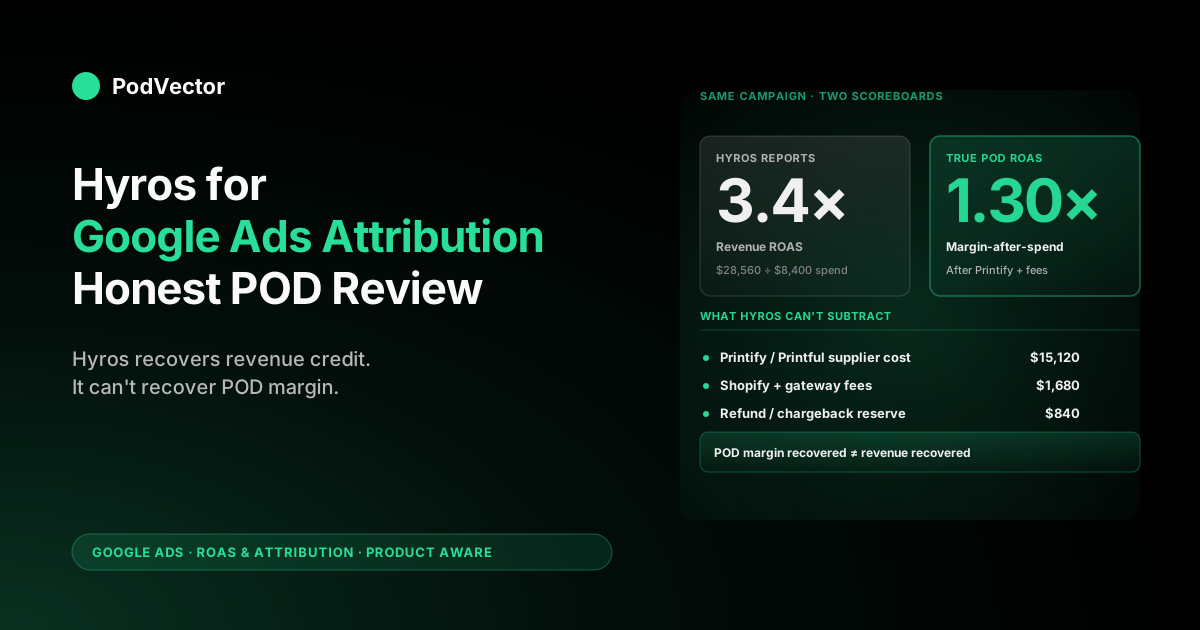
A PMax campaign Hyros credits with 3.4× ROAS can still be margin-negative on a $34 hoodie at $9 true margin. The right read for a POD seller: Hyros is a useful instrument if you're already over $10k/month and need cross-platform attribution, but the higher-leverage move for most POD operators under that threshold is sending margin (not subtotal) as conversion value into Google Ads and judging campaigns on margin-after-spend instead of recovered revenue.
What Hyros actually is (and what it isn't)
Hyros is a server-side ad-tracking and attribution platform. The pitch, stripped of marketing language, is that it runs its own tracking pixel in parallel with the ones Google Ads, Meta, TikTok, and the rest install on your store, then reconciles the conversion picture across all of them with multi-touch attribution. Because the Hyros pixel runs server-side, it sees conversions that browser-based tracking loses to ad blockers, Apple's Intelligent Tracking Prevention, and consent-mode signal loss — typically 18–40% more conversions than a vanilla Google tag or Meta pixel will capture on its own.
Two mechanics the reviews keep returning to. Hyros tracks a customer across years, not the 7-day click / 1-day view window the ad platforms default to, so a buyer who first clicked an ad in January and converted in April still gets attributed. And it exposes three attribution models side by side — last-click, first-click, and its proprietary "scientific" multi-touch mode — so you can see how credit shifts depending on which lens you pick.
That is what Hyros is. What it isn't matters more for POD sellers, because the Hyros marketing copy and most of the third-party reviews stop at the recovery percentage and never go further.
One feature the 2026 reviews now foreground is AIR (Automated Income Recovery) — a remarketing layer that fires email/SMS campaigns at abandoners and lapsed buyers, reported to recover roughly 3–16% additional revenue (3–7% on early installs, 10–15% on well-tuned ones). It's a real add, but it's a recovery-of-revenue feature too: the same margin caveat below applies to every dollar AIR brings back.
Hyros is not a margin tool. It does not know what your Printify or Printful supplier cost is.
It does not know your Shopify or Shopify Payments fees. It does not subtract any of that from the revenue it credits to a campaign.
A "3.4× ROAS" returned by Hyros is gross revenue divided by ad spend, full stop — not gross margin divided by ad spend, and certainly not net margin after fulfilment, fees, refunds, and chargebacks. For a POD account where supplier cost alone is 50–70% of order value, that distinction is the difference between a profitable scaling decision and a slow leak.
This article is the operator-direct read on the Hyros reviews POD sellers actually find when they search — what's true, what's overstated, what the third-party coverage misses, and how to decide whether Hyros earns its line item in a POD account's stack. For the broader attribution context, this piece sits inside the cluster hub at Google Ads ROAS and attribution for POD, which itself sits inside the topic hub at Google Ads for POD.
Hyros's headline claims, in plain language
Across the major Hyros reviews — StreamlineResults, Softailed, AazarShad, TrueROAS, ThinkOrion, the Trustpilot front page — the same five claims appear. Stating them plainly first makes the rest of this review easier to navigate.
- Server-side tracking recovers 18–40% more conversions than browser-based pixels alone, with the high end concentrated in cookie-aggressive browser populations (Safari, Firefox, mobile webviews).
- Multi-touch attribution across platforms — Hyros distributes credit across Google, Meta, TikTok, email, and call/landing page touches, instead of every platform claiming the same conversion under last-click.
- Up to 250% more conversions tracked than native ad-platform reporting, per the Hyros marketing site. Independent reviews soften this — the realistic ceiling is closer to the 18–40% recovery range above for a clean install.
- AI-powered ad optimisation using the unified conversion stream to recommend bid and budget shifts.
- $10k+ monthly ad spend recommended as the floor at which Hyros pays back. AazarShad mentions a historical $3,500 upfront onboarding fee; the 2026 reviews (CheckThat.ai, AdLibrary) report the model has since moved to revenue-indexed subscriptions starting around $379/month on a 12-month commitment, with the upper tiers gating the cross-platform features POD sellers actually need.
Three of those claims are well-supported. The 18–40% recovery is consistent across Trustpilot accounts (2026 reviews put the Google-specific gap at 29–33% more conversions than Google Ads' own reporting), the cross-platform credit reallocation is the platform's core feature and demonstrably works, and the $10k/month floor is repeated by enough independent reviewers that it's clearly load-bearing in Hyros's own qualifying. The "250% more conversions" headline is marketing — accurate only against a worst-case baseline like an unconfigured Meta pixel without Conversions API.
Hyros pricing for POD: what reviewers report
Hyros doesn't publish full pricing on its homepage; you book a demo, and pricing is revenue-indexed — anchored to the monthly revenue Hyros tracks, not a flat sticker. That's a structural shift from the flat-monthly figures older reviews quoted. The 2026 third-party reviews triangulate roughly to:
- Entry — ~$379/month. CheckThat.ai's 2026 breakdown puts the realistic floor here, well above the ~$99–$199 figures circulating in 2024 reviews. The POD-relevant tier (Google + Meta + TikTok) sits at or above this.
- Scaling tiers — ~$379 up to $1,639/month as tracked revenue rises, per CheckThat.ai; AdLibrary's operator-reported estimates run higher still on $1M+/month accounts. Pricing moves with your revenue, so it climbs as you scale — unlike a flat tool such as Triple Whale.
- 12-month minimum commitment. The 2026 reviews report an annual contract is now standard, and some users flag renewal increases of up to ~43% after the first term. This is the most important pricing change since the older reviews this page first cited.
- 90-day money-back guarantee still appears in reviews, but reconcile it against the 12-month term before signing — the trial window and the contract length are different commitments.
- Historical $3,500 upfront referenced in AazarShad's 2024 review. The market moved to revenue-indexed subscriptions during 2024–2026; the upfront onboarding fee is no longer the headline cost, the annual commitment is.
The $10k+ monthly ad spend floor matters more than the sticker price. At a ~$379/month minimum on $5k/month ad spend, Hyros is roughly 7.6% of paid-media budget — heavy overhead for a POD account that's still figuring out whether Google Shopping or Meta is its real channel, and now locked in for a year.
At $379/month on $20k/month ad spend, it's under 2% — easily justified by the 18–40% conversion recovery. Most independent POD stores live below the $10k/month threshold; that's the structural reason Hyros isn't the default attribution layer for the segment, not anything specific to the product. The revenue-indexed model and annual commitment push that break-even higher than the old monthly-sticker math implied.
The Google Ads integration is the harder one
Hyros's own documentation acknowledges that "Google ads are not nearly as easy to understand and make work as Facebook ads." That admission shows up in reviews repeatedly and is worth taking at face value, because it explains a recurring pattern of confused users.
The structural reason: Meta's attribution model is last-click within a 7-day click / 1-day view window, computed at the user level on Meta's side. Hyros sits in parallel and reconciles cleanly because both are talking about the same conversion event with comparable rules.
Google Ads, by contrast, runs data-driven attribution as the new default across the campaign types POD sellers use most (Performance Max, Standard Shopping, branded Search). DDA distributes fractional credit across a path that may include three or four touches Hyros also tracks, but Google's modeling and Hyros's modeling are not the same — they are two parallel multi-touch systems disagreeing about how to slice the same conversion. The 2026 default change is covered in detail at Google Ads attribution news explained for POD sellers and on the dated changelog at Google Ads attribution update news explained for POD sellers.
The practical effect for a POD seller running Hyros + Google Ads:
- Hyros's Google Ads numbers will not match Google Ads' own reporting. Reviewers consistently flag this; the gap is structural, not a bug. Treating either number as ground truth is the mistake.
- Smart Bidding still optimises against Google's signal, not Hyros's. If you set a Target ROAS in Google Ads, the auction-time decision uses Google's attributed conversions, not Hyros's. Hyros becomes a reporting layer rather than a bidding signal unless you also push its conversions back into Google as offline conversion imports.
- The Google Tag Gateway closes part of Hyros's gap. The Q1 2026 Google Tag Gateway delivers an average ~14% measured-conversion uplift directly inside Google Ads. That doesn't replace Hyros, but it does narrow the recovery delta — a POD account with the Tag Gateway live is recovering some of what Hyros would otherwise be the only source of.
None of this kills the Hyros case. It does mean the Hyros-on-Google reviews tend to read as harder-won than the Hyros-on-Meta reviews, and any POD seller evaluating the tool should expect the Google integration to require more configuration time than the Meta one. The mechanics of how Google's own DDA works, for context against Hyros's parallel model, are walked through in Google Ads data-driven attribution explained for POD sellers and data-driven attribution Google Ads help explained for POD sellers.
Pros and cons through a POD lens
Most Hyros reviews end here. We're going to keep going past this section, because the pros/cons frame is necessary but not sufficient for a POD account.
Pros
- Real conversion recovery. The 18–40% range is well-supported across independent reviews and Trustpilot accounts. For a POD account in Safari/mobile-webview-heavy audiences (most are), the upper end of that range is realistic.
- Cross-platform reconciliation. If you run Google + Meta + TikTok in parallel — which most growing POD brands do by year two — having one system that doesn't double-count across them is a meaningful operating improvement.
- Server-side resilience. Ad-blocker share is high in POD audiences (young, mobile, often gaming/sports/fandom adjacent). Server-side tracking holds up better than client-side here than the e-commerce average would suggest.
- 90-day money-back guarantee. Lowers the trial risk meaningfully. Reviewers note the team will let you walk if the install doesn't pan out.
- Trustpilot 5★. Volume and consistency of positive reviews on Trustpilot are real signal, even with the usual caveats about post-purchase review prompting.
Cons
- $10k/month ad-spend floor. If you're not there, the math doesn't work. Most independent POD stores aren't.
- Steep learning curve. Reviewers consistently flag the dashboard complexity. The platform is a power tool; treating it as a plug-and-play install will burn time.
- Google Ads integration friction. The Hyros team's own admission that Google is harder than Facebook is borne out in reviews. Budget extra setup time for the Google side.
- Numbers won't match native platforms. Hyros and Google Ads will disagree on conversion totals by 15–35%. If you can't tolerate that ambiguity in operating decisions, Hyros adds noise, not signal.
- Long, hands-on onboarding. The 2026 reviews put realistic implementation at 2–12 weeks, with extreme cases dragging to ~6 months and 5+ setup calls. Plan the install as a project, not an afternoon — especially on the Google side.
- Polarized support. Reviewers split hard: some call the team "phenomenal," others report "crappy" service with as little as one email a week during a critical install. Worth a reference check before you commit to the annual term.
- Annual commitment and revenue-indexed pricing. The 2026 reviews report a 12-month minimum and renewal increases of up to ~43%, with cost climbing as your tracked revenue grows. A year-long lock-in is a heavier bet than the old month-to-month framing suggested.
- The attribution model isn't independently audited. A recurring 2026 critique: Hyros's multi-touch logic is proprietary, so you're trusting its recovered-conversion claims without third-party verification. For a POD operator, that's another reason to reconcile Hyros against bank-deposited revenue rather than treating its number as ground truth.
- Recovery is revenue, not margin. The headline gap and the one no Hyros review covers. We unpack this in the next section.
The POD-specific reality Hyros reviews skip
Here's the part of the Hyros conversation that doesn't show up in StreamlineResults, Softailed, AazarShad, or any of the top-ranking reviews: the recovered revenue is not net margin, and the gap matters disproportionately for Print-on-Demand sellers because POD is a thin-margin business by structure.
A typical POD hoodie:
- Sale price: $34
- Printify or Printful supplier cost (base + print + shipping): ~$18
- Shopify + Shopify Payments fees (~3% + a flat fee per order): ~$2
- Refund/chargeback reserve: ~$1
- True per-order contribution before ad spend: ~$13
- If ad cost-per-acquisition is $9: net margin per order ~$4
Hyros's recovery surfaces a conversion the Google tag missed. That's real value — but the recovered conversion is still a $34 sale, not a $13 margin event.
If Hyros recovers an extra $1,000 in revenue across a campaign, the margin recovered is closer to $380, not $1,000. Hyros's reported ROAS uplift overstates the margin uplift by the inverse of your gross margin ratio, which on POD is typically 2.5–3×.
This is not a flaw in Hyros. It's a category truth: every attribution tool reasoning about revenue is mechanically blind to margin unless you feed margin in as the conversion value.
The fix isn't a different attribution tool. The fix is sending margin (not subtotal) as conversion value into Google Ads, and judging campaigns on margin-after-spend rather than reported ROAS — covered at the complete guide to Google Ads ROAS and attribution for POD and the underlying mechanics at attribution models Google Ads explained for POD sellers.
If you do that work, Hyros becomes a useful supplemental layer rather than the centre of the attribution stack. If you don't, Hyros is recovering the wrong number with high precision.
A worked POD scenario: Hyros's 3.4× vs. true margin
Concrete numbers make the POD-specific gap concrete. Suppose a Print-on-Demand store running Performance Max on Google Ads sees the following Hyros report for the trailing 30 days:
- Ad spend (PMax): $8,400
- Hyros-attributed conversions: 840 (vs. 612 in Google Ads' native report — a 37% recovery)
- Hyros-attributed revenue: $28,560 (840 × $34 average order value)
- Hyros-reported ROAS: 3.4×
The reading inside Hyros: PMax is winning. The reading once you subtract the POD cost stack:
- Supplier cost (~$18 × 840): $15,120
- Platform fees (~$2 × 840): $1,680
- Refund/chargeback reserve (~$1 × 840): $840
- Total cost-of-goods stack: $17,640
- Gross margin generated: $28,560 − $17,640 = $10,920
- Ad spend in same period: $8,400
- Margin after spend: $10,920 − $8,400 = $2,520
- Margin-ROAS (gross margin / spend): 1.30×
The Hyros number is 3.4×. The number that decides whether the campaign pays the rent is 1.30×.
They're not contradictory — both are correctly computed from their inputs — but the operating decision they imply is different. At 3.4× revenue ROAS, you would scale PMax aggressively. At 1.30× margin ROAS, you would scale carefully and only after testing whether the marginal next dollar of spend holds the same ratio.
This is the gap every POD seller has to internalise before adding Hyros to the stack. Hyros makes the 3.4× more accurate by recovering the lost conversions.
It does not move the 1.30× — that is a function of POD economics and ad spend, regardless of which attribution model is doing the counting. For more on building the margin-after-spend view inside Google's own surface, see Google Ads attribution reports explained for POD sellers.
Hyros vs. alternatives a POD seller actually considers
Reviewers tend to compare Hyros to Triple Whale, Wicked Reports, Northbeam, and Polar Analytics. For a POD seller, the realistic shortlist is narrower because the operating constraints are different: thin margins, supplier-cost data living outside Shopify, Printify/Printful as a meaningful cost layer, and most independent stores under the $10k/month ad-spend floor where premium attribution tools become economic.
- Hyros. Best fit for POD brands above $10k/month ad spend running 2+ paid platforms in parallel and willing to invest setup time on the Google side. Recovery is real; margin work is still on you.
- Triple Whale. Closer to native Shopify, popular with DTC brands. Stronger product analytics layer, weaker on the ad-side server-side recovery. POD brands often start here and migrate to Hyros if cross-platform attribution becomes the bottleneck.
- Native Google Tag Gateway + Conversions API. Free. Recovers a meaningful portion of what Hyros would recover (~14% on average inside Google, similar with Meta CAPI on the Meta side). Doesn't reconcile across platforms — you'll still see Google and Meta both claim the same conversion. For POD brands under $10k/month ad spend, this is the right baseline before considering paid attribution.
- A unified warehouse + Shopify + Printify margin pipeline. What PodVector AI's Victor sits on top of. Doesn't replace platform attribution; replaces the manual reconciliation work that turns attribution into margin-after-spend decisions. Covered below.
The mistake POD sellers make most often in this comparison: choosing Hyros (or any premium attribution tool) before sending margin as conversion value to Google. Sequencing matters.
Margin-as-conversion-value is the higher-leverage move; cross-platform attribution is the next step once margin is correctly wired in. Reverse that order and you lock into a 12-month contract north of $4,500/year recovering revenue you can't act on. For broader strategy context, see the complete Google Ads playbook for print-on-demand sellers.
Who Hyros fits in the POD universe
From the review patterns and the POD-economics overlay, three POD profiles are reasonable Hyros fits:
- Multi-platform POD brands above $20k/month ad spend. Running Google + Meta + TikTok, scaling actively, where cross-platform double-counting is materially distorting which channel gets budget. Hyros pays back here.
- Niche POD brands with high LTV. Apparel licensing, fandom-specific stores with repeat-buy behaviour, where Hyros's customer-journey reporting (call/email/landing page) earns its keep beyond pure ad attribution.
- Agencies running multiple POD clients. The agency tier amortises across accounts; the cross-platform attribution view is a real client-deliverable improvement.
Three POD profiles where Hyros is overkill or premature:
- POD stores under $10k/month ad spend. Native Tag Gateway + Meta CAPI gets you most of the recovery for free. Sequence the basics first.
- Single-platform POD operations. If you only run Google Shopping and don't have a meaningful Meta presence, the cross-platform reconciliation that justifies Hyros isn't your bottleneck. Native Google Ads attribution + a margin-as-conversion-value setup will outperform Hyros for this profile.
- POD stores not yet sending margin as conversion value. Layering Hyros over a subtotal-as-value setup recovers the wrong number with more precision. Fix the conversion value first.
For the conversion-value mechanics specifically — how to send true margin (subtotal − Printify/Printful cost − fees) into Google Ads — see Google Ads attribution model explained for POD sellers.
A four-step decision frame before you book the demo
If you're a POD seller actively considering Hyros, walk these four checks before booking the sales call. They take an hour together and prevent the most common Hyros-on-POD mistake (premium tool layered over an unfixed measurement foundation):
- Is monthly ad spend above $10k? If no, defer Hyros. Configure Google Tag Gateway and Meta Conversions API instead — those recover most of what Hyros would, for free.
- Are you sending margin (subtotal − supplier cost − fees) as conversion value to Google Ads? If no, fix this first. It's the single highest-leverage attribution change a POD account can make and is upstream of any premium tool decision.
- Are you running 2+ paid platforms in parallel? If no, the cross-platform attribution that justifies Hyros's pricing isn't your bottleneck. Native attribution plus a margin overlay will serve you better.
- Do you have someone willing to own the integration for a month or more? Hyros is not a configure-and-walk-away install — the 2026 reviews put it at 2–12 weeks, longer on the Google side. If no internal owner is identified, the 90-day money-back window can run out before the install fully lands.
Yes to all four: book the demo, you're a real candidate. Anything other than four-yes: there's a higher-leverage move first, and Hyros will pay back better after you've made it. The decision tree for Google's own attribution surface lives at Google Ads attribution explained for POD sellers.
How Victor reads attribution against live POD margin
Hyros's job is to recover lost revenue credit. The harder POD problem — the one no attribution tool solves on its own — is keeping a live, SKU-level picture of margin-after-spend that survives every credit reallocation. PodVector AI's agent Victor sits on top of a unified live data warehouse (Shopify orders, Printify or Printful supplier costs, Shopify and gateway fees, Google Ads and Meta spend) and answers margin questions against the current state of the world rather than a stale dashboard.
Concretely, Victor doesn't compete with Hyros — it complements it (or substitutes for the use case Hyros doesn't actually solve). When Hyros reports a 3.4× ROAS on PMax, Victor answers the next question Hyros is structurally blind to: "what's the margin-after-spend on those same conversions, after Printify supplier cost, after Shopify fees, after the actual ad spend in the period?" When Google Ads' DDA reweights credit from branded Search to YouTube, Victor doesn't ask whether YouTube's reported ROAS went up.
It asks whether the campaigns YouTube is now getting credit for are still margin-positive after the cost stack. When the Google Tag Gateway lifts measured conversions by 14%, Victor recalibrates the margin benchmark so the step-change isn't read as new performance.
Victor answers — "what's my true ROAS on PMax this week, after Printify cost?" — in seconds against live data. Tomorrow's roadmap is agentic: pause campaigns whose margin-after-spend slips below threshold without waiting for you to ask.
Hyros and Victor solve different halves of the same problem; the right POD stack often runs both, with Hyros on attribution recovery and Victor on margin reasoning. For the broader paid-media context, our pieces on Google Ads + Shopify integration for POD and the Google Ads services for POD buyer's guide show how this slot fits the broader stack.
For independent context on Hyros itself, the Softailed long-form review at softailed.com/blog/hyros-review is the most analytical of the top-ranking reviews and the closest to operator-direct on the platform's actual mechanics.
FAQs
Is Hyros worth it for a POD store?
If monthly ad spend is above $10k, you run 2+ paid platforms in parallel, and you've already configured margin (not subtotal) as conversion value into Google Ads, yes — the 18–40% conversion recovery and cross-platform reconciliation pay back. If any of those three conditions don't hold, there's a higher-leverage move first, and Hyros will land better after you've made it.
How much does Hyros cost?
Pricing is revenue-indexed and isn't published — quotes come from a demo call. The 2026 reviews (CheckThat.ai) report a realistic floor around $379/month scaling up to ~$1,639/month as tracked revenue grows, on a 12-month minimum commitment, with some users flagging renewal increases of up to ~43%. The older ~$99–$199/month flat figures from 2024 reviews are dated. A 90-day money-back guarantee still appears, but reconcile it against the annual contract before signing.
Why does Hyros report different conversion numbers than Google Ads?
Both are running multi-touch attribution, but with different models, different lookback windows, and different conversion-recovery mechanisms. The 15–35% gap between the two is structural — neither is "wrong." Treating either as ground truth is the mistake; reconcile both back to bank-deposited revenue at the monthly level instead.
Does Hyros account for Printify or Printful supplier cost?
No. Hyros tracks revenue attribution only. Supplier cost, Shopify fees, gateway fees, and refund reserves are not subtracted from the revenue Hyros credits to a campaign. For POD economics, that distinction is material — a campaign Hyros credits with 3.4× revenue ROAS can still be margin-negative once the POD cost stack is subtracted.
Is the Google Ads integration as easy as the Meta one?
No, by Hyros's own documentation. Google Ads' data-driven attribution and Hyros's multi-touch model are two parallel attribution systems disagreeing about how to slice the same conversion path; Meta's last-click model is structurally simpler to reconcile against. Budget extra setup time for the Google side and expect a 14-day stabilisation window where the numbers wobble.
What's the highest-leverage attribution change a POD seller can make before considering Hyros?
Send margin (subtotal − Printify/Printful supplier cost − Shopify and gateway fees) as conversion value into Google Ads, and judge campaigns on margin-after-spend rather than reported ROAS. That single change neutralises most of the revenue/margin distortion that any attribution tool — Hyros included — is structurally blind to.
Read Hyros (or any attribution tool) against live POD margin
Hyros recovers lost revenue credit. PodVector AI recovers the rest of the picture. Connect your Shopify, Printify or Printful, and Google Ads accounts to PodVector AI and let Victor answer "what's my margin-after-spend on the campaigns Hyros credits" against your live data — in seconds.
Try Victor free