
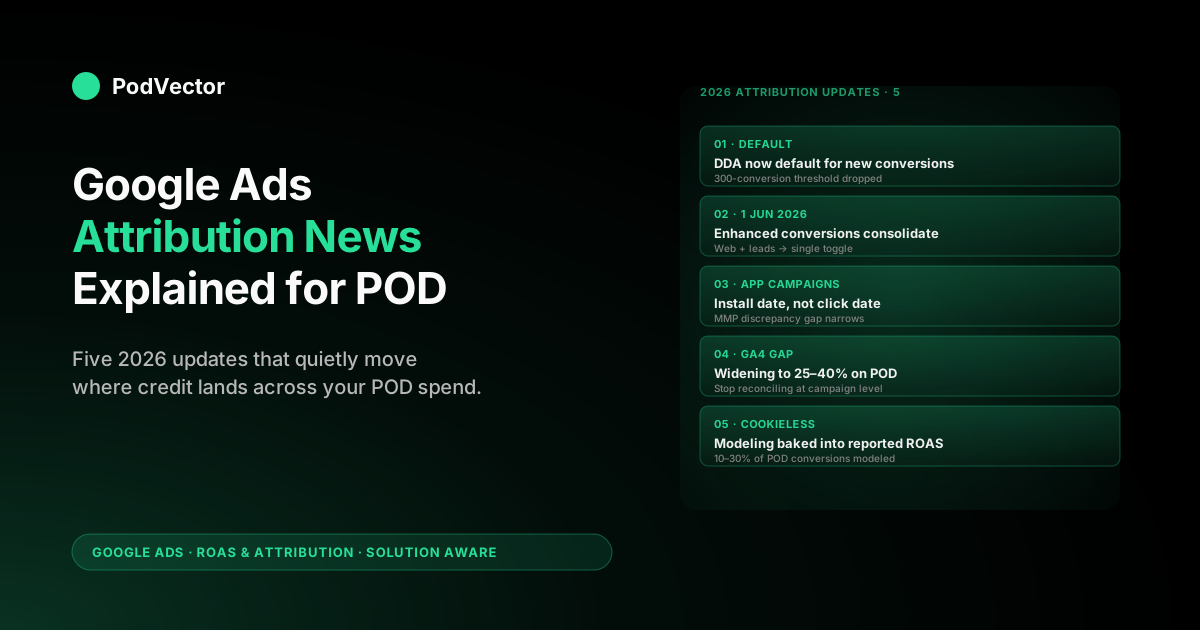
Quick Answer: The headline Google Ads attribution news is already settled: Google sunset its four rules-based models — first-click, linear, time-decay, and position-based — by September 2023, so every account now chooses between just two models, data-driven attribution (DDA) and last-click. On top of that base, five updates landing between late 2025 and June 2026 all matter for print-on-demand sellers: DDA becomes the default for every new conversion action (Google reports roughly a 6% lift in conversions on the switch), the two enhanced-conversion features consolidate into a single first-party-data toggle on 1 June 2026, app campaigns now attribute conversions to install date instead of click date, the GA4 vs. Google Ads conversion gap is widening to 25–40% on multi-channel POD accounts, and cookieless measurement is shifting reported ROAS by another 10–20% as Safari and Firefox modeling assumptions get baked into Smart Bidding. None of this changes the core POD problem — your $34 hoodie still has $9 of profit before you spend a cent on ads — but every one of these updates moves where credit lands across PMax, Search, Demand Gen, and YouTube. The actions to take this quarter are concrete: turn DDA on if it isn't already, set up enhanced conversions before the June consolidation, send margin (not subtotal) as conversion value, and stop trying to reconcile Google Ads numbers with GA4 at the campaign level.
Why Google Ads attribution news matters more for POD than for general ecommerce
A general ecommerce brand with a 60% gross margin can survive a 15% attribution wobble. The reported ROAS shifts, the Smart Bidder reweights for two weeks, the brand notices nothing structural. A print-on-demand seller running a $34 hoodie with $9 of true margin after Printify or Printful supplier cost and Shopify fees cannot.
A 15% credit reallocation can move a profitable PMax campaign into the unprofitable column overnight, not because the campaign changed but because the attribution math underneath it did. That is why every Google Ads attribution news cycle is operationally relevant for POD in a way it isn't for, say, a SaaS company with $400 LTV per signup.
The 2025–2026 round of attribution news is also denser than usual. Google Ads has been quietly pulling four levers at once — model defaults, conversion-data sources, app-campaign measurement, and cookieless modeling — and the stack effect on a POD account is larger than any single update suggests. POD-aware reading of the news, not the headlines, is what tells you which of these changes you actually need to act on this month. For a broader anchor on how attribution sits inside POD ROAS measurement, the cluster hub at Google Ads ROAS and attribution for POD covers the model-window-bidding triangle this article ties back to, and the topic hub at Google Ads for POD ties attribution back to the wider Google Ads playbook.
Three constants matter when reading any of the 2026 announcements:
- POD margin is variable per SKU. A $24 mug and a $48 hoodie have different supplier costs, different shipping, and different gross margins. Reported "value" in Google Ads needs to track that, or every attribution decision is being made on noise.
- POD paths are short but multi-channel. Most POD purchases involve 1–3 ad touches, but those touches frequently mix Shopping, branded Search, and YouTube. That mix is precisely the case where DDA produces meaningfully different credit than last-click — and where every 2026 update compounds.
- POD volume is usually below the historical DDA threshold. Most independent POD stores are under 300 conversions per month. The "modeled DDA" path Google ships when an account is below the threshold matters more for POD than for any other vertical.
Update 1: DDA becomes the default for all new conversion actions
Some context first, because most "attribution news" coverage still leads with it: Google already sunset its four rules-based models — first-click, linear, time-decay, and position-based — across Google Ads and Analytics by September 2023, after fewer than 3% of conversions were using them. That left exactly two models to choose between: data-driven attribution and last-click. So when you read a 2026 headline about "Google Ads attribution models," the menu is already down to those two, and everything below is about which one runs and how well.
The first live update is the simplest one to act on: data-driven attribution is now the default model for every newly-created conversion action, regardless of account size, and Google has removed the historical 300-conversion / 3,000-ad-interaction minimum that used to gate account-specific DDA models. Google's own figure for the switch from last-click to DDA is roughly a 6% lift in conversions, with third-party measurements ranging higher on accounts with longer paths. New POD accounts created in 2026 will have DDA on by default for the purchase conversion action; existing accounts that still have last-click set will not be auto-migrated, but the in-platform recommendations now nudge toward DDA on every new conversion action.
What "default" really means in 2026: Google trains a modeled DDA on broader cross-account purchase data when your own account is below the historical threshold, then progressively replaces that modeled signal with your account-specific data as you accumulate conversions. From a POD seller's vantage, this removes the old gating problem where small accounts had to use last-click because DDA "couldn't run." DDA now always runs. The question is just whether your account is contributing data to the training or borrowing it.
The operational implication: if your POD account is running last-click and spending more than $1,000 a month on Google Ads in 2026, switching to DDA almost certainly improves the credit distribution feeding Smart Bidding. A 14-day stabilisation window applies after the switch, during which daily ROAS will be noisy.
For the deeper mechanics of how DDA distributes credit across paths, our data-driven attribution Google Ads help explained for POD sellers guide unpacks the counterfactual modelling. For a step-by-step decision tree on whether your particular POD setup should switch, see about data-driven attribution Google Ads help explained for POD sellers.
Update 2: Enhanced conversions consolidate into one feature on 1 June 2026
The biggest structural change of the 2026 cycle is the consolidation of enhanced conversions for web and enhanced conversions for leads into a single, unified feature. Until June 2026, advertisers have had to set up two parallel pipelines depending on whether the conversion happens on the website (purchase) or off it (lead form, CRM-recorded sale). After 1 June 2026, both flow through one toggle and one configuration in Google Ads' Data Manager, with the platform automatically routing the user-provided data to the right model server-side.
For pure POD ecommerce — purchase happens on Shopify, no lead-gen step — this consolidation is largely a simplification rather than a behaviour change. The signal sent to Google is the same: hashed email, hashed phone, hashed first-name/last-name/zip pulled from the Shopify checkout, sent through the Google tag, used to match conversions to user accounts that Google can identify. What changes is the configuration surface: one feature, one place to verify it's running, one diagnostic.
For POD sellers also doing lead-gen for licensed-design programmes, custom-printing services, or B2B bulk orders, the consolidation matters more. Pre-consolidation, those flows had to be set up separately in enhanced conversions for leads with offline conversion imports.
Post-consolidation, the same first-party data feeds both purchase conversions and lead-tracking conversions through one pipeline. The win is fewer broken setups; the risk is that an under-tested unified pipeline starts dropping signal across both flows simultaneously.
Three things to verify before the 1 June switch lands on your account:
- Enhanced conversions is actually firing. Open Conversions → Diagnostics in Google Ads. The user-provided-data column should show a match rate; for a healthy POD account it sits between 30% and 70% depending on how aggressively you collect email at checkout. Below 20% means the tag isn't reading the checkout fields correctly.
- Hashing is happening client-side. The personally identifiable fields (email, phone, name) must be SHA-256 hashed in the browser before they leave the site. Most Shopify implementations do this correctly via the Google & YouTube channel; a hand-rolled GTM setup needs a manual check.
- Your privacy policy mentions the practice. Sending hashed customer data to Google for ads measurement is a documented use; the privacy policy needs to reflect that to stay compliant with most regional rules.
If enhanced conversions is currently disabled on your POD account, turn it on now rather than waiting for June. The historical performance lift sits in the 5–15% range on reported conversions — not because more sales are happening, but because previously-unmatched conversions get attributed correctly.
That bumps DDA's credit accuracy and Smart Bidding's signal quality at the same time. For the broader anatomy of attribution including conversion windows alongside enhanced conversions, see Google Ads attribution explained for POD sellers.
Update 3: App campaign conversions now attribute to install date, not click date
The third 2026 update is narrower in scope but important if your POD operation has a mobile app component — and most don't, but some merch-driven brands do run companion apps for fan communities, custom-design tools, or repeat-buyer loyalty. Google has shifted app campaign conversion attribution from the date of the ad click to the date of the app install. The MMP (mobile measurement partner) industry has been asking for this for years because the click-date model created persistent discrepancies with platforms like AppsFlyer and Adjust.
For a POD seller without an app, this update is a non-event. For one with an app, three things change:
- Reported app campaign conversions now look more like MMP-reported installs. The 10–20% gap that used to exist between Google Ads' install column and your AppsFlyer dashboard should narrow significantly.
- Day-over-day reporting becomes more volatile. Conversions can now land on days when you didn't run any ads (because the install lagged the click), which makes daily ROAS noisier even though weekly numbers stabilise.
- Smart Bidding's optimisation loop gets a more accurate reward signal. The bidder is now optimising toward the date the user actually arrived in the app rather than the date Google delivered the ad, which reduces over-bidding on high-CPM placements that produce clicks but slow installs.
If you're not running app campaigns, you can skip this update entirely. If you are, the action is to expect the daily-noise increase for the first 14 days after the change rolled into your account, then compare weekly app-install ROAS pre- and post-change to confirm the new numbers track your MMP more closely.
Update 4: The GA4 vs. Google Ads gap is widening to 25–40%
The most-asked attribution question in 2026 isn't about a specific update — it's "why does my Google Ads dashboard show 30 conversions and GA4 show 22 for the same campaign over the same week?" The honest answer is that this gap is widening, not narrowing, and the 2026 updates are part of why.
Google Ads attribution in 2026 uses DDA over a 30-day click and 1-day engaged-view window, deduplicated against enhanced conversions, with cookieless modeling layered on top. GA4 uses DDA over a 30-day window too, but its model uses a different input mix: web traffic first, with paid-channel touchpoints reconstructed from auto-tagged GCLID matching.
The two systems share machine-learning architecture but not training data. They are not supposed to match. Trying to reconcile them at the campaign level wastes time POD operators don't have.
The split that actually works for a POD account in 2026:
- Use Google Ads for in-platform optimisation decisions. Bid adjustments, campaign-level ROAS targets, asset rotations, and Smart Bidding recalibration all use Google Ads' attribution numbers because that is what the bidder consumes.
- Use GA4 for cross-channel and behavioural decisions. Channel mix questions ("how much of my revenue actually comes from organic vs. paid?"), product-page funnels, and audience definitions use GA4's broader view because it sees non-paid traffic that Google Ads doesn't.
- Use neither for true margin. Both report subtotal-level conversion value. Neither subtracts the $7 Printify supplier cost from the $34 hoodie sale. That work either happens manually in Sheets, in a profit-tracking tool like LittleData or Triple Whale, or in something like Victor that reads Printify and Shopify directly.
Trying to make Google Ads' 30 and GA4's 22 reconcile to a single number is a category error. They are answering different questions about the same data, and both answers are useful — for different decisions. The external explainer at Analytics Mates' founder's guide to GA4 vs. Google Ads attribution walks the technical mismatch in more depth.
Update 5: Cookieless modeling is now baked into reported ROAS
The fifth update is the quietest but the most pervasive. As Safari and Firefox restrict third-party cookies and as Apple's intelligent tracking prevention (ITP) erodes first-party cookies on iOS, Google has been increasing the share of conversions reported via "consent mode" modeling and conversion-modeling — statistical inference that fills in conversions Google can't directly observe.
By 2026, modeling accounts for somewhere between 10% and 30% of reported conversions on a typical POD account, depending on how much of the traffic is iOS Safari (where ITP bites hardest) and whether consent mode v2 is enabled. The numbers in the Google Ads dashboard include these modeled conversions; they're not labelled separately in the default views. This means every reported ROAS on a 2026 POD account is partly real, partly inferred, and the inference quality depends on how good Google's training data is for accounts like yours.
The practical implication for POD: reported conversions should be treated as approximately accurate at the account level, less accurate at the campaign level, and unreliable at the keyword/ad-group level. This affects how aggressively you can re-optimise on small slices. A keyword showing 4 conversions and 3.2x ROAS over the past 14 days is not a 4-conversion / 3.2x ROAS keyword — it's a small sample where one or two of those conversions might be modeled, and the true number is in a wider range than the dashboard implies.
Action: stop making campaign- or ad-group-level decisions on conversion counts below 30 over the lookback window. Use account-level totals to validate that your overall ROAS is real, then use Smart Bidding's automation to handle the slice-level re-optimisation that humans can't reliably do on noisy data.
What actually changes for a POD account this quarter
Five updates is a lot to process. The actions worth taking this quarter on a POD account are smaller than the news cycle suggests. In priority order:
Action 1: Confirm DDA is on for the purchase conversion action. Conversions → Conversion actions → click your purchase action → Attribution model → "Data-driven." If it says "Last-click" and you're spending more than $1,000 a month, switch it. Expect 14 days of noisy daily ROAS, then compare campaign-level credit before and after.
Action 2: Turn enhanced conversions on if it isn't. Conversions → Settings → Customer data terms (accept) → toggle enhanced conversions for web. Verify match rate in the Diagnostics tab is above 30% within seven days. If you're on Shopify, the Google & YouTube channel handles this automatically; if not, GTM with the user-provided-data variable is the standard path.
Action 3: Send margin as conversion value, not subtotal. This is the highest-leverage POD-specific action and it's not a 2026-specific update — it just becomes more important as DDA's credit distribution becomes more accurate. The way to do this depends on the stack: a Shopify Function or a custom GTM tag that subtracts a SKU-level supplier-cost lookup from the order subtotal before sending it to Google.
Most POD operators leave this on the table; the ones that don't see Smart Bidding actually optimising for profit instead of revenue. The detailed setup approach is covered in Google Ads attribution models explained for POD sellers.
Action 4: Stop reconciling Google Ads with GA4. Pick one for each decision: Google Ads for in-platform optimisation, GA4 for cross-channel measurement. Trying to make the numbers match is a 2024 problem and it doesn't get easier in 2026.
Action 5: Raise your decision threshold from 4 conversions to 30. Anything below 30 conversions over the lookback window is too small a sample to act on, given modeled conversions, DDA's continuous retraining, and short POD paths. Let the bidder handle the small-sample work.
The POD attribution stack after the 2026 changes
What does a clean POD attribution stack look like in mid-2026, with all five updates accounted for? The shape:
- Google Ads, in-platform layer. DDA on for the purchase conversion action, enhanced conversions on with verified match rate, conversion value sent as margin (not subtotal), Smart Bidding running tROAS or Maximize Conversion Value depending on volume.
- Google Tag / GTM layer. Google & YouTube channel on Shopify or a GTM container with the user-provided-data variable. Consent mode v2 enabled if you have any EU/UK traffic. SHA-256 hashing happening client-side before any PII leaves the browser.
- GA4, cross-channel layer. Auto-tagged GCLID-matched conversions, used for channel-mix and product-funnel decisions only. Not reconciled to Google Ads at the campaign level.
- Profit / margin layer. Either a manual Sheets pull, a profit-tracking tool, or a live-data agent that reads Shopify orders and Printify/Printful line-item costs. This is the only layer where "what did this campaign actually make" gets answered honestly.
The layers above are independent. Each can be wrong without breaking the others, which is helpful when something does go wrong (and something will, because every 2026 update introduces new failure modes). For the cluster-level overview of how this stack supports actual ROAS measurement, the hub at Google Ads ROAS and attribution for POD ties the parts together, and the cross-cluster complete Google Ads playbook for print-on-demand sellers covers how attribution interacts with campaign structure and bidding strategy on a POD account.
Three mistakes POD sellers are making while reading the news
The 2025–2026 attribution news cycle has been long enough that some bad reading has hardened into received wisdom inside the POD operator community. Three patterns to avoid:
Mistake 1: Treating "DDA is now default" as "DDA is now optional." The wording in some agency newsletters has implied that since Google has dropped the conversion threshold, DDA is now a soft recommendation rather than a meaningful change. It isn't.
The threshold was the gating mechanism that prevented small accounts from running DDA at all. Removing it means DDA now runs on every account; the only question is whether your account contributes data to the model or relies on the modeled fallback. Either way, last-click is now the deviation, not DDA.
Mistake 2: Waiting for June 2026 to set up enhanced conversions. The consolidation is a configuration simplification, not a feature gate. If enhanced conversions isn't running on your POD account in April 2026, you are leaving 5–15% of conversion attribution on the table for every month you delay. Set it up now; the consolidation in June will be a no-op for you.
Mistake 3: Reading the GA4 widening gap as a Google Ads bug. A surprising number of POD-focused community threads in 2026 frame the gap as "Google Ads is overcounting" or "GA4 is undercounting." Neither is true. They're measuring different things with different inputs.
The mistake is treating one as the ground truth that the other should match. Pick one for each decision and move on. For a related dive on the model-window-bidding triangle, the attribution model Google Ads explained for POD sellers guide covers how the model choice ripples downstream.
How Victor reads the new attribution against live POD margin
The reason this attribution news cycle matters more for POD than for general ecommerce is the same reason a single attribution layer doesn't answer the question POD operators actually have. Google Ads' DDA tells you how to distribute credit across touchpoints.
GA4 tells you how to read channel mix. Neither tells you which campaigns are over-bid for the actual margin on the products being sold.
Victor sits across all four layers — Shopify orders, Printify or Printful line-item costs, Google Ads campaign spend, and the DDA-credited conversion data — and answers margin questions in plain English. "Which DDA-credited campaigns sold sub-25%-margin SKUs last week" or "is the new enhanced-conversions match rate correlating with higher reported ROAS or just more matched conversions" are queries that don't fit any single dashboard but fit the live data when it's read together. That is the agentic-roadmap angle: Victor answers the questions; tomorrow it executes the bid adjustments those answers imply, against live margin rather than reported subtotal.
FAQs
What is the most important Google Ads attribution news for POD sellers in 2026?
The consolidation of enhanced conversions into a single feature on 1 June 2026 and DDA becoming the default for every new conversion action. Both improve how Google Ads matches conversions to user accounts and how credit is distributed across touchpoints. For a POD seller running a multi-channel mix of Shopping, Search, and PMax, these two updates change reported campaign-level ROAS by 10–20%.
Do I need to do anything before 1 June 2026?
If enhanced conversions is already on, no — the consolidation is a backend configuration change. If it isn't on, set it up now rather than waiting. Every month it's off is 5–15% of conversion attribution missed.
Which Google Ads attribution models did Google remove?
Google sunset four rules-based models — first-click, linear, time-decay, and position-based — across Google Ads and Analytics, completing the change by September 2023 after fewer than 3% of conversions used them. That leaves two models on the menu today: data-driven attribution (DDA) and last-click. Accounts still set to one of the retired models were migrated to DDA automatically. For POD sellers this matters because the "which model should I pick" question is now a binary, and DDA is the default for new conversion actions.
Has Google really retired the 300-conversion threshold for DDA?
Yes. The threshold was the historical gate that meant small accounts had to use last-click. As of 2026, DDA runs on every account; small-account models are trained on broader cross-account data (modeled DDA) and progressively replaced with account-specific data as you accumulate conversions.
Why is the GA4 vs. Google Ads conversion gap widening?
Both platforms now use DDA but with different inputs. Google Ads sees only ad-touched paths; GA4 sees all sessions. Cookieless modeling in 2026 fills the gaps differently in each platform. Trying to reconcile the two at the campaign level isn't useful — pick one for each decision instead.
Should I worry about the app campaign install-date change?
Only if you run a mobile app for your POD store. Most independent POD operators don't. If you do, expect daily reporting to be noisier for two weeks after the change rolls in, then weekly numbers to track your MMP more closely.
What does "consent mode v2" have to do with attribution?
Consent mode v2 lets Google distinguish between consented and non-consented users and apply conversion modeling to the latter. With it on, modeled conversions fill the gaps left by users who declined cookies; with it off, those conversions disappear from your dashboard. For an account with significant EU/UK traffic, enabling it recovers 10–30% of reported conversions.
Should I send revenue or margin as the conversion value to Google Ads in 2026?
Margin. The DDA improvements in 2026 make Smart Bidding more accurate at distributing credit, but only if the value being credited reflects actual profit.
A POD account sending order subtotal is asking the bidder to optimise for top-line revenue, which on a 25–35% gross margin business is the wrong target. Setting up margin-as-value requires a SKU-level supplier-cost lookup in your tracking layer.
What's the difference between DDA in Google Ads and DDA in GA4?
Same architecture, different training data. Google Ads' DDA learns from ad-touched paths only and feeds Smart Bidding; GA4's DDA learns from all sessions and feeds attribution reports. The two are not supposed to produce identical numbers and shouldn't be reconciled at the campaign level.
If DDA is the default, when does last-click still make sense?
Three narrow cases: an account spending under $1,000/month where the noise of switching isn't worth it, a brand running only branded Search where the conversion path is genuinely one click, or a debugging context where you need a deterministic baseline to compare against. Outside those, DDA is the right default.
Where should a POD seller go for ongoing attribution news without the agency-newsletter spin?
Google's official Ads & Commerce blog publishes the actual feature changes, and the Google Ads Help Center documents the technical detail. Most POD-specific attribution implications then need to be derived against your own margin data — which is the work Victor does live.
Read the new attribution news against your real POD margin
The 2026 updates change how Google Ads credits conversions; they don't change whether the credited conversions actually made you money. Victor reads DDA-credited campaigns against live Printify and Printful margin and tells you which campaigns are over- or under-bid in real-money terms. Connect your accounts and ask questions like "which campaigns sold sub-25%-margin SKUs last week" without opening five dashboards.
Try Victor free