
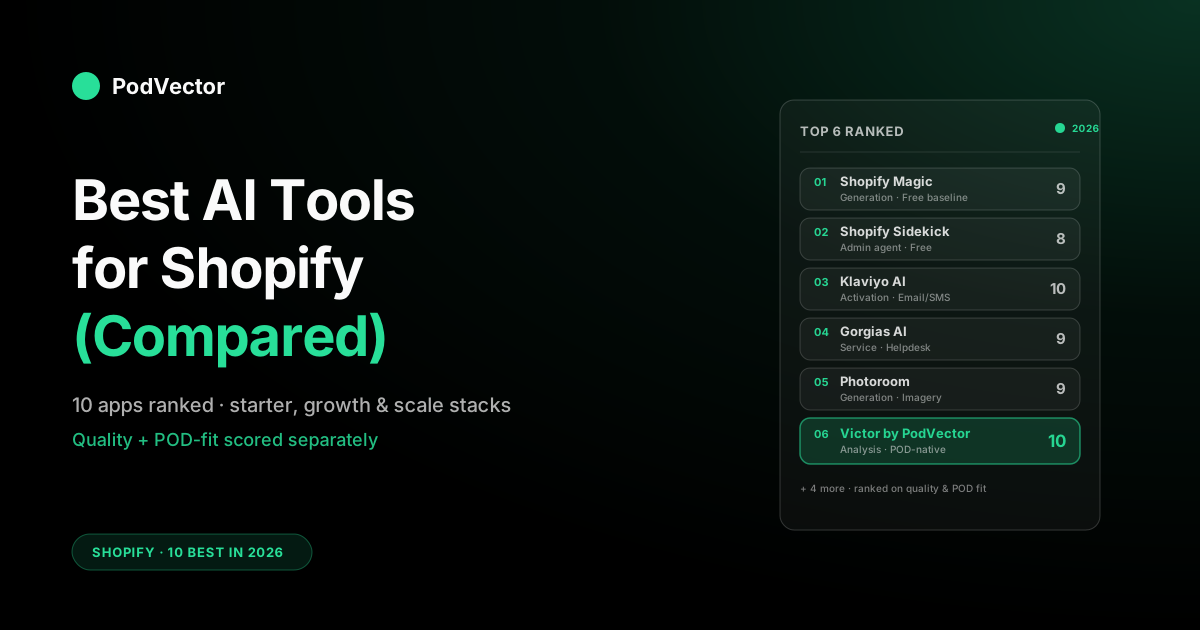
Quick Answer: The best AI tools for Shopify in 2026, ranked by job: 1. Shopify Magic (free native generation), 2. Shopify Sidekick (admin AI assistant, free), 3. Klaviyo AI (email/SMS lifecycle), 4. Gorgias AI (helpdesk, from $10/mo), 5. Photoroom (product imagery, from $7.50/mo), 6. Victor by PodVector AI (POD-native AI employee), 7. Shopify Inbox AI (chat replies, free), 8. Tidio AI (live chat, from $29/mo), 9. Rebuy (cart upsells, from $99/mo), 10. Octane AI (quizzes, from $50/mo).
The ranking shifts once you factor in store type. Inventory-owning DTC brands and print-on-demand stores hit different bottlenecks, so this guide ranks each tool on raw quality first, then flags where the answer changes for POD operators on Printify or Printful.
Three concrete stack picks at the end — starter, growth, scale — with monthly costs. A note on adjacent categories that surface in the same searches: GEO/AEO tools (Profound, AthenaHQ, AIclicks) monitor how AI engines cite your brand — that is a distinct job from store operations and is not a substitute for any tool on this list. That category is covered in its own section below.
What Makes an AI Tool "Best" for Shopify in 2026
Shopify shipped more native AI in the last 18 months than every other ecommerce platform combined. Magic is in the admin. Sidekick can answer admin questions. Shopify Inbox writes chat replies. The "best" Shopify AI tool today has to clear a bar that didn't exist in 2024 — it has to be more useful than what comes free with the platform you already pay for.
A second shift worth naming: the 2026 AI landscape for Shopify has moved from "how many AI tools can I add?" to "how do I avoid AI tool sprawl?" The fastest ROI on Shopify usually comes from support automation, product description workflows, and email tools — before more complex analytics stacks. The right answer is almost never one all-in-one platform; it's a tight stack of category leaders, each owning a distinct job.
A third shift is the emergence of GEO (Generative Engine Optimization) as a real Shopify concern in 2026. According to Shopify's own blog, GEO is now the practice of structuring content so AI-driven search engines like ChatGPT and Google Gemini cite and surface your store — separate from traditional SEO. Tools like Profound, AthenaHQ, and AIclicks operate in this layer; they are not store-operations tools and are not substitutes for Klaviyo, Gorgias, or any other app on this list. That category gets its own section below.
For this comparison, each tool was scored on four things:
- Time-to-ROI — does the AI deliver measurable revenue lift, cost reduction, or hours saved inside 60 days of install? Tools with a 6-month payback get downranked because most stores don't have the runway to wait.
- Shopify integration depth — does it install through the Shopify App Store, read from the Shopify admin natively, and follow Shopify's permission model — or does it require a developer to wire up a webhook?
- Pricing match — does the floor pricing match the floor revenue of stores that need the tool? A high-floor app that only pays back at significant MRR is dead money for a smaller store.
- POD compatibility — for stores fulfilling through Printify, Printful, Gelato, or similar, does the tool's data model handle variable supplier costs and zero on-hand inventory? Most don't.
A few popular Shopify apps didn't make the top 10 because they failed at least two criteria. Those calls are explained in the FAQs. For broader category context, see our 12 best AI tools for ecommerce comparison, the complete guide to AI tools for POD sellers, and the wider tools cluster.
Comparison Table: 10 Best AI Tools for Shopify
Scored on quality and on POD-fit separately. The "Quality" score reflects how well the tool does its core job for a generic Shopify store. The "POD fit" score reflects how well it works for a store fulfilling through Printify or Printful.
| Rank | Tool | Job | Starting price | Quality (/10) | POD fit (/10) |
|---|---|---|---|---|---|
| 1 | Shopify Magic | Generation (native) | Free with Shopify | 9 | 9 |
| 2 | Shopify Sidekick | Admin-side AI assistant | Free with Shopify | 8 | 7 |
| 3 | Klaviyo AI | Activation (email/SMS) | Free to ~250 contacts; paid from ~$45/mo | 10 | 9 |
| 4 | Gorgias AI | Service (helpdesk) | From $10/mo (per ringly.io) | 9 | 8 |
| 5 | Photoroom | Generation (imagery) | From $7.50/mo | 9 | 9 |
| 6 | Victor by PodVector AI | AI employee (POD-native) | Free tier; paid plans | 8 | 10 |
| 7 | Shopify Inbox AI | Service (chat replies) | Free with Shopify | 7 | 7 |
| 8 | Tidio AI | Service (live chat) | From $29/mo (per commercepundit.com) | 8 | 7 |
| 9 | Rebuy | Activation (upsells) | From $99/mo | 9 | 7 |
| 10 | Octane AI | Activation (quizzes) | From $50/mo | 8 | 7 |
Three of the top five are tools you're either already paying for (Shopify Magic, Sidekick) or that have been around long enough to be battle-tested (Klaviyo, Gorgias). Photoroom and Victor are newer but earn their slots by solving jobs no incumbent solves well. The "best" label here means "highest probability of paying for itself within 60 days," not "most innovative."
The 10 Tools, Ranked
1. Shopify Magic — The Free AI Suite You Already Own
Best for: any Shopify store, full stop.
Pricing: free with any Shopify plan.
What it does: Shopify Magic covers product description generation that adopts your brand voice, automatic email subject lines in Shopify Email, image background editing in the Photo Editor, FAQ generation for product pages, store policy drafting, and Shopify Inbox reply suggestions. According to commercepundit.com, Shopify Magic covers AI product description writing, email subject line generation, Sidekick (the AI merchant assistant), and background image removal for product photos — and is a solid starting point included free on all plans. Magic is also the layer powering AI search inside the admin and the "ask Shopify" experience.
A 2026 update worth noting: Shopify's own blog now frames Magic as a GEO-aware content layer — it can help you structure product pages so they are more likely to be cited in AI-generated shopping answers. That's a new capability most third-party content tools don't match yet.
Why it ranks #1: the cost-to-value ratio is unbeatable — every other tool on this list has to clear the bar of "more useful than what Magic already gives you for free." For a brand-new Shopify store, the right move is to use Magic's full feature set for 30 days before evaluating any paid Shopify AI app.
2. Shopify Sidekick — The Admin-Side AI Assistant
Best for: any Shopify operator who finds themselves clicking through the admin for routine tasks.
Pricing: free with any Shopify plan. According to ringly.io, Sidekick is included free with every Shopify plan as of 2026.
What it does: Sidekick is Shopify's chat-based assistant that lives in the admin and can answer questions about your store and trigger setup actions. It reads your store data through Shopify's permission model rather than asking you to build an integration. As noted by ringly.io, Sidekick is "embedded directly into the Shopify admin — meaning zero setup time, native access to all store data."
Sidekick can adjust theme settings, draft policies, segment customers, and walk new operators through setting up shipping and tax — workflows that previously required hunting through multiple admin screens.
Why it ranks #2: Sidekick replaces a meaningful share of what stores used to hire a Shopify expert for. The reason it isn't #1 is depth — Sidekick is great at admin navigation and Shopify-internal questions, but it doesn't pull from outside the Shopify boundary, so margin questions that depend on Printify cost data still need a separate AI employee layer. For Shopify operators new to the platform, see how Sidekick fits into the broader stack in our AI agent for Shopify guide.
3. Klaviyo AI — The Email and SMS Workhorse
Best for: any Shopify store doing meaningful revenue with an email list.
Pricing: free up to approximately 250 contacts; according to commercepundit.com, paid plans range from roughly $45–$400/month based on list size at mid-market volumes.
What it does: Klaviyo is the de facto standard for ecommerce email and SMS marketing. According to nestscale.com's 2026 roundup, Klaviyo AI integrates machine learning into your email and SMS workflows — covering predictive segments (likely-to-purchase, churn risk), AI-generated subject lines, send-time optimization, and AI-powered SMS audiences. Predictive analytics tell you when a contact is most likely to buy and what message to send.
Klaviyo's Shopify integration is the deepest in the email category — it reads order history, product data, and browsing behavior natively.
Why it ranks #3: email remains the highest-margin channel for most Shopify stores, and Klaviyo is the platform with the deepest AI roadmap inside ecommerce-native lifecycle marketing. The lifecycle templates work for any Shopify store; the AI layer makes them better without a list-management hire. For how Meta vs. Google attribution interacts with this layer, see our Facebook Ads vs. Google Ads guide for POD sellers.
4. Gorgias AI — Resolves Order-Status Tickets End-to-End
Best for: Shopify stores doing meaningful ticket volume where a large share are "where's my order."
Pricing: according to ringly.io, Gorgias starts at $10/month for the basic helpdesk, with AI Agent resolution fees on top.
What it does: AI Agent ingests your help center and historical conversations, then resolves common tickets (shipping status, refund eligibility, size and fit) without a human in the loop. The Shopify integration is deep — the AI can look up order status, issue partial refunds within rules you set, and triage edge cases to humans.
A 2026 update added a Shopping Assistant for pre-purchase product recommendations alongside the existing Support Agent. For smaller stores, the pricing and complexity of enterprise options make them overkill, and Gorgias or Tidio are the more practical choice at this scale.
Why it ranks #4: support is the biggest hidden cost in scaling a Shopify store, and Gorgias is the most mature tool for resolving the high-volume, low-complexity tickets that eat hours every day. For the deeper helpdesk comparison, see AI chatbot for Shopify: what it looks like for POD sellers.
5. Photoroom — Product Imagery in Seconds
Best for: any Shopify store generating product imagery for new SKUs at scale.
Pricing: free tier; Pro from $7.50/month; teams from $20/seat.
What it does: background removal, AI lifestyle backgrounds, batch processing of mockups, shadow generation, and a growing library of AI-generated scenes. Drag a flat product photo in, get a hero image in seconds.
Photoroom's Shopify app pushes processed imagery straight to your product pages without a manual upload step.
Why it ranks #5: the cost-per-image is functionally zero at scale. For POD specifically, Photoroom is one of the highest-ROI subscriptions on this list — see AI tools for print on demand: options compared for the deeper POD stack analysis.
6. Victor by PodVector AI — POD-Native AI Employee
Best for: Shopify stores fulfilling through Printify or Printful that want a single AI employee to read their ads, listings, and fulfillment data — and execute approved Shopify-side changes — not just another dashboard.
Pricing: free tier for early users; paid plans at launch.
What it does: Victor is an AI employee purpose-built for print-on-demand sellers on Shopify. He looks at your Shopify, Meta Ads, Google Ads, Printify, and Printful data together, so he can show you the true profit on every product no matter which supplier made it. He suggests specific actions, and — once you approve — he carries them out on Shopify.
What Victor can execute today (Shopify-side writes, with your approval before each move): reprice your worst-margin SKUs to a target margin, set up a buy-one-get-one discount, raise your free-shipping threshold, bulk-update product prices, create free-shipping or customer-specific discounts, organize your collections, draft and schedule a Klaviyo email campaign, and build an abandoned-cart flow. He also reads Meta Ads and Google Ads data and proposes moves — but ad-platform writes are not executed by Victor; those proposals wait on your action. For the discount mechanics and how raising the free-shipping threshold lifts AOV, see our Printify promo code breakdown.
Victor reads — but does not write to — Meta Ads, Google Ads, Printify, and Printful. Every material action requires your approval first. He delivers a Weekly Health Report analyzing the prior week's performance across all connected platforms.
Ask "which Printify SKUs lost margin this month and why?" and he answers using live order-side cost data — then proposes the fix and executes it once you approve. For how fulfillment setup connects to this, see our Printful no upfront cost breakdown and our Gelato vs. Printful vs. Printify comparison.
Why it ranks #6: Victor is the newest tool on this list, but it's the only one that reads POD-native margin math across Shopify, Meta, Google, Printify, and Printful and acts on it inside Shopify. For inventory-owning DTC brands, Triple Whale or Polar Analytics are solid picks; for POD on Shopify, Victor is the one built for variable supplier costs. See the architecture in our AI employee platform for Shopify guide.
7. Shopify Inbox AI — The Free Chat Reply Suite
Best for: Shopify stores at the early stage who want a chat widget without paying extra.
Pricing: free with Shopify.
What it does: Shopify Inbox is the on-site live-chat widget bundled with every Shopify plan. The AI layer suggests replies based on your store data and past conversations, drafts FAQ answers, and escalates when it doesn't know. Inbox AI can also push proactive product recommendations based on browsing behavior.
Why it ranks #7: for a free, zero-install option, Inbox AI is genuinely useful at the small-store stage. The reason it isn't higher is depth — it's not as deeply integrated with order data as Gorgias, and the AI doesn't yet take resolution actions like refunds or shipping changes. Treat Inbox as the right baseline; graduate to Tidio or Gorgias when the math says so.
8. Tidio AI — Lighter-Weight Chat for Smaller Stores
Best for: Shopify stores who want richer chat than Inbox without the Gorgias floor.
Pricing: according to commercepundit.com, Tidio starts at $29/month for the AI plan.
What it does: conversational chat with Lyro (Tidio's AI bot), automated cart-recovery flows triggered by chat behavior, and product-recommendation tiles inside the chat widget. Easier setup than Gorgias and more visible to shoppers because it's chat-first rather than email-first.
Why it ranks #8: Tidio is the right answer at the small-store stage where Gorgias is overkill but Shopify Inbox isn't quite enough.
Once ticket volume grows substantially, the cost-per-resolution math typically flips and Gorgias's AI Agent becomes the better buy. Tidio's AI is solid; it's just less deeply integrated into Shopify-specific data than Gorgias is.
9. Rebuy — AI Cart Personalization and Upsells
Best for: Shopify stores with higher AOVs and an active product catalog.
Pricing: from $99/month; scales with order volume.
What it does: according to nestscale.com's 2026 roundup, Rebuy monitors real-time consumer data and browsing history to display relevant product recommendations across the buying journey, including predictive recommendation blocks on individual product pages and slide-out cart drawers, and automatically generated Frequently Bought Together bundles calculated from historical purchase combinations. Rebuy's Shopify integration uses Shopify's native checkout extensions, so the upsells survive checkout-extension API changes.
For how checkout completion rate connects to the upsell math, see our average checkout completion rate benchmark for ecommerce.
Why it ranks #9: Rebuy is the cleanest implementation of cart personalization for Shopify. The reason it isn't higher: at the lower AOVs common for POD apparel and accessories, the absolute dollar lift per order doesn't always cover the $99 floor — it pays for itself faster at higher AOVs.
10. Octane AI — Quizzes and Product Discovery
Best for: Shopify stores with a wide catalog where the customer needs help choosing.
Pricing: from $50/month; scales with quiz traffic.
What it does: AI-powered shopping quizzes that match shoppers to the right product based on their answers. Klaviyo and Shopify integrations sync quiz responses into segments and personalization. AI-generated quiz questions and answer options based on your catalog. According to nestscale.com, zero-party data collection — gathering information directly from users through interactive elements like quizzes — is now essential for Shopify stores as background tracking becomes less reliable.
Why it ranks #10: quizzes lift conversion meaningfully when the catalog is wide and the buying decision is non-obvious. For Shopify POD stores selling a handful of designs on the same product type, a quiz is overkill. For Shopify stores with a wide multi-category SKU range, Octane AI is one of the highest-conversion-rate apps on this list.
Best Picks by Job-to-Be-Done
If you don't want a 10-app stack, here's the one-tool-per-job shortlist. Each pick is the highest-fit option for a generic Shopify store; the "POD swap" notes where the answer changes for print-on-demand operators.
Generation (text and imagery)
- Best: Shopify Magic (free) for product copy + Photoroom ($7.50/mo) for imagery.
- Add Jasper or a long-form content tool only when long-form content marketing is a committed channel. For most Shopify stores, Magic + ChatGPT covers the majority of what Jasper would do.
- POD swap: none — Shopify Magic and Photoroom are top picks for POD too. For how faster listing velocity connects to fulfillment decisions, see our Printful shipping time guide.
Activation (email, SMS, on-site)
- Best: Klaviyo AI for lifecycle email/SMS.
- Add Rebuy or Octane AI when AOV climbs past a threshold where bundle/upsell math becomes meaningful.
- POD swap: Klaviyo's predicted CLV can be systematically off if your supplier mix has wide margin variance — fix with custom properties or rely on Victor for the margin-aware view. For how Meta vs. Google attribution interacts with this, see our Facebook Ads vs. Google Ads guide for POD sellers.
Service (chat, helpdesk, AI agent)
- Best at early stage: Shopify Inbox AI (free).
- Best at mid stage: Tidio AI (from $29/mo per commercepundit.com).
- Best at higher volume: Gorgias AI (from $10/mo per ringly.io).
- POD swap: Gorgias and Inbox don't natively read Printify or Printful production-status APIs, so pre-shipment "where's my order" tickets sometimes escalate to humans. Worth knowing before you set resolution-rate targets — see AI chatbot for ecommerce store for POD sellers for the deeper analysis.
Admin operations (the Shopify-only category)
- Best: Shopify Sidekick — free, native, and uniquely positioned because it has admin permissions no third-party app gets.
- Add nothing here yet — there's no second tool worth installing in this category in 2026.
Analysis (the layer most Shopify stores skip)
- Best for inventory-owning DTC on Shopify: Triple Whale.
- Best Shopify-first BI: Polar Analytics.
- Best for POD on Shopify: Victor by PodVector AI — the only AI employee that reads supplier-side cost data from Printify and Printful natively and acts on it inside Shopify. For how attribution gaps affect this layer, see our Shopify Facebook Ads course guide for POD operators.
The GEO/AEO Layer: AI Search Visibility for Shopify Stores
A distinct category of tools has emerged in 2026 that surfaces alongside Shopify AI app comparisons but does a completely different job: GEO (Generative Engine Optimization) and AEO (Answer Engine Optimization) tools that monitor and improve how AI systems describe, cite, and surface your brand across ChatGPT, Perplexity, Gemini, and similar engines.
This is a legitimate and growing need. According to Shopify's own blog, GEO is now the practice of "optimization of content for AI-driven search engines like ChatGPT and Google Gemini" — and it requires a different strategy from traditional SEO. According to Yotpo's 2026 AEO analysis, tracking standard keyword rankings no longer provides a complete picture of your visibility; forward-thinking brands are now tracking their AI Share of Voice — the percentage of times your brand is mentioned or recommended within AI-generated responses for your target topics.
What these tools do (and don't do)
A GEO/AEO tool does three things: it tracks whether AI engines mention your brand, tells you which prompts you appear (or don't appear) for, and points to why — so you can fix it. They do not write product descriptions, send emails, answer support tickets, or modify your Shopify catalog. They are an additional layer, not a replacement for any of the 10 tools above.
The main options for Shopify stores
- Profound: according to Profound's own blog, it is an agentic marketing platform that pairs AI visibility analytics with agent-driven workflows — capturing front-end, real-user data across all major engines, showing when, where, and how a brand is cited. Best fit for enterprise teams managing multi-brand portfolios.
- AthenaHQ: according to workduo.ai's 2026 roundup, AthenaHQ positions itself as an end-to-end AEO and GEO platform with cross-platform AI visibility tracking, automated content optimization recommendations, and citation source analysis — a good middle-ground option for commerce brands that want to improve how AI systems describe their products without needing a shopping-agent-only workflow.
- Shop Mentions: according to answersocrates.com, Shop Mentions is a Shopify-native app that pulls your actual product catalog into the dashboard and checks, product by product, whether AI is recommending you — the most product-native option for Shopify stores.
- AIclicks: according to aiclicks.io's 2026 roundup, AIclicks tracks visibility across AI platforms through their real interfaces, ties that data to real traffic through Google Analytics, and turns it into a ranked action plan — starting from $59/month.
- Indexly: according to Shopify's blog, Indexly's LLM Indexing Toolset tracks how AI platforms like ChatGPT or Gemini see your pages and offers LLM optimization suggestions to improve your content so AI answers cite your pages — priced from $14/month.
POD guidance on GEO/AEO tools
For most POD sellers at the growth stage, structured-data hygiene (Product, FAQ, and Article schema) delivers more AI search lift per dollar than a monitoring subscription. Revisit when you're managing multiple brands or SKU lines, or when your store generates enough organic traffic that AI-cited visibility materially affects revenue. For AEO-specific tools, see our comparison of AI marketing companies and AEO tools for ecommerce.
Recommended Shopify Stacks: Starter, Growth, Scale
Three concrete stacks priced for the revenue band most common at each tier. Skip anything not on the list — adding more apps at each tier produces diminishing returns and stack bloat.
Starter Stack: $0–$10K/month revenue
Total: ~$0/month (everything free or bundled).
- Shopify Magic — free
- Shopify Sidekick — free
- Shopify Inbox AI — free
- Klaviyo AI — free up to approximately 250 contacts
- Photoroom Free — $0
The bottleneck at this revenue band is product-market fit and design throughput, not analytics or upsell automation. The Shopify-native AI tier alone covers the vast majority of what most stores need at this stage.
Adding paid AI apps beyond this list usually doesn't pay back. For more on the early-stage POD operator's playbook, see our POD seller's guide to AI for ecommerce productivity.
Growth Stack: $10K–$100K/month revenue
Total: roughly $200–$400/month depending on list size and ticket volume.
- Shopify Magic + Sidekick — free
- Klaviyo AI — scales with list size; according to commercepundit.com, mid-market plans range from roughly $45–$400/month based on contact volume
- Gorgias AI — from $10/mo plus per-resolution fees (per ringly.io)
- Photoroom Pro — $7.50/month
- Victor by PodVector AI (POD) or Polar Analytics (DTC) — for the AI employee layer
- Optional: Tidio at the lower end of this band, before graduating to Gorgias
This is where AI starts compounding. Each app above is designed to pay for itself within 30–60 days at this revenue band, mostly through reduced labor (support tickets, design throughput) and faster response to margin leaks. The growth stack is also the band where an AI employee layer matters most — under $10K/month you're close to the data; over $100K/month you have the team to do it manually. For how Printify vs. Printful supplier cost differences affect the AI employee layer, see our Gelato vs. Printful vs. Printify comparison.
Scale Stack: $100K+/month revenue
Total: roughly $800–$2,500/month depending on plan tiers and seat counts.
- Shopify Magic + Plus AI features — included in Plus
- Klaviyo AI — scales at this list size; see Klaviyo's current pricing page for tiers
- Gorgias AI Pro — see Gorgias's current pricing page
- Photoroom Teams — $20+/seat
- Triple Whale (DTC) or Victor by PodVector AI (POD) — for analysis
- Rebuy ($99+) and Octane AI ($50+) for personalization
- Optional: a GEO/AEO visibility tool (Profound, AthenaHQ, Shop Mentions) if managing multiple brands or SKU lines and organic AI-cited traffic is a meaningful channel
At this scale, the marginal ROI on each additional Shopify app is harder to prove and the danger is stack bloat, not stack gaps. Audit your app roster every quarter; uninstall anything that hasn't shipped a measurable lift in 90 days. Shopify Plus's bundled AI tier (advanced segmentation, B2B AI, Flow with AI triggers) covers a meaningful chunk of what you'd otherwise pay for. For the Printful-side of the scale stack, see our Printful no upfront cost breakdown.
How to Choose Without Stack Bloat
The single most expensive mistake on Shopify is installing a second app that overlaps significantly with the first one. The App Store doesn't help — every listing claims unique value. According to commercepundit.com, the right stack depends on your revenue stage: small stores need roughly three tools; mid-market stores need roughly five; enterprise stores run a full AI stack. Four questions to ask before adding anything to your stack:
- What's the bottleneck this app unblocks? If you can't name a specific operational bottleneck (support ticket backlog, design throughput, lifecycle email gap, margin visibility), the app isn't the problem yet.
- What's the payback period? Calculate the monthly subscription against the dollar lift you're forecasting. If payback is more than 90 days, the app needs to clear a higher confidence bar before you commit.
- Does it overlap with what Shopify already gives you? Magic, Sidekick, Inbox AI, and Shopify Email's AI subject lines overlap with a meaningful chunk of the "AI for Shopify" app category. Audit Shopify-native features before installing anything paid.
- Will it survive the next platform shift? Apps deeply tied to one channel carry switching cost if you change platforms. Apps that abstract across channels (AI employee layers, content tools) are more durable.
Healthy AI stacks for Shopify are smaller than most operators expect. According to ringly.io's 2026 roundup, the best AI tools for Shopify cover different jobs and "the right pick depends on the task you're automating, not a single all-in-one tool." Optimize for "every app earns its slot," not "we have AI for everything." The useful question is not "which AI platform is best?" but "which workflow are we trying to improve, what data does it need, who reviews the output, and how will we know it worked?"
Where the Best-of List Changes for POD Sellers
The 10-tool ranking above works for a generic Shopify store. For print-on-demand operators on Printify or Printful, three positions shift meaningfully:
- Victor moves up. Triple Whale and Polar Analytics — the default analyst-layer picks for inventory-owning Shopify brands — assume per-SKU COGS is a single number. POD has variable cost per fulfillment partner per blank per print method, and the margin math drifts whenever supplier mix shifts. Victor by PodVector AI reads Printify and Printful order-side cost data natively; for POD specifically, it climbs from #6 toward the top three. For the side-by-side on ad channel selection, see our Facebook Ads vs. Google Ads guide for POD sellers. For how to connect your fulfillment stack, see our guides on connecting Printify to WooCommerce and connecting Printify to Squarespace.
- Rebuy and Octane AI drop one or two slots. Both rely on AOVs that justify the floor pricing. POD AOVs typically cluster at lower per-unit price points, which makes the absolute-dollar lift per upsell smaller. They still work; they just take longer to pay back than they do for higher-AOV DTC brands. For benchmarks on what "healthy" checkout completion looks like, see our average checkout completion rate benchmark.
- Photoroom moves up. POD stores launch new SKUs at a higher cadence than inventory-owning brands (no inventory cost to test a design), so per-image generation savings compound faster. Photoroom is closer to a top-three tool for POD than its #5 generic ranking suggests. For the shipping side of new SKU launches, see our Printful shipping time guide.
If you sell on both Shopify and Etsy, note that Victor reads your Shopify, Meta Ads, Google Ads, Printify, Printful, and Klaviyo data — Etsy is not included. The deeper analysis of why generic Shopify AI stacks misfit POD lives in our AI tools for ecommerce: options compared for POD piece, and the topic-level overview lives in AI analytics.
FAQs
What's the single best AI tool for Shopify in 2026?
Shopify Magic — but only because it's free with the platform you already pay for. Among paid Shopify apps, Klaviyo AI delivers the highest revenue lift per dollar for most stores. The "best" answer flips by store size and category, which is why the ranking above splits by job-to-be-done rather than handing back a single name. According to ringly.io, the right pick depends on the task you're automating, not a single all-in-one tool.
Are there Shopify AI apps that didn't make the top 10 but are still worth considering?
Yes — Constructor (AI-powered Shopify search), Bloomreach (personalization for enterprise catalogs), Nosto (recommendations), Surfer SEO (content optimization, often paired with a long-form writing tool), AdCreative.ai (paid-ad creative variants), Polar Analytics (Shopify-first BI), Wiser (recommendations on a free tier), Loox (AI-summarized reviews), Rep AI (an agentic commerce assistant for Shopify that combines AI-powered sales and support), Consio (AI phone and outbound call recovery for Shopify brands), and Intercom Fin (enterprise-grade AI helpdesk with voice support). They didn't crack the top 10 because each is best in a narrower use case — not because they're weak apps.
What about GEO and AEO tools — are they Shopify AI tools?
They're adjacent but distinct. GEO (Generative Engine Optimization) tools like Profound, AthenaHQ, Shop Mentions, AIclicks, and Indexly help you monitor and improve how AI engines describe, cite, and surface your brand across ChatGPT, Perplexity, and Gemini. According to Yotpo's 2026 analysis, this layer is about tracking AI Share of Voice — the percentage of times your brand is mentioned in AI-generated responses — and it's a real and growing concern for Shopify stores in 2026. But these tools don't write content, send emails, answer support tickets, or modify your product catalog. They're a separate layer with a dedicated section above.
Can I get away with only free Shopify AI tools?
Up to about $5K/month in revenue, yes. Shopify Magic + Sidekick + Inbox AI + Klaviyo's free tier + Photoroom Free + ChatGPT covers the basics for most early-stage Shopify stores. The labor savings from paid apps don't outweigh subscriptions when you're personally the labor.
How quickly should I expect ROI from adding a Shopify AI app?
By app: Photoroom and Shopify Magic show ROI in week one (time saved on imagery and copy). Klaviyo AI shows ROI in 2–4 weeks (revenue lift on optimized subject lines and predictive segments). Gorgias AI shows ROI in 4–8 weeks (ticket resolution rate improvements). Analytics tools (Triple Whale, Victor) show ROI in 1–3 months — the value compounds as your team learns to ask the right questions and act on them faster.
Is Shopify Sidekick a replacement for hiring a Shopify expert?
For setup-stage stores, mostly yes. Sidekick walks you through tax, shipping, theme settings, and discount creation faster than reading the docs. For migrations, custom theme work, and Shopify Plus configurations, you still need a human expert — Sidekick can answer questions about those workflows but can't do the migration. Treat Sidekick as the docs-and-onboarding-replacement layer; agencies still own the deeper builds.
What's the biggest mistake Shopify stores make with AI apps?
Buying generation apps (more copy, more imagery, more ad variants) when the actual bottleneck is analysis (which SKUs are profitable, which ad sets are losing margin, which channels are mis-attributed). Generation apps make you faster at producing things; analysis tools make you faster at producing the right things. The second is much more valuable once you're past the early-traction phase. See AI analytics platform for ecommerce for POD sellers for the deeper case.
Is there an "all-in-one Shopify AI app" worth buying?
Not really. Vendors selling "all-in-one AI for Shopify" are usually wrapping a thin layer over a general-purpose model with a standard Shopify connector. The best apps on this list are deeply specialized in one job — Klaviyo for email, Gorgias for support, Photoroom for imagery. The "all-in-one" pitch trades depth for breadth, and the depth is where the ROI lives. According to ringly.io's 2026 roundup, the best AI tools for Shopify cover different jobs and "the right pick depends on the task you're automating." There is no single best platform for every Shopify workflow.
How do AI apps change for Shopify stores selling on Etsy or Amazon too?
Most apps on this list are Shopify-native first. Klaviyo, Gorgias, and Rebuy have some multi-channel support but it's less mature. For multi-channel stores, what matters most is whether a tool pulls your data together from every channel on its own — not whether you're stuck using three separate tools, one per channel. Note that Victor reads your Shopify, Meta Ads, Google Ads, Printify, Printful, and Klaviyo data — Etsy and Amazon are not included. See also AI automated dropshipping tools for Shopify and Amazon options compared for the multi-channel breakdown.
Will an AI app help me rank in ChatGPT Shopping or AI search?
Most apps on this list don't directly affect AI search visibility. For that, a dedicated GEO/AEO layer is needed. According to Shopify's own blog, GEO is now a foundational practice — structuring content so AI-driven search engines cite and surface your store. Tools like Profound, AthenaHQ, Shop Mentions, and Indexly operate in this layer. The apps in the top 10 above optimize store operations; GEO/AEO tools optimize discoverability inside AI answers — those are different jobs. For the deeper comparison of AEO tools, see our comparison of AI marketing companies and AEO tools for ecommerce.
Where can I see deeper external coverage of Shopify AI apps?
Ringly's 2026 roundup at ringly.io covers seven tools with detailed pricing breakdowns and a chat-first lens. Commerce Pundit's category guide at commercepundit.com goes deep on the full category stack with agency-tested results. NestScale's 2026 comparison at nestscale.com covers seven tools with a strong focus on personalization and zero-party data. Shopify's own AI SEO tools guide at shopify.com is worth reading for the GEO and AI-visibility category specifically.
Hand your Shopify + Printify ops to a POD-aware AI employee
The 10 apps above cover generation, activation, service, and admin — but none of them read your full POD margin math and execute Shopify-side fixes for you. Victor does.
Connect your Shopify, Printify, Printful, Meta Ads, and Google Ads data once. Victor reads live order-side cost data across your supplier mix, proposes specific Shopify actions — repricing worst-margin SKUs, adjusting your free-shipping threshold, setting up discounts, drafting Klaviyo flows — and executes each one only after you approve.
Triple Whale and Polar weren't built for variable Printify base costs. Victor was — for POD sellers on Shopify, specifically.
Try Victor free