
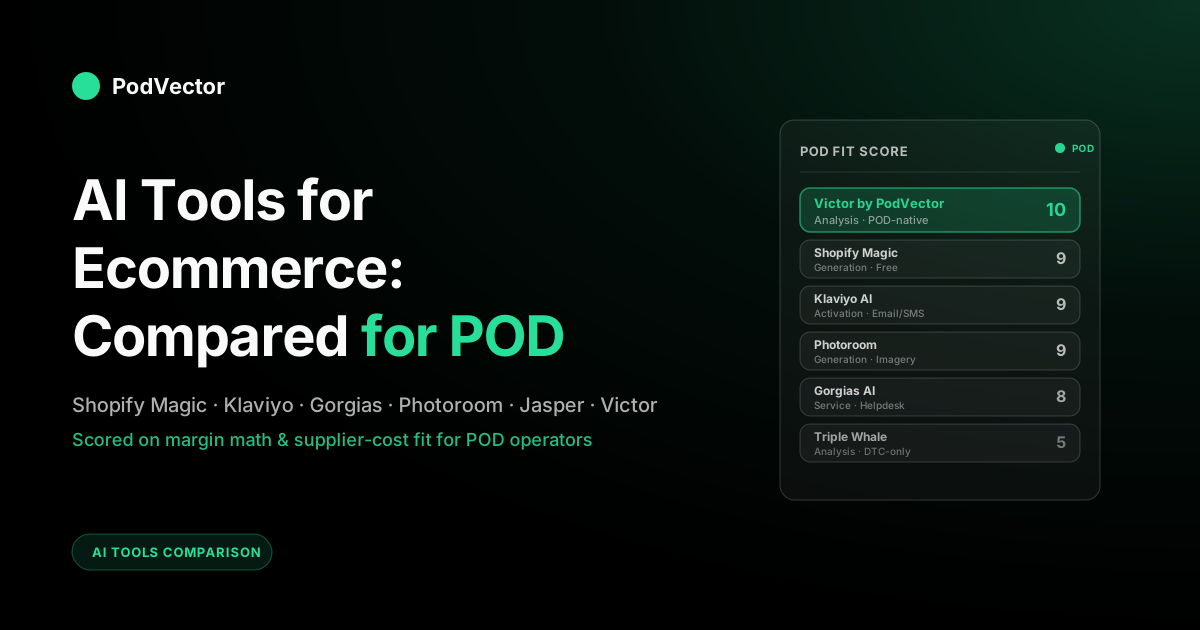
Quick Answer: The best AI stack for a print-on-demand store in 2026 is small: Shopify Magic (free) for product copy, Klaviyo AI for email/SMS, Gorgias AI or Tidio for support, Photoroom for imagery — plus a POD-aware AI employee to run ads and store ops with your approval, the gap Victor by PodVector AI fills. Skip the generic DTC analytics tools (Triple Whale, Polar); their margin math assumes you own inventory.
Most "top 10 AI tools" lists were written for inventory-owning brands. POD's supplier-side costs, royalty payouts, and design-IP risk break their assumptions. Below: nine tools scored on POD fit, a stack-by-revenue-band shortlist, and what changed in 2026 — agentic AI, shopping agents, and AEO.
What Counts as an "AI Tool for Ecommerce" in 2026
Every roundup currently ranking on Google lumps three different things together: AI features inside platforms you already pay for (Shopify Magic, Klaviyo AI), AI point tools that solve one job (Photoroom, Jasper, Gorgias), and AI analytics and AI-employee layers that sit on top of your data (Triple Whale, Polar Analytics, Victor). Treating them as one category is how stores end up paying for five tools that overlap on 60% of features.
For a POD operator, the useful split is by job-to-be-done, not by vendor:
- Generation — produce text, images, video, or ad creative on demand. Jasper, Photoroom, Shopify Magic.
- Activation — fire personalized messages, recommendations, or upsells based on behavior. Klaviyo AI, Rebuy, Octane AI.
- Service — answer customer questions and resolve tickets. Gorgias AI, Tidio AI, Fin.
- Acquisition — generate, test, and bid on paid ads. Smartly.io, AdCreative.ai, Meta Advantage+.
- Analysis — query your data and surface what's working in plain English. Triple Whale, Polar Analytics — and Victor by PodVector AI, who goes a step further and acts on the answers with your approval.
POD stores typically need one tool from each row, not five from one row. The mistake is buying multiple "AI ecommerce platforms" that all do generation and activation but nothing for analysis — the layer that tells you whether the rest of the stack is paying for itself.
How POD Operators Should Choose AI Tools
Most "how to choose" sections in the top-ranking roundups give generic SaaS advice — start with your biggest bottleneck, evaluate integrations, run a trial. True, but useless if you sell on Printify or Printful, because the bottlenecks are different. Four questions specifically for POD:
- Does it know your itemized base cost? A "smart" recommendation that pushes a $4-margin Bella+Canvas tee over an $11-margin Printful tri-blend is a tax on your AI stack. Tools that ignore supplier-level cost data give recommendations that look right and lose money.
- Will it survive a base-price change? Printify and Printful raise base prices 1–3 times a year. Any AI tool whose value proposition depends on hard-coded margin assumptions will quietly drift out of accuracy. Live-data tools survive; static-rule tools don't.
- Does it integrate at your AOV? POD AOVs cluster at $25–$45. Many "ecommerce AI" tools price as if every customer is a $200-AOV DTC apparel brand. The math on a $400/month subscription against a $35 AOV is brutal — you need 50+ extra orders/month from that tool just to break even.
- Can it answer a question, not just generate output? Generation tools are commoditizing fast. Analytical tools that answer "why did margin drop this week?" — across Shopify, Printify, and ad platforms in one query — are scarce and getting scarcer to build well. Bias your stack toward analysis as the generation layer commoditizes.
If a tool fails any of those four, it doesn't belong in a POD stack regardless of how impressive its demo is. The POD seller's guide to AI for print on demand covers the why behind those criteria in more depth.
Quick Comparison: 9 AI Tools for Ecommerce
Scored for fit with a POD store on Shopify, fulfilling through Printify or Printful, with $30K–$500K/year in revenue. "Fit score" is on 10 — POD-specific, not the tool's general quality.
| Tool | Job | Starting price | Best for | POD fit (/10) |
|---|---|---|---|---|
| Shopify Magic | Generation (built-in) | Free with Shopify | Product copy, email subject lines | 9 |
| Klaviyo AI | Activation (email/SMS) | Free to ~250 contacts; $20+/mo | Lifecycle email, predictive segments | 9 |
| Gorgias AI | Service (helpdesk) | From $10/mo + $0.90–$1.00/AI resolution | Order-status & refund tickets | 8 |
| Tidio AI | Service (live chat) | From $29/mo | Smaller stores, conversational | 7 |
| Photoroom | Generation (imagery) | From $9.99/mo | Mockup & lifestyle imagery | 9 |
| Jasper AI | Generation (content) | From $49/mo | Blog/SEO content at scale | 6 |
| AdCreative.ai | Acquisition (paid) | From $39/mo | Ad creative variants, A/B testing | 7 |
| Triple Whale | Analysis (DTC) | From $129/mo | Inventory-owning DTC analytics | 5 |
| Victor by PodVector AI | Operator (POD-native) | Free tier; paid plans | Runs ads + store ops with approval | 10 |
The Triple Whale score isn't a knock on the tool — it's an excellent inventory-owning DTC analytics platform. It's a knock on the fit.
Triple Whale was built for brands that own SKUs and care about cost-of-goods, not for stores where the "inventory" is a supplier API and the cost-of-goods changes per fulfillment partner. For POD-native analysis, see the best AI tools for ecommerce data analysis comparison.
The 9 Tools, Reviewed Through a POD Lens
1. Shopify Magic — The Free Baseline Every POD Store Should Use
Best for: any Shopify store, full stop.
Pricing: free with any Shopify plan.
What it does well for POD: product description generation that pulls from your existing brand voice, automatic email subject lines in Shopify Email, image background editing, FAQ generation for product pages. Shopify shipped 150+ AI features in their Winter 2026 Edition, including brand-voice cloning.
None of it requires extra spend.
POD-specific gap: Magic doesn't know about Printify or Printful product taxonomy. It'll generate generic apparel copy that says "premium soft cotton" regardless of whether the underlying SKU is a Bella+Canvas 3001 or a Gildan 64000. You still need to edit for accuracy on materials and fit.
2. Klaviyo AI — The Lifecycle Marketing Workhorse
Best for: any POD store doing $5K+/month with an email list.
Pricing: free up to ~250 contacts; ~$20/month for 1,500 contacts; scales with list size.
What it does well for POD: predictive segments (likely-to-purchase, churn risk), AI-generated subject lines that lift open rates 5–15%, send-time optimization, and SMS audiences that complement email. The lifecycle templates work for any store; the AI layer makes them better without a list-management hire.
POD-specific gap: Klaviyo's predicted CLV math assumes consistent gross margin per order.
If half your sales are on Printify Bella+Canvas (~$4 margin) and half are on Printful tri-blend (~$11), the predicted-revenue forecasts are systematically wrong. You can fix it manually with custom properties, but most stores don't.
3. Gorgias AI — Resolve Order-Status Tickets Without a Human
Best for: stores doing 100+ tickets/month where 60%+ are "where's my order."
Pricing: from $10/month for the basic helpdesk; AI Agent at $0.90–$1.00 per resolved conversation.
What it does well for POD: Gorgias AI Agent ingests your help center and historical conversations, then resolves common tickets (shipping status, refund eligibility, size/fit) end-to-end. For POD, the killer feature is order-status resolution — the AI looks up the Printify or Printful tracking number and replies with the carrier event, which is 40–60% of POD tickets at most stores.
POD-specific gap: Gorgias doesn't natively pull production-status data from Printify/Printful APIs. "Your order is in production" is a real status that matters for POD; Gorgias treats it as "shipped" until the tracking event arrives. You'll need a custom integration or accept that some pre-shipment "where's my order" tickets escalate to humans.
4. Tidio AI — Lighter-Weight Chat for Smaller Stores
Best for: POD stores under $5K/month who want a chat widget but can't justify Gorgias yet.
Pricing: from $29/month for the AI plan.
What it does well for POD: conversational chat that handles size/fit questions, drives discounts to recover abandoned carts, and qualifies leads. Easier setup than Gorgias and more visible to shoppers because it's chat-first rather than email-first.
POD-specific gap: Tidio is conversational but not deeply integrated into your fulfillment data.
Like Gorgias, it doesn't natively understand POD production states. Best as a top-of-funnel discovery tool, not as your post-purchase support layer.
5. Photoroom — The One Imagery Tool POD Stores Actually Need
Best for: any POD store generating product imagery for new SKUs at scale.
Pricing: free tier; Pro from $9.99/month.
What it does well for POD: background removal, AI lifestyle backgrounds, batch processing of mockups, and shadow generation. POD stores upload 10–100 new product mockups a week — Photoroom turns the Printify/Printful flat mockup into a "model wearing it on a rooftop" hero image in seconds.
The cost-per-image is functionally zero at scale.
POD-specific gap: AI lifestyle backgrounds occasionally hallucinate hands or distort logos at the edges of the print area. Always QA the output, especially for brand assets and trademarked designs.
6. Jasper AI — Content Volume Tool, Not a First Hire
Best for: POD stores running an active blog or category-page SEO program.
Pricing: from $49/month for the Creator plan; team plans priced per seat.
What it does well for POD: long-form blog content, SEO-optimized landing pages, ad copy variants, and brand-voice memory across pieces. Strong if you've decided to invest in content marketing as a channel.
POD-specific gap: Jasper isn't ecommerce-aware.
It writes generic apparel content that any Shopify store could use — which means it doesn't help you rank for queries like "Printify vs Printful" where POD-specificity is the moat. For most POD stores under $30K/month, ChatGPT Plus at $20/month does 80% of what Jasper does at half the price.
7. AdCreative.ai — Ad Variant Generation for Meta and Google
Best for: stores spending $1K+/month on Meta or Google ads.
Pricing: from $39/month; scales with creative volume.
What it does well for POD: generates 10–50 ad creative variants from a single product image, runs predicted-performance scoring, and integrates directly with Meta and Google ad accounts. For POD stores testing 5–15 designs a month, the creative production saves 4–8 hours/week.
POD-specific gap: AdCreative.ai's predicted-performance score is trained on cross-vertical data, not POD apparel specifically. Treat its scores as directional, not authoritative — your account-level data after 50+ creatives will outperform their model for ranking your own variants.
8. Triple Whale — Best DTC Analytics, Mediocre POD Fit
Best for: inventory-owning DTC apparel brands.
Pricing: from $129/month; scales with revenue.
What it does well in general: connects Shopify, Meta, Google, Klaviyo, and TikTok into a single attribution view. The "Moby" AI assistant lets you ask questions in natural language.
Best-in-class for inventory-owning DTC.
POD-specific gap: three structural mismatches. (1) Cost-of-goods is a single per-SKU number — Triple Whale doesn't model variable supplier cost across Printify, Printful, Gelato, etc. (2) "Inventory" is an inventory-owner concept; POD has supplier capacity and lead time, not stock-on-hand. (3) Triple Whale's margin math will be off whenever your supplier mix shifts. Worth running on a free trial to see if you can live with the gaps; we know POD operators who do.
9. Victor by PodVector AI — POD-Native AI Employee
Best for: POD stores that want an AI employee to run the business — not another dashboard to check.
Pricing: free tier for early users; paid plans at launch.
What it does well for POD: Victor connects to Shopify, Printify, Printful, Meta Ads, and Google Ads, so he can see your orders, ad spend and supplier costs all together. He reallocates ad spend, pauses losing creative, updates listings, and adjusts fulfillment — asking for your approval before each action.
Because that warehouse models supplier-side cost per blank and print method, his moves respect your real margins. Ask "which Printify SKUs lost margin this month and why?" and you get an answer in seconds — then a proposed fix Victor executes once you approve.
POD-specific gap: Victor is the newest tool on this list.
Today's integrations are Shopify, Printify, Printful, Meta Ads, and Google Ads. If your store sells primarily through other channels or suppliers, check the AI tools cluster for the latest integration status.
AI Tools for Ecommerce by Category
If you're starting from zero and want a one-tool-per-category shortlist, the picks below have the best POD fit at each job. The runner-up matters when the primary doesn't integrate with your platform.
Generation (text and imagery)
- Primary: Shopify Magic (free) for product copy + Photoroom ($9.99/mo) for imagery.
- Runner-up: ChatGPT Plus ($20/mo) for anything Shopify Magic can't handle.
- When to add Jasper: only when you've committed to a content-marketing program and need 10+ long-form pieces a month.
Activation (email, SMS, on-site)
- Primary: Klaviyo AI for email/SMS lifecycle.
- Runner-up: Omnisend if your list is small and you want a cheaper entry point.
- When to add Rebuy or Octane AI: when AOV climbs past $50 and bundle/upsell math becomes meaningful.
Service (chat, helpdesk, AI agent)
- Primary at $0–5K/month revenue: Tidio AI ($29/mo).
- Primary at $5K+/month: Gorgias AI ($10/mo + ~$1/resolution).
- Runner-up at scale: Fin ($0.99 per resolved conversation; built for full resolution, not deflection).
Chat-first options get a deeper treatment in our guide to AI chat tools for ecommerce on Shopify, including how the workflow looks for a POD store specifically.
Acquisition (paid ads, creative, bidding)
- Primary: Meta Advantage+ campaigns plus Google Performance Max — both free, both AI-powered, and both your starting baseline.
- Add AdCreative.ai when you're spending $1K+/month and creative production is your bottleneck.
- Skip Smartly.io until you're north of $50K/month in ad spend; the floor pricing assumes enterprise scale.
Analysis (the layer most POD stores skip)
- Primary for POD: Victor by PodVector AI — the only AI employee that models supplier-side cost variance natively and acts on it (ad changes, listing updates, fulfillment swaps) with your approval.
- Runner-up if POD-native isn't required: Polar Analytics (~$300/mo) for Shopify-first DTC.
- Skip Triple Whale for POD-only stores — the cost-of-goods modeling won't match your reality.
For a deeper take on the analytics layer specifically — including how live-data architectures differ from caching-style attribution platforms — see the complete guide to AI analytics for print-on-demand.
Where Generic AI Stacks Fail POD Sellers
The top-ranking AI ecommerce roundups (fin.ai, Yotpo, and others) are written for inventory-owning brands. That's not a value judgment — it's a structural assumption that breaks for POD in three places.
- Margin math assumes a single COGS per SKU. POD has variable cost per fulfillment partner per blank per print method. The "predict CLV" and "find your most profitable SKUs" features in Klaviyo, Triple Whale, and Polar all bake in the wrong assumption. Every recommendation downstream inherits that error.
- "Inventory" features are dead weight. Half the AI ecommerce category — restock prediction, low-stock alerts, demand forecasting tied to warehouse capacity — is irrelevant to POD. You're paying for surface area you'll never use; see what AI inventory forecasting actually looks like for POD sellers before buying any of it.
- Royalty and design-IP economics are invisible. If you run a designer-royalty model (Sellfy, Redbubble-style), your "ad budget" is partly other people's money — a different margin calculation. If you sell trademarked or parody designs, AI tools that broadcast your hottest SKUs to AI engines for indexing increase IP risk. No mainstream ecommerce AI tool models either dynamic.
The honest fix for most POD stores is a small, focused stack — Shopify Magic + Klaviyo + Gorgias + Photoroom — plus a POD-aware AI employee layer. Avoid the "all-in-one ecommerce AI platform" pitch. Those platforms are built for the median DTC brand, and POD is two standard deviations off the median.
Recommended Stacks by Revenue Band
The right stack depends on revenue more than any other variable. Below: three concrete stacks with monthly cost.
Starter Stack: $0–$10K/month revenue
Total: ~$30/month.
- Shopify Magic — free
- Klaviyo AI — free to 250 contacts
- Tidio AI — $29/month
- Photoroom Free — $0
- Meta Advantage+ — free (you're paying for the ads, not the AI)
Skip everything else. At this revenue band, the ROI on additional tools is negative — your bottleneck is product-market fit and design throughput, not analytics or ads automation.
Growth Stack: $10K–$100K/month revenue
Total: ~$200–$400/month.
- Shopify Magic — free
- Klaviyo AI — $50–$200/month depending on list size
- Gorgias AI — ~$100/month including a few hundred AI resolutions
- Photoroom Pro — $9.99/month
- AdCreative.ai — $39–$99/month if ad creative is the bottleneck
- Victor by PodVector AI — free tier or paid plan for analysis
This is where AI starts compounding. Each tool above pays for itself within 30–60 days at this revenue band, mostly through reduced labor (support tickets, ad creative) and reduced margin leakage (analysis catches losing SKUs faster). For more on Victor specifically, see the complete guide to AI tools for POD sellers.
Scale Stack: $100K+/month revenue
Total: ~$800–$2,500/month.
- Shopify Magic + Plus AI features — included in Plus
- Klaviyo AI — $400–$1,200/month at this list size
- Gorgias AI Pro — $300+/month
- Photoroom Teams — $20+/seat
- AdCreative.ai or Smartly.io — $200+/month
- Victor by PodVector AI or Polar Analytics — $300–$500/month for the operator/analytics layer
- Optional: Rebuy ($99+) or Octane AI ($50+) for personalization
At this scale, the marginal ROI on each additional tool is harder to prove — the danger is stack bloat, not stack gaps. Audit your tool roster every quarter and cut anything that hasn't shipped a measurable lift in 90 days. The best AI tools for ecommerce comparison goes deeper on the trade-offs at this scale.
What Changed in 2026: Agentic AI, Shopping Agents, and AEO
The AI ecommerce category moved fast in the past year. Three shifts now show up in every top-ranking roundup, and each one changes how a POD operator should buy.
Tools now execute, not just generate
The 2024–25 generation of tools wrote copy and drew charts. The 2026 generation acts: Fin resolves support tickets end-to-end, Shopify Flow (free with Shopify) chains automations across your store, and Victor runs ad and fulfillment decisions behind approval gates.
When you evaluate a tool now, ask what it will do, not what it will show you. Our comparison of AI tools for ecommerce automation goes deeper on the execution layer, and if you run a hybrid dropship model alongside POD, see the AI automated dropshipping tools comparison.
Buyers now ask AI what to buy
ChatGPT, Perplexity, and Google's AI results increasingly sit between shoppers and your store. Tools like Yotpo Discover exist purely to influence which SKUs those engines recommend — a category called answer engine optimization (AEO) that barely existed in 2025 roundups.
For POD, AEO cuts both ways: visibility for your winners, broadcast risk for parody or trademark-adjacent designs. Our comparison of AEO tools for ecommerce covers the options.
Stacks are consolidating into platforms
The top-ranking roundups now push consolidation — fewer tools, each doing more. That's directionally right for POD too: the five-category stack above is a ceiling, not a target.
Start with the free layer (Shopify Magic, Shopify Flow, Meta Advantage+), then add one paid tool per proven bottleneck. Browse the AI analytics hub when you're deciding what earns the next slot.
FAQs
What's the single most underrated AI tool for POD?
Photoroom. It costs $9.99/month and replaces 4–8 hours/week of manual mockup editing for any POD store launching new designs regularly. Most "best AI tools" lists put it in fifth place; for POD specifically, it should be in the top three.
Do I need a separate AI tool, or is Shopify Magic enough?
For stores under $5K/month, Shopify Magic plus a free chat widget plus the free tier of Klaviyo is enough. The marginal value of additional AI tools at that revenue is negative once you factor in setup time. Once you cross $10K/month, add Gorgias AI for support and Photoroom for imagery — those two are the highest-ROI second purchases.
How is Victor different from Triple Whale or Polar Analytics?
Triple Whale and Polar are analytics platforms — they report, and you act. Victor is an employee built around POD's actual reality: he models variable supplier cost across Printify and Printful, then executes the fix — ad changes, listing updates, fulfillment swaps — with your approval.
The other difference is freshness. Victor checks your orders, ads and costs live, not from a report made yesterday, so his decisions run on today's numbers, not old ones.
Are AI ecommerce tools worth it for a side-hustle POD store?
The free and free-tier tools — Shopify Magic, Klaviyo's free tier, Photoroom Free, Meta Advantage+ — are 100% worth it; they're free. Paid AI tools rarely make sense under $5K/month in revenue. The labor savings don't outweigh the subscription cost when you're the labor.
Will an AI tool help me rank in ChatGPT Shopping or Perplexity?
Most of the tools on this list don't directly affect AI search visibility. For that, look at AEO-specific tools — see our comparison of AI marketing companies and AEO tools for ecommerce. The tools above optimize the operations of your store; AEO tools optimize its discoverability inside AI answers.
How quickly can I see ROI from adding AI tools to my POD store?
By tool: Photoroom and Shopify Magic show ROI in week one (time saved). Klaviyo AI shows ROI in 2–4 weeks (revenue lift on optimized email subject lines and predictive segments).
Gorgias AI shows ROI in 4–8 weeks (resolution rate on order-status tickets). Victor shows ROI in 1–3 months — the value compounds as you approve more of the day-to-day and he takes over the routine ad and listing decisions.
What's the biggest mistake POD stores make with AI tools?
Buying generation tools (more copy, more imagery, more ad variants) when the actual bottleneck is analysis (which SKUs are profitable, which ad sets are losing margin, which suppliers are mis-priced this month). Generation makes you faster at producing things; analysis makes you faster at producing the right things. The second is much more valuable for POD operators specifically.
Skip the generic DTC analytics — get a POD-aware AI employee
Triple Whale and Polar report on a business you still have to run. Victor runs it with you. He connects your Shopify, Printify, Printful, and ad accounts, then reallocates spend, pauses losing creative, and fixes margin leaks — asking for your approval before every material action.
Try Victor free