
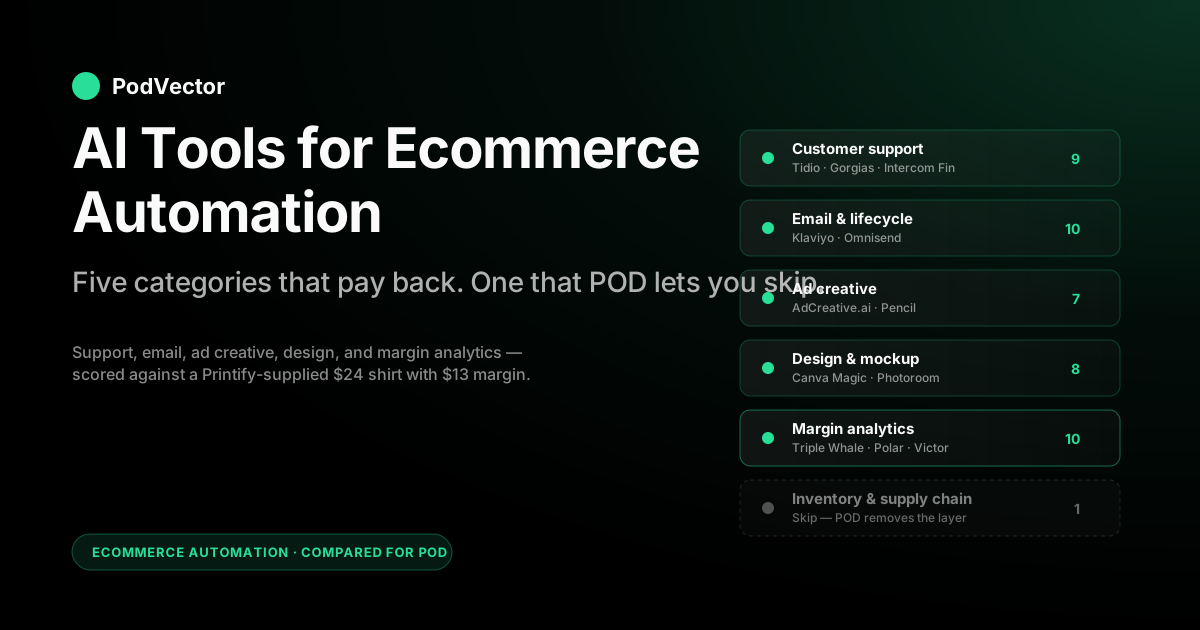
Quick Answer: For a print-on-demand operator, the AI ecommerce-automation categories that actually move the needle are email and lifecycle marketing (Klaviyo, Omnisend), customer support (Tidio, Gorgias, Intercom Fin), design and mockup automation (Canva Magic Studio, Photoroom), ad creative generation (AdCreative.ai, Pencil, Cropink), catalog creative automation (Marpipe, Cropink, Hunch — for price overlays, rating badges, and category-specific templates), content and listing copy (Jasper, ChatGPT, Surfer), and margin and decision analytics (Triple Whale, Polar Analytics, Victor by PodVector AI). The category every generic ecommerce roundup leads with — inventory and supply-chain automation — barely applies to POD because Printify and Printful eliminate the inventory layer entirely: there is nothing to forecast, no warehouse to pick from, and no stockout to prevent.
A subtopic the 2026 top results now prominently cover that many older POD guides miss: catalog creative automation — tools that apply different overlay templates to different product categories (price overlays on new arrivals, rating badges on bestsellers, sale stickers on clearance). This guide covers that layer explicitly in the ad creative section and in the new catalog creative automation section below.
This guide picks across each category through a POD lens: what the tool automates, how the cost stacks up against your unit economics, and which workflows still have no good automation in mid-2026 — most of them involve per-design profitability, supplier-cost variability, and figuring out which designs actually make money after real Printify or Printful order costs flow through.
Why "Ecommerce Automation" Maps Differently for POD
Most "best AI tools for ecommerce automation" lists treat the category as a single template — inventory forecasting, order routing, warehouse picking, fulfillment optimization, customer support, marketing automation, search and discovery. The tools that rank for the term all assume an inventory model: that you have stock somewhere, that you have to predict demand, that you have to route orders through warehouses, and that getting any of that wrong costs real money.
POD throws away most of that. When Printify or Printful holds zero inventory in your name, when every order is fulfilled on demand at a published per-SKU cost, when you can list hundreds of designs across dozens of product variants and pay nothing until a customer buys — the entire inventory-and-supply-chain automation category collapses. There is nothing to forecast. There is no warehouse to pick from. There is no stockout to prevent.
A large share of every generic ecommerce automation roundup is irrelevant to a POD operator from the first paragraph, even when the individual tools are genuinely good. What is left, and what actually compounds in a POD store, is automation around the four functions that do exist: handling customer questions, running marketing, generating creative, and figuring out which designs are actually profitable after real supplier cost flows through.
One subtopic the 2026 top results now explicitly surface — and that generic lists often miss for POD — is catalog creative automation: tools that apply different overlay templates per product category, so new arrivals get price overlays, bestsellers get rating badges, and sale items get sticker callouts, all driven from feed data rather than manual Photoshop work. That layer is real and covered in its own section below.
Those areas are real and they pay back. This guide ranks tools inside each category through a POD operator's lens — integration surface against Shopify and Printify, cost against a real unit-economic profile, and which tool actually earns its monthly subscription against a thin gross margin per unit.
For the higher-altitude framing of how every AI category fits together in a POD stack, the complete guide to AI tools for POD sellers is the pillar. The AI for print-on-demand business guide covers the agentic-AI layer specifically, and the AI analytics topic hub is where the margin-and-decision question — the one most automation tools don't touch — gets answered.
The Scorecard: Categories That Pay Back
Scores out of 10 on POD-specific axes — payback per dollar of subscription against a typical Printify-supplied unit-economic profile, Shopify integration depth, and whether the automation handles the "many designs across many variants" pattern that defines a POD store.
| Category | Top picks | Payback for POD | Starting cost/mo | Integration with Shopify + Printify | Best for stage |
|---|---|---|---|---|---|
| Email & lifecycle | Klaviyo, Omnisend | 10 | $0–$16 | Shopify native | Day one |
| Customer support | Tidio, Gorgias, Fin | 9 | $0–$29 | Shopify native, Printify via order data | Past 50 orders/mo |
| Design & mockup | Canva Magic, Photoroom | 8 | $0–$13 | Canva → Printify native | Day one |
| Ad creative | AdCreative.ai, Pencil | 7 | $39–$119 | Asset hand-off only | Past first ad campaign |
| Catalog creative automation | Cropink, Marpipe, Hunch | 7 | $0–custom | Product-feed driven; Meta DPA native | Past first catalog ad campaign |
| Content & SEO copy | Jasper, ChatGPT, Surfer | 6 | $0–$49 | Manual hand-off | Catalog scale / blog |
| Margin analytics | Triple Whale, Polar, Victor | 10 | $0–$129 | Native (Victor); paid (Triple Whale) | Past $5K MRR |
| Inventory/supply chain | Netstock, ShipHero | 1 | $100+ | Irrelevant for POD | Skip |
The picks below cover what each tool actually automates in a POD context, where it earns its subscription, and where the seam is between automation and the next decision an operator has to make manually.
Customer Support: Tidio, Gorgias, Intercom Fin
Customer support is where ecommerce-automation ROI shows up first because every minute saved is a minute you don't spend answering "where's my order" for the third time today. POD adds a wrinkle most generic tools don't think about: tracking is multi-leg (Printify produces, then ships via a regional carrier, then hands to the destination postal service), refund policy depends on supplier print errors versus customer mistakes, and SKU complexity means even simple product questions involve variant logic.
Tidio
Pricing: Free plan with 50 conversations/mo; $29/mo Starter; Growth from $59/mo; Lyro AI agent add-on from $39/mo (lower when billed annually), per Tidio's pricing page.
Best for: POD operators under $30K/month doing their own support.
Tidio's Lyro AI agent reads your help center, FAQ, and past chat transcripts and answers a large share of repetitive questions without escalation. For a POD store, the questions Lyro reliably handles are the high-volume, low-emotion ones: shipping timelines, sizing charts, return policy, order status. The free tier covers 50 conversations per month, which is workable through your first hundred orders; past that the paid tier earns back quickly on time saved per resolved ticket.
Gorgias
Pricing: Ticket-tiered plans; AI Agent metered per resolved conversation — see Gorgias's pricing page for current tier prices.
Best for: Shopify POD stores past 500 orders/mo.
Gorgias was built for Shopify and it shows — order data, customer history, refund actions, and tracking links all surface in the support inbox automatically. The AI Agent drafts replies grounded in your order data, not just your knowledge base, which matters for POD because most questions are order-specific ("did my Printify order ship yet?") rather than policy-specific. The trade-off: Gorgias is more expensive than Tidio and the per-ticket pricing model penalizes stores with high refund-question volume.
Intercom Fin
Pricing: $0.99 per resolution (usage-based); requires Intercom subscription from $39/seat.
Best for: Multi-store operators, brands with deeper SaaS infrastructure.
Fin is the most capable of the three at end-to-end resolution — it can issue refunds, update orders, and execute account actions when given backend access, not just answer questions. For POD that capability shines on the supplier-error side: a customer sends a photo of a misprinted shirt, Fin can verify against the Printify order, trigger a reprint or refund, and close the loop without operator touch. The trade-off is cost predictability — usage-based pricing on a high-refund product category gets expensive faster than seat-based plans.
For a deeper category breakdown including Shopify-specific picks, see the best AI chatbot for ecommerce comparison and the POD-operator framing of AI chatbots for ecommerce.
Email and Lifecycle: Klaviyo, Omnisend
Email is the highest-payback automation category for POD because the marginal cost of an extra send approaches zero and the AOV-lift from a triggered abandoned-cart or post-purchase flow is real. POD also has an unusual asset for email: huge SKU and design variety means more variant-specific cross-sell opportunities than a single-SKU brand, but only if your email tool can pull product data dynamically.
Klaviyo
Pricing: Free up to 250 active profiles and 500 email sends/mo (plus 150 monthly SMS credits); paid plans scale with active-profile count, per Klaviyo's pricing page.
Best for: Any POD store from launch onward.
Klaviyo's predictive analytics (CLV, churn risk, expected next-order date) are the two-year-running default in this category, and they apply cleanly to POD. The flows that compound for POD operators specifically: post-purchase product-design cross-sell (customer bought a Halloween shirt, recommend three other designs in the same niche), abandoned-cart with size/color reassurance, and win-back triggered on the gap between expected next-order date and actual silence. Klaviyo's product feed pulls Shopify variants natively, so a POD store with hundreds of active SKUs doesn't have to manually maintain segments. Victor by PodVector AI reads your Klaviyo data too, so your email results sit right alongside your Shopify sales and ad numbers when he works out your true profit.
For the specific browse-abandonment flow setup that works best for POD catalogs, see the Klaviyo browse abandonment flow setup guide.
Omnisend
Pricing: Free up to 250 contacts; from $16/mo at 500 contacts; SMS bundled into Pro from $59/mo, per Omnisend's pricing page.
Best for: Smaller POD stores, operators preferring pre-built ecommerce templates.
Omnisend is the value pick — slightly cheaper than Klaviyo, with email, SMS, and push bundled into one workflow editor. The pre-built templates skew toward conversion-focused ecommerce flows out of the box (welcome, abandoned cart, order-confirmation cross-sell), which lets a new POD operator launch every required automation in an afternoon. The ceiling is lower than Klaviyo's: predictive analytics and segmentation depth aren't quite at parity, which matters less under 5,000 contacts and more above 25,000.
Content and SEO Copy: Jasper, ChatGPT, Surfer
The category every 2026 roundup now leads with — AI content generation — has a narrower but real job in POD: writing product descriptions and listing copy across a catalog that can run to hundreds of SKUs, plus the blog and SEO content that drives organic traffic to those listings. The leverage is volume, the same as ad creative: one design becomes many product variants, each needing a title, description, and tags. The roundups are right that this is the most commoditized AI category — so the buying decision is mostly about how much you want to pay for essentially the same underlying capability, not about which tool is meaningfully smarter.
Jasper
Pricing: $49/mo Creator; $69/mo Pro; enterprise above, per Jasper's pricing page.
Best for: POD operators producing high listing volume across many niches.
Jasper generates product descriptions, ad copy, and blog posts from a brief and a stored brand-voice profile. For POD the payback is listing throughput — feed it the design concept and product type and it returns SEO-aware titles and descriptions in bulk, with a consistent voice across a sprawling catalog. The ceiling: it doesn't see your actual conversion data, so the copy is a strong first draft to test, not a proven winner.
ChatGPT
Pricing: Free tier; $20/mo Plus; $25/seat Team.
Best for: Any operator who wants a general-purpose copy and research assistant.
ChatGPT is the commoditized baseline — product descriptions, email copy, niche research, and FAQ drafting at $20/mo. It has no native Shopify or Printify integration, so it's a manual paste-in workflow, but for a solo operator it covers most of the content-generation need without a dedicated subscription. Don't overpay for a wrapper that does what the base model already does.
Surfer
Pricing: $69/mo Essential; higher tiers above, per Surfer's pricing page.
Best for: POD brands building organic search traffic to a store blog.
Surfer is the SEO-content layer — it scores a draft against what currently ranks for a target term and tells you which subtopics to add. For a POD store building a content moat (niche guides, gift roundups that funnel to listings), Surfer turns "write a blog post" into "write a blog post that can rank." Below a few thousand monthly organic sessions the payback is thin; above it, it compounds. The same gap as the rest of this category applies: it optimizes for ranking, not for which design actually sells once the visitor lands. For CRO techniques that make those visitors convert once they arrive, see the CRO techniques guide.
Ad Creative: AdCreative.ai, Pencil
Paid acquisition is where most POD operators lose money before they figure out what works. AI ad creative tools don't fix the strategy problem (you still have to target the right audience and pick the right offer), but they do collapse the production cycle from "design six ad variants in Photoshop" to "type a brief, get a batch of ad-ready creatives in minutes." For a POD store testing multiple designs per niche per week, that compounds quickly.
AdCreative.ai
Pricing: Starter from $39/mo billed monthly (lower on yearly billing); higher tiers scale by credit volume — see AdCreative.ai's pricing page for current rates.
Best for: Stores running paid ads on Meta or Google with a rotating design catalog.
AdCreative.ai takes a product image (your Printify or Printful mockup), brand colors, and a copy brief and returns a batch of platform-spec ad creatives. For POD specifically, the value lever is volume: a single shirt design auto-generates ad-spec variants across Meta feed, Reels, Story, Google Display, and Pinterest in one pass. One limitation to note: according to Synter's 2026 tool comparison, AdCreative.ai "stops at the export button, so you still download, format, and upload every asset to your ad accounts by hand" — build that manual step into your workflow estimate.
Pencil
Pricing: $119/mo Pro; $499/mo Premium; enterprise above.
Best for: POD brands past $50K/mo running structured creative testing.
Pencil is the more enterprise-flavored option — heavier on brand controls, structured creative briefs, and learning loops that integrate with your Meta or TikTok ad-account performance data. For a single-operator POD store the price is hard to justify; for a brand running a managed ad budget where one underperforming week of creatives costs more than the subscription, Pencil's tighter feedback loop earns out.
For more depth on which AI marketing tools fit a POD stack and how to lift AOV from the traffic you've already paid for, see the increase AOV with AI guide.
Catalog Creative Automation: Overlays, Badges, and Category Templates
This subtopic is now prominently covered by the 2026 top results and deserves its own section for POD operators running catalog ads. The question is specific: I need to apply different overlay templates to different product categories — price overlays on new arrivals, rating badges on bestsellers, sale stickers on clearance. Which tools support this?
The answer is a dedicated tier of tools that sits between raw ad creative tools (AdCreative.ai) and full media-buying platforms (Smartly). They connect your product feed — pulled from Shopify via a catalog integration — and apply conditional template logic: if a product tag is "new-arrival," apply the price-overlay template; if it's tagged "bestseller," apply the rating-badge template. The output feeds directly into Meta Dynamic Product Ads (DPAs) or Google Shopping.
For POD specifically, this is most relevant once you're running catalog ads against a feed of more than a few dozen designs. At that point, manually producing overlay variants for every SKU combination is the bottleneck — catalog creative automation collapses it.
Cropink
Pricing: Free forever plan for up to 25 products; paid tiers for larger feeds — see Cropink's pricing page for current rates.
Best for: Small-to-mid POD stores running Meta DPA with a product catalog under a few hundred SKUs.
According to Cropink's own comparison, the tool "lets you apply branded templates, price tags, logos, and seasonal messages across your entire feed" — with its standout feature being enriched catalog ads powered by product data enrichment. The Figma plugin is useful if you have a designer on the team; the free plan is enough to test on a small design catalog before committing. It bridges the gap between Meta's native (and limited) overlay controls and a full enterprise creative platform.
Marpipe
Pricing: Custom — see Marpipe's pricing page.
Best for: POD stores with large catalogs that need template-per-category logic baked into DPA feeds.
According to Marpipe's 2026 catalog comparison, Marpipe "builds product ads directly from feed data using branded catalog templates" and "automates pricing, product names, badges, and promotional overlays inside ad creative." The per-category template control is the key capability for POD: you set one template for new arrivals (price overlay), one for bestsellers (badge), and the feed logic applies them automatically across any size catalog. The trade-off is pricing opacity — Marpipe is custom-quoted and generally mid-market rather than indie-operator priced.
Hunch
Pricing: Custom — contact for rates.
Best for: POD brands spending meaningfully on Meta DPAs who want AI-enhanced creative overlays.
Hunch occupies a position between creative tool and media platform: it connects catalog data to dynamic ad production. According to Rocketium's 2026 creative automation review, Hunch offers "AI background removal, intelligent color matching, and Catalog Product Videos (CPV) that blend lifestyle footage with dynamic overlays" — useful for POD mockups where the product image quality matters more than for commodity goods. The per-category overlay logic for DPAs is strong. The price puts it beyond early-stage POD budgets.
Meta's native catalog enhancements (Advantage+)
Pricing: Included with Meta Ads; no additional cost.
Best for: POD stores not yet ready to invest in a dedicated catalog creative tool.
Meta's Advantage+ creative suite includes catalog enhancements — overlays like price, shipping info, and stickers on catalog ads — applied automatically. According to the 2026 Advantage+ complete guide, these catalog enhancements are "toggled at the ad level under the Advantage+ creative section" and include price, shipping, and promotional sticker overlays. The limitation: you can't apply different templates per product category — Meta applies a uniform treatment across the catalog. If you need category-specific logic (new arrivals vs. bestsellers vs. sale), you need one of the dedicated tools above.
For how catalog creative performance connects to margin — so you can see which overlay-driven DPA SKUs are actually profitable after Printify cost — see the PodVector AI for POD sellers overview and the increase AOV with AI guide.
Design and Mockup Automation: Canva Magic Studio, Photoroom
POD design automation overlaps with general AI-design tools but has a specific narrow job: take a generated graphic, get it onto a product mockup at print spec, and push it to Printify or Printful for listing. The full design-tool category is covered in depth in the AI design tools for print on demand comparison; what matters here is the automation sliver — collapsing five manual steps into one.
Canva Magic Studio
Pricing: Free tier; $15/mo Pro; $30/mo Teams, per Canva's pricing page.
Best for: Any POD operator who isn't already in the Adobe ecosystem.
Canva's Magic Resize is the killer automation: one design auto-scaled to t-shirt placement, mug wrap, poster, sticker sheet, and tote bag specs in one click. Combined with the native Printify and Printful Canva integrations, the workflow becomes "generate or upload design → Magic Resize → push to Printify → sync to Shopify" without leaving Canva. For a single operator producing multiple designs per day, Magic Resize alone is worth the $15/mo subscription.
Photoroom
Pricing: Free with watermarks; $13/mo Pro; $20/mo Pro Plus, per Photoroom's pricing page.
Best for: POD operators producing batched mockup images for listings.
Photoroom's batch-processing pipeline handles background removal, AI background generation, and consistent-shadow application across hundreds of mockup images at once. For POD that matters when listing the same design across many product variants and you want consistent brand-aesthetic mockups across all of them. The API tier is genuinely useful if you're building an ops pipeline that programmatically handles thousands of mockups.
Margin and Decision Analytics: Triple Whale, Polar Analytics, Victor
This is the category that decides whether the rest of the automation stack pays back. You can automate support, send beautifully targeted emails, generate hundreds of ad creatives, and ship designs faster — but if you don't know which designs and product variants are actually profitable after Printify supplier cost, ad spend, refunds, and processing fees, you're scaling whatever happens to be on top of the noise. Understanding net profit margin benchmarks for POD at the design level is the question this category exists to answer.
Triple Whale
Pricing: $129/mo Growth; $399/mo Pro; enterprise above, per Triple Whale's pricing page.
Best for: DTC stores past $50K/mo with paid-acquisition complexity.
Triple Whale is the default DTC analytics dashboard for ad-attribution and consolidated performance reporting. It pulls data from Shopify, Meta, Google, and other sources into one operator dashboard with AI-flavored insights. For POD the trade-off is real: the platform was built for a stock-and-attribute DTC model, so SKU-level supplier-cost integration with Printify or Printful is shallow — you can manually input average COGS, but the live per-order Printify cost (which varies by product, color, size, and shipping destination) doesn't flow in natively. See also the average checkout completion rate benchmarks for context on which revenue metrics are worth tracking alongside margin.
Polar Analytics
Pricing: $300/mo Plus; $750/mo Premium; enterprise above, per Polar Analytics's pricing page.
Best for: Mid-market DTC brands wanting a customizable BI layer.
Polar Analytics is the more flexible BI-layer option — same data source coverage as Triple Whale but with custom-metric building, cohort analysis, and SQL-like query power for operators who want to define their own KPIs. The same POD limitation applies: per-order Printify supplier cost integration is a manual layer rather than a live feed. Worth the price above $250K/mo, hard to justify below.
Victor by PodVector AI
Pricing: Free trial at app.podvector.ai; paid tiers for production stores.
Best for: POD operators on Shopify with Printify or Printful at any scale.
Victor is the AI employee purpose-built for POD. The big difference from every generic analytics tool: Victor connects directly to Shopify, Printify, and Printful and pulls in the real cost of every single order — not an average cost, but the exact cost Printify or Printful charged for that variant and shipping destination. That's the shipping math that makes POD margin so different from stock-based DTC. He also reads Meta Ads, Google Ads, and Klaviyo, so your full revenue and cost picture sits in one place.
You ask in plain English ("which designs from the last 30 days have the highest gross margin per unit, and what's CAC on the listings they're on?") and the answer comes back in seconds, pulled straight from your synced data. Victor then proposes the next profit move — repricing a worst-margin SKU, bulk-updating prices to a target margin, creating a BOGO discount on a collection, adjusting the free-shipping threshold — and runs the approved change on Shopify. He also reads Meta Ads and Google Ads and can make the approved change right there too, like pausing a campaign or updating a budget.
One honest limit worth knowing: Victor does not generate designs, print-ready files, or mockups — that's the layer Canva and Photoroom cover. Victor reads your Shopify, Meta Ads, Google Ads, Printify, Printful, and Klaviyo data; he does not read Etsy or Amazon. And each session starts fresh — Victor has no memory from one chat to the next, so carry context forward manually when you return.
For deeper coverage of how live margin analytics fits into a POD operation, see the PodVector AI strategy overview, the Etsy-to-Shopify dropship data reconciliation guide, and the net profit margin benchmark reference.
The Categories POD Operators Should Skip
Three categories show up on every generic ecommerce automation list and have no payback for a POD operator. Knowing what to skip is as valuable as knowing what to buy.
Inventory and supply-chain forecasting
Tools like Netstock, Lokad, and ShipHero exist to forecast demand, optimize stock levels, and route warehouse picking. POD has none of those problems — Printify and Printful handle production on demand from a SKU catalog they manage. There is no inventory to forecast and no stockout to prevent. The price tag for these tools buys nothing usable. Skip the entire category.
Order management systems
OMS tools (Linnworks, Brightpearl, Cin7) coordinate orders across multiple sales channels and warehouses. For a POD operator, the Shopify-to-Printify-to-customer chain is already an OMS — Printify's app handles routing, status updates, and tracking automatically. Adding a third-party OMS layer adds latency and cost without solving any problem.
Dynamic pricing tools
Dynamic pricing tools (Prisync, Intelligems, Wiser) adjust prices based on competitor monitoring, demand signals, or A/B test outcomes. For POD this is mostly noise: your retail price is constrained on the bottom by Printify's per-unit cost and on the top by the customer's tolerance for a printed product at a given design quality. The optimization space is narrower than for stock-DTC, and the volume per SKU is rarely high enough to A/B test prices meaningfully. Spend the budget on better designs and smarter creative instead — or use Victor to reprice at the margin level once you have real cost data flowing through your warehouse. For context on how shipping costs interact with your pricing floor, see the Printful shipping cost breakdown.
Three Automation Stacks by Store Stage
What you should pay for changes with revenue. The right stack at $2K/month is wrong at $50K/month and vice versa.
Stack 1 — First 100 orders ($0–$15/mo)
Email: Klaviyo or Omnisend free tier (under 250 contacts).
Support: Tidio free tier (50 conversations/mo).
Design: Canva free tier with Printify integration.
Analytics: Shopify dashboard plus manual Printify cost spot-checks.
Total cost: $0–$15/mo.
Trade-off: You're slower than competitors with paid stacks but spending nothing pre-validation. Once a niche is producing ten or more orders per week consistently, upgrade. For context on whether your checkout flow is underperforming at this stage, the average checkout completion rate benchmark gives a useful baseline.
Stack 2 — Profitable side store ($115–$170/mo)
Email: Klaviyo paid tier at 500–2,000 contacts.
Support: Tidio Starter + Lyro AI ($68/mo) or an entry Gorgias ticket tier.
Design: Canva Pro ($15/mo).
Analytics: Victor by PodVector AI for live Shopify + Printify + Printful margin analytics.
Trade-off: You've stopped guessing on which designs make money and you're automating the highest-volume support categories. The stack pays back inside the incremental revenue from a handful of recovered abandoned carts and one or two margin-improving reprices per month.
Stack 3 — Scaled operator ($400–$700/mo)
Email: Klaviyo at 10,000+ contact tier with SMS add-on.
Support: Gorgias Pro or Intercom Fin (usage-based).
Ads: AdCreative.ai on a higher-credit tier; Cropink for catalog overlay automation on Meta DPAs.
Design: Canva Teams + Photoroom Pro Plus.
Analytics: Victor by PodVector AI plus supplemental dashboards as needed.
Trade-off: Every category that compounds at scale is automated, and the analytics layer tells you which subscriptions are paying back per cohort. At this stage the full stack costs less than two days of CAC on a single underperforming campaign — the upgrade is straightforwardly worth it. For how to push AOV higher from your existing traffic before scaling ad spend further, see the increase AOV with AI guide.
Where Ecommerce Automation Still Doesn't Reach
The hardest decisions in a POD operation aren't automated by anything in the broader ecommerce automation category, even after a full stack purchase.
Per-design profitability across full unit economics. Triple Whale and Polar Analytics get close on the ad-side and gross-revenue side, but neither pulls live per-order Printify or Printful cost. Without that, "this design is profitable" is approximate. Victor was built specifically to close this gap — and the net profit margin benchmark reference walks through exactly why the standard COGS shortcut breaks down for POD.
Supplier-cost variability. Printify and Printful both have shipping cost that varies by product, color, size, and destination — sometimes materially on the same SKU between two orders. No generic ecommerce automation tool models this; most assume a flat-COGS attribution. The math gets wrong fast on bundled orders or international shipping. See the Printful shipping cost breakdown for a concrete sense of how wide that variance can be.
Catalog creative overlay logic per category. The new section above covers Cropink, Marpipe, and Hunch for this workflow. But even those tools stop at the creative-production and ad-delivery layer — they don't close the loop back to which overlay-driven SKU is actually profitable after supplier cost. That synthesis still requires a dedicated margin layer like Victor.
Cross-platform listing intelligence. A design that crushes on Etsy may flop on a Shopify store with Meta ads. Generic dashboards don't disaggregate channel performance at the design level for POD; either the data isn't connected or the COGS model assumes single-channel unit economics. Decisions still happen in spreadsheets for most operators. Note: Victor reads Shopify, Meta Ads, Google Ads, Printify, Printful, and Klaviyo — he does not read Etsy or Amazon, so cross-marketplace attribution still needs a separate layer. For a realistic look at how Etsy-to-Shopify data reconciliation works in practice, see the Etsy-to-Shopify dropship data reconciliation guide.
Niche gap detection. Knowing which adjacent niche to enter next based on what your existing customers are buying is a question every operator has and no generic tool answers well. The data exists (Shopify customer purchases plus Printify product taxonomy plus ad audience overlap), but the synthesis is largely manual today. Agentic AI for ecommerce analytics is where this is heading; we cover it in the AI agents for ecommerce explainer and the AI for print-on-demand business guide.
For broader category context, the AI tools for print on demand comparison and the best AI tools for small ecommerce stores 2026 guides cover the surrounding decision space, and the AI tool for ecommerce comparison picks individual single-tool entry points for new operators.
FAQs
What's the most important AI automation tool for a print-on-demand business in 2026?
Email and lifecycle automation, by a wide margin. Klaviyo or Omnisend running abandoned-cart, post-purchase cross-sell, and win-back flows produces measurable revenue lift inside 30 days at near-zero marginal cost per send. The next category to add depends on your bottleneck: support automation if you're drowning in tickets, ad creative if your CAC is rising, and margin analytics (Victor) if you can't tell which designs are actually profitable after real supplier cost.
Which tools support different overlay templates for different product categories — price overlays on new arrivals, rating badges on bestsellers?
This is catalog creative automation, and the tools built for it are Cropink (free up to 25 products, best for small-to-mid POD catalogs), Marpipe (mid-market, DPA-feed native, conditional template-per-category logic), and Hunch (enterprise DPA, AI-enhanced overlays including background matching and product videos). Meta's native Advantage+ catalog enhancements give you basic overlays (price, shipping stickers) at no extra cost but apply a uniform treatment — they don't support different template logic per product category. If you need "new arrival = price overlay" and "bestseller = rating badge" as separate rules, you need Cropink or Marpipe. For POD specifically, start with Cropink's free plan to validate the workflow before committing to a paid catalog creative tier.
Can AI fully automate a print-on-demand store?
Not in 2026 — and that's mostly fine, because the parts that aren't automated (niche selection, brand voice, design taste, customer-relationship judgment) are also where the moat is. What AI can automate today is the high-volume repetitive layer: support, email, mockup generation, ad creative production, catalog overlay management, and margin-driven repricing and catalog updates.
What's coming next on the agentic-AI roadmap is deeper decision automation — automatically surfacing losing listings for removal, scaling winning creatives, detecting adjacent niches. That bridge is being crossed now; "fully automated" is still several quarters out for most workflows.
How does AI ecommerce automation differ for POD versus inventory-based DTC?
The biggest difference is what you don't need. POD eliminates the entire inventory-and-supply-chain automation category — no demand forecasting, no warehouse management, no stockout prevention, no purchase-order automation. That removes a large portion of what generic ecommerce automation tools sell against.
POD also has higher SKU and design variety than typical DTC, which makes design and mockup automation more valuable, and per-order shipping cost variability that generic analytics tools don't model well, which makes purpose-built POD analytics more valuable.
Which AI tools integrate with both Shopify and Printify?
Klaviyo (Shopify native; Printify data via order tags), Tidio and Gorgias (Shopify native; Printify status surfaced via order metadata), Canva (native Printify integration for design-to-listing handoff), and Victor by PodVector AI (connects to Shopify, Printify, and Printful and pulls in the real cost of every order as it happens). Triple Whale and Polar Analytics integrate with Shopify but treat Printify cost as a manual COGS layer rather than a live feed.
What's the cheapest AI automation stack for a new POD store?
Around $15/mo total or less. Klaviyo free tier for email under 250 contacts, Tidio free tier for support under 50 conversations per month, Canva free tier for design and mockups, and the Shopify dashboard plus manual Printify cost checks for analytics. The stack scales until you hit the free-tier ceilings; at that point the first paid upgrades — email and support automation — are the ones to buy, because their payback compounds directly with order volume.
Should I use one all-in-one AI tool or multiple specialized tools?
Multiple specialized tools, in 2026. The "all-in-one ecommerce AI platform" pitch usually means a tool that does email well, support adequately, and analytics shallowly — and POD specifically rewards depth in each category over breadth across them.
Better to run Klaviyo for email, Gorgias or Tidio for support, Canva for design, and a margin analytics layer (Victor for POD) than to settle for one platform that does all four at reduced capability. The integration cost is lower than the depth gain.
Do AI ecommerce automation tools work for Etsy as well as Shopify?
Some do, fewer than Shopify-natives. Klaviyo has Etsy integration via third-party connectors but not native; Canva's Etsy integration is direct; Tidio works on any web property; Gorgias is Shopify-first.
For multi-channel POD operators running both Etsy and Shopify, the right architecture is usually a Shopify-as-system-of-record approach with Etsy listings managed through a sync tool — and the AI automation stack hangs off Shopify rather than off Etsy directly. Victor reads Shopify orders alongside Printify and Printful supplier cost; he does not read Etsy, so the channel-of-record decision matters more than which storefront a shopper clicked through.
How does Victor by PodVector AI differ from a standard analytics dashboard?
Most analytics dashboards show you what happened. Victor is an AI employee: he reads your Shopify, Meta Ads, Google Ads, Printify, Printful, and Klaviyo data, finds the next profitable move, and makes it happen with your approval — repricing worst-margin SKUs, bulk-updating prices to a target margin, creating a BOGO or free-shipping discount, adjusting your free-shipping threshold, or organizing collections. He also reads your ad accounts and, with your approval, can act there too, like pausing a campaign or changing a budget. The key distinction: Victor acts on the analysis, with approval, rather than leaving the execution step to you. He does not generate designs or mockups, and each session starts fresh — he has no memory from one chat to the next.
Hand the operating layer to an AI employee.
The tools in this guide handle the upstream pieces — email, support, ad creative, catalog overlays, mockup generation. The decision layer that closes the loop is acting on what's actually profitable after live Printify or Printful supplier cost, ad spend, refunds, and processing fees.
Victor by PodVector AI connects directly to Shopify, Printify, and Printful, pulls in every order's real cost, then proposes and runs the next profit move with your approval — repricing losing SKUs, flagging the winners worth more spend, and updating the catalog so your automation stack pushes the right designs instead of the loud ones.
Try Victor free