
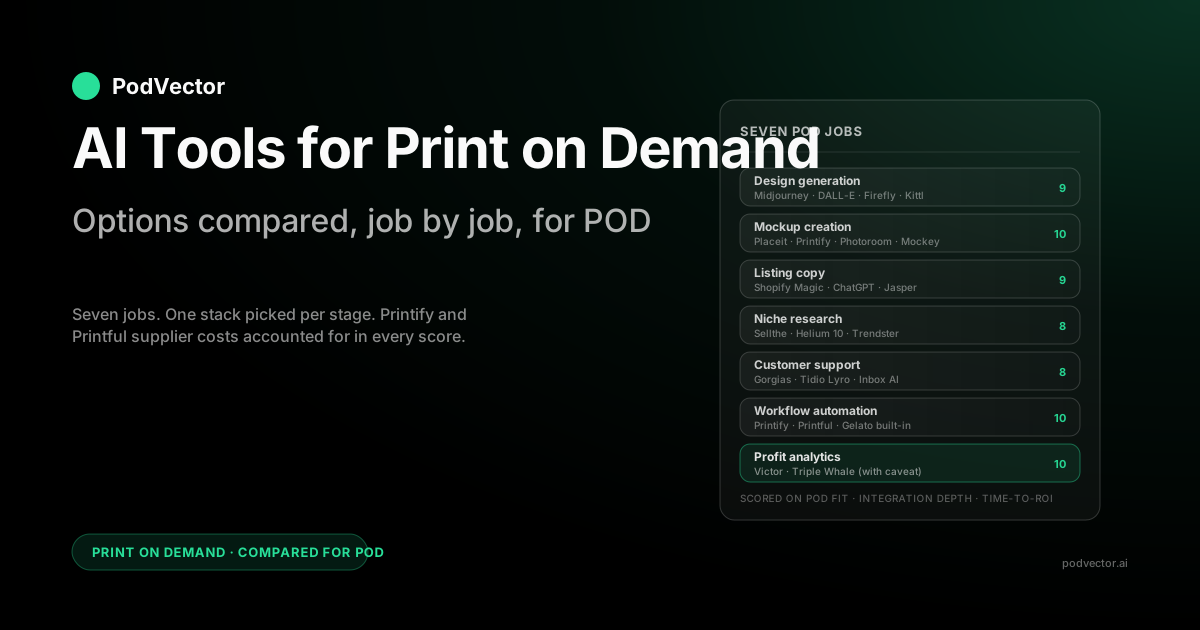
Quick Answer: The AI tools that actually move the needle for a print-on-demand seller fall into seven jobs: design generation (Midjourney, Ideogram, DALL-E 3, Adobe Firefly, Kittl), mockup creation (Placeit, Photoroom, Mockey), listing copy (ChatGPT, Jasper, Shopify Magic), niche and trend research (Sellthe, EverBee, Alura), customer support (Gorgias AI, Tidio Lyro), workflow automation (Printify, Printful, Gelato built-in AI), and profit analytics (Victor by PodVector AI).
The trap most lists fall into: ranking design tools by raw image quality and ignoring the rest of the stack. A POD seller scaling past early revenue milestones spends more time on listings, support, and figuring out which design is actually profitable than on generating new art. Pick AI tools by job-to-be-done — design beauty doesn't sell shirts, knowing your real per-SKU margin after Printify's supplier cost does.
Why Job-by-Job Beats Tool-by-Tool for POD
Open any 2026 roundup of "best AI tools for print on demand" and you'll find the same shape: design tools at the top, mockup tools in the middle, then a handful of copy and workflow picks at the bottom. The lists are functionally identical because they all index the same SERP and copy each other's tool selections.
None of them are wrong, exactly. They're just answering the wrong question for a seller who already runs a store.
If you've never sold a POD product, "what tool generates the best art" is the right starter question. If you're past your first hundred orders, the leverage has moved.
New designs are cheap to ship; what's expensive is figuring out which of last week's designs is actually profitable, why the support inbox keeps growing faster than revenue, and whether your analytics dashboard is showing you real margins or fictional ones. Those problems aren't solved by another image generator.
This guide ranks the tools by the seven jobs a POD store actually needs done — in roughly the order they become bottlenecks as the store grows. Tools that don't map to a job are noise. Tools that do are scored on three POD-specific axes: POD fit (does it handle variable supplier cost or zero on-hand inventory natively), integration depth (does it actually plug into Printify, Printful, or Shopify or is it a parallel system you copy data into), and time-to-ROI (does it pay back quickly for a store at growth stage).
The 2026 update worth flagging: as noted across the current SERP, the design AI category has split cleanly into two camps — standalone image generators like Midjourney and Ideogram, and design workflow software with AI built in like Kittl and Canva. The right pick depends on which constraint you're hitting, not which tool gets the most blog coverage. According to Vaybel's 2026 AI tools roundup, "the print-on-demand sellers pulling ahead in 2026 aren't necessarily better designers" — they're the ones who built efficient AI-powered workflows across the full stack.
Summary Table: AI Tools by Job, Scored for POD
Scores are out of 10, weighted toward POD sellers. A perfect-for-DTC tool scores lower here if it ignores supplier-side cost or inventory.
| Job | Top pick | Starting price | POD fit | Integration |
|---|---|---|---|---|
| Design generation | Midjourney + Ideogram | $10/mo + free tier | 9 | Manual export |
| Mockup creation | Placeit (or Printify built-in) | $14.95/mo (or free) | 10 | Native to Printify |
| Listing copy | Shopify Magic + ChatGPT | Free + $20/mo | 9 | Native (Shopify) |
| Niche research | Sellthe / EverBee / Alura | Varies | 8 | External |
| Customer support | Gorgias AI | $10/mo base + per-AI-fix fees | 8 | Native |
| Workflow automation | Printify built-in AI | Free | 10 | Native |
| Profit analytics | Victor by PodVector AI | Free trial | 10 | Native (Shopify + Printify/Printful) |
The picks above are defaults — what usually wins for a POD seller. Each section below covers the runners-up and the cases where you'd choose them instead.
Job 1: Generate Designs You Can Actually Print
Design is the job every "AI for POD" article leads with, partly because it's the most fun and partly because it's the easiest to demo. The catch for POD specifically: not every AI image is printable. Resolution, color profile, transparency handling, and licensing all matter once you're putting the file on a print-ready template.
According to Spocket's 2026 roundup, the best POD AI tools "lean into speed and print readiness" — they upscale images to meet DPI requirements, remove backgrounds, and generate clean PNGs that hold up on real products. That's the bar every design tool in this section is measured against.
The 2026 landscape has split into two distinct camps: standalone image generators (Midjourney, Ideogram, DALL-E 3, Adobe Firefly) and design-workflow tools with AI built in (Kittl, Canva Magic Studio). Neither camp replaces the other — they solve different problems in the pipeline.
Midjourney — the creative ceiling
Midjourney consistently produces the most visually striking output of any text-to-image tool, which matters in POD because the design itself is the product. According to Do Dropshipping's 2026 tools roundup, Midjourney is "best for realistic AI art" and "creates highly lifelike and artistic visuals, ideal for detailed apparel or canvas designs." Operators in apparel, wall art, and accessories use it for anything that benefits from artistic style — illustrative graphics, painterly portraits, surreal compositions.
The two POD-specific catches are output resolution (you'll need to upscale through Topaz Gigapixel or Magnific to hit print specs at 300 DPI) and the Discord-native interface, which slows down batch workflows. Commercial rights are clean on paid plans — designs you generate on a Standard plan or higher are yours to sell. For POD that's table stakes; tools that don't grant commercial rights aren't usable.
Ideogram — the text-in-image pick
Ideogram has emerged in 2026 as the strongest choice for slogan tees, mug quotes, and sticker packs — any design where readable text inside the image is essential. According to Wearview's 2026 design tools guide, generators like Ideogram can design across product types including mugs, stickers, posters, and apparel. Ideogram also outputs transparent backgrounds more reliably than most generators, reducing cleanup time before upload. The recommended two-tool stack for most POD sellers: Midjourney for art-led products and Ideogram for text-led products, with Kittl as the finishing layer when designs need typography on top.
DALL-E 3 (via ChatGPT) — the conversational generator
DALL-E 3 inside ChatGPT Plus is the easiest entry point because the prompting happens in normal conversation — you describe what you want, iterate in the same thread, and generate variations without switching tabs. According to Do Dropshipping's 2026 roundup, DALL-E 3 is "best for ease of use" and "lets users generate diverse print-ready images from simple prompts with minimal learning curve." It handles text inside images better than Midjourney, though Ideogram now edges it out specifically for slogan-heavy products.
Adobe Firefly — the print-safe pick
Adobe Firefly is the AI image generator most useful for POD sellers worried about commercial rights, because Adobe trained it on licensed and public-domain images only. According to Podbase's 2026 roundup, Firefly is among the top design picks for POD in 2026, and its direct integration with Photoshop and Illustrator is where most professional POD designers do final cleanup before upload. As noted across multiple 2026 sources, Etsy and other marketplaces have updated AI-disclosure requirements in 2025–2026, so always check current marketplace policy regardless of which generator you use.
Kittl — the design-workflow hybrid
Kittl is the AI tool most explicitly built for POD design workflows. According to Podbase's 2026 AI tools roundup, Kittl is among the top design tools for POD sellers, combining AI image generation with vector tools, typography effects (textures, distortions, vintage treatments), and POD-platform artboard presets for Printify, Printful, and Redbubble. For sellers focused on typography-driven niches — gym shirts, dog dad shirts, wedding favors — Kittl is faster than Midjourney + Photoshop because the typography tooling is built in. According to Vaybel's 2026 roundup, if design is your slowest step, Kittl is one of the two tools to start with.
Canva Magic Studio — the all-in-one default
Canva bundles AI image generation (Magic Studio), background removal, mockup templates, and basic design tools in one interface. According to Do Dropshipping's 2026 roundup, Canva is "best for image editing" and "enables precise editing and resizing of AI-generated images for branded merchandise." Canva is the tool most beginners default to and it's enough to run a small POD store entirely. Sellers often outgrow Canva for high-ceiling image generation but keep it for layout, social assets, and as the assembly bench that ties other tools together.
Leonardo.ai — the upscale-ready alternative
Leonardo.ai has gained traction in 2026 as an image generator with a built-in upscaler that can hit print-quality DPI, plus a realtime canvas for edits. According to Spocket's 2026 roundup, Leonardo.ai "offers image generation with an upscaler that can hit print quality DPI, plus a realtime canvas for edits." It's a strong option for sellers who want to skip the separate Topaz/Magnific upscale step and stay in one tool from generation to print-ready export.
What to pick
Default stack for 2026: Midjourney for art-style designs + Ideogram for text-heavy designs + Adobe Firefly for marketplace-safe output. Add Kittl if your niche is typography-heavy and you want a single-tool finish. Add Leonardo.ai if you want a built-in upscale pipeline. Use Canva as the layout and export layer rather than as your primary generator once you're past the beginner stage.
For a deeper dive into how these generators compare on print-spec output, see the AI design tools for print on demand comparison on this site.
Job 2: Turn a Flat Design into a Lifestyle Mockup
Mockups are where POD design converts to listing-ready assets. A flat product photo on a white background converts at a fraction of the rate of the same design shown on a person in context. AI mockup tools collapse the gap from "I have a finished design" to "I have a hero image" from hours to minutes.
According to Wearview's 2026 guide, "better imagery on a print-on-demand listing usually moves conversion more than another design variant" — which makes mockup quality one of the highest-leverage decisions in the stack.
Placeit by Envato — the established default
Placeit is the most-used mockup tool in POD because it has the largest template library and the templates look like real product photography. According to Podbase's 2026 AI tools roundup, Placeit is among the top AI mockup options for POD in 2026 alongside Mockey and Mockuuups Studio. For POD sellers in any common niche, Placeit's library has the mockup you need without art-direction overhead.
Printify Mockup Generator — free and built-in
If you're already on Printify, the built-in mockup generator gives you product-on-white and basic lifestyle mockups for free, no upload needed. The output is less stylized than Placeit but it's free and it pushes directly to your Printify catalog. According to Printify's own documentation, their Product Creator lets you pick a product, add artwork or AI-generated graphics, preview mockups, and publish to your store without leaving the dashboard.
For most sellers, the workflow is: Printify mockups for the listing image gallery + one Placeit lifestyle hero for the main image. See also the Printify monthly cost breakdown for POD sellers for the full picture of what you're paying across the platform.
WearView — the on-model AI photography tool
WearView is a 2026 addition worth flagging for apparel-focused POD sellers. According to Wearview's own 2026 guide, the platform lets sellers "run virtual try-on on a model, convert flat-lays into model shots with AI, keep one consistent AI model identity across an entire collection, and create ghost mannequin photography shots." For clothing-focused POD stores where lifestyle photography drives conversion, WearView fills the gap between a flat Placeit mockup and a real photoshoot. It's not a design generator — pair it with Kittl or Ideogram to create the print, then bring the flat design into WearView for the model shot.
Photoroom — the AI background scene tool
Photoroom does the job Placeit doesn't: generating new backgrounds for a product photo via AI rather than dropping the design into a fixed template. For POD sellers who want a unique lifestyle scene that doesn't exist in any stock template library, Photoroom's scene generation is the tool. It also handles batch processing for ad creative variations.
Mockey — the free alternative
Mockey is the strongest free Placeit alternative. According to Mockey's own 2026 content, it is an "AI mockup generator where you can add your design to apparel, home and living, packaging, baby products, and more," and "product folds, wrinkles, and models look realistic." The template library is smaller and photography quality varies, but for sellers testing a niche before paying for tools, Mockey covers the bases. Podbase's 2026 roundup lists it alongside Placeit and Mockuuups Studio as the top AI mockup options for POD.
What to pick
For Printify or Printful sellers: built-in mockups for the catalog + Placeit for the hero image + Photoroom for ad creatives. For apparel-focused stores: add WearView for on-model lifestyle shots. Mockey works as a free substitute for Placeit if budget is the constraint, but Placeit's library size pays back on time saved as volume increases.
Job 3: Write Listings That Rank and Convert
Listing copy is the highest-volume writing job a POD seller does — every new design needs a title, bullets, description, and tags. Doing it manually at scale is a major time sink; doing it with AI cuts that to a fraction of the effort.
Shopify Magic — the free floor
If you sell through a Shopify store, Magic is the AI floor: free, native, and good enough for a first-draft product description from a few bullet points. The output isn't optimized for SEO or brand voice, but it's faster than starting from blank. Combined with Shopify Inbox AI for chat replies and Sidekick for admin questions, it covers the basic generation surface inside the platform.
ChatGPT and Claude — the all-purpose option
For POD sellers selling on Etsy, Amazon Merch, or Redbubble — anywhere Shopify Magic doesn't reach — ChatGPT Plus or Claude Pro handle the same job with more flexibility. According to Mockey's 2026 seller insights roundup, "many sellers say ChatGPT is one of the best AI tools for print on demand" and use it "to find POD niche ideas, explore product concepts, write better listings, and plan their store strategy." Set up a system prompt with your brand voice, your typical product attributes, and the marketplace's character limits, and you can batch-generate listings quickly. Feeding real customer language — from reviews, support tickets, and search terms — back into the prompts is what makes AI-generated copy outperform generic output.
Jasper — the brand-voice scaler
Jasper is worth the upgrade past ChatGPT once you're shipping enough listings that voice consistency starts to matter. According to Podbase's 2026 roundup, Jasper is among the top AI tools for POD marketing in 2026, with an ecommerce-specific template library. According to Podbase's 2026 roundup, the best AI tools for copy and SEO include "Jasper, Surfer, and Writesonic" — Jasper for brand voice, Surfer for keyword optimization. Its brand-voice memory means you don't re-prompt voice for every listing. For sellers running high listing volume with a distinct brand identity, Jasper saves meaningful time per week.
What to pick
Lower listing volumes: Shopify Magic + ChatGPT Plus. Higher volumes with a distinct brand: add Jasper. Skip Shopify-app AI description generators that wrap OpenAI — most cost more than ChatGPT direct without adding meaningful workflow value.
Job 4: Find Niches Before Competitors Saturate Them
Niche selection is the upstream decision that determines everything downstream — design direction, target audience, ad creative angle, pricing tier. AI tools that surface emerging niches before they hit the SERP pay back fast in POD, because being early to a niche is worth more than being best at a saturated one.
Sellthe — the POD-specific trend tool
Sellthe reads marketplace data (Etsy, Amazon Merch, Redbubble) for emerging niches and trending design themes. The AI surfaces niches that are growing in search volume but underserved by existing sellers — the exact gap a new entrant wants. For POD sellers who don't have a strong design instinct, Sellthe replaces the "stare at trending Etsy listings for two hours" workflow with a daily report.
EverBee and Alura — the Etsy research picks
EverBee and Alura are strong alternatives for sellers whose primary channel is Etsy. According to Vaybel's 2026 AI tools roundup, if you're "guessing what to sell, start with EverBee or eRank." According to Mockey's 2026 roundup, Alura is "another excellent AI tool for print-on-demand" and "if you want to sell products on Etsy, it's very important to know what's trending right now so you don't waste time creating designs that won't convert." EverBee focuses on product analytics and revenue estimates; Alura combines keyword research with listing optimization and competitor analysis.
Helium 10 — the Amazon Merch lens
If you sell on Amazon Merch on Demand, Helium 10's keyword and competitor research tools (originally built for Amazon FBA) translate well. The AI features rank keyword opportunity by competition and search volume, which maps cleanly to Merch decisions.
Trendster and PodSpy — the marketplace scrapers
Lower-cost trend tools like Trendster and PodSpy scrape best-seller lists across POD marketplaces and surface what's currently top-ranked. Useful as input rather than as the decision — what's already top-ranked is probably saturated, but the patterns reveal demand structure within niches that are actually growing.
What to pick
For Shopify-first POD stores: Sellthe is the highest-leverage single tool because it surfaces underserved niches rather than saturated ones. For Etsy-primary sellers: EverBee or Alura. For Amazon Merch sellers specifically: Helium 10. Don't pay for more than one trend tool simultaneously — they index similar data and the marginal signal drops fast.
Job 5: Resolve Order-Status Tickets Without Hiring
POD support volume scales linearly with order volume, and at higher order volumes the inbox starts consuming founder time you'd rather spend on design and marketing. The good news is that the majority of POD support tickets cluster around the same few questions: where's my order, what's your return policy, and can I change a size or color before it ships. AI handles all three without escalation.
Gorgias AI — the helpdesk pick for Shopify POD
Gorgias AI is the most common pick for POD stores doing meaningful ticket volume. For POD specifically, Gorgias pulls live tracking from your Printify or Printful order without custom wiring, which covers the single most-asked question and the hardest to handle without supplier-side data.
Tidio AI (Lyro) — the flat-rate alternative
Tidio's Lyro AI is a viable alternative at lower ticket volumes. For POD sellers who prefer flat pricing over per-resolution billing, Tidio works. The integration depth on supplier-side data isn't as deep as Gorgias.
Shopify Inbox AI — the free baseline
For Shopify stores with low ticket counts, the free Shopify Inbox AI suggestions cut response time meaningfully without paying for a dedicated helpdesk. It's not autonomous resolution, but it's a meaningful productivity bump for solo sellers.
What to pick
Low ticket volume on Shopify: free Inbox AI. Mid-range: Tidio Lyro. Higher volume or where supplier tracking depth matters: Gorgias AI.
Job 6: Automate the Order-to-Fulfillment Path
The workflow job is unique to POD because it's not really an AI job in the modern sense — it's the original automation that made print-on-demand possible. Printify, Printful, and Gelato all handle order routing, supplier selection, and fulfillment automatically once you wire up your store. The AI layer added in 2025–2026 sits on top of that core automation.
Printify built-in AI
According to Printify's own documentation, their Product Creator is a built-in design tool made specifically for POD — you pick a product, add artwork or AI-generated graphics, preview mockups, then publish to your store. According to Do Dropshipping's 2026 roundup, Printify is "best for integrated POD solution" and "bundles AI design tools with a full print on demand platform including fulfillment and mockups." Printify's AI Image Generator is OpenAI-powered with a free daily tier, covers multiple preset styles, and auto-upscales to print resolution. SmartSelect uses AI-driven supplier routing based on shipping and quality scores. For sellers already on Printify, these features are worth using because they're free and reduce friction in the catalog flow.
Printful built-in AI
Printful's AI features focus on the design-to-mockup pipeline: automatic background removal on uploads, design template generation, and AI-powered design quality checks. Printful's AI is more conservative than Printify's — fewer experimental features, but reliable on the ones it ships. For a detailed look at Printful's product quality beyond the AI layer, see the Printify monthly cost breakdown for context on how both platforms compare on cost.
Gelato built-in AI
Gelato's AI focuses on global fulfillment routing — its AI selects which print partner to fulfill a given order from based on cost, transit time, and capacity. For sellers with international order volume, this is meaningful margin protection.
No-code workflow automation
According to Podbase's 2026 roundup, store owners can now "build their own scripts and integrations with AI without any coding experience" — using tools like Zapier or Make to connect POD platforms, Shopify, and email tools. These aren't AI tools per se, but they're often what sellers mean when they ask about "AI workflow automation." The actual AI layer (suppliers like Printify and Gelato) is already built in; the no-code layer connects it to your specific store logic.
What to pick
Stick with whichever supplier you're already on; the built-in AI features aren't differentiated enough to switch suppliers for. The bigger automation question is what sits between your store and your supplier — Zapier or Make for marketplace sync and custom logic. Those aren't AI tools but they're often what sellers mean when they ask about "AI workflow tools."
Job 7: See Real Margin After Supplier Cost
This is the AI job that almost every "best AI tools for print on demand" list either skips or gets wrong. The standard ecommerce analytics stack is built on the assumption that Shopify knows your cost of goods.
For a stocked DTC store that's correct. For a POD store, your COGS is your supplier invoice, and Shopify never sees it.
Where the default tools mislead
A t-shirt with a Printify base cost, ad spend, Shopify fees, and shipping looks like a high gross margin in a generic Shopify analytics dashboard because the dashboard only sees the Shopify side. The real margin after supplier cost is typically far lower. If you scale ad spend on a product showing an inflated margin in your dashboard, you can be unprofitable for an extended period before you notice. POD sellers who hit revenue plateaus often blame the market when the real cause is bad cost data feeding bad scaling decisions.
For a deeper look at how Printify and Printful compare on cost and quality — which directly affects your real margin — see the Printify monthly cost full breakdown for POD sellers. For benchmarks on what healthy ecommerce margins actually look like, see the net profit margin benchmark for ecommerce.
Victor by PodVector AI — built for this gap
Victor is the AI employee built specifically for the POD profit-visibility gap. He looks at your Shopify store, your Printify or Printful account, Meta Ads, Google Ads, and Klaviyo all at once, and answers plain questions like "what was my actual profit last month after supplier cost and ad spend," "which SKUs are losing money at current ad CPM," or "what's my real margin by design family." He pulls your supplier costs from Printify, Printful and Gelato before you even make a sale, so his numbers reflect reality rather than Shopify's partial view.
Beyond analysis, Victor can execute approved Shopify-side actions: repricing worst-margin SKUs to a target margin, setting up buy-one-get-one discounts, raising your free-shipping threshold, bulk updating prices, creating or updating discount codes, organizing collections, and scheduling a Klaviyo email campaign. Every action requires your explicit approval before Victor executes — nothing runs autonomously. For how buy-X-get-Y promotions fit into a POD margin strategy, see the PodVector AI strategy guide for POD sellers.
A note on honest limits: Victor reads Shopify, Meta Ads, Google Ads, Printify, Printful, and Klaviyo. He does not read Etsy, Amazon, or TikTok. He pulls your product costs from Printify, Printful and Gelato before you sell anything, so he can show you margin even on a brand-new product with no orders yet. With your approval, Victor can also make changes inside Google Ads and Meta Ads, not just Shopify. If you're evaluating CRO improvements to boost the revenue side of your margins, see the CRO techniques guide for POD sellers.
What to pick
POD-only stack: Victor for the actual profit-after-supplier number. For stores with significant paid social spend, pair Victor's margin analysis with a dedicated ad attribution tool. For context on how checkout completion affects your revenue baseline, see the average checkout completion rate benchmark for ecommerce.
Where Generic AI-for-POD Lists Mislead Sellers
Most AI-for-print-on-demand roundups in 2026 — including the top results for that query — share four blind spots when read by a seller running a real store. Knowing them upfront saves months of wrong-tool spending.
Trap 1: Treating AI as a design problem. The SERP is dominated by image generators because they're the most visible "AI for POD" tools. For a seller past the first hundred orders, design is the easiest problem in the stack. Listings, support, and profit visibility consume more time and have higher leverage. Spending all your AI budget on Midjourney while leaving the support inbox manual is a false economy.
Trap 2: Recommending Printify or Printful built-in AI as a primary tool. Both have AI features. Both are useful. Neither is a reason to switch suppliers, and neither replaces a dedicated tool for the same job. The built-in AI is a nice-to-have that comes free with the platform you're already on.
Trap 3: Ignoring profit analytics entirely. No mainstream AI-for-POD list covers the COGS gap because the gap is invisible to anyone who hasn't tried to scale ad spend on a POD product with bad margin data. Once you've experienced it, you don't make that mistake again. The category is real even if the SERP doesn't reflect it yet.
Trap 4: Recommending Canva or Kittl as if they replaced Midjourney + Photoshop. Canva and Kittl are strong all-in-one workflow tools. Kittl wins on typography-first designs and POD-specific presets; Canva wins on breadth and ease of use. Neither is the ceiling for artistic image generation — sellers serious about design quality reach a point where they want a dedicated generator (Midjourney, Ideogram, Leonardo.ai) feeding into the Kittl or Canva finishing layer, rather than using the platform's built-in generator exclusively. According to Mockey's 2026 seller insights, "many sellers still edit their designs manually in Photoshop before selling" — AI generates, humans refine.
For comparison, Do Dropshipping's print on demand AI tools roundup is one of the more thorough generic lists in the SERP — useful for context on the design-tool category, but it lands the first three traps directly.
Print-Readiness: The Spec Problem Every AI List Skips
Every 2026 AI tools roundup focuses on which generator produces the most beautiful output. Almost none of them address whether that output is actually printable. This is a real problem for POD sellers who generate art in one tool and upload it to Printify or Printful without a spec check.
According to Spocket's 2026 roundup, the best POD AI tools "upscale images to meet DPI requirements, remove backgrounds, and generate clean PNGs that hold up on real products, not just on screen." According to Vaybel's 2026 AI tools guide, the key output settings are: "always export at 300 DPI or higher, use the correct color profile (CMYK for most printing), and verify the design at actual print size before ordering samples."
According to Mockey's 2026 seller insights, "AI tools do not always handle these properly" — wrong image size, improper DPI, non-transparent PNGs, and incorrect scaling are the most common upload failures. The fix:
- Resolution: Generate at the highest available resolution, then upscale through Topaz Gigapixel, Magnific, or Leonardo.ai's built-in upscaler to hit print-spec DPI. Printify and Printful both publish minimum DPI requirements per product.
- Transparency: Ideogram and Adobe Firefly handle transparent backgrounds most reliably among the major generators. For others, Photoroom or Canva's background remover handles the cleanup step.
- Color profile: Most AI generators output RGB. Most commercial printers expect CMYK. Convert in Photoshop, Affinity Photo, or Adobe Illustrator before final upload — the shift can be significant on saturated colors.
- File type: PNG for designs with transparency; JPEG for all-over-print backgrounds. SVG is accepted by some suppliers for vector art but not supported by all generators natively.
According to Mockey's 2026 content, "for print designs, Photoshop is still very useful" for fixing AI-generated artifacts — "weird fingers, broken outlines, strange faces, or odd textures" are common in complex art and need manual correction before the file is production-ready.
This is the step that separates sellers who have print quality problems from sellers who don't. No AI tool on the market today generates a file that goes straight from generator to production at print quality without a spec check. Build that step into every design workflow.
Three POD AI Stacks by Store Stage
The right AI stack depends on revenue stage. Three concrete builds:
Starter stack (early-stage store): ~$20/mo total
- ChatGPT Plus for design prompts (DALL-E 3) and listing copy
- Printify built-in AI for mockups (free)
- Mockey for hero mockups (free)
- Shopify Magic + Inbox AI if on Shopify (free)
- EverBee or Alura free tier for niche research
- Victor free trial for profit visibility
This stack gives a beginner POD seller most of the AI leverage available at minimal recurring cost. Don't add anything else until one of these becomes the bottleneck.
Growth stack (scaling store): ~$120/mo
- Midjourney for design
- Ideogram for text-heavy designs (free tier available)
- ChatGPT Plus for listings and DALL-E variants
- Placeit for mockups
- Tidio Lyro for support
- Sellthe for niche research
- Victor for profit visibility and approved Shopify-side execution
This is the stack most POD sellers end up on as they scale. The profit visibility line is the one that pays back biggest at this stage — knowing real margin per SKU before you scale ad spend is worth more than every other tool combined. For the margin management workflow this enables, see the Klaviyo browse abandonment flow setup for POD sellers — recovering abandoned browsers is one of the highest-ROI moves once you have margin visibility to back it up.
Scale stack (high-volume store): ~$350/mo
- Midjourney Pro + Adobe Firefly + Kittl for design
- Leonardo.ai for print-ready upscaling
- Jasper for listing copy
- Placeit + Photoroom + WearView for imagery
- Gorgias AI for support
- Sellthe + Helium 10 for research
- Victor for profit visibility + approved Shopify-side execution
At scale, the constraint is decision-making speed, not tool cost. Having profit visibility that feeds directly into approved Shopify actions — repricing, discount creation, collection organization — is where Victor's model pays back. For how paid social fits alongside this stack, see the guide to increasing AOV with AI for POD sellers. For data reconciliation questions that come up at scale, see the Etsy-to-Shopify dropshipping data reconciliation guide.
FAQs
What is the best AI tool for print on demand overall?
There isn't one — different jobs need different tools. The most-cited picks across 2026 SERPs are Midjourney or Ideogram for design, Placeit for mockups, ChatGPT for listings, Gorgias for support, and Victor for profit visibility. The "best overall" framing assumes the jobs are interchangeable; they aren't. Pick by which job is currently your bottleneck, not by which tool gets the most blog coverage.
Are AI design tools worth it for a small POD store?
Yes, but the free options cover most of what a starter store needs. ChatGPT Plus gives you DALL-E 3 design generation plus listing copy, Ideogram has a usable free tier for text-heavy designs, and Printify's built-in AI handles mockups for free. Don't pay for Midjourney, Kittl, or Adobe Firefly until you've maxed out what the free tools can do — usually around month two or three of consistent design output.
Does Printify or Printful have its own AI tools?
Both do. According to Do Dropshipping's 2026 roundup, Printify is "best for integrated POD solution" and "bundles AI design tools with a full print on demand platform including fulfillment and mockups." Printify's built-in AI Image Generator is OpenAI-powered, covers multiple preset styles, and auto-upscales to print resolution. Printful has AI-powered design checks, background removal, and template generation. Gelato has AI fulfillment routing for international orders. The built-in AI is genuinely useful but not a substitute for dedicated tools — use the built-in features as the floor and pay for upgrades only where they pay back.
Which AI tool helps with finding profitable POD niches?
Sellthe is the most POD-specific niche research tool because it surfaces underserved niches rather than saturated ones. For Etsy-focused sellers, EverBee and Alura are strong picks — according to Mockey's 2026 roundup, Alura helps sellers know "what's trending right now so you don't waste time creating designs that won't convert." Helium 10 is stronger for Amazon Merch specifically. Once you're picking between profitable niches, Victor tells you which existing designs are actually making money — which is upstream of "which new niche to enter," because expanding from your real winners outperforms entering an unrelated trending niche cold.
Can AI write Etsy listings for print on demand?
Yes — ChatGPT, Claude, and Jasper all write Etsy listings well. The trick is feeding the AI your top-performing existing listings and asking it to produce variations in that voice, rather than starting from scratch. Generic AI-written listings rank poorly because they look like every other AI-written listing in the niche. Personalizing the prompt with your real customer language is what makes AI-generated copy outperform manual. Note that Victor doesn't work with Etsy data — he reads your Shopify, Meta Ads, Google Ads, Printify, Printful, and Klaviyo accounts instead. For Etsy listing optimization you'll need one of the dedicated tools above.
Is there an AI tool that handles the entire POD workflow end to end?
No, and don't trust any tool that claims to. The POD stack is too varied — design, mockups, listings, support, fulfillment, and analytics all have different vendors with different data. The closest you can get is a tight stack that covers each job with the right specialist tool, plus an analytics-and-execution layer that reads across them. That's what the seven-job framework above is — there's no single tool, but there are clear choices that compose into a working stack.
What's the cheapest viable AI stack for a POD beginner?
ChatGPT Plus for design and listings + Printify built-in AI for mockups (free) + Mockey for hero shots (free) + Shopify Inbox AI for support if on Shopify (free) + Victor free trial for profit visibility. The only recurring cost is ChatGPT Plus. This stack covers all seven jobs at a beginner level and is enough to scale a POD store before any single tool becomes a meaningful bottleneck.
Does Victor work with Printify and Printful at the same time?
Yes — Victor pulls supplier cost and order data from both Printify and Printful, alongside Shopify, Meta Ads, Google Ads, and Klaviyo, so he can see it all together. For POD sellers who fulfill through multiple suppliers depending on cost or availability, this gives you a true cross-supplier margin view. A note on limits: Victor pulls your product costs from Printify, Printful and Gelato before you sell anything, so he can tell you the margin on a product even with zero orders. Every change Victor proposes requires your explicit approval before it runs — nothing happens without your sign-off. See the Printify monthly cost full breakdown for how Printify and Printful compare as fulfillment options.
Do I need to check print specs when using AI-generated designs?
Yes, every time. According to Mockey's 2026 seller insights, "AI tools do not always handle" resolution, color profile, transparency, and scaling properly. The minimum checklist: export at 300 DPI or higher, convert from RGB to CMYK before upload, ensure transparent backgrounds on non-full-bleed designs, and verify the design at actual print size. Tools like Topaz Gigapixel, Magnific, or Leonardo.ai's built-in upscaler handle the resolution step; Photoroom or Canva handle background removal; Photoshop or Affinity Photo handle the color profile conversion. No AI generator today produces a file that goes straight to production without a spec check.
Get the one AI tool no other POD list covers
Design tools, mockup tools, and listing tools are well-covered by every "best AI for POD" article. The gap is profit visibility — knowing your real margin after Printify or Printful supplier cost, ad spend, and fees, and having an AI employee who can act on that data with your approval. Victor by PodVector AI is built for that gap. No credit card required.
Try Victor free