
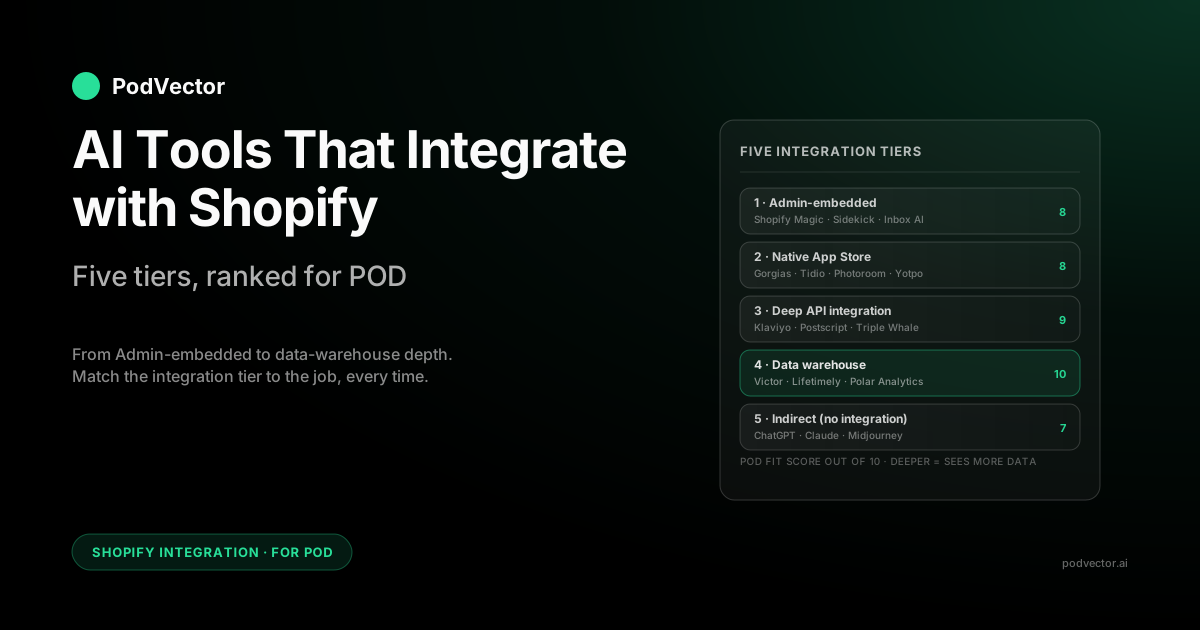
Quick Answer: AI tools that integrate with Shopify fall into five tiers ranked by how deep they reach into your data. Admin-embedded (Shopify Magic, Sidekick, Inbox AI — free, built into the platform). Native App Store apps (Gorgias, Tidio, Photoroom, OnModel — one-click OAuth install, reads Shopify data through official APIs). Deep API integrations (Klaviyo, Postscript, Triple Whale — subscribe to every event Shopify emits, sync in near-real-time). Data-warehouse integrations (Victor by PodVector AI — pulls Shopify and supplier data into a unified live warehouse). Indirect tools (ChatGPT, Copilot, Midjourney — no Shopify integration; you paste context in and paste output back).
For POD operators, the tier that matters most is Tier 4. Every tier below it hits the same ceiling: it can only see what Shopify shows it, which means it never sees your Printify or Printful supplier costs. Any tool computing margin without supplier costs is computing the wrong number. Pick by tier first — match the tier to the job — then choose the tool within that tier.
Why "Integration Depth" Is the Right Filter for POD
Most "AI tools that integrate with Shopify" lists treat integration as a binary — either the tool has a Shopify app or it doesn't — and then rank by features. That works fine for a stocked DTC store where Shopify is the single source of truth. It breaks for print-on-demand because Shopify isn't your single source of truth: your supplier (Printify, Printful, Gelato) holds the cost of goods, the production timing, and half the order detail.
So for a POD operator, "integrates with Shopify" is the wrong question. The right question is "what data does this tool actually see, and is that enough to do its job?" Generating product copy needs almost nothing. Predicting customer lifetime value needs every Shopify event. Telling you which design is genuinely profitable needs Shopify and supplier-side cost data — that's a tier most tools never reach.
The five tiers below are ordered by how deep the tool reaches into your Shopify data. The right tool for any given job is usually the lowest tier that still has enough data to answer the question. Buying a Tier 4 data-warehouse tool to write product descriptions is overkill; using a Tier 5 ChatGPT prompt to compute true profit is impossible. Match the tier to the job.
If you're newer to comparing AI tooling for POD on Shopify, start with the job-by-job AI tools for Shopify comparison for the comparison cut by what each tool does, then come back here for the integration-depth cut. The AI tools cluster indexes every comparison guide in this set and the AI analytics topic hub covers the broader analytics angle.
Also worth reading alongside this guide: best AI for ecommerce compared for the broader category view, and AI agents for Shopify — what it looks like for POD sellers for the agentic angle now emerging at every tier.
Summary: Five Integration Tiers, Ranked Picks
Each tier below has a top pick for POD operators on Shopify. The full reasoning is in the per-tier sections; this is the one-screen version.
| Tier | Top pick | What it sees | POD fit | Starting price |
|---|---|---|---|---|
| 1. Admin-embedded | Shopify Magic + Sidekick | Everything in Admin | 8 | Free with Shopify |
| 2. Native app | Gorgias AI | Orders, customers, tickets | 8 | From $10/mo + AI fees |
| 3. Deep API | Klaviyo AI | Every event, every product | 9 | Free to ~250 contacts |
| 4. All your data in one place | Victor by PodVector AI | Shopify + Printify/Printful + Meta/Google Ads | 10 | Free trial |
| 5. Indirect | ChatGPT / Copilot | Whatever you paste in | 7 | Free / paid plans |
POD fit is scored 1–10 based on how well the tool's data depth matches its job for a Printify or Printful seller — not on raw feature count. A perfect-for-DTC tool can score lower on POD fit if its job needs supplier-cost data it can't see.
Tier 1: Admin-Embedded — AI Inside Shopify Itself
Tier 1 is the AI Shopify ships natively in the Admin. It's not a third-party integration — it is the integration, because it lives at the same level as the rest of the Shopify app. No data leaves Shopify, no auth handshake, no app to install.
Shopify Magic — generation everywhere
Shopify Magic is the suite of AI generation features baked into Shopify Admin: product description writing, FAQ generation, email subject lines, image background editing, store policy drafting, blog post outlines, and SEO meta description suggestions. Every one is one click away from where you'd already be working. For a POD operator listing many SKUs a week, Magic alone removes the most repetitive copy-writing work at no added cost.
The integration is, by definition, total — Magic sees every product attribute, every variant, every image you upload. The limit isn't access; it's that Magic's models are tuned for general-purpose retail and don't optimize for POD-specific concerns like supplier-side print constraints or niche-specific brand voice. For under-fifty-SKUs-a-week throughput, that's fine. Past that, you start wanting voice memory.
Shopify Sidekick — conversational Admin assistant
Shopify Sidekick is the conversational AI that sits in the corner of Shopify Admin and answers operational questions — "how do I set up a free shipping promotion above $50," "show me my best-selling product this month," "draft an abandoned cart email." According to Shopify's own documentation on business data integration, tools like Sidekick can generate insights from integrated data and offer suggestions based on real-time information. Increasingly, it takes admin actions on your behalf instead of just explaining them. It's free with every Shopify plan and it's the closest thing Shopify has to an in-platform AI agent today.
For POD operators, Sidekick handles the long tail of "how do I do X in Shopify" questions instantly, which is genuinely useful if you're the founder doing every operational task in tabs. Where it falls short is anything requiring data that lives outside Shopify — it can't answer "what's my real profit after Printify costs," because Sidekick doesn't see Printify. The deeper breakdown is in the POD seller's guide to Shopify Sidekick AI.
Shopify Inbox AI — the chat baseline
Shopify Inbox is the on-site chat widget Shopify ships, and the AI suggestions inside it draft replies based on your products, orders, and policies. It's not autonomous — a human still hits send — but for a one-founder support setup, it cuts response latency meaningfully. Free, and worth turning on as the floor before you pay for anything heavier in Tier 2.
What to pick
Turn on all three by default. Magic for generation, Sidekick for operational questions, Inbox AI for chat suggestions. Total cost: zero. They cover the AI surface area Shopify itself can address with the data already in Admin.
Tier 2: Native App Store Apps — One-Click Install
Tier 2 is third-party AI tools that publish in the Shopify App Store and install via OAuth in one click. Once installed, they read Shopify data through Shopify's official APIs and write back through them. No custom integration work — but also no access to data outside what Shopify itself stores.
When you connect a third-party AI tool through the App Store, you review and authorize the data access level the tool requests before it can act on your store. That authorization step matters — it defines exactly what events the tool can read and what actions it can take on your behalf. A current criterion from leading Shopify AI roundups: the tool should sync effortlessly with Shopify's ecosystem, pull real-time data from your store, and work natively with Shopify features and workflows.
Gorgias AI — support that reads order data
Gorgias is the most-installed AI helpdesk in the Shopify App Store. The AI Agent feature handles the bulk of common customer questions autonomously, reading your help center, your past replies, and your live Shopify order data to answer "where's my order," "what's your return policy," and "can you change the shipping address."
The POD-specific advantage is that Gorgias pulls live tracking numbers from Printify and Printful into ticket replies without you wiring anything custom — that's the standout feature, since "where's my order" is the majority of POD support volume and the tracking number lives on the supplier side. The full chatbot ranking is in the best AI chatbot for Shopify comparison.
Tidio AI (Lyro) — the volume-capped alternative
Tidio Lyro is the lower-cost Tier 2 chat AI for stores doing lower ticket volumes per week. The integration is the same Shopify App Store install pattern; the data depth is lower than Gorgias on POD-specific needs (no automatic supplier tracking pull), but the flat monthly price beats Gorgias's per-resolution model at lower volumes. For the full head-to-head on conversational tools, see the best AI chat tools for ecommerce comparison.
Photoroom — imagery that pushes back to Shopify
Photoroom handles AI imagery — background removal, scene generation, batch lifestyle mockups — and the Shopify app pushes finished images directly back to product pages. For POD specifically, the workflow is: Printify or Printful gives you a clean t-shirt mockup, Photoroom adds the lifestyle layer (model in a coffee shop, etc.), and pushes the result to Shopify. One install, no manual file movement.
Yotpo AI — reviews and loyalty
Yotpo's AI features handle review summarization (turning hundreds of reviews into one synthesized highlight), sentiment-based response drafting, and loyalty-program recommendations. The Shopify App Store install reads orders and customers; the AI layer adds the synthesis. For POD stores building social proof on niche-specific designs, the review summarization is the highest-ROI piece — most POD shoppers read reviews on the design, not the t-shirt blank.
Octane AI and Rebuy — conversion and upsell at App Store depth
The category that's grown fastest in the "AI tools for Shopify" SERP is on-site conversion AI — quizzes, AI-recommended bundles, and upsell offers. Octane AI builds AI-personalized product-recommendation quizzes that route a shopper to the right design or product; its Smart Quiz Builder can create an entire quiz, including questions, logic, and results, from a single prompt. Rebuy reads recent purchase behavior to generate cross-sell and bundle offers in cart and post-purchase. Both install from the App Store and read Shopify order and product data through standard scopes.
For POD, the quiz angle works well when your catalog spans many niches — a quiz that asks two questions and surfaces the matching design beats a flat collection page. The bundle angle is weaker than for stocked retail: AI bundle engines optimize for revenue, not margin, so they'll happily bundle two designs whose combined supplier cost wrecks the blended margin. The bundle suggestion is only as good as the cost data behind it, and these tools don't see Printify or Printful costs — pair them with the Tier 4 margin truth below before you let an AI auto-discount a bundle. For more on improving order value, see increasing AOV with AI.
OnModel — model photography at App Store depth
OnModel is an AI app in the Shopify App Store that generates realistic model photos without physical photoshoots — you can change models' age, ethnicity, gender, and styling to better reflect your audience. For POD apparel sellers, this closes a real gap: Printify and Printful provide blank-mockup images, and OnModel adds the representation layer that converts browsers into buyers. It installs in one click and stays entirely within the Shopify/App Store ecosystem.
Wiser — AI product recommendations
Wiser is an AI-powered recommendations engine in the Shopify App Store that surfaces personalized product suggestions across the store — product pages, cart, and post-purchase. It's a lighter alternative to Rebuy for stores that want recommendation widgets without the broader personalization overhead. Like every Tier 2 tool, it reads Shopify order and product data through the standard API scopes but has no visibility into supplier costs.
What to pick
Default Tier 2 stack for a POD store: Gorgias AI for support, Photoroom for imagery, Yotpo for reviews. All three install in under five minutes, all three start working with no configuration past auth, and none of them require data that Shopify doesn't already have. Add OnModel if your catalog is apparel-heavy and you want diverse lifestyle imagery without a photoshoot budget.
Tier 3: Deep API Integrations — Reading Every Event
Tier 3 tools see everything that happens in your store — every order, every cart, every product view, every customer change — as it happens. They still only see Shopify data, not your supplier costs, but they see far more than a Tier 2 app and they update in close to real time.
Klaviyo AI — the depth winner for email and SMS
Klaviyo is the default email/SMS AI for Shopify, and the integration depth is the reason. Klaviyo syncs Shopify data and builds a customer profile that includes every product viewed, every cart abandoned, every order placed, every email opened, and every SMS clicked. The AI features — predictive lifetime value, smart-send timing, brand-voice subject lines, AI-generated copy, predictive segments, churn prediction — all run against that full profile.
For POD: Klaviyo's AI works without modification because it's optimizing for revenue and engagement, both of which Shopify already knows. The one POD-specific tweak: clone flows per supplier-shipping-zone if you fulfill from multiple suppliers to different geographies, because predictive send-time optimization improves when underlying delivery variance is consistent. A browse abandonment flow is one of the highest-returning automations you can build — the setup walkthrough is in the Klaviyo browse abandonment flow setup guide. The fuller cut on Klaviyo versus other platforms is in the AI platform for ecommerce comparison.
Postscript AI — SMS-first depth
Postscript is the SMS-equivalent Tier 3 integration. It reads the same Shopify event stream as Klaviyo and adds two-way conversational AI — a customer texts back asking about sizing, Postscript answers from product data. POD audiences in apparel-heavy niches tend to overperform on SMS; if SMS is a meaningful revenue channel for you, Postscript pays back fast.
Triple Whale — attribution at API depth
Triple Whale is a strong Tier 3 attribution and analytics tool. It reads Shopify, Meta, Google, TikTok, and Klaviyo events and synthesizes them into a single attribution dashboard with AI-recommended creative scaling. For DTC stores, Triple Whale is a common analytics pick — the broader category cut is in AI search analytics platforms for ecommerce teams for POD sellers.
For POD, Triple Whale has a structural blind spot — it doesn't see your Printify or Printful supplier costs, so its margin numbers are wrong by exactly the size of your supplier invoice. Run Triple Whale alongside a Tier 4 tool (next section) for attribution; don't run it alone for POD profit decisions. Background on the same gap from the analytics side is in AI analytics platforms for Shopify for POD sellers.
What to pick
Default Tier 3 stack: Klaviyo AI for email/SMS, Triple Whale for attribution. Add Postscript only if SMS is already meaningful. Tier 3 is where the integration depth starts mattering more than the feature list — pick by event-stream coverage, not by surface features.
Tier 4: Data-Warehouse Integrations — Shopify Plus Suppliers
Tier 4 is the level that matters most for POD and the level most Shopify AI tools never reach. A Tier 4 tool pulls in your Shopify data plus data from systems Shopify can't see — your supplier, your ad accounts down to the smallest detail, your fulfillment events — and keeps it all together in one place, then runs AI on the whole picture.
Why Tier 4 exists
Every Tier 1, 2, and 3 tool above has the same data ceiling: it can only see what Shopify shows it. For a POD store, that's not enough to answer the most important questions. Real margin needs supplier cost. Winner detection needs profit-per-design after supplier cost. None of those answers exist in the Shopify event stream alone.
Tier 4 tools solve this by keeping all your data together in one place. They pull in your Shopify data and your supplier data (and anywhere else they can reach), combine it, and use it to power AI features that finally see the whole picture.
Victor by PodVector AI — built for Shopify + Printify/Printful
Victor is the AI employee built specifically for the Tier 4 gap on POD. Victor reads live data from your Shopify store, your Printify or Printful account, your Meta Ads, and your Google Ads, and keeps it all together in one place. On top of that, Victor proposes and carries out actions in your store — repricing products to a target margin, bulk repricing across your store, creating discounts (BOGO, free-shipping threshold, customer-specific codes), organizing products into collections, scheduling Klaviyo email campaigns, and undoing price changes — and nothing runs until you approve it.
Because supplier costs are itemized per fulfillment, Victor works with real numbers, not Shopify-only guesses. He reads your Meta Ads and Google Ads accounts to see where your ad spend is going compared to your margin, and he can also pause or turn back on campaigns, and adjust budgets and bids on those platforms, once you approve the change. For broader context on how this connects to profit benchmarking, see net profit margin benchmarks for POD and average checkout completion rate benchmarks.
You can ask Victor anything — "what was my actual profit last month after supplier costs and ad spend?" — but each recommended action requires your approval before it runs. Operator context lives in agentic AI for ecommerce for POD sellers. For the automation angle on the Shopify store side specifically, see Shopify Admin API store modifications and automation for POD.
Lifetimely — DTC LTV at warehouse depth
Lifetimely (acquired by Triple Whale) does customer lifetime value at warehouse depth — predictive LTV, cohort analysis, repeat-purchase modeling. The integration is Shopify-native plus subscription and ad-platform data. It doesn't reach to Printify or Printful by default, so for POD, the LTV numbers are useful but the margin numbers behind them carry the same Tier 3 blind spot. Use Lifetimely for the cohort and retention angle, layer Victor on top for the cost-side truth.
Polar Analytics — DW with custom integrations
Polar Analytics is a Tier 4 BI tool that builds a Shopify-centered warehouse with optional custom integrations into other systems. With engineering effort, you can bridge it to Printify or Printful — but it's not out of the box, and the implementation cost is real. For POD operators who need a fully custom analytics layer and have engineering bandwidth, it's a viable build. For most operators, a purpose-built tool like Victor is faster to value.
What to pick
POD-first stack: Victor for the supplier-side truth. Add Lifetimely or Polar only when you have a specific question they answer that Victor doesn't — most operators don't, because the missing data is supplier-side and that's exactly what Victor adds. The tighter cut on profit-tracking apps for POD is in the POD profit-tracking apps comparison. For the supplier-comparison angle, see Printify vs. Printful vs. Gelato — which is best for POD sellers.
Tier 5: Indirect — Powerful Tools Without an Integration
Tier 5 isn't really a "tool that integrates with Shopify" at all. It's the AI you use alongside Shopify — copy-pasting context in and copy-pasting outputs back. The integration is your clipboard. That's actually fine for a lot of jobs, and pretending these tools have a Shopify integration when they don't would be the wrong frame.
ChatGPT and general AI assistants — the all-purpose backstops
ChatGPT and Microsoft Copilot Pro cover the long tail of one-off content jobs that don't fit any specialized tool: ad copy, email subject brainstorms, niche research summaries, niche-keyword expansion, customer-survey synthesis, anything prompt-engineerable. The integration with Shopify is none — you paste the context in, get the output, paste it where it goes. That sounds primitive and it is, but it's also the most flexible AI tool in the stack and the cheapest specialized work you can do per dollar.
For POD specifically, the most useful workflow is feeding a prompt template loaded with your brand voice plus product attributes and asking for a batch of listing variations at once. The deeper workflow walkthrough is in the POD seller's guide to ChatGPT for Shopify.
Midjourney — creative ideation
Midjourney generates visually striking imagery for ads and creative ideation. It doesn't integrate with Shopify in any sense — output is a downloaded file that you upload to Shopify or to your ad platform. For POD ad creative, it's a widely-used AI image tool for good reason: the imagery converts in social ads in a way that Photoroom-style lifestyle mockups sometimes don't.
Adobe Firefly — brand-trained imagery
Adobe Firefly generates brand-trained images you can use in product pages or ads. The integration with Shopify is essentially manual export, but Firefly's commercial-safe training data is meaningful for POD — POD imagery often runs in paid social where unclear AI image rights are a real liability.
Jasper — copywriting at scale
Jasper sits between Tier 5 and Tier 2. It has a Shopify app and a browser extension that pulls in product context, but the integration depth is shallow — it's faster than copy-pasting into ChatGPT, but it doesn't read your event stream the way Klaviyo does. For high-volume POD listing creation with a distinct brand voice, Jasper's voice-memory is genuinely worth the upgrade past ChatGPT-direct.
What to pick
Default: ChatGPT + Midjourney. Combined cost is low, covers the long tail of generative work that doesn't need integration depth. Add Jasper if you're doing more than fifty listings a week and want voice consistency without re-prompting each time.
New in 2026: Shopify's Agent and Commerce Layer
The SERP for Shopify AI tools has shifted noticeably in 2026. According to Polar Analytics' 2026 overview of Shopify AI, the platform now spans three distinct layers: "native generative tools (Magic for copy and images, Sidekick for admin actions), a new agent and commerce layer (AI Toolkit, Storefront MCP, agentic checkout, plus AI Overviews sending traffic), and the third-party app ecosystem." Beyond Magic and Sidekick (Tier 1), the new agent and commerce layer is what every POD operator should understand, even if most of it is developer-facing today.
Shopify AI Toolkit — for developers wiring AI coding assistants
The Shopify AI Toolkit is a developer-facing integration that connects AI coding assistants — Claude Code, Cursor, Gemini CLI, and others — directly to Shopify's documentation, API schemas, and a local CLI-backed execution environment. For a non-technical POD operator, this is background infrastructure; for operators with a developer on staff, it dramatically speeds up building custom integrations against the Shopify Admin API. Relevant context: Shopify Admin API store modifications and automation.
Storefront MCP and Catalog MCP — AI agent commerce
Shopify has published a Storefront MCP (Model Context Protocol) and Catalog MCP that let external AI agents — including consumer agents like ChatGPT — discover products, retrieve details, and complete checkouts directly through a Shopify storefront without a human clicking through the store. For POD operators, the implication is that your product catalog can become discoverable and purchasable inside AI-native shopping surfaces. This is still early, but it's the reason "AI Overviews sending traffic" has appeared as a new attribution source in Shopify analytics for some stores in 2026.
Universal Commerce Protocol (UCP)
Shopify is a participant in the Universal Commerce Protocol, a published spec that aims to let an agent built by any AI vendor complete a checkout on Shopify, BigCommerce, or a custom platform without writing a new integration for each. For POD operators, this is the longer-term reason to keep your product data, pricing, and variant structure clean inside Shopify — it's increasingly the feed that agent-driven commerce reads.
What this means for the five-tier framework
The five tiers still hold. The new layer sits between Tier 1 and Tier 2 — it's Shopify-native infrastructure (like Tier 1) but it's designed to be consumed by external agents (like Tier 2 and above). For POD operators, the practical action today is: keep Tier 1 tools on, stay current on Storefront MCP adoption in your analytics, and revisit this layer in six months as the consumer agent surfaces mature.
What to Look for When Evaluating a Shopify AI Integration
Current top-ranking roundups on this topic converge on a consistent set of evaluation criteria. Before paying for any Shopify AI tool, check these four things:
Real-time data sync. Does the tool pull live data from your store, or does it work off a daily batch export? For anything time-sensitive — support, attribution, repricing — batch data is stale data. Tier 3 and Tier 4 tools connect directly to your store's live feed and update in close to real time; many Tier 2 apps do not.
Actual data scopes. During install, Shopify shows you exactly which data scopes the app requests. A thin AI wrapper asks for very few scopes because it reads very little. A real Tier 2 or Tier 3 integration asks for orders, customers, products, events, and sometimes financial summaries. Check what the app requests before you authorize — it tells you what the tool actually sees.
Shopify Plus workflow and POS compatibility. If you run a hybrid store — online plus any in-person component — confirm the AI tool works natively with Shopify Plus workflows and Shopify POS. Many AI apps are optimized for online-only and have no concept of in-store transactions. This matters less for pure POD sellers, but it's worth confirming before you're locked in.
Supplier-data coverage for margin questions. No Tier 1, 2, or 3 tool sees your Printify or Printful supplier costs. If the tool is being sold to you as a profit or margin analytics tool and it only has a Shopify App Store install — it cannot compute real POD margin. The only tools that can are in Tier 4. For context on what real margin looks like, see net profit margin benchmarks and CRO techniques for POD stores.
Three Integration Mistakes POD Operators Make
The "AI tools that integrate with Shopify" search query attracts a lot of generic SaaS-buying advice. Three mistakes specifically hurt POD operators:
Mistake 1: Choosing a deep integration tier when the job doesn't need it. Buying Klaviyo for a 50-customer store is overkill — Shopify Inbox AI plus a free Klaviyo tier covers everything you need at zero monthly cost. Tier 3 tools are priced for stores that have the data volume to justify them. Match the tier to the volume.
Mistake 2: Choosing a shallow integration tier when the job needs supplier data. The opposite mistake, and the more expensive one. Picking a Tier 3 analytics tool to track POD profit guarantees wrong margin numbers, which guarantees wrong scaling decisions. The fix is moving the analytics piece up to Tier 4 — every other tier of the stack can stay where it is. For more on the dropshipping and supplier data angle, see can I dropship from Etsy to Shopify.
Mistake 3: Treating "has a Shopify App Store listing" as a quality signal. The App Store has thousands of AI apps, most of which are thin AI wrappers that cost more than basic AI tools used directly. The presence of a one-click install doesn't mean the integration is deep — many App Store apps in the AI category read very little Shopify data and add little over a generic AI prompt. Check what events the app subscribes to before paying. A real integration is explicit about the events it reads because that's where its value comes from.
The Ringly best AI tools for Shopify roundup covers Tiers 1, 2, and parts of 3 well, and lands all three of these mistakes from a POD operator's perspective. Useful as a category overview; not a buying guide if you're fulfilling through Printify or Printful.
Building a Cross-Tier Stack for POD
The right stack pulls one or two tools from each tier rather than over-investing in any single tier. Three concrete builds by store stage:
Starter (under $10K/mo): minimal monthly cost
- Tier 1: Shopify Magic + Sidekick + Inbox AI (free)
- Tier 2: Photoroom free tier
- Tier 3: Klaviyo free tier (under ~250 contacts)
- Tier 4: Victor free trial
- Tier 5: ChatGPT free or paid plan
This stack reaches every tier at near-zero cost. Don't skip Tier 4 just because you're early — getting the supplier-cost layer in place from day one prevents the "scaled the wrong product" mistake that hits most POD operators in the early growth phase. For a wider starter shortlist, the best AI ecommerce tools for a small business comparison covers the budget end in more depth. Also relevant: is print-on-demand drop shipping for context on how the supplier-cost layer differs from traditional dropshipping.
Growth ($10K–$50K/mo)
- Tier 1: Magic + Sidekick + Inbox AI (free)
- Tier 2: Tidio Lyro for support, Photoroom paid
- Tier 3: Klaviyo paid (volume-priced at this stage)
- Tier 4: Victor paid tier
- Tier 5: ChatGPT + Jasper + Midjourney
This is where most POD operators settle in around the $20K/mo mark. The Tier 4 tool stops being optional here — bad scaling decisions cost more than the analytics tool. This is also where ad spend starts mattering enough to warrant reading the Google Ads vs. Facebook Ads cost comparison for 2026 and the Google Ads vs. Facebook Ads features comparison for POD sellers.
Scale ($50K+/mo)
- Tier 1: Magic + Sidekick + Inbox AI (free)
- Tier 2: Gorgias AI for support, Yotpo for reviews, OnModel for imagery
- Tier 3: Klaviyo + Postscript + Triple Whale for attribution
- Tier 4: Victor + (optionally) Lifetimely
- Tier 5: Jasper + Midjourney + Firefly
At this scale the constraint is decision speed, not tool cost. A redundant tool that gives you 10% more confidence on a scaling decision is worth its monthly fee many times over. The ad-platform side warrants dedicated strategy guides: Google Ads vs. Facebook Ads cost comparison 2026 and the CRO techniques guide for store-side conversion improvements that compound with ad scale.
FAQs
What does it mean for an AI tool to "integrate with Shopify"?
Five different things, depending on the tier. Tier 1 means embedded in Shopify Admin (Magic, Sidekick). Tier 2 means installable from the Shopify App Store with one-click setup (Gorgias, Photoroom). Tier 3 means a deep connection that sees your store's full stream of activity (Klaviyo, Triple Whale). Tier 4 means the tool keeps your Shopify data together with data from other systems, all in one place (Victor, Lifetimely). Tier 5 means no integration — you use the tool alongside Shopify (ChatGPT, Midjourney). Most "integrates with Shopify" claims mean Tier 2; the deepest integrations are at Tiers 3 and 4.
Which tier do I need for POD profit tracking?
Tier 4. Every tier below that — including the deepest Tier 3 tools — only sees Shopify-side data, which means it can't see your Printify or Printful supplier costs, which means the margin numbers it computes are wrong. Victor is the Tier 4 tool built for exactly this gap; he brings Shopify and supplier data together in one place and works out your profit using the real numbers. The deeper background is in AI-powered ecommerce analytics for POD sellers. For benchmark context on what healthy margins look like, see net profit margin benchmarks.
Are Shopify App Store AI apps better than non-app AI tools?
Not automatically. The App Store install pattern is convenient but it's not a quality signal — many App Store AI apps are shallow AI wrappers that don't subscribe to deep Shopify event streams and don't add much over using a general AI tool directly. Check the app's actual data scopes (what events it reads, what it writes back) before paying. A non-App-Store Tier 3 tool like Klaviyo with deep API access will outperform a Tier 2 thin wrapper for any job that needs real event data.
Can I run a POD store on free AI tools alone?
Mostly yes. Shopify Magic + Sidekick + Inbox AI (Tier 1, free), Klaviyo free tier (Tier 3, free under roughly 250 contacts), and Victor free trial (Tier 4) cover the most important AI jobs at near-zero recurring cost. Add ChatGPT free tier for the long tail. This stack covers listing copy, chat support, email automation, and supplier-aware profit visibility — enough to run a store profitably until you have a specific paid bottleneck to solve.
Does Shopify Sidekick replace third-party AI tools?
For Shopify-Admin operational questions, mostly yes. For anything requiring data outside Shopify — supplier costs, ad attribution beyond what Shopify sees, deep customer LTV modeling — no, because Sidekick is bound to Shopify's own data. The right setup is Sidekick for in-Admin work plus higher-tier tools for jobs that need data Shopify doesn't have. Coverage of where Sidekick wins and loses is in the POD seller's guide to Shopify Sidekick AI.
How do I tell if an AI Shopify app is a thin AI wrapper?
Three signals: (1) it asks for very few Shopify data scopes during install — a thin wrapper doesn't need much; (2) the pricing exceeds what a general-purpose AI tool costs for a feature that AI can do natively; (3) the app's marketing leans on "AI-powered" without naming what specific Shopify events it subscribes to. Real Tier 2 and Tier 3 integrations are explicit about the events they read because that's where their value comes from.
Which AI tools see Printify and Printful data inside Shopify?
Tier 4 tools that explicitly support POD suppliers. Native dual-source integrations are still rare — most analytics tools assume Shopify is the single source of truth. Victor brings your Shopify and supplier-side cost and order data together in one place; Gorgias pulls live supplier tracking numbers into ticket replies (a narrower but useful slice); Photoroom can push back to Shopify product images that originated as Printify mockups. For everything else you're either using the AI tool on the Shopify side and accepting the supplier-cost gap, or doing manual data work to bridge it. For comparison context on the suppliers themselves, see Printify vs. Printful vs. Gelato compared.
What is Shopify's new agent and commerce layer, and does it affect POD sellers?
In 2026, Shopify shipped a developer-facing agent layer on top of the native Admin AI: the Shopify AI Toolkit (for connecting AI coding assistants to Shopify's APIs), Storefront MCP and Catalog MCP (for letting external AI agents discover and purchase from your storefront), and participation in the Universal Commerce Protocol (for cross-platform agent checkout). For most POD operators today, these are background infrastructure — the practical implication is that your Shopify product data is increasingly the feed that AI-native shopping surfaces read, so keeping it clean and complete matters more than ever. The agentic angle is covered in depth at AI agents for Shopify — what it looks like for POD sellers.
How does ad platform data connect to my Shopify AI tools?
Tier 3 tools like Triple Whale read Meta Ads and Google Ads data alongside Shopify events, giving you a combined attribution view. Tier 4 tools like Victor read Meta Ads and Google Ads at line-item depth and pair that spend data with supplier-side costs — so you can see not just which ad drove a sale, but whether the sale was actually profitable after supplier costs. For the channel-comparison angle, see the Google Ads vs. Facebook Ads cost comparison for 2026 and average checkout completion rate benchmarks for context on where Shopify-side conversion data fits in.
Get an AI employee that integrates with both Shopify and your supplier
Most AI tools that integrate with Shopify stop at the Shopify line and never see your supplier costs. Victor by PodVector AI reads live data from your Shopify store, your Printify or Printful account, your Meta Ads, and your Google Ads, and keeps it all together in one place — then proposes and carries out actions in your store (repricing, discounts, collections, Klaviyo campaign scheduling, and more) with each change waiting on your approval before it runs. No credit card required.
Try Victor free