
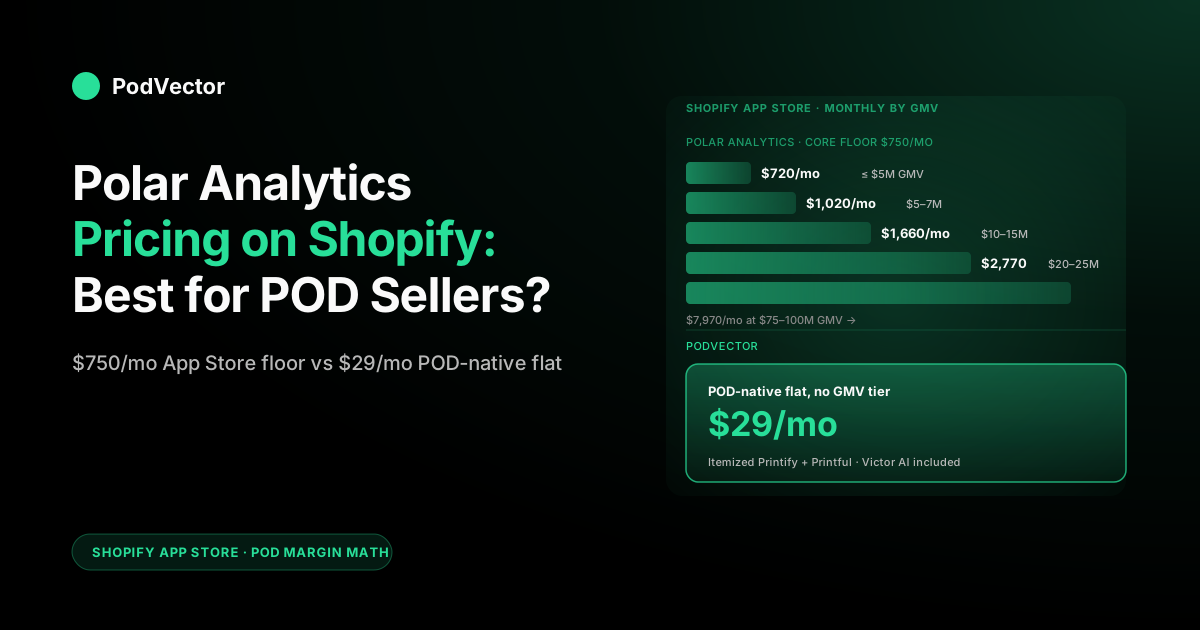
Quick Answer: On the Shopify App Store, Polar Analytics runs a GMV-based pricing model. The Core plan starts at $750/month, billed every 30 days through Shopify in USD — a figure confirmed by MerchantFlow (verified June 2026), Bloom Analytics, and TestFeed as of mid-2026. According to Arlo's comparison page, GMV brackets step up materially: $1,020/month at $5M–$7.5M GMV, $1,380/month at $7.5M–$10M GMV, and $1,660/month at $10M–$15M GMV, with the largest published tier exceeding $17,000/month above $300M GMV.
For Shopify stores running Printify or Printful, that math gets uncomfortable fast. Polar's pricing tier is keyed off Shopify GMV, but POD operating margin is a fraction of GMV — so a POD store crosses Polar's pricing thresholds long before it has the operating profit to absorb them.
If you want a Shopify-native tool sized for POD economics, PodVector AI starts at $29/month with itemized Printify and Printful supplier costs built in. Below is the full Shopify pricing breakdown, two real Shopify cost scenarios, and how to decide.
What the Shopify App Store shows for Polar Analytics
Open the Polar Analytics listing on the Shopify App Store and the pricing card is short. Per MerchantFlow, which verified the listing in June 2026, the Core plan started at $750/month — billed in USD every 30 days through Shopify. Bloom Analytics and TestFeed both independently confirm the same $750/month Core plan floor as of mid-2026.
Note: some third-party review sites (including G2) still show entry-level Polar plans at $300–$450/month. Per MerchantFlow, Polar's pricing page no longer publishes flat prices — it quotes only after you select your annual GMV. G2's data reflects an older plan structure (Monthly Tracked Orders-based billing) that Polar has since retired. If a comparison table you're reading shows Polar at $300, confirm the date and which plan it references before drawing conclusions.
| Plan (Shopify App Store) | Starting price | What's included |
|---|---|---|
| Core | $750/month (per MerchantFlow, June 2026) | Business Intelligence, Klaviyo Audiences, Advertising Signals, Polar MCP, unlimited users, unlimited historical data, unlimited connectors |
| Custom / à la carte | From $510/month (BI-only, per Arlo) | Individual modules — Business Intelligence, Klaviyo Audiences, Advertising Signals, Polar Headless MCP, Incrementality Testing — priced separately off the same GMV bands |
That $750/month figure is the floor, not your eventual rate. Per MerchantFlow, pricing is based on online GMV with discounts available for annual terms. As of mid-2026 the listing routes you into demo store access and a guided onboarding rather than a no-card self-serve trial — the paid Core plan is still where billing begins for a live store.
One thing worth flagging if you're comparing sources: several third-party blogs still cite a free Starter plan plus lower-cost Growth and Scale tiers for Polar. Those numbers reflect an older pricing structure. The live Shopify App Store listing and sources that verified it in 2026 consistently show the GMV-based Core plan starting at $750/month.
How Polar billing works through Shopify
This is the part most operators don't think about until the first invoice hits.
Recurring Shopify-billed charges
Your base subscription runs through Shopify's recurring app charge system. Charges are billed in USD every 30 days and appear on your Shopify invoice alongside your other app subscriptions.
The 30-day cycle matters because Shopify's billing window is calendar-based on your store's billing date, not the date you installed Polar. If you install mid-cycle, your first charge is prorated, and renewals fall on your store's next billing day.
External Polar charges
Some line items don't go through Shopify at all. Polar invoices certain charges directly — for example, per-test fees on incrementality testing and some custom modules. The App Store listing flags this with a note that "external charges may be billed by the app provider separately from your Shopify invoice."
For finance and bookkeeping, that means Polar costs typically split across two places: your Shopify monthly statement (the recurring base) and direct Polar invoices (the usage and module add-ons). Worth knowing if you're reconciling SaaS spend across multiple Shopify stores.
Annual contracts and the discount
Per MerchantFlow, Polar offers discounts only on annual terms. Once you're past the entry tier, Polar's standard contract structure typically shifts to annual prepay — which means the Shopify-billed portion may shrink and the externally invoiced portion grows as you move to a direct relationship with Polar's sales team.
Polar's GMV-tiered pricing in full
The $750/month App Store starting price is the floor. The actual rate scales with annual GMV. According to Arlo's 2026 comparison, which publishes the most granular GMV bracket data available from third-party sources, the tiers step up as follows:
| Annual Shopify GMV bracket | Approximate monthly cost | Source |
|---|---|---|
| Under $5M GMV (entry floor) | $720–$750/month | Arlo / MerchantFlow, June 2026 |
| $5M–$7.5M GMV | ~$1,020/month | Arlo |
| $7.5M–$10M GMV | ~$1,380/month | Arlo |
| $10M–$15M GMV | ~$1,660/month | Arlo |
| $300M+ GMV (largest published) | $17,000+/month | Arlo |
| $20M+ GMV (estimated Enterprise threshold) | Custom quote | TestFeed |
Above the Enterprise threshold, you're on a fully bespoke plan negotiated directly with Polar's sales team. Below the entry tier — sub-$1M GMV brands — Polar still quotes you at the Core floor, which is why the pricing feels steep for smaller Shopify stores. As Bloom Analytics puts it, the $750/month entry point "is designed for established DTC brands with meaningful GMV and a data team or agency partner to make use of a full BI stack."
What every Shopify install includes
Every plan gets the same core platform. Differentiation kicks in via modules and GMV-driven price, but the base feature set is real.
- Dedicated managed data warehouse. Each Shopify store gets its own database, so you can query your data with SQL if you want. The dedicated-per-customer warehouse architecture is cited by multiple reviewers as a genuine differentiator versus competitors that co-mingle customer data.
- Unlimited Shopify users. No per-seat cost, no charge for adding agency partners or contractors.
- 45+ connectors. Per Arlo, 45+ native connectors ship across all tiers, covering Shopify, Klaviyo, Meta, Google, TikTok, Amazon, and more.
- Unlimited historical data. No retention cliff — you keep everything Shopify and your other sources have ever sent.
- Pre-built Shopify dashboards. Marketing, finance, retention, and product analytics templates wired up out of the box for Shopify-shaped data.
- Polar AI assistant and MCP endpoint. AI agents (Ask Polar plus role-based agents) and the MCP endpoint ship across all tiers, per Polar's own pricing page.
- Klaviyo Audiences, Advertising Signals. Per Bloom Analytics, the Core plan bundles Business Intelligence, Klaviyo Audiences, Advertising Signals, and Polar MCP — all included at the base tier.
- Dedicated success manager. Plus a private Slack channel and live chat support for setup and troubleshooting.
Which features unlock at higher Shopify spend
Polar's tiering is more about modules than seats. Here's what gets added as you climb the GMV ladder.
Polar Pixel and server-side attribution
Polar's first-party pixel — a server-side script that captures Shopify checkout events and ships them through Polar's attribution engine — is bundled into every plan, alongside the dedicated data warehouse and ecommerce semantic layer. What scales with spend is the depth around it: the full set of attribution models, Conversion API enhancement for Meta, and demographic enrichment surface through higher configurations rather than the base floor.
For Shopify stores running Meta and Google ads, attribution is the headline reason to be on Polar at all. As BlackBelt Commerce notes, Polar added incrementality testing capabilities that make it particularly valuable for brands where Meta's attribution has become unreliable.
Intraday refresh instead of daily
The base plan refreshes Shopify and ad data once a day. Higher tiers move you to multiple intraday refreshes, which matters if you make ad-spend decisions during the day rather than at the morning standup.
Incrementality testing
Incrementality testing — running holdout regions against treatment regions to measure true causal impact of channels — is an add-on module priced per-test and billed externally rather than through Shopify. Per TestFeed, Klaviyo Audiences, Advertising Signals, and Incrementality Testing are all sold as separate modules on top of the Core plan.
Klaviyo Audiences and Advertising Signals
While bundled in Core, expanded versions of these modules push Polar-derived audiences out to ad platforms or Klaviyo for activation. Polar can enrich Klaviyo customer profiles with purchase data, helping brands build smarter segments and trigger more targeted flows — so if Polar identifies high-value buyers in a specific segment, that audience can sync to a Meta lookalike or a Klaviyo flow automatically. For POD sellers looking at Klaviyo automation more broadly, see our guide to setting up a Klaviyo browse abandonment flow for POD.
Polar Headless MCP
The MCP module lets external agents query your Polar warehouse directly. It's available as part of the Core bundle and as a standalone add-on. According to Arlo, à la carte Business Intelligence alone (without the rest of the stack) runs from $510/month for brands under $5M GMV.
Buying modules à la carte
Polar's pricing page sells modules as standalone products — Business Intelligence, Klaviyo Audiences, Advertising Signals, Polar Headless MCP, and Incrementality Testing each carry their own GMV-based price. The Core plan bundles them and saves on individual product costs versus buying each separately.
For a POD operator the practical takeaway is unchanged: whichever way you assemble it, the entry point is still the $750/month Core floor (per MerchantFlow, June 2026), because the individual products are priced off the same GMV bands. The à la carte option mainly helps brands that want one specific capability without the full stack.
Multi-store Shopify pricing
If you run multiple Shopify stores — a common pattern for POD operators with separate niche stores — Polar's pricing logic deserves a closer look.
Multi-store reporting is a real feature: Polar can combine data across storefronts, countries, or brands in a single view. The trade-off is that pricing aggregates GMV across stores, so two stores are priced as one combined brand at their total GMV.
For most multi-brand operators that's fair. For POD operators running a portfolio of small niche stores — say, several Shopify stores each below $1M — you're billed off the combined GMV but each individual store is below the practical threshold where Polar's features pay back meaningfully. The math still works out to roughly the Core floor, but you're paying it for a toolset built for data-team workflows, not lean POD operations.
Total Shopify cost example: a small POD store
Concrete math is more useful than tier tables. Take a typical small POD operator: one Shopify store running Printify, with modest annual GMV.
A representative P&L for a lean POD store might look like this:
- Shopify GMV: modest annual revenue (well under $1M)
- Printify supplier cost (base + shipping): the majority of revenue — apparel POD COGS run high relative to DTC
- Ad spend (Meta + Google): a significant portion of remaining gross profit
- Shopify subscription, apps, payment processing: fixed overhead
- Operating profit: thin — typically a small fraction of GMV for a store at this stage
A store like this falls below the GMV bands where Polar's attribution stack materially changes decisions. Per MerchantFlow, the Core plan starts at $750/month regardless of store size — there is no documented sub-$750 tier. Annualized, that's $9,000/year for the analytics tool alone before any modules or add-ons.
As Bloom Analytics notes plainly, this entry price "is not a small-store price." For a lean POD operation with thin operating margins, that level of fixed SaaS cost consumes a disproportionate share of profit. The same store on PodVector AI at the $29/month tier pays $348/year, with itemized Printify and Printful supplier costs already wired in — no custom data-engineering work required.
Total Shopify cost example: a mid-market brand
Now the case where Polar earns the price. A Shopify brand at meaningful scale across Meta, Google, Klaviyo, and a mix of Printify plus a traditional print partner.
At this scale the P&L looks different:
- Shopify GMV: substantial (multi-million dollars annually)
- COGS (mixed POD + traditional): a lower percentage of GMV than a pure-apparel POD store, leaving more gross profit
- Ad spend: significant across multiple channels
- Operating profit: enough to absorb a meaningful analytics investment
Per Arlo, a brand in the $5M–$7.5M GMV bracket pays about $1,020/month — roughly $12,240 annually before discounts or add-ons. At this scale, multi-touch attribution alone — better calibration of which channels actually drive incremental Shopify revenue — can pay for the platform several times over. As TestFeed puts it, Polar suits "multi-channel brands past roughly $5 million in GMV that have someone to own reporting." Polar starts making sense around the $3–5M Shopify GMV band, and the case strengthens above that.
Where Polar's pricing model misfits POD on Shopify
Three structural reasons the GMV tier doesn't fit POD economics, regardless of which Shopify pricing card you're looking at.
POD margin is thinner than typical Shopify DTC margin
A typical Shopify DTC brand runs meaningfully higher gross margins than a Printify or Printful POD store. Polar's pricing assumes the higher-margin DTC shape. The same dollar of GMV generates less operating profit in a POD store — and less ability to absorb a fixed analytics cost that's pegged to the revenue line, not the profit line.
Per Bloom Analytics, Polar's entry price "is designed for established DTC brands with meaningful GMV and a data team or agency partner" — a profile that describes almost no solo POD founder.
The first-party pixel premium pays back slowly in POD
Polar's pixel and attribution stack is the headline reason DTC brands pay the price. For POD on Shopify, the win is real but slower. POD's blended customer acquisition economics are typically dominated by product-level price-elasticity, not by precision attribution between Meta and other channels. Better attribution decisions matter more at high AOV than they do on lower-priced POD products where per-unit margins are thin. For a deeper look at the attribution gaps that exist regardless of which analytics platform you're on, see our guides on how to start Google Ads for your Shopify store and the complete guide to Google Ad types for POD sellers.
Custom Shopify warehouse work is on you
Polar gives you a managed data warehouse — but loading per-order Printify and Printful supplier costs into it (vs. flat or category-level COGS pulled through Shopify) is custom work. Polar reports ROAS, CAC, and LTV well, but brands looking to calculate contribution margin at the product level need to bring that data themselves. You either build that yourself in SQL, hire it out, or live with approximate margin numbers. For a POD seller, that's the margin number that matters most — see how Printful's cost structure compounds this in our Printful free-shipping cost breakdown.
Polar is reporting-first; POD operators need action-first
There's a fourth gap that's less about price and more about what you get for it. Per TestFeed, whether Polar is worth it comes down to "do you have someone who will open it every morning and act on what it says?" Polar surfaces the number; you go act on it somewhere else — reprice the listing in Shopify, adjust the campaign in Meta, reorder in Printify. For a lean POD operator, every handoff between "seeing the number" and "doing something about it" is unpaid labor the monthly subscription doesn't cover.
For a deeper look at how AI is changing that equation for POD sellers, see our best Shopify AI tools in 2026 checklist for POD sellers and our guide to AI inventory forecasting for POD on Shopify.
PodVector AI's Shopify pricing for comparison
PodVector AI is built around the POD-on-Shopify use case specifically. Pricing is flat-rate, not GMV-tiered.
| PodVector AI tier | Monthly price | Annualized |
|---|---|---|
| Starter | $29/month | $348/year |
| Growth | $79/month | $948/year |
| Scale | $129/month | $1,548/year |
Every tier includes itemized Printify and Printful supplier cost ingestion at the order line item level — not flat COGS — so margin numbers reflect actual per-product profit instead of an estimate. Shopify integration is direct via the Shopify API; Meta Ads and Google Ads connect through OAuth and are read into the same live data warehouse.
Victor, the AI employee included on every tier, is the core difference from Polar. Victor reads your live Shopify, Meta Ads, Google Ads, Printify, and Printful data, identifies the highest-profit next move, and proposes it as an approval card showing old and new values — then executes the approved action on your Shopify store. Ask Victor in plain English what a campaign actually netted after supplier costs and shipping, and the answer comes from your unified live data warehouse rather than a static dashboard. Victor can then act on it: repricing your worst-margin SKUs to a target margin, creating or updating discount codes, setting up a buy-one-get-one offer, raising your free-shipping threshold, organizing collections, bulk-updating Shopify prices, or scheduling a Klaviyo email campaign — with your approval before each move. That's the line between a reporting tool you read and an AI employee that does the work.
Victor reads Meta Ads and Google Ads for analysis and attribution context — but his write actions are Shopify-side only. He reads those ad platforms and proposes moves; he does not pause campaigns, change budgets, or adjust bids. For a full picture of what Victor does and how it compares to other POD tools, see the PodVector overview for POD sellers and our detailed Polar Analytics vs PodVector deep-dive comparison.
How to decide: a Shopify-stage recommendation
Stage-based, not feature-based. The right Shopify analytics stack is the one that fits your current operating profit and your current data complexity.
Early-stage POD store (low monthly Shopify GMV): PodVector AI Starter
At this stage you don't need multi-touch attribution; you need accurate margin per product. PodVector AI Starter at $29/month gives you that with itemized Printify or Printful supplier costs already wired up. Polar at its $750/month floor (per MerchantFlow, June 2026) would consume most of the operating profit a lean POD store generates. Per TestFeed, "for a smaller store, or a team that only needs profit or attribution answered," Polar is not the right call.
Growing POD store with ad spend across Meta and Google: PodVector AI Growth or Scale
You're scaling, you have ad spend across Meta and Google, you need an AI-driven view of where the money's actually going after supplier costs. PodVector AI Growth or Scale fits. Polar still doesn't, unless you have very specific multi-platform attribution problems that justify the cost. At this stage, understanding how ad numbers line up (or don't) with your Shopify data is critical — see our guides on getting started with Google Ads for Shopify and the complete guide to Google Ad types for POD sellers.
Multi-channel POD brand at meaningful scale: evaluate both
Honest answer. At this scale you have enough ad spend that Polar's attribution stack starts paying back, and you have enough operating profit to absorb the cost. But you also have enough Printify and Printful complexity that POD-native supplier cost ingestion still matters. Per Arlo, Polar is best suited to "data teams at $20M+ brands" running multi-channel paid acquisition. Worth modeling what each path actually unlocks for your specific numbers before committing.
Large-scale Shopify brand ($1M+/month GMV, multi-channel): Polar (with a POD layer)
At significant scale, Polar becomes the right tool. The pricing fits, the attribution stack is best-in-class for Shopify, and the dedicated success manager pays for itself. Per TestFeed, Polar is a great fit for "multi-channel brands past roughly $5 million in GMV that have someone to own reporting" and want one source of truth.
The thing you'll still want to bolt on is a POD-aware supplier cost layer. PodVector AI at the Scale tier complements Polar at this stage rather than replacing it — Polar for warehouse-depth attribution, Victor for POD-native cost visibility and Shopify execution. See our full Polar Analytics vs PodVector comparison for how that stack works in practice.
FAQs
How much does Polar Analytics cost on Shopify?
The Core plan starts at $750/month, billed every 30 days in USD through the Shopify App Store — confirmed by MerchantFlow (verified June 2026), Bloom Analytics, and TestFeed. Actual pricing scales with your annual Shopify GMV — per Arlo, brackets step to $1,020/month at $5M–$7.5M GMV, $1,380/month at $7.5M–$10M GMV, and $1,660/month at $10M–$15M GMV, with the highest published tier exceeding $17,000/month above $300M GMV. Brands past an estimated $20M GMV move to custom Enterprise pricing per TestFeed.
Does Polar Analytics offer a free trial on Shopify?
The Shopify App Store listing routes you into demo store access and a guided onboarding flow rather than a no-card self-serve trial. Per Arlo, "Polar's sales motion is demo-led: you book a demo or explore their public demo app with sample data." For a live store, billing begins at the Core plan floor.
Is Polar Analytics worth the Shopify App Store price for POD sellers?
For POD stores under $1M annual Shopify GMV, the math is hard to justify — the $750/month floor (per MerchantFlow, June 2026) consumes too much operating profit relative to the decisions it informs, and as Bloom Analytics notes plainly, it "is not a small-store price." For Shopify POD stores at meaningful scale with active multi-channel ad spend, the attribution and multi-store features start paying back.
How is Polar Analytics billed on Shopify — through Shopify or directly?
The base subscription is billed through Shopify's recurring app charge system, every 30 days in USD. Some line items — incrementality test fees, certain custom modules — are invoiced directly by Polar separately from your Shopify bill, per the App Store listing's note on external charges.
Can I use Polar Analytics across multiple Shopify stores?
Yes. Polar supports multi-store Shopify reporting with per-store breakouts and consolidated dashboards. Pricing aggregates GMV across stores, so a portfolio of small niche POD stores is billed at their combined GMV total.
What's the cheapest Polar Analytics plan I can get on Shopify?
Per MerchantFlow (verified June 2026), the Core plan at $750/month is the floor on the Shopify App Store. Per Arlo, à la carte Business Intelligence only starts from $510/month for brands under $5M GMV — but that's a stripped-down module, not the full platform. There is no documented sub-$510 tier for live stores.
How does Polar Analytics' Shopify pricing compare to Triple Whale's?
Triple Whale offers a free entry tier and lower-cost paid plans, while Polar's entry-level starts at $750/month for the Core plan. Triple Whale tends to win on entry price and ease of setup; Polar tends to win on managed data warehouse depth and granular attribution at higher GMV. For a broader comparison of AI-powered tools for POD specifically, see our best Shopify AI tools in 2026 checklist for POD sellers.
What's the cheapest POD-native alternative to Polar Analytics on Shopify?
PodVector AI at $29/month is the lowest-priced POD-specific alternative on Shopify, with itemized Printify and Printful supplier costs included and Victor — your AI employee — on every tier. For how Printful's cost structure affects your margin math specifically, see our Printful free-shipping full breakdown for POD sellers.
Will my Shopify GMV automatically move me up a Polar tier?
Yes. Polar's pricing is GMV-based, and your tier is reviewed at renewal (typically annual) rather than monthly. Crossing key GMV thresholds during a contract year typically triggers a renegotiation at the next renewal cycle. Per MerchantFlow, discounts are available only on annual terms — month-to-month billing offers no discount at any GMV level.
Want POD-native Shopify pricing that fits your operating margin?
Polar's $750/month floor is built for large-scale Shopify DTC brands with a data team to work it. PodVector AI starts at $29/month with itemized Printify and Printful supplier costs, a POD-tuned live data warehouse, and Victor — your AI employee — included on every tier. Victor reads your Shopify, Meta Ads, Google Ads, Printify, and Printful data, proposes your highest-profit next move as an approval card showing old and new values, and executes it on your Shopify store once you approve. Ask Victor what a campaign actually netted after supplier costs, and the answer comes from your live data — not a static dashboard.
Try Victor free