
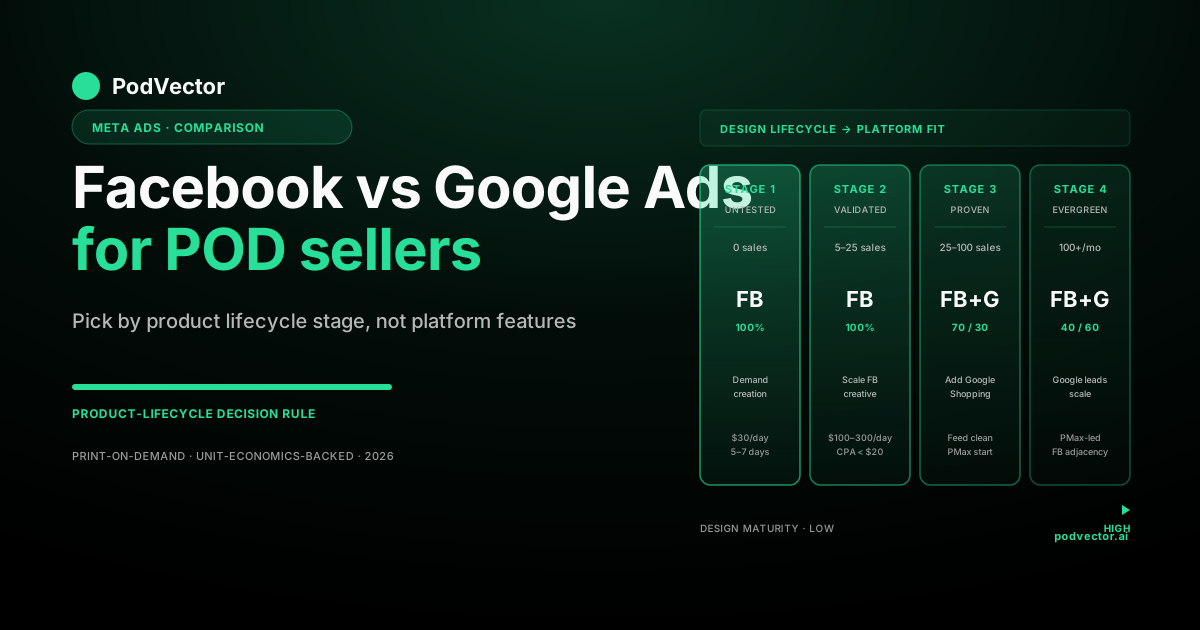
Quick Answer: For most print-on-demand sellers running their first or second paid channel in 2026, the answer is Facebook Ads — and the reason is product lifecycle, not platform features. Untested designs and most validated-but-unscaled designs need demand-creation, which is what Facebook does.
Proven winners with real search volume and clean Shopify product feeds are the exception where Google Ads (specifically Shopping and Performance Max) takes over. The right framing isn't "which platform is better" — it's "which lifecycle stage is each design at, and which platform fits that stage." This guide gives you a four-stage product-lifecycle decision rule, the unit-economics math behind it at a typical $26 POD AOV, and the order to add the second platform once your first one is profitable.
Why "Facebook vs Google Ads" answers differently for POD
Most "Facebook vs Google Ads" comparisons online — including the comprehensive breakdowns from WordStream, Databox, and Instapage — are written for direct-to-consumer brands with stable cost-of-goods, 60–80% gross margins, and a curated SKU list of maybe twenty products. The advice in those guides — match platform to "funnel stage" or "industry" — generalizes well for those businesses.
It does not generalize well for print on demand. Three structural differences change the answer.
The first is margin. A POD hoodie at a $26 net average order value typically has $14 of Printify or Printful base, $5.50 of shipping, $1.20 of platform-and-payment fees, and roughly $5.30 of contribution before any ad cost.
A DTC candle at the same price might keep $18. The same click cost burns very different fractions of a sale's contribution depending on the business model — and the platform with cheaper clicks isn't automatically the right one, because cheaper clicks can still be too expensive.
The second is SKU shape. POD shops have hundreds of designs across a handful of physical products, with new designs launching weekly.
Google's algorithm is built around stable products with stable conversion histories. Facebook's is built around creative-driven prospecting where every new design is a new creative test. The platform's optimization style has to match the cadence at which your inventory changes — and POD inventory changes far faster than DTC.
The third is demand shape. A DTC brand selling a known category (candles, supplements, bedsheets) has people typing the category into Google every day.
A POD brand selling "german shepherd retired-K9 unit dad shirt" has roughly nobody searching for that exact phrase, but plenty of people scrolling Facebook who would buy if they saw it. Most POD designs lean demand-creation, not demand-capture — which structurally favors one platform over the other for the majority of designs you'll launch.
Read together: the right comparison for POD isn't "which platform is broadly better." It's "which platform fits the typical POD design's margin, SKU velocity, and demand shape." That's why the answer most POD operators land on differs from the standard advice — and why it also depends on where each individual design is in its lifecycle.
The 30-second answer for a POD seller
If you're running paid for a POD store and you have not picked a platform yet, start with Facebook Ads. The reasons:
- Lower minimum efficient daily spend. Facebook ad sets produce useful signal at $30/day. Google Shopping needs $50–$100/day per campaign before its algorithm has anything to learn from. Below $5K monthly ad budget, that floor matters.
- Demand creation, not just capture. Most POD designs target "didn't-know-I-wanted-it" buyers. Facebook is the platform for putting the design in front of people who would buy if they saw it, even though they weren't searching.
- Visual-first format matches your existing assets. A design mockup is already a complete Facebook ad. No new creative production required to start.
- Lower upfront platform cost. Facebook needs an ad account, a pixel, and a few creatives. Google Shopping needs a clean Merchant Center feed (which most POD shops fail on the first try) plus conversion tracking. Time-to-first-test is days versus weeks.
Add Google Ads as the second channel once a specific design is a proven winner — meaning it has produced enough Shopify orders that real search demand has emerged for the design or the niche, and the supplier-cost math works. That sequencing — Meta first, Google second once a design is proven — is what the rest of this guide walks through.
Facebook Ads in plain English (POD lens)
Facebook Ads (Meta's paid platform spanning Facebook, Instagram, Messenger, and the Audience Network) is the system you use to put designs in front of people who fit a profile, whether or not they're shopping right now. You upload a design mockup, write a few lines of copy, and Meta's AI decides who in your target group sees it, when, and on which surface. The optimization signal is the conversion event you choose — for POD, almost always Purchase via the Meta Pixel and the Conversions API.
For POD sellers in 2026, the dominant campaign type is Advantage+ Shopping Campaigns (ASC) or a broad-prospecting Sales-objective campaign. Detailed-targeting interest stacks still work in some niches but are increasingly secondary; the platform has shifted toward "feed Meta enough creative variety and let it find buyers." That shift suits POD well, because you already produce more creative variety per week than most DTC brands do per quarter — every new design is, structurally, a new ad.
The trade-off is Meta's reported ROAS. Post-iOS 14, Meta's in-platform attribution overstates true contribution by 20–40% in most accounts.
Your Shopify or warehouse numbers are the truth; Meta's number is the directional signal. Operators who trust the platform number without triangulation routinely scale unprofitable campaigns. The complete guide to Meta Ads ROAS and attribution for POD covers how to triangulate that gap.
For the operating playbook behind Facebook campaigns at the POD-specific level — campaign structure, naming, budget pacing, creative cadence — see the complete Meta Ads playbook for print-on-demand sellers.
Google Ads in plain English (POD lens)
Google Ads is the umbrella for paid placements across Google Search, Google Shopping, YouTube, the Display Network, Discover, and Performance Max — Google's AI-driven format that pools inventory across all of those into one campaign. For POD, the relevant formats are Shopping and Performance Max; Search Ads play a supporting role for branded queries and high-intent niches; Display and YouTube are usually wrong-shape for POD until accounts cross $50K monthly spend.
The mental model is the inverse of Facebook's. Demand already exists; Google captures it the moment somebody types a query.
For apparel and accessories, Google Shopping CPCs run $0.95–$2.80 with conversion rates of 2.5–5.5% on well-matched queries — meaningfully higher than Facebook's prospecting CPC × CVR product on cold audiences. The catch is that Google can only capture demand that's already being expressed in search. If your niche has fewer than ~500 monthly searches across all variants, Google has nothing to feed on.
The hard part isn't the cost. It's the feed.
Google Shopping needs a structured product feed — clean titles, accurate descriptions, GTIN handling, inventory states, image quality, and policy compliance — submitted through Google Merchant Center. POD shops with hundreds of design SKUs frequently get flagged for image quality, "promotional overlay" violations on the design itself, restricted categories, or third-party copyright complaints.
Feed work is the price of admission. Once it's clean, the platform can be highly efficient — but the setup curve is several weeks for most POD operators, where Facebook's first ad can run the same afternoon.
For the POD-specific Google Ads playbook covering campaign structure, feed setup, and Performance Max configuration, see the complete Google Ads playbook for print-on-demand sellers.
The product-lifecycle decision rule
The choice of platform is rarely "Facebook OR Google" once you zoom out. It's "which platform suits each design at its current lifecycle stage." A POD seller with thirty active designs typically has designs in three or four lifecycle stages at the same time, and each stage has a structurally correct platform answer.
Stage 1: Untested concept (0 sales)
The design exists, has a mockup, and has never been advertised. You have no purchase signal, no way to know whether the niche has search demand, and no Merchant Center feed history. Run it on Facebook Ads exclusively. $30/day per ad set, broad audience or one tight interest stack, 3–5 creative variants.
You're testing whether the design produces Purchase events at a CPM the niche can support — that's a creative test, not a search-demand question. Spend $50–$150 per design over 5–7 days and let the platform tell you whether to kill or keep.
Stage 2: Validated, no scale (5–25 sales)
The design has produced sales but not enough to know whether it has legs. Lookalike audiences are too small to be useful (you need ~200 purchasers minimum for a strong LAL signal). Stay on Facebook Ads, add a second ad set with different creative, do not yet add Google. Spend $100–$300/day across the design and its variants.
Watch CPA against your true contribution margin (use Shopify or a warehouse, not Meta-reported ROAS). If CPA stays below $20 against a $26 net AOV with $14 supplier base, the design is moving toward Stage 3.
Stage 3: Proven winner (25–100+ sales)
The design has produced consistent purchases over weeks. You have lookalike-quality customer data.
Real search demand is starting to appear in your Google Search Console for the niche or design name. This is where Google Shopping or Performance Max gets added. Set up the Merchant Center feed, submit the proven-winner SKU first (not your full catalog), allocate $50/day to a Shopping campaign. The Stage 3 design is where Google's intent-capture math actually works — you have purchase data to feed PMax's audience signals, and there's enough search demand on the design to capture. Continue Facebook Ads in parallel; the two platforms aren't competing, they're capturing different demand types from the same buyer pool.
Stage 4: Mature evergreen (100+ sales/month, multiple months)
The design has crossed into evergreen status. It sells consistently month after month.
Search demand is established; the customer file is large enough for advanced lookalike modeling. Both platforms run, with Google often the bigger spender by this stage. Performance Max becomes the primary scaler because feed-as-creative removes the weekly creative-volume burden Facebook imposes at scale. Facebook Ads runs alongside as the discovery engine for adjacent designs and the lookalike-prospecting layer.
This is the rule that matters: Stages 1 and 2 are Facebook-only. Stage 3 adds Google. Stage 4 runs both with Google often leading spend. Most POD shops have 60–70% of their designs in Stages 1 and 2, which is why Facebook is the right starting platform for the business as a whole, even though Google is often the right scaling platform for individual proven designs.
Cost math: per 100 orders at a $26 POD AOV
Round numbers tied to how a POD shop actually spends. Assume a $26 net AOV, $14 supplier base (Printify mid-tier hoodie or comparable Printful), $5.50 shipping, $1.20 platform-and-payment fees, leaving $5.30 of contribution per order before ad spend.
Facebook Ads (Stage 1 design, cold prospecting): $1.07 average e-commerce CPC, 1.2% conversion rate from cold traffic. To get 100 purchases you need ~8,330 clicks, costing ~$8,910.
That's $89.10 per acquisition. Against $5.30 of pre-ad contribution, you're losing $83.80 per order. Stage 1 is not where Facebook makes money — it's where Facebook tells you which designs to kill.
Facebook Ads (Stage 3 design, scaled with lookalikes + retargeting): $0.85 effective CPC blended across cold/warm/customer audiences, 2.4% conversion rate. To get 100 purchases you need ~4,170 clicks, costing ~$3,540.
That's $35.40 per acquisition. Against $5.30 contribution before ads, you're still losing $30.10 per order — which means a Stage 3 design needs higher AOV (bundle math, accessory upsell, embedded subscription) or a tighter supplier base (Printful Pro pricing, Printify Premium) to be profitable. This is the under-discussed POD reality: a "winning" Facebook campaign at average POD economics still loses money without AOV engineering.
Google Shopping (Stage 3+ design, well-matched query): $1.85 average apparel-and-accessories Shopping CPC, 3.8% conversion rate. To get 100 purchases you need ~2,630 clicks, costing ~$4,870.
That's $48.70 per acquisition — higher than Facebook's Stage 3 number, but those purchases are from people actively searching for the design, which means higher AOV through cross-sell and stronger repeat purchase rates. The lifetime-value math typically tilts Google ahead at Stage 4 in ways the first-purchase number doesn't capture.
The takeaway: at default POD economics, neither platform is profitable on first-purchase contribution alone. The lever is AOV engineering — bundles, accessories, premium-tier supplier pricing — combined with multi-channel mix that sequences the cheap discovery (Facebook) ahead of the higher-intent capture (Google) on the same design. Operators who skip the AOV math and just pick a platform usually scale into negative contribution.
The factor most beginners miss: feed health
The single biggest reason POD operators stay on Facebook past Stage 3 — when they should be adding Google — isn't preference or analysis. It's that their Shopify product feed isn't ready for Merchant Center.
Common failures: design files used as product images (Merchant Center routinely rejects "promotional overlay" on the product); GTINs missing without "GTIN does not apply" properly set; product titles that say "Hoodie - Sage Green - Small" with no design name (low query relevance); descriptions copied from Printify's default copy (duplicate content across sellers); restricted categories (anything with weapon imagery, religious imagery on apparel, certain political content). Any one of these blocks Shopping ads from running.
The work to fix it usually takes 4–10 hours of focused setup: pulling clean lifestyle mockups instead of flat design files, writing unique product titles and descriptions per design, configuring Shopify's Google Channel app, and resolving the first round of Merchant Center policy flags. None of it is hard. All of it is mandatory before Google Ads can work.
The reason this matters for the comparison: a POD seller comparing Facebook vs Google "in the abstract" assumes both platforms are available to them today. In practice, Facebook is available today and Google is available in 2–4 weeks once feed work is done. That asymmetry shifts the answer for any seller whose runway is measured in weeks, not quarters.
Sequencing: when to add the second platform
The "both" answer is correct for mature POD operators — but the order matters, and the trigger for adding the second platform is specific.
If you started with Facebook Ads: Add Google when (1) at least one design has crossed 50 cumulative Shopify orders, (2) you can name three or more search queries that converted in Google Search Console for the niche or design, and (3) you have completed Merchant Center feed setup with the proven design's SKU(s) approved. Below those thresholds, Google's algorithm doesn't have enough signal to optimize against and you're effectively donating budget to learning.
If you started with Google Ads: This is rare for POD. If it's you, add Facebook when (1) Google has shown you which design types convert (you'll see this in PMax asset-group performance), (2) your customer file has 200+ purchasers (lookalike threshold), and (3) you have 8+ design mockups ready as creative variants. Facebook needs creative variety to learn at the same way Google needs feed quality.
If you have $5K+ monthly budget and are starting from scratch: Run both, but allocate 70% to Facebook and 30% to Google for the first 60 days. Use Facebook to find which designs work; use Google Shopping to capture the search demand that emerges from Facebook-driven brand awareness. After 60 days, the spend split adjusts toward whichever channel is producing better blended CPA at your target AOV.
The moment you run both, a measurement trap shows up — and it's the one issue the current crop of "Facebook vs Google" guides now leads with. Both platforms run their own pixel and both will claim the same Shopify sale, so a buyer who saw a Facebook ad and then searched your brand on Google gets counted twice. Add the two platform-reported ROAS figures together and they describe more revenue than your store actually booked. The fix isn't picking a "better" attribution window inside either ad manager; it's deduplicating at the warehouse/Shopify level and judging each channel on incremental, blended CPA rather than its self-reported number. Until you do that, "which platform is winning" is a question the two dashboards will both answer "me."
Beyond Meta and Google, several other channels enter the POD mix at scale (TikTok, Pinterest, Reddit, programmatic). The full multi-channel framing is in Meta Ads vs alternatives: the complete comparison for POD.
Two companion comparisons in this same cluster apply different decision lenses to the same Facebook/Google question — the Google Ads vs Facebook Ads comparison uses an MRR-stage decision rule, and the Facebook Ads vs Google Ads breakdown uses a niche-type rule; this article uses product lifecycle. Pick whichever lens fits how you think about your store. For context on how this comparison sits inside the broader cluster, the Meta Ads comparison hub aggregates every related decision in one place, and the Meta Ads topic hub sits one level above that with all Meta Ads coverage.
FAQs
Is Facebook or Google better for a brand-new POD store with no sales?
Facebook, at default POD economics. The minimum efficient daily spend is lower, the format matches your existing design mockups, and you're testing demand-creation against a niche where search volume probably doesn't exist yet. Spend $50–$150 per design over 5–7 days on Facebook to find your first winner before considering Google.
What's the cheapest CPC — Facebook or Google?
Facebook, in raw terms — POD prospecting clicks run roughly $1.05–$1.70 in 2026 against Google's ~$2.69 e-commerce search average. (Facebook's blended e-commerce CPC has crept up year over year as Advantage+ adoption concentrates spend, so the old "$0.60-ish Facebook click" number you'll still see quoted is stale.) But cheap clicks aren't always cheap acquisitions. Google's higher CPC is offset by 2–3x higher conversion rates on intent-driven queries, so cost-per-acquisition is often closer than CPC alone suggests — especially for proven designs in niches with established search demand.
Can I run both Facebook and Google Ads with a $1,000/month budget?
Yes, but probably shouldn't until at least one design is past Stage 2. At $1,000/month split across both platforms, neither has enough daily budget to learn (Google especially needs $50/day per Shopping campaign). Better play: $1,000/month all-in on Facebook to find a winner, then add Google when that winner is proven.
Does Facebook still work for POD after iOS 14?
Yes, with caveats. Reported ROAS overstates true contribution by 20–40% in most accounts, so you have to triangulate against Shopify or warehouse numbers.
The platform itself still finds buyers — what changed is your ability to trust its self-reported number. Modeled conversions, the Conversions API, and properly configured custom events restore most of the lost signal at the campaign-optimization level even if attribution at the user level is permanently murkier.
Why does Google reject my POD products in Merchant Center?
Five common reasons: design files used as product images instead of lifestyle mockups; product titles missing the design's identifying detail; descriptions duplicated from Printify's default copy; missing GTIN handling (set "identifier exists" to false); or category restrictions on the design's imagery (religious, political, occupational, weapon-adjacent). Each is fixable — and each is a one-time fix, not recurring work.
Should I worry about losing budget on Facebook to ad-account bans?
It's a real risk specifically for POD. Trademark complaints, copyright trolls on similar designs, and Meta's enforcement around "personal attributes" targeting (which sneaks into a lot of niche apparel — "german shepherd dad" qualifies) hit POD accounts disproportionately.
Mitigations: use a Business Manager structure with multiple ad accounts; respond fast to any policy-related warnings; keep clean creative compliant with Meta's "personal attributes" policy. Google has its own enforcement issues but rarely the account-disable-overnight pattern Meta's auto-enforcement produces.
Which platform has better data for POD operators?
Google's data is more honest at the individual-conversion level (10–15% gap to true contribution vs Meta's 20–40%). But Facebook's data is more useful for design discovery — its detailed-targeting and creative-performance breakdowns tell you which design styles work with which audiences in ways Google can't.
The right answer for a serious POD operator is "neither, by itself" — both platforms feed into a single source of truth at the warehouse level where true blended CPA and contribution can be calculated. That's the architecture Victor is built on.
Is Performance Max worth it for POD?
Yes, once you're past Stage 3 with at least one design and your Merchant Center feed is clean. PMax pools Shopping, Search, Display, YouTube, and Discover inventory and lets Google's AI optimize across them — which removes the weekly creative-volume burden that Facebook imposes at scale. Below Stage 3, PMax doesn't have enough conversion signal to optimize against and burns budget while learning.
Will Victor pick the platform for me?
Today, Victor works the live data across both platforms and makes the call — which channel is producing better blended CPA at your true contribution margin, with no platform-reported ROAS in the loop to inflate it. The employee roadmap extends that: Victor answers "where is my next dollar best spent right now," then acts on the answer by reallocating budget across platforms for you. The "Facebook vs Google" question stops being a manual analysis you run each week and becomes a real-time decision the agent owns.
Stop guessing which platform deserves your next dollar
Victor works your live Shopify, Printify, Meta, and Google data, pins true contribution margin per design across both platforms, and calls the shot — which lifecycle stage each design is at and which channel earns the next $50. No spreadsheets, no Meta-reported ROAS to second-guess, no waiting for end-of-month attribution reconciliation.
Try Victor free