
Quick Answer: An AI analytics platform for ecommerce ingests your storefront, ad, fulfillment, and email data and lets an AI agent answer questions about it in plain English — and increasingly, take Shopify-side actions like re-pricing a listing or creating a discount. Triple Whale, Polar, Glew, Improvado, Tellius, Pulse, Daasity, Graas, Northbeam, and a fast-growing agentic tier all compete here. The 2026 inflection is clear in what now ranks: the tools that take actions across systems are pulling ahead of the dashboard-only ones.
The catch for print-on-demand: every one of them was built for a data model where a SKU has one cost, one price, and an inventory count. POD breaks all three every day.
For a POD seller on Shopify, WooCommerce, BigCommerce, or Etsy, the platform that actually works ingests Printify or Printful cost at the line-item level, handles a 10,000+ variant catalog without choking, and exposes the SQL the agent ran so the answer is verifiable. This guide covers what the category means in 2026, which platforms match the POD use case, and how to evaluate before signing anything.
What "AI analytics platform for ecommerce" means in 2026
The phrase stretches across three product shapes that look similar in marketing copy and behave very differently in production. A POD operator researching the category needs to be able to tell them apart before the first vendor call, because the shape of the platform determines what questions it can actually answer.
The first shape is an ecommerce reporting suite with AI-flavored features bolted on. Triple Whale, Polar Analytics, Glew, and most of the top-ranked apps on the Shopify App Store and WooCommerce marketplace live here.
The platform ingests from your storefront, ad platforms, email tool, and a handful of other sources; it ships a set of pre-built dashboards; the AI layer surfaces anomalies in plain English, summarizes weekly performance, and answers a bounded set of natural-language questions against the data it owns. The chat agent is real but narrow — it works inside the schema the vendor built.
The second shape is a data-integration platform with a semantic model and an agent on top. Improvado, Tellius, Daasity, and the enterprise tier of a few DTC-native tools sit here.
The platform pipes your storefront, ad, and ops data into a managed warehouse (or writes to yours), models it with a semantic layer, and exposes the modeled data to a natural-language agent. Because the agent composes against a richer schema, it can handle cross-source questions the reporting-suite shape can't. The tradeoff is a longer implementation — weeks rather than an afternoon — and a higher price point.
The third shape is an AI employee that reasons over a live warehouse and executes approved actions. Shopify Sidekick within the Shopify admin, and Victor for POD, fit here.
The primary output is an answer to a specific question with the work shown, not a dashboard tile. The product direction is biased toward execution — the agent will draft the price update, propose the collection restructure, or surface the variant that's losing money on every order, and ask for the operator's approval before any change is made.
The three shapes are not interchangeable. A POD operator who expects agentic behavior from a reporting suite will be disappointed; one who expects a reporting suite's turn-key simplicity from a warehouse-native platform will miss their launch window.
Cutting across all three shapes is a capability every current top-ranked ecommerce-analytics guide now treats as table stakes rather than a differentiator: prediction. Forecasting next quarter's revenue, flagging the customers most likely to churn, and predicting lifetime value from a first order are standard 2026 expectations, not premium add-ons. For POD the predictive questions worth pressing a vendor on are POD-shaped: which designs are trending toward the portfolio's bottom quartile, which supplier is drifting toward a lead-time or base-cost problem, and which variant mix a scaling campaign will actually drive. Generic churn-and-LTV forecasting ports over fine; the POD-specific forecasts only work if the cost and design model underneath them is right.
The first real question in any evaluation is which shape you're looking at, regardless of what the marketing copy implies. For the underlying architecture comparison, the complete guide to AI agents for ecommerce analytics walks through each shape in depth.
Why the storefront platform matters less than operators think
POD operators often start their evaluation by filtering for "works with Shopify" or "WooCommerce integration." That filter matters at the connection step — a platform with no native connector to your storefront is a non-starter — but it matters much less than operators think once the data is flowing. The reason is that every serious AI analytics platform in 2026 normalizes storefront data into roughly the same object model: orders, line items, customers, products, variants, inventory events, refunds. Whether that data came from Shopify's REST API, WooCommerce's REST API, BigCommerce's API, or Etsy's Open API, it ends up in the same shape in the platform's warehouse.
What actually separates platforms, once storefront data is ingested, is how they handle three POD-specific problems that no storefront solves for them:
Fulfillment-cost ingestion. None of the major storefronts know what Printify or Printful charged to fulfill a given order. Shopify has a "cost per item" field that's usually empty or stale; WooCommerce's product meta fields have the same problem; Etsy doesn't model COGS at all.
The platform has to query Printify or Printful directly, match line items back to orders, and store the real cost. Most platforms don't.
Cross-channel attribution with POD economics. Knowing that Meta drove a large share of last week's revenue is useful; knowing that Meta drove that revenue at a meaningfully lower margin because the ads skewed toward a cheaper garment is what lets the operator make a real decision. That requires the platform to join ad-platform data (Meta and Google) against line-item-level cost data. Storefront-of-choice is irrelevant; what matters is whether the join exists — and, after iOS privacy changes gutted pixel-based tracking, whether the platform rebuilds the lost click signal with server-side tracking or statistical modeling rather than passing through inflated platform-reported numbers.
Multi-storefront consolidation. Most POD operations run more than one storefront — a Shopify main brand, a WooCommerce niche site, maybe an Etsy presence for organic discovery, sometimes a Printify Pop-Up store. Every serious POD operator eventually asks the same cross-storefront questions: which designs perform on which storefront, where are the return rates highest, what does the blended margin look like. Platforms vary enormously on whether they consolidate cleanly or force you into one-account-per-storefront workflows that defeat the consolidation.
When these three problems are handled well, the storefront platform becomes an almost-invisible layer underneath. When they're handled badly, the cleanest Shopify integration in the world doesn't rescue the analytics layer. The thing POD operators are buying is POD-native cost modeling, not storefront connectivity. For a deeper look at first-party attribution on Shopify specifically, see first-party attribution for Shopify POD stores.
The three data-model gaps where POD breaks generic platforms
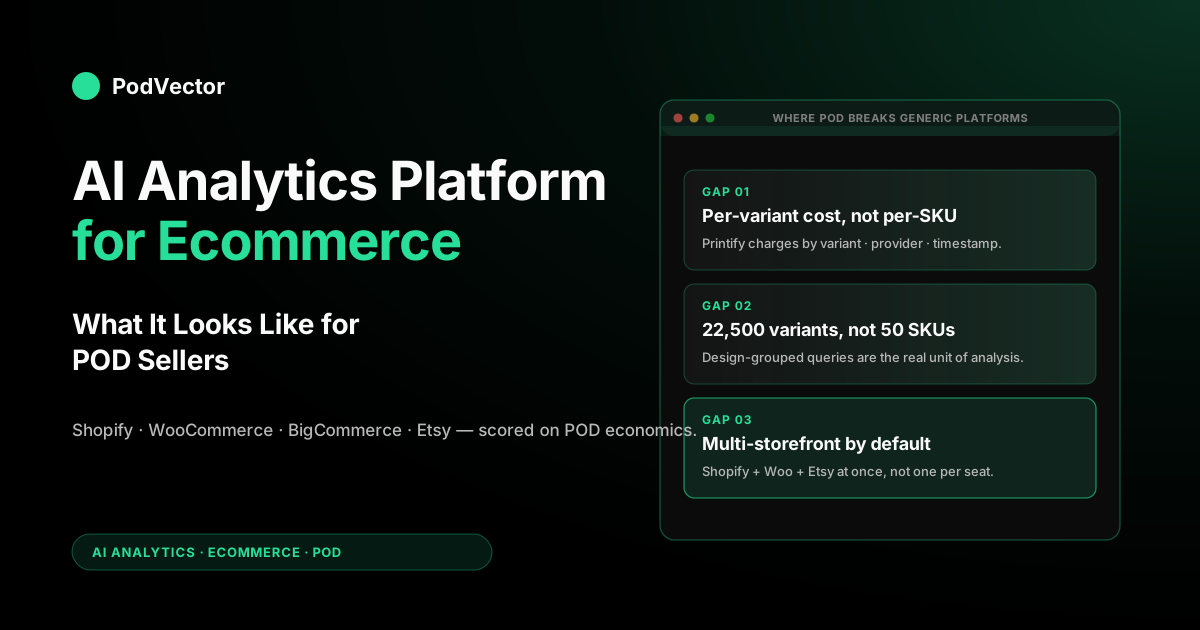
The ecommerce analytics category was designed around a specific data model. A SKU has a single cost, a single retail price, a single inventory count, and a velocity.
Marketing math that works for a DTC skincare brand selling wholesale-purchased tubes at a fixed cost each is the reference model for how these platforms think. POD breaks the reference model in three places, and the platforms handle the break with varying degrees of honesty.
Gap 1: "Cost per SKU" is a lie for POD. A Comfort Colors 1717 in size M, color blue spruce, fulfilled by Printify on a given date, costs one amount. The same SKU one variant up (size 2XL) costs noticeably more. The same SKU a week later, after a supplier base-cost update, costs more still. Cost is a function of variant, provider, and timestamp — not SKU alone.
Platforms that load "average COGS per SKU" from a CSV get every margin report structurally wrong. The error doesn't look big in a summary ("margins are within a few percent of expected") and is devastating in a decision ("this campaign looks profitable, let's scale it" when it's actually underwater on the variant mix it drove).
This matters more now because profitability tracking has become the headline feature across the category — the top-ranked ecommerce-analytics guides in 2026 all lead with COGS, margin, and product profitability rather than raw revenue. The catch for POD is that "we track COGS" almost always means "we accept a cost number you supply per SKU," not "we read the real per-line cost from Printify or Printful at fulfillment time." The marketing claim and the POD reality are one averaging step apart, and that step is exactly where the margin number goes wrong. For the mechanics of how Shopify gross margin gets miscalculated, see gross margin on Shopify for POD stores.
Gap 2: Inventory metrics are irrelevant. The most common AI-generated alert in the ecommerce analytics category is "you'll run out of SKU X in 14 days." POD holds no inventory, so that alert fires constantly and incorrectly. The questions that actually matter — supplier print capacity, provider lead times, design turnover rate, catalog freshness — are not in the schema that generic platforms ship. A POD operator who tunes out the inventory alerts is missing the actual operational signals the platform was supposed to surface.
Gap 3: Variant-to-catalog ratio is huge. A mid-size POD operation might have 150 active designs across 6 garment styles, 5 colors per style, and 5 sizes per color — tens of thousands of variants in catalog terms. Generic dashboards that show "top 50 SKUs" hide the vast majority of the catalog from analysis.
The useful queries for POD are almost always design-grouped or garment-family grouped, not SKU-grouped. A platform that can't GROUP BY design_id at query time forces the operator into spreadsheet workflows that were the reason they bought the platform.
A platform that is honest about these gaps and lets the AI-employee layer in POD-specific modeling is usable. A platform that claims accurate margin reporting and silently computes margins from averaged cost is dangerous, because the operator makes decisions on numbers they believe are right. The honest test during evaluation is to ask the vendor directly how they handle each of the three gaps and watch how specific the answer gets. For the formula mechanics behind margin, see the margin formula reference for ecommerce.
The platforms POD sellers will encounter in evaluations
These are the AI analytics platforms a POD seller running an ecommerce operation will run into most often in a 2026 evaluation. Each description is the operator-relevant version.
Triple Whale
The best-known DTC analytics brand. Strengths: blended attribution across paid channels, a chat agent (Moby) that now reaches into ad accounts to draft campaigns and creative rather than just answering attribution questions, deep Shopify integration, fast time-to-value.
Limits for POD: cost ingestion is per-SKU rather than per-line-item; the Printify connector is shallow; non-Shopify storefronts are supported unevenly. Best fit when the operator wants the strongest ad-attribution layer and is willing to maintain a separate variant-cost workflow alongside.
Polar Analytics
Positions as a unified-stack reporting layer with an AI agent on top. Strengths: writes to a managed warehouse (no self-provisioning), an agent that handles cross-source questions reasonably, flexible attribution.
Limits for POD: same per-SKU cost limitation; design-grouped queries require custom modeling; WooCommerce and BigCommerce support exists but is less mature than Shopify.
Northbeam
Attribution-specialist platform built around multi-touch attribution and media-mix modeling, with a machine-learning layer that reconstructs the buyer journey after iOS privacy changes broke pixel-based tracking. Strengths: among the most statistically rigorous attribution in the category, strong for operators spending heavily across Meta and Google who need numbers they trust over the platform-reported ones. Limits for POD: it is an attribution engine, not a POD-economics engine — COGS is a number you supply per SKU, there is no Printify or Printful line-item cost layer, and design-grouped margin analysis is out of scope. Best fit as the attribution layer alongside a POD-native cost model, not as the whole stack.
Glew
Lightweight cross-channel analytics. Strengths: fast setup, clean cross-platform reporting, reasonable pricing for small operators. Limits: AI features are thinner than Triple Whale or Polar — closer to "smart dashboards" than agentic chat; POD cost handling is basic. Best fit for POD stores in early growth where the analytics need is clean reporting, not deep agents.
Improvado
Data-integration heavy. Strengths: 500+ connectors, strong ETL backbone, configurable warehouse write, a usable AI layer.
Limits for POD: built for the marketing data team at a mid-market brand; the depth of connectors is wasted on a POD operator who needs 5 sources modeled well, not 50 sources modeled shallowly. POD-specific economics require custom modeling work. Pricing is enterprise-flavored.
Tellius
Augmented analytics with a natural-language layer. Strengths: genuinely strong auto-insight generation, good for exploratory analysis, works well when data is already in a warehouse. Limits for POD: requires more data-engineering setup than the DTC-native tools; the POD-specific semantic layer has to be built by the operator; not pre-wired for Printify or Printful.
Pulse AI
Positions explicitly as "ask your store a question in English." Strengths: low-friction chat interface, sensible defaults for small DTC brands, priced for an operator rather than a data team. Limits for POD: same Shopify-schema limitations as the reporting suites, and pricing advantages evaporate as data volume grows.
Daasity
Warehouse-native, dbt-friendly, enterprise-flavored. Strengths: writes to your own data warehouse, supports custom transformations, models data cleanly, exposes the modeled schema to the agent layer.
Limits for POD: implementation is 3–4 weeks; pricing starts above most POD operators' comfort range. Best fit when a POD operation has reached the scale where data ownership and customization outweigh time-to-first-dashboard.
Shopify Sidekick
Native to the Shopify admin. Strengths: free, zero integration work, answers Shopify-native questions fast.
Limits for POD: scoped to Shopify-side data; doesn't see Meta spend, Printify cost, or Klaviyo attribution; margin questions structurally wrong for POD because COGS input is the near-empty Shopify cost field. Useful as one input to operating decisions, not a complete ecommerce analytics layer.
Graas
One of the newer agentic-commerce entrants, marketed as "AI agents that run commerce end to end." Strengths: a stack of named agents — an analytics agent (Hoppr) that fields revenue, ad, and SKU questions without a dashboard, plus marketplace listing, inventory, and demand-forecasting agents — and genuine multi-marketplace reach. Limits for POD: the framing is marketplace-and-inventory-first, so it inherits the stocked-goods data model POD breaks (inventory risk modeling, stock orchestration), and there is no native Printify or Printful line-item cost layer. Worth a look for operators running heavy on Amazon and other marketplaces; thinner for a Shopify-plus-fulfillment-API POD economics question.
Victor (PodVector AI)
POD-native by construction. Victor is an AI employee: he reads your Shopify, Meta Ads, Google Ads, Printify, Printful, and Klaviyo data, so he can see your orders, ad spend, supplier costs, and customer emails all in one place. With your approval, he can act too — and not only inside Shopify. He can reprice products to a target margin (single or bulk), create or update discounts (buy-one-get-one, free-shipping, customer-specific), create collections, set a free-shipping threshold, and also make changes in Google Ads, Meta Ads, and Klaviyo, like pausing a campaign or turning an email flow back on.
Strengths: pulls your Printify and Printful costs before you ever make a sale, so you know your margin even on a product with zero orders. Victor tracks margin down to the variant level, and can answer questions grouped by design or garment family. He shows you exactly what he found and why, in plain English, so nothing is hidden from you. Victor never acts without your approval. Limits: built specifically for POD operators on Shopify who advertise on Meta and Google — not a fit for stocked-inventory DTC brands or sellers on Etsy, Amazon, or TikTok. With your approval, Victor can already make changes in Google Ads, Meta Ads, and Klaviyo, and act on Printify and Printful orders and products — not just in Shopify.
Scoring matrix on POD-specific criteria
Feature-parity matrices from vendor comparison pages are optimized for a generic DTC buyer. The matrix that predicts POD outcomes is narrower and weighs a different set of capabilities. Six rows capture most of the variance:
| Capability | Triple Whale | Polar | Improvado | Daasity | Sidekick | Victor |
|---|---|---|---|---|---|---|
| Line-item Printify/Printful cost ingestion | Partial | Partial | Custom | Custom | No | Native |
| Cost snapshot at fulfillment time (not re-queried) | No | No | Possible | Possible | No | Yes |
| Variant-level margin and ROAS | Limited | Limited | Possible | Yes (with modeling) | No | Native |
| Design-grouped and garment-family queries | No | Limited | Possible | Possible | No | Native |
| Multi-storefront consolidation (Shopify + Woo + Etsy) | Limited | Yes | Yes | Yes | No (Shopify only) | Yes |
| Agent exposes the work it did | Partial | Yes | Limited | Yes | Limited | Yes |
The matrix is deliberately uncomfortable for the horizontal platforms because the six rows are things they didn't build for. That's not a criticism of the platforms — Triple Whale is excellent at what it built for, Improvado's connector library is genuinely impressive, Daasity's data modeling layer is best-in-class for a POD operation willing to invest in the setup.
The matrix is a sorting tool: an operator who weights these six rows highly ends up with a different shortlist than the one a generic DTC evaluation would produce. For the cross-tooling version of this comparison, see Lifetimely vs Peel Analytics and best AI tools for ecommerce data analysis compared.
Cross-platform specifics: WooCommerce, BigCommerce, Etsy, Amazon
Most POD analytics guides assume Shopify. The reality is that a meaningful percentage of POD operations run on other storefronts, and the analytics story changes by platform in ways worth flagging.
WooCommerce. The REST API is mature, but data quality depends on the plugin ecosystem the store uses. A Woo store with a well-configured setup looks similar to a Shopify store from an analytics-ingestion point of view.
A Woo store with a patchwork of plugins often has line-item property data in inconsistent locations, which breaks design-level analysis unless the platform knows how to handle multiple conventions. Ask during evaluation how the vendor handles WooCommerce meta-field variance.
BigCommerce. A smaller install base than Shopify, which means fewer pre-built connectors. Platforms that advertise "works with BigCommerce" sometimes ship a shallower integration than the Shopify version — worth confirming specifically that the same data coverage exists. For POD operators, the Printify and Printful cost integration is the critical piece, and that's orthogonal to the storefront, so the gap is usually in storefront-native reporting rather than POD economics.
Etsy. The Etsy Open API gives decent order data but limited customer data (Etsy protects buyer identity more than DTC platforms do). Analytics platforms that join on customer email for cohort analysis get only partial data from Etsy. For POD operators running Etsy as an organic-discovery channel alongside a main DTC site, the right expectation is that Etsy-side customer cohort analysis will be thinner than the DTC side, and blended margin analysis still works because order-level data is complete. Note that Victor can read your Shopify, Meta Ads, Google Ads, Printify, Printful, and Klaviyo data — but not Etsy.
Amazon (Merch by Amazon + fulfillment partnerships). Amazon data is gated behind their reporting APIs and report scheduling model, which introduces latency. Most generic ecommerce analytics platforms don't ingest Merch by Amazon data well.
POD operators on Amazon typically export weekly CSVs into a BI tool or warehouse and reconcile manually; the agent layer sits on top of the reconciled data. It's a workflow worth planning for explicitly during evaluation. Victor does not currently read Amazon data.
Printify Pop-Up and other hosted-storefront experiments. These often have no analytics API at all, which means the data has to come from the Printify merchant dashboard or Shopify's equivalent. Operators testing these as secondary channels should scope the analytics expectation to "Printify's native reporting plus monthly reconciliation" rather than "full AI analytics coverage."
The cross-platform reality for most POD operations is that one storefront is the primary revenue source and the rest are secondary. The right analytics investment is a platform that handles the primary storefront with full fidelity and at least tolerates the secondaries, not a platform that claims equal depth across all of them.
Two-week evaluation playbook
Vendor sales processes are tuned to a 30-minute demo where every platform looks excellent. Real platforms separate in the first two weeks of production data. Compress the evaluation window deliberately and most of the marketing claims fall apart on their own.
Week 1: connect and reconcile. Connect the platform to the storefronts, the fulfillment API (Printify or Printful), the paid-ad platforms (Meta and Google minimum), and the email tool (Klaviyo or equivalent). Pick the most recent completed week.
Produce a P&L from the platform — spend, revenue, COGS, fees, refunds, net margin. Reconcile against your manual close from the same week.
The reconciliation almost never matches on the first try. The question is by how much, and where the variance lives.
Revenue variance under a few percent is acceptable; margin variance under around eight percent is acceptable; margin variance over ten percent is a failure signal because it usually means the COGS layer is structurally wrong. A vendor who shrugs at a large margin variance is telling you that POD isn't actually in scope for their product. For context on what reconciliation looks like at the data level, see first-party attribution for Shopify and what P&L means in business.
Week 2: ask ten real questions. Write down ten questions you've actually asked yourself this quarter — not textbook benchmark questions, real ones. Good examples: "what's the variant mix on my Comfort Colors line and how has margin shifted in the last 90 days," "which design has the lowest cost-adjusted contribution," "show me the customers who bought from the January drop and haven't bought since," "what's my net margin on the Spring Tumbler campaign after Printify cost and Meta spend." Ask each one to the platform's agent. Score three things: did it answer at all, was the answer correct (verify with a manual query), and how much friction was in getting from question to answer.
For ROAS and ROI definitions to anchor your question set, see ROAS vs ROI for ecommerce. For the shipping-margin dimension that often surfaces in these questions, see shipping margin and Facebook ads for POD.
Exit signals. A platform that fails Week 1 reconciliation and can't explain why is out. A platform that handles 8+ of the 10 Week 2 questions cleanly is winning.
A platform that tells you to file a support ticket for half the questions is selling you the demo, not the product. By the end of Week 2 the picture is clear without needing another vendor call. Most POD operators running this process end up with one or two platforms that survive, and from there it's a pricing and contract-term negotiation.
For the broader "how do we even evaluate AI tools" framing that underlies this playbook, see the best AI agents for ecommerce 2026 comparison and the AI agents for ecommerce guide.
Where AI analytics platforms are heading
The trajectory in the category is clear even if the timeline is fuzzy: platforms are moving from passive dashboards to active agents. Three years ago, the AI layer was anomaly detection. Two years ago, the AI layer added a chat surface. Today, the leading platforms are starting to take actions — draft the price update, propose the collection change, surface the variant that's losing money on every order — and ask for the operator's confirmation before executing.
For a POD operator evaluating in 2026, the question is which platform's roadmap aligns with the actions that actually matter for POD. Three are POD-specific and worth pushing vendors on: automatic price re-floor when a Printify or Printful supplier base cost rises, variant-weighted break-even ROAS alerting when a campaign crosses a threshold, and automatic flagging of designs that are underperforming relative to a portfolio benchmark. Vendors who can't speak to these three specifically are selling a roadmap they haven't engineered yet.
The five-year trajectory is platforms that don't just take individual actions but operate as a continuous AI employee for the operating loop — driving the weekly close, drafting the quarterly review, surfacing the questions the operator should be asking but isn't. The first version of this is already in production for a small set of operators.
Victor's proactive surface today is a Weekly Health Report — everything else is query-driven. Cross-session memory is not yet built, so each conversation starts fresh. The retention and email pillar (Klaviyo reads) is on the read surface but Klaviyo write actions are not yet shipped. The direction is toward a continuous operating loop; the current build is the foundation.
The mainstream version will arrive faster than most vendors are signaling. The agentic AI for ecommerce guide covers the governance model that has to ship alongside the action capabilities. For the benchmark context that helps POD operators set performance expectations, see fashion ecommerce conversion rate benchmarks.
For the vendor's-eye view of where ecommerce analytics is heading as a category, Improvado's ultimate guide to ecommerce analytics tools is a reasonable primer on the horizontal shape of the market — the POD-specific version of that story is narrower, more action-biased, and more focused on cost-side modeling than the general DTC version.
FAQs
What's the best AI analytics platform for ecommerce for a POD seller?
It depends on which capabilities you weight highest. For cross-channel ad attribution with clean UX and you can live with averaged COGS, Triple Whale or Polar Analytics. For data ownership and warehouse-native modeling at mid-market scale, Daasity. For POD-specific economics — line-item Printify cost, variant-weighted margin, design-grouped queries, and approved Shopify-side actions — Victor. Most operators use a native Shopify Sidekick or equivalent free tool alongside whichever cross-channel platform they pick.
Can a generic ecommerce analytics platform handle POD accurately?
Partially, with manual work. You can maintain a spreadsheet of variant-level Printify or Printful costs, push it into the platform via custom integration or periodic import, and re-import every time supplier costs update. Most operators don't sustain this past month two, which is when reported margins start drifting from reality. The structural alternative is a platform that ingests cost from the fulfillment API directly so the spreadsheet doesn't exist.
What does an AI analytics platform for a POD ecommerce store cost?
The realistic 2026 budget for a POD operation doing 500–5,000 orders per month is in the low-to-mid hundreds of dollars per month for reporting-suite tools. Daasity sits higher because of its warehouse-native architecture. Sidekick is free but doesn't replace a cross-channel layer. Avoid annual contracts in the first year — POD usage patterns change quickly and locking in too early is the most common overspend mistake in the category.
How long does implementation take?
For a reporting-suite platform like Triple Whale, Polar, or Glew, expect 1–2 weeks to connected and reconciled. For a warehouse-native platform like Daasity or a custom-modeled Improvado setup, expect 3–4 weeks. For native tools like Shopify Sidekick, zero. The reconciliation step in Week 2 is the actual gate — platforms that quote "live in 48 hours" are skipping the reconciliation work that determines whether the numbers are right.
Do these platforms work across Shopify, WooCommerce, BigCommerce, and Etsy?
The top-tier platforms all advertise multi-storefront support, but depth varies. Shopify is universally the deepest-supported. WooCommerce is well-supported by Triple Whale, Polar, and Improvado. BigCommerce is supported but usually shallower. Etsy is partially supported everywhere because of the API's customer-data restrictions. If you run more than one storefront, ask for a live multi-storefront demo during evaluation rather than trusting the compatibility matrix on the vendor website.
Is Shopify Sidekick enough on its own for a POD store?
For Shopify-native customer, product, and basic revenue questions, Sidekick is fast and usable. For cross-channel margin and ROAS questions, Sidekick can't see the data it would need — Meta spend, Printify or Printful cost, and Klaviyo attribution all live outside Shopify. Most POD operators use Sidekick alongside a cross-channel analytics platform rather than instead of one. The parallel Shopify-specific AI analytics guide goes into Sidekick's limits in more detail.
Should I wait for the category to mature before adopting?
The answer layer is mature enough to deploy today for weekly P&L, campaign-level margin, and customer cohort behavior. The action layer — Shopify-side price re-floors, discount creation, collection management — is in production today for Victor; broader write automation across ad platforms and fulfillment providers is still expanding. The risk of waiting is another year of slow, blended-margin decisions; the risk of moving now is a contract that doesn't fit your usage profile. Mitigate the second risk with month-to-month billing in year one.
What's the difference between AI analytics platforms and BI tools like Power BI or Tableau?
BI tools are general-purpose visualization layers — you build the model, you build the dashboards, you write the queries. AI analytics platforms ship the model and dashboards pre-built for ecommerce, with an agent that answers natural-language questions without requiring the operator to build charts first. For a POD operator without a data team, the AI analytics platform path is faster to first useful answer. For a sophisticated brand with dedicated analyst capacity, a BI tool plus a custom semantic layer gives more control. Most POD operations are firmly in the first category.
Want an AI employee built for POD economics, not bolted on?
Victor sees your Shopify orders, Meta Ads, Google Ads, and Printify/Printful fulfillment costs all together — so he can show you variant-level margin, break-even ad spend, and results grouped by design, right from your first sale. When the numbers point to a move — a price change, a new discount, a free-shipping threshold update — Victor shows you the move as a card, and nothing happens until you approve it.
Try Victor free