
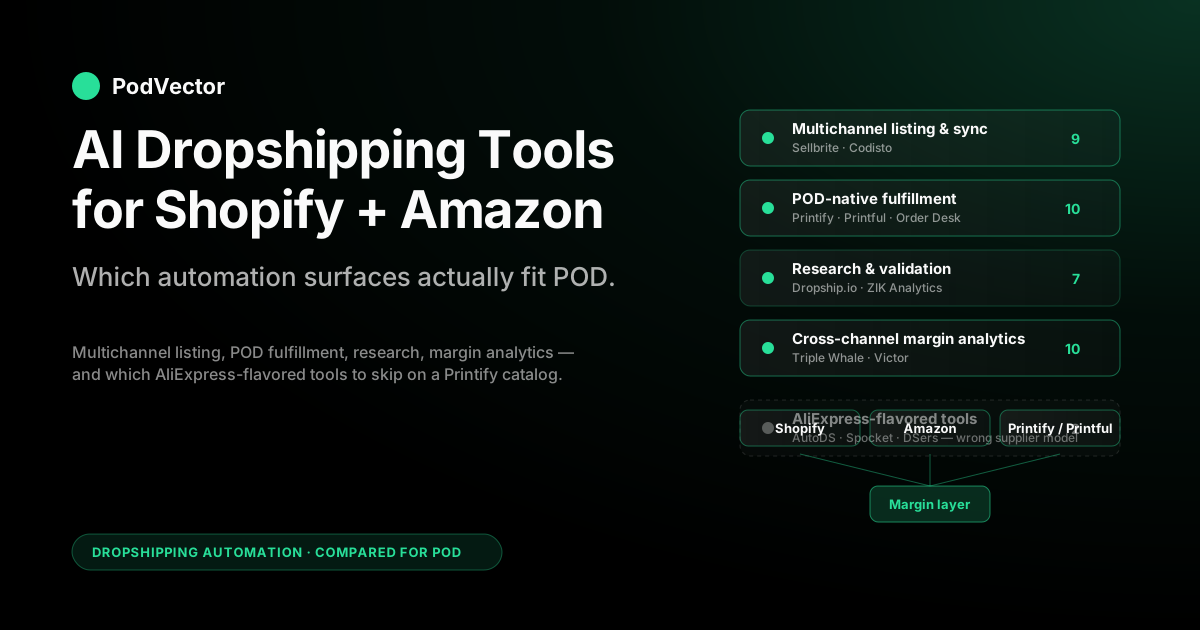
Quick Answer: The AI automated dropshipping tools that actually map to a print-on-demand operator running Shopify + Amazon are multichannel listing and inventory sync (Sellbrite, Codisto), POD-native order automation (Printify and Printful's built-in routing, plus Order Desk for multi-supplier failover), research and product validation (Dropship.io, ZIK Analytics for trend signal), and margin-aware approved actions across channels (Triple Whale for reporting, Victor by PodVector for proposed store actions). The tools every "best dropshipping AI" roundup pushes hardest — AutoDS, Spocket, DSers, Syncee, AppScenic — are built around an AliExpress-style sourcing model that POD operators don't use, because your supplier is already built into Printify/Printful and the automation gap is somewhere else entirely.
This guide compares the tools through a POD lens: which automation surfaces (sourcing, fulfillment, multichannel listing, repricing, analytics) actually exist for a Printify-supplied $24 shirt sold on Shopify and Amazon, which AliExpress-flavored tools to ignore, and where the real POD multichannel automation gap still sits in 2026.
Why "Dropshipping Automation" Maps Differently to POD
Most "best AI tools for dropshipping" roundups — including the top three Google results for the search term in 2026 (the Shopify 10-tool guide, the ZIK Analytics 11-tool roundup, and the Shopify automated-dropshipping guide) — assume one default sourcing model: a seller imports a product from AliExpress, CJ Dropshipping, Spocket's catalog, or another third-party supplier, sets a markup, and lets the tool automate price monitoring, inventory sync, and order forwarding. That's a coherent pattern for general dropshipping, and the tools (AutoDS, Spocket, DSers, Syncee, AppScenic, Dropshipping Copilot) are mostly variations on that same automation surface.
POD doesn't use that model. When a Printify-supplied shirt sells, the supplier is already built into the platform — Printify routes the order to one of its print partners automatically, the inventory is effectively unlimited (until a SKU goes out of stock at all partner locations), and the supplier-cost data is exposed through the Printify API.
There is no "import from AliExpress, monitor for price changes, switch suppliers if margin shrinks" workflow because the catalog isn't third-party in that sense. The same is true for Printful, Gelato, Gooten, and the Amazon-Merch-on-Demand backend: the supplier is the platform.
What that means in practice is that 60–70% of the feature surface in a typical dropshipping-automation tool is irrelevant to POD operators. AutoDS's price monitor doesn't help when Printify's prices are fixed in your storefront.
Spocket's supplier directory is useless when your supplier choice is already Printify-vs-Printful. DSers's AliExpress order routing has no place to plug in. The tools aren't bad — they're just not pointed at the same problem.
The actual automation gaps for a POD operator on Shopify + Amazon are different: multichannel listing parity (the same design needs to live on Shopify, Amazon Seller Central, Etsy, and sometimes TikTok Shop, with consistent titles, mockups, and pricing), per-channel-fee-aware repricing, design-level demand validation, and margin reporting that nets out Printify supplier cost, Amazon referral fees, FBA-versus-FBM choice, and shipping subsidies. Those are the questions worth automating. This guide ranks tools by how much of that surface they actually cover — and flags the AliExpress-built tools as a category to mostly skip.
For the higher-altitude framing of the POD AI stack, see the complete guide to AI tools for POD sellers. The tools cluster hub indexes every comparison guide on the site, and the AI analytics topic hub is where the cross-channel margin question — the one most dropshipping tools don't touch — gets answered.
The Scorecard: Tools by POD Automation Surface
Scores out of 10 on POD-specific axes — coverage of the automation surface that actually exists for a print-on-demand operator running Shopify and Amazon, integration with Printify or Printful, and whether the tool produces something usable beyond an AliExpress-flavored workflow.
| Tool | Primary surface | POD fit | Starting cost/mo | Shopify + Amazon coverage | Best for stage |
|---|---|---|---|---|---|
| Sellbrite | Multichannel listing & sync | 9 | $0–$59 | Native to both | Past first Amazon SKU |
| Codisto (Shopify Marketplace Connect) | Multichannel listing & sync | 9 | Free (1% fee past free tier) | Native to both | Day one for Shopify-led POD |
| Order Desk | Order routing & supplier failover | 8 | $20+ | Shopify native; Amazon via add-on | Past 500 orders/mo |
| Printify / Printful built-in | POD order fulfillment | 10 | Included | Shopify native; Amazon Merch separate | Day one |
| Dropship.io | Trend research | 7 | $39 | Insight only — no order plumbing | Past first 10 designs |
| ZIK Analytics | Marketplace research | 6 | $30 | Mostly eBay; Shopify and Amazon partial | Niche-validation phase |
| Triple Whale | Margin analytics (with manual COGS) | 7 | $129 | Shopify native; Amazon partial | Past $30K MRR |
| Victor (PodVector) | POD-native AI employee | 10 | Free in beta | Shopify + Printify/Printful | Day one |
| AutoDS | AliExpress / supplier import | 3 | $29.90 | Shopify + Amazon listing — wrong supplier model | Skip for POD |
| Spocket | Third-party supplier directory | 2 | $39.99 | Shopify native; not POD | Skip for POD |
| DSers | AliExpress order automation | 1 | $0–$49.90 | Shopify only; AliExpress-locked | Skip for POD |
If you came here for a comparison table, use the scorecard above as the short list: listing sync first for Shopify + Amazon expansion, POD-native fulfillment by default, research only when it validates real design demand, and Victor when the next step should be proposed and run with your approval.
The picks below cover the automation surface each tool actually owns for POD, the cost-per-shirt math against a Printify-supplied $24 unit with $11 of supplier cost, and where the seam is between automated and still-manual.
Multichannel Listing and Sync: Sellbrite, Codisto
The single highest-leverage automation surface for a POD operator selling on both Shopify and Amazon is keeping the same design listed across both channels with consistent titles, mockups, prices, and inventory state. Done manually, this is a 20-minute job per design per channel — and a POD store with 200 designs across two channels has burned 130 hours just keeping the listings parallel. The 2026 multichannel sync tools do the heavy lifting here without assuming a particular supplier model, which is why they fit POD cleanly where AliExpress tools don't.
Sellbrite
Pricing: Free up to 30 orders/mo; $29/mo Pro (100 orders); $59/mo Pro Plus (500 orders).
Best for: POD operators selling on Shopify + Amazon + sometimes Etsy who want one place to push design listings.
Sellbrite (owned by GoDaddy since 2019) is the workhorse multichannel listing tool for Shopify-led sellers. Push a design's product record once, Sellbrite creates the matching listing on Amazon Seller Central, Etsy, eBay, and Walmart with platform-correct title, attribute, and image formatting.
For POD specifically, the integration with Printify or Printful flows the right direction: product record originates on Shopify (where your Printify product lives), Sellbrite syndicates outward, and inventory state stays consistent. Where it earns its subscription: the Amazon listing flow, which in 2026 still requires a brand registry, A+ content, and the right browse-node taxonomy — Sellbrite handles the formatting glue that would otherwise eat 30 minutes per listing.
Cost-per-shirt math: at $29/mo Pro for 100 orders, breaking even requires about 3 incremental orders/month from the Amazon channel that wouldn't have happened without the tool. Most POD stores that get past the first Amazon-listing setup-friction hit that floor inside week two.
Where Sellbrite falls short for POD: Amazon Merch on Demand (Amazon's own POD program, separate from Seller Central) isn't a supported channel. If your Amazon strategy is Merch-on-Demand-first rather than Seller-Central-first, Sellbrite doesn't help.
Codisto / Shopify Marketplace Connect
Pricing: Free for the first 50 listings; 1% transaction fee thereafter (capped at $99/mo).
Best for: POD operators who already use Shopify as the source of truth and want Amazon, eBay, Walmart, and TikTok Shop wired in through a single Shopify-native app.
Codisto rebranded as Shopify Marketplace Connect in 2024 and is now the Shopify-recommended multichannel app. The pitch versus Sellbrite is tighter integration (it lives inside the Shopify admin, not as a separate dashboard) and the transaction-fee pricing model that scales with usage rather than a flat tier. For POD, the Shopify-native angle matters — Printify and Printful both publish to Shopify first, so anchoring multichannel sync at the Shopify layer means design changes propagate cleanly to all downstream channels without an intermediate sync step.
Cost-per-shirt math: 1% of order value caps at $99/mo, which translates to about $9,900/mo of marketplace-channel revenue. For a sub-$10K MRR multichannel POD store, the effective cost is meaningfully below Sellbrite's flat $29 — most operators land below the cap until well past $30K MRR. Above that, Sellbrite's $59 flat tier wins on absolute dollars.
Decision rule: pick Codisto / Shopify Marketplace Connect if you're under $10K of marketplace-channel revenue/month and want the Shopify-native interface. Pick Sellbrite if you've got more than 100 designs across 3+ channels and need the dedicated dashboard for bulk operations.
POD-Native Order Automation: Printify, Printful, Order Desk
The order-automation surface that AliExpress dropshipping tools obsess over — push order to supplier, monitor fulfillment, sync tracking back — is already done for POD by Printify and Printful natively. Worth understanding what they do automatically before paying for tools that promise to do it again.
Printify built-in routing
Pricing: Included with Printify (free, $29/mo Premium, custom Enterprise).
Best for: Every POD operator using Printify — this is automatic, not optional.
Printify's order-routing engine assigns each Shopify order to one of its print partners (Monster Digital, Drive Fulfillment, SwiftPOD, etc.) based on cost, location, and capacity. The 2026 version weights routing by region (US orders go to the closest print partner with the SKU in stock) and by partner reliability score (newer partners get smaller order volumes until their fulfillment-time and defect-rate metrics stabilize). This is the automation that an AliExpress dropshipping tool would charge $29/mo for — for Printify users, it's table stakes.
Where the gap is: when a print partner runs out of a specific blank or hits a capacity ceiling, Printify routes to a fallback, but the cost difference (sometimes $1.50–$3/unit between partners) doesn't propagate to your storefront pricing automatically. A design that prints 80% at one partner and 20% at a more expensive backup will quietly lose margin on the 20% — and unless you're watching the supplier-cost line in your analytics, you won't see it.
Printful built-in routing
Pricing: Included with Printful (free; $9/mo Plus; $59/mo Business).
Best for: POD operators who prioritize quality consistency over the lowest possible supplier cost.
Printful uses a single-supplier model — they own the print facilities themselves rather than routing to partners — which trades the cost flexibility of Printify for production consistency. There's no routing engine because there's no choice to route between.
For POD operators on Printful, the automation question is mostly inventory-aware (which fulfillment center has stock and capacity) rather than supplier-aware. The 2026 Printful auto-fulfillment update added smarter region matching: orders ship from the closest US/EU/Mexico/Latvia facility with stock, reducing transit time without operator intervention.
Order Desk
Pricing: $20/mo Starter (12 stores, 500 orders); $50/mo Pro; custom Plus.
Best for: POD operators with multiple suppliers (Printify + Printful, or POD + a custom merch supplier) who want one place for order routing, failover, and supplier-by-rule logic.
Order Desk is the multi-supplier router that solves the gap Printify and Printful don't touch — when you've got designs that print better at Printful (apparel) and others that print better at Printify (mugs, bags, accessories), Order Desk routes incoming Shopify orders to the right supplier per SKU based on rules you configure. The AI piece is in the rule-recommendation engine: it watches your historical fulfillment outcomes and suggests routing changes when a supplier consistently underperforms on a given product type.
Cost-per-shirt math: at $20/mo Starter, you need about 2 incremental orders/month that would have failed (or gone to a higher-cost supplier) without the routing rules to cover the subscription. For multi-supplier POD operations past 500 orders/month, the rule-based routing typically saves 4–8% of supplier cost across the catalog versus single-supplier pricing.
Product Research and Validation: Dropship.io, ZIK Analytics
Where the dropshipping-AI roundups overlap usefully with POD is in research and trend-validation tools. These tools watch the broader ecommerce SERP and surface what's selling — which translates for POD into "which design themes, niche communities, and demographic targets are showing demand right now." The product-import side of these tools (the AliExpress-flavored "click to import this winning product to your store") doesn't apply, but the data feed does.
Dropship.io
Pricing: $39/mo Basic; $79/mo Pro; $99/mo Premier.
Best for: POD operators researching design niches and validating that a theme has commercial pull before investing 3 hours of design time.
Dropship.io's research suite tracks competitor stores and their product-level sales data, identifies trending products on TikTok and Facebook ad libraries, and surfaces niches with rising search demand. For POD, the highest-leverage use is the "competitor sales tracker" — identify a small Shopify store selling shirts in a specific niche (say, "registered nurse with 3+ years"), pull their inferred monthly order count, and use that as a sanity check before spending a weekend designing your own version. The 2026 update added AI-driven niche-scoring that ranks how saturated a niche is by counting active competitors at different revenue tiers.
Cost-per-shirt math: at $39/mo Basic, breaking even is about 4 incremental shirts/month from designs that wouldn't have launched (or wouldn't have been killed soon enough) without the research signal. Most POD operators report a meaningful change in their design-validation hit rate inside the first 60 days — designs that pass Dropship.io's niche-volume filter sell at roughly 2–3x the rate of designs picked from intuition alone.
Where Dropship.io falls short for POD specifically: the data feed is heavily weighted toward dropshipping (AliExpress-supplied gadgets, beauty SKUs, novelty items) rather than POD-style design-driven apparel. You're essentially using a research tool built for a different business model, which means roughly 40% of its surfaced "winning products" are irrelevant to a POD store.
ZIK Analytics
Pricing: $19.99/mo Pro Lister; $29.99/mo Pro; $44.99/mo Enterprise.
Best for: POD operators with an eBay channel; partial fit for Shopify and Amazon Merch operators.
ZIK Analytics's strongest data is on eBay sell-through rates and pricing — which is genuinely useful for the subset of POD operators who run an eBay channel for clearance designs or older styles. The 2026 version added Shopify-store research (similar surface to Dropship.io) and an Amazon Turbo Scanner that pulls pricing and review-velocity data from Amazon's catalog. For POD on Shopify + Amazon Seller Central, the Amazon scanner is the part worth paying for: it identifies design themes where the existing Amazon catalog has weak coverage and where a POD listing has a structural opening to rank.
Where ZIK falls short for POD: the AI Store Builder (a 2024 launch that auto-generates a Shopify store from keywords) is built for general dropshipping, not POD design workflow, and the Adsy ad-research tool is calibrated for AliExpress products, not apparel. About half the toolset is unused by a POD operator.
The AliExpress Crowd: AutoDS, Spocket, DSers, Syncee, AppScenic
This is the section that breaks from every other "best dropshipping tools" roundup. The tools below — AutoDS, Spocket, DSers, Syncee, AppScenic, Dropshipping Copilot — are excellent at what they do, and they're the right answer for a non-POD dropshipping operator.
For POD specifically, they're mostly the wrong tool. Including a brief assessment of each so a POD operator searching for dropshipping automation can confirm which to skip.
AutoDS
Pricing: $29.90/mo Starter (200 products); $39.90/mo Advanced; $49.90/mo Premium.
Best for: Sellers importing from AliExpress, Amazon, Walmart, or eBay to a Shopify store. Wrong tool for POD.
AutoDS is the most comprehensive dropshipping automation platform on the market — product import, price monitoring, inventory sync, automated order fulfillment, supplier-side switching, and a TikTok-product-finder layer. It's a clean ten out of ten for the use case it's built for.
For POD, the entire value stack assumes a third-party supplier model (you import a $4 product from AliExpress, mark it up to $24, AutoDS watches the supplier price for changes). When your supplier is Printify, none of that engine applies — Printify's pricing is exposed, fixed in your storefront, and routed automatically without AutoDS in the loop.
Spocket
Pricing: $39.99/mo Starter; $59.99/mo Pro; $99.99/mo Empire.
Best for: Shopify dropshippers wanting US/EU-sourced products from a curated supplier directory. Not a POD tool.
Spocket's value is the supplier directory — fast US/EU shipping, branded invoicing, and a curated catalog of products you can drop-ship without going through AliExpress. None of that maps to POD: your supplier is Printify or Printful, your catalog is your designs (not Spocket's), and the "branded invoicing" feature is solved natively by Printful's white-label option.
DSers
Pricing: Free Basic; $19.90/mo Advanced; $49.90/mo Pro.
Best for: AliExpress-sourced Shopify dropshipping. No POD application.
DSers is the official AliExpress dropshipping partner with the deepest AliExpress integration — bulk-order processing, supplier optimization, and the AliExpress-API access most other tools don't have. For POD, AliExpress isn't part of the equation, so DSers is a flat skip.
Syncee, AppScenic
Best for: Multi-supplier dropshipping with global supplier networks. Limited POD relevance.
Syncee (12,000+ suppliers, $29/mo) and AppScenic ($29/mo) are both global supplier directories with auto-sync. They overlap heavily with Spocket's pitch and don't add anything POD-specific. Skip unless you're building a hybrid catalog where some products are POD and some are dropship-supplied — at which point Syncee's broader catalog is a slight edge over AppScenic.
Margin-Aware Analytics: Triple Whale, Victor
The last surface — and the one most "best AI dropshipping tools" lists ignore — is cross-channel margin analytics. For a POD operator running Shopify + Amazon, the actual unit-economic math is harder than for a single-channel store: the same shirt sells for $24 on Shopify with 2.9% + 30¢ payment fees, and $26 on Amazon with a 15% referral fee plus FBA storage if FBA, plus different shipping subsidies per channel, plus Amazon's Brand Registry costs amortized across SKUs. A tool that just shows "Shopify revenue this month" isn't enough; you need per-channel-per-design contribution margin.
Triple Whale
Pricing: $129/mo Founders; $349/mo Growth; custom Pro.
Best for: POD operators past $30K MRR who can configure per-SKU COGS and per-channel-fee logic manually.
Triple Whale is the dominant Shopify ecommerce analytics platform and the 2026 release added Amazon Seller Central as a first-class channel. For POD, Triple Whale will produce useful margin reports — but you have to manually configure per-SKU COGS for every Printify or Printful variant, the per-channel fee logic for Amazon, and any FBA storage costs.
The mapping is doable; the maintenance is real (Printify supplier costs change quarterly, FBA fees change annually). Operators willing to keep the COGS table accurate get genuinely useful margin-by-design reporting; operators who skip the COGS work get revenue-only attribution and miss the actual POD signal.
Victor (PodVector AI)
Pricing: Free during beta; pricing TBD post-launch.
Best for: POD operators on Shopify + Printify or Printful who want margin-by-design without manual COGS work.
Victor is PodVector's AI employee for POD sellers — connect Shopify and Printify or Printful, then ask which designs, channels, or products need action. Victor reviews your store and supplier signals, proposes the next move, and waits for approval before running changes such as pricing checks, delist reviews, or product-mix adjustments.
For POD operators evaluating tools today, the trade-off versus Triple Whale is mostly: pay $129/mo and configure COGS yourself for reporting, or use Victor's POD-native operating layer to turn margin checks into approved actions on Shopify.
Two Reference Stacks: Shopify-Only POD vs. Shopify + Amazon
The right tool stack depends entirely on whether you're running Shopify-only or expanding into Amazon. Two reference stacks for the typical sub-$50K MRR POD operator:
Stack A: Shopify-only POD
- Sourcing & fulfillment: Printify or Printful built-in (free, automatic)
- Order routing: Built-in only; Order Desk if running multi-supplier ($20/mo)
- Multichannel listing: Skip — single channel
- Research: Dropship.io Basic ($39/mo) past your first 10 designs
- Operations: Shopify Analytics + Victor (free in beta) for margin checks and approved actions
Total: $0–$59/month. Most automation work is already done by Printify/Printful and Shopify itself. The dropshipping-tool layer adds nearly nothing here.
Stack B: Shopify + Amazon POD
- Sourcing & fulfillment: Printify or Printful built-in (free, automatic)
- Order routing: Order Desk if multi-supplier ($20/mo)
- Multichannel listing: Codisto / Shopify Marketplace Connect (free up to 50 listings; ~$30–$99/mo at scale) or Sellbrite ($29–$59/mo)
- Research: Dropship.io Basic ($39/mo) + ZIK Analytics Pro ($29.99/mo) for the Amazon scanner
- Operations: Triple Whale Founders ($129/mo) once you can maintain COGS, or Victor (free in beta) for cross-channel margin checks and approved actions
Total: $50–$220/month depending on multichannel-listing tier. The marginal cost over Stack A is mostly the multichannel-listing layer plus Amazon-aware research; everything else stays the same.
Where Dropshipping Automation Tools Still Miss for POD
The stack above covers listing, fulfillment, research, and analytics. What it doesn't cover — and where POD operators on Shopify + Amazon still spend most of their decision time — is the design-portfolio question: which of your 200 designs across two channels are compounding, which are zero-volume, and which are listed but quietly margin-negative once you net out Amazon's referral fees, FBA storage, and Printify's per-partner cost variance.
None of the dropshipping automation tools above answers that natively. Sellbrite and Codisto sync listings but don't read margin.
Order Desk routes orders but doesn't surface profitability. Dropship.io and ZIK find new niches but don't audit existing ones.
Triple Whale comes closest with manual COGS upload, but the per-channel-per-design cross-tab requires custom dashboarding. The structural gap is that dropshipping tools are organized around suppliers and orders, while POD's actual ROI surface is organized around designs, channels, and supplier-cost variance.
Closing that gap manually is what most POD operators do in spreadsheets — and it's the specific problem AI analytics for print-on-demand is built to solve. For the demand-side companion (forecasting which designs to restock and reorder before they go out of stock), see AI inventory forecasting on Shopify for POD sellers. And for the employee capability — answering and acting on those answers — see agentic AI for ecommerce, applied to POD.
FAQs
Are AutoDS or Spocket worth it for a POD store on Shopify and Amazon?
No, in almost every case. AutoDS and Spocket are built around an AliExpress-style sourcing model — import a third-party product, monitor supplier prices, switch suppliers if margin shrinks.
POD operators don't have that workflow because Printify and Printful are the supplier, with cost data exposed and fulfillment routed automatically. The features you'd be paying $30–$60/month for are already done for free by your POD platform.
What's the best free or near-free automation stack for a Shopify + Amazon POD store?
Printify or Printful for fulfillment (free, automatic), Codisto / Shopify Marketplace Connect for multichannel listing (free up to 50 listings), Shopify Analytics for revenue tracking, and Victor (free during beta) for Shopify margin checks and approved POD actions against Printify/Printful supplier cost. That's roughly $0/month for the day-one stack and covers about 80% of the automation surface a paid dropshipping tool would offer.
How does Amazon Merch on Demand fit into this?
Amazon Merch on Demand is Amazon's own POD program — separate from Seller Central, separate fulfillment, and not covered by Sellbrite, Codisto, or any of the multichannel-listing tools. If you're running Merch on Demand alongside Shopify + Printify, you're effectively running two parallel POD operations with no listing-sync layer. The 2026 reality is that there isn't a great tool for unifying the Merch-on-Demand workflow with Shopify + Printify — most operators who run both manage them as separate stores and reconcile in spreadsheets.
Does Dropship.io actually find POD-relevant winning products?
Partially. Roughly 40% of Dropship.io's surfaced "winning products" are POD-relevant (apparel niches, mug niches, gift-occasion themes); the other 60% are AliExpress-flavored gadgets and beauty SKUs that don't map to a POD catalog. Use it as a niche-validation tool (does this theme show commercial pull?) rather than a product-import tool, and the per-shirt math works.
Can a single tool handle Shopify + Amazon order routing, listing, fulfillment, and analytics for POD?
Not in 2026. The closest is a bundle: Printify or Printful for fulfillment, Codisto for listing sync, Order Desk for multi-supplier routing, and Victor for Shopify margin checks and approved POD actions against Printify/Printful supplier cost.
There's no single platform that owns all four surfaces specifically for POD, and the AliExpress-flavored "all-in-one dropshipping platform" tools all miss at least the multichannel-margin layer. Expect a fragmented stack with 2–3 tools running in parallel.
How long should it take to see ROI from adding a multichannel listing tool?
30–60 days. The payback comes from listing parity: a design that's been live on Shopify for two months and only just gets listed on Amazon (because manual setup was a barrier) starts producing Amazon orders within days of going live. Most POD operators who add Sellbrite or Codisto see Amazon revenue cross 10% of total within the first 60 days, which is where the subscription clears in any reasonable cost-per-shirt math.
Want Victor to propose the next POD action?
Victor reviews your Shopify and POD supplier signals, proposes pricing, delist, and product-mix actions, then runs the changes you approve. while it's in beta.
Try Victor free