
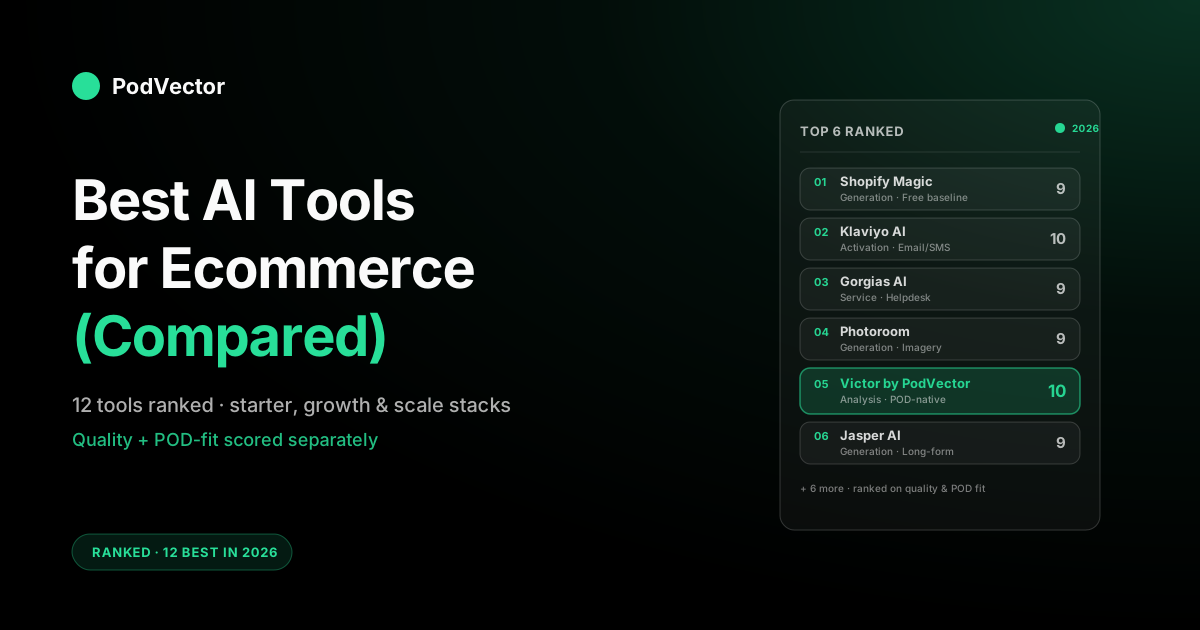
Quick Answer: The best AI tools for ecommerce in 2026, ranked by job-to-be-done: 1. Shopify Magic (free built-in baseline), 2. Klaviyo AI (email/SMS lifecycle), 3. Gorgias AI (Shopify-native support resolution), 4. Photoroom (product imagery at scale), 5. Victor by PodVector AI (POD-native AI employee), 6. Jasper AI (content production at catalog scale), 7. Rebuy (cart upsells), 8. Octane AI (quizzes and guided discovery), 9. Triple Whale (DTC attribution), 10. Tidio AI (live chat for smaller stores), 11. Smartly.io (enterprise paid-ad automation), and 12. Fin (end-to-end support resolution by resolution rate).
For stores asking specifically about an answer engine — a tool that both reads your live store data and acts on it, not just surfaces charts — the field narrows fast. Shopify Sidekick answers questions inside the admin; Fin resolves support tickets end-to-end; Victor by PodVector AI is the only option that reads a POD seller's Shopify, Meta Ads, Google Ads, Printify, Printful, and Klaviyo data and then executes approved Shopify-side moves (repricing, discounts, collections, Klaviyo flows, threshold changes). The right pick depends on what you need the "answer" to do.
The ranking shifts once you factor in store type. Inventory-owning DTC brands and print-on-demand stores have different cost structures and data models. This guide ranks each tool on raw quality for a generic Shopify store, then flags where the answer flips for POD operators fulfilling through Printify or Printful. Three concrete stack picks — starter, growth, scale — with monthly costs are at the end.
What Makes an AI Tool "Best" for Ecommerce in 2026
"Best" gets thrown around a lot in roundups, and the criterion that separates the keepers from the trial-cancellations is usually the same: the tool either ships measurable revenue lift inside 60 days or it doesn't earn its slot. Brand recognition, demo polish, and feature breadth all rank below that one test.
For this comparison, each tool was scored on four things:
- Time-to-ROI — how fast does revenue lift, cost reduction, or labor saved actually appear after install? Tools that take six or more months to prove value get downranked because most ecommerce stores don't have the runway to wait.
- Integration depth — does it plug into Shopify, Klaviyo, Meta, Google, and your fulfillment provider out of the box, or does it need a developer to wire up?
- Pricing reality — does the floor pricing match the floor revenue of stores that need the tool? A high-priced tool that only pays back at substantial monthly revenue isn't useful for the store doing early-stage numbers.
- POD compatibility — for stores fulfilling through Printify, Printful, Gelato, or similar, does the tool's underlying data model work with variable supplier costs and zero on-hand inventory?
A few popular tools didn't make the top 12 because they failed at least two criteria. We'll flag those in the FAQs.
As coursiv.io notes in its June 2026 roundup, the best approach is to "start with support automation if tickets are eating time, content tools if your catalog is growing, personalization/search if shoppers cannot find products, and analytics/attribution if you are scaling paid channels" — a bottleneck-first framework that holds regardless of store size.
What Is an AI Answer Engine for Ecommerce?
The term "answer engine" is appearing more often in 2026 tool comparisons — and it means something more specific than a chatbot or a dashboard with a search bar.
A true AI answer engine for ecommerce does three things: it pulls in your live store data from every channel, it answers your plain-English questions using that data, and — critically — it takes or suggests an action based on the answer. The distinction matters because most tools stop at step two.
- Shopify Sidekick is an answer engine for Shopify admin data. According to Shopify's own help center (as documented by coursiv.io, June 2026), Sidekick can generate content, analyze data, manage orders, edit products, and present changes for review — but its read surface is the Shopify admin only, not ad accounts or fulfillment providers.
- Fin by Intercom is an answer engine for support: it reads your help content and order data, then executes resolutions (refunds, address updates, subscription changes) rather than just deflecting tickets.
- Victor by PodVector AI is an AI employee built for print-on-demand sellers. He connects to your Shopify, Meta Ads, Google Ads, Printify, Printful, and Klaviyo accounts, reads your live data, then suggests a clear next step (reprice this product, set up this discount, raise the free-shipping threshold, draft a Klaviyo flow, adjust an ad campaign) along with his reasoning and what he expects it to do. You see every change as a card and approve or reject it; Victor only makes a move once you say yes. He's the only tool in this roundup that goes from reading your whole store and ad accounts to actually making the change for you.
- Triple Whale's Moby answers questions about attribution, LTV, and creative performance in natural language — but it stops at the answer; the action is still on the merchant.
If your bottleneck is "I need better answers about my data," any of these work. If your bottleneck is "I need the answer and the action executed," the list shortens to Fin (for support) and Victor (for POD operations). Keep this distinction in mind as you read the rankings below.
AI-visibility platforms like Yotpo Discover add a third layer: Yotpo Discover is the first AI visibility platform made specifically for the messy reality of commerce; it sits between passive operational analytics and active search improvement, working to make sure AI engines recommend your specific SKUs at the moment someone is deciding what to buy. That's an answer-engine concern for a different audience — shoppers in AI search — rather than the operator-facing answer engines above.
AI Agents vs. Chatbots: Why the Distinction Matters in 2026
Most roundups still use "AI chatbot" and "AI agent" interchangeably. They're not the same thing, and buying the wrong one wastes budget.
A chatbot answers questions and deflects tickets — it points shoppers at a help article or fires a canned reply. An AI agent resolves the issue end-to-end: it reads system data, executes the action (issues the refund, updates the address, modifies the subscription), and closes the loop without a human in the queue.
The same split applies beyond support. Victor is an AI employee, not a chatbot — he doesn't just surface "this SKU is losing margin," he proposes the Shopify-side fix with specific old/new values (raise the price, adjust the discount, update the free-shipping threshold) and executes it once you approve. Tidio, by contrast, provides AI chat and automation through its Lyro AI agent — it handles pre-sales questions and straightforward support flows effectively, though it lacks the action depth to process refunds or modify orders in backend systems. Knowing which mode you're buying saves a lot of disappointed post-trial cancellations.
For POD sellers managing ad-platform moves, see our guides on AI media buying and UGC to combat ad fatigue — both cover how agent-style automation interacts with paid-ad workflows.
AI Tools for High-SKU Ecommerce: What Changes
Most AI roundups are written for stores with a few dozen products. The moment your catalog crosses a few hundred SKUs, several of the standard recommendations break down — and a handful of tools that didn't appear in the top ten suddenly matter a lot more.
The core problem is discovery. The highest-impact tools in high-SKU environments are those that resolve issues and take action across systems, not just generate content or deflect conversations. At catalog scale, the bottlenecks shift:
- Search and discovery become conversion levers. A shopper hitting a catalog of thousands of SKUs and getting generic results will leave without a ticket or an abandoned cart email — just gone. AI-powered site search tools like Constructor and Algolia are overkill at narrow catalogs but become genuine revenue tools at scale.
- Content production becomes a bottleneck. Writing compelling, SEO-optimized product descriptions for hundreds or thousands of SKUs is one of the most time-consuming content tasks in ecommerce. This is where Jasper's catalog-scale templates and Shopify Magic's bulk-generation features stop being nice-to-haves and start being operational necessities.
- Merchandising control matters more. Tools like Bloomreach and Constructor, which rank results by revenue and business rules rather than keyword match, become relevant once your catalog is wide enough that generic search visibly suppresses revenue.
- Image production compounds. Batch-processing capabilities in tools like Photoroom become critical when you're launching new SKUs at high velocity — especially for POD stores where the marginal cost of a new design is near zero.
- Pricing guardrails matter. Define your minimum acceptable margin before enabling automated price changes — AI pricing tools work best with clear guardrails around profitability floors. This is especially true for POD stores where supplier-cost variance across blanks and fulfillment partners can silently erode margin on specific SKUs.
The recommendations in the comparison table below apply to a generic Shopify store. The high-SKU callouts within each tool section flag where the ranking or recommendation changes for stores with wide catalogs. See also our guides on AI media buying and UGC to combat ad fatigue — both compound in high-SKU environments where creative volume is high.
Comparison Table: 12 Best AI Tools for Ecommerce
Scored on quality and on POD-fit separately. The "Quality" score reflects how well the tool does its job for a generic Shopify store. The "POD fit" score reflects how well it works for a store fulfilling through Printify or Printful with moderate to strong annual revenue. Verify current pricing at each vendor's site before subscribing — ecommerce AI pricing changes frequently.
| Rank | Tool | Job | Starting price | Quality (/10) | POD fit (/10) |
|---|---|---|---|---|---|
| 1 | Shopify Magic | Generation (built-in) | Free with Shopify | 9 | 9 |
| 2 | Klaviyo AI | Activation (email/SMS) | Free to ~250 contacts (per Yotpo) | 10 | 9 |
| 3 | Gorgias AI | Service (helpdesk) | From $10/mo + per-resolution AI fees | 9 | 8 |
| 4 | Photoroom | Generation (imagery) | Free tier; pro plans available | 9 | 9 |
| 5 | Victor by PodVector AI | Operations (POD-native AI employee) | Free tier; paid plans | 8 | 10 |
| 6 | Jasper AI | Generation (content) | From $39/mo | 9 | 6 |
| 7 | Rebuy | Activation (upsells) | From $99/mo | 9 | 7 |
| 8 | Octane AI | Activation (quizzes) | From $50/mo | 8 | 7 |
| 9 | Triple Whale | Analysis (DTC) | From $129/mo | 10 | 5 |
| 10 | Tidio AI | Service (live chat) | From $29/mo | 8 | 7 |
| 11 | Smartly.io | Acquisition (paid ads) | Enterprise pricing | 9 | 5 |
| 12 | Fin | Service (resolution AI) | $0.99/resolution | 9 | 7 |
The ranking is conservative on novelty. Three of the top five (Shopify Magic, Klaviyo, Gorgias) have been around long enough that their AI features are battle-tested. Photoroom and Victor are newer but earn the position by solving a job no incumbent solves well. The "best" label here means "highest probability of paying for itself," not "most innovative."
The 12 Tools, Ranked
1. Shopify Magic — The Free AI Suite You Already Own
Best for: any Shopify store, full stop.
Pricing: free with any Shopify plan.
What it does: Shopify's AI features are baked directly into the admin — product description generation that matches your brand voice, automatic email subject lines in Shopify Email, image background editing, FAQ generation for product pages, store policy drafting, and Shopify Inbox chat-reply suggestions. Sidekick, Shopify's AI assistant, goes further: Shopify's help center describes Sidekick as an AI-enabled commerce assistant inside Shopify admin that can generate content, analyze data, manage orders, edit products, and present changes for review. None of this requires extra spend.
Why it ranks #1: the cost-to-value ratio is unbeatable — every other tool on this list has to clear the bar of "more useful than what Shopify Magic already gives you for free." For a brand-new store, the right move is to use Magic's full feature set for 30 days before evaluating any paid AI tool.
High-SKU note: Shopify Magic's bulk-description generation becomes genuinely important at catalog scale — writing descriptions for hundreds of SKUs manually is the kind of task that buries merchandising teams.
2. Klaviyo AI — The Email and SMS Workhorse
Best for: any ecommerce store with an active email list.
Pricing: free tier up to 250 contacts; paid plans scale with list size.
What it does: predictive segments (likely-to-purchase, churn risk), AI-generated subject lines, send-time optimization, AI-powered SMS audiences, and a growing set of AI marketing agents. Klaviyo is an email and SMS marketing platform purpose-built for e-commerce — it pulls in customer purchase history, browsing behavior, and lifecycle stage to trigger automated flows (welcome sequences, abandoned cart nudges, post-purchase upsells) without someone manually scheduling each send, resulting in a retention engine that runs in the background while your team focuses on the next campaign. Revenue attribution is calculated at the campaign level, so you can see which flows are actually driving repeat orders rather than inflating open-rate metrics that don't connect to dollars.
Why it ranks #2: email and SMS remain the highest-ROI marketing channels for ecommerce, and Klaviyo is the platform with the deepest AI roadmap inside ecommerce-native lifecycle marketing. The lifecycle templates work for any store; the AI layer makes them better without a list-management hire.
3. Gorgias AI — Resolves Order-Status Tickets End-to-End
Best for: stores doing meaningful ticket volume where a large share are order-status questions.
Pricing: from $10/month for the basic helpdesk; AI Agent pricing is per resolved conversation — confirm current rates at Gorgias's site before subscribing.
What it does: Gorgias is an AI-powered customer support tool designed exclusively to assist e-commerce support teams in replying faster and more efficiently; it automates ticket categorization, suggests replies, and handles repetitive support workflows while keeping humans in the loop when needed. The Shopify integration is deep — the AI can look up order status, issue partial refunds within rules you set, and triage edge cases to humans.
Why it ranks #3: support is the biggest hidden cost in scaling ecommerce, and Gorgias is the most mature tool for resolving the high-volume, low-complexity tickets that eat hours every day. Pre-shipment "where's my order" tickets for POD stores can still escalate to humans when Printify or Printful production status isn't available to the helpdesk — set resolution-rate targets with that gap in mind. For POD-specific ad-platform diagnosis that reduces inbound support pressure, see our guide on AI media buying.
4. Photoroom — Product Imagery in Seconds
Best for: any ecommerce store generating product imagery for new SKUs at scale.
Pricing: free tier available; pro and team plans — confirm current pricing at Photoroom's site before subscribing, as rates vary by plan and region.
What it does: background removal, AI lifestyle backgrounds, batch processing of mockups, shadow generation, and a growing library of AI-generated scenes. Drag a flat product photo in, get a hero image with a model wearing it in seconds. Batch processing handles large catalogs efficiently, making Photoroom especially useful for marketplace sellers and teams managing large SKU counts.
Why it ranks #4: the cost-per-image is functionally zero at scale. Stores launching many new SKUs per week save meaningful designer hours. For POD specifically, Photoroom is one of the highest-ROI subscriptions on this list — see our guide on how PodVector AI helps POD sellers for the broader POD stack context.
High-SKU note: batch processing is the standout feature at scale. If you're launching dozens of designs per week, the batch workflow replaces a part-time design contractor.
5. Victor by PodVector AI — POD-Native AI Employee and Answer Engine
Best for: POD stores that want an AI employee to read their Meta Ads, Google Ads, Shopify catalog, and Printify/Printful fulfillment data — and make approved changes, not just show charts.
Pricing: free tier for early users; paid plans at launch.
What it does: Victor is an AI employee built for print-on-demand sellers. He connects to your Shopify, Printify, Printful, Meta Ads, Google Ads, and Klaviyo accounts, reads your live data, then suggests a clear next step along with his reasoning and what he expects it to do. You approve or reject each change as a card; Victor only acts once you say yes.
Ask "which Printify products lost margin this month and why?" and you get a real answer in seconds, with your supplier costs factored in. Then Victor suggests a fix: raise the price on the losing product, set up a discount on a better-margin collection, or adjust the free-shipping threshold. He can also use what he sees in your ad accounts to suggest a change there too, like pausing a campaign or adjusting a bid — but he only makes the change once you approve it.
<<<<<<< Updated upstreamShipped Shopify-side actions today include: repricing worst-margin SKUs to a target margin, setting up buy-one-get-one discounts, raising the free-shipping threshold, bulk-updating product prices, creating and updating discount codes (including BxGy, free-shipping, and customer-specific), managing collections, and drafting or scheduling Klaviyo email campaigns and flows (abandoned-cart, welcome, post-purchase). Every action requires human approval before execution. Victor also reads and proposes moves informed by Meta Ads and Google Ads data — Google Ads writes are not yet built.
Honest limits: Victor cannot generate designs or mockups, and he has no memory from one chat to the next. His only proactive update is a Weekly Health Report every Monday; the rest of the time he answers when you ask. Etsy, Amazon, and TikTok are not connected.
Why it ranks #5: Victor is the only tool on this list that both answers questions across a POD seller's full set of store and ad data and makes the approved change himself, whether that's on Shopify, Google Ads, Meta Ads, or Klaviyo. For inventory-owning DTC brands, Triple Whale or Polar are the right picks; for POD operators, Victor is the one tool that sees everything and acts on it. For the Meta and Google ad strategy that feeds Victor's recommendations, see our guides on Facebook Ads for ecommerce POD stores and how to set up Google Ads for Shopify.
Shipped Shopify-side actions today include: repricing worst-margin SKUs to a target margin, setting up buy-one-get-one discounts, raising the free-shipping threshold, bulk-updating product prices, creating and updating discount codes (including BxGy, free-shipping, and customer-specific), managing collections, and scheduling or delaying a Klaviyo email flow or campaign. Every action requires human approval before execution. Victor also reads and proposes moves informed by Meta Ads and Google Ads data — Google Ads writes are not yet built.
Honest limits: Victor cannot generate designs or mockups (the #1 user-requested unbuilt capability), has no cross-session memory, and cannot answer margin questions for stores with no completed orders. His proactive surface is a Weekly Health Report; everything else is query-driven.
Why it ranks #5: Victor is the only tool on this list that both functions as an answer engine across a POD seller's full data surface and executes the approved action on Shopify. For inventory-owning DTC brands, Triple Whale or Polar are the right picks; for POD operators, Victor is the one tool that reads the warehouse and acts on it. For more on margin visibility in POD, see our guides on net profit margin benchmarks and average checkout completion rate in ecommerce.
6. Jasper AI — Content Production at Scale
Best for: ecommerce stores running an active blog or category-page SEO program — especially those with large catalogs where manual content writing is impractical.
Pricing: Creator plan from $39/month; team plans from $59/seat — confirm current pricing at Jasper's site.
What it does: long-form blog content, SEO-optimized landing pages, ad copy variants, and brand-voice memory across pieces. The Surfer SEO integration scores drafts against the top-ranking results for a target keyword, which closes the gap between writing and ranking. Jasper is most valuable when catalog scale makes manual writing impractical — it accelerates product descriptions, category copy, ad variants, landing page drafts, emails, and SEO content for teams managing large SKU counts.
Why it ranks #6: Jasper is a strong tool at catalog scale, but for early-stage stores with a handful of products, a general-purpose AI writing assistant at a lower price point does most of what Jasper does. Add Jasper when content marketing is a committed channel and you need many long-form pieces per month, or when your catalog is large enough that manual description writing has become a genuine bottleneck.
High-SKU note: this is where Jasper's ranking flips — for stores with hundreds of SKUs, Jasper's brand-voice training and catalog-scale templates become genuinely differentiated versus alternatives.
7. Rebuy — AI Cart Personalization and Upsells
Best for: Shopify stores with higher average order values and an active product catalog.
Pricing: from $99/month; scales with order volume.
What it does: personalized product recommendations on PDPs, in cart, and post-purchase. AI-powered upsell and cross-sell modules. A/B testing framework for upsell offers. Smart bundles that adapt to what's selling. Generic product recommendations — the kind that show the same bestsellers to every visitor — leave significant revenue on the table; AI-powered recommendation engines analyze individual browsing behavior, purchase history, cart contents, and session data to surface the products each shopper is most likely to buy. Rebuy applies this logic to Shopify's cart and checkout natively.
Why it ranks #7: Rebuy is the cleanest implementation of cart personalization for Shopify. The reason it isn't higher: at lower AOVs (common for POD apparel and accessories), the absolute dollar lift per order doesn't always cover the floor subscription cost — it pays for itself faster at higher AOVs. For more on lifting AOV through AI-driven tactics, see our guide on Google Ads vs Facebook Ads budget comparison for POD sellers.
8. Octane AI — Quizzes and Product Discovery
Best for: stores with a wide catalog where the customer needs help choosing.
Pricing: from $50/month; scales with quiz traffic. Confirm current pricing at Octane AI's site.
What it does: AI-powered shopping quizzes that match shoppers to the right product based on their answers. Klaviyo and Shopify integrations sync quiz responses into segments and personalization. Quiz output flows into Klaviyo, Shopify customer profiles, and Meta audiences as zero-party data — exactly the kind of signal that became harder to capture when iOS attribution changed.
Why it ranks #8: quizzes lift conversion meaningfully when the catalog is wide and the buying decision is non-obvious. For POD stores selling a small number of designs across a single category, a quiz is overkill. For stores with a large number of SKUs across categories, Octane AI is one of the highest-conversion-rate tools on this list.
High-SKU note: Octane AI and Constructor are the two tools that move up most meaningfully in high-SKU environments. Once your catalog is wide enough that shoppers can't easily browse to a product decision, guided discovery becomes a revenue tool rather than a nice-to-have.
9. Triple Whale — DTC Attribution and Profit Analytics
Best for: inventory-owning DTC apparel and consumer-product brands.
Pricing: from $129/month; scales with revenue.
What it does: connects Shopify, Meta, Google, Klaviyo, and TikTok into a single attribution view. Triple Whale's AI assistant Moby answers natural-language questions about LTV, payback, cohort retention, and creative performance — it's an answer engine for DTC attribution data. Its server-side pixel, Sonar, captures conversions ad platforms can no longer attribute on their own.
Why it ranks #9: Triple Whale is genuinely excellent — for inventory-owning brands. The reason it isn't top-three: three structural mismatches break the math for POD. Cost-of-goods is modeled as a single per-SKU number, "inventory" is treated as an inventory-owner concept, and supplier-mix shifts make margin math drift. Worth a free trial if you're DTC; for POD, Victor is the purpose-built alternative. For the ad-budget trade-off analysis that feeds these decisions, see our guide on Google Ads vs Facebook Ads budget comparison for POD sellers.
10. Tidio AI — Lighter-Weight Chat for Smaller Stores
Best for: stores at an earlier revenue stage who want a chat widget but can't justify Gorgias.
Pricing: the free plan includes 50 conversations per month; paid plans start at $29 per month with Lyro as a $39 per month add-on.
What it does: Tidio's Lyro AI chatbot handles common customer questions, suggests products based on conversation context, and executes post-purchase automations like shipping updates and follow-up messages; it integrates directly with Shopify and can perform store actions such as checking order status without human intervention. It handles pre-sales questions and straightforward support flows effectively, though it lacks the action depth to process refunds or modify orders in backend systems.
Why it ranks #10: Tidio is the right answer at the small-store stage where Gorgias is overkill. Once ticket volume grows substantially, the cost-per-resolution math flips and Gorgias's AI Agent becomes the better buy. Tidio's AI is solid; it's just less deeply integrated into ecommerce-specific data than Gorgias is.
11. Smartly.io — Enterprise Paid-Ad Automation
Best for: brands spending heavily on Meta, Google, or TikTok ads.
Pricing: enterprise (contact for pricing).
What it does: dynamic creative generation, automated bidding, multi-platform campaign management, and AI-driven creative testing. The full creative-to-bid loop runs without human involvement once configured.
Why it ranks #11: Smartly.io is genuinely best-in-class for enterprise. The pricing assumes you have the ad spend to amortize the floor. For stores at earlier ad-spend levels, Meta Advantage+ campaigns and Google Performance Max give you a large share of the value for free. For POD ad scaling context, see our guides on Shopify Performance Max campaigns for POD and UGC to combat ad fatigue.
12. Fin — Resolution-Rate Maximization for Support
Best for: brands with high ticket volumes where AI resolution rate is the headline metric.
Pricing: $0.99 per resolution (Intercom-owned).
What it does: Fin is an AI agent designed to resolve customer issues end-to-end using help center content, historical conversations, and live system data. Through Procedures, Fin executes multi-step workflows — processing refunds, updating shipping addresses, modifying subscriptions, and handling returns — according to your policies. It works across chat, email, voice, WhatsApp, Instagram, Facebook, Slack, and SMS. The pitch is "resolution rate, not deflection rate."
Why it ranks #12: Fin is excellent at what it does, but it's priced for higher-ticket-volume operations than most ecommerce stores have. For mid-market Shopify stores, Gorgias AI with deeper Shopify-native integrations is usually the better fit at comparable per-resolution economics. Fin shines once you're past high ticket volumes and resolution-rate optimization becomes the key lever.
Best Picks by Category
If you don't want a 12-tool stack, here's the one-tool-per-category shortlist. Each pick is the highest-fit option for a generic ecommerce store; the "POD swap" and "high-SKU note" lines flag where the answer changes.
Generation (text and imagery)
- Best: Shopify Magic (free) for product copy + Photoroom for imagery.
- Add Jasper only when long-form content marketing is a committed channel, or when your catalog is large enough that bulk description writing has become a bottleneck.
- POD swap: none — Shopify Magic and Photoroom are top picks for POD too.
- High-SKU note: Jasper's brand-voice training and catalog-scale templates are most differentiated at high SKU counts where manual writing is genuinely impractical.
Activation (email, SMS, on-site)
- Best: Klaviyo AI for lifecycle email/SMS.
- Add Rebuy or Octane AI when AOV climbs and bundle/upsell math becomes meaningful. See our guide on Google Ads vs Facebook Ads budget comparison for POD sellers for the underlying AOV and channel trade-offs.
- POD swap: Klaviyo's predicted CLV is systematically off if your supplier mix has wide margin variance — fix with custom properties or rely on Victor for the margin-aware view.
Service (chat, helpdesk, AI agent)
- Best at early revenue stages: Tidio AI.
- Best at growth stage: Gorgias AI (Shopify-native; per-resolution AI fees apply).
- Best at scale: Fin ($0.99/resolution) once ticket volume is high enough to justify it.
- Knowledge-heavy support alternative: CustomGPT.ai — best for stores where accurate product, policy, and support answers are the priority, grounding responses in your own connected store content rather than general model knowledge.
- POD swap: Gorgias and Fin don't natively read Printify/Printful production-status APIs, so pre-shipment "where's my order" tickets sometimes escalate to humans. Worth knowing before you set resolution-rate targets.
Answer engine (read data + propose or execute action)
- Best for Shopify admin queries: Shopify Sidekick (free, built-in) — generates content, analyzes data, manages orders, edits products, and presents changes for review.
- Best for support resolution: Fin — executes refunds, address updates, and subscription changes end-to-end.
- Best for POD operations: Victor by PodVector AI — reads Shopify, Meta Ads, Google Ads, Printify, Printful, and Klaviyo; proposes Shopify-side moves; executes with your approval.
- Best for DTC attribution questions: Triple Whale's Moby — natural-language answers across attribution, LTV, and creative performance data.
- Best for AI search visibility: Yotpo Discover puts three automated agents to work — the Onsite Agent, the Content Agent, and the Activation Agent — each keeping your brand's presence audited, improved, and promoted; it fixes technical schema errors, writes review-backed buying guides, and nudges real customers to share their experiences on high-authority discussion sites.
Search & discovery (increasingly critical for high-SKU stores)
- Best for large catalogs: Constructor — AI site search that ranks results by revenue, not just keyword match, using clickstream and behavioral data to rank results based on commercial outcomes.
- Best plug-and-play: Algolia — fast AI search with a generous free tier, easy to wire into Shopify.
- Best enterprise personalization: Bloomreach for deep catalogs that need merchandising control — it uses natural language processing to connect complex user queries with the correct inventory.
- POD swap: most POD stores sell a handful of designs per category, so on-site AI search is overkill until you cross a significant SKU threshold. Octane AI's quiz format usually beats a search bar for narrow catalogs.
Acquisition (paid ads, creative, bidding)
- Best free baseline: Meta Advantage+ campaigns + Google Performance Max — both AI-powered, both free to use beyond ad spend.
- Best paid creative tool: AdCreative.ai for stores with meaningful monthly ad spend.
- Best enterprise: Smartly.io for very high-spend brands.
- For POD sellers managing Meta campaign structure, see our guide on Facebook Ads for ecommerce POD stores. For Google Ads setup and Performance Max strategy, see our guides on how to set up Google Ads for Shopify and Shopify Performance Max for POD.
Operations and analysis (the layer most stores skip)
- Best for inventory-owning DTC: Triple Whale.
- Best Shopify-first BI: Polar Analytics.
- Best for POD: Victor by PodVector AI — the AI employee that reads your Shopify, Meta Ads, Google Ads, Printify, and Printful data, proposes Shopify-side actions (repricing, discounts, threshold changes, Klaviyo flows), and executes them with your approval. For the Google Ads connection that feeds Victor's read surface, see our guide on how to link Shopify to Google Ads for POD.
Recommended Stacks: Starter, Growth, Scale
Three concrete stacks priced for the revenue band most common at each tier. Skip anything not on the list — adding more tools at each tier produces diminishing returns and stack bloat.
Starter Stack: $0–$10K/month revenue
Total: approximately $30/month or less.
- Shopify Magic — free
- Klaviyo AI — free tier up to 250 contacts; paid plans scale with list size.
- Tidio AI — from $29/month
- Photoroom Free — $0
- Meta Advantage+ — free beyond ad spend
The bottleneck at this revenue band is product-market fit and design throughput, not analytics or upsell automation. Adding paid AI tools beyond this list at this stage usually doesn't pay back. Start with support automation if tickets are eating time, content tools if your catalog is growing, personalization/search if shoppers cannot find products, and analytics/attribution if you are scaling paid channels — which is exactly what this starter tier covers before you graduate to paid tooling.
Growth Stack: $10K–$100K/month revenue
Total: roughly $200–$400/month depending on list size and ticket volume.
- Shopify Magic — free
- Klaviyo AI — free tier up to 250 contacts; paid plans scale with list size.
- Gorgias AI — from $10/month plus per-resolution AI fees
- Photoroom Pro — pro plan; confirm current pricing at Photoroom's site
- AdCreative.ai — if creative is the bottleneck
- Victor by PodVector AI (POD) or Polar Analytics (DTC) — for the AI employee/analysis layer
This is where AI starts compounding. Each tool above pays for itself within 30–60 days at this revenue band, mostly through reduced labor (support tickets, ad creative) and faster response to margin leaks. The growth stack is also the band where an AI employee layer matters most — under $10K/month you're close to the data; over $100K/month you have the team to do it manually. For POD sellers at this stage, see our guide on PodVector AI's POD strategy framework and the Shopify-to-Google Ads connection guide to make sure Victor's Google Ads read surface has clean attribution data.
Scale Stack: $100K+/month revenue
Total: roughly $800–$2,500/month depending on tools and list size.
- Shopify Magic + Plus AI features — included in Plus
- Klaviyo AI — scales substantially at larger list sizes
- Gorgias AI Pro or Fin if resolution-rate is the headline KPI
- Photoroom Teams — per-seat pricing
- AdCreative.ai or Smartly.io (at very high ad spend) — for creative automation
- Triple Whale (DTC) or Victor by PodVector AI (POD) — for analysis and operations
- Constructor or Algolia — once catalog reaches a scale where generic search visibly suppresses revenue
- Optional: Rebuy or Octane AI for personalization
At this scale, the marginal ROI on each additional tool is harder to prove and the danger is stack bloat, not stack gaps. Audit your tool roster every quarter; cut anything that hasn't shipped a measurable lift in 90 days. For POD sellers at scale, the Google Ads channel deserves special attention — see our guide on Shopify Performance Max for POD to ensure Google-channel POAS data feeding Victor is correctly configured.
How to Choose Without Stack Bloat
The single most expensive mistake in ecommerce AI is buying a second tool that overlaps with the first one. Ecommerce teams in 2026 commonly run multiple AI tools across support, marketing, personalization, content, and analytics — the challenge is determining which tools deliver measurable outcomes on KPIs like resolution rate, conversion, and cost per order. Four questions to ask before adding anything to your stack:
- What's the bottleneck this tool unblocks? If you can't name a specific operational bottleneck (support ticket backlog, design throughput, lifecycle email gap, margin visibility, catalog discovery), the tool isn't the problem yet. Start with support automation if tickets are eating time, content tools if your catalog is growing, personalization/search if shoppers cannot find products, and analytics/attribution if you are scaling paid channels.
- What's the payback period? Calculate the monthly subscription against the dollar lift you're forecasting. If payback is more than 90 days, the tool needs to clear a higher confidence bar before you commit.
- Does it overlap with what I already pay for? Shopify Magic, Klaviyo AI, and Meta Advantage+ overlap with a meaningful chunk of the "AI for ecommerce" tool category. Audit what you already have before adding. Vendor pricing in ecommerce AI changes constantly, so verify live pricing before relying on any static comparison table.
- Will it survive the next platform shift? Tools deeply tied to one channel carry switching cost if you change platforms. Tools that abstract across channels (AI employee layers, content tools) are more durable.
Healthy AI stacks for ecommerce are smaller than most operators expect. Optimize for "every tool earns its slot," not "we have AI for everything." For a POD-specific view on where AI tools compound most, see our AI media buying guide and the UGC guide.
Where the Best-of List Changes for POD Sellers
The 12-tool ranking above works for a generic ecommerce store. For print-on-demand operators on Printify or Printful, three positions shift meaningfully:
- Triple Whale drops from #9 to outside the top 12. Triple Whale's per-SKU COGS model assumes inventory-owning brands. POD has variable cost per fulfillment partner per blank per print method — the margin math drifts whenever supplier mix shifts. For POD-native analysis and operations, Victor by PodVector AI moves up. For a POD cost-structure primer, see our guide on PodVector AI's POD strategy framework.
- Rebuy and Octane AI drop one or two slots. Both rely on AOVs that justify the floor pricing. POD AOVs typically cluster at lower price points, which makes the absolute-dollar lift per upsell smaller. They still work; they just take longer to pay back than they do for higher-AOV DTC brands. See our guide on Google Ads vs Facebook Ads budget comparison for POD sellers for tactics that improve the AOV math at POD price points.
- Photoroom moves up. POD stores launch new SKUs at a higher cadence than inventory-owning brands (no inventory cost to test a design), so per-image generation savings compound faster. Photoroom is closer to a top-three tool for POD than its #4 generic ranking suggests.
The deeper analysis of why generic ecommerce AI stacks misfit POD is in our PodVector AI POD strategy guide. For the Meta and Google ad strategy that interacts with Victor's read surface, see our guides on Facebook Ads for ecommerce POD stores and linking Shopify to Google Ads for POD.
FAQs
What's the single best AI tool for ecommerce in 2026?
Shopify Magic — but only because it's free with a platform you already pay for. Among paid tools, Klaviyo AI delivers the highest revenue lift per dollar for most ecommerce stores, since email and SMS remain the highest-ROI marketing channels for ecommerce. The "best" answer flips by store size and category, which is why the ranking above splits by job-to-be-done rather than handing back a single name.
What is an AI answer engine for ecommerce, and which tools qualify?
An AI answer engine reads your live store data, answers natural-language questions against it, and proposes or executes an action — not just a chart or a list. The tools in this roundup that qualify: Shopify Sidekick (admin data, presents changes for review), Fin (support resolution — executes refunds and workflow actions end-to-end), Triple Whale's Moby (attribution and LTV questions, answer-only), and Victor by PodVector AI (POD operations — reads Shopify/Meta/Google/Printify/Printful/Klaviyo, executes approved Shopify-side moves). For stores specifically asking about an answer engine that both reads multi-channel POD data and acts on it, Victor is the only option in this list that does both. Operational readiness matters more than ever, since most retailers have already woven AI into some part of their business workflows — and the answer-engine tier is where the next wave of differentiation is happening.
What's the difference between an AI chatbot and an AI agent for ecommerce?
A chatbot answers questions and deflects tickets — it points the shopper at a help article or a canned reply. An AI agent resolves the issue end-to-end: it reads order data, issues the refund, updates the address, or swaps the product, then closes the loop. Tidio provides AI chat and automation through its Lyro AI agent — it handles pre-sales questions and straightforward support flows effectively, though it lacks the action depth to process refunds or modify orders in backend systems. Fin, by contrast, executes multi-step workflows including refunds, address updates, and subscription changes. The same split applies beyond support. Victor is an AI employee, not a chatbot — he doesn't just tell you "this ad set is losing money," he can pause it, change the budget, or fix the targeting right in Meta Ads or Google Ads, and he makes the change once you approve it.
Are there AI tools that didn't make the top 12 but are still worth considering?
Yes — Constructor (AI-powered ecommerce search, especially strong for high-SKU catalogs), Bloomreach (personalization and semantic search for enterprise catalogs), Nosto (recommendations and personalization), Surfer SEO (content optimization, often paired with Jasper), AdCreative.ai (paid-ad creative variants), Polar Analytics (Shopify-first BI), CustomGPT.ai (knowledge-grounded support for product/policy-heavy stores), and Yotpo Discover — the first AI visibility platform made specifically for commerce, sitting between passive operational analytics and active search improvement, working to make sure AI engines recommend your specific SKUs at the moment someone is deciding what to buy. They didn't crack the top 12 because each is best in a narrower use case — not because they're weak tools.
What is Yotpo Discover, and should I care about it?
Yotpo Discover is worth understanding if AI search visibility is a priority. It puts three automated agents to work — the Onsite Agent, the Content Agent, and the Activation Agent — each keeping your brand's presence audited, improved, and promoted; it fixes technical schema errors, writes review-backed buying guides, and nudges real customers to share their experiences on high-authority discussion sites to improve how AI answer engines like Perplexity recommend your products. Generative search engines keep widening their reach, and a very large monthly audience now turns to Perplexity for answers. For POD stores, this is a longer-horizon investment; the tools in the top 12 above drive faster returns.
Can I get away with only free AI tools?
At very early revenue stages, yes. Shopify Magic + Klaviyo's free tier (free up to 250 contacts; paid plans scale with list size) + Photoroom Free + a general-purpose AI writing assistant + Meta Advantage+ covers the basics for most early-stage stores. The labor savings from paid tools don't outweigh subscriptions when you're personally the labor.
How quickly should I expect ROI from adding an AI tool?
By tool: Photoroom and Shopify Magic show ROI in week one (time saved). Klaviyo AI shows ROI in the first few weeks (revenue lift on optimized subject lines and predictive segments). Gorgias AI is one of the fastest-payback tools in the stack — customer support automation frequently delivers ROI in days rather than months, making the per-resolution fee model easy to validate. Analytics tools (Triple Whale, Victor) show ROI in one to three months — the value compounds as your team learns to ask the right questions.
What's the biggest mistake stores make with AI tools?
Buying generation tools (more copy, more imagery, more ad variants) when the actual bottleneck is analysis (which SKUs are profitable, which ad sets are losing margin, which channels are mis-attributed). Generation tools make you faster at producing things; analysis tools make you faster at producing the right things. The second is much more valuable once you're past the early-traction phase. See our guide on PodVector AI's POD strategy framework for a framework for identifying which SKUs actually earn their keep.
Is there an "all-in-one AI ecommerce platform" worth buying?
Not really. Vendors selling "all-in-one AI for ecommerce" are usually wrapping a thin layer over a general-purpose AI model with a Shopify connector. The hard part in 2026 is separating real automation platforms from apps that simply rebrand a single AI call as "AI ecommerce." The best tools on this list are deeply specialized in one job — Klaviyo for email, Gorgias for support, Photoroom for imagery. The "all-in-one" pitch trades depth for breadth, and the depth is where the ROI lives.
What's the single most underrated category in ecommerce AI stacks right now?
AI-powered site search — specifically Constructor and Algolia. Most roundups lead with content generation, email, and chatbots. But for stores with catalogs above a few hundred SKUs, site search is often the highest-conversion-rate lever available. Generic product recommendations — the kind that show the same bestsellers to every visitor — leave significant revenue on the table; AI-powered recommendation engines analyze individual browsing behavior, purchase history, cart contents, and session data to surface the products each shopper is most likely to buy. The same logic applies to site search: AI-ranked results surface the right product faster, which is the cheapest way to lift conversion rate at scale. For POD sellers with narrower catalogs, Octane AI's quiz format solves the same problem without requiring a full search integration.
Resolution rate vs. deflection rate — which one matters?
Resolution rate is the share of tickets the AI fully closes without a human. Deflection rate just counts how many shoppers gave up before reaching one — which can look great while customer satisfaction quietly tanks. Buy on resolution rate. Gorgias and Fin both report it; for POD, remember that pre-shipment "where's my order" tickets often need Printify/Printful production status the helpdesk can't see, so set resolution targets with that gap in mind.
How do AI tools change for stores selling on Etsy or Amazon vs. Shopify?
Most of the tools on this list are Shopify-native. Klaviyo, Gorgias, and Rebuy have Etsy/Amazon support but it's less mature. For multi-channel stores, the data matters most — pick a tool that connects to all your channels directly rather than three separate tools per channel. Note: Victor connects to Shopify, Meta Ads, Google Ads, Printify, Printful, and Klaviyo — Etsy, Amazon, and TikTok are not connected.
What AI tools matter most for high-SKU ecommerce specifically?
The tools that move up most in high-SKU environments are Constructor and Algolia (site search), Jasper (bulk description writing), and Photoroom (batch image processing). Writing compelling, SEO-optimized product descriptions for hundreds or thousands of SKUs is one of the most time-consuming content tasks in ecommerce — Jasper and Shopify Magic's bulk generation address this directly. At narrow catalogs, these tools are overkill; once catalog width creates a discovery bottleneck, they become genuine revenue tools.
Will an AI tool help me rank in ChatGPT Shopping or Perplexity?
Most of the tools above don't directly affect AI search visibility. For that, Yotpo Discover is the most purpose-built option in 2026 — it is the first AI visibility platform made specifically for commerce, sitting between passive operational analytics and active search improvement, working to make sure AI engines recommend your specific SKUs at the moment someone is deciding what to buy. The tools in the top 12 optimize the operations of your store; AI-visibility tools optimize its discoverability inside AI answer engines.
Where can I see a deeper comparison from an external source?
The coursiv.io guide at coursiv.io covers 20 tools with a bottleneck-first framework updated June 2026. Fin's roundup at fin.ai goes deep on the customer-support category and the resolution-vs-deflection distinction. Yotpo's operations-focused roundup at yotpo.com covers AI visibility and Klaviyo in depth. The dscpsmartfulfillment.com guide at dscpsmartfulfillment.com (June 2026) has useful hands-on notes specifically for fulfillment-oriented sellers.
Hand your Shopify, Printify, and ad ops to a POD-aware AI employee
The 12 tools above cover generation, activation, service, and acquisition. But running them is still on you. Victor by PodVector AI is the AI-employee layer: he reads your margins across Shopify, Printify, Printful, Meta Ads, and Google Ads, then proposes Shopify-side actions — repricing SKUs, setting up discounts, adjusting your free-shipping threshold, scheduling Klaviyo flows — with your approval before each move.
Triple Whale and Polar weren't built for variable Printify base costs or supplier-mix shifts. Victor was. He's the answer engine for your POD ops.
Try Victor free