
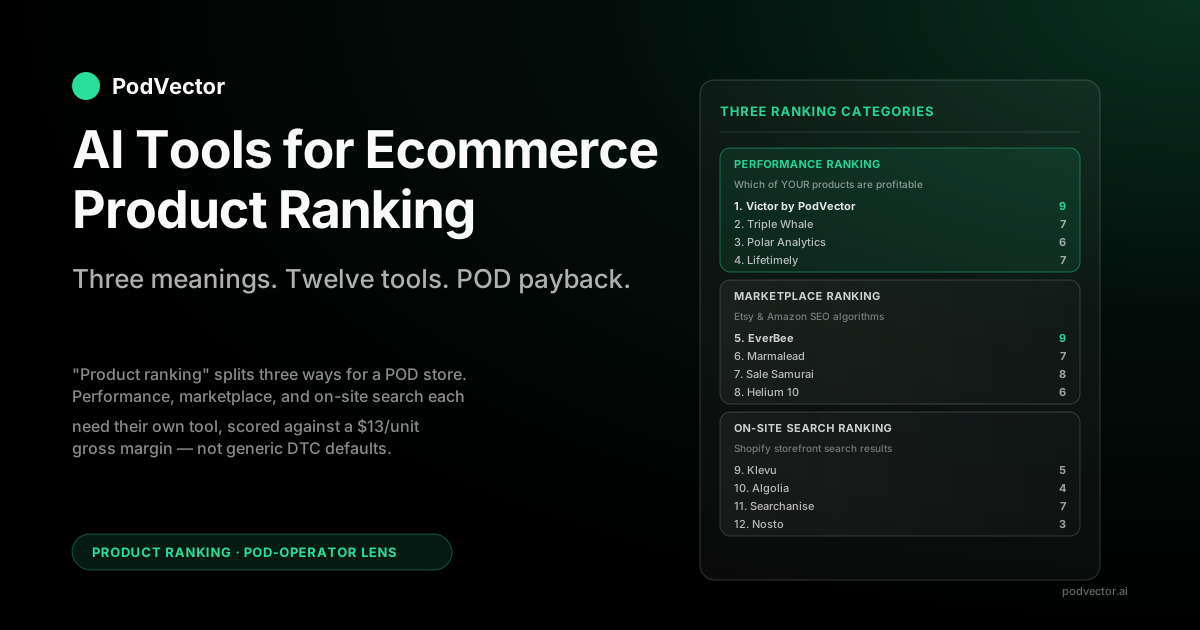
Quick Answer: For a print-on-demand store, "product ranking" splits three ways and the right tool depends entirely on which one you mean. For performance ranking — deciding which of your designs to scale and which to kill — the strongest options are Victor by PodVector AI, Triple Whale, Polar Analytics, and Lifetimely.
For marketplace ranking on Etsy and Amazon, the picks are EverBee, Marmalead, Sale Samurai, and Helium 10. For on-site search ranking inside your own Shopify store, the working options are Klevu, Algolia, Searchanise, and Nosto.
The 2026 SERP — including fresh roundups from G2, LimeSpot, and Fast Simon — leads with enterprise merchandising platforms (Bloomreach, Constructor, Luigi's Box, Dynamic Yield) and behavioral-ranking engines built for retailers with thousands of SKUs. None of those picks make sense for a POD operator at the founder stage, and none of the roundups separate the three meanings of "ranking" or weight their picks against thin-margin POD unit economics.
This guide ranks twelve tools across the three real meanings of "product ranking," scored against the unit economics of a print-on-demand SKU rather than the high-margin DTC defaults the SERP assumes. Each pick names the MRR stage at which it actually pays back, the supplier integrations that matter for POD, and the tool you should skip first when the bill comes due.
The Three Meanings of "Product Ranking"
Every 2026 roundup of "AI tools for ecommerce product ranking" runs into the same problem on the second screen: the term means three completely different things to three different operators, and the SERP doesn't separate them. A Shopify-native DTC brand at $200K MRR is asking about on-site search ranking. An Etsy POD seller at $5K MRR is asking about marketplace SEO ranking. A founder figuring out which of 47 designs to scale is asking about performance ranking. Recommending Klevu to all three is a costly monthly mistake the SERP makes by default.
Print-on-demand sits at the intersection of all three because POD distribution is multi-channel by design — most operators sell on Etsy, on a Shopify store, sometimes on Amazon Merch, and treat each channel's ranking algorithm as its own problem. The right tool stack is built per-channel, weighted by where revenue actually concentrates today, and pruned ruthlessly when a tool doesn't move a metric inside 60 days. This guide separates the three meanings in the order POD operators actually need them:
- Performance ranking — your tools, your data. Which of your existing products is making money, which is losing money, and which is just breaking even while still eating your ad budget. This ranking helps you decide which designs to make more of. The four tools in this category are built to help store owners see their numbers clearly, not to sell to shoppers.
- Marketplace ranking — Etsy and Amazon's algorithms decide whether your listing shows up on page one or page nine of a category search. The four tools in this section optimize for those algorithms specifically — Etsy's keyword/tag system and Amazon Merch's title/bullet ranking are completely different from Google's organic SEO and need their own toolset.
- On-site search ranking — when a shopper searches your Shopify store for "vintage tee," which products appear and in what order. This is the SERP's default interpretation of the term and is real but only material once you cross 200+ SKUs and meaningful internal-search traffic.
The pillar for the broader category is the complete guide to AI tools for POD sellers; the closely related ranking-adjacent comparisons are the best AI tools for ecommerce data analysis and the best AI search-analytics tools comparison. The tools cluster hub indexes every tool comparison in this series.
What's Changed in 2026: The SERP Has Shifted
The current ranking SERP has moved sharply toward enterprise-tier merchandising platforms and what one 2026 roundup calls "agentic commerce" — platforms that claim to run multiple revenue jobs (on-site sales, catalog AI-readiness, cross-brand intelligence) from a single layer. The leading 2026 agentic-commerce comparisons recommend Constructor or Bloomreach for search, and catalog-readiness tools like getcatalog or Fermat for making your product data legible to AI shopping agents. None of those picks are relevant for a POD operator.
Three new entrants appear in 2026 roundups that weren't prominent a year ago:
- Luigi's Box — positioned as best for intelligent search, product ranking, and recommendations, with merchandisable on-site search, synonym management, boosting/burying controls, and analytics to tune relevance quickly. Enterprise pricing on request; not a POD-stage tool.
- Fast Simon — an AI-driven search and merchandising platform with dynamic filters and personalized product recommendations, analyzing user behavior in real time to surface products aligned with individual preferences. Mid-market, Shopify-compatible, but built for catalogs larger than most POD stores carry.
- Clerk.io — a unified platform combining AI-driven search, product recommendations, audience segmentation, and email campaigns, analyzing browsing behavior and purchase history to deliver personalized results across product pages, carts, and ads. Better fit for general ecommerce than for POD's thin-margin, multi-supplier structure.
The pattern across 2026 results: the SERP is recommending tools designed for enterprise retailers — teams with dedicated merchandising staff, thousands of SKUs, and developer resources to integrate behavioral-ranking engines. The entry-tier tools getting attention — such as edrone — are quick-to-launch AI recommendation systems aimed at small e-commerce brands that don't need heavy dev help. Even those, however, aren't built around POD's defining constraint: variable per-variant supplier cost from Printify or Printful. None of the 2026 SERP leaders address that gap. The POD-specific tool stack below still stands.
How We Ranked: POD-Specific Methodology
The 2026 generic ecommerce-tools roundups score every product against the same rubric — feature breadth, NLU quality, integration count, G2 reviews, pricing tier. Three of those signals are useful and two of them mislead a POD operator.
Print-on-demand has two cost-structure quirks that bend tool ROI hard: gross margin is thinner than a typical DTC brand's, and there is no inventory holding cost because the supplier doesn't print until you sell. That changes which tools earn their subscription.
Each tool below is scored against four POD-specific criteria:
- Live supplier-data access. Does the tool know what Printify's or Printful's per-SKU cost actually is, including the variant-level price tier? Generic ecommerce ranking tools assume a flat COGS field on the Shopify product — fine for a wholesaler, wrong for a POD store where the same shirt costs different amounts at S, 2XL, and 4XL.
- Per-channel awareness. A POD listing on Etsy ranks by tags and recency-of-sale; the same SKU on Shopify ranks by your store's internal-search configuration; the same SKU on Amazon Merch ranks by title-keyword density. A tool that scores all three against a single metric ignores the channel that probably drives most of your revenue.
- Setup time at solo-operator scale. POD founders are typically running solo with no engineering resource. A tool that needs a developer to wire up to your warehouse or to write search-relevance rules is effectively unavailable for the first five years of the business.
- Payback at POD margin. Combined ranking-tool spend should stay under 1.5% of revenue at every stage. The right question isn't "does this tool have a feature I need" — it's "does this tool drive enough incremental margin to cover its own cost at my current scale." The answer changes dramatically by MRR band.
Reference lists worth reading for the generic view: G2's 2026 best e-merchandising software roundup, LimeSpot's AI product recommendations platform comparison, and Fast Simon's seven best AI solutions for ecommerce search and merchandising. All three lead with enterprise or mid-market tools and none separate the three meanings of "ranking" or weight picks against POD margin — which is the first cut a print-on-demand operator must make.
The Comparison Table
Pricing is the all-in monthly bill including AI usage fees, not the headline plan price. POD payback is scored 1–10 against a thin-margin POD gross-margin profile. Channel column shows where the tool actually moves a metric.
| # | Tool | Ranking type | Channel | Starting cost | POD payback |
|---|---|---|---|---|---|
| 1 | Victor by PodVector AI | Performance | All channels via live warehouse | Free → paid | 9 |
| 2 | Triple Whale | Performance | Shopify-native | $129/mo | 7 |
| 3 | Polar Analytics | Performance | Multi-channel | $300/mo | 6 |
| 4 | Lifetimely | Performance / LTV | Shopify | $34/mo | 7 |
| 5 | EverBee | Marketplace | Etsy | Free → $29.99/mo | 9 |
| 6 | Marmalead | Marketplace | Etsy | $19/mo | 7 |
| 7 | Sale Samurai | Marketplace | Etsy | $9.99/mo | 8 |
| 8 | Helium 10 | Marketplace | Amazon Merch | $39+/mo | 6 |
| 9 | Klevu | On-site search | Shopify | $79/mo | 5 |
| 10 | Algolia | On-site search | Shopify / custom | $0.50/1K records | 4 |
| 11 | Searchanise | On-site search | Shopify | Free → $19/mo | 7 |
| 12 | Nosto | Cross-sell ranking | Shopify Plus | $2K+/mo | 3 |
The on-site search tier (rows 9–12) scores lower at the entry POD stage on purpose. None of those tools earns its keep below $50K MRR or 200 SKUs, and the SERP's default recommendation of Klevu or Algolia to a low-MRR Etsy-first store is the single most expensive misread of the term. Below $20K MRR, the tools that actually move a needle are in rows 1, 4, 5, and 7.
Performance-Ranking Tools (Operator-Facing)
This category answers the question every POD founder asks looking at the Printify dashboard at midnight: "which of my 47 designs is actually making money?" Generic ecommerce analytics tools answer that for a 12-SKU DTC brand with one supplier and one channel; they fall over for a POD store with 200 SKUs split across three suppliers and four sales channels. The four tools below all access live revenue and cost data, but they take very different approaches to combining it.
For context on how performance-ranking decisions connect to margin improvement actions, see the PodVector AI strategy guide and the overview of Printify costs and promo codes — both are upstream of knowing which products are actually profitable at real supplier cost.
1. Victor by PodVector AI — Best for Multi-Supplier POD
Starting cost: Free during early access
POD payback: 9/10
Best for: POD operators on Printify or Printful selling through Shopify
Victor takes the top slot for one specific reason: he is the only AI employee in this category built around a live warehouse sync of your Printify, Printful, Shopify, Meta Ads, Google Ads, and Klaviyo data, which means the ranking he produces uses the actual variant-level supplier cost rather than a flat-COGS approximation. Ask Victor "rank my products by net margin" and the answer reflects the real Printify base price for each variant including size upcharges, the per-channel listing fee, and the per-channel ad spend from your connected Meta or Google account. Most generic Shopify analytics tools can only do that math if you maintain a per-variant cost field manually — which most POD operators don't.
The architecture matters because POD pricing is a moving target. Printify changes base prices, Printful adds new placement options, both suppliers run periodic discounts and surcharges. A tool that lives on a snapshot of cost data ranks your products against last quarter's economics. Victor's warehouse sync pulls the live supplier data on every query, so the ranking is always against today's margins.
You can ask Victor things like which orders came in, which designs make the most money, and what your supplier costs are — all in one simple chat. You don't need to know anything technical. Just type "rank designs by margin contribution" and get an answer. And Victor doesn't just show you numbers — he can also take action in Shopify: repricing your worst-margin products, adjusting your free-shipping threshold, setting up a buy-one-get-one discount, creating a product collection, and updating many prices at once. He shows you the change first as a card, and nothing happens until you approve it. That way every action is easy to see before it runs.
Victor also reads Meta Ads and Google Ads data and proposes moves based on what he sees — though ad-platform writes (pausing campaigns, changing budgets or bids) are not yet built. The reads-and-proposes model on ad data, combined with Shopify-side execution, is where the ranking-to-action loop closes for a POD operator. For broader context on connecting channel data to campaign decisions, see the guide on when to use Google Ads vs Facebook Ads and best practices for Shopify Google Ads.
One thing to know: PodVector AI pulls your Printify and Printful product costs before you sell anything, so Victor can tell you the margin on a brand-new product with zero orders — even a brand-new store can get this answer right away. Victor also has no memory across chats — each conversation starts fresh, so you'll need to give him context again if you pick up where you left off. And Victor checks in on his own through a Weekly Health Report every Monday. The rest of the time, he answers when you ask.
Where Victor falls short: this is an early-access program, so some features that bigger, general Shopify analytics tools offer (like tracking repeat customers by traffic source) are still being built. The core ranking workflow works well today. Victor doesn't read data from Etsy, Amazon, or TikTok — right now he reads Shopify, Meta Ads, Google Ads, Printify, Printful, Gelato, and Klaviyo.
2. Triple Whale — Best for Shopify-Native Attribution
Starting cost: $129/month
POD payback: 7/10
Best for: Shopify POD stores at $30K+ MRR with significant paid ad spend
Triple Whale is the strongest pure-play product-ranking tool in the SERP-default ecommerce-analytics category. The Sonar attribution engine reconciles ad spend to specific product-level revenue, which means you get a ranking of "which products are profitable after ad cost" rather than the gross-margin ranking most Shopify reports produce. For a POD operator running Meta ads or Google Shopping at $30K+ MRR, that distinction is the difference between scaling a winner and scaling a money pit.
The catch for POD specifically: Triple Whale doesn't natively know Printify or Printful per-variant costs. You can pipe them in via the COGS field on Shopify products, but that's only as accurate as your maintenance discipline. For a 50-SKU POD store with infrequent base-price changes, that works. For a 500-SKU store across multiple supplier accounts, the COGS field drifts and the ranking degrades.
The Moby AI assistant lets you ask product-ranking questions in natural language ("rank products by ROAS this quarter, weighted by inventory we can fulfill"), which is a fair competitor to Victor's chat surface — except for the supplier-data gap above. For Shopify-only POD operators with a one-supplier setup and disciplined COGS maintenance, Triple Whale at $129/month is the most defensible pick at this price point.
Where Triple Whale falls short: not multi-channel by design — Etsy and Amazon Merch revenue lives outside Triple Whale's data model unless you build custom imports.
3. Polar Analytics — Best for Multi-Channel POD
Starting cost: $300/month (Plus plan)
POD payback: 6/10
Best for: POD operators selling on Shopify + Etsy + Amazon at $50K+ MRR
Polar Analytics is the strongest multi-channel option in the performance-ranking category, with native connectors to Shopify, Amazon, Etsy, Klaviyo, Meta Ads, and Google Ads. For a POD operator who concentrates revenue across three or four channels, Polar's unified product-ranking view is genuinely useful — you can ask "rank our top 20 SKUs by net margin across all channels" and get an answer that includes the Etsy listing fees, the Amazon referral fees, and the channel-specific ad spend.
The price point is the friction. At $300/month, Polar needs to drive or save a meaningful amount in incremental POD contribution just to break even — plausible at $50K+ MRR but a stretch below $30K. The setup workflow is slower than Triple Whale's — connector configuration takes one to two days for a multi-channel store — and the AI ranking surface is less polished than Moby or Victor's chat experience.
For a POD operator past $50K MRR with three or more active sales channels, Polar's payback math works. For a Shopify-only operator at any scale, Triple Whale is the better pick.
Where Polar falls short: the AI/natural-language layer is shallower than Triple Whale or Victor — most ranking questions still need a dashboard build rather than a chat query.
4. Lifetimely — Best for LTV-First Ranking
Starting cost: $34/month
POD payback: 7/10
Best for: Repeat-purchase POD niches (apparel-as-merch, gift-niche stores) at $10K+ MRR
Lifetimely's product-ranking angle is different from the rest of the category — it ranks SKUs by LTV contribution rather than first-purchase margin. For most POD niches that's a marginal distinction, but for repeat-purchase categories (band merch, fandom apparel, gift-occasion stores) the LTV-weighted ranking flips the order materially. A lower-priced item that drives meaningful follow-on repeat orders can outrank a higher-margin hoodie that brings no repeat buyers — a dynamic that generic Shopify reports never surface.
The $34/month price point is the most defensible in the performance-ranking category and the Shopify integration is one-click. Lifetimely doesn't have Triple Whale's ad-attribution depth or Polar's multi-channel reach, but for the specific question of "which products bring back repeat buyers," it's the best-fit pick. Understanding LTV-weighted contribution pairs naturally with reviewing your Printify cost structure — the two metrics together tell the full unit-economics story.
Where Lifetimely falls short: single-channel (Shopify only), and the ranking depth assumes you have cohort data — stores under approximately 1K orders rank with too much noise to be actionable.
Marketplace-Ranking Tools (Etsy / Amazon)
For most POD operators, marketplace ranking is the channel that actually moves the revenue needle at the founder stage. The Etsy ranking algorithm is more sensitive to title, tag, and listing-attribute optimization than Google or Amazon's algorithms are. The four tools below all sit on top of marketplace data — none of them are general-purpose ecommerce tools. For POD operators also selling on Amazon, the Amazon print-on-demand shirts guide covers the listing and ranking fundamentals specific to that channel.
5. EverBee — Best for Etsy POD
Starting cost: Free → $29.99/month for full keyword/tag features
POD payback: 9/10
Best for: Etsy-first POD operators at any stage
EverBee is the strongest Etsy-specific ranking tool in this comparison and the most-used product-research tool among Etsy POD sellers. The Chrome extension reveals each Etsy listing's monthly sales estimates, conversion rate, and tag list — which means you can reverse-engineer the ranking strategy of any top-ranked listing in your niche in under five minutes.
For POD specifically, EverBee's product-ranking value is two-sided: research and optimization. On the research side, you can rank-search a niche ("dad jokes shirts") and immediately see which listings are converting, what tags they use, and what the price band is — feeding directly into your design and pricing decisions. On the optimization side, the listing-helper tool ranks your draft listing against the top results in your category and surfaces tag and title gaps. The Etsy ranking algorithm rewards relevance, recency-of-sale, and listing quality score; EverBee instruments the first and third directly.
At $29.99/month, EverBee pays back its subscription on the first listing optimization that moves a product from page three to page one. Operators consistently report meaningful sales lift within 30 days of running their existing top listings through EverBee's optimizer.
Where EverBee falls short: Etsy-only by design. Multi-channel POD operators need a different tool for Shopify and Amazon.
6. Marmalead — Best for Etsy Tag Research
Starting cost: $19/month
POD payback: 7/10
Best for: Etsy POD operators who already use EverBee but want a second opinion on tags
Marmalead is the older Etsy-SEO incumbent and the depth of its keyword data is genuinely better than EverBee's on long-tail tag research. The "engagement" and "competition" scores per keyword combine Etsy search-volume signals with click-through-rate proxies, which gives a more nuanced ranking signal than raw volume alone.
For a POD operator running Marmalead alongside EverBee, the workflow is: EverBee for "what's working in the niche right now," Marmalead for "which long-tail tags are underserved." That two-tool combo costs around $50/month combined and outperforms either tool alone for Etsy-first POD stores past 50 active listings.
Where Marmalead falls short: the UI is dated and the workflow has more friction than EverBee's Chrome-extension-first approach. Most operators end up using EverBee as the daily driver and Marmalead for monthly deep dives.
7. Sale Samurai — Best Budget Etsy Tool
Starting cost: $9.99/month (annual) — has a 3-day free trial
POD payback: 8/10
Best for: Etsy POD operators under $5K MRR who can't justify EverBee yet
Sale Samurai is the price-leader pick in the Etsy-ranking category. The keyword research tool, tag suggestions, and competition analysis are credible alternatives to EverBee and Marmalead at a fraction of the price. The Chrome extension reveals listing-level revenue estimates and the bulk-listing helper makes mass-tag-update workflows efficient.
For a POD operator under $5K MRR, Sale Samurai at $9.99/month is the right call — at that revenue stage, you need just enough ranking insight to validate the niche, and any of these three tools clears that bar. The upgrade path to EverBee or Marmalead makes sense once Etsy revenue concentrates and the cost of one missed ranking opportunity exceeds the price gap.
Where Sale Samurai falls short: the data depth is shallower than EverBee's at the high end. Past $20K Etsy MRR, the EverBee-vs-Sale-Samurai gap starts to matter on tag-strategy decisions.
8. Helium 10 — Best for Amazon Merch
Starting cost: $39/month (Starter), $79/month (Platinum)
POD payback: 6/10
Best for: POD operators with Amazon Merch on Demand or Merch by Amazon listings
Helium 10 is the Amazon-ranking incumbent and the most-used keyword tool among Amazon Merch sellers. The Cerebro and Magnet tools surface high-traffic, low-competition keywords that Amazon's A10 ranking algorithm rewards on title and bullet-point density. For POD operators publishing on Merch by Amazon or Amazon Merch on Demand, the keyword-rank-tracker tool is the only credible way to monitor where your listings sit on a given search term over time.
The catch is that Amazon Merch is a different beast from third-party seller Amazon — you don't pay COGS, you don't manage inventory, and your unit economics are on royalty splits. Helium 10's pricing is built for FBA operators with much higher revenue, so the Starter plan at $39/month is the right entry point and the Platinum-tier features are largely irrelevant for Merch. For a fuller picture on the Amazon POD channel, see the Amazon print-on-demand shirts guide.
Where Helium 10 falls short: Amazon-only and built for FBA pricing logic. Most POD operators don't need it unless Amazon Merch is a meaningful revenue channel.
On-Site Search Ranking (Shopify Storefront)
The on-site search category is where the SERP's default recommendations live, and for most POD stores it's the lowest-priority of the three ranking categories. Internal-search traffic on a POD store is rarely meaningful below 200 SKUs and $50K MRR — most discovery happens via product-page direct entry from Etsy or Google Shopping ads, not via the storefront's search box.
That said, once you cross the threshold, the on-site search ranking choice meaningfully affects conversion rate. Three of the four tools below earn their keep at scale; one is enterprise-only and shouldn't be on a POD shortlist below $1M GMV. On-site search performance is also increasingly tied to checkout conversion — for the full picture on turning search-driven traffic into orders, see the guide on niche product strategy for POD sellers.
One 2026 development worth flagging: the leading agentic-commerce comparisons now recommend tools like getcatalog or Fermat for making your catalog legible to AI shopping agents — a new layer on top of traditional on-site search. For a POD store under $200K MRR, this is not yet a priority, but the framing signals where on-site ranking is heading.
9. Klevu — Best for 500+ SKU Catalogs
Starting cost: $79/month (Discovery), $499/month (Recommended)
POD payback: 5/10
Best for: Shopify POD stores at 500+ SKUs and $50K+ MRR with significant internal-search traffic
Klevu is the strongest mid-market on-site search tool for Shopify and the default recommendation in most ecommerce-tools roundups. The AI-powered search engine learns from in-store behavior — which products shoppers click after which queries — and re-ranks search results to maximize click-through and revenue per query. For a POD store with 500+ SKUs, that learning compounds and produces a measurable lift in search-driven conversion rate within 30–60 days.
The starting plan at $79/month is reasonable for the value at scale, but the upgrade pressure is significant — most POD operators end up on the Recommended plan at $499/month within six months because the "smart category pages" and "AI merchandising" tier is where the real ranking-improvement features live. At that price, Klevu needs to drive or save a meaningful number of incremental POD units per month, which is plausible at $50K+ MRR but a stretch below.
Where Klevu falls short: overkill for stores under 200 SKUs or $30K MRR. The setup time (one to two weeks) is also a real cost at solo-operator scale.
10. Algolia — Best for Engineering-Equipped Teams
Starting cost: $0.50 per 1K records + $0.40 per 1K queries
POD payback: 4/10
Best for: Shopify Plus POD stores with in-house engineering and 1K+ SKUs
Algolia is the technical incumbent for ecommerce search, and the tool 2026 roundups push hardest for teams with engineering resources. Algolia's NeuralSearch combines keyword precision with semantic understanding — returning relevant results even for vague or misspelled queries — while its AI Ranking model auto-promotes converting results without manual tuning. A Merchandising Studio lets teams pin, boost, or bury products from a visual dashboard, and a newer MCP Server connects your product catalog to external AI assistants. Both NeuralSearch and AI Ranking sit behind higher-tier plans, which pushes the real cost well above the entry record pricing.
For POD specifically, Algolia is almost always the wrong call. It's the default for brands with large catalogs and dedicated developer resources — a profile that describes almost no POD operator. Without an engineer to operate the merchandising rules, you're paying for capability you can't use.
Where Algolia falls short: developer-first product. POD founders without engineering resources should default to Klevu or Searchanise instead.
11. Searchanise — Best Free Shopify Option
Starting cost: Free up to 25 products → $19/month for unlimited
POD payback: 7/10
Best for: Shopify POD stores under 200 SKUs getting their first on-site search beyond Shopify's native
Searchanise is the free-tier on-site search pick and the right answer for most POD stores under 200 SKUs. The free plan covers up to 25 products with full search and filter functionality; the $19/month plan is uncapped. The AI-driven autocomplete, typo-tolerance, and synonyms work credibly well out of the box without any merchandising rule configuration.
For a POD operator at the entry stage, Searchanise replaces Shopify's native search (which is genuinely poor) at almost zero cost and almost zero setup time. The ranking quality is below Klevu's once you cross 500 SKUs and meaningful traffic, but for the first $30K MRR of a POD store's life, it's the right pick.
Where Searchanise falls short: the merchandising rule depth is shallow and the AI-personalization layer doesn't exist. Past 500 SKUs, the upgrade to Klevu becomes worthwhile.
12. Nosto — Best for Cross-Sell Ranking
Starting cost: $2K+/month (revenue-based, custom)
POD payback: 3/10
Best for: Shopify Plus POD stores at $1M+ GMV running personalization at scale
Nosto is a robust AI-powered personalization platform that leverages real-time behavioral data to dynamically present the most relevant products to each individual shopper, aiming to boost conversion rates and average order values. It sits adjacent to the product-ranking category — ranking cross-sell and upsell recommendations on product pages, in cart, and in email rather than ranking search results. For Shopify Plus POD stores at $1M+ GMV, the per-visitor product-ranking layer can drive meaningful AOV lift.
For most POD operators, Nosto isn't on the shortlist. The minimum spend is $2K/month and the implementation requires either Shopify Plus or a developer build. At $1M+ GMV, the math works; below that, the spend belongs in marketplace tools or performance ranking instead.
Where Nosto falls short: price floor is enterprise-only. POD operators below $1M GMV should default to Rebuy or LimeSpot for the cross-sell-ranking job, not Nosto.
Emerging Tools Worth Watching
Three tools appearing in 2026 merchandising roundups are worth monitoring, though none yet earn a POD recommendation at the founder stage:
- Luigi's Box — merchandisable on-site search with synonym management, boosting and burying controls, and analytics to tune relevance quickly. Pricing is enterprise on-request. Watch for SMB pricing tiers.
- Fast Simon — AI-powered search with dynamic filters and personalized product recommendations, analyzing user behavior in real time. Shopify-compatible and lighter than Bloomreach or Constructor, but still better suited to catalogs larger than most POD operators carry.
- Clerk.io — a unified platform combining AI-driven search, product recommendations, audience segmentation, and email campaigns. The unified channel scope is appealing; the POD gap is the same as with other behavioral-ranking engines — none handle variant-level supplier cost natively.
The consistent pattern: these tools are good fits for general ecommerce brands with large, uniform catalogs and developer resources. They enter POD consideration only once a store crosses into Shopify Plus territory with a full-time ops team.
How to Choose by MRR Stage
The tool stack changes meaningfully at each MRR threshold. The right ranking-tool budget allocation is roughly 1.5% of revenue, and the channel mix dictates which ranking type to fund first. Four reference profiles:
Stage 1 — $0 to $5K MRR: Performance ranking with Victor (free during early access), marketplace ranking with Sale Samurai ($9.99/mo) or EverBee free tier. Total spend: under $10/month. Skip on-site search entirely. The ranking question at this stage is "is the niche real" — that's an EverBee/Sale-Samurai question, not a Klevu question. Understanding your supplier cost structure is foundational at this stage; see the TikTok Shop Printify setup guide at TikTok Shop + Printify integration for how costs flow across a new sales channel.
Stage 2 — $5K to $30K MRR: Add Lifetimely ($34/mo) for performance ranking depth, upgrade to EverBee paid ($29.99/mo) for marketplace, add Searchanise ($19/mo) once SKU count crosses 100. Total spend: $80–100/month. Performance ranking and marketplace ranking together drive most of the leverage at this stage. If you're running paid ads, review the when to use Google Ads vs Facebook Ads guide — channel allocation is a primary reason product-level performance ranking diverges from raw revenue rank.
Stage 3 — $30K to $200K MRR: Add Triple Whale ($129/mo) or Polar Analytics ($300/mo) for paid-attribution ranking, upgrade to Klevu ($79–499/mo) for on-site search once you cross 200 SKUs. EverBee and Sale Samurai still earn their keep. Helium 10 ($39/mo) becomes worth it if Amazon Merch is now a real channel. For Google Ads specifically, see best practices for Shopify Google Ads — the product-ranking signal from Victor's Google Ads read connects directly to Shopping campaign prioritization decisions at this stage. For POD niche expansion ideas, see the print-on-demand puzzles guide and the TikTok Shop Printify setup for channel diversification that feeds back into performance ranking.
Stage 4 — $200K+ MRR: Polar's multi-channel ranking earns its $300/mo, and Nosto's cross-sell ranking earns its $2K floor at $1M+ GMV. At this scale, the Klaviyo browse abandonment flow also becomes a ranking-adjacent lever — shoppers who browse but don't buy are a product-ranking signal for which SKUs need better on-site positioning or better email re-engagement. For the broader tool stack at this stage, see the top AI tools for ecommerce 2026 comparison.
Tools POD Operators Should Skip
Several tools that show up high on generic ecommerce-ranking SERP lists don't earn their keep at POD margin. The first to skip:
- Bloomreach. An AI-powered personalization platform that combines AI-driven discovery with merchandiser controls to personalize search, categories, and recommendations at scale — with enterprise pricing on request. POD operators rarely have the SKU volume or merchandising staff to justify it.
- Constructor. Same enterprise tier — behavioral-data-based ranking that needs both traffic volume and an integration team. Best for teams managing thousands of SKUs where generic search underperforms. Not a POD entry-stage tool.
- Luigi's Box. Strong relevance features but enterprise pricing on request. Watch for future SMB tiers, but skip for now unless you're past $1M GMV.
- Dynamic Yield (Mastercard). A leading AI-powered personalization platform empowering brands to craft individualized experiences. Built for large retailers — pricing and implementation requirements put it well outside POD range.
- Algolia at low SKU count. The pay-per-record/pay-per-query model means a small POD store with high traffic but a small catalog still pays a meaningful bill — and gets less ranking lift than Searchanise's $19/month.
- Triple Whale below $30K MRR. The $129/month bill needs ad-attribution depth to earn out, which a small POD store rarely has at low ad spend volumes.
- Generic Shopify "AI ranking" apps. Most low-cost apps in the Shopify app store under "AI ranking" are wrappers around Shopify's native search with a thin re-sort layer. They don't move the metric.
The pattern: enterprise tools below their target stage, behavioral-ranking engines that require catalog scale and engineering resources POD operators don't have, and feature wrappers that don't add ranking signal. All three categories have heavy SERP presence in 2026 and all three lose money at POD margin.
FAQs
What's the difference between AI product ranking and AI search?
AI product ranking is the broader concept — it's how a system orders a list of products by some objective (relevance, profitability, conversion likelihood). AI search is one specific application: ordering products in response to a shopper's typed query. The other applications are performance ranking (operator-side, deciding which products to scale) and marketplace ranking (channel-side, optimizing for Etsy or Amazon's algorithm). Most generic roundups conflate the three.
Do I need an AI tool for product ranking, or can I use spreadsheets?
Spreadsheets work for under 50 SKUs and a single channel. Past that, the manual COGS maintenance, multi-channel reconciliation, and recency-of-data problems compound — by the time the spreadsheet finishes loading, the data is stale. The break-even point for a low-cost tool is roughly 50–100 SKUs or two active sales channels, whichever comes first.
Which tool ranks Etsy listings best?
EverBee is the strongest Etsy-specific ranking tool overall, with Marmalead as a deeper-data alternative and Sale Samurai as the budget pick. None of the Shopify-focused tools (Klevu, Algolia, Triple Whale) work for Etsy ranking — Etsy's algorithm is closed and only the Etsy-specific tools have credible signal.
How much should a POD store spend on ranking tools?
Roughly 1.5% of revenue across all three ranking categories combined. The exact mix depends on channel concentration. An Etsy-first POD store skews the majority of the budget toward marketplace tools; a Shopify-primary store skews toward performance ranking and on-site search.
Can ChatGPT or Claude rank my products?
Only if you paste the data in manually, and only against the data you paste. Both general-purpose chatbots can do credible ranking analysis when given a CSV of orders and costs, but they don't have live access to your Printify, Shopify, or Etsy data. Tools like Victor by PodVector AI solve that gap by syncing the live data automatically via a connected warehouse.
Does Shopify have built-in AI product ranking?
Partially. Shopify Magic includes a thin AI-driven product-recommendations layer on product pages and the storefront, and the native Shopify Search and Discovery app has basic merchandising rules. Both work as a baseline but aren't competitive with Klevu or Searchanise on relevance, and don't address performance ranking or marketplace ranking at all.
What's a "live warehouse sync" and why does it matter for POD?
A live warehouse sync means the tool queries your actual Printify, Printful, Shopify, Meta Ads, Google Ads, and Klaviyo data on every question, rather than running on a snapshot updated nightly. For POD specifically, that matters because supplier costs change frequently — Printify base price tier shifts, Printful surcharges, supplier discounts. A snapshot-based tool ranks against last week's costs; a live-sync tool ranks against today's. Victor by PodVector AI is the operator-facing tool built around this pattern.
What are "agentic commerce platforms" and do I need one?
Agentic commerce platforms are a 2026 category of tools that claim to handle multiple revenue jobs — on-site selling, catalog AI-readiness for external shopping agents, and cross-brand intelligence — from a single layer. The category is real and growing, but it's built for DTC brands with developer resources and large catalogs. For a POD operator under $200K MRR, the performance-ranking and marketplace-ranking tools in this guide drive more incremental margin than any agentic-commerce platform will at current price points.
How does product ranking connect to ad strategy and Klaviyo?
Performance ranking tells you which SKUs deserve ad budget; ad strategy determines how that budget is deployed. The two are tightly coupled — a product that ranks as a margin winner can still lose money if your ad frequency climbs too high and creative fatigue sets in. Once a product ranks well on-site, Klaviyo browse abandonment flows become a powerful complement: shoppers who view a top-ranked product but don't convert can be re-engaged automatically. See the Klaviyo browse abandonment flow setup guide for the implementation, and the Google Ads vs Facebook Ads guide for channel allocation once you know which SKUs to push.
Rank your POD products against today's supplier costs, not last week's
Victor by PodVector AI connects to Printify, Printful, Shopify, Meta Ads, Google Ads, and Klaviyo, so the product ranking he gives you uses your real per-product supplier costs, real channel fees, and real ad spend. Ask "rank my designs by net margin" and get the answer in seconds — no spreadsheets, no guessing at costs. Victor can then suggest changes in Shopify — repricing, threshold changes, collections, bulk price updates — and you approve each one before anything changes.
Try Victor free