
Quick Answer: An AI agent for Shopify is software that reads state from your store, reasons about it, and either answers or acts. For print-on-demand sellers the split that matters is shopper-facing vs operator-facing. Shopper-facing agents (Gorgias, Tidio Lyro, Minami, Vanchat) close support tickets and lift conversion. Operator-facing agents like Victor read your Shopify, Meta Ads, Google Ads, Printify, and Printful data, surface the next profit move, and execute it on Shopify only — with your approval.
The 2026 context: Shopify's Universal Commerce Protocol means external agents on Google AI Mode and ChatGPT can now complete a checkout against your storefront without the shopper visiting your site, which changes how POD catalogs need to be structured to be discoverable.
What an AI agent for Shopify actually is in 2026
By 2026 the term "AI agent" has finally settled on a working definition that vendors will mostly stand behind. An agent is software that perceives state, reasons about it against a goal, calls tools to gather context or take action, and reports or commits the result — in a loop.
On Shopify, the agent sees what's happening through your store, your apps, and other tools it's connected to, like your supplier or your reviews app. Under the hood, it uses a smart AI model to figure out what to do next. Then it takes action: drafting an order, applying a discount, flagging a refund for you, pulling a margin report.
For a print-on-demand seller running on Shopify, this matters in a specific way. Shopify gives an agent clean, reliable data to work with — your orders, products, and updates all flow through in a dependable way. Shopify-native agents start with a head-start on every other ecommerce platform.
The catch is that almost none of them know about Printify or Printful natively, and the second-largest source of POD support load and the entire margin layer of the business live on the supplier side of that boundary. A Shopify AI agent that hasn't been wired to your supplier API can answer half your questions correctly and get the other half wrong with confidence. Picking the right agent is mostly about how that wiring gets done.
The other 2026 shift: Shopify itself is now an active AI agent platform, not just a passive integration target. Sidekick ships in the admin. Shopify Magic generates content across the platform. The Storefront MCP server lets external agents transact on your store. The Universal Commerce Protocol Shopify announced with Google means an agent in Google's AI Mode can complete a checkout against your storefront without ever touching your site. That changes the surface area of what "AI agent for Shopify" even means, and the right strategy for a POD operator includes being legible to those external agents, not just installing one in your admin.
Sidekick and Shopify Magic — what the native stack does and doesn't
Start here because it's free and it's already in your admin. Sidekick is Shopify's first-party AI assistant; Magic is the umbrella for the AI features sprinkled across the platform (image editing, email composition, product description generation, theme block suggestions, and so on). Sidekick is the part most resembling an "agent" — it can answer questions about your store, edit metafields, set up domains, draft an email campaign, and surface insights from your reporting.
What Sidekick is good at on a POD store:
- Generic Shopify-admin tasks — adding a metafield, configuring shipping zones, drafting a discount code with the right exclusions, finding the setting you can't remember the name of.
- Content generation that touches Shopify-native objects — product descriptions, email subject lines, blog post drafts, theme block copy.
- Top-of-funnel reporting questions — "what was my AOV last week," "which collection is converting best," "what's my ad spend by source this month."
What Sidekick can't do for a POD store, and won't be able to for the foreseeable future:
- Read Printify or Printful production state. It's a Shopify-internal tool. The supplier API isn't on its tool list. Every "where is my order" question that goes deeper than "unfulfilled vs fulfilled" is out of scope.
- Compute true margin per SKU. Sidekick reports gross revenue and Shopify's COGS field. If you're not maintaining COGS by hand on every SKU (and almost no POD operator does — the costs change with supplier discounts, base price updates, and tier promotions), the margin numbers are wrong.
- Join ad spend to fulfillment cost. Sidekick sees Shopify ad spend through the Marketing tab, but it doesn't reconcile against Printify/Printful per-line-item costs to give you net margin by campaign. That join is the entire job of an AI employee.
The takeaway is that Sidekick and Magic cover the Shopify-internal half of an AI agent's job competently. The POD-specific half — the supplier integration and the unit-economics layer — they don't touch. You'll layer either a third-party shopper agent (App Store category) or an AI employee (Victor) on top to cover that. Most POD operators end up with at least one of each, plus Sidekick.
The four categories of AI agent you'll see on Shopify
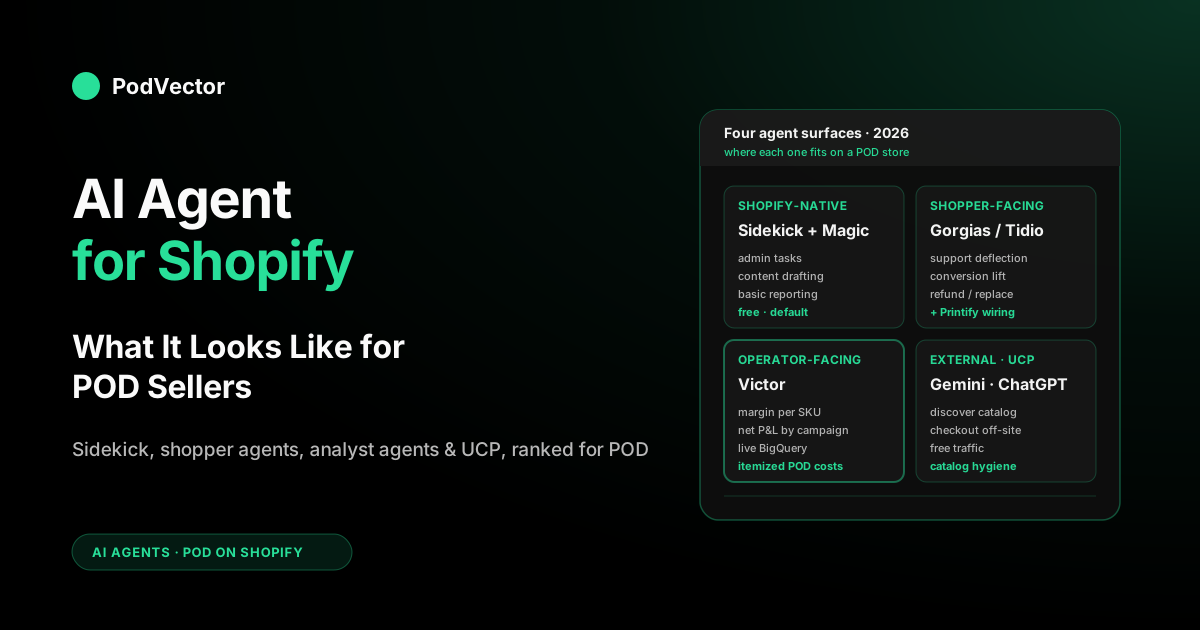
The roundup posts tend to lump every "AI for Shopify" product into one list. The categorization that matters when you're picking is finer than that. Four meaningful categories on Shopify in 2026:
1. Shopify-native agents (Sidekick, Magic)
Built by Shopify, ships in the admin, runs on Shopify-internal data. Strengths: friction-free install, deep awareness of admin objects, free at the base tier. Limits: Shopify-internal data only, no supplier or warehouse integration, doesn't know your unit economics. Right tool for: admin tasks, content drafting, basic reporting questions.
2. Shopper-facing third-party agents (App Store)
Installed via the Shopify App Store, runs on your storefront. Examples: Gorgias AI Agent, Tidio Lyro, Intercom Fin, Ada, Minami, Vanchat, Exei, Debales. Strengths: handles support load, resolves "where's my order" tickets end-to-end, lifts conversion through pre-purchase conversation, and increasingly runs across SMS, WhatsApp, Messenger, and email — not just the on-site chat widget. Limits: most don't natively integrate Printify or Printful — you wire it via custom action or webhook. Right tool for: closing the support gap, lifting conversion on engaged sessions.
3. AI employees
See all your numbers in one place and answer business questions in plain English, based on your real costs. Examples: Victor (POD-specific), Triple Whale Moby, Polar Analytics, Northbeam Conductor. Strengths: answers margin questions, surfaces losing campaigns, and puts ad spend and supplier cost together so you see true profit. Limits: most generic ecommerce AI employees pull a flat COGS percentage and miss POD's per-base cost structure. Right tool for: the Monday-morning margin question, the post-launch SKU watch, the campaign reallocation call.
4. External agents transacting on your store (UCP, Storefront MCP)
Not installed on your store at all — agents on Google's AI surfaces, ChatGPT, Microsoft Copilot, or third-party shopping assistants that discover your products and complete checkout via Shopify's Universal Commerce Protocol or the Storefront MCP server. Strengths: a traffic source you don't pay for and don't directly manage. Limits: requires your catalog to be structured, image-rich, and policy-clean. Right tool for: extending reach into the agentic commerce surface that's emerging on the major AI providers.
Most POD operators in 2026 should expect to be running across at least three of these four categories. Sidekick is on by default. Add one shopper-facing agent from category two and one AI employee from category three. Category four is becoming non-optional — even if you don't do anything explicit, Shopify is exposing your catalog to the UCP partners on your behalf.
The POD-specific criteria that should rerank the SERP shortlists
The generic roundups weight features the same way regardless of store type. That's wrong for POD. These are the criteria that should shift the ranking when you're a print-on-demand seller:
1. Live Printify or Printful integration (or a clean path to one)
Non-negotiable for the shopper-facing agent. Without it, the bot quotes Shopify's "unfulfilled" status instead of the real production ETA, and a significant share of your tickets get a wrong-but-confident answer. Ask every vendor: "Does the agent natively pull Printify or Printful production state, or do I wire it via custom action?" The honest vendors will answer the second; the dishonest ones will hedge. The custom-action path is a couple of days of dev work and it does work — but the vendor that ships it pre-built saves you that work.
2. Variant-aware reasoning across mixed catalogs
POD apparel stores commonly mix Bella+Canvas, Gildan, AS Colour, Comfort Colors, and Next Level on the same catalog. Each fits differently. An agent that answers "what size for me" by quoting one size chart for the entire store will lose conversions. The agent needs to read the base on the variant the shopper is looking at, then apply the brand's chart with the right fit adjustment. This is a demo question — make the vendor walk through it on your actual product page, not theirs.
3. Margin-aware promo logic
Cart-recovery flows that fire a discount code without a per-SKU margin floor will quietly destroy your profit on POD products, where pre-ad margins are typically thin. The agent needs a discount ceiling it won't breach — ideally per-SKU, at minimum per-collection. If the vendor can't show you exactly where that rule is configured in the admin, don't deploy it.
4. Made-to-order refund logic
POD items don't restock. Refund logic should default to "refund without return shipment" for most defect cases under a per-supplier dollar threshold. Almost no platform ships with this as a default — most assume a stocked-inventory model. You override it during setup. Ask the vendor whether the refund flow is configurable at the SKU or supplier level, not just at the store level.
5. Auditability of agent decisions
Agents that act — issuing refunds, applying discounts, opening replacement orders — need a transcript of how they decided. "It refunded $32 because the shopper claimed a misprint and uploaded a photo that the vision model classified as defective" is what good audit looks like. "It refunded $32" with no chain is what bad audit looks like, and you'll regret it the first time the same shopper games the system.
6. Resolution rate, not deflection rate
The 2026 roundups have moved off "deflection" as the headline metric, and POD operators should too. Deflection counts a ticket the agent answered without escalating — even if the answer was wrong. Resolution counts a ticket the shopper actually got fixed. The gap matters most on POD's hardest tickets: a bot that "deflects" a where's-my-order question by quoting Shopify's "unfulfilled" status hasn't resolved anything — the shopper opens a second ticket, or charges back. Ask every vendor for resolution rate on POD-supplier tickets specifically, not blended deflection across all intents.
7. Operator agent: itemized cost grounding
For the AI employee on the operator side, the criterion is whether margin is computed from itemized supplier costs (Printify base + print + supplier shipping + Shopify/payment fees, by line item) or from a flat COGS percentage. Generic ecommerce AI employees do the latter. The numbers diverge materially on bad SKUs and they're useless for actual decisions. For more on the cost side that drives this, see our guide to improving COGS for POD sellers and the breakdown of drop-ship fees.
The 2026 Shopify shortlist, ranked for POD operators
Six picks for the shopper-facing side, re-scored against the POD criteria above.
1. Gorgias AI Agent — best for stores past $20k/month with real ticket volume
Most mature support agent on Shopify. Native order/return/refund actions, configurable per-SKU promo logic, full audit log on every decision, decent escalation flow when confidence drops. Its 2026 update split the product into a pre-purchase Shopping Assistant and a post-sale Support Agent, so you can run product recommendation and ticket deflection as separate flows. The Printify/Printful integration isn't native — you build it as a custom action — but Gorgias's tool framework makes that a couple-day project. Pricing scales aggressively past a few hundred tickets/month; below that, Tidio is usually the better economic call.
2. Tidio with Lyro AI — best balance for stores under $20k/month
Cheaper than Gorgias, easier to install, the Lyro layer is genuinely conversational and not just rule-routed. Pre-purchase conversion lift is the strongest measured of the shortlist. Same Printify/Printful gap — wire it via webhook. Limits: the audit trail is thinner than Gorgias, and the action surface (refunds, returns, discounts) requires more manual configuration.
3. Shopify Inbox + Magic — best free starting point
The native option. Free, installs in two clicks, the Magic layer handles enough of the basic conversation for stores doing under 50 tickets/week. No third-party data, no custom actions, no audit log past the conversation transcript. You'll outgrow it the first month you cross $10k revenue, but it's the right tool to start with — installing a paid agent before you have ticket volume is overkill.
4. Minami — best for stores that want post-purchase agentic actions
Newer entrant pitched specifically on "performs real actions, not just replies" — handles returns, processes cancellations, updates orders autonomously. Worth the demo if your support load is dominated by post-purchase issues rather than pre-purchase questions. The Shopify integration is good; the supplier integration is the same custom-action story as the rest.
5. Vanchat — best for catalogs with deep product reasoning needs
Specializes in pre-purchase product Q&A — strong on "which of these designs will hold up in the wash" or "what's the difference between the Bella and the Comfort Colors version of this tee." For POD stores with 100+ SKUs and active design merchandising, the conversion lift is meaningful. Less mature on the post-purchase side; pair it with Gorgias if you need full coverage.
6. Exei — best for stores that want a sales-agent framing
Pitched as a 24/7 sales assistant rather than a support tool. Active recommendation, review summarization, image and price surfacing in chat. Strong on stores where the conversion lift on engaged sessions is the primary metric. Lighter on the support deflection side.
What didn't make the cut: Sidekick (an admin tool, not shopper-facing), Intercom Fin (a genuinely strong agent but its per-resolution pricing and volume assumptions don't pencil out for most POD stores — revisit it at scale), Ada and Zendesk AI (enterprise pricing), Beam AI (an ops-automation agent for order/inventory workflows rather than a shopper-facing chat agent), Klaviyo's chat layer (still a marketing tool with chat features). For a head-to-head comparison across the full profit analytics stack, see our BEProfit alternatives comparison and the BEProfit profit analytics Shopify app review.
The operator side — the AI employee Sidekick can't replace
The roundup posts skip this entirely because the search "AI agent for Shopify" usually surfaces shopper-facing intent. But every POD operator past about $20k/month finds the operator side is where the bigger leverage actually sits. The shopper-facing agent saves you support hours; the AI employee helps you make better decisions.
The job: answer business questions on demand, in plain English, against your live data, grounded on the actual unit economics of every order. "Which Meta campaigns made money last week after fulfillment costs." "Which SKUs are losing margin at current promo pricing." "What's my net AOV trend by acquisition channel." These are the questions that drive decisions, and they're the questions Sidekick and the shopper-facing agents can't answer because they don't have the data.
What works for POD: your Printify and Printful costs, your Shopify orders, and your Meta and Google ad spend, all in one place and matched up line by line. The agent looks up the answer and hands you the chart and the breakdown. Time-to-answer should be seconds, not the 40-minute spreadsheet round-trip AI employees are replacing.
Vendors in this category split into two: the generic ecommerce AI employees (Triple Whale Moby, Polar, Northbeam) that handle the join layer well but pull a flat COGS percentage instead of itemized supplier costs, and the POD-specific ones (Victor) that ground on the actual per-base cost structure. For a POD store the difference shows up in margin numbers — generic agents will tell you a campaign is profitable that's actually losing money on the wrong SKU mix, because the COGS percentage averages out the per-base variation. For deeper context on why the data reconciliation layer matters, see our guide to Meta modeled conversions and the Facebook CAPI vs pixel duplicate events explainer.
One honest limit worth stating: Victor reads ad platforms and proposes moves, but ad-platform writes (pausing Meta campaigns, changing Google Ads budgets or bids) are not built yet — the merchant executes those. What Victor does execute, with your approval, is on the Shopify side: repricing products to a target margin, creating or updating discounts (including BOGO and free-shipping), creating collections, and raising free-shipping thresholds.
Universal Commerce Protocol and what it means for POD storefronts
Shopify's UCP announcement with Google is the part of the AI-agent-for-Shopify story most operators haven't internalized yet. The short version: agents in Google's AI Mode in Search, ChatGPT, and increasingly Microsoft Copilot can now discover your products and complete checkout against your Shopify store without the shopper ever visiting your site. Shopify exposes your catalog through the protocol; the external agent does the conversation; the order lands on your store as a normal Shopify order.
For a POD operator, three things follow from this:
- Catalog hygiene becomes traffic. The external agent picks products by reading your titles, descriptions, images, sizing, materials, and reviews. Sparse product pages — the kind a lot of POD stores ship because the design is the differentiator and copy feels like overhead — are invisible to UCP-driven traffic. The stores that win this surface are the ones with rich product copy, materials specs, fit notes, and clean image sets.
- Policy clarity becomes conversion. The external agent will refuse to recommend or transact a product whose return, shipping, or sizing policy isn't legible. POD-specific policies (made-to-order, refund-without-return, supplier production windows) need to be on the product page or in a structured location the agent can pull. Pages that bury policy in PDFs or footer links lose the agent.
- Supplier ETAs become a transactional input. If the external agent quotes "ships in 2 days" because that's what your storefront says — and the actual production ETA is 7–10 days — you'll see refund requests and chargebacks within a week of the agent surfacing your product. Your storefront ship time needs to reflect supplier production reality, not just your shipping carrier's window.
This isn't a problem you solve by installing an agent. It's a problem you solve by making your store legible to the agents that already exist. The investment is hours, not dollars, and the upside is a traffic channel that didn't exist 12 months ago. For broader e-commerce best practices that intersect with this, see our e-commerce best practices guide.
A realistic deployment sequence on Shopify
Skip the vendor's "10-minute install" pitch — it's true for the install, false for the rollout. A real Shopify-side rollout for the shopper-facing agent:
- Week 0 — pick the side. Shopper-facing or operator-facing first? Most POD operators get more leverage from the AI employee because their support load is already managed. Stores with overflowing inboxes start shopper-facing.
- Week 1 — check your data. For shopper-facing: are product descriptions filled in, are size charts on-page per base, is your supplier account cleanly tied to Shopify? For operator-facing: is your itemized cost showing up correctly, is ad spend matched to the right sales, is the data fresh enough to trust?
- Week 2 — install the platform and wire the supplier integration. Shopify install is two clicks. The Printify or Printful custom action is the work. Build the production-status endpoint, register it as a tool the agent can call, write the prompt that uses it.
- Week 3 — build the top-10 flows manually. Sizing, shipping ETA, defect refund, design change request, order status, payment failure, discount code request, return policy, custom personalization, gift card. Each gets a tested response.
- Week 4 — soft launch on 20% traffic. Watch resolution rate, CSAT, conversion lift on engaged sessions, and Lighthouse LCP (the chat widget loads on every page — if it costs you 200ms of LCP you'll lose more conversion than the agent gains).
- Week 6 — ramp or pause. If metrics hold, ramp to 100%. If they don't, pause and tune. The most common failure modes: the agent misreads the supplier ETA on one product family, or the discount logic breaches the margin floor on a specific SKU type. Both are fixable; neither is reason to abandon.
The ROI math, with POD numbers
Vendors quote dramatic conversion lifts and support cost reductions. For a POD store on Shopify, the math is more concrete. Pick a representative store doing $50k/month, 1,200 orders/month, $42 AOV, 100 support tickets/week.
- Shopper-facing agent on Shopify. Cost: roughly $300/month for a mid-tier platform with custom Printify integration. The resolution-not-deflection distinction matters here, because a deflected-but-unresolved POD ticket comes back as a second contact or a chargeback that erases the saving. Human cost saved at typical ticket-handling cost, conversion lift on engaged sessions — most operators see payback in month one if even a fraction of tickets are genuinely resolved.
- AI employee. Cost: $200–$600/month depending on tier. Time saved: hours per month at typical operator hourly value. Decision impact: catching one losing SKU one week earlier on a $50k store can save meaningful ad spend. Payback in month one if even one decision moves.
- UCP-driven traffic. Hard to quantify precisely in 2026 because the channel is young. Cost: zero — it's catalog hygiene work, not a vendor purchase. The stores reporting early wins are those with complete product copy and clear made-to-order policies.
The numbers scale roughly linearly up to $500k/month. Above that, custom pricing dominates and the calculation shifts from "save time" to "make decisions the team couldn't have made manually." For a deeper look at how revenue attribution affects these calculations, see our explainer on CAPI vs pixel duplicate events and the e-commerce best practices guide.
Buying mistakes Shopify POD operators keep making
Five mistakes that show up in trial logs more often than any other:
- Trusting the App Store rating. The high-rated apps on the App Store are rated by a population that doesn't run POD. A 4.9-star "AI chatbot for Shopify" with thousands of reviews can be the wrong tool for your store because none of those reviewers were POD operators with a Printify integration to wire up. Read recent reviews specifically from POD stores, not the aggregate.
- Installing a generic agent and leaving it on Shopify-only data. The default install reads Shopify and stops. Without the supplier wiring, the agent will quote wrong ETAs and you'll learn it from refund requests. Plan the supplier integration before the install, not after.
- Buying one agent for everything. Vendors will pitch "shopper and operator coverage in one product." The data each one needs doesn't overlap, the security needs are different, and the user is different. You'll regret consolidating in month three. Buy two agents, one per side.
- Skipping the discount-floor configuration. The agent's cart-recovery flow may ship with a default discount code. On POD margins, that can be net-zero or net-negative on most SKUs. Configure the per-SKU or per-collection floor before you go live, not after the first promo cycle. See our COGS improvement guide for the margin math that should govern these floors.
- Ignoring Lighthouse impact. The chat widget loads on every page and adds 100–400ms to LCP if not configured well. Test it during the soft launch and demand the vendor optimize if the regression is over 100ms.
The employee roadmap on Shopify — answers your questions and acts on them with approval
The honest framing of where AI agents on Shopify are in 2026: most of them answer well, the better ones act on a narrow surface, and the next 12–18 months are about widening the action surface safely. Shopper-facing agents already issue refunds and schedule replacements within constrained authority limits — that's the easy half because the actions are reversible and dollar amounts are bounded. AI employees on the operator side are expanding their write surface carefully, with human approval at every step.
The pattern that's emerging: agents get a narrow action surface, prove safety on it, then expand. On the operator side, Victor currently answers your business questions and executes a defined set of Shopify-side actions with your approval: repricing products to a target margin (single or bulk), creating or updating discounts (BOGO, free-shipping, customer-specific), creating collections, and setting free-shipping thresholds. Ad-platform actions — pausing Meta campaigns, adjusting Google Ads budgets — are on the roadmap but not shipped; Victor reads those platforms and proposes moves, and the merchant executes them. Printify and Printful writes are also not yet built.
For the POD operator picking an agent today, weight the vendor's roadmap and audit story. The vendor that ships actions first without auditability will burn a customer publicly within a year. The vendor that ships actions last loses customers to the ones that shipped responsibly. The middle path — narrow actions, full audit log, operator authority gates — is where the durable agents will land.
Victor is also the only operator-side tool in this category built specifically for POD — grounding every margin answer on itemized Printify/Printful supplier costs, not a flat COGS percentage. The proactive surface today is a Weekly Health Report; everything else is query-driven. Cross-session memory is not yet built, so each conversation starts fresh. As Klaviyo read ships, the retention pillar will open up — it's currently dark. For context on how that attribution layer should be structured before the agent can answer retention questions accurately, see our Meta modeled conversions explainer. And for the economics of the platform decisions Victor informs, see the e-commerce best practices guide and the Capital One Shopping extension fraud explainer — a data-integrity issue that can silently corrupt the revenue numbers any AI employee reads.
FAQs
What's the difference between Sidekick and a third-party AI agent on Shopify?
Sidekick is Shopify's first-party admin assistant — free, installed by default, runs on Shopify-internal data only. It's good at admin tasks, content drafting, and basic reporting. Third-party AI agents (Gorgias, Tidio, Minami, Victor) extend the surface — they read shopper conversations, supplier APIs, ad platforms, and your warehouse, and they can take actions Sidekick can't (refunds, replacements, margin-grounded reports). Most POD operators run Sidekick plus at least one third-party agent.
Does Shopify Sidekick work with Printify or Printful?
No. Sidekick is a Shopify-internal tool and doesn't have the supplier APIs in its tool list. For "where is my order" questions that require live supplier production state — the bulk of POD support load — you need either a third-party shopper-facing agent with a custom Printify/Printful integration, or you escalate manually. Shopify hasn't announced supplier-API access for Sidekick.
What's the best AI agent for a Shopify POD store under $20k/month?
Tidio with Lyro AI on the shopper-facing side, Sidekick for admin tasks, and either a lightweight analyst tool or skip the operator side entirely until you cross $20k/month. The shopper-facing layer is where the deflection and conversion lift will pay back fastest at this stage. Don't overinvest in tooling that needs scale to justify itself.
Will agents on Google and ChatGPT actually drive Shopify sales?
Yes, but the channel is young. Shopify's Universal Commerce Protocol with Google launched and external-agent traffic is still in its early stages for most stores. The trajectory is up — the major AI providers are all building agentic shopping surfaces, and Shopify's protocol position makes its catalog a default destination. Optimize your catalog for legibility now; the channel is too young to ignore and too cheap to delay.
Can I run two AI agents on the same Shopify store at once?
Yes, and most POD operators above $50k/month do. The pattern: Sidekick for admin, one shopper-facing agent for the storefront, and one AI employee like Victor to watch your orders, costs, ad spend, and true profit. The conflicts are minimal because they don't overlap on the surface — the shopper-facing agent owns the chat widget, the profit-tracking AI employee runs in its own chat, and Sidekick stays in the admin. Just don't run two shopper-facing agents on the same widget — they'll race for the conversation.
How much does an AI agent for Shopify cost?
Sidekick is free. Shopper-facing agents start at $0 (Shopify Inbox + Magic), $20–$100/month (Tidio starter, ManyChat), $200–$1,000/month (Gorgias mid-tier, Tidio Lyro, Intercom Pro), and into enterprise pricing above that. AI employees run $200–$1,500/month for SMB tiers (Triple Whale Moby, Polar, Victor) and into custom enterprise pricing above that. Plan for $400–$1,000/month total across both sides for a $50k–$500k MRR POD store.
Is Victor an AI agent for Shopify?
Yes — Victor is an AI employee built specifically for Shopify-based POD sellers. He reads your Shopify, Meta Ads, Google Ads, Printify, and Printful data, and matches your supplier costs to each Shopify order so he can answer business questions in plain English. On the action side, Victor can make changes to your Shopify store, your Google Ads account, and your Meta Ads account, all with your approval first: repricing products to a target margin, creating or updating discounts, creating collections, setting free-shipping thresholds, pausing or resuming ad campaigns, and adjusting ad budgets. Victor is not the shopper-facing chatbot — that's a separate category and most POD operators run both. Try Victor free.
How do I make my Shopify store discoverable to external AI agents (Google AI, ChatGPT)?
Three things. First, fill in product copy — titles, descriptions, materials, fit notes, sizing details. The agents read your store the same way a human shopper does, but they bail faster when the page is sparse. Second, surface policies on the product page or in structured locations — return policy, shipping window, made-to-order language. Third, make sure shipping windows on your product pages reflect supplier production reality, not just carrier transit time. Shopify exposes your catalog through the Universal Commerce Protocol automatically on supported plans; your job is making the catalog worth surfacing.
Pick the agent that matches the side of the line you're on.
Sidekick handles the admin. Gorgias or Tidio handles the storefront. Both are necessary; neither can tell you which Meta campaigns made money last week after itemized Printify and Printful fulfillment costs, or which SKUs are eroding margin at your current promo settings. Victor does — reading your live Shopify, Meta, Google, Printify, and Printful data, proposing the next profit move, and executing it on Shopify with your approval.
Try Victor free