
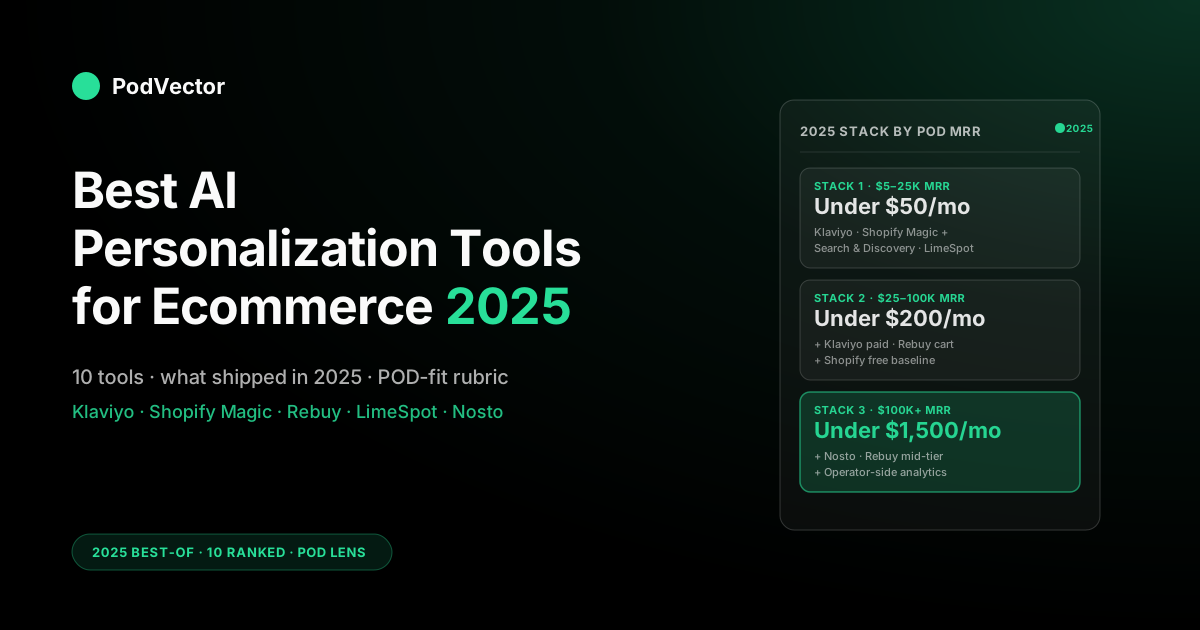
Quick Answer: The 10 best AI personalization tools for ecommerce, ranked for POD-store fit, are: 1. Klaviyo (predictive AI + send-time AI, free to 250 contacts), 2. Shopify Magic + Search & Discovery (free with Shopify, on-site recommendations), 3. Rebuy (cart and post-purchase AI, from $99/mo), 4. LimeSpot (Shopify-native, from ~$18/mo), 5. Constructor (analyst-recognized leader for commerce search and product discovery, enterprise pricing), 6. Nosto (on-site personalization, back-to-back Gartner Magic Quadrant recognition, mid-market floor), 7. Insider (Sirius AI, strong in mobile-first and omnichannel, enterprise floor), 8. Dynamic Yield (testing-led with conversational search, enterprise), 9. Bloomreach (CDP + Loomi AI + product discovery, enterprise), and 10. Adobe Target (legacy enterprise, Sensei GenAI). For most POD stores under $1M revenue, the winning stack is Klaviyo + Shopify's free tools + one cart app (Rebuy or LimeSpot) for well under $200/month — the enterprise tools are over-built for POD economics.
Three things changed most recently that re-ordered the rubric: agentic AI reached the personalization category (platforms now generate full campaigns from a plain-language prompt), conversational shopping interfaces moved from beta novelty to a standard feature on enterprise platforms, and the small-store stack got cheap enough that most personalization software roundups now over-recommend enterprise tools that POD economics can't support. This guide scores each tool against a current rubric and gives three stack picks for stores from $5K to $100K+ MRR.
What Changed for AI Personalization
Three shifts have genuinely moved the rankings in the current cycle, rather than the usual vendor reshuffling. First, agentic AI reached the personalization category — according to Bloomreach, tools can now generate full campaigns, segment audiences, and optimize journeys from a plain-language prompt, without manual rule-writing. That's a real capability jump, not just marketing language.
Second, conversational shopping moved from optional add-on to table stakes on enterprise platforms. Dynamic Yield shipped its Experience Search and Shopping Muse conversational chatbot; Bloomreach expanded its conversational shopping assistant; Klevu added MOI, an AI chatbot powered by conversational AI for on-site search. The market now spans a spectrum from single-purpose specialists (search, email, experimentation) to unified systems that deliver marketing automation, on-site personalization, and search discovery from a single AI intelligence layer — and both approaches serve real needs depending on store stage.
Third, Klaviyo pushed predictive LTV scoring and send-time AI down into its lower-priced tiers — which means stores on standard plans now get the same prediction layer that used to sit behind enterprise paywalls. That made the small-store stack meaningfully more capable without raising the price.
What did not change: enterprise platforms (Bloomreach, Dynamic Yield, Insider, Adobe Target) still need a substantial MRR base to pay back their license cost. Their AI capabilities improved — Bloomreach's Loomi, Insider's Sirius AI, Adobe's Sensei GenAI all shipped genuinely useful upgrades — but the math at small scale is unchanged. They are excellent tools for the wrong customer profile if you're under $1M annual revenue.
For a print-on-demand seller fulfilling through Printify or Printful, the implication is concrete: the current best-of list is heavier at the bottom (free and sub-$100/month) and the enterprise tier is mostly aspirational. Skip it until store revenue earns the floor. The full POD-specific lens is later in this guide. To understand which margin metrics actually matter before layering in personalization tools, see the net profit margin benchmark for ecommerce.
How These 10 Tools Were Scored
"AI personalization" isn't one job — it's three, and most tools are strong at one of them and bolted-on at the others. Before the rubric, it helps to know which surface each tool actually owns:
- Lifecycle — what email, SMS, and push subscribers see, when, and with what subject line and product feed (Klaviyo, Insider, MoEngage).
- On-site — what the homepage, search, category pages, and recommendation widgets show each visitor based on behavior and session intent (Shopify Search & Discovery, LimeSpot, Nosto, Constructor, Klevu, Algolia).
- Cart and post-purchase — upsells, cross-sells, bundles, and "complete the look" offers at the highest-intent moment (Rebuy, LimeSpot).
A complete POD stack covers all three, which is why the stacks later in this guide combine tools rather than chasing one platform that claims to do everything. The market now spans a wide spectrum: on one end, single-purpose specialists that do one thing exceptionally well (search, email, experimentation); on the other, unified systems delivering marketing automation, on-site personalization, and search discovery from a single AI intelligence layer. Each tool earned points on five axes:
- What shipped recently (0–10) — did the platform release a meaningful AI capability in the current cycle, or is it coasting on 2023 marketing?
- Floor price (0–10) — does the tool have a usable free or sub-$30 entry, or does the AI live behind a high-dollar paywall?
- Time-to-payback (0–10) — for a store doing $10–50K/month, how fast does the tool earn its monthly cost back? Sub-30 days scores 10; 90+ days scores 4 or below.
- Setup without a developer (0–10) — is it a one-click Shopify install, or does it need API plumbing and a CDP migration?
- POD compatibility (0–10) — does the data model handle variable per-unit Printify/Printful costs, low-to-mid AOV apparel, and zero on-hand inventory?
The composite score is the average. A score of 8.5+ earns a place in almost any POD stack. Below 7.0, the tool is better postponed until revenue justifies the floor. For context on how personalization lift translates to checkout outcomes, the average checkout completion rate benchmark gives a useful baseline.
Comparison Table: 10 Best AI Personalization Tools
The "Free or low tier" column is what you can actually use without a credit card. "POD fit" reflects how well the tool handles a Shopify + Printify/Printful store at $10–60K MRR.
| Rank | Tool | Primary job | Floor price | Free or low tier? | Score | POD fit (/10) |
|---|---|---|---|---|---|---|
| 1 | Klaviyo | Lifecycle (email/SMS) | $0 → $20/mo | Yes (250 contacts) | 9.4 | 9 |
| 2 | Shopify Magic + Search & Discovery | On-site (search/recs) | Free with Shopify | Yes (full) | 9.2 | 9 |
| 3 | Rebuy | Cart and post-purchase | $99/mo | No (14-day trial) | 8.4 | 8 |
| 4 | LimeSpot | On-site (Shopify-native) | ~$18/mo | Yes (15-day trial) | 8.3 | 8 |
| 5 | Constructor | Search and discovery | Custom (enterprise) | No | 7.8 | 5 |
| 6 | Nosto | On-site personalization | Custom (mid-market) | No | 7.5 | 6 |
| 7 | Insider | Omnichannel / mobile-first (Sirius AI) | Custom (enterprise) | No | 7.2 | 4 |
| 8 | Dynamic Yield | Testing + conversational search | Custom (enterprise) | No | 6.9 | 3 |
| 9 | Bloomreach | CDP + Loomi AI + discovery | Custom (enterprise) | No | 6.7 | 3 |
| 10 | Adobe Target | Testing + Sensei GenAI | Custom (enterprise) | No | 6.4 | 2 |
The first four tools have either a free tier, a sub-$30 floor, or an under-$100 ceiling. They stack for well under $200/month combined and cover lifecycle, on-site, and cart — roughly the full scope of what a POD store actually needs from personalization today. Tools 5–10 only earn slots once revenue passes the threshold where their licenses start paying back. Raising AOV so that each of those tools pays back faster is addressed in the guide to increasing AOV with AI.
The 10 Tools, Ranked
1. Klaviyo — Best All-Around for Lifecycle
What it does: Email, SMS, and push automation with predictive AI scoring (LTV, churn risk, expected next-order date), send-time AI, subject-line generator, segment AI, and a benchmark database that compares your store to similar Shopify accounts.
Recent ship list: The biggest update was pushing predictive analytics down into lower-priced tiers — predictive LTV and churn scores now ship with the standard plan instead of starting at the enterprise tier. Klaviyo also rolled out an AI segment generator (describe a segment in plain English, it builds the filter logic) and AI-generated subject lines that pre-test against historical open rates.
Floor: Free for the first 250 contacts and 500 sends per month. Paid plans start at $20/month at 251–500 contacts. The AI features ship on every paid tier.
POD fit: Klaviyo reads Shopify order, customer, and product objects natively, including variant-level data. The predictive LTV is a real signal for POD stores where the difference between a one-shirt buyer and a four-shirt repeat customer is the entire margin story. The one weakness — true of most lifecycle tools — is that Klaviyo doesn't see your supplier cost. The predicted LTV figure assumes retail revenue, not contribution margin after Printify/Printful base costs. You'll need a separate operator-side analytics layer to see the margin truth.
Score: 9.4 — earns a slot at literally any store size. Setting up a Klaviyo browse abandonment flow is the highest-leverage first automation to run once you're on the platform.
2. Shopify Magic + Search & Discovery — Best Free Baseline
What it does: Magic generates product descriptions, blog posts, email subject lines, and FAQ answers using Shopify's generative AI. Search & Discovery ships AI-powered semantic search (so "soft cotton tee" matches products tagged "100% combed cotton t-shirt"), AI-generated synonyms, and recently viewed / recommended-products widgets.
Recent ship list: Search & Discovery rolled out semantic search to all Shopify plans (it was previously Shopify Plus only). Magic added a "fill missing product metadata" bulk action that backfills descriptions, alt text, and meta titles across the catalog. Sidekick — the in-admin AI agent — left beta and now answers Shopify Q&A in the merchant chat.
Floor: Free with any Shopify plan. There's no upgrade path because it's already included.
POD fit: Native to the platform every POD store is already on. The semantic search lift is most valuable for stores with 100+ SKUs — a typical POD print catalog. The recommended-products widget is the simplest possible personalization surface and it's free; turn it on before paying for any third-party recs. Improving on-site search relevance is one of the first free levers to pull when CRO techniques are on the roadmap.
Score: 9.2 — the free baseline that every other tool layers on top of.
3. Rebuy — Best Cart and Post-Purchase AI
What it does: AI-driven cart upsells, cross-sells, post-purchase one-click offers, and on-site recommendation widgets. The AI engine is trained on the merchant's order history and product affinity, then run as in-cart blocks and post-purchase pages.
Recent ship list: Rebuy rolled out a generative AI bundle builder that proposes "complete the look" sets from product attributes, plus a smart cart that re-ranks upsell offers based on live cart contents instead of a static rule. Post-purchase widgets received a performance upgrade with a new edge runtime.
Floor: $99/month for the entry tier (Shopify Plus pricing scales up). 14-day free trial.
POD fit: Rebuy works well for POD once a store has the AOV to justify the floor. The post-purchase one-click upsell — which doesn't require re-entering payment — is the highest-EV use case for POD because the supplier cost is already locked in on the first item. For stores watching ad spend erode margin, lifting AOV through post-purchase upsells is a non-ad-spend path to protecting returns. See the guide to increasing AOV with AI for the full framework.
Score: 8.4 — earns its slot from around $10K/month upward.
4. LimeSpot — Best Shopify-Native On-Site Personalization Under $30
What it does: AI-driven product recommendations on home, product, cart, checkout, and post-purchase pages. Multi-language support, A/B testing of widget placements, and a discount-personalization engine that adjusts offer thresholds per segment.
Recent ship list: A new generative-AI placements builder (it suggests where to place which widget based on traffic patterns) and a measurable-lift report that attributes revenue to specific recommendations rather than just showing widget clicks.
Floor: Around $18/month for the entry tier; mid-tier is in the $50–60/month range. 15-day free trial. The AI features ship across all paid tiers, not gated to the top.
POD fit: LimeSpot is one of the cleanest fits for sub-$50K/month POD stores. It installs as a Shopify app, reads variant data, and the entry tier is affordable enough that even early-stage stores can run it. Where it falls short is at scale — once you're past a high monthly revenue threshold, Nosto or Dynamic Yield will out-perform on testing depth and segment granularity.
Score: 8.3 — best-fit on-site personalization for small and mid POD stores.
5. Constructor — Best Pure-Play Search and Discovery
What it does: AI-powered product search, navigation, and recommendations purpose-built for retail catalogs. Constructor's positioning is "search as personalization surface" — the search and category results re-rank in real time based on session intent and historical behavior.
Recent ship list: Constructor has received analyst recognition from both Forrester and Gartner for its commerce search and product discovery capabilities. Product side: shipped a new conversational search interface and tightened LLM grounding so search results stay anchored to the actual catalog.
Floor: Custom enterprise pricing aimed at retailers with large catalogs and substantial revenue. Not designed for small stores.
POD fit: Realistically, none for most POD sellers. Constructor is best-in-class for what it does, but the pricing floor and integration scope make it inappropriate below the largest POD aggregators. Listed here because the analyst leadership rerates the category, not because most readers should buy it. For smaller stores, Klevu (see "Worth knowing" below) covers much of the same search-personalization surface at a mid-three-figure monthly price point.
Score: 7.8 (5 for POD-fit, scored higher on capability).
6. Nosto — Best Mid-Market On-Site Personalization
What it does: On-site product recommendations, content personalization, behavioral targeting, A/B testing, and merchandising. Nosto has earned back-to-back recognition in Gartner's Magic Quadrant for personalization, making it one of the most analyst-validated mid-market tools in the category.
Recent ship list: A new attribute-based merchandising engine and tighter Shopify integration that reduces the implementation cycle. AI-generated category banners that auto-personalize per visitor.
Floor: Custom mid-market pricing. Not designed for early-stage stores — there is a 14-day free trial, but the contract floor makes it a commitment suited to stores with established revenue.
POD fit: Nosto is a capable tool that fits a narrower POD customer profile. The pricing floor is appropriate for larger stores doing premium apparel or print, but a typical POD operator at a smaller revenue level will struggle to earn back the license. If you're past the threshold, Nosto and LimeSpot are the two strongest non-enterprise options on this list.
Score: 7.5 — capability earns 9, but POD-fit drags it down.
7. Insider — Best Mobile-First Omnichannel Personalization (Enterprise)
What it does: A predictive-AI engine (Sirius AI) that scores customer behavior across web, app, email, SMS, WhatsApp, and push, then orchestrates the next-best-action across all channels via the "Architect" workflow tool. Insider is particularly strong in mobile-first personalization, making it a good fit for ecommerce brands with large app audiences. The platform has consistently ranked as a leader in G2's category reports.
Recent ship list: Sirius AI shipped a generative content layer (auto-write subject lines and push copy per segment), a unified inbox for omnichannel conversations, and tighter WhatsApp integration. The platform can be complex to implement and often requires technical expertise to unlock full capabilities.
Floor: Custom enterprise pricing. Realistically starts at a meaningful monthly investment for the smallest deployments and scales into five figures monthly for full omnichannel rollouts.
POD fit: The capability is real, but the floor is wrong for almost any POD seller. Insider's value is in coordinating five or more channels at scale; if your store does most of its revenue through Shopify checkout and email, you can't extract enough lift to justify the platform spend.
Score: 7.2 (4 for POD-fit).
8. Dynamic Yield — Best Testing-Led Personalization
What it does: Experimentation-first personalization platform — every personalization rule is an A/B test by default, with statistical significance reporting and a deep audience segmentation engine. Originally built for retail, now part of Mastercard. The platform recently launched Experience Search (AI-powered search that handles complex, multi-word queries) and Shopping Muse (a conversational chatbot for product discovery), expanding beyond its core testing and optimization capabilities.
Recent ship list: A generative-AI variant builder that proposes copy and layout variants for tests, and tighter integration with Mastercard's commerce data services. For brands with mature experimentation programs that want to layer personalization on top of their testing infrastructure, Dynamic Yield offers a comprehensive solution.
Floor: Custom enterprise pricing — high monthly investment suitable for enterprise-scale deployments.
POD fit: Same story as Insider. Excellent platform; wrong floor for under-$1M-revenue stores. POD operators with growing order volumes can usually run faster experiments inside Shopify Plus's native A/B framework or with a lower-cost tool for a fraction of the cost.
Score: 6.9.
9. Bloomreach — Best CDP + Personalization Bundle
What it does: Combines a customer data platform (Engagement) with site search, content management, and an AI engine called Loomi. It's one of the few platforms that genuinely unifies CDP and on-site personalization in a single SKU. According to Bloomreach, the platform excels in product discovery, helping ecommerce websites deliver real-time personalization that drives engagement and conversion.
Recent ship list: Loomi got a generative AI campaign builder, a new visual journey designer, and tighter Shopify and BigCommerce integrations. Bloomreach also expanded its conversational shopping assistant — agentic AI tools can now generate full campaigns, segment audiences, and optimize journeys from a plain-language prompt, without manual rule-writing.
Floor: Custom enterprise pricing. The effective floor makes it a commitment suited only to stores with established data complexity.
POD fit: Bloomreach is best-in-class for unified customer data, but a POD store under $1M revenue rarely has the data complexity to need a CDP at this price. Klaviyo + Shopify's native customer data covers the vast majority of what a POD store would extract from Bloomreach, at a fraction of the cost.
Score: 6.7.
10. Adobe Target — Most Established Enterprise Tool
What it does: Adobe's testing, targeting, and personalization platform — part of the Adobe Experience Cloud and powered by Sensei GenAI. It's the longest-tenured tool on this list. It's particularly compelling for companies that want full control over AI-driven personalization and are already using or planning to adopt the broader Adobe Experience Cloud for analytics, testing, and cross-channel marketing.
Recent ship list: Sensei GenAI shipped variant generation across copy and creative, and Target tightened its integration with the broader Adobe stack (Analytics, AEM, Journey Optimizer).
Floor: Custom enterprise pricing. Only makes sense as part of an Adobe Experience Cloud commitment.
POD fit: Almost zero for native POD operators. Adobe Target lives in a stack that POD sellers don't run. Listed here only because every "best AI personalization" article mentions it; in practice, no POD store at a typical revenue level has any reason to evaluate it.
Score: 6.4.
Worth knowing but off the main list:
- Klevu is a personalization and conversion rate optimization solution for ecommerce businesses focused on website personalization, AI site search, product recommendations, and its AI chatbot (MOI) for on-site search. It's a credible alternative to Shopify Search & Discovery for stores that have outgrown native search but aren't ready for Constructor's floor — it installs as a Shopify app with mid-three-figure monthly pricing.
- Algolia is a search and discovery platform offering AI-powered site search, browse personalization, and product recommendations — another strong mid-market alternative to Constructor for stores needing more than Shopify's native search.
- Salesforce Commerce Cloud with Einstein AI is a mature personalization system that operates across search, merchandising, content, and cross-channel marketing — but it's best suited for enterprise retailers and fast-growing mid-market brands with complex requirements, substantial technical teams, and budget to match. For most small and mid-size online stores it's too heavy and too expensive.
- Maestra appears in current 2026 roundups as an emerging platform offering AI-driven personalization that optimizes automatically with algorithmic content selection.
None of these crack the top 10 for POD fit, but all come up in current roundups and are worth recognizing by name.
Three Stacks by Store Stage
The right personalization stack depends on revenue stage, not on which tool has the loudest marketing. Three concrete stacks below.
Stack 1 — Under $50/month (stores doing $5–25K/month)
- Klaviyo Free or $20 tier — predictive LTV, send-time AI, lifecycle automations
- Shopify Magic + Search & Discovery — free, on-site recommendations and semantic search
- LimeSpot Starter (~$18/month) — Shopify-native on-site recommendation widgets
Total: roughly $40/month. Covers lifecycle, on-site, and search. This is the floor stack — almost every POD store doing under $25K MRR should run exactly this configuration before adding anything else. Setting up a Klaviyo browse abandonment flow is the single highest-leverage automation to layer in first.
Stack 2 — Under $200/month (stores doing $25–100K/month)
- Klaviyo paid tier — full predictive AI, more sends, advanced segmentation
- Shopify Magic + Search & Discovery — free, still the on-site baseline
- Rebuy ($99/month) — cart and post-purchase upsells, the highest-EV upgrade at this revenue band
Total: roughly $120–160/month depending on list size. Adds the cart layer where POD economics are most fragile — a meaningful AOV lift here is usually the difference between break-even and profit. See the guide to increasing AOV with AI for the playbook, and review the average checkout completion rate benchmark to understand what a conversion lift at this stage is actually worth in dollar terms.
Stack 3 — Under $1,500/month (stores doing $100K+/month)
- Klaviyo Pro tier — full lifecycle AI, segments, benchmark database
- Nosto or LimeSpot mid-tier — deeper on-site personalization with merchandising and A/B testing
- Rebuy mid-tier — cart, post-purchase, smart bundles
- Operator-side analytics layer — to read margin truth across the supplier and ad data, since the personalization tools above don't see Printify/Printful cost
Total: roughly $800–1,400/month depending on tier. This is the threshold where Nosto starts to pay back, and where the operator-side analytics layer becomes essential — without it, you'll mistake revenue lift for margin lift, and they're not the same thing for POD. For POD-specific margin context, the net profit margin benchmark shows exactly what healthy margins look like at this revenue level.
Where the Best-of List Bends for Print-on-Demand
Most personalization roundups assume warehoused inventory, three-figure AOV, and a single supplier. Print-on-demand inverts all three: zero on-hand inventory, lower per-item AOV on apparel, and per-unit costs that change by Printify or Printful provider, blank, and print method. The best-of list bends in four concrete ways for POD:
Margin per order is thin, so personalization needs to lift conversion or AOV to pay for itself. That rules out enterprise tools whose AI was tuned for high-AOV stores — at typical POD price points, even a meaningful lift is a small dollar amount per order, and enterprise monthly floors would require very high order volumes to break even on the license alone.
Variable supplier cost breaks predictive LTV math. Klaviyo's predicted-LTV column is gross revenue; for a given customer LTV, the contribution margin after Printify/Printful base cost is meaningfully lower. A retention campaign that looks profitable on revenue terms can look very different on margin terms. The fix is reading margin separately — the personalization tool isn't going to do it for you. See the net profit margin benchmark for the full POD-specific context.
Search and discovery matters more for POD than for the median DTC store. A POD store with 200+ designs across eight product types behaves more like a marketplace than a focused brand — visitors don't know exactly what they want, and the search experience is doing real personalization work. Shopify Search & Discovery's free semantic search pays back here at zero cost; Constructor's enterprise version pays back only at scale far above what most POD stores reach. Klevu and Algolia fill the mid-market gap.
The conversational shopping shift is mostly irrelevant for POD right now. Dynamic Yield's Shopping Muse and Bloomreach's conversational assistant are genuinely impressive — but the customer base for conversational product discovery at scale is large-catalog retailers, not the typical POD seller whose catalog is discoverable through good search and recommendation widgets alone. Don't over-invest in this surface until AOV and order volume justify it.
The practical implication: a POD store should run lifecycle (Klaviyo) and the free on-site baseline first, add cart AI (Rebuy or LimeSpot) once AOV justifies it, and skip the enterprise tier entirely until store revenue passes the threshold where the floor pays back. The PodVector strategy guide covers how to read actual margin across your supplier and ad data once the personalization stack is in place.
Five Mistakes Sellers Make Picking Personalization
1. Treating "best-reviewed" as "best for me." Forrester and Gartner leadership rates capability, not fit. A platform can be a category leader and still be the wrong tool for your revenue stage. Pick on rubric, not on logo.
2. Buying enterprise floor before lifecycle is dialed in. Klaviyo and Shopify's native tools cover the majority of what most POD stores need. Sellers consistently jump to Bloomreach or Insider before they've fully run the basics — and end up paying for capabilities they can't operationalize. A Klaviyo browse abandonment flow alone will outperform an enterprise platform that's poorly configured.
3. Confusing revenue lift with margin lift. Personalization tools all report revenue attribution. For POD, the revenue number masks the margin truth — variable supplier cost means a revenue lift can be a much smaller margin lift if the lift came from heavier blanks or premium print methods. Track margin separately. The net profit margin benchmark gives the reference point.
4. Ignoring the cart-and-post-purchase moment. The single highest-EV personalization surface for POD is the post-purchase one-click upsell, because the supplier cost is already locked in on the first item — the second item ships in the same package, often at the same supplier base cost. Most sellers leave this surface dark for years. Understanding how to increase AOV with AI puts this moment in the full context of order economics.
5. Skipping the operator-side layer. Personalization tools optimize visitor experience. POD profit is a function of operator decisions — supplier mix, design ranking, ad spend allocation. Personalization without operator analytics is half the system. The other half is reading what's working across your stack against actual margin, not just revenue. The comparison of analytics and attribution tools for POD sellers is the right starting point for evaluating that layer.
FAQs
What is the best AI personalization tool for ecommerce right now?
For most stores under $1M annual revenue, Klaviyo earns the top slot — the recent ship list (predictive LTV in lower tiers, segment AI, send-time AI) made it the strongest all-around tool at a usable price. For enterprise stores doing $5M+, Bloomreach, Insider, or Dynamic Yield are stronger on omnichannel and CDP depth.
Are AI personalization tools worth it for small ecommerce stores?
Yes, but only the ones with free or low-cost floors. Klaviyo's free tier and Shopify Magic cost nothing and earn back almost immediately on a small store. Tools with $99+ floors only earn back once a store reaches meaningful monthly revenue, and enterprise tools rarely earn back below high monthly revenue thresholds.
What's new in AI personalization compared to 2023–2024?
Three things changed: agentic AI reached the category (tools can now generate full campaigns from a plain-language prompt), conversational shopping interfaces (Dynamic Yield's Shopping Muse, Bloomreach's conversational assistant, Klevu's MOI chatbot) moved from novelty to standard, and Klaviyo pushed predictive AI down into lower tiers. The gap between affordable and aspirational widened — the small-store stack got better; enterprise floors stayed flat.
Which AI personalization tool works best with Shopify and Printify or Printful?
Klaviyo and Shopify Magic + Search & Discovery are the cleanest fits — both read Shopify data natively and don't require a developer to install. LimeSpot is the strongest paid Shopify-native add-on in the sub-$30/month range. Most enterprise tools work with Shopify but their floor pricing makes them unworkable for typical POD economics.
Do I need a customer data platform (CDP) for AI personalization?
Below ~$1M annual revenue, no. Shopify's native customer data and Klaviyo's predictive layer cover the use cases that matter at that scale. A CDP (Bloomreach, Segment, Tealium) starts paying back only when you're orchestrating multiple channels and have the data engineering capacity to keep the CDP clean.
What's the AI personalization tool with the highest ROI for POD specifically?
Post-purchase one-click upsells via Rebuy or Shopify's native post-purchase pages — once a store is doing meaningful monthly order volume. The supplier cost is already locked in on the first item, and the second item often ships in the same package at the same base cost, so the margin on the upsell is unusually high. This single surface tends to earn back the Rebuy floor for POD stores with solid monthly order counts. For the full AOV framework, see the guide to increasing AOV with AI.
How do I know if my checkout is the bottleneck before adding personalization?
Check the average checkout completion rate benchmark first. If your rate is below the ecommerce median, personalization spend upstream of checkout will be less efficient until the checkout itself is fixed — conversion rate optimization at the checkout level is higher-leverage than recommendation widgets for stores with a checkout gap.
How does Victor by PodVector fit into a personalization stack?
Victor is not a personalization tool — he's the operator-side AI employee that reads what your personalization tools are actually doing to margin. Personalization platforms (Klaviyo, Rebuy, LimeSpot) optimize the visitor side; Victor reads live business data from your connected platforms — Shopify, Meta Ads, Google Ads, Printify, and Printful — proposes specific margin-moving actions (repricing SKUs, adjusting discount thresholds, scheduling Klaviyo campaigns, pausing underperforming Meta campaigns from the read side) as approval cards, and executes approved Shopify-side writes after you confirm. The two layers are complements: personalization for the customer, Victor for the operator. See the full PodVector strategy guide for how the two layers fit together, and the analytics tool comparison for how Victor's read surface stacks up against other POD analytics options.
The Operator-Side Layer That Personalization Tools Don't Cover
Klaviyo, Rebuy, LimeSpot, and Nosto optimize the visitor experience. None of them see your Printify or Printful supplier cost, your ad spend, or your true margin per design. That's where Victor sits — a POD-native AI employee that reads live order, supplier, and ad data from your connected platforms (Shopify, Meta Ads, Google Ads, Printify, Printful, and Klaviyo), proposes a next margin move as an approval card, and executes approved Shopify-side actions after you confirm. Personalization for the customer; Victor for the operator.
Try Victor free