
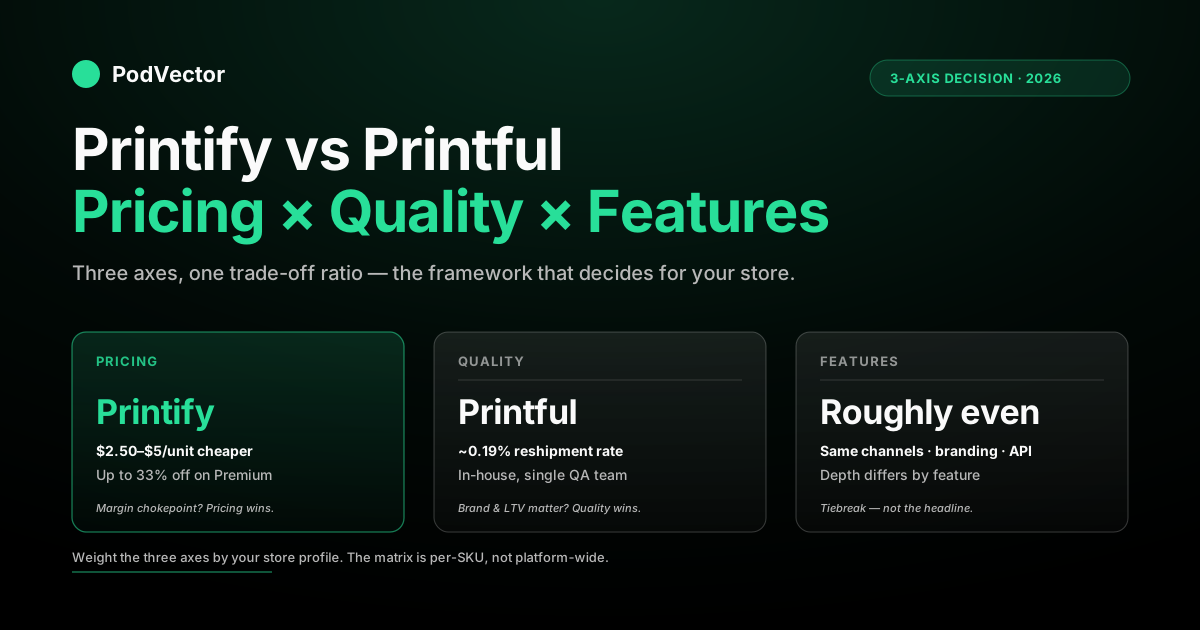
Quick Answer: Printify wins on pricing — its base unit cost runs ~$3–6/unit cheaper on standard apparel, and that gap holds even though Printify's $29/month Premium plan caps at up to 20% off versus Printful Growth's up to 33% off ($24.99/month). Printful wins on quality consistency (in-house production, ~0.19% reshipment rate). Features are roughly even — both cover the major sales channels, branding, and design tools.
The real answer is rarely either-or. Your store's correct pick depends on the trade-off ratio between those three axes — how much margin you'd give up for tighter quality variance, and how much that variance actually costs you in refunds and chargebacks.
Below: the three-axis decision framework, the per-axis breakdown, integration mechanics most comparisons skip, and the matrix that converts the three factors into a single per-store call.
The three-axis trade-off (and why platform-level winners don't exist)
Most "Printify vs Printful" articles pick a winner. That's the wrong frame. Pricing, quality, and features each pull in different directions, and the right answer for your store is the trade-off ratio, not a thumbs-up on one platform.
Here's the simple version. Printify is cheaper but has wider quality variance because orders route across a network of independent providers. Printful is pricier but produces in-house, so quality variance is tight. Features are close enough on both that the tiebreak comes from the first two axes.
The mistake operators make is treating these as separable. They're not. A $3 cheaper unit cost matters less if your refund rate doubles. Tighter quality matters less if you're priced out of the market. Features matter only insofar as they unblock the channels you actually sell on.
Below, each axis on its own, then the framework that combines them.
Axis 1: Pricing
Pricing on POD comes from three places: per-unit base cost, the subscription plan that discounts that base cost, and shipping. Printify wins the per-unit cost decisively; Printful actually wins the discount percentage ceiling, but a deeper discount off a higher base still loses to Printify on net. Printful and Printify are roughly even on shipping for domestic US orders.
Per-unit base cost
On a Bella+Canvas 3001 unisex tee in the most common sizes, Printify base cost runs around $9.50–$10.50 from a top-tier provider. Printful's same garment runs around $12–$13 base. That's a $2.50–$3.50 gap before any subscription discount.
Hoodies widen the gap. A Gildan 18500 on Printify is roughly $18–$21 from leading providers; Printful's comparable Gildan or in-house pull-over runs $24–$28. Embroidered hats land closer — usually within $1–$2 of each other.
Subscription discount
Printify Premium is $29/month and applies up to 20% off product base prices. Printful's Growth plan is $24.99/month and advertises a steeper headline — up to 33% off Printful's base prices. So Printful wins the discount percentage, which trips up a lot of comparisons. The catch: 33% off Printful's ~$12.50 tee is ~$8.38, while 20% off Printify's ~$9.50 tee is ~$7.60. The lower base wins net even with the smaller discount.
The Premium/Growth math only works above ~30 orders per month on $10 garments. Below that, the free tier on either platform is the right call. Above 100 orders/month, Printify (Premium) still typically beats Printful (Growth) by $4–$6 per garment on net unit cost despite Printful's larger discount percentage.
For the deeper plan-and-pricing breakdown, see our Printful Premium Membership Price Full Breakdown and the Premium Membership Pricing & Benefits Breakdown.
Shipping
Domestic US apparel shipping runs ~$3.99 first item / $1.50 each additional on Printify (provider-dependent), and ~$3.99 / ~$2.00 on Printful. International shipping is messier — Printful's owned facilities in EU, Mexico, and Canada cut transit time on cross-border orders, which can be worth the per-unit premium for non-US-heavy stores.
Pricing scoreboard
| Pricing factor | Winner | Approximate gap |
|---|---|---|
| Base unit cost (apparel) | Printify | $2.50–$5/unit cheaper |
| Subscription discount ceiling (% off base) | Printful (Growth) | 33% vs 20% |
| Net unit cost after discount | Printify | ~$0.50–$1.50 cheaper despite smaller % |
| US shipping cost | Roughly even | < $0.50 typical |
| International shipping | Printful | 1–4 days faster transit |
Axis 2: Quality
Quality is where the platform-level conversation breaks down. Printful runs everything through its own facilities with a single quality team — variance is tight, reshipment runs ~0.19% per Printful's published numbers. Printify routes orders across a network of independent providers (Monster Digital, SwiftPOD, Dimona Tee, MWW, and dozens more), so quality depends on which provider got your order.
What "consistency" actually means for refunds
The quality gap shows up in refund rates. On Printful, a typical apparel-only store reports 0.5–1.5% refund/replacement rate. On Printify, the same store profile typically reports 1.5–4% — wider variance with the lower bound on top-provider-only stores and the upper bound on stores that didn't curate their providers.
That difference compounds. On a $25 retail tee with a $10 cost, a 2-percentage-point higher refund rate eats roughly $0.30 per gross unit (lost product cost + shipping the replacement). The unit-cost savings from Printify need to clear that bar.
Quality by category
Printful's edge is biggest on premium tees (Bella+Canvas 3001, Stanley & Stella), heavy hoodies, and embroidered hats — categories where in-house DTG calibration and embroidery machines pay off. Printify's edge appears on basic Gildan tees, mugs, and all-over-print apparel where top-tier providers have category specialization Printful's generalist setup doesn't match.
The full per-category breakdown lives in our Printful vs Printify vs Gelato Comparison piece. The short version: don't pick a platform on apparel quality alone if you sell across categories.
The variance management problem
Choosing Printify means choosing a network. The platform's quality is the median of providers you allow your account to use. Top stores manage this by locking provider routing to one or two pre-vetted partners — that gets you Printify's pricing with Printful-adjacent variance, at the cost of throughput limits per provider.
Axis 3: Features
Feature parity is closer than most articles suggest. Both platforms cover the major channels, branding controls, design tools, and order automation that 95% of stores need. Where they diverge is in the depth of each feature, not the existence of it.
Where they're equal
Sales channels (Shopify, Etsy, Amazon, eBay, TikTok, Wix, BigCommerce, Squarespace, WooCommerce) — both platforms cover the standard list. Mockup generators — both offer in-app mockups. Order automation — both push tracking back to your store automatically. Bulk uploads via CSV — both. Design library storage — both.
Where Printful is deeper
Branding: branded inserts, packing slips, labels, and packaging are more polished on Printful and available at lower order volumes. Embroidery: more fabric-and-thread-color combinations, plus custom embroidery file (DST/EMB) upload. Premium-stitched embroidery on hats is consistently rated higher.
Warehouse and fulfillment add-ons: Printful Warehousing & Fulfillment lets you store non-POD inventory (your own merch, books, coffee bags) alongside POD orders for a single fulfillment pipeline. Printify doesn't offer this.
Where Printify is deeper
Catalog breadth: 1,300+ products vs Printful's ~370. The depth shows up in niche categories (drinkware, tech accessories, home décor, plush toys, AOP everything).
Provider choice: pick which provider fulfills which product, lock routing for consistency, switch on stockouts. Printful is one provider — no choice to make, but no choice when it fails either.
Premium plan unlocks: Premium ($29/mo) gives up to 20% off and unlocks a higher product limit (up to 10 connected stores) and self-serve account features that Printful doesn't lock the same way.
Integration mechanics — the feature axis nobody itemizes
Comparison posts list integrations as logos. The mechanics matter more than the count.
Shopify push depth
Both push variants, prices, mockups, and inventory to Shopify. Printful additionally syncs cost-of-goods (COGS) per variant back to Shopify if you enable it — useful for in-Shopify margin reporting. Printify's COGS sync is partial; many sellers maintain a separate margin sheet.
Etsy variation handling
Etsy's 70-variation limit per listing is the bottleneck for both platforms. Printify's variant chooser handles overflow by auto-splitting into multiple listings; Printful flags the overflow but doesn't auto-split — you decide the cut.
API and webhooks
Both platforms have public REST APIs. Printful's is older and more documented; Printify's is newer with cleaner versioning. Webhook reliability for order events (created, shipped, canceled) is comparable — both are stable enough that mid-sized stores wire them into their own dashboards.
Third-party tooling
Mid-sized stores often layer tools like OrderDesk, MerchTitans, or PrintifyAPI wrappers on top. Printify has a slightly larger third-party ecosystem; Printful has fewer wrappers but tighter native integrations with Shopify and Etsy. For a hands-on comparison from a competing source, see Merch Titans' workflow-focused breakdown.
The push-frequency gotcha
Printful pushes inventory and pricing changes to your store on a schedule (typically every few hours). Printify is similar but provider-dependent — when a Printify provider goes out of stock, the inventory update can lag by 4–8 hours. If you sell flash-driven volume, this matters.
How to weight the three axes for your store
The framework: assign each axis a weight from 0 to 1 based on your store's bottleneck. The axis that wins your weighted sum wins the platform pick.
Pricing weight goes up if
You're in a price-competitive niche (generic motivational quotes, cat memes, basic streetwear) where the AOV ceiling is low and margin is the chokepoint. Or you're at scale (1,000+ orders/month) where 50¢ per unit is real money.
Quality weight goes up if
You're building a brand with repeat-customer ambitions, your AOV is > $40, you're targeting Etsy "Star Seller" or Amazon Brand Registry, or your refund rate already eats > 2% of revenue.
Features weight goes up if
You sell across > 3 channels, you need branded inserts and labels, you sell embroidery, you're doing warehousing for non-POD merch, or you need the Printify catalog breadth (drinkware, tech accessories, plush, niche AOP).
The single weighted question
"On the SKUs I actually sell, in the channels I actually sell on, at the volume I actually do — does Printify's pricing edge clear the cost of its quality variance, given the features both platforms support?"
That's the question. Most stores answer it once and don't revisit it as their margin and refund profile changes — which is the deeper mistake than picking the "wrong" platform on day one.
Decision matrix by store profile
| Store profile | Recommended primary | Why |
|---|---|---|
| New store, < 50 orders/month, basic apparel | Printify (free tier) | Pricing pressure dominates; quality variance is manageable at low volume. |
| Brand-led, premium tees, AOV > $40 | Printful | Quality consistency drives repeat purchase; refund cost dominates over unit cost. |
| Etsy seller, mixed catalog | Printify | Catalog breadth fits Etsy buyer behavior; price competition rewards margin. |
| Embroidery-heavy (hats, polos) | Printful | Embroidery quality and color match are visibly better in-house. |
| International (EU/CA-heavy) | Printful | Owned facilities in EU/MX/CA cut transit time and customs friction. |
| 1,000+ orders/month, multi-channel | Both (split by SKU) | Margin gap on Printify worth keeping for high-volume basics; Printful for premium SKUs. |
| Non-POD merch + POD blend | Printful | Warehousing & Fulfillment unifies the pipeline. |
For deeper pairwise reads on each option, the Printful vs Printify Reviews piece collects operator reviews, and the Printful vs Printify vs Gelato vs Redbubble 2026 roundup adds the broader four-way context if you're not locked into a two-horse race.
The hidden cost most comparisons miss
The cost most articles ignore: the ongoing cost of not knowing which decision is right.
What POD operators actually carry
Most POD operators run on intuition for the platform pick. They picked one early, didn't formally compare margin per SKU later, and stuck with it. That's defensible at small scale and expensive at growth scale.
The right way to make the call is on real numbers: per-SKU margin, per-SKU refund rate, per-SKU customer lifetime value. Those numbers live in your Shopify, Etsy, and supplier invoice data. Stitching them together by hand is the project most operators never get to.
How operators resolve it without a data team
The decision becomes mechanical once your sales channel data, supplier invoice data, and ad spend data are read off together — but most POD operators don't have a warehouse, a data hire, or the time to write the queries that would join them. Building that pipeline yourself is the project that never ships.
The operator path is to connect the accounts to an AI employee that reads them for you, answers "which platform wins for SKU X" in plain English, and then moves the SKUs once you approve. You stay the operator making the call; the per-SKU margin-and-refund math just stops being a manual project. Without it you're picking on platform reputation; with it you're picking on margin-per-order and refund-rate-per-SKU, and the answer often differs from the platform-level conventional wisdom.
Verdict — when each platform wins
Printify wins if: pricing pressure dominates your unit economics, you sell across the broader catalog (especially drinkware, tech accessories, AOP), you're willing to lock provider routing to manage quality variance, or you sell on Etsy where price-comparison buyers reward the lower retail price.
Printful wins if: quality consistency drives your brand (premium tees, embroidered hats, branded packaging), your AOV justifies the unit-cost premium, you need branded inserts at low order volumes, you're international-heavy and want owned EU/MX/CA fulfillment, or you blend POD with non-POD merch through Warehousing.
Use both if: you're past 1,000 orders/month and your margin can absorb the operational complexity of two suppliers. Route premium SKUs to Printful and high-velocity basics to Printify. Track per-SKU profitability monthly and re-route as the data shifts.
FAQs
Does Printify always have lower prices than Printful?
On standard apparel and most catalog overlap, yes — Printify is typically $2.50–$5 cheaper per unit on a top-tier provider. On embroidered hats and premium products, the gap narrows or flips. Always check the specific SKU rather than relying on platform-level averages.
Is Printful's quality really worth the higher price?
It depends on your refund rate and AOV. At $25 AOV with a 2% refund rate gap, Printful's quality clears its premium for most premium-positioned stores. At $15 AOV with margin-tight unit economics, Printify's pricing usually wins even with a higher refund rate.
Can I use both Printify and Printful at the same time?
Yes — many mid-sized stores route by SKU. Premium tees and embroidered hats to Printful, basic apparel and catalog niches (drinkware, tech) to Printify. The operational cost is two supplier accounts and two reconciliation streams; the upside is per-SKU margin optimization.
Which platform has better Shopify integration?
Both Shopify integrations are solid. Printful's is slightly deeper on COGS sync to your Shopify reports. Printify's is slightly more flexible on provider routing per product. For a simple Shopify-only store, either works; for a margin-reporting workflow, Printful's COGS sync saves a step.
What's the best plan for a new POD store?
Stay on the free tier of whichever platform you pick until you clear ~30 orders/month. Above that, run the Printify Premium ($29/mo, up to 20% off) or Printful Growth ($24.99/mo, up to 33% off) math against your actual catalog. The plan only pays back if your discounted unit cost × monthly volume exceeds the subscription cost.
Is Printify reliable when individual providers have issues?
Printify's network design is its biggest feature when a provider goes down — you can re-route. The flip side is that the platform doesn't auto-detect quality drops; you have to monitor it. Locking your account to one or two top-tier providers (Monster Digital, SwiftPOD, Dimona Tee for apparel) is the standard way to manage this.
Does Printful or Printify have better customer support?
Printful's support is more consistent — single team, single SLA. Printify's support quality varies because some inquiries route to providers, not Printify itself. For mission-critical issues (lost orders, defects), Printful tends to resolve faster.
Where can I read more on the broader Printful vs Printify decision?
The cluster hub for Printful comparisons is at Printful Comparison Articles, and the topic hub is Printful with everything else (pricing, costs, integrations, reviews).
Stop guessing the platform pick. Ask Victor.
Picking between Printify and Printful on a feature grid is a 2018 question. The 2026 question is: which supplier is more profitable for the SKUs my store actually sells, factoring my real refund rate and ad cost?
That's the question Victor — PodVector AI's AI employee for POD sellers — answers in plain English. Connect your Shopify, Printify/Printful supplier accounts, and Meta/Google ad accounts. Ask "Should I move my Bella+Canvas SKUs from Printify to Printful?" and get a margin-and-refund-aware answer back, not a generic comparison.
Victor answers. Victor acts on the answer with your approval.
Try Victor free