
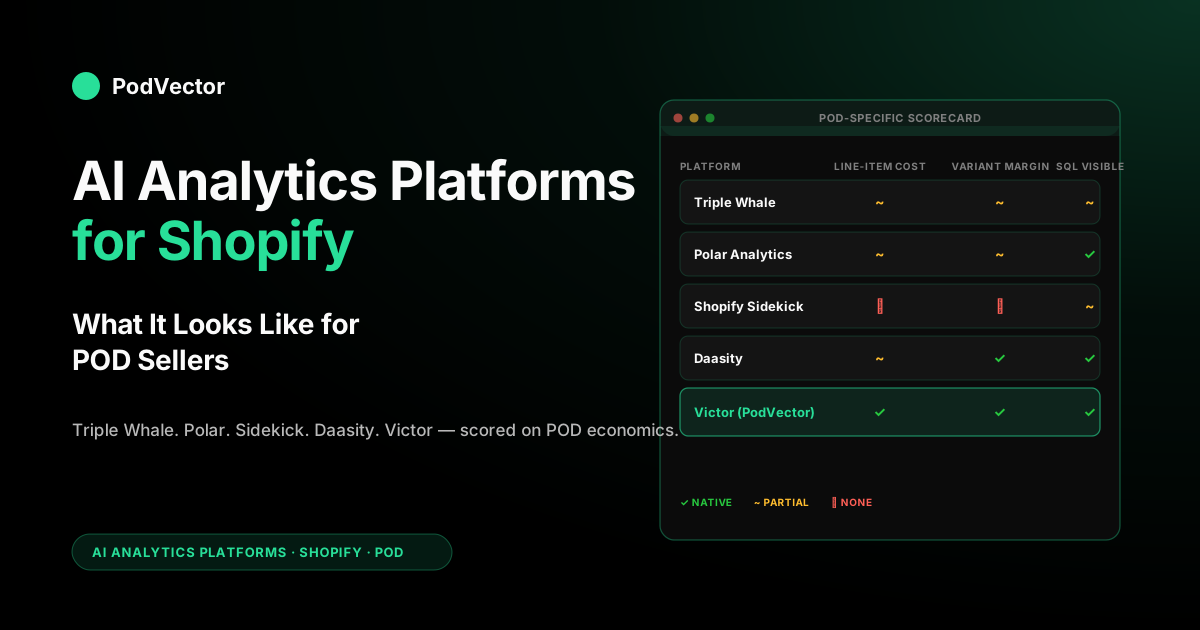
Quick Answer: The AI analytics platforms most Shopify stores compare in 2026 are Triple Whale, Polar Analytics, Northbeam, Glew, Saras Pulse, Daasity, and newer App Store entrants like Datadrew and By The Numbers — plus Shopify's own Sidekick assistant, included with every plan, and GA4, which nearly every store already runs.
For print-on-demand the shortlist is shorter. Every horizontal platform was built for stocked-inventory DTC, so they miss the numbers that decide POD profitability: line-item Printify or Printful cost captured at fulfillment time, variant-weighted break-even ROAS, and supplier base-cost drift.
This guide compares the major platforms on those POD-specific criteria — and shows where the category is heading as agentic operators start replacing passive dashboards.
What "AI analytics platform for Shopify" actually means in 2026
The phrase covers a wider category than most operators realize when they start evaluating. An "AI analytics platform for Shopify" in 2026 is one of three product shapes, and confusing them costs months of evaluation time and at least one bad annual contract.
The first shape is a DTC reporting layer with AI-flavored alerts and explanations. Triple Whale, Polar Analytics, Glew, Northbeam, and most of the Shopify App Store's top-ranked analytics apps live here.
The platform pulls from Shopify, Meta, Google, and a few other sources; it builds dashboards; the AI layer surfaces anomalies in plain English. The chat interface is real but narrow, scoped to the schemas the platform owns.
The second shape is a data warehouse-native platform with a semantic model and a chat agent on top. Daasity, Polar's enterprise tier, and a handful of newer entrants fit here.
The platform writes to your data warehouse, models the data with dbt or a proprietary semantic layer, and exposes the modeled tables to a natural-language agent. The chat surface is broader because the agent can compose against a richer schema.
The third shape is an AI employee that reasons over a live warehouse and is starting to take actions. Shopify Sidekick (within the Shopify admin context), Victor (POD-native), and a small set of horizontal AI-data startups sit in this shape.
The agent's primary output is an answer with the work shown, not a dashboard tile. The product roadmap is biased toward execution — the agent proposes a price update or flags a campaign move for the operator's confirmation, not just reports that it should happen.
Most stores comparing platforms in 2026 are technically comparing across these three shapes without realizing it, which is why head-to-head matrices look so confusing. The right first question in any evaluation is: which shape does this platform actually deliver in production today, regardless of what the marketing copy implies. As noted by a recent head-to-head review at Blackbelt Commerce, analytics tools are expanding beyond marketing attribution into operational intelligence — and for Shopify merchants that means knowing which promotions will be incremental versus cannibalistic, not just which campaigns drove revenue. The follow-up question that separates the field is depth, not breadth — how many domains the agent can reason across in a single query (orders, ad spend, fulfillment cost, refunds), not how many logos sit on the integrations page. A platform with 30 connectors that can only answer "what was revenue last month" is shallower than one with five connectors that can answer "am I profitable by campaign after line-item Printify cost and refunds." For the underlying architecture comparison across the three shapes, see the complete guide to AI agents for ecommerce analytics.
Two themes dominate the 2026 marketing across all three shapes, and a POD operator should read both with a cost-first eye. The first is first-party and server-side tracking — with third-party cookies gone and iOS signal loss now permanent, platforms compete on how accurately they stitch a purchase back to the click that drove it. The second is incrementality testing: Polar, Northbeam, and Triple Whale all now sell experiments that measure what a channel actually caused versus what it merely took credit for.
Both matter — bad attribution sends spend to the wrong channel. But for POD they sit on top of a layer the category still gets wrong: the cost side. As TrueProfit notes, tracking revenue alone completely hides whether your growth is actually profitable — and that gap is exactly what AI-driven profit analytics is built to close. Incrementality on revenue is only half the equation; incrementality on contribution needs the line-item Printify or Printful cost that generic platforms don't ingest, so a channel that looks incremental on revenue can be unprofitable once fulfillment cost lands.
Why the Shopify category misses POD economics
The Shopify analytics category was built for DTC brands that hold inventory. The data model assumes a SKU has a wholesale cost, a retail price, an inventory count, and a velocity. AI layers built on top of that model give clean answers to questions like "which SKUs have the highest contribution margin" or "what's my inventory weeks-of-cover by category." For a stocked brand selling t-shirts wholesale-purchased at a fixed per-unit cost, those answers are right.
POD breaks the assumption in five places, and a generic Shopify analytics platform gets each of them slightly wrong:
1. Cost is per-line-item, not per-SKU. A "Comfort Colors 1717 in size M, color heather purple" costs a specific amount to fulfill with Printify on the day the order ships. The same SKU one variant up — size 2XL — costs noticeably more. The same SKU in a base color can be cheaper still. A platform that loads "average COGS per SKU" from a CSV or from Shopify's cost field captures none of this. Real margin per order is unknowable until the platform queries the Printify or Printful API for that specific line item at that specific time.
2. Cost drifts continuously. Printify and Printful update supplier base costs without customer-facing announcements. A platform that snapshots cost at order time gives correct historical margin; one that re-queries on every report silently rewrites your past as supplier costs change. Most generic platforms re-query.
3. Inventory weeks-of-cover is meaningless. POD has no held inventory, so the most common AI-generated alert in the Shopify analytics category — "you'll run out of SKU X in N days" — never fires correctly. The questions that matter for POD are about supplier capacity, print-provider lead times, and design freshness, none of which the standard analytics schema models.
4. SKU count is much larger than the catalog implies. A POD store with 80 designs across 6 garments, 5 colors, and 5 sizes is operating thousands of variants. Generic dashboards that assume "show me your top 50 SKUs" hide the vast majority of the catalog from analysis. A query layer that can group by design or by garment family is required, and most platforms don't ship those groupings out of the box. What AI can do at product level at that catalog scale is a topic of its own — see the POD seller's guide to AI for ecommerce products.
5. Refund economics are asymmetric. A cancellation before Printify starts production costs you the Shopify transaction fee only. The same cancellation after fulfillment is a total loss. Generic refund analytics treat refunds as a flat percentage of revenue; the right POD model separates pre-fulfillment from post-fulfillment refunds and reports cost-weighted refund impact.
None of these is a deal-breaker if the platform is honest about its limits. The deal-breaker is when the platform claims accurate margin reporting and quietly delivers margins computed from wrong cost assumptions — because then every campaign decision flowing from that number is wrong, and the operator doesn't know it. The complete guide to AI analytics for print-on-demand covers each of the five points in more depth.
The platforms POD sellers will see in evaluations
These are the AI analytics platforms a Shopify-based POD seller will encounter most often in 2026 evaluations. Each summary is the operator-relevant version, not the marketing version.
This page is part of a larger comparison series — the AI agents cluster covers the agent-shaped tools head-to-head, and the AI analytics hub holds the full library.
Triple Whale
The most-recognized name in DTC analytics. Strengths: blended ROAS view across paid channels, a chat agent (Moby) that now extends to forecasting as well as attribution questions, deep Shopify and ad-platform integrations, and an incrementality-testing layer added through 2026. As noted by Blackbelt Commerce's 2026 head-to-head, Triple Whale expanded Moby in 2025–26 to handle forecasting questions, allowing merchants to ask forward-looking questions and get AI-generated projections with confidence ranges.
Limits for POD: cost ingestion is per-SKU rather than per-line-item, so margin numbers reflect average cost not actual fulfillment cost. The Printify integration exists but is shallow. Pricing starts at $219/month according to Blackbelt Commerce's 2026 review, which can be prohibitive for smaller stores. Best fit when a POD store wants the strongest ad attribution layer and is willing to maintain its own variant cost spreadsheet alongside.
Polar Analytics
Positions itself as a unified data stack with a no-code dashboard layer and an AI agent. Strengths: writes to a managed warehouse (you don't have to provision one), the AI agent can answer cross-source questions, attribution is configurable, and 2026 added incrementality testing across Meta, Google, and TikTok.
Limits for POD: same per-SKU cost limitation as Triple Whale unless you push line-item cost in via custom integration. Pricing scales with revenue and seats; check Polar's current pricing page directly, as it changes with plan tiers and order volume. Best fit when an operator wants a managed-warehouse approach without standing up a warehouse themselves.
Glew
Lighter-weight unified analytics. Strengths: fast to set up, clean cross-channel reporting, sensible free tier for small stores.
Limits: AI features are narrower than Triple Whale or Polar — more "smart dashboards" than agentic chat. POD cost handling is basic. Best fit for POD stores in the early growth phase that need clean reporting before they need a deep agent layer.
GA4 and Mixpanel (the horizontal foundation)
Almost every comparison a POD seller reads will also list Google Analytics 4 and, less often, Mixpanel. They belong in a different bucket than the rest of this list: GA4 is the free traffic-and-conversion layer most stores already run, and Mixpanel is an event/behavior analytics tool aimed at product funnels. Blackbelt Commerce notes that GA4's default attribution is last-click in 2026 — to measure accurate multi-touch attribution, you need additional configuration or a dedicated attribution tool like Triple Whale or Northbeam.
Limits for POD: neither one models cost at all. GA4 sees sessions, traffic sources, and Shopify-reported revenue but nothing about Printify or Printful fulfillment cost, so it can rank channels by revenue but never by margin. Mixpanel is strong for on-site behavior questions and weak for the cost-and-channel P&L questions that decide POD profitability. Treat both as inputs to the funnel side of the picture, not as the margin layer.
Saras Pulse
Predictive-AI focused. Strengths: forecasting, anomaly detection, machine-learning models trained on commerce data.
Limits for POD: predictive models assume stocked-inventory patterns that don't fit POD's design-turnover-driven LTV. The platform is a strong fit for a brand with stable SKUs and slow-moving catalogs; less obvious fit for a POD store that drops new designs frequently. Check Saras Pulse's current pricing page directly for up-to-date plan costs.
Northbeam
The attribution specialist of the list. Strengths: multi-touch attribution plus media mix modeling (MMM — a statistical read on what each channel actually contributes to sales, no cookies required), strong server-side first-party tracking, and incrementality testing built for brands spending heavily across paid channels.
Limits for POD: Northbeam models revenue attribution, not fulfillment cost. There is no Printify or Printful ingestion, so it can tell you which channel drove the order but not whether the order was profitable. Pricing is geared to brands with serious ad budgets; best fit as a dedicated attribution layer on top of a margin-aware stack, not as the margin layer itself.
Datadrew and By The Numbers (newer App Store entrants)
Two AI-analytics apps climbing the Shopify App Store rankings in 2026. Datadrew leans on one-click integrations across Shopify, Amazon, Google, Meta, and GA4 with AI insights spanning performance marketing, CRO, retention, and products. By The Numbers positions itself for merchants who don't have time to build reports — connect the sources, get profit and revenue dashboards.
Limits for POD: both inherit the category's per-SKU cost assumption, so "profit" is computed from whatever COGS lands in the Shopify cost field rather than line-item Printify or Printful cost at fulfillment time. They're worth a look for fast cross-channel reporting at the small-store stage, but the margin numbers carry the same caveat as every other generic platform here.
Daasity
Warehouse-native and dbt-friendly. Strengths: writes everything to your data warehouse, exposes the modeled data through their semantic layer, supports custom transformations.
The AI layer is newer than Triple Whale's but built on a cleaner foundation. Limits for POD: requires more setup work — typically a multi-week implementation.
Pricing is enterprise-flavored and starts higher than the DTC-native tools. Best fit when a POD store has reached the size where data ownership and customization matter more than time-to-first-dashboard.
Shopify Sidekick
Shopify's native AI assistant inside the admin. As Shopify's own documentation confirms, Sidekick is included with every Shopify plan and can answer questions about your store data in plain language. Strengths: no integration work, sits in the place operators already work, handles natural-language queries against the Shopify-native data well.
Limits for POD: scoped to Shopify-side data — sees orders, products, customers, but not Printify or Printful cost, not Meta spend, not cross-channel attribution. Margin questions get answered with whatever cost is in the Shopify cost field, which for POD is usually missing or stale. Strong as a reporting layer for Shopify-only questions; not a complete answer for the cross-channel margin questions a POD operator actually has.
Victor (PodVector AI)
POD-native by construction, and an AI employee rather than a dashboard. Victor reads live data from Shopify, Meta Ads, Google Ads, Printify, and Printful, so he can see your orders, ad spend, and product costs together — then he suggests specific actions with his reasoning shown, and only takes the approved action on Shopify once you say yes. Approved Shopify-side actions Victor can take today include repricing a product to a target margin, bulk repricing across the store, setting up a buy-one-get-one discount, creating a free-shipping discount, raising your free-shipping threshold, creating a customer-specific discount, organizing products into a collection, and reverting a price change. Write automation is expanding.
What's underneath is built for POD: Victor pulls in your Printify and Printful costs down to each item as orders come in, works out margin for each product variant, can group results by design the way generic platforms can't, and shows you exactly how he got each number. For a breakdown of how POD-specific costs flow into margin, see Printify t-shirt cost and profit breakdown and how to get contribution margin.
Limits: the platform is narrower than horizontal options — it's built for POD operators specifically and doesn't claim to fit a stocked-inventory DTC brand. Victor never acts without explicit human approval. Best fit when a POD store has hit the complexity wall on spreadsheets and wants an analytics layer that knows the model from day one.
Side-by-side comparison on POD-specific criteria
The standard SaaS comparison matrix asks about feature parity. The matrix that actually predicts POD outcomes asks about a narrower set of POD-specific capabilities. The five questions below sort the platforms quickly:
| Capability | Triple Whale | Polar | Glew | Sidekick | Daasity | Victor |
|---|---|---|---|---|---|---|
| Printify/Printful costs tracked down to each item | Partial | Partial | No | No | Possible (custom) | Native |
| Cost snapshot at fulfillment time | No | No | No | No | Possible | Yes |
| Variant-level margin views | Limited | Limited | No | No | Yes (with modeling) | Native |
| Variant-weighted break-even ROAS by campaign | No | No | No | No | Possible | Yes |
| Agent shows its work | Partial | Yes | No | Limited | Yes | Yes |
| Writes to a warehouse you control | No | Yes (managed) | No | No | Yes | Yes (warehouse) |
The matrix is deliberately uncomfortable for the horizontal vendors because the five rows are the things they didn't build for. That's not a value judgment about the platforms — Triple Whale is excellent at what it built for.
It's a sorting tool: a POD operator who weights these five capabilities highly will arrive at a smaller shortlist than the standard DTC review process produces. For the side-by-side at the broader tooling level, see best AI tools for ecommerce data analysis compared.
Shopify Sidekick: the native option
Sidekick deserves its own section because most Shopify operators encounter it first and need a clear sense of where it fits. It's free, it's already in the admin, and Shopify has invested heavily in its capabilities through 2026. For a POD store, the honest assessment is that Sidekick is excellent at a defined slice of the analytics workload and incomplete for the rest.
What Sidekick handles well. Natural-language queries against Shopify-native data. "Show me my top 10 products by revenue this month broken down by traffic source," or "which discount codes had the highest conversion rate in March," or "draft a customer segment for buyers who purchased in January but not since." These questions live entirely in Shopify's schema and Sidekick answers them quickly. As Shopify's own documentation notes, Sidekick can answer questions about any of your store data in plain language. For a POD operator who previously had to either build a Shopify report or export to a spreadsheet, the productivity gain is real.
Where Sidekick is incomplete for POD. Margin and ROAS questions. Sidekick can compute revenue, conversion, and customer-side metrics; it cannot tell you what a campaign actually made because it doesn't see Meta spend, doesn't see itemized Printify cost, and doesn't see cross-channel attribution.
The "cost per item" field in Shopify is Sidekick's only handle on COGS, and for POD that field is either empty or filled with averaged guesses that drift over time. A Sidekick answer to "what's my net margin on the Spring Tumbler campaign" is structurally wrong even when the SQL is right, because the inputs are wrong.
The right way to use Sidekick. Pair it with a cross-channel agent. Use Sidekick for Shopify-only questions (customer segments, product-level revenue, fulfillment status) where it's fastest. Use a separate AI analytics layer for cross-channel margin and ROAS questions where Sidekick can't see the data. The two coexist cleanly because they're answering different question types. A POD operator running this pattern is using Sidekick the way a stocked-inventory DTC operator uses Shopify's native reporting — as one input to operating decisions, not the whole picture.
If the chat surface itself is what you're evaluating — what a conversational assistant inside Shopify can and can't do for a POD store — what a Shopify AI chatbot looks like for POD sellers covers that side in depth.
How to evaluate a platform in two weeks
The vendor sales process for AI analytics platforms is optimized for a 30-minute demo. The reality is that most platforms look good in a demo and get separated by their behavior on real data over the first two weeks of usage. Compress the evaluation window deliberately and most of the marketing claims fall apart on their own. As TrueProfit's 2026 comparison notes, the best approach is to match the tool to how you actually make decisions — not to a feature checklist.
Week 1: connect and reconcile. Connect the platform to Shopify, Printify or Printful, and Meta ads. Pick the most recent completed week and produce a P&L from the platform: spend, revenue, COGS, fees, refunds, net margin. Reconcile against your manual close from the same week. The first reconciliation almost never matches — the question is by how much, and where the variance lives.
Watch how the platform handles the gap. The strong ones explain the variance for you — Shopify gross revenue rarely equals your Stripe or payout-provider settlements because of refunds, pending payouts, and transaction fees, and a good agent reconciles those automatically instead of leaving you to play detective in a spreadsheet. The weak ones just show two different numbers and let you guess which is right.
A variance under a few percent on revenue is acceptable. A double-digit variance on margin is a sign the COGS layer isn't right, which is the whole game for POD. For a deeper look at what correct contribution margin looks like for a POD store, see how to get contribution margin.
Week 2: ask the agent ten real questions. Write down ten questions you've actually asked yourself this quarter — not benchmark questions, real ones. Examples: "what's my variant mix on the Comfort Colors line and how has the average margin shifted in the last 90 days," "which campaign has the lowest cost-adjusted contribution," "show me the customers who bought from the January drop and haven't bought since." Ask each one of the platform's agent. Score on three dimensions: did it answer at all, was the answer right (verify with a manual query), and how much friction was there in getting from the question to the answer.
The exit signals. A platform that fails Week 1 reconciliation and can't explain why is failing. A platform that handles 8 out of 10 Week 2 questions cleanly is winning. A platform that tells you to file a support ticket for half of the questions is selling you the demo, not the product. By the end of Week 2 the picture is clear without needing a vendor call.
Price the hidden costs, not just the subscription. The sticker price is the smallest number in the decision. The real cost of a generic platform for POD is the labor to keep a variant cost spreadsheet current, the integration maintenance when a connector breaks after an API change, and the decision risk of acting on a margin number computed from the wrong COGS. A low-sticker platform that needs several hours a week of cost-file upkeep and produces margins that are quietly wrong is more expensive than a higher-sticker tool that ingests line-item cost directly. Score this explicitly during the two weeks — count the manual steps you had to perform to trust each number. The labor side of that math is the subject of the POD seller's guide to AI for ecommerce productivity.
Most POD operators who run this process end up with one or two platforms that survive. From there it's a pricing and contract-term negotiation, not a feature comparison. For the broader pattern of how platforms get evaluated against the AI Agents category, see best AI agents for ecommerce 2026.
Integration gotchas specific to Shopify + Printify or Printful
Five integration gotchas show up consistently in the Shopify-plus-POD stack. Each one has cost a real POD operator real hours and dollars. Knowing them in advance is the difference between a clean rollout and a painful one.
Shopify cost field is unreliable for POD. Most Shopify themes leave the per-product "cost per item" field empty or fill it with a static estimate. Generic AI analytics platforms read this field as authoritative COGS, which means the margin numbers they produce are based on guesswork until you fix the field. As TrueProfit's 2026 platform guide notes, missing or incorrect COGS is one of the primary ways AI analytics platforms produce unreliable results. Either populate it correctly with a script or use a platform that pulls cost from the Printify or Printful API directly. For Shopify admin-level automation options that can help maintain accurate product data, see Shopify Admin API store modifications and automation.
Order tags vs. line item properties. POD stores often use line item properties to carry per-item customization (the design name, the variant slug, the personalization text). Some analytics platforms ingest order tags but ignore line item properties, which means design-level analysis fails silently. Verify that any platform you evaluate captures line item properties end-to-end.
Multi-store consolidation. A POD operation often runs two or three Shopify stores — a main brand and a couple of niche stores. Platforms vary in how they handle multi-store consolidation. Some require a separate seat per store; some merge data into one account but lose store-level segmentation; some get it right. Ask explicitly during evaluation if your operation has more than one storefront.
Print provider routing visibility. Printify sends your orders to different print providers based on who is available and who is cheapest. The same product made by SwiftPOD, Monster Digital, or Hispanic Sales can cost different amounts, take different time to ship, and have different defect rates. A tool that only shows you "Printify cost" but not which print provider made the order is missing an important piece of the picture.
Refund attribution to the original campaign. When a refund happens 35 days after the order, the analytics platform needs to attribute the refund back to the campaign that drove the original purchase. Some platforms handle this; some attribute the refund to the day the refund happened, which inflates the margin of the original campaign's reporting period. Test this on your historical data during evaluation.
For the cluster-pillar overview of how the integration story fits the broader AI tooling stack, see the complete guide to AI tools for POD sellers.
Where the platforms are heading: from dashboards to agents
The dominant trajectory in the AI analytics platform category is the move from passive dashboards toward active agents. Three years ago, the AI layer in these platforms was anomaly detection — flag the metric that drifted and let the operator investigate. Two years ago, the AI layer added a chat surface — answer the operator's natural-language question with a chart. Today, the leading platforms are starting to propose actions: flag a campaign move, draft the price update, surface the discount opportunity — all for operator approval.
Shopify itself signaled the direction in 2026 by shipping conversational connectors that let outside AI assistants look up store data directly. Your store data is easier to reach than ever; the question is no longer whether an AI can see your numbers, but whether it understands POD economics once it does. Blackbelt Commerce's 2026 review captures this clearly: analytics tools are "expanding beyond marketing attribution into operational intelligence," with the leading edge of the trend toward analytics that drive operational decisions — not just marketing ones.
For a POD operator evaluating in 2026, the question is which platform's roadmap aligns with the actions that actually matter for POD economics. Three actions are POD-specific and worth pushing vendors on: automatic price re-floor when a Printify supplier base cost rises, flagging ad-spend moves when the variant-weighted ROAS on a campaign crosses a threshold, and flagging designs that are underperforming relative to a portfolio benchmark. Vendors who can't speak to these three with specifics are selling you a roadmap they haven't engineered yet. For a ranked look at the agent options shipping today, see top AI agents for Shopify compared.
The longer trajectory is platforms that don't just propose individual actions but operate as an AI employee on staff for the operating loop. They drive the weekly close. They draft the quarterly review. They surface the questions the operator should be asking but isn't. The first version of this is already in production for a small set of operators. For the ad-side of what that looks like — knowing when to scale and when to pull back — see how to avoid ad fatigue and what is ad frequency. The agentic AI for ecommerce guide covers the governance model that has to come with that capability.
For the platform-vendor's view of where the analytics category is going industry-wide, Shopify's overview of AI analytics is a useful reference point — the POD-specific version of that arc is narrower and more action-biased, but the same direction of travel.
FAQs
Which AI analytics platform for Shopify is best for a print-on-demand store?
It depends on the cluster of capabilities you weight highest. If the priority is cross-channel attribution and ad analytics and you can live with averaged COGS, Triple Whale or Polar Analytics. If the priority is data ownership and warehouse-native modeling, Daasity. If the priority is POD-specific economics — line-item Printify cost, variant-weighted margin, design-grouped queries — Victor. Sidekick handles Shopify-native questions for free and pairs cleanly with any of the others.
Does the right platform change with store size?
Yes — the choice tracks operating stage more than revenue. A store at low order volumes can run GA4 plus Sidekick and a disciplined cost spreadsheet and be fine; the overhead of a paid platform isn't justified yet. As order volume grows and the spreadsheet starts breaking, a cross-channel layer earns its keep — this is where Triple Whale, Polar, or a POD-native AI employee like Victor pull ahead. Past that, when data ownership and custom modeling matter, a warehouse-native option like Daasity enters the picture. The trap is buying the enterprise-flavored tool too early or staying on spreadsheets too late.
Can I get accurate margin reporting for a POD store using a generic Shopify analytics platform?
Partially, with manual work. You can keep a separate spreadsheet of variant-level Printify or Printful costs, upload it to the platform, and update it every time supplier costs change. Most store owners don't keep this up past month two, which is when reported margins start drifting from reality. The better option is a platform that pulls cost straight from Printify or Printful automatically, so you never have to touch a spreadsheet. For the underlying margin mechanics, see how to get contribution margin.
Is Shopify Sidekick enough on its own?
For Shopify-only questions about customers, products, and basic revenue, Sidekick is fast and good. For cross-channel margin and ROAS questions, Sidekick can't see the data it would need to answer correctly — Meta spend, Printify cost, and cross-channel attribution all live outside Shopify. Most POD operators end up using Sidekick alongside a cross-channel platform rather than instead of one.
What does it cost to run a serious AI analytics platform for a POD Shopify store?
Pricing varies significantly by platform and order volume. Triple Whale starts at $219/month according to Blackbelt Commerce's 2026 review. Polar Analytics pricing scales with revenue and seats — check their current pricing page for your volume tier. Daasity sits higher because of its warehouse-native architecture. Sidekick is included with every Shopify plan at no additional cost. Avoid annual contracts in the first year — usage patterns change quickly and locking in is the most common over-spend mistake.
How long does implementation take?
For a Shopify-native platform like Triple Whale or Polar, expect one to two weeks to get connected and reconciled. For a warehouse-native platform like Daasity, expect several weeks because of the modeling layer. For Sidekick, zero — it's already in your admin. For any platform, the reconciliation step in the first week is the gate, not the connection step. Vendors who quote "live in 48 hours" are skipping the reconciliation work that determines whether the numbers are right.
What's the difference between AI analytics platforms and BI tools like Power BI or Tableau?
BI tools are general-purpose visualization layers — you build the data model, you build the dashboards, you ask the questions. AI analytics platforms ship the data model and the dashboards pre-built for ecommerce, with a chat agent that answers questions without requiring the operator to build the chart first. As Luca AI's 2026 evaluation guide notes, integration depth matters more than count: shallow tools show "what happened," while deep integrations explain "why" and recommend actions across domains. For a POD operator without a data team, the AI analytics platform path is much faster to first useful answer; for a sophisticated brand with dedicated analyst capacity, BI tools offer more control. Most POD operations are firmly in the first category.
Do incrementality testing and first-party tracking matter for a POD store?
Yes, but as the second priority, not the first. First-party and server-side tracking restore the attribution signal that cookie deprecation and iOS changes took away, and incrementality testing tells you which channels actually caused sales versus claimed them — both are real upgrades the category shipped in 2026. For POD the catch is that they measure revenue, not profit. A channel can test as a winner on revenue and still lose money once your Printify or Printful cost comes in, so pair any incrementality testing with a platform that pulls in your real fulfillment cost — otherwise you're aiming at the wrong number with better math. For the checkout and conversion side of this equation, see ecommerce checkout conversion rate optimization.
What data do these platforms access, and is that a privacy risk?
All of them need read access to your Shopify orders and customers, your ad accounts, and depending on the platform, your payment processor. The vendor questions worth asking: is your data used to train models shared with other customers, can you fully delete it when you leave, and does the platform hold write permissions it doesn't need. Read-only connections are the norm for dashboard-shaped platforms. Platforms that take actions for you do need write access — which is exactly why approval on every real action is non-negotiable in that part of the category. Victor, for example, never makes a change to your store, your ads, or your email flows without showing you first and getting your approval.
Should I wait for AI analytics platforms to mature before adopting one?
The category is mature enough to deploy in production now for the questions that matter most: weekly P&L, campaign-level margin, customer cohort behavior. The action layer (auto-reprice, propose discounts) is still early and worth being skeptical about — but the answer layer pays for itself if you're past the spreadsheet wall. The risk of waiting is another year of slow, blended-margin decisions; the risk of moving is a contract that doesn't fit your usage. Mitigate the second risk with month-to-month pricing in year one. If you're also evaluating financing options while you scale, see how to get Shopify Capital and does Shopify Capital check credit.
Hand POD ops to an AI employee built for the model
Victor doesn't just chart your numbers. He reads your Shopify orders, Meta Ads, Google Ads, Printify, and Printful data so he can see the whole picture — then he suggests repricing, discounts, and collection changes with his reasoning shown, and only makes each change after you approve it.
Variant-level margin and break-even ROAS built in from line-item fulfillment cost, not bolted on from a spreadsheet.
Try Victor free