
Quick Answer: "AI for ecommerce productivity" is the bucket of tools and workflows that return hours per week to an ecommerce operator — listing creation, copy, photography, customer support, and the analytics work that used to require toggling between five dashboards. For print-on-demand sellers, the productivity math is unusually steep: a one-person POD store can carry the SKU count of a wholesale brand with a 10-person ops team, and the only way that math works is if AI absorbs the listing, imagery, and per-order profit reconciliation work that scale would otherwise drown. The 2026 stack moves beyond per-task tools into agentic workflows — a single AI employee that watches your live store, supplier costs, and ad spend and answers operator questions in seconds instead of an afternoon of spreadsheet wrangling.
What "AI for ecommerce productivity" actually counts
"Productivity" gets used loosely in the ecommerce-AI category, so it helps to nail down what the term should mean before talking about tools. Productivity in this context is not "AI does cool things." It is the measurable reduction in operator hours required to run a given catalog at a given revenue, with output quality held constant or improved. Anything else is a feature, not a productivity gain.
By that definition, AI productivity tools fall into two buckets. The first is task automation: a tool that does in 30 seconds what used to take 30 minutes — generating a product description, mocking up a hoodie on a model, drafting a customer support reply, summarizing a week of orders.
The second, growing faster in 2026, is decision automation: a tool or agent that absorbs the question itself, not just the keystrokes. "Which designs lost money last week?" used to be a 90-minute spreadsheet exercise; an agent that pulls in your Shopify, Printify, and Printful data turns it into a 10-second conversation. Both buckets matter. The decision-automation bucket compounds faster.
For broader context on how the AI stack maps to ecommerce more generally, the POD seller's guide to AI for ecommerce covers the layer model and the AI Overview cluster hub indexes the rest of the cluster. The article you are reading drills into the productivity slice specifically. For benchmarking against the industry-wide framing, BigCommerce's overview of AI in ecommerce is a useful read.
What does not count as productivity
Three things consistently get filed under "AI productivity" in vendor pitches but rarely deliver hours back:
- Tools that require constant human review to be safe to ship. If every output needs a 5-minute audit, the productivity gain washes out at the audit step. This is the failure mode for most AI copywriting tools used without templates.
- Dashboards labeled "AI-powered" that surface the same metrics you already had. Color-coded charts are not productivity. The productivity gain comes when the dashboard answers the next question the metric provokes, not when it just visualizes the metric.
- Tools that demand new operational habits to extract value. If you have to re-organize your workflow around the tool, the onboarding tax often exceeds the time savings for the first six months.
Why POD productivity math is different
Most ecommerce-AI productivity articles are written for the generic Shopify merchant: a wholesale brand with 50 SKUs, fixed COGS, professional photography, and one supplier. The productivity questions for that operator are different from the productivity questions for a POD seller. If you read those articles and apply the recommendations directly, you will spend on the wrong tools and skip the ones that actually return hours.
SKU count is decoupled from team size
A POD store can launch ten new designs in an afternoon, and each design becomes between one and fifty SKUs depending on how many product types and colorways you fan it out across. A small POD operation routinely carries 1,000 to 10,000 active SKUs with one or two people running it.
That ratio is impossible without AI doing the listing, copy, and imagery work. A wholesale brand with a 10-person ops team and 50 SKUs has slack to ignore productivity tools. A POD operator with 5,000 SKUs and one person does not.
Profit per SKU is variable per order, not fixed
The same hoodie design fulfilled by Printify and shipped to one ZIP code costs a different amount than the same hoodie shipped to another ZIP code. Add Printful as a second supplier and the cost surface gets even more textured.
This is the reason most POD sellers have an inaccurate sense of what is making them money: the spreadsheet model assumes one COGS per SKU, but the reality is one COGS per order. The complete guide to AI analytics for print-on-demand walks through the math in detail. The implication for productivity tools is that any time-saving claim about "knowing your winners faster" depends entirely on whether the tool can pull in itemized supplier invoices, not just store-level revenue.
Customer support volume scales with the catalog, not just orders
POD sellers field a higher volume of pre-purchase questions per order than a typical merchant — sizing, print placement, color accuracy, shipping windows from Printify versus Printful. AI customer support that handles common queries before they reach a human is more leveraged for POD than for almost any other model.
Ad creative iteration runs on a faster clock
POD operators ship more designs and run more ad creative per week than a typical brand because the catalog is constantly turning over. The productivity question is not "how do I write better ad copy" but "how do I generate, test, and kill 30 ad variants this week without a copywriter." That is an AI workflow, not an AI tool.
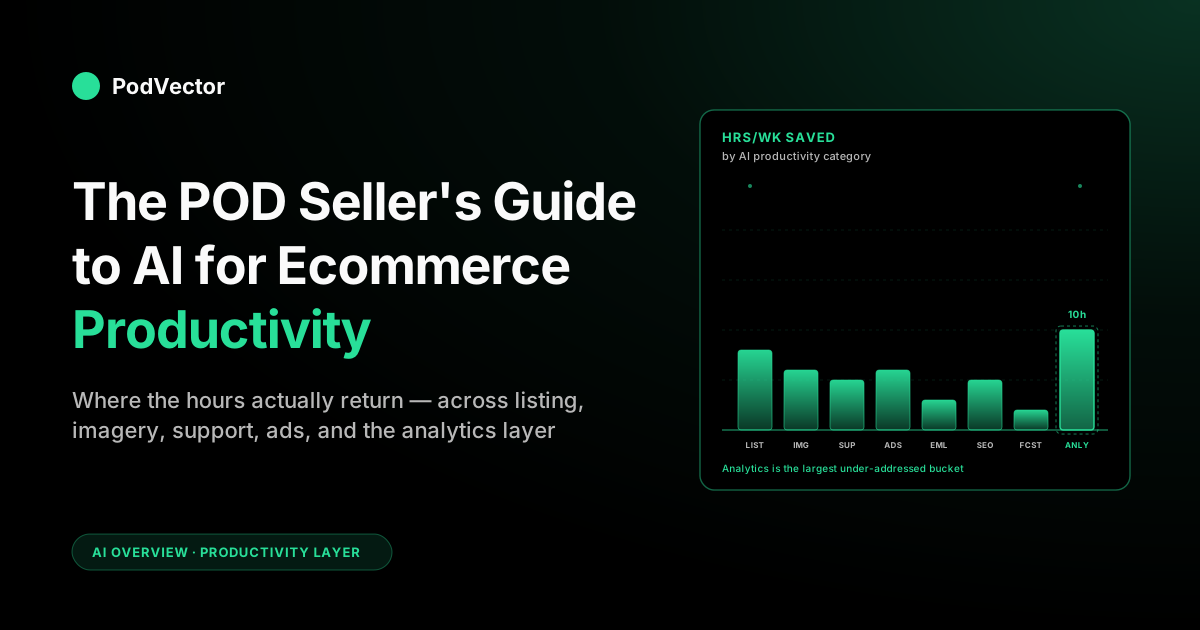
The 8 productivity categories that move the weekly hour count
Narrowing the productivity-AI category to the slices that actually return measurable hours per week to a working POD operator. Approximate weekly time savings are based on operators in the 5,000–50,000 monthly revenue band running their store solo or with one part-time helper.
1. Listing creation and product copy (3–8 hours/week)
The single largest productivity bucket for active POD stores. An LLM-driven workflow takes a design file, product type, and brand voice template and produces a full listing — title, bullet points, long-form description, structured attributes, alt text — in seconds.
The right way to use it: lock in a prompt template that enforces brand voice and SEO scaffolding, audit a sample per batch. The POD seller's guide to AI for ecommerce product content creation covers the template patterns. Stores launching more than five new designs a week should treat this as table stakes.
2. Product imagery and on-model mockups (2–6 hours/week)
Generate on-model lifestyle shots, scene compositions, multi-angle product photography, and category tiles from a single design file. Industry estimates put the automatable share of routine image-processing work around 80%, and modern tools turn around a finished image in seconds rather than the minutes a manual edit takes. POD-specific value: every new design becomes a full visual product set at the moment of launch, not weeks later when budget allows. The hours saved here come less from "you used to do it manually" and more from "you used to skip it entirely and lose the conversion lift." Compare options in the best AI art generator for POD comparison.
3. Customer support deflection (2–5 hours/week)
An AI chatbot that handles pre-purchase sizing, shipping, and product questions deflects the long tail of queries that would otherwise eat operator time. Aim for 60–80% deflection on common queries with clean handoff to email for everything else.
Implementation specifics in the AI chatbot for Shopify guide for POD sellers. The productivity payoff is bigger for stores doing more than 200 orders per month.
4. Ad creative generation and iteration (3–6 hours/week)
AI image and copy generators that produce ad variants in batches, scoped to the design and audience, ready for Meta or TikTok. The productivity gain is not the per-variant time savings but the volume of variants you can run without a creative bottleneck. Ad performance compounds on volume of testable variants, so this category often shows up as both a time saving and a revenue lift.
5. Email and lifecycle automation (1–3 hours/week)
AI in Klaviyo, Omnisend, and similar tools that generates abandoned-cart sequences, post-purchase flows, and win-back campaigns from a brand voice prompt. Less hours-saved than the listing or imagery buckets, but high reliability — these are workflows that work in the background while you focus on catalog or ads.
6. SEO and GEO content generation (2–5 hours/week)
AI-assisted blog and product-content generation that targets long-tail keywords and generative-engine answer queries. The productivity gain is real but only materializes if you have a publishing cadence — a post a week, not a post a quarter.
The pipeline that publishes the article you are reading uses the same pattern. See the POD seller's guide to AI SEO strategy for ecommerce brands for how the publishing-cadence math works.
7. Inventory and demand forecasting (1–2 hours/week, where applicable)
For POD this is mostly relevant to stores running hybrid models (some held inventory, some POD), or for sellers using Printful's Pro warehouse. AI forecasting reduces stock-out and over-stock errors and replaces the manual sales-velocity spreadsheet. Pure dropship POD stores get less out of this bucket.
8. Operations summarization and reporting (4–10 hours/week)
This is the bucket most operators under-count, because the work itself is invisible. It is the sum of all the small reconciliation tasks: pulling a weekly sales summary, comparing supplier invoices to Shopify orders, building the monthly ad-spend ROI breakdown, answering "which designs lost money last week" before a kill-list decision. This is the analytics productivity bucket, and it is the largest and least addressed by the typical AI productivity tool stack.
The hidden category: analytics productivity
If you add up the hours an active POD operator spends pulling reports, comparing dashboards, and answering questions about their own store, it routinely exceeds the time spent on listing, copy, and imagery combined. Most operators don't see it because the work is fragmented — twenty minutes here checking Shopify, fifteen there cross-referencing a Printify invoice, an hour on a Sunday rebuilding a P&L spreadsheet.
None of those individual tasks looks like a project. Together they run 4–10 hours a week.
The reason this category has been under-served is that the analytics work for a POD store does not fit into a single dashboard. The numbers live across at least four systems — Shopify (revenue and orders), Printify and Printful (per-order supplier cost), Meta and Google Ads (ad spend), and your bank account (refunds, fees, chargebacks).
Generic "AI analytics" dashboards that hook into one of those systems and label themselves AI-powered don't address the productivity problem at all. The productivity gain only appears when one tool reads from all of them and answers the operator's question in natural language.
What productive analytics looks like in 2026
The 2026 pattern is an AI employee who sees your store, supplier, and ad data together in one place. You ask "which designs are losing money this month accounting for ad spend" and get an answer in seconds with the underlying breakdown.
You ask "what is my real margin on the navy hoodie variant after Printify's price-curve break" and you get the right number, not the spreadsheet approximation. You ask "compare last week's Printify versus Printful average margin per order" and Victor pulls itemized invoices from both and surfaces the delta.
This is the bucket Victor — PodVector AI's AI employee — was built for. He connects to Shopify, Printify, Printful, Meta Ads, and Google Ads, and you can ask him questions in plain English. He knows the true supplier cost on every single order, so the margin math is actually correct.
The 4–10 hours a week of reconciliation collapses into a conversation. It answers and extends into actions like generating the Printful kill-list draft for the designs Victor flagged as unprofitable.
The deeper architecture and design choices are covered in the complete guide to AI analytics for print-on-demand and the complete guide to AI agents for ecommerce analytics. The AI Analytics topic hub indexes the cross-cluster reading list.
From AI tools to AI workflows to AI agents
The productivity gain has been compounding because the unit of value is moving up the stack. The progression looks like this:
- AI features (2022–2023). Single capabilities embedded in existing tools — the AI button on the description editor, the AI mockup generator. Per-task time savings, but you still drove every workflow.
- AI tools (2023–2024). Standalone tools built around an AI capability — Jasper for copy, Photoroom for imagery. Bigger time savings per task, but tool sprawl and human-in-the-loop on every output.
- AI workflows (2025). Multi-step automations chained across tools — a new design triggers mockup generation, copy drafting, listing publication, ad creative generation, email teaser. The operator approves and the workflow runs.
- AI agents (2026). The operator delegates the goal, not the steps. "Watch margin per design and surface anything below 15% to me weekly with the recommended action." The agent decides which queries to run, which data to pull, when to surface a finding, and — increasingly in 2026 — when to take action directly.
The productivity multiplier compounds at each layer. Features save minutes. Tools save hours. Workflows save days per month. Agents save weeks. For a deeper read on the agentic shift, see agentic AI for ecommerce: what it looks like for POD sellers.
A working productivity stack for a one-person POD store
A pragmatic stack for an active operator running 1,000–5,000 SKUs solo. Optimized for hours returned per dollar spent, not feature breadth.
Listing and copy layer
An LLM with a brand-voice template plus a structured-attribute extractor. Bulk listing generation triggered by new design uploads. Manual audit on a 1-in-10 sample.
Imagery layer
An AI mockup generator for on-model and lifestyle shots, scoped to your top 5 product types. Skip the long tail of product types where supplier mockups are good enough.
Support layer
A Shopify-native AI chatbot trained on your shipping, sizing, and refund policies. Auto-deflect common queries, escalate the rest to email. See the POD seller's guide to AI chat for ecommerce for the implementation pattern.
Ad creative layer
An AI image and copy generator wired into your ad-publishing workflow. Generate variants in batches per design, kill underperformers weekly.
Analytics layer
An AI employee with live integration to Shopify, Printify, Printful, and your ad accounts. This is the one tool in the stack that should pay for itself in pure operator-hours-saved within the first month, before any revenue lift from better decisions. Victor was built specifically for this slot in the POD stack.
Email and SEO layers
Built-in AI in Klaviyo (or comparable) for lifecycle. AI-assisted blog and product-content generation on a weekly cadence. Both are background-running productivity gains.
How to measure whether AI is actually saving you time
Most operators adopt AI tools and never measure whether the productivity gain is real. The tools feel productive, which is not the same as being productive. Three checks worth running quarterly:
- Hours per week of operational work. Track the number, even roughly. If it has not gone down quarter over quarter while catalog and revenue have grown, the AI tools are not paying off in productivity terms.
- SKU-to-operator ratio. Active SKUs divided by full-time-equivalent operators. This number should climb steadily as your AI stack matures. A POD store hitting 2,000 SKUs per FTE in 2024 should be at 5,000+ in 2026 with a comparable AI stack.
- Time-to-decision on operator questions. Pick five questions you ask about your store regularly ("which designs lost money last week," "what was my margin on Printify orders in March," "which ad creatives outperformed by audience segment"). Time how long it takes to get the answer today. If it is more than 5 minutes per question, you have an analytics productivity gap that is worth fixing before adding any more per-task AI tools.
Productivity anti-patterns to avoid
- Buying tools faster than you adopt workflows. Three AI tools used at 80% utilization beats ten at 20%. Tool sprawl is the most common productivity drain in the AI category.
- Skipping the analytics layer because per-task tools are sexier. The analytics bucket is the largest hours-saved bucket. Operators tend to defer it because dashboards are less viscerally satisfying than a generated mockup. Reverse that bias.
- Letting AI generate without templates. Untemplated copy generation creates near-identical descriptions Google deduplicates and brand voice that drifts. The productivity gain disappears at the audit step.
- Treating AI output as final without sample audits. A 1-in-10 audit on bulk-generated listings catches drift early. A 1-in-100 audit catches it after it has hurt your conversion rate.
- Adopting AI tools that require restructuring your workflow. If the onboarding tax exceeds two weeks of operator time, the productivity ROI rarely materializes. Pick tools that fit how you already work.
FAQs
How many hours per week can AI realistically save a one-person POD operator?
For an active store with 1,000+ SKUs and 200+ orders per month, a mature AI stack returns 15–25 hours per week. About half comes from listing, copy, and imagery automation; about half from analytics and support deflection. Stores below that activity threshold see proportionally less because the manual baseline was lower.
Which AI productivity category should a POD seller adopt first?
Listing and copy generation if you are launching more than five new designs a week. Analytics if your store is already past 100 SKUs and you are losing operator time to weekly reporting. The analytics bucket is the higher-leverage starting point for established stores; the listing bucket is the higher-leverage starting point for stores in scale-up mode.
Do I need separate tools for each productivity category, or can one tool do everything?
One tool rarely covers all eight categories well. The pragmatic 2026 pattern is one specialized tool per category, ideally ones that connect and share data so the workflow works across them. Beware tools that promise to do everything — they typically do most things adequately and nothing well.
What is the difference between AI productivity and AI automation?
Productivity is the broader category — anything that returns hours to the operator. Automation is the specific mechanism where a workflow runs without operator intervention. Most AI productivity tools today are still operator-in-the-loop. The shift toward agentic systems is the shift from productivity gains via faster operator work to productivity gains via delegated operator work.
How do I avoid wasting money on AI productivity tools that don't deliver?
Three filters. First, demand a measurable hours-saved baseline before you buy — if the vendor cannot tell you how to measure productivity gain post-adoption, the gain is probably aspirational. Second, run a 30-day audit after adoption: did your weekly operator hours actually drop. Third, kill anything that requires more than two hours of weekly maintenance — the maintenance burden cancels the productivity gain.
Where does Victor fit in an AI productivity stack for POD?
Victor is the analytics layer. It absorbs the 4–10 hours a week most POD operators spend on reconciliation, P&L spreadsheets, and per-design profit analysis by reading live Shopify, Printify, Printful, Meta, and Google Ads data and answering operator questions in plain English. It does not replace the listing, copy, or imagery tools — those slots still need specialized tools — but it owns the analytics-productivity bucket that most stacks under-serve.
Get the analytics productivity bucket back
The 4–10 hours a week most POD operators lose to reconciliation, P&L spreadsheets, and toggling between Shopify, Printify, Printful, and ad dashboards is the largest under-addressed productivity bucket in the category. Victor reads live data from all of them and answers your questions in plain English — the per-design profit, the per-ad ROI, the per-supplier margin breakdown — in seconds, not afternoons.
Try Victor free