
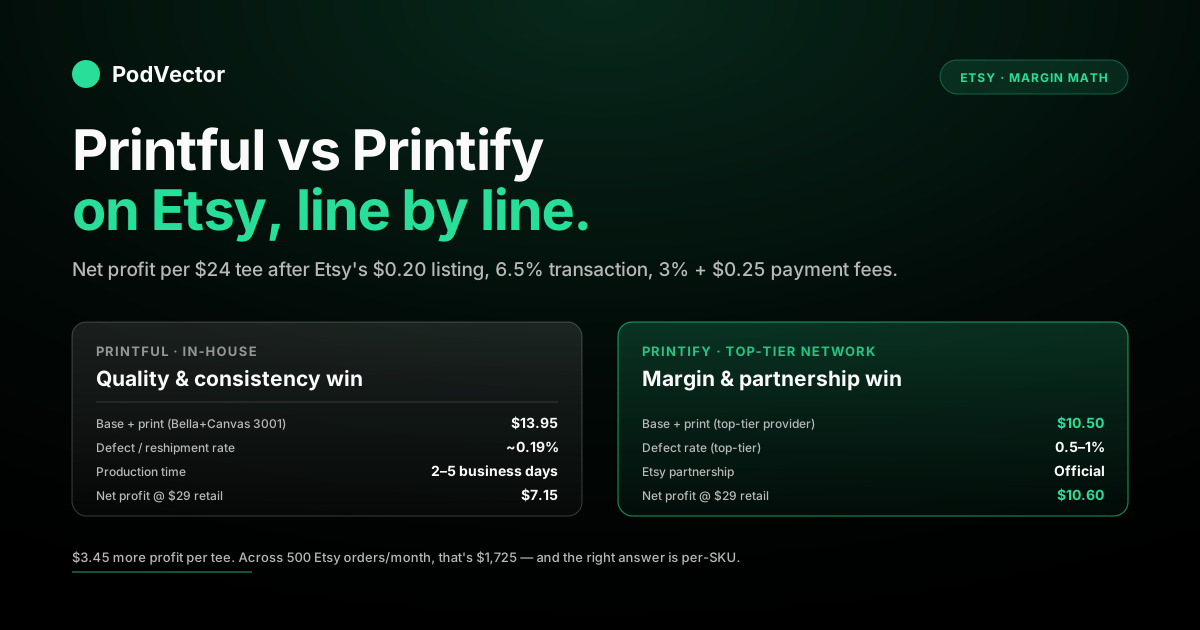
Quick Answer: For most Etsy sellers, Printify still wins on margin — roughly $1–4 more profit per tee after Etsy's fees, depending on provider tier. Lower base costs (~$8–11/tee on top providers) leave more room after Etsy's 6.5% transaction fee, 3% + $0.25 payment fee, and $0.20 listing fee. Printify also holds the official Etsy partnership with cleaner auto-routing.
For brand-led Etsy stores, paid-ad-driven shops, or embroidery-heavy catalogs, Printful wins on consistency. In-house production, ~0.19% defect rate, and standardized packaging hold up under marketplace review pressure where every 1-star review compounds.
Below: the Etsy-fee-adjusted margin math, the integration differences that affect listing speed, and the per-SKU decision framework that beats either-or platform picks.
Why the Etsy comparison is different
The generic Printful vs Printify comparison gets re-written every quarter and lands in roughly the same spot — Printful runs in-house, Printify runs a network, pick by margin or by quality. Etsy changes the question.
On Etsy, you're competing inside a marketplace with roughly 90 million active buyers and millions of independent sellers. Three things shift compared to running on Shopify or your own site.
First, fees stack against your margin. Etsy takes a $0.20 listing fee, a 6.5% transaction fee on item + shipping, and a payment processing fee (3% + $0.25 in the US). On a $24 tee plus $5 shipping, that's about $3.21 in fees before you've paid the supplier. The base-cost advantage you pick up on Printify gets amplified by Etsy's percentage fees, not flattened.
Second, buyers don't see your brand the way they would on Shopify. They see Etsy's listing card, Etsy's shipping estimate, Etsy's reviews. Printful's branded packaging matters less when the buyer is loyal to "Etsy" rather than to your shop. The trade-off Printful sells on — premium customer experience — flattens on a marketplace.
Third, reviews are a survival metric. Etsy's algorithm leans hard on review velocity and rating. A 1-star review for a defective shirt can take weeks to recover from, where the same defect on Shopify is a refund email and you move on. The defect-rate gap between Printful and Printify hits Etsy sellers harder than it hits direct-to-consumer brands.
So the right Etsy comparison isn't "which has better quality" or "which has better pricing." It's: how do these two platforms handle the specific stack of Etsy fees, Etsy integration mechanics, Etsy review pressure, and Etsy buyer expectations?
Etsy integration: partnership, routing, and tag entry
Both Printful and Printify connect natively to Etsy, but the integrations are not the same.
Printify launched an official Etsy partnership that gets surfaced inside Etsy's seller-tools recommendations. The connection auto-imports orders, routes them to the chosen print provider, and updates Etsy's tracking number when fulfillment ships. Printify's app inside Etsy's marketplace handles the OAuth flow and syncs both ways.
Printful is a long-running Etsy integration that does the same core job — auto-import, auto-route, auto-tracking — but lacks the formal partnership badge inside Etsy's tooling. Functionally the order flow is similar; the difference is more visibility than mechanics.
Where the integrations diverge in day-to-day work is the listing workflow:
- Printful → Etsy: push a product directly from Printful's dashboard. Mockups, description, and base tags transfer. Most sellers tweak the title and description on Etsy after the push.
- Printify → Etsy: the push works, but Printify's product builder generates more variants (different providers' size/color combinations). Some Printify sellers report needing to manually edit tags on Etsy after the import — Printify's transferred tag set is sparser than Printful's. Add 5–10 minutes per listing for SEO cleanup.
Neither integration is broken, but the Printify side has more setup steps when a SKU lives across multiple Printify providers (which it usually should, for redundancy and per-region routing). For a deeper view of how Printful connects to Etsy, Shopify, and other channels, see the complete guide to Printful integrations.
Pricing after Etsy's fee stack
Etsy's fee structure compresses margin. The way Printful and Printify divide what's left is the most-asked Etsy question, so it's worth running the actual math.
Take a Bella+Canvas 3001 tee priced at $24 with $5 shipping (Etsy's typical setup for free-shipping-eligible buyers). Etsy fees stack as follows:
| Etsy fee | Amount on a $24 tee + $5 shipping |
|---|---|
| Listing fee (per listing, every 4 months) | $0.20 |
| Transaction fee (6.5% of item + shipping) | $1.89 |
| Payment processing (3% + $0.25 in US) | $1.12 |
| Total Etsy fees | $3.21 |
That's before you pay the supplier or factor in offsite ads (15% on the order, capped at 12% if your shop hits the threshold). Now add the Printful or Printify base cost:
| Line item | Printful | Printify (top-tier provider) | Printify (budget provider) |
|---|---|---|---|
| Base + print (Bella+Canvas 3001 white M) | ~$11.69 | ~$10.50 | ~$7.99 |
| Shipping to US buyer | ~$4.69 | ~$4.69 | ~$4.69 |
| Etsy fees (from above) | $3.21 | $3.21 | $3.21 |
| Landed cost | $19.59 | $18.40 | $15.89 |
| Net profit at $29 retail (item + shipping) | $9.41 | $10.60 | $13.11 |
The Printify advantage is real but narrower than the old guides claim — Printful's 2026 base prices came down. On a single tee, Printify (top-tier) leaves about $1.19 more profit than Printful. On a budget provider, $3.72 more.
Across 500 Etsy orders a month, that's roughly $595–$1,860. For a thin-margin starting shop, the budget-tier gap is still the difference between paying yourself and not.
Both platforms also sell membership plans that cut base costs further. Printful's Growth plan ($24.99/month, free once your shop clears $12K in annual sales) takes ~15–20% off — dropping that Bella+Canvas tee to about $9.59.
Printify's Premium plan ($39/month) takes 20% off, pulling a top-tier tee to ~$8.40. With both memberships active, Printify keeps a ~$1–3/unit edge — smaller than the legacy $4–6 figure, but still real on volume.
The budget-provider column comes with risk, though. A 3–5% defect rate at $7.99/unit eats roughly $0.35 per order in reprint costs alone, plus the LTV hit from a bad review. The honest comparison for a margin-conscious Etsy seller is Printify (top-tier) vs Printful — and on that line, Printify still leads by ~$1.19/unit before memberships.
For the broader pricing breakdown across all garments, see Printful vs Printify pricing. For the underlying cost lines on each platform, the Printful costs and fees guide and the Printify costs guide cover the per-line items.
Shipping speed on Etsy listings
Etsy displays an estimated delivery date on every listing. Sellers who consistently miss it lose Star Seller status and get punished in search. Shipping speed isn't a footnote on Etsy — it's a ranking signal.
Printful's median production time runs 2–5 business days, with a published 2-day handling target on most apparel. Printful reports that 97.66% of orders ship within five days — variance is narrow because production sits inside its own facilities. Once production ships, transit is standard USPS/UPS ground in the US.
Printify's production time depends entirely on which provider fills the order. The published targets:
- Top-tier providers (Monster Digital, SwiftPOD, Dimona Tee): 2–4 business days, similar to Printful.
- Mid-tier providers: 3–7 business days.
- Budget providers: 5–10 business days, with reported outliers stretching to 12+ during peak.
For an Etsy seller writing the listing, this means Printful's shipping estimate is a single number you can promise. Printify's is a range you have to set conservatively — or risk shipping late on the worst day. Sellers who set a 1–3 day handling time on Etsy with a budget Printify provider routinely lose Star Seller. Sellers who set 5–7 day handling time underperform on the Etsy estimated-delivery comparison shown to buyers.
The Printify workaround: pin to top-tier providers and treat the budget tier as a price-shopper's option you don't list on Etsy. That preserves the margin advantage on the SKUs that matter while keeping handling time tight enough to meet Star Seller. For a deeper view of Printful's shipping rates and zones, see the complete Printful shipping guide; the Printify side is in the complete Printify shipping guide.
Who keeps the shipping fee
One Etsy-specific wrinkle the platform comparisons usually skip: who pockets the shipping charge. Printful bills you a calculated shipping rate per order. If you set an Etsy shipping price above that cost, the overage is yours — sellers routinely net a small profit on shipping, especially on international orders where Printful's local-facility rate beats what Etsy buyers expect to pay.
Printify rolls shipping into the order total and you keep whatever Etsy collects above the provider's rate, but the per-provider rate is less transparent and varies SKU to SKU. For Etsy sellers who lean on free-shipping listings, this changes the real landed-cost math the margin table above can't fully capture — your true shipping cost depends on the platform and the buyer's location, not a flat $4.69.
Listing workflow: mockups, variants, SEO
Etsy SEO runs on title, tags, attributes, and listing photos. The amount of cleanup required after pushing a product from Printful or Printify to Etsy is real working time.
Mockups
Printful's mockup generator produces 1–4 default mockups per design (front, back, lifestyle if available). Printify's mockup generator produces more — sometimes 6–10 — because each provider runs their own photography. For Etsy, where listings allow up to 10 photos, Printify's larger default set is convenient.
The trade-off: Printify's mockups vary in style across providers. A Monster Digital tee mockup looks different from a SwiftPOD tee mockup of the same design. If you're listing the same design on Etsy via two Printify providers (for redundancy), buyers see inconsistent presentation.
Variants
Etsy lets you list up to 70 variants per listing. Printful pushes a clean variant set — sizes and colors aligned to Etsy's structure. Printify pushes more variants by default because providers offer different size/color combinations. Sellers regularly trim Printify's variant list inside Etsy after import to keep the listing focused.
The catalog gap feeds this: Printify carries over 1,300 products versus Printful's ~500, so a Printify SKU often has more provider-specific size and color permutations to prune. The upside is breadth — if your Etsy niche needs an unusual blank, Printify is likelier to have it.
Tags and SEO
Etsy gives you 13 tags, each up to 20 characters, and they carry significant ranking weight. Printful's Etsy push transfers a base tag set — usually 5–8 tags, decent but not optimized. Printify transfers fewer (3–6 tags is common), with some sellers reporting tag fields landing empty after the import. Either way, tag editing is a manual step on Etsy after the listing posts.
Plan on 5–15 minutes per listing for SEO cleanup on either platform. Etsy keyword research tools (Marmalead, eRank, Alura) feed this step regardless of which POD supplier sits behind the listing.
Print quality and review risk
Quality matters everywhere, but on Etsy it has a multiplier: reviews. Every defective shipment risks a 1- or 2-star review that drags shop rating down for months. The compounding cost of a bad review is bigger than the refund.
Printful's published reshipment rate is around 0.19%, which is genuinely low — in the band of direct-to-consumer apparel brands that print in-house. Across 1,000 orders, that's about 2 defective items, which an alert customer-service workflow can catch before the buyer leaves a negative review.
Printify's defect rate is provider-dependent. Top-tier providers (Monster Digital, SwiftPOD, Dimona Tee) run 0.5–1%. Budget providers can hit 3–5% per seller-reported data. Across 1,000 Etsy orders on a budget provider, that's 30–50 defective shipments — and even at a high resolution rate, you're looking at 5–15 negative reviews on a marketplace where shop rating drives traffic.
Two implications for Etsy:
- Etsy raises the cost of provider variance. The same defect on Shopify is a refund. On Etsy, it's also a review event with multi-month visibility.
- The Etsy seller's quality lever is provider selection on Printify. Printify's top-tier pinning pulls the defect rate close to Printful's range. Most quality complaints from Etsy sellers about Printify trace back to budget-tier provider choices made for margin reasons.
For a deeper view on the quality side specifically, see Printful vs Printify quality.
Order management on a marketplace
Etsy buyers expect quick responses. The platform measures response time and folds it into Star Seller. Order management mechanics differ between Printful and Printify in ways that hit Etsy customer service directly.
Cancellations and changes
Printful lets you cancel or modify an order from the dashboard within a small pre-production window — usually 30–60 minutes after the order lands, longer for some categories. After that window the order is in production and locked.
Printify's cancellation flow is more variable. The official policy is similar (cancellations possible within a short window before production), but the actual mechanics route through the print provider. Some providers honor cancellations within hours; others require email contact and may not respond before production starts. For a buyer who wants to cancel an Etsy order an hour after placing it, Printful's path is cleaner.
Reshipments
Printful handles reshipments at the platform level — file a claim with photos, Printful approves and reships at no cost. Printify routes reshipment claims through the provider, which adds steps and time. Sellers report Printify reshipments resolving in 5–10 days vs Printful's 3–6 days.
Returns
Neither platform handles end-buyer returns directly — POD doesn't have inventory to take back. Both expect the seller to refund and dispose of the defective item at their discretion. Etsy's policy nuance: Etsy expects the seller to accept returns or process refunds promptly. Slow reshipment turnaround on Printify can stretch the buyer's patience past Etsy's expected response window.
Branding on a marketplace
The Printful vs Printify branding debate is mostly settled on Shopify (Printful wins). On Etsy, it's more nuanced.
Etsy buyers are buyer-loyal to Etsy first, shop second. The unboxing experience matters less because the buyer's mental frame is "I bought something on Etsy" rather than "I bought something from this brand." Branded packaging, custom collar tags, and inserts move the needle less on a marketplace than on a direct site.
That said, branding still matters for two Etsy sub-cases:
- Repeat buyers and shop favorites. Etsy's repeat-purchase rate is 30–40% for active shoppers. A buyer who returns to your shop has been imprinted with the unboxing experience. Printful's standardized packaging gives a consistent imprint; Printify's varies by provider.
- Photography and listing presentation. Even within Etsy's marketplace frame, professional product photography (which Printful's standardized blanks make easier to source) translates into better listing performance.
Printful supports inside-collar branding at $2.49/item across most apparel SKUs and consistent polybag packaging across all 15 facilities. Printify supports branded labels through specific providers, with execution varying. For a brand-led Etsy shop building toward repeat-buyer revenue, Printful's branding execution is cleaner.
International Etsy sellers: VAT and customs
For sellers based outside the US, Etsy adds another layer to the comparison: international fulfillment.
Etsy's marketplace operates globally, but POD shipping logistics aren't global by default. Cross-border shipments trigger VAT, customs duties, and longer delivery windows that affect Etsy's estimated-delivery display.
Printful runs facilities in the US, EU (Riga, Latvia), Mexico, Australia, and Japan. Orders auto-route to the closest fulfillment center, so an EU buyer's order ships from Riga rather than Charlotte. This local fulfillment avoids most cross-border shipping issues for buyers in those regions.
Printify's network includes top-tier providers in the EU (Print Logistic, Drukarnia, T-Pop) and AU. Local routing works well when you've manually pinned the right provider per region — but it doesn't auto-route based on buyer location the way Printful does. Sellers running an international Etsy shop on Printify usually duplicate listings across regional providers and link them via Etsy's variation system.
The international comparison: Printful's auto-routing wins for ease, Printify's network wins for breadth if you're willing to set up regional listings manually. If your Etsy volume is mostly outside the US, it's worth weighing a third option — Gelato routes roughly 90% of orders to a printer in the buyer's own country across 140+ facilities in 32 countries, which sidesteps most VAT and customs delay that drags on Etsy's estimated-delivery display. For a deeper take on the three-way comparison including regional fulfillment, see Printful vs Printify vs Gelato.
The Etsy-specific decision framework
The platform-vs-platform answer flips on a few specific Etsy attributes. Here's the decision tree most experienced Etsy POD sellers actually use:
Pick Printify if:
- You're new to Etsy and starting with thin margin tolerance — the $3–6/unit Printify advantage funds your first 90 days of paid promotion.
- Your catalog skews heavily toward tees, hoodies, and standard apparel where top-tier Printify providers match Printful on quality.
- You're willing to do provider selection per SKU (read Performance Scores, order samples, pin top-tier).
- You sell in markets where Printify has strong local providers (US, EU via Print Logistic/Drukarnia, AU via T-Pop).
Pick Printful if:
- You're running paid social or Etsy Offsite Ads and need defect-rate consistency that holds up under review pressure.
- Your catalog includes embroidery, all-over-print, or premium garments where consistency outweighs base-cost saving.
- You want a single-vendor branded experience across the catalog without per-provider setup work.
- You sell internationally and want auto-routing to closest fulfillment without manual per-region listing duplication.
Use both if:
- Your catalog is large enough that flagship SKUs (worth quality optimization) and long-tail SKUs (worth margin optimization) deserve different platforms.
- You can absorb the extra dashboards, the extra reconciliation, and the extra mockup-style variance in your listings.
Most established Etsy POD shops above $10k/month gross run both, with flagship products on Printful and long-tail on Printify (top-tier providers). That hybrid splits the difference rather than picking one extreme.
For a fuller view of the comparison beyond Etsy, see the full Printful vs Printify comparison. For Printful's complete operating model, the complete Printful guide covers it; the Printful topic hub has every angle. The Printful comparison hub indexes every Printful-vs-X article.
The per-SKU answer Etsy sellers actually need
Every framework above gives a platform-level answer. Pick A on flagships, B on long-tail. Pick A if you do paid ads, B if you don't. Pick A in the US, B in the EU. The actual question your Etsy P&L runs on is per-SKU.
On your top-selling tee design, in your chosen color and blank, shipped from your chosen provider to your top buyer states — what's the real margin after Etsy fees, after Offsite Ads (when that applies), after the actual reprint rate from your last 90 days? Which 10 SKUs would clear $5+ more per order if you switched suppliers? Which Printify provider's Performance Score has slipped enough this quarter to move flagship listings off it?
None of the public Printful-vs-Printify guides answer these. They quote averages — $4 per shirt, 0.19% defect rate, 6.5% Etsy fee — and stop there. Your contribution dollars don't run on averages. They run on the specific SKU + provider + buyer-state + ad-channel combination that produced the order.
Closing this gap takes three pieces working together. Every Etsy order's supplier-charged cost, fee breakdown, refund event, and reshipment has to land in a single source of truth alongside ad cost (Etsy Offsite, Meta, TikTok), processor fees, and customer LTV. The math has to run per-SKU and per-supplier so a tee profitable on Monster Digital and a hoodie profitable on Printful both surface clearly. The answer has to refresh fast enough to act on — switching a provider 90 days late is too slow on Etsy where review velocity drives ranking.
This is what PodVector AI built Victor to run. A unified data warehouse ingests Shopify, Printful, Printify, Meta, and Google per-order data — then Victor acts on it. He flags the flagship SKUs whose Printify provider Performance Score slipped this quarter and, with your approval, re-routes them to a steadier provider or to Printful.
He reallocates Etsy Offsite and Meta spend toward the SKU-and-provider combinations actually clearing margin, and updates the affected listings when a supplier switch changes your handling time. Every material change is gated on your sign-off — Victor does the legwork, you keep the final call.
For more on building Etsy-side profitability per platform, see Printful vs Printify vs Teespring and is Printify profitable.
FAQs
Which is better for Etsy, Printful or Printify?
For most margin-conscious Etsy sellers, Printify (with top-tier providers) wins. Lower base costs leave more room after Etsy's fee stack — roughly $1–4 more profit per tee on standard apparel in 2026, a narrower gap than older guides quote because Printful's base prices came down. For brand-led Etsy shops running paid ads or selling premium garments, Printful's quality consistency and branded packaging are worth the cost difference.
Does Printify have an official Etsy partnership?
Yes. Printify has a formal Etsy partnership surfaced inside Etsy's seller-tools recommendations, with a connector that auto-imports orders, routes to the chosen print provider, and updates Etsy tracking on shipment. Printful integrates with Etsy too, but without the formal partnership badge.
Can I use both Printful and Printify on Etsy?
Yes, and many established Etsy shops do. Run flagship SKUs on Printful for consistency, long-tail or margin-sensitive SKUs on Printify (top-tier providers). The hybrid splits the trade-off but adds dashboards and reconciliation work.
How do Etsy fees affect Printful vs Printify margins?
Etsy stacks a $0.20 listing fee, 6.5% transaction fee on item + shipping, and 3% + $0.25 payment processing — about $3.21 on a $24 + $5 shipping order. The base-cost gap between Printful and Printify gets amplified by Etsy's percentage fees, so on a $24 tee Printify (top-tier) leaves about $1–2 more profit; budget Printify leaves roughly $3–4 more. Both platforms' membership plans (Printful Growth, Printify Premium) shift the exact gap.
Do Printful or Printify charge a monthly fee to sell on Etsy?
Neither requires a paid plan to connect to Etsy — both have free tiers. Printful's Growth plan ($24.99/month, free once your shop passes $12K in annual sales) and Printify's Premium plan ($39/month) each cut base costs ~15–20%. The subscription pays for itself only once your order volume is high enough to clear the monthly cost, so most new Etsy shops start on the free tier and upgrade later.
Who keeps the shipping fee on Etsy, Printful or Printify?
Printful bills you a calculated shipping rate per order, so if your Etsy shipping price is set above that cost, the overage is yours — some sellers net a small profit on shipping, especially internationally. Printify rolls shipping into the order and you keep whatever Etsy collects above the provider's rate, but the per-provider rate is less transparent. Neither makes shipping a reliable profit center, but Printful's dynamic rates give you more visibility.
What's the shipping speed difference for Etsy orders?
Printful's median production time is 2–5 business days with low variance. Printify's production time depends on provider — top-tier providers (Monster Digital, SwiftPOD) run 2–4 days, mid-tier 3–7 days, budget 5–10 days. For Etsy Star Seller, pin Printify orders to top-tier providers.
Do Etsy buyers see which print provider fulfilled their order?
No. Buyers see your shop name, your branding (within whatever the platform supports), and the shipping carrier. They don't see "Printful" or "Printify" or which provider in Printify's network printed the item. The platform choice is invisible to buyers — only its consequences (quality, speed, packaging) show up.
Which has better mockups for Etsy listings?
Printify produces more mockups by default (6–10 vs Printful's 1–4) because each provider runs its own photography. Printful's mockups are more consistent across SKUs — useful if listings need to share a visual style. Etsy allows up to 10 photos per listing, so Printify's larger set is convenient if it matches your aesthetic.
How do Printful and Printify handle Etsy returns and reshipments?
Neither handles end-buyer returns — POD has no inventory. Both reship defective items at no cost. Printful's reshipment turnaround is 3–6 days; Printify's routes through the provider and runs 5–10 days. The slower Printify path can stretch past Etsy's expected response window on customer messages.
Which platform is better for international Etsy sellers?
Printful auto-routes to its closest facility (US, EU/Riga, Mexico, AU, Japan), which simplifies international order handling. Printify has strong regional providers (EU, AU) but requires manual per-region setup. For ease, Printful wins; for breadth and per-region cost optimization, Printify wins with extra setup work.
Can I move my Etsy listings between Printful and Printify?
Yes, but it's a manual re-listing rather than a one-click migration. Both platforms push to Etsy as new listings rather than swapping fulfillment on existing ones. Plan to re-photograph mockups, recreate the Etsy listing, and link it to the new POD supplier. Run both in parallel during transition to avoid breaking existing reviews.
Which is more Etsy SEO friendly out of the box?
Printful's tag transfer is slightly richer (5–8 tags vs Printify's 3–6 typical), but neither is a substitute for manual Etsy SEO work. Plan 5–15 minutes per listing for tag, title, and description optimization regardless of which platform pushes the product.
Where can I find more on the broader Printful vs Printify comparison?
The non-Etsy axes are covered in the full Printful vs Printify comparison, with deep dives on pricing and quality. The Printful comparison hub indexes every Printful-vs-X article and the Printful topic hub covers everything Printful.
Let Victor run the supplier call on every Etsy SKU.
The right Printful vs Printify answer changes per SKU, per provider, per buyer state, per fee structure — and it goes stale by the next pricing cycle. Victor pulls every Shopify order, every Printful and Printify charge, every refund and reshipment into one live data layer, then acts on it: re-routing flagging SKUs, reallocating ad spend, and updating listings — each step gated on your approval. Hand off the busywork, keep the final say.
Try Victor freeFor external context, the Ryan Hogue first-person Etsy review covers similar ground from a long-running POD seller's perspective. To go broader, see the complete Printful guide and the complete Printify guide.