
Quick Answer: Printify is cheaper than Printful on almost every comparable SKU. According to printify.com (January 2026 data), Printify's lowest-cost tee is around $7 versus $8.17 at Printful — and selling 100 tees a month at $25 each, you'd net roughly $80 more per month on Printify than Printful. According to inkandpxl.com (April 2026, citing Merch Titans data), the base cost gap on a standard Gildan 64000 is approximately $4 per unit between the two platforms. According to chayaani.com (March 2026), Printify Premium is $39/month (20% off all products) and Printful Growth is $24.99/month (up to 33% off select products).
That gap is real, but it's not the whole P&L. Once you layer in shipping, branding, reshipment rates, subscription ROI, and the time you spend curating providers, the answer shifts for several specific product categories — embroidery, branded packaging, and international auto-routing among them. A recent factor: according to stylefactoryproductions.com (July 2026), Printful implemented significant price cuts of 6% to 9% on many products, narrowing — though not eliminating — the base-price gap.
Below: a SKU-by-SKU cost teardown, the math on when each subscription pays for itself, 12-month total-cost-of-ownership scenarios for three seller archetypes, the DTF vs DTG shift that changes the quality conversation, and the categories where Printify's base-price win quietly evaporates.
Cost snapshot at a glance
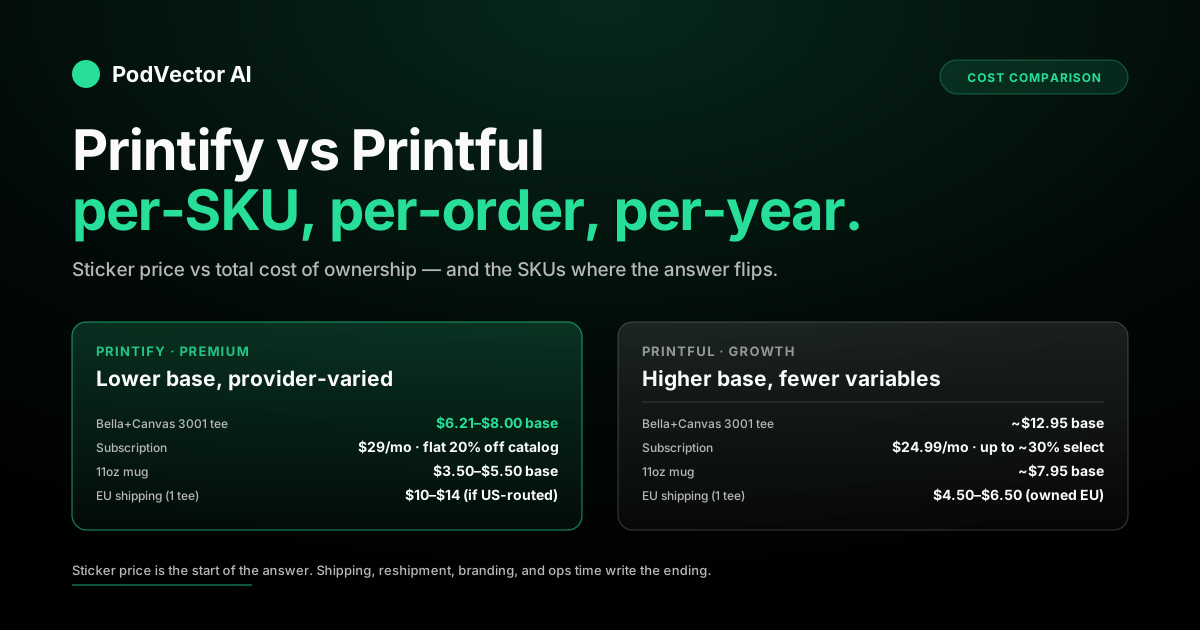
If you only have 90 seconds, this is the shape of it. Printify wins on raw base price for most apparel. Printful wins on operational consistency, embroidery, branded packaging, and US-to-EU shipping where it has a fulfillment center.
The dollar gap on a basic tee looks small per unit. At 100 orders a month it compounds into meaningful margin you can either reinvest or leave on the table. According to printify.com (data collected January 2026), selling 100 tees a month at a $25 retail price yields roughly $80 more per month in profit on Printify versus Printful. Separately, according to stylefactoryproductions.com (July 2026), Printful recently implemented price cuts of 6% to 9% on many products — so that gap is narrower than it was in 2025, but it has not closed.
| Cost line | Printify | Printful | Cheaper |
|---|---|---|---|
| Basic unisex tee — lowest available (free plan) | ~$7 base (per printify.com, Jan 2026) | ~$8.17 base (per printify.com, Jan 2026) | Printify |
| Standard unisex tee — free plan range | ~$10 (per printondemandbusiness.com, 2026) | ~$12 (per printondemandbusiness.com, 2026) | Printify |
| Standard tee — with paid subscription | ~$8 with Premium discount (per printondemandbusiness.com, 2026) | Same ~$12 unless Growth discount applies | Printify |
| Subscription (paid tier) | $39/mo Premium — 20% off all products (per chayaani.com, Mar 2026) | $24.99/mo Growth — up to 33% off select (per chayaani.com, Mar 2026) | Depends on catalog mix |
| Domestic shipping (1 tee, first item) | ~$4.75 (per chayaani.com, Mar 2026) | ~$4.69 (per chayaani.com, Mar 2026) | Roughly equal (Printful marginally ahead) |
| Reshipment policy | Provider-dependent | Centralized | Printful (lower ops time) |
| Branding consistency | Provider-dependent | Catalog-wide | Printful |
That table is the answer most comparison posts stop at. It's a useful starting point and a terrible decision tool. The next sections are where the actual money sits.
Base product prices: SKU-by-SKU
Printify doesn't have one base price — it has many. The same product might cost differently depending on which of its vetted print providers you select, with variation in print method, ink quality, and turnaround. You're picking the provider, not just the platform.
Printful runs centralized in-house production. The same tee has one base price across the catalog, with regional variants for the EU. Less choice, more consistency — and according to stylefactoryproductions.com (July 2026), Printful has recently cut prices by 6% to 9% on many of its products, bringing it closer to Printify on raw base cost than it has been historically.
The big six SKUs sellers actually push volume on
Basic unisex tee (the workhorse). According to printify.com (data collected January 2026), Printify's lowest-cost tee is around $7 versus Printful's $8.17. According to printondemandbusiness.com (2026), a standard unisex cotton tee on Printful runs around $12, while on Printify you can find a similar shirt for around $10 on the free plan — dropping to roughly $8 with the Premium discount applied. The gap per unit is meaningful; at volume it compounds into real margin.
Gildan 64000 softstyle tee. According to inkandpxl.com (April 2026, citing Merch Titans' April 2026 comparison), Printify's base cost on a standard Gildan 64000 sits at approximately $8 and Printful's at approximately $12 — a $4 gap that at 100 monthly orders produces meaningfully more gross margin before any subscription discount is applied. Printful's Gildan equivalent sits at a higher base; if your store standardized on Gildan, Printify is structurally cheaper.
Hoodies and sweatshirts. Printify carries this SKU across multiple providers at competitive prices. Printful's print consistency on hoodies is among the highest in the category — reshipment risk is meaningfully lower — but the base-price gap still favors Printify for most volume-focused sellers.
11oz white ceramic mug. Mugs are where Printify's provider network shines — multiple specialized mug printers, fast turnaround, lower base cost. Printful's base price on the same mug is materially higher, making mug margin on Printify noticeably stronger.
Embroidered apparel. For embroidery specifically, the cost gap narrows and Printful's consistency often wins on reorder rate. Printful's in-house embroidery delivers consistent stitch quality and broader SKU support. See our guide on does Printify charge you or the customer for how Printify's cost pass-through works on specialty items like embroidery.
All-over print (AOP). Printify wins on raw cost across AOP SKUs; both platforms show similar reject rates because of the inherent complexity of the print method. For context on how AOP margins behave when you're also running paid ads, see our guide on CRO techniques for POD stores — your cost advantage per unit only holds if site conversion doesn't leak margin back out.
Subscriptions: when each pays for itself
Both platforms offer a paid tier. The math is different and the breakeven volume matters more than the headline percentage.
According to chayaani.com (March 2026), Printify Premium costs $39/month and gives you a flat 20% off base prices across the catalog, with up to 10 stores included. Printful Growth costs $24.99/month and offers up to 33% off — but as chayaani.com notes, the 33% only applies to select products, not everything in the catalog.
An important structural difference confirmed by inkandpxl.com (April 2026): Printful Growth becomes free once a store reaches $12,000 in annual sales (roughly $1,000/month), eliminating the subscription cost before a seller reaches serious volume. Printify has no equivalent sales-threshold waiver.
Breakeven math
At $39/month for Printify Premium, the breakeven on the 20% discount requires more monthly volume than the previous $29/month price point did. On a $10 base-cost tee, the 20% discount saves $2 per unit — you need to sell approximately 20 units per month just to cover the subscription fee before pocketing any net savings. Beyond that threshold the savings compound, but the higher subscription cost means Premium makes less sense for lower-volume sellers than it used to.
Printful Growth's $24.99/month pays for itself faster at moderate volume, and the fee disappears entirely once you clear $12,000 in annual sales per inkandpxl.com (April 2026) — making it structurally more attractive for sellers climbing toward meaningful scale.
When a subscription is actively bad
Two cases. First, if your monthly volume is low — the membership fee eats your margin before the discount can offset it, and the raised Printify Premium price makes this threshold higher than before. Second, if you spread orders across both platforms, you're paying two subscriptions to get two partial discounts; one consolidated platform often wins on total cost. For modeling whether your current margins justify the subscription spend, our net profit margin benchmark guide walks through the right framework for POD sellers.
Shipping costs: domestic and international
Shipping is the line item where Printify's base-price advantage gets quietly compressed.
Domestic US shipping (single tee). According to chayaani.com (March 2026), Printify charges approximately $4.75 for the first item and $2.40 per additional item; Printful charges approximately $4.69 for the first item — Printful's edge is just $0.06 on the first item. Chayaani.com confirms Printful has a slight edge on multi-item orders because of the lower additional-item rate.
International shipping. This is where Printful's owned EU and AU facilities matter substantially. A tee shipped from a Printful EU center to a European customer avoids the transatlantic rate entirely. The equivalent Printify order, if no EU provider stocks that SKU, ships from the US at a considerably higher rate. On meaningful EU volume, that shipping delta can swamp the base-price win.
Multi-item orders. Printify's provider-splitting problem hits hardest here. A two-item order routed across two providers is effectively two separate shipments billed to you. Because Printful ships everything from one facility per region, it eliminates the split-shipment risk entirely — a structural advantage on multi-item cart orders.
The honest read: shipping is roughly a tie for single-item US orders, a Printify loss for multi-item orders that split providers, and a Printful win for international. If your average order value includes multiple items or you have significant EU traffic, model shipping separately — it can erase the base-price gap. See our checkout completion rate benchmarks for how multi-item cart structure affects your overall unit economics.
Branding and packaging fees
Branding is where the cost discussion gets nuanced. Both platforms charge for the same line items; the implementation differs significantly.
Custom inside neck label. Available on both platforms, though on Printify availability varies by provider. Printful's rate is consistent catalog-wide.
Custom outside label / hem tag. Printify's availability is inconsistent across providers. Printful supports this across the catalog at a consistent per-garment rate. Printful wins on availability if outside branding matters to your brand.
Packing slip with logo. Available on both. Printful includes branded packing slips by default on all plans — a meaningful operational advantage for brand-conscious sellers.
Custom packaging insert / thank-you card. Printify support is limited and provider-dependent. Printful supports inserts catalog-wide. Printful wins here.
If you're running a basic brand (logo on neck label only), branding cost is roughly equal. If you're running a premium brand with consistent branded unboxing across SKUs, Printful's centralized branding stack is meaningfully easier to operate and often cheaper once you factor the time spent coordinating Printify providers who each handle branding differently.
DTF vs DTG: how the print shift affects cost and quality
One topic most cost comparisons still skip: the industry-wide shift from direct-to-garment (DTG) to direct-to-film (DTF) printing. According to inkandpxl.com (April 2026), this shift meaningfully changes the quality conversation that has historically favored Printful's centralized production model.
DTF transfers adhere to a wider range of fabrics than DTG, produce more vibrant color on dark garments, and wash more durably in many conditions. As inkandpxl.com (April 2026) notes, because DTF equipment is increasingly available across Printify's provider network, the print-quality gap that once reliably justified Printful's higher price has narrowed significantly over the past two years.
What this means practically:
- Printify's quality variance argument is weaker in 2026. With DTF-capable providers in the network, a carefully curated Printify provider can deliver print quality that matches or approaches Printful's output — especially on dark garments and performance fabrics where DTG historically struggled.
- Printful's consistency advantage still holds for embroidery and AOP. DTF doesn't change the embroidery story, and all-over print still requires specific equipment that not all Printify providers run reliably.
- The cost implication: if you previously accepted Printful's higher base price primarily for print quality assurance, the DTF shift means you should re-evaluate that trade-off against your specific SKUs before renewing your Printful subscription at scale.
For Shopify sellers running paid traffic, print quality affects return rates — and return rates affect your real per-unit margin more than most sellers model. Our guide on increasing average order value covers the demand side of the same equation: higher AOV gives you more margin buffer to absorb quality-related returns without killing unit economics.
Hidden costs nobody puts in the table
These don't show up on the platform's pricing page. They show up in your P&L.
Reshipment rate. When a print is wrong or a garment arrives damaged, who eats the reship? Both platforms cover production defects. The catch: as chayaani.com notes (March 2026), Printify's quality depends entirely on which print provider you select — some providers are excellent, while others may be inconsistent, and the trade-off for lower costs is less control over quality. A meaningful reshipment delta across a high-volume catalog is pure margin loss that doesn't appear in any base-price comparison.
Customer service time. Printify routes support through the provider for production issues, through Printify for platform issues. Printful runs one support stack. The time cost of triaging "is this a Printify problem or a provider problem?" adds up — and at any meaningful volume, disputes are a recurring operating cost.
Provider switching. If a Printify provider goes offline or drops a SKU, you're rebuilding products. This happens. Budget time every 60–90 days for SKU maintenance on Printify that Printful sellers don't face.
Catalog curation time. According to printify.com, Printify now offers 2,000+ products across its provider network versus Printful's 445+ curated products. More choice means more analysis time picking SKUs and comparing provider quality. For a solo operator, that time has a real cost — bill it against your hourly rate and it's a meaningful operating line.
None of these are dealbreakers. They're the reason "Printify is cheaper per tee" isn't the same as "Printify nets you more per order."
12-month TCO: three seller archetypes
Sticker price comparisons assume identical volume and identical product mix. Real sellers don't look like that. The scenarios below use qualitative cost structure so you can apply your own provider costs and volume.
Archetype 1: hobbyist tee seller, low volume, US-only
Single SKU, no branding, free tier on both platforms.
- Printify's lower base cost flows directly to margin at this scale — no subscription overhead offsets it
- Shipping is roughly a wash for single-item US orders, per chayaani.com (March 2026)
- No branding fees on either platform
- Verdict: Printify wins clearly — the base-price gap is the dominant variable and nothing else disturbs it at low volume
Archetype 2: side-hustle brand, moderate volume, mixed US and EU traffic, basic neck label branding
Mix of tees, hoodies, mugs. Both paid subscriptions considered.
- Printify's base-price advantage holds on apparel, but the raised $39/month Premium subscription (per chayaani.com, March 2026) requires higher volume to justify versus Printful Growth at $24.99/month
- EU shipping: Printful's owned EU centers cut international shipping rates materially versus Printify routing from the US — on meaningful EU volume this delta can exceed the base-price savings entirely
- Reshipment overhead on a multi-provider Printify setup erodes margin further
- Verdict: roughly a tie — the base-price win is largely consumed by international shipping and reshipment overhead at this scale
Archetype 3: branded apparel store, high volume, US-only, custom labels and packaging inserts
Tees, hoodies, embroidered polos. Both subscriptions active.
- Printify's base-price gap (compounded by the 20% Premium discount) still generates a real cost advantage at scale, even with the raised $39/month Premium fee per chayaani.com (March 2026)
- Branding fees are roughly equal on per-unit cost; Printful wins on operational consistency and SKU-level availability of inserts and hem tags
- Reshipment delta matters more at high volume — Printful's centralized QC produces a more predictable defect rate
- Verdict: Printify still wins on net cost, but the gap is much smaller than the sticker price suggests once reshipment and branding coordination costs are included. For sellers where branded unboxing consistency is non-negotiable, Printful's TCO catches up substantially
To track how your actual per-SKU margins evolve month to month — especially when you're running paid traffic — see our guide on net profit margin benchmarks for POD sellers. That's the number that captures all of these cost layers together.
Which platform is cheaper per SKU type
The honest by-category breakdown, factoring base price plus the hidden costs above. According to merchtitans.com (April 2026), for most sellers in 2026 Printify wins — the margin advantage is real, the catalog is deeper, and the quality gap has narrowed significantly over the past two years. That said, Printful wins on specific dimensions.
- Basic tees (Bella+Canvas, Gildan): Printify wins. According to printify.com (January 2026 data) and inkandpxl.com (April 2026), Printful's base prices are consistently higher on comparable apparel — even after Printful's recent 6–9% price cuts per stylefactoryproductions.com (July 2026).
- Premium tees (Comfort Colors, AS Colour): Printify wins on base; Printful's print consistency narrows the gap on reorder-driven brands, though the DTF shift per inkandpxl.com (April 2026) has reduced that quality delta.
- Hoodies and sweatshirts: Printify wins on base; Printful narrows it via lower reshipment exposure. Printify still ahead for most sellers.
- Mugs and drinkware: Printify wins decisively. Multiple specialized providers, lower base cost.
- Embroidered apparel: Roughly a tie on cost; Printful wins on consistency, which matters for embroidered brand programs. DTF doesn't change this category.
- All-over print (AOP): Printify wins on base; reject rates are similar on both platforms.
- Posters and wall art: Printify wins on base; Printful wins on packaging quality and damage rate. Net: Printify ahead at low volume, roughly a tie at high volume.
- Phone cases and accessories: Printify wins on catalog breadth and base price; Printful's catalog is thinner here.
- Brand-heavy unboxing (inserts, hem tags, custom packaging): Printful wins on operational simplicity and SKU-level branding consistency catalog-wide.
- International EU fulfillment: Printful wins because of owned EU facilities — the shipping delta swamps the base-price gap on meaningful EU volume.
If you're running paid traffic to these SKUs, your cost-per-unit analysis only tells half the story — the other half is whether your ads are converting efficiently enough to keep CAC from eating the margin. Our guide on CRO techniques covers the conversion side of that equation, and our Klaviyo browse abandonment flow setup covers recovering margin lost to incomplete sessions.
For a wider comparison that includes Printify's other competitors, see our three-way breakdown of Gelato vs Printful vs Printify, or our full Printful alternatives comparison.
The Fyul merger and pricing direction
According to podbase.com (July 2026) and inkandpxl.com (April 2026), Printify and Printful announced a merger in November 2024 and now operate under the combined entity Fyul — but both brands continue to run independently with separate catalogs, pricing, and accounts as of mid-2026. As podbase.com notes, "the rivalry that kept prices and quality sharp now sits under one roof."
Three things to watch in the second half of 2026 and beyond.
First, pricing alignment. Printful's recent 6–9% price cuts on many products (per stylefactoryproductions.com, July 2026) may already reflect early rationalization pressure from operating under the same parent. If Fyul continues rationalizing catalogs to reduce overlap, base prices on shared SKUs could converge further.
Second, subscription consolidation. A unified Fyul subscription that gives you discounts on both platforms is plausible. If you're choosing now, prefer monthly subscriptions over annual prepays until the picture clarifies.
Third, fulfillment coordination. The biggest operator win would be Printify's provider network becoming available for Printful order routing — eliminating Printful's catalog ceiling without giving up centralized branding. No public timeline exists.
For now: model your costs as if the platforms stay independent. Revisit your stack on the next pricing announcement. For the broader head-to-head on features beyond cost, see our full POD platform strategy guide.
How to model your real cost without guessing
The category-level rules above will get you most of the way there. The remaining part — the part that matters for actual margin decisions — needs your own order data, not a comparison table.
What you actually need to know per SKU:
- Blended base cost (after subscription discount, weighted by provider mix on Printify)
- Blended shipping cost (weighted by destination, factoring multi-provider split risk)
- Branding fee per unit
- Reshipment cost amortized across orders (defect rate × replacement cost)
- Customer-acquisition cost amortized per order
Sum those, subtract from your sell price, and you have real per-order margin. Most sellers do this on a spreadsheet for the top five SKUs and eyeball the rest. That's how the long tail quietly leaks margin.
The faster version: connect your Shopify, Printify, and Printful data to a single live data warehouse so the per-order cost rolls up automatically. That's what Victor — PodVector's AI employee — does. Victor reads your live order data from Shopify, your supplier cost data from Printify and Printful (from completed orders), and your ad spend from Meta Ads and Google Ads, then surfaces the per-SKU margin picture and proposes specific actions to close gaps: which SKUs to reprice, which to promote, which to retire. You approve; he executes the Shopify-side change.
Because Victor ingests Printify and Printful cost data from completed orders, the margin picture is grounded in what you actually paid — not catalog estimates. For the full context on how supplier cost decisions interact with your store's profitability levers, see our dropshipping cost reconciliation guide and our net profit margin benchmark for POD sellers.
The math stops being a quarterly spreadsheet exercise. Try Victor free and replace the guesswork with live per-SKU margin data.
FAQs
Is Printify always cheaper than Printful?
On base price for apparel and mugs, generally yes — even after Printful's recent price cuts of 6% to 9% on many products, per stylefactoryproductions.com (July 2026). According to printify.com (January 2026 data), Printify's lowest-cost tee is around $7 versus Printful's $8.17 on a comparable item. On total cost including shipping, reshipment, and branding overhead, the gap narrows substantially for international sellers and brand-heavy stores. For US-only single-SKU sellers, the base-price win flows through to margin almost completely.
How much does Printify Premium cost vs Printful Growth?
According to chayaani.com (March 2026), Printify Premium is $39/month (flat 20% off all products, up to 10 stores) and Printful Growth is $24.99/month (up to 33% off select products). The 33% only applies to certain items — chayaani.com confirms most apparel discounts are narrower than the headline figure. Per inkandpxl.com (April 2026), Printful Growth becomes free for the following year once your store hits $12,000 in annual sales — a meaningful structural advantage for sellers scaling toward that threshold.
What's the cheapest tee on each platform?
According to printify.com (data collected January 2026), Printify's lowest-cost tee is around $7 versus Printful's comparable entry at around $8.17. According to printondemandbusiness.com (2026), a standard unisex cotton tee on Printify runs around $10 on the free plan, dropping to roughly $8 with the Premium discount. Printful's comparable tee runs around $12 before any Growth discount is applied.
Does Printful or Printify have cheaper shipping?
According to chayaani.com (March 2026), Printify charges approximately $4.75 for the first item and Printful charges approximately $4.69 — essentially a wash for single-item US orders. Printful is meaningfully cheaper for EU and AU shipping where it owns fulfillment. Printify is more expensive on multi-item orders that route across multiple providers, because each provider ships separately.
How does the DTF shift affect which platform to choose?
According to inkandpxl.com (April 2026), the industry-wide shift from DTG to DTF printing has narrowed the print-quality gap that historically justified Printful's higher price. DTF-capable providers are increasingly available across Printify's network. If you previously accepted Printful's premium primarily for quality assurance, the DTF shift means that trade-off deserves re-evaluation — especially on dark garments and performance fabrics where DTG historically underperformed.
Can I use both platforms to optimize cost per SKU?
Yes, and many sellers do. Push basic apparel and mugs to Printify for lower base cost; push embroidery and branded unboxing to Printful for consistency. The friction is operational: two product feeds, two support stacks, two dashboards. Model the per-order ops time against the margin you're chasing before committing. Victor reads data from both platforms simultaneously, so if you're using both, you don't have to choose which dashboard to live in. See our guide on does Printify charge you or the customer for the detailed cost pass-through mechanics.
Will the Fyul merger change pricing in 2026?
Partially already has. According to stylefactoryproductions.com (July 2026), Printful implemented price cuts of 6% to 9% on many products. According to podbase.com (July 2026) and inkandpxl.com (April 2026), both platforms continue to operate independently with separate catalogs and accounts as of mid-2026. The most likely near-term direction is continued base-price convergence on shared SKUs and a possible unified Fyul subscription. Prefer monthly subscriptions over annual prepays until the picture fully clarifies.
What about cost vs alternatives like Gelato or Gooten?
Gelato wins on international fulfillment cost via its local-print network; pricing is competitive with Printify on apparel. Gooten sits between Printify and Printful on base price with weaker branding support. For a full comparison including those alternatives, see our POD platform strategy guide.
How do I know if my SKU mix favors Printify or Printful?
Run the per-SKU P&L for your top sellers on both platforms. Apparel and mugs almost always net more on Printify. Embroidered items, branded packaging programs, and EU-heavy mixes often net more on Printful once shipping and reshipment costs are included. If you have live order data flowing into a warehouse, the answer is calculable quickly rather than requiring a quarterly spreadsheet exercise. Victor reads your completed order data from both Printify and Printful to surface exactly this comparison — see how it works at app.podvector.ai.
For context on how supplier cost decisions interact with your ad scaling decisions, see our guide on increasing AOV with AI — margin per SKU determines how aggressively you can afford to scale spend before the unit economics break.
For another perspective on the same head-to-head, the Merch Titans 2026 breakdown is worth reading; their take leans toward Printify for most sellers but goes deeper on print-quality testing than on cost mechanics.
Stop modeling Printify vs Printful in a spreadsheet
Per-SKU cost math is the boring part of running a POD store. It's also the part that decides whether you net strong margins or thin ones. PodVector connects your Shopify, Printify, Printful, Meta Ads, and Google Ads data into one live data layer, then puts an AI employee — Victor — on top of it.
Victor reads your real per-order cost across both suppliers, finds the SKUs where you'd net more margin, and proposes the repricing and discount actions to close the gap. You approve; he executes on Shopify. And replace the spreadsheet with an operator.
Try Victor free