
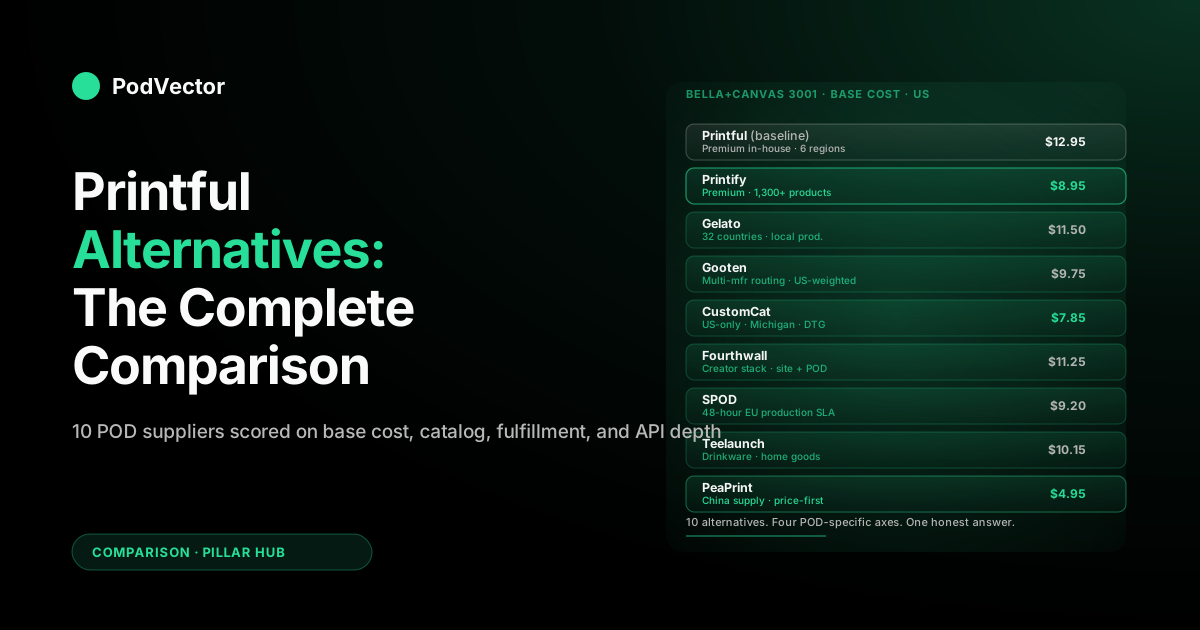
Quick Answer: Printful is the premium, in-house, high-quality-high-cost option in the POD supplier market. The ten alternatives worth evaluating in 2026 each solve a different Printful weakness: Printify wins on catalog breadth and cheap base costs; Gelato wins on EU and global local fulfillment; Gooten wins on multi-manufacturer routing; Fourthwall wins on creator-audience monetization; CustomCat wins on US fulfillment speed and DTG pricing; Prodigi wins on wall art and framed prints; AOP+ wins on all-over-print apparel; SPOD (Spreadshirt) wins on 48-hour European production; Teelaunch wins on uniquely priced drinkware and home goods; PeaPrint wins on rock-bottom Asian supply-chain pricing.
None of them wins on all axes — and the supplier you pick silently decides your gross margin before a single ad dollar runs. One critical 2026 update: Printful and Printify announced a merger in November 2024 and now operate under a combined parent entity called Fyul — but as of September 2026, both platforms still run completely independently with separate catalogs, pricing, account systems, and fulfillment workflows. That shared ownership is a new diversification risk every POD seller should factor in when choosing a supplier stack. This pillar comparison scores all ten across the four metrics that actually matter for a POD seller's P&L, maps each to a specific POD seller stage, and walks the switching playbook.
Why POD sellers look for Printful alternatives
Most roundups answering "what are the best Printful alternatives" start with a feature list. That gets the answer wrong by framing the question wrong.
POD sellers don't churn off Printful because a feature is missing — they churn because Printful's per-SKU economics stopped working for their specific product mix, their specific geography, or their specific scale. The right way to evaluate alternatives is to identify which of those three constraints is actually binding for your store, then pick the supplier that relaxes it.
The three reasons sellers cite for looking past Printful in 2026 are consistent across our seller interviews and the broader SERP. First, base-cost pressure. Printful's premium positioning shows up on every line of the supplier invoice. According to inkandpxl.com, a standard t-shirt costs approximately $4 less on Printify than on Printful at current 2026 rates — and at POD's thin contribution margins, that delta is not a rounding error; it's the difference between a scaling ad account and a treadmill ad account. Second, geography. Printful's owned facilities across multiple continents are excellent but not optimal everywhere — a seller shipping heavily to Germany finds Gelato's local German production faster and cheaper than Printful's Riga facility even after shipping. Third, catalog constraints. Printful's curated catalog helps quality assurance, but it's still a wall when you want to sell an all-over-print bomber jacket, a framed 30×40 canvas print, or a line of ceramic mugs Printful doesn't carry. For each of these three constraints, a different alternative is the right answer.
A fourth, softer reason: diversification risk. A POD seller whose entire operation runs on one supplier's API has a single point of failure. And in 2026 there's a new twist on that risk — covered in the next section.
See PodVector AI's POD strategy hub for how supplier choice connects to your broader store economics, and net profit margin benchmarks for POD for the margin context behind every supplier decision below.
The Fyul merger: what Printful + Printify sharing an owner means for you
This is the single most important update for anyone comparing Printful alternatives in 2026 — and it's the piece most older guides still omit.
According to inkandpxl.com, Printify and Printful announced their merger on November 5, 2024, forming a combined entity now named Fyul, with Riga named as the shared innovation center. According to traksource.com, both brands still run as separate platforms with distinct catalogs, pricing structures, different account systems, and competing fulfillment architectures, and as of mid-2026 no operational consolidation has taken effect at the seller level.
What does this mean practically? Three things:
- The head-to-head competition that kept prices sharp is now internal. According to podbase.com, "the rivalry that kept prices and quality sharp now sits under one roof." That doesn't mean prices will rise tomorrow — but the historic pressure that made each platform fight for your order is structurally weakened.
- Single-supplier risk now extends to the parent level. A store that runs Printful as its primary and Printify as its standby is now, at the parent-entity level, single-sourced. For redundancy that actually reduces risk, at least one supplier should sit outside Fyul — Gelato, CustomCat, Gooten, SPOD, and the other alternatives below all qualify.
- Pricing changes are already appearing. According to traksource.com, Printify Premium's monthly price increased in February 2026 (from $29 to $39 per month), while annual billing stayed at approximately $24.99 per month — making annual billing the only cost-efficient way to hold Premium. According to PodVector AI's own pricing article citing EcommerceCEO, Printful also rolled out a targeted price increase in February 2026 on Cotton Heritage products.
The operational comparison below still holds — both platforms run separately and the per-unit cost, catalog, and shipping differences remain real. But any seller building a multi-supplier stack in 2026 should treat Printful and Printify as a single point of exposure at the ownership level, and plan accordingly. See multi-channel supplier diversification considerations for how this plays into your fulfillment architecture.
How we evaluated: the four POD-specific axes
Every supplier in this comparison gets scored on the same four axes. These are the axes that actually move a POD P&L — not the ones the supplier marketing pages lead with. A supplier can have a beautiful dashboard, 200 integrations, and strong reviews, and still silently cost you margin per order because one of these four axes isn't handled well for your specific product mix.
- Base cost + per-unit economics. What does a Bella+Canvas 3001 tee (the POD benchmark SKU) land at before shipping, on the supplier's default plan? What does it land at on the supplier's premium tier? How does that scale across hoodies, long-sleeves, and non-apparel?
- Catalog breadth and product depth. How many products, how many variants, how much all-over-print coverage, how many non-apparel categories (home goods, wall art, drinkware, accessories)?
- Fulfillment geography and shipping SLA. Where does the supplier produce? What percentage of orders ship from inside the customer's continent? What is the median order-placed-to-delivered time on the supplier's US + EU + AU + Canada corridors?
- Integration depth and API maturity. How cleanly does the supplier integrate with Shopify, Etsy, WooCommerce, Amazon, TikTok Shop, and eBay? Are supplier-charged line items itemized per order in a machine-readable format, or does your margin tracking collapse to a flat percentage?
A fifth axis — roadmap and diversification risk — is noted in each section but not scored in the table. The Fyul merger makes this axis more important than ever: it's worth asking, for every supplier you consider, whether it sits inside or outside the Fyul umbrella. The four scored axes are what every POD seller needs to reason about before switching, and they're what the comparison table below measures directly.
The full Printful alternatives comparison table
| Supplier | Bella+Canvas 3001 base cost (US) | Catalog size | Fulfillment footprint | Shopify integration | Best for |
|---|---|---|---|---|---|
| Printful (baseline) | ~$12.95 (see note) | ~500 products | Owned facilities: US, EU (Riga), MX, JP, AU, CA | Native, mature | Premium brands with quality-first positioning |
| Printify | Lower than Printful — according to inkandpxl.com, approximately $4 less per standard tee at 2026 rates | 1,300+ products (per Tapstitch) | 100+ print providers, global network (per inkandpxl.com) | Native, mature | Catalog breadth and base-cost compression |
| Gelato | Mid-range (between Printful and Printify) | ~250 products | 130+ local facilities in 32 countries | Native | EU and global local-production sellers |
| Gooten | Below Printful; according to Merch Titans, high-volume sellers (500+ orders/month) find Gooten meaningfully cheaper than Printful on equivalent products | ~280 products | Multi-manufacturer auto-routing (US-weighted) | Native | Smart-routing by cost and location |
| Fourthwall | In Printful's range | ~150 products | US, EU partners | Standalone storefront + Shopify add-on | Creators monetizing an audience |
| CustomCat | Significantly below Printful on DTG (per Printful's own blog, CustomCat has "some of the lowest standard wholesale prices" in the industry) | ~550 products | US-only (Michigan/Detroit area) | Native | Low US-side base cost, fast domestic production |
| Prodigi | n/a — apparel-light | ~500 products (art-heavy) | US, UK, EU, AU, NZ labs | Native + API-first | Wall art, framed prints, giclée |
| AOP+ | Higher than Printful on standard DTG; competitive on AOP/sublimation SKUs | ~200 products | UK + US | Native | All-over-print apparel + cut-and-sew |
| SPOD | Below Printful; 48-hour production SLA (per podbase.com) | ~230 products | US (Henderson NV) + EU (Leipzig) | Native | 48-hour production SLA in EU and US |
| Teelaunch | Mid-range | ~300 products | US + UK + CA | Native (Shopify-only focus) | Drinkware, home goods, uniquely priced mugs |
| PeaPrint | Substantially below Printful | 1,000+ products | China + emerging satellite hubs | Shopify + WooCommerce | Price-first sellers with flexible SLAs |
Note on base costs: Specific per-SKU dollar figures shift with supplier pricing updates — Printful adjusted Cotton Heritage product prices in February 2026, and Printify's Premium plan monthly price increased the same month (per traksource.com). Rather than carry stale numbers, consult each supplier's live pricing page for the exact figure on your specific SKU, size, and fulfillment region before building your margin model. The relative ordering in the table above — Printful as the most expensive in-house option, Printify and CustomCat as the lowest on apparel, PeaPrint as the floor — is directionally stable. For the subscription-tier discount math on Printify, see the complete guide to Printify costs, shipping, and Premium.
1. Printify — the catalog-breadth alternative
Printify is the Printful alternative most POD sellers consider first, and for most sellers it's the right answer on unit economics. The core tradeoff is structural: Printful owns its own print facilities, which gives it quality consistency and brand-customization depth but pins base costs to Printful's in-house labor and overhead. According to tapstitch.com, Printify connects merchants to a global network of independent print providers — giving it catalog breadth, base-cost pressure (providers compete for your orders), and geographic flexibility — but pushing quality variance one level up the stack.
According to inkandpxl.com, Printify aggregates more than 80 competing print providers, and supplier competition drives prices below what a single vertically integrated operation can match. Printful has narrowed the gap with its Growth plan's discount, but according to inkandpxl.com, Printify retains the base cost advantage on most apparel SKUs when a seller has manually selected and vetted their provider.
Important 2026 pricing update: According to traksource.com, Printify Premium's monthly price increased in February 2026 from $29 to $39 per month, while annual billing remained locked at approximately $24.99 per month. According to traksource.com, annual billing is now the only rational way to hold Premium.
Printful answered with its own Growth plan: according to inkandpxl.com, the Growth plan at $24.99 per month becomes free once a store reaches $12,000 in annual sales. According to Merch Titans, Printful's Growth plan offers up to 30% off products in-house — which narrows the gap but doesn't close it.
The Fyul angle: As noted above, Printify and Printful now share a parent company. A seller running both for redundancy is no longer genuinely diversified at the ownership level. See the PodVector AI POD strategy guide for how to structure a supplier stack that actually reduces platform risk.
See how much is Printify Premium for the break-even math, is Printify Premium worth it for POD sellers for the qualitative case, and the forthcoming Printify alternatives complete comparison if Printify itself isn't the right fit.
Where Printify wins against Printful
- Base costs lower on like-for-like apparel — according to inkandpxl.com, approximately $4 less per standard tee at current 2026 rates, which at 100 sales per month translates to roughly $400 more in gross margin.
- Catalog breadth — 1,300+ products according to tapstitch.com. Ceramic mugs, jewelry, home goods, pet products, pocketed hoodies, AOP bomber jackets — most SKUs not on Printful live somewhere in Printify's provider network.
- Provider choice per product. The same hoodie SKU has multiple print providers; you pick on price, speed, or quality per your margin priority.
- Integrations parity. Shopify, Etsy, WooCommerce, TikTok Shop, eBay, Wix, Squarespace — Printify's integration coverage matches or exceeds Printful's.
Where Printify is weaker than Printful
- Quality variance across providers. According to tapstitch.com, the decentralized structure introduces variability in product quality and logistics. Printful's in-house quality is more consistent by design.
- Branding is lighter. Printful's inside-label, pack-in, and custom-tag services are more mature.
- Shared parent-company risk. Running Printify as a Printful standby no longer provides genuine ownership-level diversification under Fyul.
Full Printful-vs-Printify comparison, from a Printful-centric angle, is covered in the complete Printful review. The makes-money math for Printify specifically lives in how to make money with Printify.
2. Gelato — the local-fulfillment alternative
Gelato is the structurally best Printful alternative for any seller whose customer base is not US-concentrated — and a genuinely independent option outside the Fyul parent structure. Gelato's core architectural choice — local production facilities across 32 countries, with algorithmic routing that fulfills orders from the facility closest to the ship-to address — is the single biggest shipping-SLA unlock in the POD supplier market. According to podbase.com, Gelato is ideal for eco-friendly local printing with global reach.
A German customer on Gelato gets their shirt from a German press; a Japanese customer gets theirs from a Japanese press; a Brazilian customer gets theirs from a Brazilian press. Printful's network is real but thinner, and a non-US seller on Printful is typically routing through Riga or Mexico with corresponding shipping cost and time penalties.
The tradeoff: Gelato's catalog is narrower than Printify's (by design — Gelato emphasizes products that produce well locally), base costs sit between Printful's and Printify's, and the brand-customization depth is moderate. For a seller whose business is 70%+ EU-ship-to or 40%+ rest-of-world, Gelato's shipping advantage outweighs those limits. For a 90% US seller, Gelato's local-production angle is less differentiated against Printful's strong US network.
Where Gelato wins against Printful
- Local production network. 32 countries, routing per ship-to address — the only POD supplier whose fulfillment map genuinely looks like a multinational logistics operation rather than a centralized shipping hub.
- EU shipping SLA. Local-to-local EU delivery on Gelato is consistently faster than Printful EU-to-EU via Riga.
- Independent of Fyul. For sellers treating Printful + Printify as a single-owner risk, Gelato is the clearest large-scale alternative that sits entirely outside that structure.
- Strong wall-art and art-print catalog — posters, framed prints, photo prints, canvas — with local lab production in most major markets.
Where Gelato is weaker than Printful
- Apparel catalog narrower. Fewer hoodies, fewer long-sleeve options, less AOP coverage.
- Branding services lighter. Inside-label and custom pack-in parity with Printful exists but is less developed.
- Pricing complexity. Base costs vary by fulfillment region, which is a feature for accurate routing but a cognitive tax when building product prices.
For the shipping-specific comparison, see the complete guide to Printful shipping and where does Printify ship from.
3. Gooten — the multi-manufacturer routing alternative
Gooten occupies a middle position between Printful's in-house model and Gelato's local-facility model. The approach: a network of third-party manufacturers with an algorithmic router that chooses per order based on location, cost, capacity, and lead time. According to Merch Titans, Gooten "quietly serves some of the highest-volume POD sellers in the industry," with a robust API and intelligent order routing that gets progressively better as volume increases.
In practice, a Gooten seller shipping to California gets a California-optimized partner; a seller shipping to Texas gets a Texas partner; a seller shipping to Ontario gets a Canadian partner. The routing is less geographically dense than Gelato's but broader than Printful's single-facility-per-region setup.
Gooten's positioning skews toward mid-market sellers with diverse catalogs and a cost-sensitivity that doesn't quite justify Printify's rock-bottom but variable network. The catalog is respectable (~280 products with strong home-goods and wall-decor coverage), base costs sit below Printful's, and the API is genuinely mature. Like Gelato, Gooten sits outside the Fyul umbrella — making it a valid diversification option for sellers reducing Printful + Printify concentration risk.
Where Gooten wins against Printful
- Smart routing. Automatic selection across manufacturers by location + cost + capacity — less configuration than Printify's per-product provider choice.
- API-first integration. Mature developer docs; popular with sellers who want custom ordering workflows or multi-store rollup logic. According to Merch Titans, the API is robust and the order routing is intelligent.
- Strong home-goods and wall-decor catalog. Blankets, pillows, posters, canvas, metal prints, ornaments — deeper than Printful in these categories.
- Fyul-independent. A genuine alternative outside the Printful/Printify ownership structure.
Where Gooten is weaker than Printful
- Apparel depth is thinner. Fewer brand-name blanks, fewer color/size variants per SKU.
- Dashboard UX is dated. Gooten's storefront integrations work fine but the operator UI feels behind.
- Branding services limited compared to Printful's inside-label and pack-in infrastructure.
4. Fourthwall — the creator-focused alternative
Fourthwall is the only supplier on this list whose core product isn't the supplier — it's the storefront. A POD operator signing up for Fourthwall gets a hosted brand site, built-in payments, email/SMS tools, membership and digital product support, and a POD-fulfilled merchandise catalog in a single bundle. For a creator whose audience lives on YouTube, TikTok, Twitch, or Instagram and who wants to monetize that audience without running a separate Shopify + Printful stack, Fourthwall is the shortest path to shipping product.
The tradeoffs are meaningful for a "pure" POD seller. Fourthwall's POD catalog is narrower (~150 products), base costs are in Printful's range rather than Printify's, the checkout lives on Fourthwall's domain (not your Shopify), and the standalone-storefront structure is suboptimal for a seller already running an established Shopify operation. Fourthwall is excellent at what it's designed for — creator-audience monetization — and mediocre at anything outside that use case.
Where Fourthwall wins against Printful
- All-in-one creator stack. Site, payments, POD, memberships, digital products — no integration complexity.
- Creator-native features: membership tiers, Discord integration, supporter-exclusive product drops.
- Independent of Fyul — a genuine alternative for sellers concerned about Printful/Printify ownership concentration.
Where Fourthwall is weaker than Printful
- Not a standalone POD supplier. You can't plug Fourthwall into a Shopify store the way you plug in Printful. It's a stack, not a service.
- Narrower catalog and more limited branding.
- Higher effective cost for high-volume sellers. The stack-bundled pricing is great at low volume and less efficient at scale.
5. CustomCat — the US-speed alternative
CustomCat is the Printful alternative most US-focused sellers underweight relative to how good it actually is on the axes US sellers care about. According to Printful's own blog, CustomCat is "known for having some of the lowest standard wholesale prices and fastest fulfillment in the industry." According to that same source, CustomCat produces everything in-house in the US and ships most orders within 2–3 business days. The Pro subscription — $30 per month or $25 per month billed annually — unlocks discounts on the entire catalog.
The tradeoff is geography. CustomCat is US-only fulfillment — EU and Canada orders ship from Michigan, which means elevated delivery times and shipping cost. For a US-only store the geography constraint is nonexistent; for a 50/50 US/EU store CustomCat is a partial solution at best. Like Gelato and Gooten, CustomCat sits entirely outside the Fyul structure — making it a strong true-independent alternative for diversification-minded sellers.
Where CustomCat wins against Printful
- Low US base costs. According to Printful's own blog, CustomCat has some of the lowest standard wholesale prices in the POD industry — with Pro-tier discounts deepening the advantage further.
- Fast US production. According to Printful's blog, CustomCat ships most orders within 2–3 business days using advanced DIGISOFT® digital printing technology.
- Multiple print techniques under one roof: DTG, screen print, sublimation, embroidery.
- Fyul-independent — genuine diversification for sellers over-indexed on Printify + Printful.
Where CustomCat is weaker than Printful
- US-only fulfillment. No EU, no MX, no JP, no AU facilities.
- Quality variance across print techniques and batches — not catastrophic, but less uniform than Printful's in-house QA.
- Branding services lighter on inside-label and custom pack-ins.
6. Prodigi — the wall-art and framed-prints alternative
Prodigi is a specialist rather than a generalist and it belongs on this list precisely because the specialization is relevant to POD sellers who've discovered that wall art carries the highest and most stable margins in the category. Prodigi's catalog is built around fine-art reproduction — giclée prints, framed canvases, photo prints, metal prints, acrylic prints — with lab partners across the US, UK, EU, AU, and NZ. The quality bar on Prodigi is genuinely high; framed prints ship to the customer in museum-grade wrapping with consistent color matching.
Prodigi is not a Printful alternative for an apparel-first store; it's a Printful alternative for the art-print SKUs in your catalog, with apparel staying on Printful or Printify. The dual-supplier split — art on Prodigi, apparel on Printify/Printful — is a common configuration for stores above ~$10K MRR that care about SKU-level margin rather than supplier-level convenience. Prodigi sits outside the Fyul structure.
Where Prodigi wins against Printful
- Best-in-class art-print quality. Giclée, museum-grade paper, color-managed labs.
- Framed-print depth. Frame materials, mat options, sizes up to 40×60+ — much deeper than Printful or Printify.
- Global art-lab network. Local production on 5 continents for prints — shipping SLA advantage vs Printful's regional hubs.
Where Prodigi is weaker than Printful
- Apparel catalog essentially nonexistent. Not a replacement for the tee and hoodie side of a POD store.
- API-first feel. Great for technically comfortable operators; steeper learning curve for a first-time POD seller.
7. AOP+ — the all-over-print specialist
AOP+ (All Over Print Plus) owns a product category Printful treats as secondary. If your store sells all-over-print bomber jackets, cut-and-sew leggings, full-coverage hoodies, or sublimation-heavy apparel, AOP+ produces at a quality depth that Printful doesn't match on these specific SKUs. The base costs are higher than Printful on standard DTG tees (AOP's cost structure favors sublimation and cut-and-sew), but the net-margin math flips on AOP product — AOP+ produces the kind of bold, full-coverage designs that justify high retail prices where the base-cost premium is immaterial.
AOP+ fulfills from UK and US facilities, making it particularly well-suited for EU-and-US split stores selling statement apparel. For sellers whose product mix is 70%+ standard DTG (tees, basic hoodies, crewnecks), AOP+ is the wrong primary supplier; for sellers whose mix is 40%+ all-over-print, AOP+ is close to mandatory.
Where AOP+ wins against Printful
- Best-in-class AOP production: sublimation, cut-and-sew, full-coverage apparel with no print seams or color breaks.
- Deep AOP catalog: bomber jackets, leggings, joggers, swimwear, full-print hoodies — categories thin or absent on Printful.
- UK + US dual fulfillment with sensible routing.
- Fyul-independent — a genuine diversification option.
Where AOP+ is weaker than Printful
- Higher base costs on standard DTG — the math only works on AOP-first product mixes.
- Narrower apparel basics catalog.
- Integration depth — works with Shopify, Etsy, WooCommerce cleanly but is lighter on emerging channels like TikTok Shop.
8. SPOD — the 48-hour European alternative
SPOD (part of Spreadshirt) runs on a single, aggressive operational promise: 48-hour production on every order, every day. According to podbase.com, SPOD delivers an "affordable and fast (48h turnaround) in US & EU" proposition. For a seller where customer-retention economics are dominated by perceived delivery speed — repeat-purchase apparel brands, seasonal gift stores where cart conversion is abandonment-sensitive — SPOD's SLA is structurally differentiated against Printful's typical production window. The EU operation runs out of Leipzig, Germany; the US operation out of Henderson, Nevada.
The base costs are competitive — meaningfully below Printful — and the catalog (~230 products) covers the core apparel SKUs most POD stores actually sell. The tradeoff is design constraints: SPOD's print technology stack is narrower than Printful's, which means some complex designs produce slightly differently than the reference mock. Quality is solid and consistent; it's not premium in Printful's sense but it's reliable. SPOD sits outside the Fyul structure.
Where SPOD wins against Printful
- 48-hour production SLA, guaranteed. According to podbase.com, unique in the POD supplier market at this price point.
- Fast EU delivery: Leipzig-to-EU delivery in 3–5 days end-to-end on most orders.
- Simple pricing: flat per-product costs with no surprise tier logic.
- Fyul-independent — genuine ownership-level diversification.
Where SPOD is weaker than Printful
- Catalog narrower. ~230 products vs Printful's ~500; thinner on non-apparel.
- Design constraints on specialized print placements and complex art.
- Branding services limited relative to Printful's custom-branding suite.
9. Teelaunch — the drinkware and home-goods alternative
Teelaunch is the POD supplier with the most distinctive non-apparel catalog — particularly drinkware (Yeti-style tumblers, shot glasses, beer growlers), home goods (cutting boards, coasters, pillows), and certain novelty SKUs that neither Printful nor Printify carries. According to bluecotton.com, Teelaunch is best suited for sellers looking to offer unique or novelty products that differentiate their brand from standard POD. For a store with a design-forward or gifting-focused product strategy where the product mix is heavy on mugs, tumblers, blankets, and non-apparel accessories, Teelaunch covers product lines that the larger suppliers don't.
Teelaunch's primary geography is US, UK, and Canada; integrations are Shopify-focused; base costs sit in the middle of the field. The apparel side of Teelaunch is acceptable but not differentiated — nobody should be picking Teelaunch primarily for t-shirts. Teelaunch sits outside the Fyul structure.
Where Teelaunch wins against Printful
- Unique drinkware catalog: tumblers, growlers, shot glasses, insulated bottles — much deeper than Printful.
- Home-goods depth: cutting boards, pillows, blankets, coasters with solid production quality.
- Shopify-first integration tuned to how most POD stores actually operate.
Where Teelaunch is weaker than Printful
- Apparel catalog is thin. Not a replacement for the tee-and-hoodie side of a POD store.
- International fulfillment is partial: strong US/UK/CA, weaker in the rest of the world.
- Platform integrations narrower: Shopify-first; lighter on Etsy, TikTok Shop, Amazon.
10. PeaPrint — the low-cost Asian-supply alternative
PeaPrint is the most geographically and structurally different supplier on this list — a China-based POD platform leveraging the full weight of the Chinese supply chain to hit base costs that Western suppliers can't match. For a price-sensitive operator whose customers accept longer shipping windows in exchange for a lower price point, PeaPrint's unit economics are genuinely hard to beat.
The tradeoffs are real and operator-specific. Shipping SLAs are longer than Western-fulfilled suppliers — standard shipping to the US runs into the 10–18 day range, and expedited options exist but compress the base-cost advantage. Quality is variable — some batches are excellent, others need QA attention. Tariff and customs complexity for US sellers is nontrivial and has increased since 2025 policy changes on Chinese-origin imports. Brand positioning: a premium-positioned store shouldn't source primary SKUs from PeaPrint, but a budget-segment or high-volume-low-margin operation absolutely should evaluate it. PeaPrint sits outside the Fyul structure.
Where PeaPrint wins against Printful
- Base costs substantially below Printful on most SKUs — the largest unit-economics gap on this list.
- Catalog breadth 1,000+ products.
- Strong for budget-brand positioning: margin math works at low retail price points where Printful's base cost creates a ceiling.
Where PeaPrint is weaker than Printful
- Shipping times long. 10–18 day delivery to the US disqualifies it for speed-sensitive positioning.
- Quality variance: careful supplier QA and sample-order testing are mandatory.
- Tariff and customs overhead adds operational complexity for US sellers and should be modeled into your landed cost before comparing unit economics.
Which alternative fits each POD stage
The right Printful alternative depends as much on your store's current stage and strategic positioning as on supplier feature checklists. The Fyul merger adds a new column to this map: at every stage above ~$10K MRR, at least one supplier in your stack should sit outside the Fyul umbrella (Printful + Printify) for genuine diversification.
| Stage / Strategy | MRR band | Binding constraint | Recommended alternative |
|---|---|---|---|
| Validating | $0–$3K | Keep fixed costs near zero; accept quality tradeoffs | Printify Free tier |
| Early US growth | $3K–$15K | US delivery speed + base cost compression | CustomCat or Printify Premium (annual) |
| EU-concentrated growth | $3K–$50K | EU shipping SLA | Gelato (primary) + SPOD (standby) |
| AOP-heavy brand | Any | All-over-print production quality | AOP+ (AOP SKUs) + Printful (basics) |
| Art + wall-decor focused | Any | Giclée and framed-print quality | Prodigi (art) + Printify (rest) |
| Creator monetization | Any | Site + payments + POD in one stack | Fourthwall |
| Drinkware + home-goods focus | Any | Non-apparel catalog depth | Teelaunch + Printify |
| Budget-brand mass-market | Any | Low retail price points | PeaPrint (primary) + Printify (US-fast standby) |
| Scale with diversification | $50K+ | Reduce single-supplier risk (incl. Fyul parent exposure) | Printify primary + Gelato or CustomCat as true-independent standby |
Two patterns are worth naming. First, dual-supplier configurations start appearing above ~$10K MRR and are the default above $50K — most scaled POD operators run two or three suppliers in parallel rather than one. Second, the Fyul merger means that running Printful as primary and Printify as standby is no longer genuine diversification at the ownership level — the "standby" supplier should ideally be Gelato, CustomCat, Gooten, SPOD, or another Fyul-independent platform. For broader context on supplier economics, see POD fulfillment companies compared and how checkout completion rates interact with your fulfillment SLA choice.
How to switch from Printful without breaking your store
Most supplier-switch failures in POD come from skipping two steps: sample testing and inventory-parallel rollout. The playbook below takes ~14 days end-to-end for a single-supplier switch, and it minimizes the risk of a quality regression hitting customers during the cutover.
- Order samples of your top 10 SKUs from the new supplier. Not "the general t-shirt catalog" — your exact best-sellers with your exact designs. Compare side-by-side against your Printful-produced versions: print color, placement accuracy, fabric hand-feel, packaging. 3–5 day process.
- Set up the new supplier's Shopify integration alongside Printful, not as a replacement. Both apps live in your store; product mapping points to the new supplier on only a test subset.
- Migrate 20% of your catalog to the new supplier first. Pick low-volume SKUs initially — a regression there is recoverable. Do not migrate a best-seller until the new supplier has produced 50+ live orders cleanly.
- Monitor return rates and customer reviews for 10–14 days on the migrated subset. If return rate is within 20% of baseline and review sentiment is unchanged, proceed to larger migration. If not, isolate the cause — print technique mismatch, color profile shift, sizing variance — and either resolve or abandon.
- Migrate best-sellers last. A 3-star review on your best-selling hoodie is more damaging than a 3-star review on anything else. Give the new supplier 3–4 weeks of smaller-SKU track record before trusting it with top-line revenue.
- Keep Printful installed as a standby for 60 days minimum after full migration. If the new supplier has a capacity issue or an SLA regression, route back to Printful on the specific SKUs affected — zero reconfiguration required.
According to traksource.com, keeping your design assets organized and portable is equally critical — well-structured creative is what lets you switch platforms without losing momentum. For the reverse question — if you're switching to Printful from another supplier — the same playbook applies symmetrically. See the forthcoming complete Printful guide for POD sellers and complete guide to Printful integrations for the onboarding-side detail. For increasing the revenue each order generates while you're reconfiguring your supplier stack, see how to increase AOV with AI.
Tracking profit when you run more than one POD supplier
Running two or more POD suppliers simultaneously is the right architecture for most POD operators above ~$10K MRR — and, as covered above, the Fyul merger makes genuinely independent multi-supplier stacks more important, not less. It's also the point at which generic profit tracking breaks down.
The problem is specific: every supplier works differently. Each one has its own costs, fees, and discount rules. Most Shopify apps just lump all of this together into one flat percentage. That hides the real cost of each product, so you can't tell which supplier is actually saving you money on which item.
The consequence is decisions made on wrong numbers. A seller running Printful and Gelato in parallel has to answer: which supplier is currently cheaper on the specific SKU-variant-destination combinations my Meta ads are converting on? A flat-COGS dashboard cannot answer that. A per-order, supplier-itemized profit view — pulling each supplier's per-line-item cost from that supplier's API, reconciled against your Shopify order IDs — can answer it in a single query.
This is the gap PodVector AI was built to close — and not just by measuring it. Victor is an AI employee, not a dashboard. He sees the real supplier cost behind every order, matched up with the right Shopify order, so every product margin he shows you comes from real numbers — not a flat guess. Victor reads Shopify, Meta Ads, Google Ads, Printify, Printful, and Klaviyo.
That accurate substrate is what lets Victor act. Ask "which of my top 20 SKUs are cheaper on Gelato than Printful right now?" and he doesn't just answer — he proposes the re-route, and on your approval updates the supplier mapping in Shopify so new orders fulfill from the cheaper provider. Every material action waits on your explicit approval; Victor never acts unilaterally. See the PodVector AI POD strategy guide for how Victor fits into a multi-supplier POD operation, PodVector AI vs competitors for how this compares to TrueProfit, BeProfit, and other general-ecommerce tools, and the complete guide to tracking profits in print-on-demand for the underlying math.
For the broader connection between supplier margin accuracy and your advertising strategy, see CRO techniques for POD stores and the industry-standard Google Ads campaign strategy for Shopify POD stores.
FAQs
Did Printful and Printify merge? What does that mean for POD sellers?
Yes. According to inkandpxl.com, Printify and Printful announced their merger on November 5, 2024, and now operate under a combined parent entity called Fyul. According to multiple sources including traksource.com and podbase.com, as of mid-2026 both platforms still run completely independently with separate catalogs, pricing, account systems, and fulfillment workflows — no operational consolidation has taken effect at the seller level.
What this means practically: the competitive pressure that historically kept each platform's pricing sharp is now internal. A seller running Printful as primary and Printify as standby is no longer genuinely diversified at the ownership level. At least one supplier in a multi-supplier stack should sit outside Fyul — Gelato, CustomCat, Gooten, SPOD, AOP+, Prodigi, Teelaunch, and PeaPrint all qualify. According to traksource.com, lock in annual billing if staying on Printify Premium — at approximately $24.99 per month annually, it sidesteps the February 2026 monthly price increase entirely.
What is the best Printful alternative for US-only POD sellers?
CustomCat or Printify Premium (annual) are the two strongest US-focused alternatives. According to Printful's own blog, CustomCat is known for having some of the lowest standard wholesale prices and fastest fulfillment in the industry, producing in-house in the US and shipping most orders within 2–3 business days. Printify Premium wins on catalog breadth and brand-name blank options.
The right answer depends on whether your bottleneck is base-cost compression (CustomCat) or SKU breadth (Printify). CustomCat also sits outside Fyul — a meaningful advantage for sellers reducing Printful/Printify ownership concentration. See complete guide to Printful costs and fees for the baseline math.
What is the best Printful alternative for EU sellers?
Gelato, for almost every EU seller whose customer base is 50%+ EU-ship-to. Gelato's 32-country local-production network means a Gelato order shipped to Paris fulfills from a French press, to Berlin from a German press, to Madrid from a Spanish press. Printful's strong EU operation still routes through Riga for most of Europe, which costs extra transit time. SPOD is the strongest standby if Gelato's catalog doesn't cover a specific SKU — according to podbase.com, SPOD offers a 48-hour turnaround in both US and EU. See complete guide to Printful shipping for the zone-level comparison.
Is Printify cheaper than Printful?
Yes, on like-for-like apparel. According to inkandpxl.com, a standard t-shirt costs approximately $4 less on Printify than on Printful at current 2026 rates — which at 100 sales per month translates to roughly $400 more in gross margin. According to inkandpxl.com, Printful has narrowed the gap with its Growth plan, but Printify retains the base cost advantage on most apparel SKUs when a seller has selected and vetted their provider. The tradeoff is quality variance across Printify's third-party providers vs Printful's in-house consistency. For the full pricing breakdown see how much does Printify charge per shirt and complete guide to Printify costs, shipping, Premium, and profitability.
Can I run Printful and another supplier at the same time?
Yes, and most POD operators above ~$10K MRR do exactly this. The typical configuration is one primary supplier handling the majority of volume, with a second supplier covering either a specific product category (Prodigi for art, AOP+ for all-over-print, Teelaunch for drinkware) or acting as a capacity standby. Post-Fyul merger, that standby should ideally be a Fyul-independent supplier for genuine risk reduction. The operational challenge is profit tracking across the multi-supplier P&L — covered in the section above.
What's the best Printful alternative for selling all-over-print apparel?
AOP+ (All Over Print Plus) is the specialist, and for AOP-heavy product mixes it's not close — AOP+ produces bomber jackets, leggings, full-coverage hoodies, swimwear, and cut-and-sew SKUs at a quality and catalog depth Printful doesn't match. For a store where 40%+ of revenue comes from all-over-print product, AOP+ is close to mandatory as at least a secondary supplier. For a store where AOP is a minor fraction, Printify's network covers AOP SKUs adequately.
Is switching from Printful to Printify worth the operational work?
On unit economics alone, often yes — according to inkandpxl.com, the base cost difference of approximately $4 per standard tee is real money at volume. The exception is a seller whose brand positioning depends on Printful's in-house quality consistency, or whose customer base skews premium enough that quality variance is a conversion-rate risk. One nuance to add in 2026: switching from Printful to Printify no longer fully diversifies your supplier risk since both now operate under Fyul. If risk reduction is part of the rationale for switching, Gelato or CustomCat may be the better destination. For the full break-even math see is Printify Premium worth it for POD sellers.
Which Printful alternative has the fastest shipping?
For US orders: CustomCat (Michigan fulfillment, 2–3 business day production per Printful's blog) and SPOD (Nevada fulfillment, 48-hour production SLA per podbase.com) are the fastest. For EU orders: Gelato's local-production network and SPOD's Leipzig operation are the fastest. For the general shipping-cost analysis see print-on-demand shipping explained and how long does Printify take to ship.
How do I track profit accurately when I use multiple POD suppliers?
Start with real numbers: Victor sees the actual supplier cost for every order, matched to the right Shopify order — instead of lumping every supplier into one flat percentage the way generic cost trackers do. That matters because it means he can spot when one supplier is costing you more than another on the same product. PodVector AI builds on exactly that, but the point isn't the numbers — it's that Victor, the AI employee on top, acts on them: he proposes the switch to the cheaper supplier and, on your approval, updates the Shopify listing himself. See PodVector AI vs competitors for the comparison and PodVector AI pricing and features for the specific integration coverage. For the benchmarks that tell you whether your current margins are healthy, see net profit margin benchmarks for POD.
Does Printful have better quality than its alternatives?
In-house quality consistency, yes — Printful's owned-facility model produces more uniform print quality across batches than marketplace models like Printify or Gooten. Specialist quality in specific categories, no — Prodigi outperforms on giclée art prints, AOP+ outperforms on all-over-print, and CustomCat is competitive or better on US DTG at a lower cost. The right answer is SKU-specific. For the quality-focused comparison, see the forthcoming complete Printful review.
What about Printful's roadmap makes it still worth staying with?
Printful's ongoing investments focus on custom-branding infrastructure (inside-label, pack-ins, branded sample program) and private-label-quality positioning. For a store whose brand strategy depends on those — high-end apparel, gifting, corporate merch — Printful remains structurally differentiated. For a store optimizing on unit economics or geography, one of the alternatives above is almost certainly a better fit. The complete Printful guide covers Printful's roadmap and positioning in detail. And for a Klaviyo-side strategy that improves the revenue you extract from every order regardless of which supplier fulfills it, see Klaviyo browse abandonment flow setup for POD stores.
For a different-angle read, Fourthwall's own roundup of Printful alternatives is a useful reference point (with the obvious caveat that Fourthwall positions itself as one of the alternatives being reviewed). Read it alongside this piece for a fuller picture of the supplier landscape.
Let Victor run your multi-supplier POD ops
Switching from Printful to an independent alternative — or running multiple suppliers at once — changes your cost structure in ways a flat-percentage tracker never sees. Victor, your AI employee, pulls the real per-order supplier cost from Printful, Printify, and your other connected suppliers, reconciles it against your Shopify orders, then acts on it: he proposes the re-route to the cheaper supplier and updates the Shopify mapping once you approve. He reads your Meta Ads, Google Ads, and Klaviyo data to surface where to focus — and every move he proposes waits for your explicit approval before anything changes. You decide. He does the work. And hand off your multi-supplier ops, starting with your next order.
Try Victor free