
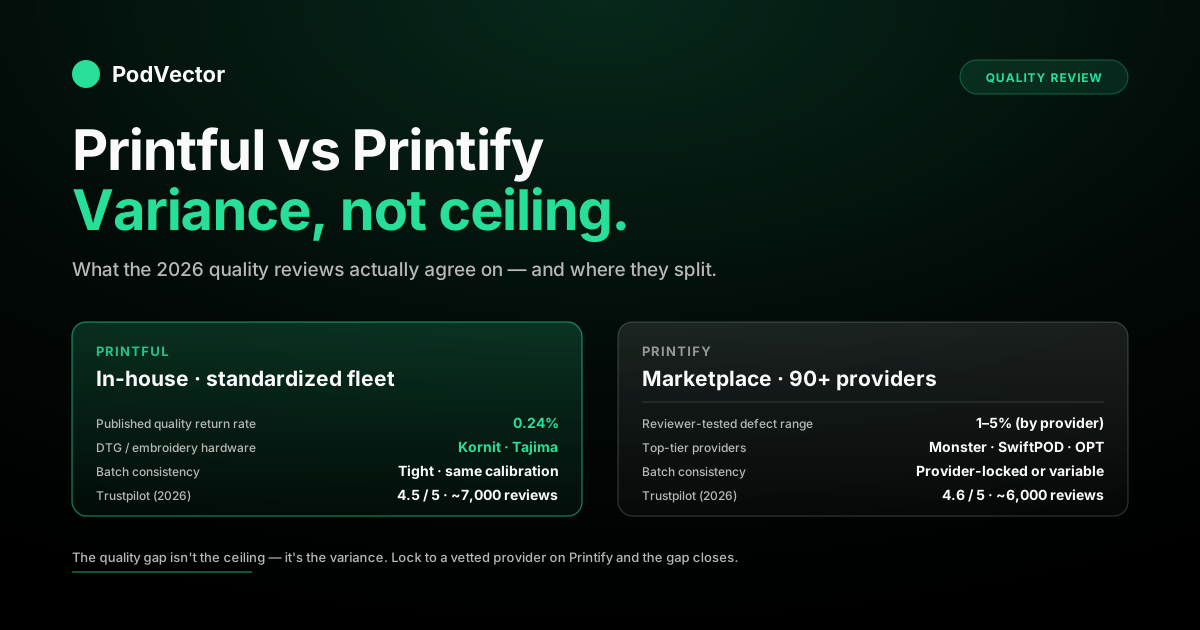
Quick Answer: Read the 2026 quality reviews end to end and the verdict is consistent — Printful is more consistent, Printify ranges from excellent to disappointing depending on the print provider you lock to. The absolute ceiling on both is now comparable; the variance is not.
Printful's published reshipment rate for quality issues sits at ~0.19% in 2026 (down from the ~0.24% cited in earlier reviews). Printify doesn't publish a marketplace-wide rate, and reviewer-tested defect rates on Printify's lower-tier providers run 3–5x higher than Printful's. The gap closes when sellers lock to top providers like Monster Digital, SwiftPOD, or OPT OnDemand.
Below: what the actual reviews say, by print method (DTG, DTF, embroidery, sublimation, UV), how to read the variance, and the per-SKU question every seller should be asking instead of "which platform is better."
Why quality reviews keep disagreeing
If you've read three Printful vs Printify quality reviews, you've probably read three different verdicts. That's not random.
The two platforms are structurally different. Printful runs in-house production across 7+ owned facilities with standardized equipment — Kornit DTG printers, Tajima embroidery machines, Mimaki UV printers, the same calibration across regions. Quality variance is small.
Printify is a marketplace of 90+ independent print providers, each with their own equipment, ink, and quality controls. The reviewer who tested with Monster Digital or SwiftPOD got results comparable to Printful. The reviewer who let Printify auto-route to the cheapest available provider got a different experience.
Both reviewers are reporting honestly. They're describing the same platform behaving differently because Printify's quality is a function of which provider, not the platform itself.
This is why the rest of this guide breaks down quality by print method and by provider tier — not by averages. The averages produce the wrong answer for any specific seller.
Quality snapshot — what the reviews agree on
Strip away the disagreements and a stable picture emerges across the 2026 reviews.
| Dimension | Printful | Printify |
|---|---|---|
| Production model | In-house, 7+ owned facilities | Marketplace, 90+ providers |
| DTG quality ceiling | High | High (top-tier providers only) |
| DTG quality floor | High | Variable |
| Embroidery | Strong across all SKUs (Tajima) | Strong on a handful of providers |
| Sublimation / AOP | Solid, limited catalog | Broader catalog, provider-dependent |
| UV / hard-goods printing | Solid (Mimaki on mugs/phone cases) | Provider-dependent |
| Published quality-issue reshipment rate | ~0.19% (2026) | Not published |
| Reviewer-tested defect rate | ~1% | 1–5% (provider-dependent) |
| Color consistency, batch to batch | Tight (same calibration) | Variable across providers |
| Catalog size (2026) | ~500 products (curated) | 1,300+ products (broad) |
| Branded packaging / inside labels | Standardized, custom inserts | Provider-dependent |
| Trustpilot score (2026) | 4.4 / 5 (~7,600 reviews) | 4.6 / 5 (~7,300 reviews) |
| Sample discount | 20% off, up to 3/mo | Standard pricing |
Trustpilot scores look close, but the underlying complaint distribution is different. Printful's negative reviews skew toward shipping delays and customer-support response time. Printify's negative reviews skew toward print defects and provider-routing surprises. We'll unpack both in the Trustpilot section.
Defect and reprint rates in the wild
The single most useful number in any quality review is the defect rate — how often does an order have to be reprinted or refunded because of a print or fabric problem? That's the number that maps directly to your P&L.
Printful's published number: a ~0.19% reshipment rate for quality issues in 2026 (earlier reviews cited ~0.24% — the trend has ticked down as its DTF and pretreatment lines matured). That comes from Printful's own operations data, and reviewers who have tested at volume report defect rates in the same ballpark — typically 0.5–1.5% depending on print method and season.
The implication: out of every 1,000 orders, Printful causes 2–15 reprint/refund cycles. Most well-run Printful stores plan around the ~1% line.
Printify's number is a range, not a point. Printify doesn't publish a marketplace-wide defect rate, which makes sense — the platform doesn't print anything itself. Reviewer-tested defect rates land in a 1–5% band, varying by provider.
Top-tier Printify providers (Monster Digital, SwiftPOD, OPT OnDemand) hit the 1–1.5% range — comparable to Printful. Lower-tier providers hit 3–5%, sometimes worse in peak season when their queues stretch.
That spread matters. On 1,000 orders, a 1% defect rate is 10 problem orders. A 4% defect rate is 40 problem orders. Each problem order costs you the reprint or refund plus the customer-service time plus the review-score impact — itemized further in the true cost of a quality miss.
DTG print quality
Direct-to-Garment (DTG — inkjet printing directly onto fabric) is the print method that drives most POD apparel volume. It's also where the quality reviews split most clearly.
Printful's DTG setup: standardized Kornit Atlas and Avalanche printers across all facilities. Same pretreatment, same ink (Kornit NeoPigment Eco-Rapid), same calibration. The visual result is consistent — a Bella+Canvas 3001 printed in LA looks like the same garment printed in Riga or Tokyo.
Print sharpness is high, color reproduction is accurate on white and light blanks, and color saturation on dark blanks is solid after pretreatment. Reviewers consistently rate Printful's DTG output as a quality benchmark.
Printify's DTG setup is provider-by-provider. Monster Digital and SwiftPOD run Kornit equipment comparable to Printful's. OPT OnDemand and ArtGun run mixed Kornit/Brother fleets with strong results.
The lower-tier providers in the marketplace run older Brother DTG printers, less rigorous pretreatment processes, and less consistent color calibration. The output ranges from "fine for hobby" to "would not list at retail prices."
This is why the playbook on Printify is: pick the provider before the SKU. Don't let the platform auto-route to the cheapest available. Lock each SKU to a specific top-tier provider and order samples to confirm.
DTF, sublimation, and UV
The print methods past DTG are where the differences narrow in some categories and widen in others.
Direct-to-Film (DTF — print on film, heat-press onto fabric): DTF gives sharper, more vibrant prints on dark fabrics than DTG, with better stretch retention. Printful added DTF in 2024 across most US facilities, with consistent results.
Printify offers DTF on a subset of providers. Quality on top-tier DTF providers is excellent — often beating Printful on color saturation for dark-blank designs. On lower-tier providers, DTF output can show film edges or peeling on first wash.
For a full cost and process breakdown on Printful's DTG specifically — what the per-unit cost looks like across blank tiers and how the print quality maps to the cost — see Printful DTG t-shirt cost: full breakdown for POD sellers.
Sublimation and all-over-print (AOP): sublimation produces the most vibrant, durable prints in POD — the ink becomes part of the fabric — but only works on polyester (or polyester-blend) blanks.
Printful runs sublimation on a curated AOP catalog (leggings, swimwear, AOP tees) with solid results. Printify's sublimation catalog is broader — more apparel cuts, more accessories, more home decor — but quality varies by provider. Top sublimation providers on Printify match Printful's output; lower-tier ones produce visible streaking on large-format prints.
UV printing (hard goods — mugs, phone cases, signs): Printful uses Mimaki UV printers (and Inkcups Helix for mugs) with consistent results across its facilities. Printify offers UV through more providers, with the usual variance.
Embroidery quality
Embroidery is where Printful's in-house standardization pays back most clearly.
Printful runs Tajima embroidery machines (the industry-standard high-end embroidery hardware) across its facilities with the same thread library, same digitization process, and same finishing standards. Output is consistent — and consistently good, especially on caps, polos, and inside-collar labels.
Printify offers embroidery through fewer providers than DTG, which actually narrows the variance. The top embroidery providers on Printify run Tajima or Barudan equipment with results comparable to Printful's. Lower-tier providers can produce thread bunching, off-center placement, or thread color mismatches.
For embroidered apparel specifically, Printful is usually the safer default unless you've already vetted a specific Printify embroidery provider. For a Printful-specific embroidery cost breakdown including thread density and color count, see Printful embroidered t-shirt base cost.
Fabric quality and shrinkage
Print quality is half the equation. The other half is the blank itself.
Both platforms source the same blank brands — Bella+Canvas, Gildan, Next Level, Champion, Stanley/Stella in the EU, Anvil for budget tiers. The brand is the brand. A Bella+Canvas 3001 from Printful is the same Bella+Canvas 3001 you'd get from Printify, mechanically.
What differs is which blank tiers each platform leads with. Printful curates toward premium-fabric blanks: its ~500-product catalog skews to Bella+Canvas and Next Level by default, with fewer of the budget Gildan options. Printify's 1,300+ product catalog carries the full spectrum from Anvil 980 budget tees to Comfort Colors heavyweight blanks — more choice, but a wider quality floor to manage.
Perceived quality doesn't end at the print. Packaging is a review-driving detail the platform comparisons keep surfacing: Printful ships with standardized packaging and supports custom inside labels and pack-in inserts on every order, which reads as "brand" to the customer who unboxes it. On Printify, branded packaging and label options are provider-dependent — another reason to vet the specific provider, not just the platform, before you list a premium SKU.
Shrinkage after first wash is a fabric property, not a platform property. Bella+Canvas tri-blends shrink less than 100% cotton Gildan blanks regardless of which platform routed the order. Printful's tighter curation means the average garment shrinks less because it skews toward lower-shrinkage blanks.
One quality nuance: pretreatment for DTG can leave a slight stiffness on cotton garments for the first wash. Both platforms see this. The complaint shows up more often in Printify reviews because the larger volume of budget-tier blanks shows the effect more visibly.
Color accuracy and batch consistency
This is the dimension where Printful's in-house model wins most decisively.
Consistency means: when a customer orders the same SKU twice — six weeks apart, possibly printed in different facilities — the two garments should look the same. Same color, same print position, same fabric hand.
Printful's standardized calibration delivers this. Reviewers who tested with repeat orders consistently report no visible variance batch to batch.
Printify's consistency depends on whether the order is locked to a single provider. Sellers who lock SKUs to one specific provider get strong batch consistency. Sellers who let Printify route by availability (or who have providers go out of stock and reroute) get visible variance.
For ad-driven brands building a repeat-purchase motion, this matters. A customer who orders a second tee in the same color expects it to match the first one. A noticeable shade shift is the kind of small thing that quietly tanks repeat-customer rates.
What Trustpilot reviews actually say
Both platforms sit in the 4.4–4.6 range on Trustpilot — Printful at 4.4/5 across ~7,600 reviews, Printify at 4.6/5 across ~7,300 — which makes the headline score useless for differentiating. The interesting signal is in the negative reviews.
Printful's negative review patterns: the recurring complaints are shipping delays during peak season (Q4 especially), occasional customer-support response times running 24–48 hours instead of same-day, and pricing disputes where sellers were surprised by a tier-discount change. Quality-specific complaints are rare — typically <5% of negative reviews.
Printify's negative review patterns: the recurring complaints skew toward print defects (faded prints, off-center placement, smudging), routing surprises (an order printed by a provider the seller didn't select), and reprint approval friction. Quality-specific complaints make up ~30–40% of negative reviews.
That distribution reflects the structural difference: Printful customers complain about logistics around an otherwise-consistent print. Printify customers complain about the print itself, when they end up on a lower-tier provider.
For a different framing of the same quality data — including pricing context — see Printify vs Printful pricing, and for a recent independent review that goes deeper on the testing methodology, the Bootstrapping Ecommerce review tested both with repeat orders across multiple SKUs.
The Printify provider vetting playbook
If you're going to run Printify at retail prices, the single highest-leverage move is provider vetting. The reviews that rate Printify quality "excellent" did this; the reviews that rate it "disappointing" did not.
The repeatable playbook from sellers running Printify at scale:
Step 1 — Read the Print Provider Performance Score. Printify publishes a per-provider score covering production time, print quality, and customer satisfaction. Filter to providers scoring 8+ on quality and 8+ on production time. That alone eliminates most of the high-defect tail.
Step 2 — Cross-check with seller forums. The provider score is useful but lagging. The active POD subreddits and Discord communities surface seasonal quality issues faster than Printify's official scores do.
Step 3 — Order samples from your top 2 candidates. Order the same SKU from two providers, same blank color, same artwork. Compare in person — color accuracy, print sharpness, fabric hand, packaging.
Step 4 — Lock the SKU to the winner. Use Printify's "Select Print Provider" option per-SKU. Don't let auto-routing pick the cheapest available — that's how lower-tier providers end up printing orders you didn't intend.
Step 5 — Re-sample annually. Provider quality drifts. A provider that was great two years ago may have changed equipment or staffing. Re-sample top SKUs once a year to confirm.
Sellers running this playbook report Printify defect rates in the 1–1.5% range — Printful-comparable — at Printify pricing.
A sample-first quality workflow
Regardless of platform, the consensus across reviews is consistent: order samples before you list. The differences are in how each platform supports that.
Printful gives a 20% sample discount and allows up to 3 sample orders per month on the free tier. Hit $300+ in monthly sales and the cap unlocks further. The sample discount makes it cheap to test new SKUs before listing.
Printify samples ship at standard catalog prices — no built-in discount — though Premium subscribers ($29/mo) get the same 20% catalog discount that applies to retail orders.
The right sample workflow for any new SKU, on either platform:
1. Order the blank in your target color. Fabric hand and shade can vary across blank brands even when the model number is the same. See it in person before committing.
2. Order a printed sample with your actual artwork. Mock-ups are generated; reality isn't always the same. Color accuracy on dark blanks especially can shift.
3. Wash it. Most quality complaints surface on first wash — fading, edge peeling, shrinkage. A sample that looks great new and falls apart in the wash is worse than a sample that's middling but stable.
4. Photograph it under your actual lighting. Product photography matters for conversion. Cheap samples that don't photograph well aren't actually cheap — they cost you ad spend.
For another framing on how price tracks with quality, see Printify vs Printful quality comparison and the broader Printify vs Printful quality review.
The true cost of a quality miss
The reason defect rate matters more than the headline platform comparison is that each defect compounds across several lines on your P&L.
A single defect on a $25 retail order — let's say a Bella+Canvas 3001 sold at $25 with a $9 supplier cost — costs you these items, in order:
The reprint or refund. If you reprint, you eat another $9 supplier cost plus shipping. If you refund, you give back the $25 plus the original $9 supplier cost is unrecoverable. Either way, the order's contribution margin flips negative.
The customer-service time. Quality complaints take 15–30 minutes to resolve well — answering the customer, processing the reprint or refund, following up. At any meaningful hourly rate, that's $5–15 of operator time per defect.
The review and rating hit. One in three quality-complaining customers leaves a 1–2 star review somewhere. Etsy ranking, Trustpilot score, and Shopify product ratings all weight recent negative reviews heavily. The hit to future conversion isn't itemized, but it's real.
The lost repeat purchase. Quality complainers don't typically order again. The expected LTV of that customer drops to zero.
Stack the items: a 1% defect rate costs around $50–80 per 1,000 orders in direct refund/reprint cost. A 4% defect rate costs $200–320 — plus the indirect hit to ratings and LTV. The platform-level base cost difference between Printful and Printify is usually $3–5 per order. The quality-driven cost difference between top-tier and bottom-tier providers can be a similar amount, but invisible until you measure it.
The per-SKU question reviews never answer
Every quality review — including this one — frames the choice at the platform level. The actual question every POD seller is trying to answer is per-SKU and per-region.
On your heather grey Bella+Canvas 3001 tee, in the design your store actually sells, shipping to the regions your store actually serves: which supplier (Printful, or which Printify provider) delivers higher contribution margin after fees, shipping, refunds, and the LTV impact of quality variance?
The answer flips by SKU. A premium-fabric heavyweight tee with a small front-chest design may be better on Printful — the consistency premium pays back faster on a higher-AOV order. A budget-tier trend tee with an AOP design and a $12 retail price point may be better on Printify Monster Digital — the supplier cost gap dominates the contribution math.
None of the platform-level quality reviews answer this. They quote averages and stop. The blocker is data: refund cost per SKU, supplier cost per SKU, ad cost per SKU, and shipping cost per region all need to live in the same place before the math runs.
That's the architecture PodVector AI built Victor on — an intelligent business employee that connects to your store's live data warehouse (Shopify orders, Printful and Printify supplier costs, Meta and Google ad spend, GA4 traffic — pulled in real time, kept fresh), runs CFO-grade unit economics per SKU and per region, and proposes specific actions on Shopify when the data warrants it: switching a supplier mapping, raising a price on a SKU where defect-adjusted margin is too thin, building a BXGY discount on a quality-tested winner. Approve in the chat and Victor executes the Shopify change with a full audit trail.
The Printful-or-Printify framing is the wrong altitude. The question that pays back is per-SKU, and a POD seller without per-SKU supplier-cost data is making the most consequential margin decision of the business on averages.
FAQs
Is Printful really higher quality than Printify in 2026?
On consistency, yes. The published rate gap (Printful's ~0.19% reshipment rate for quality issues vs Printify's unpublished 1–5% reviewer-tested range) is real. On absolute ceiling, no — top-tier Printify providers like Monster Digital and SwiftPOD match Printful. The gap is variance, not ceiling.
Which Printify providers have the best quality reviews?
Monster Digital, SwiftPOD, OPT OnDemand, and Dimona consistently rank highest in 2026 reviews and in Printify's own Print Provider Performance Score. ArtGun and District Photo earn strong reviews on specific product categories. Filter to 8+ quality scores on the marketplace and you eliminate most of the high-defect tail.
What's the actual defect rate on Printify?
Printify doesn't publish a marketplace-wide rate. Reviewer-tested defect rates land in a 1–5% band depending on provider. Top-tier providers hit 1–1.5% — Printful-comparable. Lower-tier providers hit 3–5%, sometimes worse in peak season.
Does the Printful-Printify merger affect quality in 2026?
Not yet, materially. Printful and Printify merged on 5 November 2024 under a single parent company (FYUL, which also holds Snow Commerce) — Printful's CEO leads the group, Printify's former CEO became president. But through 2026 both platforms still run separate production networks. The consumer-facing print quality on a Printful order still comes from Printful's facilities, and on a Printify order still comes from Printify's providers. Treat them as separate quality systems for now. The one thing worth watching: some reviewers flag consolidation risk — the concern that a supplier "too big to care" lets support response times and attention to detail slip. It hasn't shown up in the 2026 defect data, but it's the reason to keep sampling and not assume yesterday's quality holds.
Is print quality better on tees or on hoodies?
On both platforms, lightweight cotton tees (Bella+Canvas 3001, Gildan 64000) are the most consistent. Heavyweight hoodies and fleeces show more variance — fabric texture interacts with DTG and DTF differently, and color accuracy on dark heavyweight blanks is the hardest print case. Sample dark hoodies before listing on any platform.
Do sample orders predict production quality?
Mostly. A sample reveals print sharpness, color accuracy, fabric hand, and packaging. What it doesn't catch is seasonal variance — a provider that's great in March may have a queue blow up in November when their staffing tightens. Re-sample quarterly on your top SKUs and watch the Print Provider Performance Score.
Which platform has better embroidery?
Printful, on consistency. Both platforms use Tajima-class equipment on their top providers, but Printful's standardized digitization process across all facilities produces fewer thread-color and placement issues. If you're selling embroidered caps or polos in volume, Printful is the lower-variance default.
Will customers actually notice the quality difference?
Most won't notice on a single order. They notice when they compare two orders — a tee they bought six months ago next to the new one — and the colors don't match. That's the loyalty kill. Repeat-buyer brands feel the consistency gap; one-off transactional stores rarely do.
Should I run both platforms for quality reasons?
Many established sellers do. Common pattern: Printful for branded premium SKUs where consistency drives repeat purchases, Printify (locked to a vetted provider) for trend-driven SKUs where margin matters more than batch-to-batch identical reorders. Route by SKU, not by platform.
Quality reviews end at averages. Your P&L runs on per-SKU specifics.
Knowing Printful's reshipment rate is ~0.19% doesn't tell you whether your heather grey hoodie is more profitable on Printful or on Printify Monster Digital. Victor pulls every order, every supplier-charged cost, every ad spend, and every refund into one live data layer — then runs the unit economics per SKU and per region. Ask "which supplier is more profitable on my hoodies in EU shipments?" in plain English; Victor answers, then proposes the specific Shopify change to act on it.
Try Victor freeFor more recent independent quality framings, the Merch Titans review walks through the in-house-vs-marketplace structural divide. To stay inside the cluster, see Printify vs Printful pricing, Printify vs Printful quality comparison, and Printify vs Printful quality. The full Printful comparison cluster lives at the Printful comparison hub, and the broader Printful topic at the Printful topic hub.