
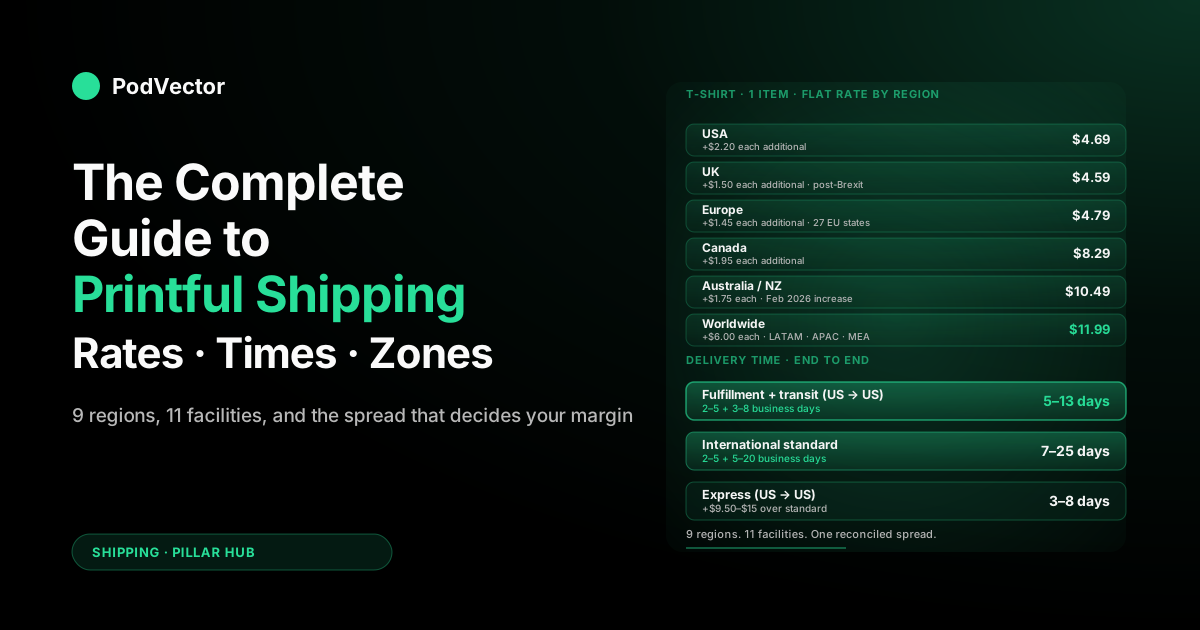
Quick Answer: Printful shipping uses a flat rate per region and product category. According to Printful's shipping page and corroborated by PodVector AI's own shipping cost breakdown, a US t-shirt currently runs approximately $4.75 for the first item plus $2.20 per additional item; a US hoodie is approximately $8.49 + $2.50 per additional. International rates run meaningfully higher — the same tee costs approximately $11.99 to ship to a Worldwide-region country, per PodVector AI's global shipping breakdown. Total delivery time is fulfillment (2–5 business days) plus carrier transit (3–8 business days US domestic standard, 8–25 business days international), per PodVector AI's shipping cost guide. Printful uses 9 shipping regions (USA, Canada, Europe, UK, EFTA, Australia/New Zealand, Japan, Brazil, Worldwide) with separate flat rates per region per product category, and switches to live-rate mode when you connect Shopify, WooCommerce, or the API.
Two rate batches have already moved in 2026. According to Bootstrapping Ecommerce's 2026 Printful pricing review, the February 26, 2026 batch raised sticker/postcard/patch shipping (US) from $3.99 to $4.29, phone cases from $4.59 to $4.99, and knitted apparel from $10.49 to $11.49 — while standard apparel (Bella+Canvas, Gildan) was not affected. A broader batch of first-item and additional-item changes then went live June 4, 2026, per Printful's shipping price updates page. Most POD sellers under-charge customers because they price against one rate snapshot without reconciling to actual Printful invoices after each batch — the fix is to track Printful's actual per-order charge against what you charged the customer, and update your zone table or live-rate markup whenever the spread drifts.
How Printful shipping actually works (the part nobody explains)
Most "Printful shipping" articles describe the rate table and stop. That's a customer-service answer, not a seller answer.
The actual shipping flow involves four parties — Printful's facility, the regional carrier (USPS, Royal Mail, Australia Post, etc.), your storefront's shipping calculator, and the customer at checkout — and money moves at three different points in the flow with three different markup opportunities. Until you understand all three, you will systematically lose revenue to shipping leakage without ever seeing it on a P&L line.
Here's the actual flow on a single $24.99 t-shirt order shipped from a US Printful facility to a US customer:
- Customer pays you at checkout. Your Shopify (or Woo, Etsy, etc.) shipping table charges them your shipping rate — for example, $5.99 flat or "free shipping over a threshold."
- Printful charges you when the order routes for fulfillment. They charge their regional flat rate for that product to that destination. Per PodVector AI's US shipping cost breakdown, a US t-shirt runs approximately $4.75 first item. You absorb the difference. If you charged $5.99 and Printful charged $4.75, you cleared $1.24 on shipping. If you offered "free shipping," you ate the full charge.
- Carrier delivers the package. Printful pre-pays the carrier (USPS, Spring GDS, etc.) at their negotiated commercial rate. You never see this number — Printful pockets the spread between their commercial rate and the flat rate they charged you. As Printful's own blog explains, "we'll always charge you the same flat rate fee" regardless of the carrier's actual cost at that moment.
The same flow on an international order has a fourth wrinkle: customs and VAT. Either Printful charges DDU (delivered duties unpaid — customer pays customs on receipt, often refusing the package) or DDP (delivered duty paid — Printful collects estimated duty at fulfillment and bakes it into your charge).
Which mode applies depends on the destination country, the customs threshold, and whether you've enabled Printful's IOSS support for low-value EU orders. One important nuance from Printful: as noted on their shipping pricing guide, the flat rate is location-based and stays the same regardless of which facility fulfills the order — so shipping a t-shirt to a US customer costs the same whether it prints in Charlotte or Riga.
For the cross-supplier framing of how shipping fits into total POD unit economics, see the Gelato vs Printful vs Printify comparison for how each provider's shipping structure compares, and our net profit margin benchmark for where shipping typically sits in healthy POD unit economics.
Fulfillment time vs shipping time vs delivery time
The single most common cause of customer support tickets in a POD store is conflating these three numbers. Printful publishes a clear formula but Shopify's shipping settings UI does not surface it cleanly, so most stores end up displaying just one of the three at checkout and field complaints when reality is the sum.
The formula is:
Estimated Fulfillment Time + Estimated Shipping Time = Estimated Delivery Time
Ranges below are per Printful's shipping page and PodVector AI's shipping cost guide:
| Stage | Typical range | What's happening | Who controls it |
|---|---|---|---|
| Fulfillment | 2–5 business days | Print, dry, QC, pack, label | Printful facility load |
| Standard shipping (US domestic) | 3–8 business days | Carrier transit (USPS, etc.) | Carrier + distance |
| Standard shipping (international) | 8–25 business days total | Carrier + customs | Carrier + customs queue |
| Express shipping (US) | 1–3 business days after fulfillment | Premium carrier (FedEx, DHL) | Service-level guarantee |
| Express shipping (international) | 3–5 business days after fulfillment | Premium international carrier | Service-level guarantee |
| Total typical EDT (US→US standard) | 5–13 business days | Sum of above | — |
The honest number to display at checkout is the sum of fulfillment plus shipping, not just shipping. A "ships in 3–4 business days" badge under a product that actually takes 5–13 business days to arrive is the single biggest driver of "where is my order?" tickets in POD. Printful's Shopify app handles this correctly if you let it manage shipping settings; manual setups almost never do.
Express speeds up the carrier leg only — per PodVector AI's shipping cost guide, it does not skip fulfillment, and the premium runs approximately $9.50–$22 per order on top of the standard flat rate.
The 9 Printful shipping regions and what countries are in each
Printful divides the world into 9 shipping regions for flat-rate calculation. Each region has its own per-category rate. The boundaries are not always intuitive — the United Kingdom is its own region (not part of "Europe"), Switzerland and Norway are in "EFTA States" (not "Europe"), and most of Latin America falls into "Worldwide" rather than getting its own zone.
| Region | Countries included | Typical fulfillment origin |
|---|---|---|
| USA | 50 states + DC, Puerto Rico, US Virgin Islands | Charlotte NC, Dallas TX, Los Angeles CA, Phoenix AZ |
| Canada | All provinces and territories | Toronto ON facility (apparel) or US |
| Europe | EU member states (Germany, France, Italy, Spain, Netherlands, etc.) | Riga LV, Birmingham UK, Barcelona ES |
| UK | United Kingdom only (post-Brexit standalone region) | Birmingham UK |
| EFTA States | Switzerland, Norway, Iceland, Liechtenstein | Riga LV / Birmingham UK |
| Australia / New Zealand | Australia + New Zealand | Brisbane AU facility |
| Japan | Japan only | Tokyo partner facility |
| Brazil | Brazil only | USA (with Brazil-specific carrier) |
| Worldwide | All other countries — Mexico, India, Singapore, UAE, South Africa, etc. | USA or nearest facility |
Two practical implications: (1) if your customer base is heavy in Mexico, Singapore, or the UAE, your average shipping cost per order is meaningfully higher than the per-region tables suggest because everything routes "Worldwide." As PodVector AI's global shipping breakdown notes, the same tee that ships for roughly $4.75 US domestic can cost approximately $11.99 to a Worldwide-region country — a spread that silently inverts your margin if you've set a flat "international" rate below that level. (2) If you set up a Shopify "International" shipping zone with a single rate, you will lose money on Worldwide-region orders and overcharge on Europe/UK/Canada orders. Set them up as separate zones. The full country-by-country breakdown is in Printful's region help article.
Also worth noting from Bootstrapping Ecommerce's 2026 review: as of February 2026, apparel shipping to Australia/NZ increased from AUD $9.80 to AUD $10.49 for the first item, and hat shipping to Canada rose from CAD $8.95 to CAD $9.75 — so even within regions, category-specific rate moves happen independently.
Shipping rates by product category (US, EU, AU, Worldwide)
Printful's flat rate is per region per product category, with a "first item" charge plus a smaller "each additional item" charge. The structure rewards multi-item carts — a 3-tee order to a US address ships for the first-item rate plus two additional-item charges, not three separate first-item charges — which is why "buy 2, get a discount" promotions tend to outperform flat sitewide discounts in POD: they shift more shipping cost onto the same first-item charge per dollar of revenue.
Representative rates for key categories, sourced from PodVector AI's shipping cost breakdown and Bootstrapping Ecommerce's 2026 Printful pricing review (after the February 26, 2026 adjustments). Always verify current figures against Printful's live shipping page before setting storefront prices, as two rate batches have already moved in 2026:
| Product category | USA (1st / +ea) | Europe (1st / +ea) | AU/NZ (1st / +ea) | Worldwide (1st / +ea) |
|---|---|---|---|---|
| T-shirt (standard) | ~$4.75 / ~$2.20 | check live calculator | ~AUD $10.49 / varies | ~$11.99 / ~$6.00 |
| Hoodie / sweatshirt | ~$8.49 / ~$2.50 | check live calculator | check live calculator | check live calculator |
| Mug | ~$4.69 / ~$2.55 | check live calculator | check live calculator | check live calculator |
| Phone case | ~$4.99 / varies | check live calculator | check live calculator | check live calculator |
| Sticker / postcard / patch | ~$4.29 / ~$0.05 | check live calculator | check live calculator | check live calculator |
| Knitted apparel | ~$11.49 / varies | check live calculator | check live calculator | check live calculator |
US rates above are per PodVector AI's shipping cost breakdown and corroborated by Bootstrapping Ecommerce's 2026 review (post-February 2026 adjustments). The AU/NZ first-item figure for apparel reflects the February 2026 increase from AUD $9.80 to AUD $10.49, per Bootstrapping Ecommerce. European and other regional rates shift independently — use the live per-product calculator on Printful's shipping page for current figures, and treat your storefront's shipping table as something you reconcile to actual Printful invoices monthly, not set-and-forget. Printful publishes each batch of price changes on its shipping price updates page.
One outlier worth highlighting: the sticker "each additional" rate of approximately $0.05 means a 10-sticker bundle ships for roughly $4.34 — the unit shipping cost is functionally zero past the first sticker, which is why sticker sellers can build strong margins on subscription boxes and bundles that would be unprofitable with any other product category.
Mixed-cart and cross-category shipping math
Single-category carts (three tees, two hoodies) share the discounted additional-item rate within the order. Mixed-category carts often do not — and this is one of the most commonly missed margin traps in POD.
Per PodVector AI's US shipping cost breakdown, a cross-category order (e.g., one t-shirt + one hoodie) typically splits into two shipments, because each category fulfills from its own production line or facility. That means you pay two first-item base rates — roughly $4.75 (tee base) + $8.49 (hoodie base) = $13.24 total shipping — rather than the $4.75 + ~$2.20 additional you'd pay on a same-category two-item cart.
Practical implications:
- If your store bundles tees with mugs or hoodies with phone cases, model shipping as two first-item charges, not one first-item plus one additional.
- Live rates handle this automatically — Printful's API splits the cart by category and returns the correct multi-shipment total. Flat-rate setups almost never account for it.
- Free-shipping-over-threshold math needs to include the worst-case multi-shipment scenario for the average cart at that store, not just the cheapest single-category outcome.
For strategies that turn multi-item cart structure into margin advantage — including how to set free-shipping thresholds and BOGO pricing that makes cross-category bundling margin-positive — see our guide on increasing AOV and CRO techniques that move POD stores past single-unit checkout.
Flat rates vs live rates: which to use when
Printful supports two rate modes and they have meaningfully different economics:
Flat rates (default in most integrations): you set a fixed shipping charge per zone in your storefront, and Printful charges you the published flat rate per their region table. The spread between what you charge and what they charge is yours to keep (or absorb when you've under-priced). This is simple, predictable, and works well for stores selling 1–2 SKUs to mostly-US customers.
Live rates (Shopify Carrier Calculated Shipping, WooCommerce Live Rates, Printful API): your customer's checkout queries Printful in real-time for the exact shipping cost based on the cart contents and destination, then charges the customer that exact amount (with optional markup). You always pass through Printful's actual cost — no spread, no leakage, no overcharging. As Printful's own blog notes, in live-rate mode Printful finds the best carrier for each order at that moment within the flat rate — so the actual carrier selection optimizes automatically.
| Decision factor | Use flat rates if… | Use live rates if… |
|---|---|---|
| SKU count | 1–10 SKUs in same category | 50+ SKUs across categories |
| International % | Mostly domestic orders | Meaningful non-US order share |
| AOV target | Single-item AOV (one tee) | Multi-item AOV (cart-builder) |
| Storefront | Etsy, basic Shopify, BigCartel | Shopify Advanced+, WooCommerce, custom |
| Margin tolerance | Predictable; willing to absorb some shipping leakage | Must zero out shipping leakage exactly |
| Customer trust signal | "Free shipping over $X" is your brand | "Real-time accurate shipping" is your brand |
The crossover point usually arrives once revenue is past hobby scale and you have a meaningful international tail. Below that, the operational simplicity of flat rates beats the precision of live rates. Above that, the leakage on flat rates compounds — and as Bootstrapping Ecommerce's 2026 review notes, Printful adjusts international rates unevenly across regions, so a flat-rate table set even one batch ago can be silently negative on affected category/zone pairs.
Express shipping: when it's worth the upcharge
Printful's express shipping delivers in 1–3 business days after fulfillment for US orders (3–5 business days for international), per PodVector AI's shipping cost guide — but note the "after fulfillment": express does not skip fulfillment time, it only accelerates the carrier transit leg. So a US-to-US express order is still roughly 3–8 business days total (2–5 fulfillment + 1–3 transit), not 1–3 days. This is the second-largest source of "where is my order?" tickets, after the fulfillment-vs-shipping confusion above.
The express premium over standard varies by product category and destination. Per PodVector AI's shipping prices breakdown, express adds approximately $9.50–$22 per order on top of the standard flat rate. Printful doesn't publish it as a single flat table — check the per-product calculator on the shipping page, or surface it directly at checkout in live-rate mode, where express appears as a separate option with its exact price. When express earns its upcharge:
- Gift orders close to a deadline — a birthday or holiday within roughly two weeks, where standard estimated delivery time would miss.
- Rush B2B / bulk orders — event merch and corporate orders where the date is fixed and the buyer is price-insensitive on shipping.
- Service recovery — replacing a damaged or delayed order, where you pay the upgrade yourself. As PodVector AI's shipping prices guide notes, this is one of two primary ways serious operators use express: as a paid checkout upgrade (margin-positive if priced correctly) or as a recovery tool when a print runs late.
For most POD stores, the right policy is: don't offer express at all on retail orders by default, and instead use express selectively to recover from a fulfillment delay you caused. The customer experience of "your order is upgraded to express at no charge" beats the conversion lift of a paid express option by a large margin for most niches.
Printful's 2026 rate changes (and what they mean for your margin)
Two separate rate batches hit in 2026, and they affected different product sets — getting this wrong means your margin math is off on different SKUs depending on which batch you missed.
February 26, 2026 batch: Per Bootstrapping Ecommerce's 2026 Printful pricing review, this round raised select accessory and specialty shipping rates while leaving standard apparel (Bella+Canvas, Gildan, etc.) untouched. Specific US changes: stickers, postcards, and patches rose from $3.99 to $4.29 first item; phone cases from $4.59 to $4.99; knitted apparel from $10.49 to $11.49. Internationally, apparel to Australia/NZ rose from AUD $9.80 to AUD $10.49 first item, and hat shipping to Canada rose from CAD $8.95 to CAD $9.75, per the same review.
June 4, 2026 batch: A broader round of first-item and additional-item changes published on Printful's shipping price updates page. Always check that page's downloadable old-vs-new list after each batch to identify which of your category/region combinations moved.
Rate changes like these are uneven by category and region, which means stores with a single flat shipping table at checkout silently absorb the deltas on every affected order — nothing breaks, no alert fires, your margin just gets thinner on the affected SKU/zone combinations. Per PodVector AI's shipping cost guide, even a small per-unit delta compounds quickly at volume: a $0.30–$1.00 first-item increase on a high-volume accessory SKU can move quarterly profit by four figures.
The fix: whenever a batch lands on the updates page, pull a Printful invoice export, sort by SKU, compare per-SKU shipping cost to your storefront shipping charge, and adjust any zone where the spread is now negative. For the broader cost-stack picture across all six lines, see the complete guide to Printful costs and fees. For a full comparison of how Printful's shipping structure stacks against Gelato and Printify, see our Gelato vs Printful vs Printify guide.
Printful's fulfillment facilities and how routing works
Printful operates in-house and partner facilities across the US, Mexico, Canada, Europe, the UK, Australia, and Japan. Routing is not customer-selectable — Printful's algorithm picks the facility based on (1) proximity to the destination, (2) inventory availability for the specific SKU/color/size, (3) facility load. You can't request a specific origin, but you can influence routing by which products you list (some catalog items are exclusive to specific facilities).
One nuance worth understanding: as Printful's own blog confirms, the flat shipping rate is location-based (destination region), not facility-based. So shipping a t-shirt to a US customer costs the same whether it prints in Charlotte or Riga. What changes with facility routing is delivery speed, not shipping cost — a UK-customer order fulfilling from Riga instead of Birmingham adds transit days without changing the rate.
| Facility | Region served | Specialties |
|---|---|---|
| Charlotte, NC (USA) | US East Coast | Apparel, AOP, embroidery |
| Dallas, TX (USA) | US Central / South | Apparel, mugs, posters |
| Los Angeles, CA (USA) | US West Coast | Apparel, headwear |
| Phoenix, AZ (USA) | US Southwest | Apparel, AOP |
| Tijuana (Mexico) | USA cross-border | Apparel cost-optimized |
| Toronto, ON (Canada) | Canada | Apparel (limited catalog) |
| Riga (Latvia) | EU | Full catalog |
| Barcelona (Spain) | EU South / Iberia | Apparel, AOP |
| Birmingham (UK) | UK + EFTA | Apparel, embroidery |
| Brisbane (Australia) | AU / NZ | Apparel (limited catalog) |
| Tokyo (Japan) | Japan | Apparel via partner |
A note on EU routing that Bootstrapping Ecommerce highlights: because Printful fulfills European orders from Latvia, Spain, or the UK — not the US — European delivery times are competitive with US delivery times despite the geographic distance, and the EU shipping rate is often cheaper than the Canada rate for a US-based seller. Before you launch a SKU, check its facility availability under the product's "production" tab in Printful, and set your Shopify shipping estimate to the slower of the two paths if both are possible.
Setting up shipping in Shopify, WooCommerce, and Etsy
Each storefront handles Printful shipping differently. Get the integration wrong on day one and you'll spend the next 12 months trying to reconcile cents-off invoices.
Shopify (recommended setup): Install the Printful Shopify app. Under Shipping & delivery → Shipping rates, delete the default zone-based flat rates and let Printful's app create app-managed shipping rates per zone, per product.
This activates Carrier Calculated Shipping (requires Shopify Advanced or higher for true live rates; Basic Shopify gets pre-calculated zone rates). Add a small flat markup — say $0.50–$1.00 — if you want to recoup payment processing on the shipping line. For Shopify-side levers that affect the economics around shipping — including free-shipping threshold adjustments — Victor, PodVector AI's AI employee, can propose and execute threshold changes on your Shopify store for you to approve. See the PodVector AI strategy guide for how that works in practice.
WooCommerce: Install the official Printful WooCommerce plugin. Under WooCommerce → Settings → Shipping, create a "Printful Live Rates" shipping method per zone.
Use Printful's "Shipping Profiles" feature to map product categories to specific zones (otherwise Woo defaults to a single rate per zone, which breaks for multi-category carts). The Live Rates plugin polls Printful's API at checkout, so make sure your hosting can handle the request latency.
Etsy: Etsy does not support real-time Printful rates. You must set up Etsy Shipping Profiles manually and choose between (1) per-item flat rate per region (set conservatively above Printful's published rate) or (2) "Free shipping" (you absorb shipping into product price, customer sees no shipping line).
Most Etsy POD sellers use option 2 because Etsy's algorithm rewards "free shipping" listings in search ranking. The math only works if you've raised your product price by the average shipping cost across your customer geography — on a US-skewed store, roughly the first-item rate for your top category on Printful's rate table. For Etsy-to-Shopify migration considerations including how shipping policy differs between platforms, see our guide on dropshipping from Etsy to Shopify.
Custom storefront / API: Use the /shipping/rates endpoint with the cart contents and destination address. Cache responses for 60 seconds per cart hash to avoid rate-limiting at high checkout concurrency. The endpoint returns both standard and express options as separate line items.
What to actually charge your customers for shipping
The rate-table-from-Printful is your cost. What you charge the customer is a separate decision driven by conversion math, not by cost-recovery math. Three working policies, in order of how often they win:
Policy 1 — Free shipping over a threshold (best when your average order can clear it): You bake the shipping cost you'd otherwise charge into your product margin. Stores using this policy typically lift AOV as customers add a second item to cross the threshold. Set the threshold high enough to prompt that second item and low enough to feel achievable: if your single-item average price is $25, a $35 threshold does both. Note the multi-category complication above — on a free-shipping policy, a tee + hoodie split-shipment order costs two first-item rates, not one, so model the free-shipping math on your actual cart composition, not just your top SKU's first-item rate.
Policy 2 — Flat shipping per zone (best for single-item, lower-AOV stores): One number per region — for example, "USA: $5.99. Canada: $9.99. Rest of world: $14.99." Simple to communicate, easy to set up, and predictable from your end. The risk is the "Worldwide" region — a single flat rate will eat your margin on multi-item Worldwide orders because, per PodVector AI's global shipping breakdown, the Worldwide first-item rate alone on a tee is approximately $11.99 with additional-item charges stacking on top. Either uncap the additional-item charge or carve "Worldwide" into 2–3 sub-zones (LATAM, Asia, Other) with different flats.
Policy 3 — Live rates pass-through (best for multi-SKU stores with higher AOV): Show the actual Printful rate to the customer, optionally with a markup — say 5–15% — to cover payment processing on the shipping line. Conversion is slightly lower than free-shipping, but margin is exactly predictable and you never have to reconcile a shipping leakage line. This is the only policy that scales cleanly with a global customer base and a multi-category catalog.
For the checkout-side conversion math — including how shipping policy interacts with checkout completion rates — see our average checkout completion rate benchmark and CRO techniques for POD.
International shipping: customs, VAT, and the long-tail problem
International shipping is where most POD stores quietly lose money. The rate table makes it look manageable — per PodVector AI's global shipping breakdown, approximately $11.99 first-item to a "Worldwide"-region country for a tee — but three additional costs hit international orders that don't hit domestic ones:
- VAT / GST collection (EU, UK, Australia): If you sell meaningfully into the EU, register for IOSS (Import One-Stop Shop) and collect VAT at the buyer's local rate at checkout. Most Shopify and Woo stores are not configured to do this. The penalty: lower-value orders get held at customs, the customer pays VAT on receipt or refuses the package, and your refund cost spikes. Printful's IOSS integration is optional but free — turn it on.
- Customs duty (over de minimis): Orders above the destination country's de minimis threshold trigger customs duty on the recipient. Thresholds vary by country and have been moving — the US significantly curtailed its de minimis exemption in 2025, affecting cross-border shipments. Check the destination's current rules rather than relying on remembered thresholds. Most single-item POD orders clear; multi-item bulk orders can cross, so configure your storefront to warn at checkout when a cart is likely to trigger duty.
- Carrier failure rate: "Worldwide" zone orders go undelivered or return-to-sender far more often than US-domestic orders. This is the single biggest hidden cost of going international. Either build a reserve into international margin or restrict the catalog to the international markets where you've validated carrier reliability.
For Printify's parallel international story (different facility footprint, different customs handling), the Gelato vs Printful vs Printify comparison covers how each supplier's international reach and shipping costs compare across major markets.
Tracking shipping cost as a unit-economics line
The mistake most POD operators make is treating shipping as a customer-facing display field rather than as a unit-economics line. Once you're past the point where shipping is a rounding error, shipping leakage becomes one of your top margin killers — revenue quietly lost to under-charging, mis-zoned customers, and rate increases that didn't propagate to your storefront. As PodVector AI's shipping cost guide notes, even a small per-unit rate change on a high-volume SKU can move quarterly profit by four figures.
The tracking workflow that actually works:
- Pull Printful's invoice export monthly. Filter to the "shipping" line items only. Sum by region, by SKU.
- Pull your Shopify (or Woo / Etsy) shipping revenue export. Sum by region, by SKU.
- Diff the two. Each row should be net positive (you charged more than Printful charged). The negative rows are your leakage list.
- Adjust the storefront table. Raise rates on the negative-spread regions; consider lowering rates on regions where you're charging far more than Printful charges you (probably hurting conversion).
- Repeat after every Printful rate batch — check Printful's shipping price updates page for new batches, or set a quarterly calendar reminder at minimum.
This is the kind of reconciliation work that an AI employee does meaningfully better than a spreadsheet — you want something that looks at Printful's invoices, your store's orders, and your ad spend all together, then flags the products and regions where shipping cost you money this month. Victor, PodVector AI's AI employee, looks at your Printful invoices and your Shopify order revenue together, shows you the weekly "shipping leakage" picture by region and product, and can suggest Shopify shipping changes (like raising your free-shipping threshold) for you to approve with a single click. Shipping is just one piece of your true profit, along with product cost, fees, refunds, and ad spend — the same math applies to all of them. See the net profit margin benchmark for where shipping typically fits as a percentage of revenue in healthy POD stores, and the Klaviyo browse abandonment flow guide for recovering revenue from the customers shipping cost drove away at checkout.
FAQs
How long does Printful shipping take?
Total customer wait is fulfillment (2–5 business days) plus shipping transit. Per PodVector AI's shipping cost guide, US-domestic standard orders run 5–13 business days end-to-end (2–5 fulfillment + 3–8 transit); international orders run 8–25 business days. Express shipping cuts the transit leg to 1–3 business days (US) or 3–5 business days (international) after fulfillment, per the same guide — but does not skip fulfillment.
Why is Printful shipping so expensive?
Printful charges sellers a flat regional rate that includes their commercial carrier rate plus a margin to cover handling, packing, and customer service. The "expensive" perception is usually about international — per PodVector AI's global shipping breakdown, a single tee to a "Worldwide"-region country runs approximately $11.99, partly because Printful absorbs a much higher non-delivery risk on those routes. For a deeper breakdown of where shipping fits in the total cost stack, see the complete guide to Printful costs and fees.
Can I use my own shipping carrier with Printful?
No. Printful pre-pays the carrier from their facility and bills you a flat rate. You cannot designate USPS-only or DHL-only or attach your own carrier account. As Printful's own blog explains, in flat-rate mode they select the best available carrier for each order at the moment of fulfillment. The trade-off is that Printful absorbs the carrier failure rate; you absorb the rate spread.
Does Printful charge shipping to the seller or the customer?
Both, separately. Printful charges you (the seller) the regional flat rate per their published table. You charge your customer whatever your storefront's shipping settings say (free, flat, or live rates). As PodVector AI's shipping cost guide notes, "free shipping" at the customer's checkout means you absorbed the cost in your retail price — it's never free to you. The two numbers are independent — your spread between them is your shipping margin (or shipping leakage if negative).
Does Printful ship internationally?
Yes — Printful ships worldwide via the 9 shipping regions. International orders fulfill from the geographically closest Printful facility (or the USA for "Worldwide"-region destinations) and ship via local carriers (Royal Mail, Australia Post, La Poste, etc.) plus regional consolidators. Per PodVector AI's shipping cost guide, expect 8–25 business days total for standard international orders.
What's the difference between flat rates and live rates in Printful?
Flat rates: your storefront charges a fixed shipping amount per zone; Printful charges you their published flat rate; you keep the spread. Live rates: your storefront queries Printful in real-time at checkout for the exact per-cart shipping cost, then charges the customer that amount; you pass through Printful's actual cost with no spread. Live rates require Shopify Advanced or a custom integration.
How do I set up Printful shipping in Shopify?
Install the Printful Shopify app, then under Shipping & delivery, delete your default flat-rate zones and let the app provision Printful-managed shipping rates per zone. On Shopify Advanced and above, the app activates Carrier Calculated Shipping for true live rates; on Basic Shopify you get pre-calculated zone rates updated nightly. Test a checkout with a UK address and a Worldwide-region address (e.g., Singapore) to confirm the rates surface correctly.
Why is the Printful shipping cost different from what I charged my customer?
Three reasons, in order of how often they apply: (1) you set a flat-rate zone but the customer ordered multiple items and your zone rate didn't account for the additional-item charge or a cross-category split shipment, (2) the customer is in a "Worldwide" zone country where Printful's rate is meaningfully higher than your default international rate, (3) Printful raised rates in one of the 2026 batches and your storefront table didn't update. Reconcile monthly using Printful's invoice export against your Shopify shipping revenue.
Do Printful shipping rates include taxes and customs?
No. The published rates are pure transportation cost. EU and UK VAT and Australian/NZ GST must be collected at checkout at the buyer's local rate, via your storefront's tax settings or via Printful's IOSS integration. Customs duty applies on orders above the destination's de minimis threshold and is owed by the recipient on receipt unless your storefront is configured for DDP (delivered duty paid). Note that de minimis thresholds have been shifting — the US significantly curtailed its exemption in 2025 — so verify current thresholds for your top international markets rather than relying on older figures.
Did Printful raise shipping rates in 2026?
Yes — twice. Per Bootstrapping Ecommerce's 2026 Printful pricing review, the February 26, 2026 batch raised sticker/postcard/patch shipping (US) from $3.99 to $4.29, phone cases from $4.59 to $4.99, and knitted apparel from $10.49 to $11.49. Apparel shipping to AU/NZ rose from AUD $9.80 to AUD $10.49 first item; hat shipping to Canada rose from CAD $8.95 to CAD $9.75. Standard apparel (Bella+Canvas, Gildan) was not affected by that batch. A second broader batch went live June 4, 2026, per Printful's shipping price updates page. Check the updates page after each batch to see which of your SKUs moved.
Stop guessing where shipping is leaking your margin
Most POD stores discover their shipping leakage months too late — usually when a rate change quietly inverts the spread on a key region. Victor, PodVector AI's AI employee, looks at your Printful invoices and your Shopify shipping revenue together, shows you the products and regions where you're under-charging, and can suggest a Shopify shipping update for you to approve before the next month's invoices arrive. Built for serious POD sellers on Shopify who want to see their real numbers and act on them — not just export a spreadsheet.
Try Victor free