
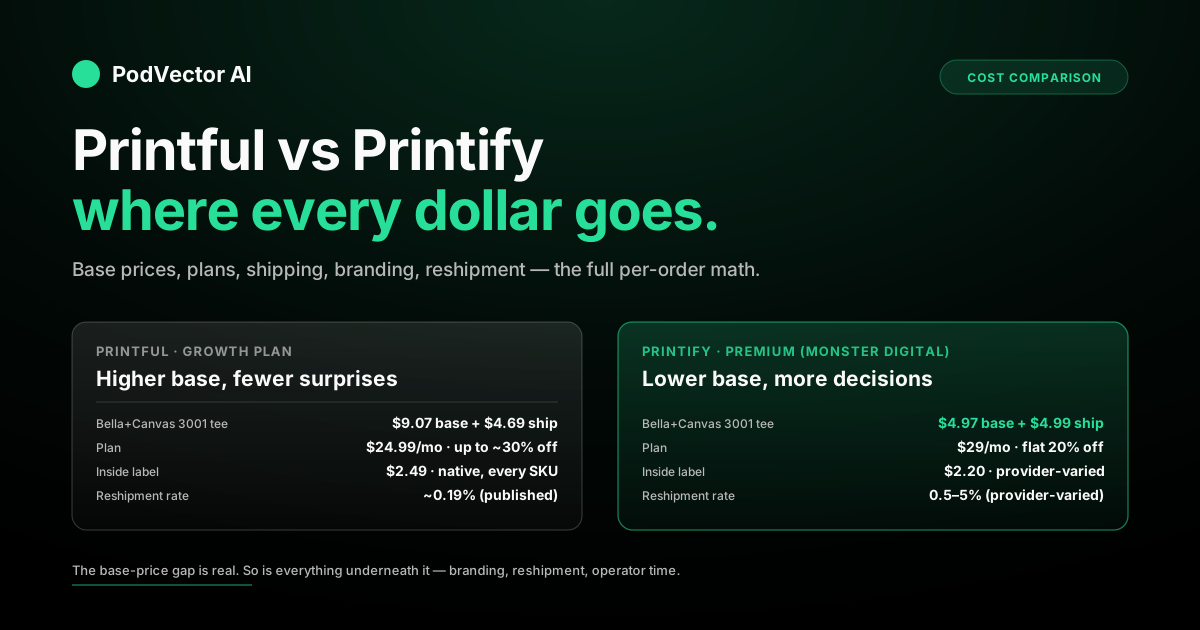
Quick Answer: On raw base price, Printify is cheaper than Printful on almost every comparable SKU — according to Merch Titans' 2026 comparison, a standard tee runs roughly $8 from Printify versus $12 from Printful. Apply Printify Premium (20% off all products) and the gap widens further. Printful Growth (up to ~33% off select products) closes the gap a little but doesn't erase it on most commodity apparel.
Base price isn't the whole cost. PSDmate's 2026 analysis finds that once you add shipping and a realistic reprint rate, Printify's advantage on a typical tee shrinks from roughly 28% to roughly 12–18% — still real, but not the number comparison tables imply. On embroidery, branded packaging, and international auto-routing, Printful's cost is often lower once you include operational overhead.
Below: every cost line item side by side, the categories where each platform actually nets more, the updated Fyul merger picture, and how to model the answer on your own catalog instead of guessing from a comparison table.
Cost snapshot
Most cost comparisons stop at the base price. That number is real, but it's about 60% of the truth. Here's the full picture at a glance.
| Cost line | Printful | Printify (top-tier provider) |
|---|---|---|
| Free plan | Yes | Yes |
| Paid plan (monthly) | $24.99 Growth · $49.99 Business | $39/mo Premium · Enterprise tier above that |
| Paid plan (annual) | $24.99/mo | ~$24.99/mo billed annually |
| Plan discount on base prices | Up to ~33% (select products) | Flat 20% (full catalog) |
| Standard tee (base, ballpark) | ~$12/unit | ~$8/unit (top-tier provider) |
| Embroidered hat (base) | Higher base | Varies by provider; gap is smaller than DTG |
| Inside-neck label | $2.49/item | $1.50–$3.50/item (provider-varied) |
| Packaging insert | $1.99–$4.99/item | Mostly unavailable |
| US standard shipping (tee, first item) | Slightly lower than Printify on multi-item | Slightly higher on multi-item; provider-varied |
| Published reshipment rate | ~0.19% (in-house QC) | Varies by provider; lower on top-tier, higher on budget |
Note: per PrintOnDemandBusiness (checked August 31, 2026), live costs shift with the blank, provider, variant, currency, print technique, and number of print areas — the table above captures the structure and relative gaps, not hard per-SKU quotes. Always verify current prices on each platform's calculator before committing.
Two things jump out. Printify's base prices are materially lower across most categories. Printful's overhead costs (branding, shipping, reshipment) are lower and more predictable. Whether that trade is worth it depends on what you're selling and to whom.
Base product prices: line by line
Base price is the cost the platform charges you for the blank product plus print. It's the number every comparison article leads with. Worth understanding before we layer in the rest.
Important caveat from PrintOnDemandBusiness: live cost changes with the blank, provider, variant, currency, print technique, number of print areas, and discounts. The figures below reflect the directional gap and category patterns — treat them as ratios, not gospel, and verify current prices on each platform before ordering samples.
T-shirts (the bellwether SKU)
The Bella+Canvas 3001 unisex tee is the most-sold POD product in the category. Both platforms carry it. The pricing gap here usually predicts the gap on the rest of your catalog.
According to Merch Titans' 2026 comparison, a standard tee runs roughly $12 on Printful versus $8 on Printify from a top-tier provider — a gap of around $4 per unit. Customily's 2026 review confirms that Printify base product costs remain significantly lower, "with a standard t-shirt running roughly $4 less per unit." Printify lists multiple providers for the same blank; top-tier US providers (Monster Digital, SwiftPOD) run at the lower end of the price range; budget providers (Dimona, Awkward Styles) can go lower still, with the trade-off of higher reshipment risk.
That per-unit gap is meaningful at volume: on a significant monthly run, the raw base-cost difference compounds quickly — before any other line item.
Mugs
Ceramic mugs follow a similar pattern — Printify's top-tier providers price materially below Printful's base. The absolute dollar difference per unit is smaller than on apparel because mugs start at a lower cost, but the percentage gap is comparable.
Hoodies and sweatshirts
Pullover hoodies show the largest absolute dollar gap between the two platforms, because hoodie base costs are higher — a larger base means a larger dollar difference even at the same percentage spread. Premium hoodies (Bella+Canvas, Lane Seven) follow the same pattern as commodity fleece: Printful priced materially above the top Printify equivalent.
Embroidered apparel
Embroidery is where Printful narrows the gap considerably. Printify's network includes fewer specialty embroidery providers (Monster Digital and MyLocker handle most embroidery on Printify), so the discount pool is smaller and the base-price gap between the two platforms shrinks significantly on embroidered SKUs versus DTG apparel.
Phone cases, posters, wall art
The pattern holds across home goods and accessories — Printify consistently comes in lower on base price across these categories, though by a smaller percentage than on commodity apparel.
All-Over Print (AOP) and specialty items
AOP apparel is a category where Printify's provider variance is most useful. Some Printify providers (Subliminator, AOP+) specialize in AOP and price competitively; others lack the equipment entirely. Printful's AOP is in-house and uniformly priced, which trades flexibility for predictability. Specialty Printify AOP providers can undercut Printful's AOP pricing, though you trade uniform quality control for the savings.
Quality at the low end
Per PSDmate's 2026 analysis, "the risk with Printify isn't bad quality — it's variable quality." A provider can print your design perfectly for months, then a queue backup can result in a lighter print and a significant delivery delay. Merch Titans notes that "the quality gap has narrowed significantly over the past two years" — top-tier Printify providers now match Printful on DTG output, but you need to pick and monitor them actively.
Subscription plans: Printful Growth vs Printify Premium
Both platforms have a free tier and a paid plan that earns its keep once your volume justifies it. The plans look similar on paper. They behave differently in practice — and Printify's pricing changed in 2026.
Printful Growth ($24.99/month)
According to PrintOnDemandBusiness, Printful Growth is $24.99/month and offers up to 33% off products, 9% off product branding, and 25% off sample orders. The 33% discount is product-specific — not everything hits that ceiling. Apparel typically lands in the 20–30% range; embroidery in the 15–25% range.
Growth also includes free custom packing slips, free clipart access, and priority support routing. Printful also says Growth becomes free for a year after qualifying annual sales reach $12,000, per PrintOnDemandBusiness.
A worth-it threshold to remember: Growth pays for itself quickly once you're producing meaningful apparel volume. Below a handful of units per month, the free plan is fine.
Printify Premium: price increase in 2026
This is the biggest structural update since the last version of this article. Spocket's 2026 comparison reports that as of February 17, 2026, Printify's Premium plan moved from $29 to $39 per month for the monthly rate. The annual plan held steady at approximately $299/year (roughly $24.99/month billed annually). Chayaani's 2026 breakdown confirms Premium is now $39/month (monthly), with up to 20% off all products and 10 stores.
The 20% is a flat discount across all providers and the entire catalog — no per-category variation. That simplicity is Premium's main advantage. PSDmate notes Premium is "worth it above about 30 orders a month; a straight loss below that." With the price at $39/month, the break-even volume threshold rises accordingly — verify the math on your own catalog.
Plan comparison: not as different as the discounts suggest
Printful's Growth has a higher headline discount (up to 33%) but it's category-graded and applies to select products. Printify's Premium is flat 20% but starts from a lower base. Per Chayaani, "Printful Growth is cheaper ($24.99 vs $39) and offers a higher maximum discount (33% vs 20%)" — though the 33% only applies to select products, not the full catalog.
Most sellers running both platforms keep both paid plans active. The combined monthly cost is rounding error past meaningful monthly volume.
Shipping costs
Shipping is the cost line most comparison articles handle poorly. Printful and Printify both quote shipping per-order at checkout, but the structure differs.
Printful shipping
Printful has a published, unified rate card. Chayaani's 2026 breakdown finds that Printful "wins by $0.06 on first item, $0.20 on additional items" versus Printify's average, and that "shipping costs are nearly identical" at the single-item level.
The rate card is the same regardless of which Printful facility ships your order — Printful auto-routes to the closest fulfillment center for the buyer's address. A US buyer gets fulfilled from a US facility; an EU buyer from a European facility; an Australian buyer from the nearest AU location. You don't configure anything.
For multi-item orders, Printful's per-additional-item rate is where the savings compound — Chayaani confirms "Printful has a slight edge on multi-item orders because of the lower additional-item rate."
Printify shipping
Printify's shipping is provider-specific. Each provider has its own rate card, and shipping is quoted per provider. PSDmate lists providers such as Monster Digital, SwiftPOD, Dimona, and Print Geek — each with different rates and locations.
The downside: you set up shipping per provider per SKU. Multi-provider orders ship as separate packages with separate shipping fees — a customer ordering a tee from one provider and a mug from another pays two shipping fees, or you absorb the difference.
The upside: top-tier US Printify providers are competitive with Printful on single-item orders, and you can route US-only stores to a single provider to avoid the multi-package issue.
International shipping
Printful's international shipping benefits from in-house routing — a customer in Berlin gets fulfilled from a European facility, not the US. Faster delivery, lower cost, no manual configuration.
Printify can match this if you configure it correctly: pick an EU provider (Print Geek, Stoked on Printing) as your EU fulfillment partner per SKU. Most sellers don't configure it correctly the first time, which means EU customers get fulfilled from US providers — slower and more expensive shipping.
Branding and packaging costs
Branding is the cost line where Printful's in-house model and Printify's provider network split most sharply.
Printful branding line items
- Inside-neck label: available (growth plan includes 9% off branding fees per PrintOnDemandBusiness)
- Outside neck label replacement: available
- Custom packing slip: free on Growth/Business plans
- Packaging inserts: available (you ship a batch to Printful; they include one per order)
- Custom woven labels and hang tags: available on select products
Every Printful branding feature works the same way on every product in the relevant category because Printful runs the production.
Printify branding line items
- Custom neck labels: available on a subset of providers (Monster Digital, MyLocker, SwiftPOD)
- Branded packing slips: native Printify feature, available across most providers
- Packaging inserts: limited — some providers support them; many don't. Hard to standardize across a catalog.
- Custom packaging (boxes, mailers with your logo): mostly not available
Branding's hidden margin impact
Branded packaging affects more than its line-item cost. It drives repeat purchase rate, review quality, and LTV. None of that shows up in the cost comparison.
For high-volume, low-AOV stores selling trend designs, branding often doesn't move the needle enough to justify the premium. For DTC brands where customer experience and repeat purchases drive profitability, Printful's consistent branded packaging can more than offset its higher base price per unit through LTV — but you need your own store's data to validate that math.
Hidden costs: reshipment, returns, support time
The cost lines no comparison article quantifies because they're operational, not unit-priced.
Reshipment rate
Printful publishes a very low reshipment rate — the result of in-house QC across its facilities. Printify's reshipment rate varies by provider: top-tier providers (Monster Digital, MyLocker, SwiftPOD) run materially lower; mid-tier providers higher; budget providers higher still.
Per PSDmate's 2026 analysis, a realistic reprint rate of 2–4% on a typical Printify order shrinks Printify's apparent per-tee advantage from roughly 28% down to roughly 12–18% once that hidden cost is included. The cost: every reshipped order is essentially a free unit you produced and shipped — it erodes margin in ways the base-price comparison doesn't show.
Return cost
Neither platform accepts customer returns by default — POD is non-returnable. But quality complaints turn into reshipments (above), refunds (you eat the cost), or chargebacks (you eat the cost plus a fee). Printful's lower complaint rate means fewer refunds. Printify's provider variance means higher tail risk — one budget provider with quality issues can spike your complaint rate significantly for a quarter.
Support time as a cost
Every customer service ticket costs you operator time. Printful's unified support handles every issue. Printify's split (app issues go to Printify, production issues go to the provider) means routing per ticket and chasing providers on production problems.
For a small seller running low order volumes per month, the difference is marginal. For an operation running thousands of orders per month, it can be a part-time hire.
Setup and switching cost
One-time but real: every time you switch providers on Printify (because a provider's quality drops, or because they discontinue a product), you redo product mockups, update sync to Shopify, and re-test the workflow. That's a few hours per SKU you switch.
Printful doesn't have this problem — there's only one provider — but switching from Printful to Printify (or vice versa) is its own multi-day project per catalog.
Blended per-order margin: a realistic example
The right way to read this section: the relative structure of the math (which line items favor which platform and by how much proportionally) is what's durable. Exact dollar figures shift as platforms update pricing. Per PrintOnDemandBusiness, always quote your own real best-selling SKUs and order samples rather than relying on comparison tables.
With that caveat: the per-order cost structure on a standard DTG tee order generally looks like this on both platforms (using illustrative figures consistent with the current gap documented by sources fetched this run):
- Base cost: Printify top-tier provider is materially lower than Printful — the largest single line-item difference.
- Branding (inside-neck label): Comparable when available on Printify; slightly less on Printify providers that support it.
- Shipping (single-item US): Roughly equal; Printful has a slight edge on multi-item via lower per-additional-item rates.
- Reshipment haircut: Lower on Printful (in-house QC); meaningful on budget Printify providers.
The net effect on DTG apparel: Printify typically nets meaningfully more per order on commodity tees and hoodies. On embroidered apparel, the picture inverts — the base-price gap nearly disappears and Printful's quality consistency on labor-intensive SKUs reduces reshipment cost, often making Printful the cheaper option on total per-order cost.
Catalog matters. If the majority of your orders are DTG tees, Printify wins on margin. If a significant share are embroidered or specialty, Printful wins. Most stores are mixed — which is why the blended-margin question is the only one worth answering on your own data.
Which platform is cheaper by product category
Here's the by-category breakdown after running the full cost stack — base + shipping + branding + reshipment. Directional guidance; verify against live prices on each platform for your specific SKUs.
| Product category | Cheaper platform | Why |
|---|---|---|
| DTG t-shirts (Bella+Canvas, Gildan, Hanes) | Printify | Materially lower base; top-tier providers run reshipment rates near Printful's |
| Pullover hoodies and sweatshirts | Printify | Largest absolute dollar gap; same provider economics as DTG tees |
| Mugs | Printify | Lower base across top-tier providers; shipping similar; minimal branding cost difference |
| Phone cases | Printify (slight edge) | Lower base; quality variance higher on budget providers |
| Posters and wall art | Printify | Cheaper base + similar shipping; provider matters more than usual |
| Embroidered apparel | Printful (slight edge) | Smaller base gap; in-house embroidery quality reduces reshipment cost |
| Embroidered hats | Printful or Printify (toss-up) | Provider-dependent; sample both before committing |
| AOP apparel | Printify (specialty providers) | Specialist providers price below Printful's in-house AOP on most variants |
| Premium DTC with branded packaging | Printful | Branding cost gap is smaller than LTV lift from consistent packaging |
| International orders (EU/UK/AU) | Printful | Auto-routing eliminates manual config and avoids cross-border shipping overhead |
| Embroidered specialty (jackets, polos) | Printful | Higher quality consistency on labor-intensive SKUs |
The pattern: DTG apparel and mugs go to Printify on cost. Embroidery, branded experiences, and international orders go to Printful on total cost. Specialty categories (AOP, premium hoodies, jackets) split based on which Printify providers handle them.
If you're exploring alternatives beyond these two platforms, see our roundup of shops like Printify for a broader look at the POD supplier landscape.
The Fyul merger: what's actually changed in 2026
Spocket's 2026 comparison notes that "on November 5, 2024, Printful and Printify announced they were merging as equal partners, combining Printful's in-house production with Printify's network." Podbase's 2026 analysis puts it plainly: "Printful vs Printify in 2026 now hinges on one twist: both brands belong to the same parent company, FYUL — so the real choice is two storefronts of one conglomerate."
Per PrintOnDemandBusiness (checked August 31, 2026), the merger transaction is complete but the platforms remain distinct. Both brands still operate independently with separate apps, separate pricing, and separate provider networks.
What has changed: Podbase notes that "the rivalry that kept prices and quality sharp now sits under one roof." Sellers who previously relied on the two platforms competing aggressively on price should factor this into long-term supplier strategy.
What to watch: if Fyul moves to more unified pricing or cross-platform features, the most likely path is further base-price compression on commodity apparel from the Printful side. But full integration is still speculation — plan around current pricing, monitor announcements, and don't assume the two platforms will stay structurally separate indefinitely.
The operator take: cost isn't a verdict, it's a question per SKU
The problem with this entire article — and every other Printful-vs-Printify comparison — is that it gives you category-level guidance when your actual decision is SKU-level.
Your store doesn't sell "DTG apparel." It sells the Bella+Canvas 3001 in Black/M with a specific design, your most-ordered SKU; the Bella+Canvas 3001 in White/L with a different design; the Gildan 18500 hoodie in Navy with your seasonal print. Each one has its own provider economics, its own shipping zones, its own customer-mix.
Per PrintOnDemandBusiness, the right approach is to "quote three to five real best-selling SKUs, order samples, and compare landed cost plus operational effort." We'd add: do it across both platforms, using your own geography mix and observed reshipment history.
The right question isn't "should I use Printful or Printify?" It's "what is my net margin on each of my top SKUs across both platforms, after shipping, branding, and observed reshipment rates — and what changes if I move them?"
Answering that requires data your dashboards don't easily surface. Printful's data lives in Printful. Printify's lives in Printify. Your shipping cost lives in your fulfillment exports. Your reshipment history lives in customer service tickets. Your branded-vs-generic LTV split lives in Shopify customer analytics — if it lives anywhere.
This is the gap Victor — PodVector AI's AI employee — is built to close. Victor reads your Shopify, Printful, and Printify data into one live data warehouse alongside your Meta Ads, Google Ads, and Klaviyo data, and lets you ask the cost question in plain English: "Show me net margin per SKU across my Printful and Printify orders, sorted by volume, last 90 days."
Victor doesn't just surface the answer — he proposes specific actions (a Shopify price change on your lowest-margin SKUs, a discount, a new collection grouping high-margin products) and executes them on your approval with a full audit trail. Every move waits for your approve/reject before anything touches your store. The combination is what operators at volume actually need: live cost data from both suppliers in one place, a proposed next move, and the ability to act on it without leaving the tool.
You can try Victor free to see your real Printful-vs-Printify cost breakdown on your own catalog. The guidance at the top of this article is right on average. Your store isn't average.
For a broader picture of how AI tools are changing the work of running a POD business, see The POD Seller's Guide to AI Automation for Ecommerce. If you're thinking about which sales channels make sense alongside your supplier choice, How to Sell Print on Demand on Amazon covers the channel economics in detail. And if you're running Meta ads to your Shopify POD store, Average ROAS on Meta Ads Explained for POD Sellers is a useful companion read — supplier margin and ad ROAS interact directly in your unit economics.
FAQs
Is Printify always cheaper than Printful?
On base price, almost always — the gap is most pronounced on commodity DTG apparel. On total per-order cost (base + shipping + branding + reshipment), Printify wins on DTG apparel and mugs but loses on embroidery, branded packaging, and international auto-routing. Catalog mix decides the blended answer. PSDmate advises treating published price ratios as directional rather than exact, since prices move with blank, provider, variant, and currency.
How much can I save with Printful Growth vs Printify Premium?
Per Chayaani, Printful Growth is $24.99/month with up to 33% off select products; Printify Premium is now $39/month (monthly rate as of February 2026) with a flat 20% off all products. On dollar terms, Printify Premium often saves more per unit on commodity apparel because the base prices are lower to start; Printful Growth often saves more on embroidery and specialty SKUs.
Did Printify Premium's price increase in 2026?
Yes. Spocket reports that as of February 17, 2026, Printify's Premium monthly rate moved from $29 to $39. The annual plan held steady at approximately $299/year. Factor the new monthly rate into your break-even calculation if you're evaluating Premium for the first time.
What's the cheapest Printify provider?
Budget providers like Dimona and Awkward Styles run below the top-tier providers (Monster Digital, MyLocker, SwiftPOD). The savings are real but come with higher reshipment rates and longer production times. Most sellers end up at top-tier for primary SKUs and budget for test products. Per PSDmate, "SwiftPOD and Monster Digital both get consistent seller praise" for quality consistency.
Are Printful's shipping rates really lower than Printify's?
On single-item US orders, roughly equal. On multi-item orders from a single Printful facility, Printful wins — Chayaani confirms Printful has "a slight edge on multi-item orders because of the lower additional-item rate." Printify can match this if all items come from one provider, but multi-provider orders ship as separate packages with separate shipping fees.
Does the Printful-Printify merger mean prices will change?
Both brands continue to price independently. PrintOnDemandBusiness (checked August 31, 2026) confirms "the merger transaction is complete, but the platforms remain distinct." Watch for integration announcements through 2026–2027. Podbase notes the rivalry that previously kept prices sharp "now sits under one roof" — a structural change worth monitoring for long-term supplier strategy.
What's the hidden cost of choosing Printify?
Operator time and quality variance. Picking the right provider per SKU, monitoring quality, managing multi-region routing for international orders, and routing customer service across multiple providers all eat time. The reshipment tail risk on budget providers also erodes per-order margin in ways the base-price comparison doesn't show.
What's the hidden cost of choosing Printful?
Margin compression. The base-price gap is the real cost — money you're paying for unified operations, in-house QC, and predictable behavior. If your competitive position depends on absolute margin, that compression can be the difference between profitable and unprofitable Meta ad campaigns — especially once ad costs are layered in.
Can I run both platforms to optimize cost per category?
Yes. The most profitable POD operations typically use Printful for branded core SKUs (consistency, low reshipment, international routing) and Printify for catalog breadth and high-margin DTG products. Both apps coexist in the same Shopify store; orders route by which app owns each SKU. See Is Print on Demand Drop Shipping? for more on how the fulfillment model works across multiple suppliers.
How do I figure out which is cheaper for my catalog specifically?
Pull a 90-day order history from your store. For each SKU, calculate: base cost on each platform (top-tier provider for Printify), average shipping cost based on customer geography, average reshipment cost based on the platform's published rate, and branding cost if you use any. Sum the lines, compare per-order net. Or connect your store to Victor — PodVector AI's AI employee — who reads your Shopify, Printful, and Printify data together and surfaces the cost question across your whole catalog, then proposes the specific actions (price changes, discounts, new collections) and executes them on your approval. Try Victor free.
Stop comparing average prices. Start comparing your prices.
Every Printful-vs-Printify cost article shows you the same blended numbers. Your store doesn't sell blended numbers. It sells specific SKUs to specific customers with specific margins.
Victor — PodVector AI's AI employee — connects to your Shopify, Printful, and Printify accounts and reads your real order data into one live data warehouse alongside your Meta Ads, Google Ads, and Klaviyo data. Ask which SKUs would net more on the other platform, what your blended margin looks like by category, where switching providers actually pays off. Victor then proposes the specific actions (price changes, discount creation, new Shopify collections) and executes them on your approval with a full audit trail. Every material action waits for your approve/reject — nothing happens autonomously.
The math is the same one this article walked through — but on your data, not average data.
Try Victor freeRelated reads: Shops like Printify: which is best for POD sellers? · How to sell print on demand on Amazon · The POD seller's guide to AI automation for ecommerce · Average ROAS on Meta Ads explained for POD sellers · Is print on demand drop shipping? · The POD seller's guide to Shopify and AI · Polar Analytics vs PodVector: which is best for POD sellers? · Gelato vs Printify vs Printful · Gooten vs Printful vs Printify · Jondo vs Printful vs Printify · The complete Printful guide for POD sellers · The complete Printful review: quality, fulfillment, profitability · External: PrintOnDemandBusiness 2026 cost comparison.