
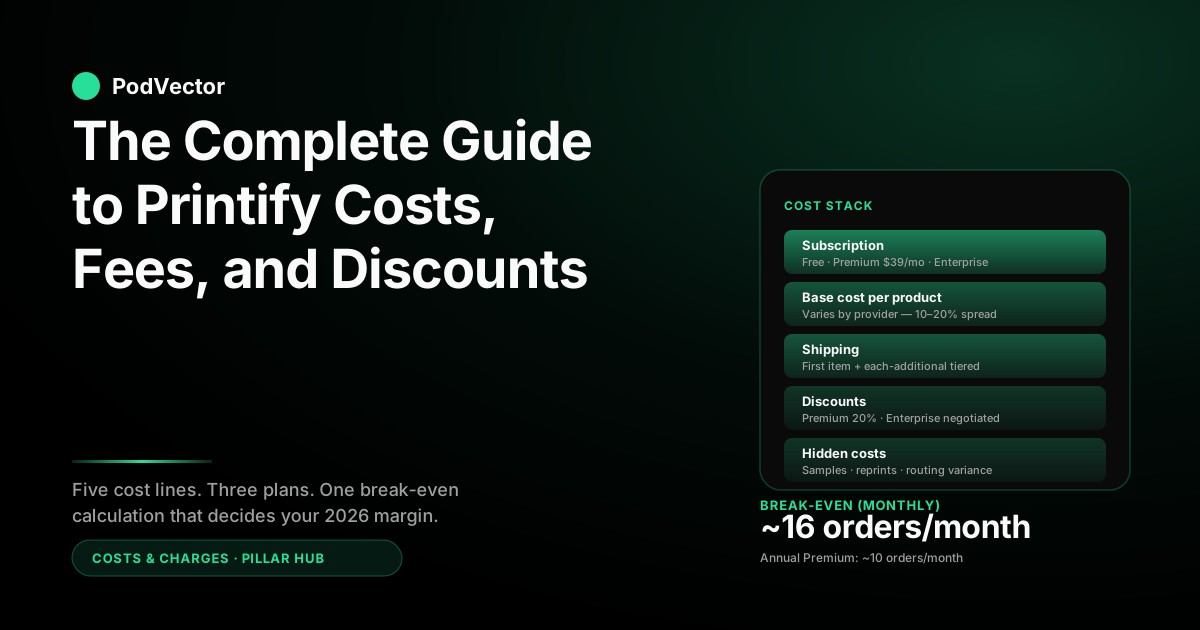
Quick Answer: Printify costs a POD seller money in five places, not one. Subscription (Free $0, Premium $39/mo monthly or $24.99/mo on annual billing at $299/year, Enterprise custom) is the line everybody sees — according to Ecommerce CEO, the monthly Premium price increased from $29 to $39 on February 17, 2026, while annual billing held flat. Per-product base cost is the largest line and varies by provider even for the same SKU. Shipping is charged per order and scales with item count. Bulk discounts on Premium save up to 20% off base cost on most catalog products — Printify confirms these bulk discounts apply automatically at checkout. Hidden costs (sample orders, rejected reprints, supplier price creep, provider-routing variance) account for the gap between what sellers expect to make and what actually hits their bank. This pillar walks through every line item, shows the math on when Premium beats Free, and explains how to track all of this cleanly so your P&L is right the first time.
The five places Printify actually costs you money
Most "Printify pricing" articles answer the question "how much is Printify?" with the subscription price and stop. That's wrong. The subscription is the smallest line a POD seller actually pays. The real cost structure — the one that decides whether a store is profitable — has five components, and they all behave differently:
- Subscription — $0 (Free), $39/month (Premium monthly, post-Feb-2026, per Ecommerce CEO), $24.99/month effective (Premium annual, billed $299/year), or custom (Enterprise). This is a fixed cost and it's the only line that isn't tied to an order.
- Per-product base cost — the price Printify charges you for the physical good before shipping. Varies by SKU, variant, size, and — critically — by which of Printify's third-party print providers fulfills the order. Same tee, same design, two different providers, different base costs. This is the largest line on almost every order.
- Shipping — billed per order, scales with item count and destination. Printify passes through provider-set shipping rates; typical apparel rates in the US follow a first-item-plus-each-additional-item structure, with international corridors running substantially higher.
- Bulk discounts — Printify's deals page confirms two discount mechanisms: a product discount of up to 20% through Premium (applied automatically at checkout) and volume-based shipping discounts that kick in at a threshold of similar items from the same print provider. Enterprise stacks additional negotiated discounts above the Premium cap. According to our own Printify bulk discounts full breakdown, the product discount can reach up to 46% off on select SKUs depending on provider and quantity.
- Hidden costs — sample orders, customer-caused reprints, rejected-order losses, supplier base-cost creep over time, and provider routing that quietly changes your margin when Printify assigns a different print shop to the same SKU.
The mistake sellers make is collapsing these five lines into two ("subscription + everything else") and then treating the "everything else" bucket as a flat percentage. That's how stores end up with margin leakage they can't explain.
The rest of this guide takes each line in order, gives you the current numbers for 2026, and shows where the levers are. If you want the broader context on what Printify is and how the business model works before diving into pricing specifically, the parent explainer is the complete Printify guide: what it is and how it works. For the supplier-comparison view — whether Printify's cost structure even beats the alternatives at your stage — see Printify alternatives: the complete comparison for POD sellers.
The three Printify plans at a glance
Printify sells three plans. The names and features moved in February 2026 with the most significant pricing change in the platform's history. Ecommerce CEO's Printify pricing analysis confirmed the Premium monthly price rose from $29 to $39 while the annual option remained at $299/year ($24.99/month effective) — so any guide published before that date is reading from a stale menu. Notably, Traksource's 2026 Printify review also flags that Printify and Printful now operate under the same parent group (Fyul, formed in late 2025), though both platforms still run separately with their own accounts, catalogs, and pricing as of mid-2026.
| Plan | Monthly cost | Annual cost | Base-cost discount | Connected stores | Best for |
|---|---|---|---|---|---|
| Free | $0 | $0 | None | 5 | Testing, low-volume sellers, single-store operators |
| Premium | $39 * | $299 ($24.99/mo effective) * | Up to 20% on most products | 10 | Scaling sellers, multi-store operators |
| Enterprise | Custom | Custom | Above 20%, negotiated | Unlimited | High-volume merchants, dedicated account manager required |
* Pricing confirmed by Ecommerce CEO and Chayaani's 2026 fee guide, both updated post-February 2026 price change.
Two framing points before going deeper. First, plans affect base cost only — they do not touch shipping, taxes, or per-provider price differences.
A Premium seller who routes an order through an expensive provider still pays the expensive base cost minus the plan discount, which can easily be more than a Free-plan seller who routes the same order through a cheaper provider. Plan choice and provider choice are two different levers.
Second, the break-even point is a function of order volume, average base cost, and discount rate, not a vibe. The math is in the break-even section below and it's the single most important number in this entire guide.
Free plan: what $0 actually gets you
Printify's Free plan has no monthly fee, no trial period, no credit card requirement at signup, and no upfront commitment of any kind. According to Chayaani's 2026 guide, you only pay when a customer places an order — base cost plus shipping, charged at fulfillment — meaning zero upfront risk. This is the on-ramp that makes Printify (and POD as a category) work for new sellers, because the risk of testing the business model is compressed to roughly the cost of one sample order plus whatever you spend on design tools and ad experiments.
What you get on Free:
- 5 connected stores. Enough for a single seller running across Shopify, Etsy, eBay, and a couple of marketplaces. Stops being enough once you're operating multiple brand accounts.
- Full catalog access. All products, all providers. Free plan sellers do not get a smaller catalog.
- Unlimited product designs. No cap on how many SKUs you publish.
- Printify Connect. The order-management layer that ties orders from your sales channel to the provider fulfillment queue. Included.
- Standard mockup generator. Unlimited mockups, standard resolution, no watermark.
- Standard customer support. Email-based with typical response times.
What you don't get:
- The base-cost discount. You pay the list price for every product you sell. Over a few hundred orders per month this gap becomes material — see the break-even math below.
- Priority support. Free plan tickets sit behind Premium plan tickets in the queue.
- Sellers Club PRO mentorship. The 1:1 coaching benefit is Premium-only.
Two tactical details that matter. First, there is no time limit on Free — you can stay on it indefinitely. Printify monetizes Free plan users by keeping the spread between base cost and the discounted Premium cost; they'd rather you grow on their platform on Free than switch away. Second, Free-to-Premium migration is instant and one-click, so sellers routinely stay on Free during the test phase and upgrade the moment their volume crosses the break-even threshold.
There is no penalty for waiting. The "should I start on Free or Premium?" question answers itself — start on Free, upgrade when the math flips. For the deep-dive on this specific question, see does Printify cost money to get started.
Premium plan: the 2026 price change and what's inside
Ecommerce CEO confirms that on February 17, 2026, Printify raised the Premium monthly price from $29 to $39 — the largest single-step bump in the plan's history. The annual price held at $299/year, and Chayaani's fee guide notes that switching from monthly to annual now saves meaningfully per year. For any seller who plans to use Premium for more than a few months, annual billing is now a much stronger deal than it was in 2025.
What Premium includes:
- Up to 20% off base cost on most products. The headline benefit. Printify's official deals page confirms these discounts apply automatically at checkout on every eligible SKU. Some providers and some product categories fall outside the cap; the discount is expressed as "up to" for this reason. In practice, apparel SKUs at most major providers do hit the full discount.
- 10 connected stores per account. Double the Free plan limit. Matters for sellers running multiple brand accounts or testing new niches in parallel.
- Unlimited product designs. Same as Free.
- 1:1 Sellers Club PRO mentorship. Access to Printify's in-house success coaches.
- Priority customer support. Faster ticket response and a dedicated line for escalations.
- Custom branding options. Inside labels and packing inserts on an expanded SKU subset.
Three details sellers get wrong about Premium. First, the discount does not apply to shipping. The savings is on base product cost only — shipping is passed through at the provider's rate regardless of plan.
Second, the discount does not stack with coupon codes applied to the subscription itself — Premium's base-cost discount is an order-level benefit; Sellers Club coupons typically reduce the monthly/annual subscription price, not the product cost. Third, the 10-store limit is hard — you can't exceed it by paying more. Sellers operating above that either consolidate or upgrade to Enterprise.
For a Premium-specific deep-dive, see how much is Printify Premium and is Printify Premium worth it for POD sellers.
Enterprise plan: when custom pricing makes sense
Enterprise is Printify's plan for merchants running significant daily sales volume. According to Chayaani's 2026 guide, Enterprise is for merchants "shipping hundreds or thousands of units monthly" and includes custom bulk discounts exceeding 20%, a dedicated account manager, API integration for automated order routing, and unlimited stores. Printify does not publish Enterprise pricing — you need to contact their sales team for a custom quote based on order volume.
Enterprise includes:
- Discounts that stack above the 20% Premium cap. Negotiated per account based on volume commitment and category mix.
- Unlimited connected stores. No cap.
- A dedicated account manager. Single point of contact for escalations, provider routing issues, and strategic decisions.
- Early access to new products and providers. Useful for category-defining stores that want first-mover advantage on catalog expansion.
- Custom API quotas and rate limits. Important for high-volume operators running automated pricing, inventory sync, or multi-channel distribution.
For most POD sellers, Enterprise is overkill. For those who actually operate at the required volume, the math usually works — the incremental discount points on every order compound quickly at scale, and the operational leverage of a dedicated account manager on provider routing issues is often worth more than the incremental discount itself.
The honest test: if you're spending more than an hour a week on Printify support tickets and you're well above $50K/month in POD revenue, Enterprise probably pencils. Below that, it doesn't.
Per-product base cost and why providers matter
The line on a POD P&L that sellers most consistently underestimate is per-product base cost — the amount Printify charges you for the physical good before shipping. On a popular tee sold through your store, base cost typically eats the largest share of the retail price before your sales channel takes its transaction fee, before payment processing, before shipping, and before any advertising cost. If your store thinks it's making high margins and is actually making far less, base cost is where the gap lives.
Three things drive base cost variance on the same SKU:
Provider routing. When you publish a product on Printify, you pick which print provider fulfills it from the available list for that SKU. The same Bella+Canvas 3001 unisex tee is fulfilled by Monster Digital, SwiftPOD, Drive Fulfillment, The Dream Junction, Sensaria, Underground Shirts, and several others — each at a different base cost. Provider choice is a bigger margin lever than plan choice for sellers who take the time to optimize it. For the specific benchmark numbers, see Printify Bella+Canvas 3001 cost: full breakdown for POD sellers.
Size and variant upcharges. Larger sizes carry upcharges over the base size. Color changes on certain specialty products (ringer tees, tri-blends, premium hoodies) also carry small surcharges. Sellers who price their listings at the base size cost and eat the oversize upcharge on every order silently lose margin on the oversize portion of the order mix.
Supplier price creep. Printify's base costs are set by the print providers, and providers raise prices periodically across most categories to keep up with blank apparel wholesale cost changes. A store that set its retail prices based on older base costs and hasn't re-benchmarked recently is almost certainly operating at less margin than it thinks. The mitigation is a recurring (monthly or quarterly) re-benchmark of top-20 SKU base costs against current listing prices.
For the specific benchmark numbers on apparel and the full per-SKU breakdown, see how much does Printify charge per shirt and Printify cost per sale: what sellers should expect.
Shipping cost: per-order, per-item, per-region
Printify passes through shipping costs from the print providers. The structure is almost always tiered per order — a first-item rate plus a reduced each-additional-item rate — and it varies by provider, product category, and destination region.
Three seller-facing implications. First, AOV matters disproportionately for POD margin because the shipping tier structure rewards multi-item orders. A store whose buyers purchase a single item pays the full first-item shipping rate on every order; a store whose buyers purchase multiple items amortizes that rate across more revenue. Any strategy that moves buyers from single-item to multi-item orders (bundle discounts, upsells, free-shipping thresholds) compounds base-cost margin directly.
Second, international orders need different retail pricing. Sellers who use a single worldwide retail price eat the international shipping delta on every non-US order, which can flip those orders to unprofitable. Either geo-price or charge the buyer shipping at cost. Third, Printify Premium does not discount shipping — the plan benefit is base-cost only — so sellers scaling into international volume do not get plan-based relief on the largest cost driver in that channel. For the specific international cost breakdown, see does Printify ship internationally and how long does Printify take to ship.
Premium break-even math on a real P&L
The question every Printify seller eventually asks is: at what order volume does Premium's subscription fee pay itself back through the base-cost discount? The math is deterministic, but most calculations skip important inputs. Here's the honest version, post-Feb-2026 price change.
The framework: take the monthly plan cost (either the monthly billing price or the effective monthly cost on annual billing, per Ecommerce CEO's confirmed figures) and divide it by your average base-cost savings per order. Your savings per order equals your average pre-discount base cost multiplied by your blended discount rate. The result is how many orders per month Premium needs to reach zero-sum — every order above that is net profit recovered.
As an illustration of why annual billing is the stronger call post-price-increase: MyDesigns notes that at around 50 orders/month with a mid-range average base cost, the 20% product discount saves meaningfully more than the monthly plan fee — the math favors staying on Premium rather than canceling. Traksource's 2026 review puts the annual break-even at roughly 15–30 orders a month depending on product mix, while monthly billing at the higher price pushes that threshold meaningfully higher — which is why both sources recommend annual as the default for consistent-volume sellers.
Two qualifications. First, the blended discount rate is lower for stores that sell heavily outside apparel — wall art, accessories, and some drinkware categories may carry smaller Premium discounts, and the effective rate can drop below the headline figure. If your mix is skewed that way, your break-even order count will be higher than the apparel-mix estimate. Second, the break-even order count is the lower bound — the return on Premium keeps growing as volume grows. Premium gets more valuable, not less, as volume scales. That's why most serious POD operators are on annual Premium well before they technically need to be — the math is lopsided once you're past the threshold.
Bulk discounts: what they are and how they stack
Printify offers two distinct bulk-discount mechanisms that are separate from the standard Premium plan discount, and many sellers conflate or overlook them entirely.
Volume-based shipping discounts. Printify's official deals page confirms a shipping discount that kicks in when ordering similar items from the same print provider in volume (Standard shipping only, and limited to certain regions including the US, Canada, and Germany). This is specifically relevant for sample runs, large launches, or wholesale-style orders — not typical one-by-one retail fulfillment.
Volume-based product discounts. Separate from the Premium plan's automatic discount, certain print providers and SKUs offer tiered quantity pricing. According to Printify, bulk purchases of custom items (such as t-shirts) can qualify for volume discounts where the per-unit price drops as quantity increases. The minimum quantity and discount depth vary by provider and SKU — sellers need to check individual product pages inside their Printify dashboard for current pricing.
How bulk discounts interact with Premium. The Premium plan's up-to-20% base-cost discount and volume-based bulk discounts are separate mechanisms. Printify confirms bulk discounts apply automatically at checkout when thresholds are met. For sellers running large print runs or sample batches, stacking the Premium plan discount with a qualifying volume order can compound the savings — but the specific stackability depends on the provider and product category, so verify on the product page before committing to a large order.
For the full breakdown of how Printify's bulk discount tiers work across different providers and product categories, see Printify bulk discounts: full breakdown for POD sellers.
Subscription discounts, coupons, and what actually stacks
Printify has three distinct discount mechanisms, and sellers routinely confuse them. Getting the hierarchy right matters because only one of them moves every order — the others are one-offs.
Plan-based discount (Premium and Enterprise). This is the base-cost discount tied to your subscription — up to 20% on Premium per Printify's deals page, negotiated higher on Enterprise. It applies automatically at the moment of fulfillment to every eligible order. It is, by far, the most valuable discount for any operating POD store because it scales linearly with volume.
Subscription coupon codes. Promotional codes applied to the Premium or Enterprise subscription itself — typically reducing the first month or first year of the plan. Seen around Black Friday, Printify's birthday, new-seller promotions, and affiliate campaigns. These are real savings, but they're one-time and they apply to the plan, not to product cost. Coupons matter at the margin; the plan discount is the structural play. For the running list of current Premium promotional codes, see Printify Premium coupon codes and discounts.
Sample-order discounts and seasonal promotions. Printify periodically offers discounted sample orders and specific seasonal promotions on individual product categories. These are communicated in-app and via email; they're useful if your launch cadence happens to align with one, but no store's P&L should depend on them. Treat as a one-off bonus.
What does not exist: a general-purpose Printify "discount code" field on regular customer orders. Sellers searching for "Printify discount code for orders" are typically looking for something that doesn't exist — the base cost discount comes from the plan, not from a code.
Hidden costs most sellers miss
Five costs don't show up on any Printify dashboard but hit your margin anyway. Sellers who don't track these line-item-by-line-item routinely over-estimate their profitability.
Sample orders. Before launching a new design or SKU, a disciplined POD operator orders a sample to verify print quality, fit, and color accuracy. Across a growing catalog, these costs add up quickly as pure margin compression that doesn't appear in any "cost per sold order" metric. Printify's periodic sample discount helps, but it doesn't eliminate the line.
Customer-caused reprints and returns. When a customer orders the wrong size, receives a gift they don't want, or reports a damage issue, the seller's policy (full replacement, partial refund, store credit) determines whether the reprint cost is absorbed by the seller or the buyer. In practice, most stores eat a significant share of reprint requests to keep reviews and ratings strong.
Rejected-order losses. Payment disputes, chargebacks, address-undeliverable failures, and fraud-flagged orders where Printify has already started fulfillment. The seller has paid Printify for the physical good, but the revenue side of the transaction didn't clear.
Supplier price creep. Covered above, but worth re-stating: providers raise list prices periodically. A store that set retail prices based on older base costs and hasn't re-benchmarked is almost certainly under-margin today without knowing it. Re-benchmark top SKUs quarterly.
Provider-routing variance. When Printify automatically routes an order to a backup provider (because your primary provider is out of stock or overloaded), the base cost of that order can shift — usually higher, occasionally lower — and the shipping rate can change too. Across a high-volume month with a meaningful overflow rate, the margin leakage can be significant and silent.
For the tactical guides on making Printify's cost structure work in your favor specifically, see how Printify makes money and how you can too, 5 proven ways to boost Printify profits, and how to make money with Printify: strategies for POD success.
Tracking Printify costs without losing your mind
The reason hidden costs stay hidden is that Printify's native dashboard doesn't surface them. The dashboard shows gross orders and fulfillment status — not base cost per order itemized against retail revenue, not shipping per order against what the buyer paid in shipping, not the exact sub-line that Etsy or Shopify took on each transaction. Store-level P&L accuracy on POD requires pulling all of these data points from different sources and matching them per order.
Three levels of tracking rigor, by store stage:
Stage 1 — Free-plan, single-store, low order volume. A spreadsheet is fine. Pull Printify orders and their base cost + shipping values weekly, match against your sales-channel order report, compute per-order margin manually. You'll miss routing-variance details, but at this volume the absolute dollar impact is small enough that precision doesn't matter.
Stage 2 — Premium, moderate order volume. A spreadsheet breaks. Sample orders, reprints, sales-channel fee variance across Shopify + Etsy + eBay, and cross-corridor shipping start creating enough line-items-per-day that manual reconciliation eats hours per week. This is where sellers either try to build their own system for tracking this (rare, expensive) or get an AI employee like Victor who shows you the true profit on every single order, automatically.
Stage 3 — high volume, multi-supplier. Provider routing variance and multi-supplier cost structures make per-order tracking mandatory. Aggregate margin percentages stop being useful — you need to see which specific SKU, provider, and shipping corridor combinations are silently losing money. This is the stage where Victor becomes structural infrastructure rather than a nice-to-have: he watches your real orders as they happen, not a monthly spreadsheet dump, and tells you exactly where the money is leaking.
PodVector AI's Victor is an AI employee built for this layer. He reads live data from your Printify, Shopify, Meta Ads, Google Ads, and Printful stack and answers operator questions on the real numbers. When he spots a margin issue, he proposes a specific action — such as repricing a Shopify product to a target margin or bulk repricing a set of products — and executes it only after you approve. Every material action requires your sign-off; Victor never acts autonomously. Learn more about how Victor works for POD sellers at /articles/print-on-demand/strategy/podvector.
If you're also running Google Ads alongside Printify-fulfilled products, accurate attribution matters as much as accurate cost tracking — see attribution model Google Ads explained for POD sellers for the full breakdown. And if you're evaluating Printful's cost structure alongside Printify's, see Printful pricing: monthly fee full breakdown for POD sellers and Printful shipping costs: full breakdown for POD sellers.
Official Printify pricing is published at printify.com/pricing; third-party analysis for the 2026 pricing change is well-covered by Ecommerce CEO's Printify pricing analysis. Cross-reference both when re-benchmarking your store's P&L.
FAQs
Is Printify really free to start?
Yes, with no time limit, no trial window, and no credit card required at signup. According to Chayaani's 2026 guide, you only pay when a customer places an order — base cost plus shipping, charged at fulfillment. The Free plan is a permanent tier, not a trial. For the full breakdown, see does Printify cost money to get started.
When did Printify's Premium price change, and to what?
Ecommerce CEO confirms that on February 17, 2026, Printify raised Premium's monthly price from $29 to $39. Annual Premium held at $299/year ($24.99/month effective). The change widened the monthly-vs-annual gap and made annual billing materially more attractive for any seller planning to stay on Premium longer than a few months.
Does Premium's discount apply to shipping?
No. Premium's base-cost discount applies to the product cost only. Shipping is passed through at the provider's rate regardless of plan. This is why the break-even calculation uses base-cost savings, not total-cost savings.
What are Printify's bulk discounts and how do they work?
According to Printify, there are two bulk-discount mechanisms: a volume-based shipping discount for orders of similar items from the same print provider (Standard shipping, select regions), and a volume-based product discount that can go well above the Premium plan's standard discount on qualifying SKUs. Both apply automatically at checkout when thresholds are met. Minimum quantities and discount depths vary by provider and SKU — check your product dashboard for specifics. See the full breakdown at Printify bulk discounts: full breakdown for POD sellers.
How many orders per month justify Premium?
Traksource's 2026 review puts the break-even on annual billing at roughly 15–30 orders a month depending on product mix, with monthly billing at the higher post-2026 price pushing that threshold meaningfully higher. Calculate your own break-even by dividing the effective monthly plan cost by your average base-cost savings per order (your average base cost multiplied by your blended discount rate). Above the threshold, Premium's return grows with every additional order.
Why do the same product's base costs differ between Printify sellers?
Because each seller picks a specific print provider for each SKU, and providers set their own base costs. A Bella+Canvas 3001 fulfilled by Monster Digital costs a different amount than the same shirt fulfilled by SwiftPOD. Provider choice is often a larger margin lever than plan choice. See Printify Bella+Canvas 3001 cost: full breakdown for POD sellers for the specific numbers.
Can I stack a Printify coupon code with the Premium discount?
Not directly. Coupon codes typically reduce the subscription price; Premium's discount is applied to product cost at fulfillment. They're two different discount mechanisms operating on two different line items. You get the subscription savings and the per-order product discount, but neither stacks on top of the other.
Does Enterprise make sense for mid-volume sellers?
Usually not. According to Chayaani's 2026 guide, Enterprise is for merchants shipping hundreds or thousands of units monthly. Below that volume, Premium's discount covers the vast majority of the margin benefit Enterprise offers, and the incremental discount points don't justify the account-minimum commitments that typically come with Enterprise contracts.
What's the simplest way to track my real Printify costs per order?
At low volume, a weekly spreadsheet reconciliation works. Above that, the manual math eats hours and misses provider-routing variance. Most stores above Stage 1 use a profit-tracking layer that reads their Printify order data, their sales-channel fees, and their ad platform spend together. See the tracking section above for the stage-by-stage recommendation, and see how Victor at PodVector AI handles this for Shopify-based POD sellers at scale.
Stop guessing at your Printify margins
Your Printify dashboard tells you orders and fulfillment status. It doesn't tell you per-order contribution margin across providers, shipping corridors, ad spend, and sales-channel fees. PodVector AI's Victor is an AI employee who reads your live Printify, Shopify, Meta Ads, and Google Ads data, proposes the next profit move as a structured action — and executes it only after you approve.
Try Victor free