
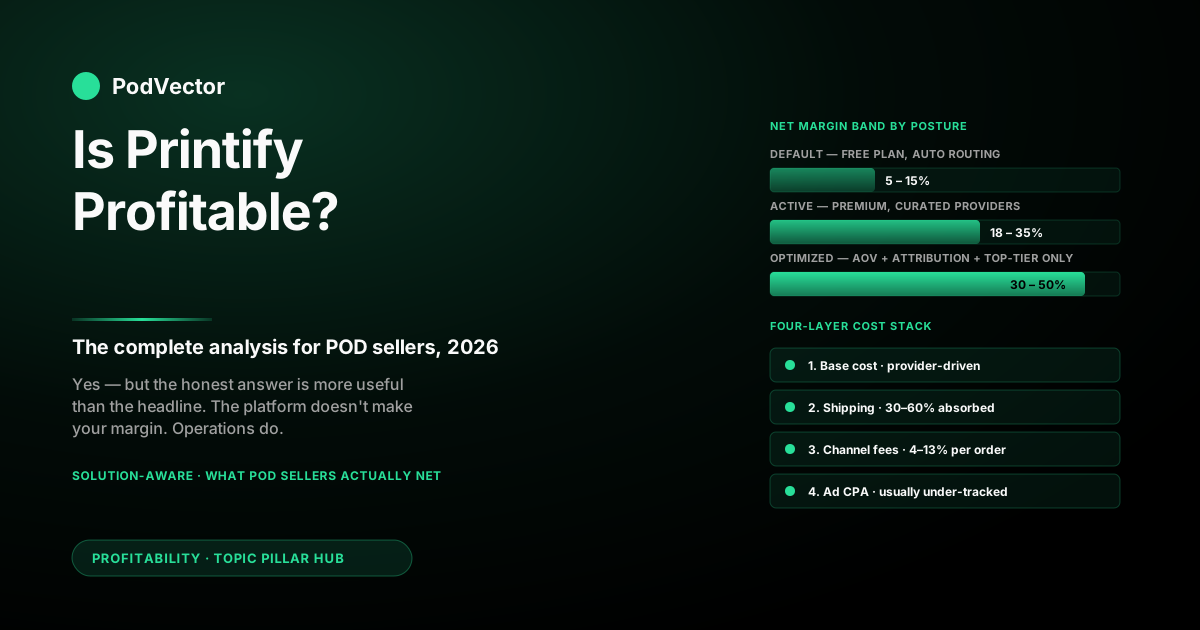
Quick Answer: Yes — Printify is profitable for POD sellers, but the honest answer is more useful than the headline. Net margin per order on Printify in 2026 typically lands at 18–35% for sellers who actively pick providers, run on Premium, and price with intent; 5–15% for sellers who default to whichever provider Printify auto-routes to and price on instinct. The platform itself does not create the margin — the margin comes from the gap between your retail price (which you control), your landed cost (which you partly control via provider selection and Premium), your channel fees, and your ad spend (which most sellers track wrong). According to Printify's own 2026 platform data, many new sellers start with 5–10% margins, while sustainable POD business growth typically requires aiming for 30–40% after marketing and printing costs.
On a $24.99 t-shirt: a Free-plan seller with default routing nets ~$2–$4; a Premium seller with curated providers nets ~$5–$8. Multiply by volume and the difference between "Printify is barely worth it" and "Printify pays my mortgage" is usually six or seven operational decisions, not the platform itself.
Why "is Printify profitable" is the wrong framing
Most "is Printify profitable" content on the internet answers the question as if it were binary — "yes, sellers report strong margins" or "it depends on your niche." Both answers are technically true and operationally useless. Printify is a sourcing platform, not a business.
The platform does not produce a margin; the seller produces a margin by combining the platform's costs with their own pricing, channel selection, ad strategy, and operational discipline. Asking "is Printify profitable?" is closer to asking "are restaurant suppliers profitable?" — the answer turns entirely on what the restaurant does with the supply.
The more useful question is: given a defined product, channel, ad strategy, and volume tier, what net margin should a competently-run Printify operation expect, and what are the operational decisions that move that number? That's the question this pillar answers. It assumes you've already read the complete guide to Printify for POD sellers and understand the platform mechanics. If you haven't, start there — this guide builds on top of it.
The honest framing also matters because of how the top-ranked SERP results discuss profitability. Printify's own knowledge-hub piece — the Printify Profit Navigator, its current playbook for margin optimisation — presents the platform as inherently high-margin and frames the seller's job as decoding cost and "unlocking" the upside.
That framing skips the operational layer where the vast majority of the variance lives. Real profitability isn't unlocked by signing up; it's earned by making the right call across roughly two dozen recurring decisions.
The real Printify profit numbers in 2026
Pull the marketing copy off the table and the Printify margin distribution looks like this. Printify's 2026 platform statistics show the average profit margin for top-selling products sits at 40–50%, with apparel benchmarking at 40% and mugs, candles, and paper products ranging from 45% to 76% on markup. Community-sourced data from Traksource's 2026 Printify review and Podbase's 2026 comparison put real-world Printify community margins ranging from 10–60%, with most platforms recommending 20–40% as a practical target.
| Operating posture | Net margin per order | Realistic monthly net at 200 orders |
|---|---|---|
| Default — Free plan, auto-routed providers, instinct pricing, no ad tracking | 5–15% | $250–$900 |
| Active — Premium, curated providers, intentional pricing, channel-aware | 18–35% | $900–$2,800 |
| Optimized — Premium, top-tier providers only, AOV-engineered, ad attribution wired in | 30–50% | $1,800–$4,500 |
Two observations. First, the spread between "default" and "optimized" at the same order volume is roughly 5–10x net dollars. The platform is the same. The distance is operational.
Second, inkandpxl's 2026 profit guide notes that Printify officially recommends targeting a 40% profit margin, while competitive basics in saturated markets can compress to 10–15% before accounting for platform fees and paid traffic — so the headline "30%+ margins are achievable" is honest but presented without the work that gets you there.
For a deeper unpack of where industry-wide POD margins actually land, see print on demand profit margins explained and is print on demand profitable: truths and myths. The pattern across seller forums and earnings disclosures is consistent: Printify is profitable, the median seller under-performs the platform's potential by a wide margin, and the gap is closeable.
The four-layer cost stack (and where margin leaks)
Every Printify order has four layers of cost between the customer's payment and the seller's bank deposit. Sellers who can name all four and quantify each one for their own store consistently outperform sellers who can't. Here they are, in the order they hit your account:
- Base product cost. What Printify charges you per unit, before shipping. Varies across providers for the same SKU. Premium discounts up to 20% off this layer. According to inkandpxl's 2026 analysis, a standard t-shirt costs approximately $4 less on Printify than on Printful at current rates — a difference that compounds meaningfully at scale.
- Shipping cost. Charged per order, sometimes per item. Domestic US is $4–$8 first item; international is $8–$22 first item. The customer often doesn't pay this in full — sellers absorb a portion to keep cart abandonment down.
- Channel fees. Etsy takes ~6.5% transaction fee + ~3% payment processing + $0.20 listing fee + a 15% off-site ads fee on relevant orders. According to Chayaani's 2026 POD breakdown, Etsy alone takes approximately 11–13% in combined fees. Shopify charges plan fees + 2.9% + 30¢ per transaction. TikTok Shop takes 5–8% commission.
- Marketing cost. Ad spend per order, expressed as cost-per-acquisition (CPA). Most underestimate this badly because they look at ROAS instead of CAC, count returning customers as new acquisitions, or ignore the portion of orders that never attribute cleanly to a campaign.
The classic worked example: a $24.99 Bella+Canvas 3001 t-shirt sold on Etsy, fulfilled by a top-tier US provider on Premium, with a $5 ad CPA on Meta:
- Retail: $24.99
- Customer-paid shipping: $4.50 (free-shipping threshold met or partial absorption)
- Base cost: $7.85 (Premium discount applied)
- Printify shipping charge to seller: $4.50
- Etsy transaction fee (6.5% of $29.49 incl. shipping): $1.92
- Etsy payment processing (~3% + $0.25): $1.13
- Etsy listing fee: $0.20
- Ad CPA: $5.00
- Net per order: $4.39 (~17.6% net margin)
Now the same shirt without the optimizations — Free plan, default provider, no Premium, higher ad CPA because the product page converts worse on a longer-shipping listing:
- Retail: $24.99 / Customer-paid shipping: $4.50
- Base cost: $9.85 (no Premium discount)
- Printify shipping charge: $5.20
- Etsy fees: $3.25 combined
- Ad CPA: $7.00
- Net per order: -$0.81 (negative margin — the seller is losing money on every shirt)
Same product, same retail price, same channel. One configuration nets $4.39; the other nets negative eighty cents. The full per-cost-layer decomposition with broader product ranges is in the complete guide to Printify costs, fees, and discounts, and the per-shirt math expanded across providers is in how much does Printify charge per shirt and Printify cost per sale: what sellers should expect.
Profitability by product category
Printify's profitability varies more by product category than most sellers realize. The pattern: low-base-cost, high-perceived-value items (drinkware, posters, certain accessories) tend to produce higher percentage margins; high-base-cost items (heavyweight hoodies, all-over-print, embroidered) produce higher absolute dollar margins per unit but lower percentage margins. Printify's own 2026 data confirms that non-clothing products tend to have higher profit margins than apparel, with small home goods costing less to fulfill and allowing for larger markups.
| Category | Base cost range | Typical retail | Typical net margin (Premium, active) |
|---|---|---|---|
| DTG t-shirts | $7.50–$11.50 | $22–$32 | 20–35% |
| Hoodies / sweatshirts | $18–$32 | $42–$65 | 22–32% |
| Ceramic mugs (11–15 oz) | $5.50–$8.50 | $18–$28 | 30–45% |
| Posters / wall art | $4.50–$15 | $22–$60 | 35–50% |
| All-over-print apparel | $22–$45 | $48–$85 | 15–28% |
| Embroidered hats / beanies | $11–$18 | $28–$42 | 22–35% |
| Phone cases | $8–$13 | $22–$35 | 25–38% |
| Tote bags | $9–$14 | $22–$32 | 20–32% |
| Pet products | $10–$24 | $24–$48 | 25–40% |
Two patterns are worth memorizing. First, posters and mugs reliably produce the highest percentage margins on Printify, and they make excellent cross-sell or AOV-building add-ons. Printify's platform data puts mugs, candles, and paper products at 45–76% markup potential — well above the apparel benchmark.
Second, all-over-print apparel looks attractive on the catalog page but produces narrower margins because the base cost is so high — the dollar-per-unit can be excellent at scale, but the percentage rarely matches a basic DTG tee. The full breakdown of which Printify products consistently drive seller revenue, with provider-specific recommendations, lives in the complete guide to Printify's most profitable products and most profitable print on demand products.
Profitability by sales channel
Where you sell changes the cost stack more than most sellers realize. Channel fees compound on every order; the right channel mix can swing your blended net margin by several percentage points without changing anything about the product.
| Channel | Combined channel fees | Typical CAC | Net margin impact |
|---|---|---|---|
| Etsy | ~11–13% (transaction + processing + listing + off-site ads) | $0–$8 (organic-heavy) | Strong on organic; off-site ads fee can sting |
| Shopify (own store) | ~3–4% + plan fee | $8–$25 (paid-traffic-heavy) | Best per-order economics; worst CAC if ads are weak |
| TikTok Shop | ~5–8% commission | $0–$12 (creator-driven) | Best blended margin when a video lands; volatile |
| Amazon Merch / Amazon | ~13% + referral fees | $0–$15 (Amazon-native traffic + sponsored) | Compressed margins; high volume potential |
| eBay | ~12.9% + $0.30 per order | $0–$5 | Surprisingly steady niche-product channel |
| Walmart Marketplace | ~6–15% referral by category | $0–$10 | Approval gate; once in, decent margin |
The structural insight: Etsy is best for organic discovery but channel fees compound; Shopify is best for per-order economics but ad spend dominates the cost stack; TikTok Shop has the highest variance — videos that go viral produce extraordinary blended margins, videos that don't produce zero. Most successful Printify sellers in 2026 run on at least two channels (commonly Etsy + Shopify, or Etsy + TikTok Shop) so they aren't dependent on a single algorithm. The integration breakdown across these channels is in the complete guide to Printify integrations for POD sellers.
The Premium math: when 20% off pays for itself
Printify Premium is the single largest lever on profitability for an active Printify operation. At $39/month or $299/year (about $24.99/month annual), Premium unlocks up to 20% off base costs across the catalog. The break-even logic is:
- Annual Premium: ~$25/month. If your average order has $1.50–$2.00 of base cost that Premium discounts, you need roughly 13 orders/month to justify annual Premium.
- Monthly Premium: $39/month. Same logic puts break-even at roughly 20 orders/month.
- The math improves with higher base-cost products — a single Premium-discounted hoodie saves meaningfully more per unit than a tee, making break-even faster for hoodie-focused stores.
- Multi-channel sellers hit break-even much faster because Premium discounts apply across all connected stores while the subscription fee is paid once.
The full break-even matrix by product category, plus the cancellation/downgrade mechanics and how Premium compares to Enterprise, is in the complete guide to Printify Premium for POD sellers. For a tighter cost-only view, see how much is Printify Premium and is Printify Premium worth it for POD sellers.
The non-obvious thing about Premium is that it's not just a cost discount — it's a behavior nudge. Sellers who pay $39/month tend to take their store more seriously, do more analysis, ship more SKUs, and run paid ads more deliberately. The discount is the visible value; the operational seriousness is the hidden one. The honest answer for any seller doing 25+ orders/month is: yes, Premium pays back, often within the first week.
The five hidden margin killers
Beyond the four cost layers above, five recurring leaks quietly destroy margin in Printify operations. None of them show up cleanly on a Printify dashboard, which is exactly why they go unfixed.
- Provider drift. A provider you picked nine months ago because it had the best base cost has quietly raised prices since then. Printify doesn't notify you. Most sellers don't notice until quarterly margin review — if they do quarterly margin review at all. Traksource's 2026 Printify review flags this as the primary risk of the marketplace model: "pick providers carefully, order samples" is not a one-time task. Audit provider pricing every 60 days.
- Shipping absorption math. Sellers offer "free shipping" without modeling how much of the shipping cost actually gets absorbed at each retail price. The full breakdown is in free shipping in POD: should you offer it and print on demand shipping explained.
- Refund and reprint costs. The customer returns a damaged print; Printify reprints free if you're enrolled, but the original sale's payment processing fees were already taken, your ad spend was already spent, and your reprint shipping is on the new order. Net effect: a refunded order is rarely zero — it's negative several dollars.
- Ad attribution decay. Most sellers track ad performance in the ad platform (Meta, TikTok, Google), which over-attributes compared to true incrementality. Net result: the ad spend in the cost stack should be materially higher than what you think it is.
- Currency conversion spread. If you sell in EUR/GBP/AUD and Printify charges you in USD, the conversion spread (typically 1–3%) eats margin invisibly. On a high-volume EU-targeting store this compounds across the year.
Two more traps that the top profitability guides flag deserve a line each. Sample order costs — you pay full retail plus shipping to vet a provider, and most sellers never amortize those sample runs back into the SKU's true cost. Design-tool subscriptions and licenses — Canva Pro, Illustrator, premium fonts, and stock-art licenses are real per-month overhead that quietly lowers your blended net before a single order ships. Neither shows up on a Printify invoice, so neither gets counted.
The hidden costs that kill POD profits goes deeper on each of these leaks and how to model them into your real per-order net.
Profitability benchmarks at three volume tiers
The economics of running a Printify store change shape at three volume thresholds. Knowing which tier you're in clarifies which decisions matter most. Printify's internal data shows the average seller takes 165 days to hit their first $1,000 in revenue — which anchors the validation tier realistically.
| Tier | Monthly orders | Realistic monthly net (active operating posture) | Dominant decision |
|---|---|---|---|
| Validation | 0–30 | $0–$200 | Prove a niche, not a margin. Free plan is fine. |
| Side income | 30–200 | $200–$1,800 | Premium is non-negotiable. Pick top-tier providers. |
| Operating business | 200–1,500 | $1,800–$15,000 | Channel mix, ad attribution, and SKU-level margin tracking are now binding constraints. |
| Scale | 1,500+ | $15,000+ | Provider negotiation, custom branding, multi-channel orchestration. Enterprise tier becomes worth evaluating. |
Most Printify sellers stall between tiers because the operational habits that worked at the previous tier stop working at the next one. A validation-tier seller can run on instinct; a side-income seller needs Premium and provider discipline; an operating-business seller needs SKU-level margin visibility or they ship money-losing products without knowing it. The transitions are where most sellers either compound or plateau.
For a closer look at what scaling actually requires, see how to increase print-on-demand profits, 5 proven ways to boost Printify profits, and how to grow average order value in print-on-demand.
The five levers profitable Printify sellers actually pull
Across profitable Printify operations, the same five levers show up disproportionately. None of them are secret; all of them are operational.
- Provider curation. They picked 2–3 providers per category, ordered samples from each, locked in the winner, and never used the others. Quality variance disappears from their store. Bottom-tier reviews disappear. Repeat purchase rate climbs. Traksource's 2026 review puts it plainly: "pick providers carefully, order samples, and Printify is the most profitable mainstream POD platform there is."
- Premium plus annual billing. They run Premium on annual billing because the math is unambiguous past 25 orders/month and the cash-flow penalty is small.
- Pricing for margin, not for matching the market. They price at the upper end of their niche's tolerance and use design quality, brand, and AOV-building bundles to justify it. Chayaani's 2026 analysis notes that profitability in POD is a pricing problem, not a product problem — the seller who charges more for a demonstrably better product nets materially more per order.
- AOV engineering. They use cross-sells (matching mug + tee, sticker + poster), free-shipping thresholds, and bundle pricing to push the average order value well above their baseline single-item price. The AOV playbook goes deep here. Pairing this with a free-shipping threshold set above your most popular single-item price is one of the highest-ROI moves in a Printify store.
- SKU-level margin visibility. They know which SKUs are profitable and which aren't, by week, by channel, by ad campaign. They double down on winners and kill losers. This is the lever most sellers don't pull because it requires either a multi-month spreadsheet build or a tool — covered in the next section.
The five levers compound. A seller who pulls all five is in the top margin band; a seller who pulls one or two sits in the middle; a seller who pulls none ends up in the bottom band, which is where most "Printify isn't profitable" complaints originate.
Why most Printify profit calculators are wrong
The Printify-branded "profit calculator" and most third-party calculator widgets compute one number: retail minus base cost minus shipping. That's gross margin, not net profit. They omit channel fees, payment processing, ad spend, returns, and reprints — which collectively account for a large share of the actual cost stack. A seller using one of these calculators sees an inflated "profit per shirt" and ships it. The actual net is far lower.
The honest profit equation for a Printify order is closer to:
Net per order = Retail − (Base + Shipping you absorb) − Channel fees − Payment processing − Apportioned ad CPA − Apportioned refund/reprint reserve − Apportioned plan fees
Building a spreadsheet that does this for every SKU on every channel is its own multi-week project, and the spreadsheet is stale the moment provider pricing changes or channel fee structures update. The deeper how-to lives in how to calculate POD profits step by step and the complete guide to tracking profits in print-on-demand.
For the conceptual scaffolding underneath those calculations — gross profit vs net sales, contribution margin, gross profit after marketing — see gross profit vs net sales in print-on-demand, what is contribution margin in print-on-demand, and what is GPAM (gross profit after marketing). These three definitions, properly internalized, separate the sellers who scale from the sellers who don't.
The visibility ceiling: the unsolved problem
The deepest reason Printify sellers under-perform their potential isn't pricing, isn't product selection, isn't even ad strategy. It's visibility. The numbers you need are out there — your cost from Printify, your revenue and fees from your sales channel, your ad spend, and what actually lands in your bank account — but they live in different places and don't line up on their own. Pulling them together into one clear view of profit, for every order and every product, is the work that separates top sellers from the rest, and most sellers just don't have time for it.
The result is a measurable ceiling. A seller who can't see real net margin per SKU ends up running a portfolio in which a meaningful share of SKUs are quietly losing money and a smaller share are quietly outperforming. They double down on the wrong winners (because they look like winners on revenue) and kill the wrong losers (because they look like losers on order count). Over a year this gap compounds to thousands of dollars and to a strategic posture that drifts further from the actual market signal each quarter.
PodVector AI's AI employee Victor exists to close this gap — and to act on it. Victor keeps track of Printify, your Shopify store, and your ad platforms (Meta and Google) all in one place and adds up your true costs. Then he does the work: repricing under-priced products in your Shopify catalog, suggesting you pause ad sets that are spending more than they're worth, and flagging suppliers whose costs have drifted — all with your approval on every move. Every change is shown to you first as a card with the old value and the new value side by side; you approve or reject it, and Victor only does what you've approved.
The point isn't that Victor can answer "what's my net margin on these tees this month?" — it's that once it sees the margin, it proposes the fix and executes it on your say-so. The decisions every successful seller eventually wires up by hand, Victor wires up once and then carries out.
The architecture and pricing of the underlying tracking system are covered in Printify + Shopify profit tracking: automating your analytics and PodVector AI pricing, features, and profit tracking for Shopify + Printify sellers. Victor surfaces the under-priced SKU, flags the provider that drifted, and proposes the AOV-building bundle based on actual co-purchase patterns — then makes the change once you approve it.
Profitability by seller archetype
Three archetypes capture roughly 80% of profitable Printify operations in 2026. Recognizing which one you are clarifies which levers to pull first.
- The Etsy designer. Sells dozens to hundreds of orders per month across one or two niches; designs in Procreate or Illustrator; runs lean. Profitable Etsy designers typically net strong margins by relying on Etsy's organic discovery (low CAC), running on Premium, and using the off-site-ads relevance threshold to avoid Etsy's 15% off-site fee. The unique risk is Etsy algorithm shifts; the unique advantage is the lowest CAC of any channel.
- The Shopify brand. Sells on a branded Shopify storefront; depends on paid acquisition; cares deeply about LTV and AOV. Profitable Shopify brands control the customer experience end-to-end and can raise AOV aggressively. The dominant cost is ads, and the dominant operational discipline is true ad attribution. The Google Ads playbook and the Meta ads playbook are foundational reading.
- The multi-channel operator. Sells the same designs across Etsy, Shopify, TikTok Shop, and increasingly Amazon. Profitable multi-channel operators hit Premium break-even on the first channel and capture the discount stack on every additional channel for free. The dominant operational discipline is keeping listings in sync without hiring a full-time operations person.
None of the three archetypes is intrinsically more profitable than the others. The deciding factor is fit between the seller's strengths and the channel's economics. A designer-first operator who tries to scale on paid Shopify ads burns cash; an ad-savvy operator who tries to grow on Etsy SEO grows slowly. The lift comes from picking the model that matches the operator and then pulling the five levers above relentlessly.
FAQs
What is the average profit margin on Printify?
For an actively operated Printify store on Premium, average net margin lands in the 18–35% range per order. Printify's own 2026 platform data puts the average margin for top-selling products at 40–50%, which represents the optimized end; the same source notes that many new sellers start at 5–10% and that sustainable growth requires targeting 30–40% after marketing and printing costs. The platform itself doesn't determine the band; the operator does.
Can you actually make a full-time income with Printify?
Yes — and the pattern holds across seller communities. A typical full-time Printify operation runs at meaningful monthly order volume with a solid net margin. The path is not a secret; the operational discipline to walk it is the rare ingredient. TrueProfit's 2026 POD analysis notes that many stores never reach significant profits because they treat POD like a "quick side hustle" rather than a serious business — the distinction is operational, not platform-specific.
Is Printify more profitable than Printful?
Per-unit, Printify usually wins on landed cost because of provider competition. inkandpxl's 2026 profit guide puts the difference at approximately $4 less per standard t-shirt on Printify vs. Printful at current rates. Per-store, the answer depends on how you value time and brand consistency — Printful's higher base cost is partly a UX premium. The full head-to-head is in Printify alternatives: the complete comparison for POD sellers.
How long does it take to become profitable on Printify?
Most committed sellers reach single-order profitability within their first 30 days (the math works as soon as you set retail above the cost stack). Printify's platform data shows the average seller takes 165 days to hit their first $1,000 in revenue. Reaching meaningful monthly profit typically takes 60–120 days because of ad-spend learning curves and the need to identify winning SKUs. Reaching a full-time income typically takes 6–12 months for sellers who treat it as a serious operation.
Does Printify Premium pay for itself?
For any seller doing 25+ orders/month with average base cost eligible for the discount, yes — often within the first 30 days. Annual Premium (approximately $24.99/month equivalent) breaks even faster than monthly Premium ($39/month). The full break-even by product category is in is Printify Premium worth it for POD sellers.
What's the most profitable thing to sell on Printify?
Printify's 2026 data confirms that non-clothing products — mugs, candles, paper products — consistently produce higher profit margins than apparel, with mugs and paper products achieving 45–76% markup potential. Posters and well-designed DTG t-shirts also rank highly: posters win on percentage margin, DTG tees win on absolute volume because they're the most familiar gift and impulse-purchase format. Detailed product-by-product margins are in the complete guide to Printify's most profitable products and most profitable POD niches right now.
How do I calculate my real Printify profit?
Start with retail price minus base cost minus shipping you absorb. Subtract channel fees, payment processing, ad CPA per order, and an apportionment of refund/reprint reserve. The result is your real net per order. For a step-by-step worked example, see how to calculate POD profits step by step. For the automated alternative — Victor running the same join against live data — see Printify + Shopify profit tracking.
Why are some Printify sellers losing money?
Three patterns dominate: (1) they're on the Free plan paying full base cost, (2) they're absorbing shipping without modeling its margin impact, and (3) they're tracking ROAS in the ad platform without correcting for over-attribution. Chayaani's 2026 breakdown adds a fourth: always price as if Etsy's Offsite Ads could trigger — "if your margin only works at 11% fees, a single ad-driven sale at 26% fees can wipe it out." Any one of these is recoverable; together they can turn a positive net margin into a negative one without the seller noticing for months.
Does Printify charge me before the customer pays?
No. Printify charges you (the seller) at the moment of fulfillment — after the customer has paid your sales channel and the order has flowed to Printify. You're never out-of-pocket before revenue. Full mechanics in does Printify charge you or the customer?.
What's the relationship between Printify profitability and Shopify vs Etsy?
Etsy compresses per-order margin via fees but reduces CAC dramatically through organic discovery; Shopify expands per-order margin but increases CAC via paid ads. The blended net margin of a well-run Etsy store and a well-run Shopify store often converge; the operational shape of getting there is very different. The integrations breakdown covers the per-channel mechanics.
Is Printify profitable in 2026 specifically, or has it gotten harder?
It has gotten more competitive (more sellers, more design saturation, more aggressive ad markets) and more profitable for the operators who scale. Printify's 2026 market data puts the global POD market at $15.19 billion this year and projected to reach $46.43 billion by 2031 — a 25.05% CAGR — which means there is still significant room for new operators. The median has compressed; the tails have widened. A serious 2026 Printify operation can still hit strong net margins, but it requires more deliberate operations than it did a few years ago.
What's the single biggest decision that affects Printify profitability?
Provider selection. Two sellers selling the same shirt at the same retail on the same channel can have a significant net-margin gap purely because one picked a top-tier provider and the other took the auto-routed default. Traksource's 2026 review frames this as the core trade of the Printify model: "skip that homework, and the same network becomes a lottery." Provider curation is the single highest-leverage one-time setup decision in a Printify store, and most sellers never revisit it after launch.
Let Victor run the Printify decisions that protect your margin
Printify shows you base cost. Shopify shows you orders and fees. Meta and Google show you ad results. None of them act on the gap. PodVector AI's AI employee Victor connects Shopify, Printify, Printful, Meta, and Google so you can see it all together, finds the products and ad sets quietly losing money, and then does the work — repricing listings, suggesting campaign pauses, flagging suppliers whose costs have drifted — with your approval on every move.
Try Victor free