
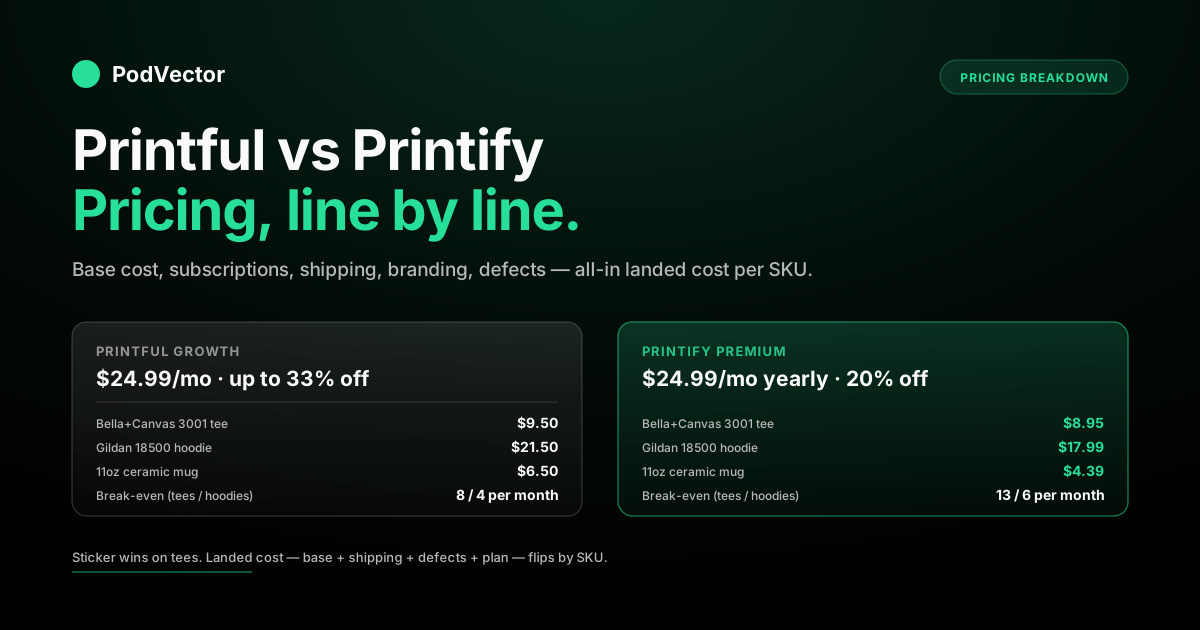
Quick Answer: On base price, Printify wins. A Bella+Canvas 3001 tee runs $8.95 on Printify Premium versus $9.50 on Printful Growth — and the gap widens to $5–7 per unit on hoodies and heavier garments.
On all-in landed unit cost — base + shipping + branding fees + defects + plan amortization — the answer flips by SKU and region. Printful is often cheaper to actually fulfill, even when its sticker is higher.
Below: the side-by-side pricing tables, the subscription math (Growth vs Premium break-even), and the cost lines most comparison guides skip.
Headline pricing — what you actually pay
Most "Printful vs Printify pricing" comparisons stop at the sticker on a single tee. That's not the comparison your P&L runs on.
The pricing question has four layers: base product cost, subscription discount, shipping (often paid by you on free-shipping stores), and the per-order extras — branded inserts, inside-collar labels, sample fees, and reprints for defects. Skip any layer and you'll over- or under-shoot your real cost by $1–4 per order.
Here's the 30-second snapshot. Each line gets its own section below.
| Cost line | Printful | Printify |
|---|---|---|
| Bella+Canvas 3001 tee, US base | $12.95 (free) / $9.50 (Growth) | $10.95 (free) / $8.95 (Premium) |
| Gildan 18500 hoodie, US base | $28.95 (free) / $21.50 (Growth) | $22.49 (free) / $17.99 (Premium) |
| 11oz ceramic mug | $8.95 (free) / $6.50 (Growth) | $5.49 (free) / $4.39 (Premium) |
| Subscription | Growth: $24.99/mo, up to 33% off | Premium: $29/mo (or $24.99 yearly), 20% off |
| US shipping, single tee | ~$4.69 | ~$5.19 |
| Branded inside-collar label | $2.49 / item | $2.50 / item (provider-specific) |
| Pack-in marketing insert | $0.50 / pack-in | Not native — provider-specific |
| Free Growth/Premium milestone | Free Growth after $12k annual sales | None |
Numbers reflect 2026 published catalogs in the US for sellers in the US. Pricing on either platform changes quarterly — always verify against the live catalog before committing your unit economics. For the line-by-line walkthrough on each platform individually, see the complete guide to Printful costs and fees and the complete guide to Printify costs, fees, and discounts.
Base product cost: tee, hoodie, mug, canvas
Base cost is the line that drives the "Printify is cheaper" narrative. The narrative is correct — but the size of the gap depends heavily on which SKU you're pricing.
Standard apparel
On the benchmark Bella+Canvas 3001 unisex tee, Printify Premium beats Printful Growth by $0.55 per unit. Small per shirt. Real at scale — a store running 1,000 tees a month is leaving roughly $550 on the table by listing on Printful instead of Printify.
The gap widens on heavier garments. A Gildan 18500 hoodie costs $21.50 on Printful Growth and $17.99 on Printify Premium — a $3.51 per-unit gap. On a hoodie-heavy fall catalog, that's $3,500 a month in margin at 1,000 orders.
One thing that's changed recently: Printful pushed through 6–9% base-price cuts across much of its apparel catalog, which narrowed — but didn't close — the gap on flagship SKUs. Printify still wins the headline on standard tees and mugs, just by less than older comparison guides report. Re-check both live catalogs before you lock a price; the spread moves every quarter.
On premium fabrics (tri-blends, ringspun cotton at 4.3oz+, organic certifications), Printful's catalog is tighter and the per-unit gap shrinks. On a Bella+Canvas 6004 women's slim tee or a Comfort Colors 1717 garment-dyed tee, Printful and Printify Premium often land within $0.50 of each other.
Non-apparel
The mug is where the catalog difference is loudest. An 11oz ceramic mug runs $6.50 on Printful Growth and $4.39 on Printify Premium — a 32% gap. Phone cases run similarly: Printful at $9–13 depending on model, Printify at $4–8 from top providers.
Wall art is split. Standard 12x18 posters land within $1 on both platforms. Framed canvas at non-standard sizes (16x24, 24x36) runs cheaper on Printify because more providers compete inside the catalog.
Embroidered goods reverse the pattern. Printful's embroidery has been in-house for years and runs $4–6 cheaper per unit than Printify's top-tier embroidery providers, with significantly tighter consistency.
What this means for catalog mix
If your catalog leans heavy on standard apparel and mugs, Printify Premium produces meaningfully cheaper base costs. If your catalog is embroidery-heavy or premium-fabric apparel, Printful's pricing closes the gap or wins outright. Most sellers don't have a homogeneous catalog — which is why platform-level pricing answers don't generalize. See Printify's most profitable products for the catalog mix that actually moves volume.
Subscription tiers: Growth vs Premium
Both platforms charge $24.99 a month at parity (Printify Premium yearly billing matches Printful Growth's monthly fee). The discount each plan unlocks is what separates them.
Printful Growth — $24.99/month
- Up to 33% off product costs on the most-discounted SKUs (less on others — average effective discount runs 20–25% on a typical apparel-led store).
- 9% off branding fees.
- 20% off sample orders (one discounted sample a month, with more unlocked at sales milestones).
- Free background removal in the design tool.
- Free Growth tier after $12,000 in annual sales — the milestone resets each year.
The Growth-tier discount is heaviest on Printful's flagship SKUs (Bella+Canvas tees, Gildan hoodies, AS Colour basics). It's lighter on premium garments and on most non-apparel categories.
Printify Premium — $29/month or $24.99/month yearly
- 20% off product costs across the catalog — flat discount, no per-SKU variation.
- Up to 10 stores on Premium (vs 5 on Free).
- Self-serve product personalization.
- No annual sales milestone — the subscription is permanent.
The Premium discount is more uniform than Printful's. You don't get the headline 33% on any single SKU, but you do get 20% on every SKU including all-over print, mugs, framed canvas, and the long-tail catalog Printful doesn't cover.
Which discount math wins
The right answer depends on catalog shape, not on the headlines.
- Apparel-heavy store on flagship SKUs: Printful Growth's 30%+ discount on tees and hoodies often beats Printify Premium's 20%.
- Mixed catalog with mugs, phone cases, all-over print: Printify Premium's 20%-on-everything wins, because Printful's deepest discounts don't apply to most of your catalog.
- Volume seller crossing $12k/year: Printful's free Growth milestone meaningfully changes the math for the second year onward.
Read the deeper Printful subscription analysis in the complete guide to Printful Premium, Plus, and Pro memberships.
Subscription break-even math
The question both subscriptions answer is: at what monthly volume does the discount pay for the plan? Most sellers eyeball this. The right approach is one line of arithmetic.
Break-even formula
The plan pays for itself at the unit count where (per-unit savings × units sold) equals the monthly fee. Rearranged:
Break-even units = $24.99 ÷ per-unit savings
Worked examples
- Printful Growth, Bella+Canvas 3001 tee: $12.95 → $9.50 = $3.45 saved per unit. Break-even = $24.99 / $3.45 ≈ 8 tees/month.
- Printful Growth, Gildan 18500 hoodie: $28.95 → $21.50 = $7.45 saved per unit. Break-even = $24.99 / $7.45 ≈ 4 hoodies/month.
- Printify Premium, Bella+Canvas 3001 tee: $10.95 → $8.95 = $2.00 saved per unit. Break-even = $24.99 / $2.00 ≈ 13 tees/month.
- Printify Premium, Gildan 18500 hoodie: $22.49 → $17.99 = $4.50 saved per unit. Break-even = $24.99 / $4.50 ≈ 6 hoodies/month.
Reading the numbers
Printful Growth pays for itself faster — about 8 tees a month versus Printify Premium's 13. That's because Printful's discount per unit on its flagship SKUs is heavier. Below those volumes, both subscriptions cost more than they save and you're better off on the free tier.
Above those volumes, both plans compound quickly. A 100-tee/month seller on Printful Growth saves $345 versus the $25 fee — a 13x return. The same seller on Printify Premium saves $200 versus the $25 fee — an 8x return.
The catch: per-SKU savings vary, and most stores aren't pure tee stores. Run the formula against your actual top-5 SKUs by volume, not against a benchmark tee, before committing to either subscription.
Shipping: where the real cost lives
Shipping is the biggest cost most pricing comparisons under-cover. On a single $20 tee order with $5 shipping, the shipping line is 25% of the customer's payment — and on a free-shipping store, it's a direct hit to your margin.
Domestic US shipping
Printful runs slightly cheaper on the standard tee (~$4.69 vs Printify's ~$5.19) because Printful's owned facilities use volume-negotiated US carrier rates. The gap reverses on phone cases — Printify's marketplace lets a tiny accessories-focused provider ship a phone case for $2.59, where Printful charges $4.99 for the same line item.
On hoodies and sweatshirts, Printful's domestic shipping advantage holds: $8.49 vs Printify's $9.99 on a Gildan 18500. On mugs, it reverses — Printify mug providers often beat Printful by $1–2 per shipment.
International shipping
This is the line that decides cross-border POD economics, and it's where the platforms diverge most.
Printful auto-routes each order to the nearest of its facilities (US East/West, EU/Riga, EU/Spain, Mexico, Japan, Australia, Canada). For a US-headquartered store with an EU customer, the order ships from Riga or Barcelona — short distance, EU rates, no customs hit. The seller does no setup. International shipping on a Bella+Canvas tee from Printful runs $4.49 to the UK, $7.19 to Australia, $8.29 to Canada.
Printify's international shipping economics depend on whether you listed the SKU through a regional provider. If your Bella+Canvas tee is listed only through a US Printify provider and the order ships to Germany, the shipping line goes international from the US — slower and pricier. UK shipping on the same tee runs ~$10. Australia runs ~$12.49.
The fix is to list the same SKU through multiple Printify providers — one US, one EU, one AU — and let Printify route by destination. Done well, this beats Printful's international economics. Done lazily, it's significantly worse.
Free shipping break-even
Stores running free-shipping promos eat the shipping line directly. On a $25 retail tee with $4.69 US shipping, free shipping cuts your margin by 19% before you've paid for anything else. The $0.55 base-cost savings on Printify gets erased — and reversed — on any order that ships internationally without per-region routing in place.
For the routing tables and per-region cost breakdowns on each platform, see the complete guide to Printful shipping and the complete guide to Printify shipping.
Branding and extra fees
Branding fees are small per unit, but they add up — and on Printful they apply uniformly while on Printify they're provider-specific.
Printful branding fees
- Inside-collar relabel: $2.49/item. Available on every garment that supports relabeling.
- Outside neck label print: $2.49/item.
- Pack-in marketing insert (postcard, sticker): $0.50/pack-in.
- Custom packing slip with your logo: Free.
- Branded sticker on package: $0.50/order.
Growth subscribers get 9% off these branding fees. Across a 1,000-order month with relabel + insert on every order, the branding line runs roughly $3,000 — meaningful enough to factor into pricing decisions.
Printify branding fees
Printify's branding options are provider-specific. Inside-collar relabeling is available on premium providers like Monster Digital ($2.50/item) but not catalog-wide. Custom packing slips are supported on most major providers. Pack-in inserts are not native to Printify — sellers wanting per-order inserts typically self-fulfill or use a third-party fulfillment add-on.
This isn't a fee disadvantage so much as an architectural one: on Printify, branding consistency is the seller's job, executed per-provider. On Printful, branding is on rails across every order.
Sample order fees
Both platforms charge full base price plus shipping for samples. Printful Growth subscribers get 20% off sample orders (one discounted sample per month, with extra discounted orders unlocking at $100/$300/$500/$1,500 sales thresholds). Printify offers no equivalent sample discount tier. For a seller testing new SKUs, that's $20–40 of monthly savings on Printful Growth.
The hidden costs that move margin
Three cost lines disappear from most "Printful vs Printify pricing" comparisons. They shouldn't.
Defect and reprint cost
A reprint costs you the full base price plus shipping a second time, plus the customer-experience cost of a delayed delivery. Printful's defect rate runs roughly 1% across facilities. Printify's defect rate ranges from 1% on top-tier providers to 4–5% on lower-tier providers.
The math: 1,000 orders/month at $9.50 base + $4.69 shipping = $14.19 reprint cost per defect. At 1% defect rate, that's $142/month. At 4%, it's $568/month. The difference between provider tiers on Printify is real money, and it doesn't show up on any pricing page.
Return and refund cost
POD returns are typically not restocked — the printed garment can't be resold. Whoever absorbs the return absorbs the full cost. On Printful, the return policy is uniform across all SKUs and facilities. On Printify, return rules depend on the provider — some accept returns at no cost, some don't.
For a paid-social store with a 5–8% return rate baseline, a 2-point spread between platforms is worth $1,500–3,000/month at 1,000 orders. Sample-test before committing.
Tax and fee pass-through
Printful and Printify both charge state sales tax on transactions in jurisdictions where they have nexus. The tax line on a $20 tee in California runs roughly $1.50–2.00. This is a wash between platforms, but should be in your unit P&L — many sellers track only the listed base + shipping and discover the tax line in their bookkeeping a quarter later.
Payment processor fees (Stripe, PayPal, Shopify Payments) are also platform-agnostic but real: 2.9% + $0.30 per order is roughly $0.88 on a $20 tee. Skipped from pricing comparisons, baked into your real margin.
All-in landed unit cost (the right comparison)
Sticker price is one cost line. Landed unit cost is the sum of every cost line that hits when you fulfill an order. The comparison that decides margin is the second one, not the first.
Worked example: Bella+Canvas 3001 tee, US shipment
| Cost line | Printful Growth | Printify Premium |
|---|---|---|
| Base product cost | $9.50 | $8.95 |
| Shipping (US, customer-paid or absorbed) | $4.69 | $5.19 |
| Inside-collar relabel | $2.27 (with 9% Growth discount) | $2.50 |
| Pack-in insert | $0.50 | — |
| Defect reserve (1% / 3%) | $0.17 | $0.50 |
| Subscription amortization (1k orders/mo) | $0.025 | $0.025 |
| Landed unit cost | $17.16 | $17.17 |
The platforms tie almost exactly on landed cost for this scenario. The $0.55 base-cost gap evaporates once shipping, branding, defects, and the realistic provider mix are stacked on. This is why "Printify is cheaper" headlines don't generalize.
Worked example: Gildan 18500 hoodie, EU shipment
Same exercise, this time on a hoodie shipping from a US store to a German customer:
| Cost line | Printful Growth | Printify Premium (US-only listing) |
|---|---|---|
| Base product cost | $21.50 | $17.99 |
| Shipping to Germany | $8.29 (Riga facility) | $18.40 (US-to-EU) |
| Defect reserve (1% / 3%) | $0.30 | $1.09 |
| Landed unit cost | $30.09 | $37.48 |
On EU shipments without per-region Printify routing, Printful is $7.39 cheaper per hoodie despite the higher base cost. Listing the same hoodie through a Printify EU provider closes most of that gap — but only if you've set it up. The setup work is the difference.
For the broader Printful vs Printify trade-off across all seven axes, not just pricing, see the full Printful vs Printify comparison.
Scenarios: which is cheaper for your store
The decision pattern depends on three variables: catalog mix, monthly volume, and customer geography. Walk through which one you are.
US-only Etsy seller, mostly tees and mugs, under $5k/month
Printify Premium wins. The base-cost gap on standard apparel and the catalog-wide gap on mugs both favor Printify. Volume is too low to justify Printful's deeper SKU-specific discount tiers. Defect-rate risk is manageable at this volume — sample-test top providers before listing.
US-only Shopify seller, paid-social, hoodie-led, 500–2,000 orders/month
Mixed. Printify Premium's $3–7 hoodie advantage matters at this volume — but so does Printful's lower defect rate on paid social, where every return chips at LTV/CAC. Most sellers in this profile run both: Printful for the brand SKUs, Printify for the margin SKUs. The full case for running both is in Printful alternatives: the complete comparison.
International store, US + EU + AU mix, mid-volume
Printful's auto-routing wins on simplicity. The EU/Riga and AU facilities cut international shipping by 50%+ versus a single-provider Printify setup. Printify can match this — but only after you list every flagship SKU through three regional providers. If you'll do the setup work, Printify wins. If you won't, Printful does.
Brand-first seller, premium garments and embroidery
Printful wins on both pricing and quality. Printful's embroidery is $4–6 cheaper than Printify's top-tier embroidery providers, and the consistency premium matters when the brand is the product. Pricing comparisons that look only at base apparel miss this entirely.
High-volume seller crossing $12k/year
Printful's free Growth milestone changes the calculus from year two onward. Past $12k, the subscription is free — and the 25–33% discount continues to apply. For a $50k/year apparel seller, that's roughly $300/year of subscription savings plus the SKU-discount compounding. Printify Premium has no equivalent milestone.
The pricing question only your data can answer
Every pricing comparison above — including this one — gives a platform-level answer. Pick A for X profile. Pick B for Y profile.
The actual pricing question your P&L runs on is per-SKU. On your Bella+Canvas 3001 in heather grey, shipping to your top region, with your ad-blended customer acquisition cost, which supplier produces a higher contribution dollar per order? The answer changes by garment, region, volume, and season.
None of the public pricing articles fill this gap. They quote averages — $4 base-cost difference, $4.69 shipping, 1% defect rate — and stop there. Your unit P&L runs on specifics, not averages.
Closing the gap takes three pieces working together. Every order's supplier-charged cost has to flow into a single source of truth alongside revenue, ad cost, refunds, and processor fees. The math has to run per-SKU and per-supplier so a tee that's profitable on Printify and a hoodie that's profitable on Printful both surface clearly. The answer has to refresh fast enough to act on — switching a single SKU's supplier weekly is high-leverage if the data is fresh, useless if it's a quarter old.
This is the architecture PodVector AI built Victor on. A unified data warehouse ingests Shopify, Printful, Printify, Meta, and Google per-order data, then lets you ask "which supplier is cheaper on my hoodies in EU shipments?" or "which SKU's margin would improve if I switched suppliers?" in plain English. The answer isn't always Printful or always Printify. The answer is per-SKU — and a POD seller without per-SKU supplier data is guessing on the most expensive lever in the business.
For more on the underlying profitability picture per platform, see is Printify profitable and how to make money with Printful.
FAQs
Is Printify cheaper than Printful?
On base product cost, yes — by $0.55 to $7 per unit depending on the SKU. On all-in landed cost (base + shipping + branding + defects + subscription amortization), the answer flips by garment, region, and store profile. On EU shipments without per-region Printify routing, Printful is often cheaper. On US-only standard apparel, Printify usually wins.
Which subscription is the better deal — Printful Growth or Printify Premium?
Both cost the same at parity ($24.99/month for Printful Growth, $24.99/month yearly for Printify Premium). Printful Growth's per-SKU discount is heavier on flagship apparel (up to 33%); Printify Premium's 20% applies uniformly across the larger catalog. Apparel-led stores often save more on Printful Growth. Mixed-catalog stores often save more on Printify Premium.
What's the break-even volume for Printful Growth?
Roughly 4–8 garments a month, depending on which SKU you're selling. Hoodies break even faster ($7.45 saved per unit means break-even at 4 hoodies). Tees break even at 8 ($3.45 saved per unit). Below those volumes, you're better off on the free tier.
What's the break-even volume for Printify Premium?
Roughly 6–13 garments a month. Hoodies break even at 6 ($4.50 saved per unit). Tees break even at 13 ($2.00 saved per unit). The break-even is higher than Printful Growth's because Printify's flat 20% discount is shallower than Printful's deepest per-SKU discounts.
How much does Printful's $12k/year free Growth milestone matter?
For sellers crossing $12k in annual sales, it's roughly $300/year of recurring subscription savings, plus the per-SKU discount compounding. For sellers below $12k/year, it doesn't apply. Printify has no equivalent milestone — Premium remains a paid subscription regardless of volume.
Does Printify's lower defect risk wipe out the base-cost savings?
Sometimes. On lower-tier Printify providers running 4–5% defect rates, the reprint cost on a $14 landed-cost tee adds roughly $0.50/order to your real cost — which can erase the base-cost gap on standard apparel. Top-tier Printify providers run 1% defect rates and don't have this problem. Provider selection is the variable.
Are there hidden fees Printful and Printify both charge?
State sales tax in nexus jurisdictions, payment processor fees (2.9% + $0.30 from Stripe/PayPal), and Shopify/Etsy transaction fees on the storefront side. None of these are platform-specific — they're a wash between Printful and Printify but should still be in your unit P&L.
How do shipping costs compare between Printful and Printify?
Printful runs slightly cheaper on US apparel shipping (~$0.50 less per tee) and significantly cheaper on international shipping when the destination matches one of its facilities. Printify can match or beat Printful's international shipping if you list the same SKU through multiple regional providers — but the setup work is real.
Can I run both Printful and Printify on the same store?
Yes — and most established POD sellers do. Both apps run in Shopify and Etsy without conflict. Route different SKUs to different suppliers based on margin, geography, or quality. The only added work is per-supplier mockup generation and per-supplier sample ordering. The case for the multi-supplier approach is in Printful alternatives: the complete comparison.
Where can I see the full Printful vs Printify comparison beyond pricing?
Pricing is one of seven axes. The full breakdown — business model, catalog, print quality, fulfillment, integrations, branding — is in the full Printful vs Printify comparison. The Printful comparison cluster lives at the Printful comparison hub and the broader Printful topic at the Printful topic hub.
Stop comparing platforms. Compare suppliers per SKU.
The right Printful vs Printify pricing answer changes by garment, region, and season. Spreadsheet comparisons go stale within weeks. Victor pulls every order, every supplier-charged cost, every shipping line, and every refund into one live data layer — then lets you ask "which supplier is more profitable on my hoodies shipping to the EU?" in plain English. POD-native unit economics, no spreadsheets.
Try Victor freeFor external context on the same axes, the Merch Titans 2026 Printful vs Printify breakdown covers similar ground with a heavier focus on quality. To go broader on Printful, see the complete Printful guide; for Printify, the complete Printify guide.