
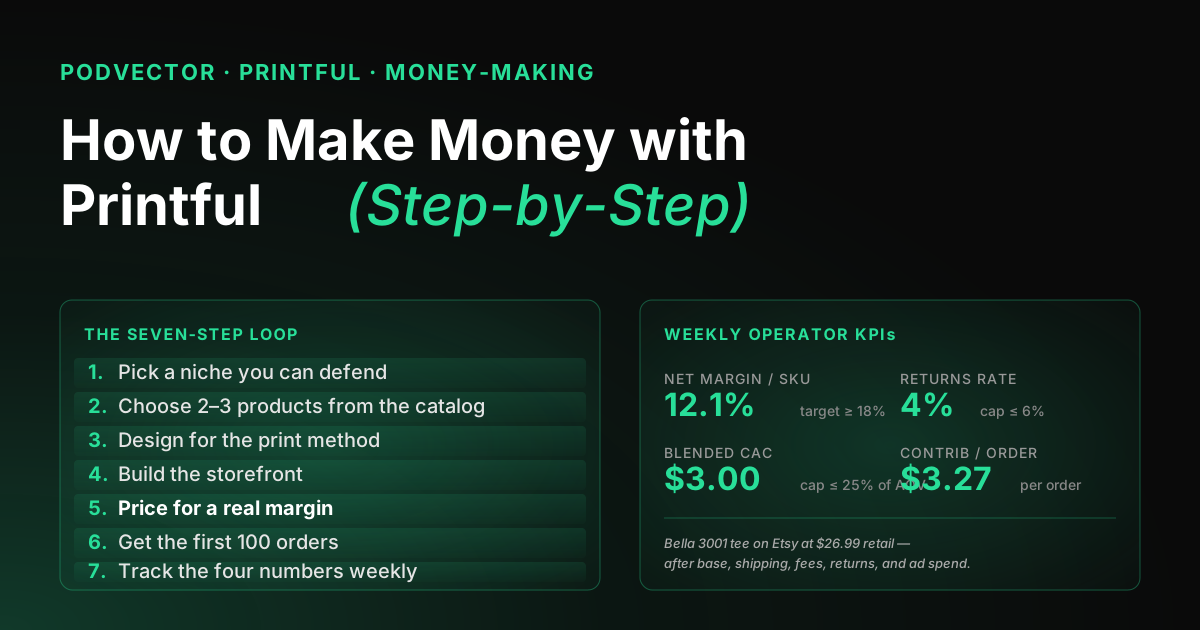
Quick Answer: Making money with Printful is a seven-step loop — pick a profitable niche, validate it with the catalog, design for one fulfillment method, build the store, price for a real (not a fantasy) margin, drive traffic, then track unit economics weekly and reprice or cut SKUs that go underwater.
Most "how to start with Printful" guides stop at step four. The money is in steps five through seven, where you discover that your "30% margin" tee is actually losing $1.10 per order after returns, ads, and your time.
This guide walks the full loop in operator language, with the formulas, the cost lines most beginners skip, and the weekly metrics that tell you whether you're building a business or a hobby.
Why most Printful sellers don't make money
The Printful pitch is honest about the parts that are easy. No inventory, no minimum order, integrations with Etsy and Shopify, a catalog of 350+ products. You really can list a shirt in an afternoon.
The pitch is quieter about the parts that are hard. Printful's base costs are higher than Printify's by 15–30% on most apparel, so the math you copy from a generic POD blog post breaks the moment you price against an Etsy competitor using Printify Choice.
Most beginners hit the same wall: they design five tees, list them at $24.99, sell three a week, and discover after sixty days that each order netted them $1.40 once ads, fees, and one return are subtracted. That's not "making money with Printful." That's a $4-an-hour part-time job.
The fix isn't to abandon Printful. It's to treat the seven steps below as a unit-economics exercise, not a content-creation exercise. Print-on-demand is a margin game first and a design game second.
Step 1 — Pick a niche you can defend
The mistake here is picking a niche you find interesting. The right move is picking one where the buyer is already willing to pay a premium for a shirt that says exactly the right thing.
A "niche" in POD terms is a buyer identity narrow enough that your designs talk to that person directly. "Funny dog shirts" is not a niche. "Funny shirts for German Shepherd owners who do nose-work training" is a niche. The second one has fewer competing sellers and a buyer who recognizes themselves in the design language.
Three checks before you commit:
- Search demand. Type the niche into Etsy's search bar — if you see 10,000+ listings already, the keyword is saturated. Aim for niches where the long-tail returns 1,000–5,000 listings.
- Buyer income. Hobbies that already involve $200+ purchases (climbing, sailing, custom keyboards, motorsports) tolerate a $30 tee. Hobbies dominated by teens don't.
- Design fluency. Can you generate ten on-brand design ideas in a single afternoon? If you have to research the niche for a week to write one funny line, the niche isn't yours.
The Printful blog's own niche advice is broader and worth reading as a starting point: their six-step POD primer walks through niche selection in more detail.
Step 2 — Choose 2–3 products from the Printful catalog
New sellers try to launch on six product types because the dashboard makes it easy. Don't. Each new product type adds a new base cost, a new shipping rule, a new return profile, and a new design template to manage. Pick two — three at the most — for the first 90 days.
The Printful catalog winners for beginners, by margin and demand:
- Unisex tee (Bella+Canvas 3001 or Gildan 5000). Base cost ~$11–14, retail $22–32, the most-searched POD product on Etsy. Forgiving on design.
- Premium pullover hoodie. Base cost ~$32–38, retail $48–65. Higher AOV (average order value) and better dollar margin per order than tees.
- Stickers, mugs, or posters as upsells. Low-base-cost SKUs ($4–8) that ride along on tee orders and lift AOV without adding fulfillment complexity.
Avoid all-over-print products, embroidered apparel, and anything with a "Premium" or "Plus" upcharge for your first 90 days. The base costs are 30–60% higher and your retail price has to absorb that without scaring the buyer. For the full landed-cost picture across the catalog, the cluster pillar on Printful as a fulfillment partner tracks updates as Printful's pricing shifts.
Step 3 — Make designs that survive the print method
A design that looks good on a screen does not always look good after it's been digitally printed onto cotton. The print method matters more than most beginners realize.
Printful runs three print methods: DTG (direct-to-garment) for tees and hoodies, DTF (direct-to-film) for some apparel, and embroidery for caps and select shirts. Each has its own design rules.
DTG rules: avoid fine outlines under 2pt. Keep design width inside 11 inches so it doesn't wrap weird on smaller sizes. Use bold colors and high contrast — pastels on a heather-grey shirt look washed out in person. Test print on a single sample before listing.
Embroidery rules: max 6 thread colors, no gradients, minimum text size 0.2 inches. Beginners who try to embroider a photorealistic logo end up paying for samples that look nothing like the mockup.
Design tools to start with: Canva for fast iteration, Kittl or Adobe Illustrator for typography-driven niches (vintage tees, motivational quotes), and Printful's own Design Maker for quick A/B variants. AI tools like Midjourney are fine for concept art but require cleanup in a vector editor before they print well at scale.
Plan to ship 10–15 designs across your 2–3 products for the launch — enough variety that the store doesn't look thin, few enough that you can re-design the misses by week six.
Step 4 — Build the storefront (Etsy, Shopify, or both)
The platform choice changes the whole economics, so read this section before you set up either.
Etsy: built-in traffic, $0.20 listing fee, 6.5% transaction fee, ~3% payment processing, plus offsite ads (12–15% if you're forced into them). You're paying roughly 9–24% of revenue to Etsy depending on which fees apply. The win: buyers are already shopping, and you can sell your first SKU with zero ad spend.
Shopify: $39/month, ~3% payment fees, no listing fees. You keep more per order but you bring the traffic, which usually means paid ads at $20–40 customer acquisition cost (CAC) until your SEO and social channels mature.
Both: the right answer for most operators after month three. Etsy validates the niche and pays the bills while you build Shopify's organic traffic. Printful connects to both natively, so each order routes to fulfillment the same way.
For the Etsy-specific setup decisions — listing limits, SEO basics, how to avoid the new-shop penalty — see the full money-making cluster; the launch checklists there are platform-specific.
Step 5 — Price for a real margin, not a fantasy one
This is the step that separates the operators from the hobbyists. Most Printful sellers price by adding their "desired margin" to the base cost. That's wrong by every measurable line item.
The right formula has five subtractions, not two:
Retail price
  − Printful base cost
  − Printful shipping (cost line, not "free shipping")
  − Platform fees (Etsy 9–24%, Shopify ~3%)
  − Returns reserve (3–8% of revenue)
  − Ad spend / CAC
  = Net profit per order
Skipping the bottom two lines is how beginners end up with "30% gross margins" that translate to $1.40 net per order. Returns happen on roughly 4% of POD orders (size issues, "didn't love it"), and even organic Etsy traffic eventually requires Etsy Ads or offsite ads to scale beyond the first 30 sales per month.
Worked example, Bella 3001 tee on Etsy at $26.99:
- Base cost: $11.95
- Printful shipping: $4.99
- Etsy fees (9% bundled, ignoring offsite ads): $2.43
- Returns reserve (5%): $1.35
- Ad spend (Etsy Ads $0.40 per click, 2% CVR = ~$20 CAC, blended ~$3 per sold order if half the sales are organic): $3.00
- Net profit: $3.27 per order (12.1% net margin)
That's the honest number. If you don't run that math before pricing, you'll discover it from your bank account in month two. For a deeper walk-through with two more product types, see the Printful profit calculator step-by-step; for category-wide margin context, what you need to know about Printful profit margins in print-on-demand covers the benchmarks by product type.
The product type matters too. Phone cases, for instance, have very different math because the base cost ratio is unusual — see the phone-case margin breakdown if accessories are on your roadmap.
Step 6 — Get the first 100 orders
Order 1 is hard. Order 100 is the first checkpoint where the data is statistically real. Until you cross it, every conclusion you draw about "what's working" is noise.
Three traffic channels that actually move the needle for new Printful stores:
Etsy SEO + Etsy Ads (the fastest 0-to-100). Etsy gives new shops a small visibility boost in the first 30 days. Use it. Run Etsy Ads at $1–3/day per listing to learn which designs convert, then turn off the ones that don't.
Short-form video (TikTok, Reels, Pinterest Idea Pins). Post the design process, the unboxing of your sample, the niche in-joke that the shirt references. Aim for one post per day for 30 days; don't optimize, just publish. A single video that hits 100K views is worth a month of paid ads.
Email and SMS (the most ignored channel). Capture emails at checkout from day one. The second sale to an existing customer costs you zero CAC and lifts your blended margin by 8–12 points. Klaviyo's free tier covers you to 250 contacts.
Note that shipping speed shows up in your reviews and your repeat rate, not just your CAC math. Printful's US-to-US shipping runs about 5–8 business days for most apparel — see Printful shipping time to US and the parallel Printful shipping time US for the route-by-route detail. If your product page promises five days and Printful delivers in nine, your refund rate doubles.
Step 7 — Track the four numbers that matter weekly
Most new sellers track revenue. Revenue is the worst signal of business health. You need the four operator numbers below, refreshed once a week.
- Net margin per SKU. Not blended margin — per individual design. The top two SKUs usually carry the store; the bottom five usually drain it. You can only see this if you track them individually.
- Customer acquisition cost (CAC), blended. Total ad spend ÷ total new customers in the period. If CAC creeps above 25% of AOV, your unit economics are deteriorating.
- Returns rate (units returned ÷ units sold). Above 6% means a fit or quality issue you can fix with a sizing chart update or a SKU swap. Above 10% means you're absorbing a hidden 4-point margin hit nobody told you about.
- Contribution margin per order. Revenue per order minus all variable costs (base, shipping, fees, returns reserve, ads). This is the number that pays for your fixed costs and, eventually, you.
The reason most Printful stores stall at $1–2K/month isn't that the niche dried up. It's that the operator never built a weekly read on those four numbers, so they keep adding designs (which they can see) instead of repricing or cutting the losing SKUs (which they can't).
How long until you're actually profitable
Real numbers, based on operators who get there:
- Month 1–2: 0–30 orders. Negative profit after ad spend. You're paying to learn what converts.
- Month 3–4: 50–150 orders. Roughly break-even if you've cut the losing SKUs. Margin still mostly absorbed by ads.
- Month 5–8: 200–500 orders/month. First real net profit, $400–$1,500/month, assuming you've shifted 30%+ of traffic to organic.
- Month 9–18: $2K–10K/month net for the operators who keep showing up and tracking the four numbers above. Past that requires either a new product line, a wholesale channel, or a paid ads team.
The drop-off between months 3 and 5 is where most stores quit. The math at month 3 looks identical to the math at month 5 — but the operator who survives is the one who has by then cut the bottom-quartile SKUs and re-priced the top quartile.
Five mistakes that kill Printful stores in month two
- Launching with 50 designs. You don't have the data to know which ten matter. Launch with 12–15, cut the bottom half by week six, and reinvest the design time into the survivors.
- Pricing off "gross margin" instead of net. Step 5 exists for this reason. If you can't show net profit per order on a SKU level, you're flying blind.
- Treating Etsy Ads as a tax. They're a research budget. Use them to find converting designs, not to chase a $1 ROAS.
- Ignoring returns. POD returns are 100% on you — Printful does not refund. A 6%+ returns rate on a 12% net-margin SKU eats half your profit.
- No SKU-level reporting. Your Printful dashboard and your Etsy/Shopify dashboard live in different places. The blended view hides the SKUs that are losing money.
FAQs
How much money can you realistically make with Printful in the first year?
Operators who follow the seven steps above and ship designs consistently land in the $200–$2,500/month net profit range by month 9–12. The top decile crosses $5K/month inside year one; they usually have either prior design or marketing experience, or they cross-list to Etsy and Shopify simultaneously.
Is Printful actually cheaper than Printify?
Per unit, no — Printify's base costs are usually 15–30% lower. Printful wins on quality consistency, print accuracy, and US warehouse logistics. The right mental model: Printful is the premium fulfillment partner with higher margins-of-trust; Printify is the cost leader with more vendor variability. Many operators use both — Printful for hoodies and signature SKUs, Printify for high-volume tees.
Do I need a Printful subscription (Growth or Business) to make money?
No. The free tier works fine until you cross ~$2K/month in revenue. Above that, Growth's 7% base-cost discount typically pays for itself within 50 orders/month. Most operators upgrade in month 5–7.
How many designs should I launch with?
12–15 across 2–3 products. Enough that the store doesn't look thin; few enough that you can iterate on each one before launching round two.
What's the fastest way to get my first sale?
Etsy with a tight niche, three Etsy Ads listings at $2/day each, and one mockup per design that uses a real-person model (not a flat lay). The first sale is usually 7–18 days after a polished launch; the listings that convert tell you what to design next.
Should I use Printful or Printify for Etsy?
Printify is usually cheaper per unit on Etsy; Printful is usually more consistent on quality and easier to operate. If you're prioritizing margin in a price-sensitive niche, Printify Choice. If you're building a brand where reviews and reorders matter, Printful. Many sellers run both.
Can I use AI to do this faster?
AI helps on the inputs (design ideation, listing copy, photo enhancement). Where it changes the game is on the analytics side — agentic AI agents can answer "which SKU is losing me money this week" against your own sales data, without you building a spreadsheet. That's the difference between treating POD as a craft and treating it as a business.
Stop guessing. Ask your data.
The hardest part of making money with Printful is not picking the niche. It's seeing the seven metrics from step 7 in one place, every week, without spending Sunday afternoons in a spreadsheet.
Victor is an AI agent that connects to your store and your Printful account, pulls everything into a single source of truth, and answers operator questions in plain English. "Which SKU lost me money last month?" "What's my real net margin after returns?" You ask. Victor answers.
Victor reports and acts with your approval — repricing the losing SKUs and pausing the underperforming ads while you're designing the next drop.
Try Victor free