
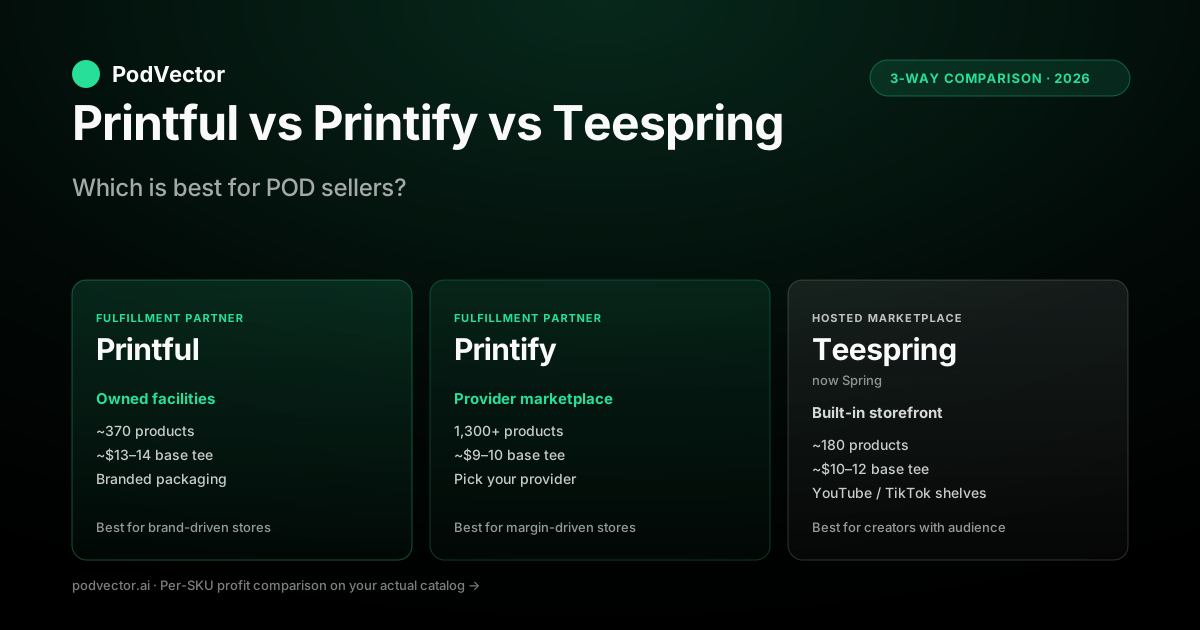
Quick Answer: Printful, Printify, and Teespring are not the same kind of product. Printful and Printify are fulfillment partners you plug into your own Shopify or Etsy store. Teespring (now branded Spring) is a hosted marketplace that prints and sells on its own platform.
Pick Printful if you run a brand-driven store on Shopify and want owned-facility quality. Pick Printify if you want the lowest US base costs and the widest catalog across third-party providers. Pick Teespring/Spring if you don't have a store yet and want a built-in audience plus zero setup.
The trap is comparing all three on "ease of use" or "price" without first deciding whether you want to build a store you own or sell inside someone else's marketplace. That decision changes everything below.
The 3-way decision in 60 seconds
Three platforms, two fundamentally different business models. Printful runs its own print facilities in the US, Canada, Mexico, Latvia, the UK, Spain, and Australia. Printify is a marketplace stitching 100+ third-party print providers together. Teespring/Spring is a hosted marketplace — it provides storefronts, fulfillment, and shopper traffic on a single platform.
That architectural difference cascades into everything else. Printful and Printify expect you to bring your own ecommerce store. Teespring/Spring expects you to bring your audience and let Spring host the rest. You're picking a model first, then a supplier.
The rest of this article unpacks each category — pricing, catalog, integrations, shipping, ease of use, support, branding — with the trade-offs each platform's marketing pages skip.
A note on Teespring vs Spring
Teespring rebranded to "Spring" in 2021. Most sellers still search "Teespring," and the underlying service is the same, so we'll use both names interchangeably. The platform is now part of Amaze.co's creator ecosystem and leans heavily into integrations with TikTok, YouTube, and Twitch creator stores.
If you read a 2019 review of Teespring, much of it is outdated. The marketplace model is still core, but the modern Spring product is closer to a creator commerce platform than a t-shirt site.
Side-by-side snapshot table
Use this as the orientation, not the decision. Each row hides nuance unpacked further below.
| Dimension | Printful | Printify | Teespring / Spring |
|---|---|---|---|
| Business model | Fulfillment partner (owned facilities) | Fulfillment partner (marketplace of providers) | Hosted marketplace + creator storefronts |
| Monthly fee | Free; Pro Membership ~$25/mo (optional) | Free; Premium $29/mo (optional) | Free |
| Base unit cost (Bella+Canvas 3001 tee) | ~$13–14 | ~$9–10 (top providers) | ~$10–12 base, paid out as margin |
| Product catalog | ~370 products | 1,300+ products | ~180 products |
| Storefront included | No (use Shopify/Etsy/etc.) | No (use Shopify/Etsy/etc.) | Yes (built-in) |
| Ecommerce integrations | 20+ (Shopify, Etsy, WooCommerce, Wix, BigCommerce, Squarespace, Amazon, eBay…) | 10+ (Shopify, Etsy, WooCommerce, Wix, BigCommerce, eBay…) | Limited (Shopify integration via Spring; YouTube/TikTok product shelf) |
| Print quality control | Single owned QA team | Varies by provider | Varies by Spring's fulfillment partners |
| Branded packaging | Yes (inserts, neck labels, custom packaging) | Limited (provider-dependent) | No |
| Best for | Brand-driven Shopify/Etsy stores | Margin-driven Shopify/Etsy stores | Creators monetizing an existing audience |
Business model: fulfillment partner vs marketplace
This is the section that should drive your decision. Everything else is a detail under it.
Printful and Printify exist to print and ship orders that originated on a store you own. You handle branding, customer acquisition, customer service, and the relationship with the buyer. They handle production and shipping.
Teespring/Spring exists to host the store, print the order, ship the product, handle customer service, and provide some level of traffic via its marketplace and creator integrations. You handle design and audience promotion.
The trade is direct. Printful and Printify give you more control and more upside; you have to build the store. Spring gives you less control and less upside; you don't have to build anything.
For a working POD operator who already runs Shopify or Etsy, Spring is rarely a primary supplier. It's a side-channel for creators who want a quick storefront on YouTube or TikTok. For Shopify operators comparing Printful vs Printify, see the 2025 Printify vs Printful breakdown for the head-to-head fulfillment-partner comparison.
Pricing, profit margins, and fees
Three different pricing models. Compare them on what they actually cost you per order, not on the surface line items.
Printful
No monthly fee to use the platform. Per-unit base cost is the highest of the three on most apparel — a Bella+Canvas 3001 tee runs ~$13–14 base with one front print. Pro Membership at ~$25/month unlocks roughly 5–7% off and design tools. Breakeven on the membership is around 30–50 orders/month on apparel.
You set retail price. Margin is whatever you charge above base + shipping.
Printify
No monthly fee for the standard plan. Same Bella+Canvas tee through top-tier Printify providers (Monster Digital, Swiftpod, Marco Fine Arts) runs ~$9–10 base. Premium plan at $29/month unlocks 20% off product prices — breakeven is around 25–35 orders/month for most apparel-heavy stores.
Margin works the same as Printful: you set retail, you keep the spread.
Teespring / Spring
No monthly fee. The pricing model is different — Spring sets a "base cost" per product (the production cost), and you set a "listed price" on top. Spring takes the production cost and you take the rest. There's no separate base-cost-plus-shipping-plus-tax math the buyer sees; the customer just sees your listed price.
The effective base on a basic tee runs ~$10–12 depending on color and size, which sits between Printify's cheapest providers and Printful's premium prints. Spring also offers volume incentives — bigger creator drops can negotiate lower base costs.
Where the real cost differences show up
Surface base cost is half the story. The full per-order cost includes shipping rate cards, transaction fees, returns / reshipment cost, payment processing, and platform commissions.
Spring takes a cut by setting the base — you pay that on every sale. Printful and Printify charge you their base + shipping, and your storefront (Shopify, Etsy) takes its own cut. Etsy's transaction fees in particular eat ~6.5% + listing + ad fees before shipping math.
The honest comparison is per-order net margin on your actual SKUs and prices, not the cheapest base-cost row on a feature page. That's the comparison most sellers actually need — covered further below.
Product catalog and quality
Catalog breadth diverges sharply across the three.
Printful (~370 products)
Curated catalog. Mostly apparel, accessories, posters, mugs, phone cases, and a small home decor line. The pitch is "the things we can print well with consistent quality," not "everything you could ever sell."
Quality is the platform's main marketing claim, and the data supports it. Operator-reported defect rates run around 1% on premium SKUs, with one QA team across all owned facilities. If your store leans on repeat purchase rate and brand reputation, that consistency is the lever.
Printify (1,300+ products)
Marketplace catalog. You pick the product, then pick which provider in Printify's network prints it. The same Bella+Canvas tee might be available from 5+ providers with different prices, shipping origins, and quality reputations.
Catalog depth is the win. Specialty items Printful doesn't carry — pet products, expanded drinkware, niche home goods, certain athleticwear — show up on Printify. The cost is variance. Quality depends on which provider routes your order, which depends on which SKU and provider you've selected.
Teespring / Spring (~180 products)
Narrowest catalog of the three. Tees, hoodies, sweatshirts, mugs, stickers, phone cases, and a curated set of accessories. The product list is designed to match what creators sell to fans — merch, not a general POD storefront.
Quality is generally good for the core apparel categories but less marketed than Printful's. Spring outsources fulfillment to a handful of partners that change over time, so per-SKU quality can shift if Spring switches providers.
Integrations and store setup
This is the category where Spring's marketplace model shows up sharpest.
Printful
The most ecommerce integrations of the three — 20+ platforms including Shopify, Etsy, WooCommerce, Wix, Squarespace, BigCommerce, Webflow, Ecwid, Square Online, Amazon, eBay, TikTok Shop, and direct API access. Order sync, inventory sync, tracking sync — all automatic on the major platforms.
Printify
Similar integration list (Shopify, Etsy, WooCommerce, Wix, BigCommerce, eBay, TikTok Shop, Squarespace, Wish, Walmart). Slightly fewer than Printful overall, but covers every major store platform a POD seller would actually use.
Teespring / Spring
Different model. Spring is the storefront, not the integration. You get a built-in storefront page, plus product-shelf integrations on YouTube, TikTok, Twitch, Instagram, and a Shopify app that syncs Spring products into a Shopify catalog.
If you want a "real" ecommerce stack — your own Shopify store, your own domain, your own analytics, your own customer list — Spring fights you on it. If you want a creator storefront that lives next to your YouTube videos and TikTok lives, Spring is built for it.
Winner depends on your goal
For Shopify or Etsy operators: Printful, then Printify. For creators monetizing existing video / streaming audiences: Spring is purpose-built. Mixing platforms is normal — many creators run a Shopify store with Printful for branded merch and a Spring store linked from YouTube for fast drops.
Shipping and fulfillment
Three different fulfillment architectures, three different reliability profiles.
Printful
Owned facilities in the US (NC, CA, FL), Canada, Mexico, Latvia, UK, Spain, and Australia. Production time on apparel runs ~2–5 business days; shipping adds 3–7 domestic, 5–14 international.
The advantage is consistency. Because one QA team handles every order, ship-time copy on your product page actually matches what buyers experience. Fewer "where's my order" tickets, fewer refund requests over delays.
Printify
No owned facilities. Production routes to whichever third-party provider you picked for that product. Top US providers (Monster Digital, Swiftpod) ship fast — often 3–5 business days production. Other providers run slower or have peak-season variance.
The lever you have: provider selection. If a provider's quality or speed slips, you can swap to another for the same SKU. Printful doesn't let you do that — you're locked to their facilities.
Teespring / Spring
Fulfillment is hidden behind Spring's branding. Spring routes orders to its partner network and the customer sees Spring branding on the package. Typical production runs ~3–7 business days; shipping adds 3–8 domestic.
You don't pick the fulfillment provider. Spring picks, and you accept the quality and speed they deliver. For most creator stores this is fine — the audience already trusts the creator, not the platform.
Ease of use
Spring wins this category by default because you don't have to set up a store.
Teespring / Spring — fastest start
Sign up, upload a design, pick products, publish. The store URL is yourstore.creator-spring.com. Customer service, payment processing, tax handling — Spring covers all of it. Time from sign-up to first listed product: minutes.
Printful — fastest store-builder workflow
Slightly heavier setup because you need a store first (Shopify, Etsy, etc.). Once connected, the Printful workflow — pick product, upload art, generate mockups, publish — is the cleanest in the category. Design tool has ~25,000 graphics and a strong mockup library.
Printify — most flexibility, more decisions
Same general workflow as Printful, but with an added step: pick which provider prints your design before publishing. That's an extra decision per SKU, which is power if you know what you're doing and friction if you don't.
Customer support
Three different support structures.
Printful runs a single internal support team handling all issues. 24/7 chat and email. Response times typically under a few hours during business hours. Refund and reshipment policy is clear and consistently applied.
Printify support is internal for billing and platform issues but routes fulfillment problems (defective prints, missing orders) to the underlying provider. For multi-provider stores, that means slightly slower resolution and inconsistent provider quality on disputes.
Spring handles customer service end-to-end because they own the buyer relationship. You don't field "where's my order" tickets — Spring does. The trade is that you also don't own that customer email or remarketing list.
Branding and customization
The white-label question. Whose brand is on the package?
Printful offers the deepest branding tier: custom neck labels, branded inserts, custom packaging, and custom return addresses. Buyers see your brand, not Printful's. This matters most for brand-equity-dependent niches (cause-based merch, fashion-forward apparel, high-AOV gift stores).
Printify offers branding on a provider-dependent basis. Some providers support neck labels and inserts; others don't. Less consistent than Printful.
Teespring/Spring offers minimal branding — the package and the storefront URL carry Spring's branding. That's by design: Spring is selling its own marketplace credibility to buyers, not yours.
Pick X if Y
The decision framework, distilled.
Pick Printful if
You run a Shopify or Etsy store, you sell apparel at $25+ AOV, your niche rewards brand equity (repeat purchase rate above 10%), and you want a single supplier you can stop thinking about. Printful's higher base costs pay back through fewer defects, fewer support tickets, and stronger brand consistency.
Pick Printify if
You run a Shopify or Etsy store, your buyers are US-heavy, you sell at lower price points where unit cost is the margin driver, and you have a wide catalog including products Printful doesn't carry. Printify's lower base costs and broader catalog compound when volume scales.
Pick Teespring / Spring if
You're a creator with an existing audience on YouTube, TikTok, Twitch, or Instagram, and you want a zero-setup storefront that lives next to your content. Spring is also the right call if you genuinely don't want to run a store at all — you just want to upload merch and let the platform handle everything else.
Don't pick Spring if
You want to build a brand, own your customer list, run paid ads to a controlled funnel, or treat POD as a real business. Spring's marketplace model fights all of those goals by design — that's not a flaw, just a different product.
Running more than one at the same time
Most established POD operators in 2026 don't pick one platform. They route by SKU and channel.
A common stack: Shopify store running Printful for branded apparel (where consistency and inserts matter), Printify for accessories and oddball SKUs Printful doesn't carry, and a separate Spring storefront linked from YouTube or TikTok for creator-driven drops where the audience is on the platform anyway.
The complexity cost is real — three suppliers means three sets of reports, three pricing models, three quality profiles to track. The margin upside usually pays back if you have the operations bandwidth to manage it.
The comparison most sellers actually need
Every comparison article — including this one — ranks the platforms on category averages. "Printful wins on quality." "Printify wins on cost." Those statements are directionally true and operationally useless for the question you're actually asking, which is: on my specific catalog, at my actual sales mix, after every fee and refund, which supplier produces the most profit per order?
That answer lives in your store data, not in a comparison chart.
It's the kind of question POD operators ask Victor — PodVector AI's intelligent agent for your store — because it's the gap between "feature page math" and "what actually shows up in my P&L." Victor pulls your Shopify orders, your Printful or Printify invoices with itemized supplier costs, and your ad spend into a live data warehouse, then answers "which supplier is most profitable on my top 20 SKUs?" in plain English — and proposes specific actions (price changes, supplier swaps for specific products) you can approve in one click.
The platform comparison is the orientation. The per-SKU profit comparison on your own catalog is the decision.
FAQs
Is Teespring the same as Spring now?
Yes. Teespring rebranded to "Spring" in 2021, and the parent company Amaze.co positions it as a creator commerce platform. The underlying merch service is the same; the brand and the integrations have expanded.
Can I use Printful and Teespring together?
Yes, and many creators do. Run Printful through your Shopify or Etsy store for branded merch, run Spring as a separate storefront linked from your video / streaming channels. The two address different audiences and don't conflict.
Which has the lowest base cost?
Printify on top-tier providers — typically $3–5 below Printful and $1–3 below Spring on standard apparel. The catch is provider variance: Printify's cheapest providers aren't always the fastest or most consistent.
Which has the best print quality?
Printful's owned-facility model produces the most consistent print quality across SKUs. Printify's quality depends on which provider you pick — top providers match Printful, lower-tier providers don't. Spring's quality is generally solid on apparel but less marketed as a differentiator.
Can I sell Teespring products on Shopify?
Yes, Spring offers a Shopify app that syncs Spring products into a Shopify catalog. The fulfillment still happens through Spring's partners, and the order flow runs through Spring's system. For most Shopify operators, using Printful or Printify directly is simpler — Spring's Shopify integration is mostly for creators who already have a Spring store and want to embed it in a broader Shopify presence.
Which one is best for beginners?
For creators with an audience already: Spring, because there's no store to build. For everyone else building a POD business from scratch: Printify is the most forgiving — broad catalog, low base costs, and free to start. Printful's higher costs pay back when you've validated demand and want brand consistency.
Do any of these handle international shipping well?
Printful has the strongest owned international footprint (Latvia, UK, Spain, Mexico, Canada, Australia). Printify has international providers but quality varies. Spring ships internationally through its partners but the rates and times depend on which fulfillment partner Spring routes the order through.
How do profit margins compare?
On a $25 retail tee: Printful nets ~$8–10 after base and shipping, Printify nets ~$11–13 on top providers, Spring nets ~$10–12 after their base. Real margin depends on shipping recovery, refund rate, and platform fees — see the Printify vs Printful cost comparison for the per-order math.
Where does this comparison cover other suppliers like Gelato or Spreadshirt?
The three-way Printful vs Printify vs Gelato breakdown is here — Gelato's distributed network model handles EU and APAC shipping better than any of the three above. The full Printful topic hub at /articles/printful and the broader Printful comparison cluster cover Spreadshirt, Redbubble, Gooten, and other supplier head-to-heads.
How do Pro Membership and Premium plans factor in?
Printful's Pro Membership and Printify's Premium plan both unlock per-unit discounts that change the per-order math significantly at volume. The breakeven analysis lives in Printful Pro Membership cost breakdown and the historical Pro Membership pricing breakdown for sellers comparing tiers over time.
Where can I read other operator comparisons?
Bootstrapping Ecommerce runs a category-by-category 3-way comparison that's worth scanning for a second perspective on quality and shipping. Their methodology weights ease of use higher than per-SKU profitability, which lands different conclusions on Spring vs the others.
Stop guessing which supplier is most profitable for your catalog
Printful and Printify both publish feature pages. Neither tells you which one nets the most margin on your SKUs after fees, refunds, and ad spend. Victor pulls your Shopify orders and your Printful and Printify invoices into one live data warehouse, then answers that question per-SKU in plain English — and proposes specific actions (price changes, supplier swaps, promo timing) you can approve in one click.
Try Victor free