
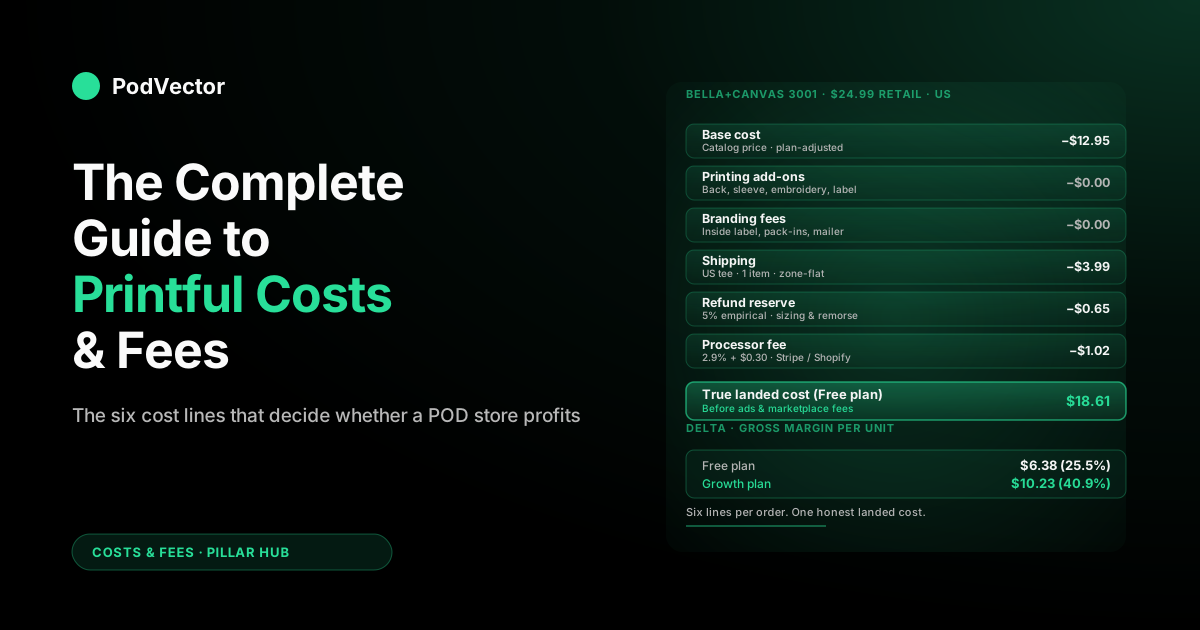
Quick Answer: Printful costs nothing to join — according to Printful's pricing page, there is no signup fee and no monthly charge on the Free plan, and you only pay when an order is placed. But every order carries a six-line cost stack that decides whether a POD store actually makes money: (1) the optional Growth subscription at $24.99/month (free for a year once your store passes $12K in annual sales, per Printful's plans page), (2) the per-product base cost — the Bella+Canvas 3001 tee lists around $13.50 on Free and roughly $10.50 with the Growth discount, (3) printing add-ons like back prints, sleeve prints, and one-time embroidery digitization at $2.95–$6.50 per design, (4) branding charges such as the $0.99 printed inside label and $2.49 outside label, (5) flat-rate shipping by product category and destination zone, and (6) reserve costs — currency conversion on non-USD payouts, customs/VAT on international orders, and reprint/refund cost the seller absorbs unless the defect is Printful's. Plan and fee figures are from Printful's pricing page.
Say you sell that tee at $24.99 with paid traffic behind it: add ad cost per sale and a marketplace take-rate and you can net close to zero on a first-time order. The Growth plan pays back at roughly nine tees a month of consistent volume (worked math below). The fix isn't a cheaper supplier — it's tracking all six lines per order so you actually know your margin instead of guessing.
The Printful cost stack: six lines that hit every order
Printful is marketed as "free to start," and that's technically true — according to Printful's Help Center, there are no setup fees, no order minimums, and a free version is available with no monthly subscription required. The framing is correct for someone deciding whether to open a Printful account.
It is misleading for anyone trying to figure out whether a Printful store will be profitable. Profitability is a function of the full cost stack, and the full stack has six lines that hit every order, not one.
Those six lines are: subscription, base cost, printing add-ons, branding fees, shipping, and reserve costs (returns, FX, customs). The "Printful is free" framing collapses all six into the second one — base cost — and silently buries the other five in the order-confirmation email.
Most new POD sellers discover them sequentially, line by line, the hard way, in their first 90 days. By the time the picture is complete they've usually already priced their products too low to recover from.
This guide walks all six lines explicitly, with numbers checked against Printful's published pricing and POD-specific benchmarks. The goal is that by the end you can compute the true landed cost of any Printful product before you list it — and know within a rounding error what your margin will actually be after all six lines clear. For a detailed breakdown of how these plans are structured see our Printful pricing and monthly fee full breakdown; for the per-category shipping deep dive see the Printful shipping cost full breakdown.
Printful subscription plans: Free, Growth, Enterprise
Printful's plan structure consolidated in early 2026: the old Business tier was folded into Growth, leaving two self-serve plans plus a custom-priced Enterprise tier for large-scale brands, according to Printful's plans page. The gating is around discount depth rather than feature access — per Printful, every plan can publish unlimited products, integrate with all supported storefronts, and access the full catalog. The figures below are from Printful's pricing page.
| Plan | Monthly cost | Product discount | Branding discount | Sample orders | Best for |
|---|---|---|---|---|---|
| Free | $0 | None (full base price) | None | 20% off | Validation, side-projects, low volume |
| Growth | $24.99/month (14-day free trial) | Up to 33% off | 9% off | 25% off | Scaling stores; free for a year once sales hit $12K/year |
| Enterprise | Custom pricing | Negotiated | Negotiated | Negotiated | Large-scale, high-volume brands |
Two structural notes worth understanding before you pick a plan. First, the $12K clause is a reimbursement, not a lower price. Printful tracks store revenue against your account; once your yearly sales reach the threshold, Printful covers the Growth subscription for a year, per its plans page. That means the break-even calculation isn't only "at what monthly volume does the discount cover the subscription?" — past the threshold the subscription cost disappears entirely, and the order in which those two crossovers happen matters for cash flow. Second, the discount is on Printful's marked base price, not on the actual marginal cost of producing the unit. Printful sets the base price based on a margin they want to earn; the discount on the Growth plan is essentially Printful sharing more of that margin with you in exchange for the subscription commitment. This is structurally different from a true wholesale discount.
The practical decision matrix: if you're selling fewer than roughly nine tee-equivalent units a month, stay on Free — the discount won't recover the subscription yet (the worked break-even math is below). Past that, Growth is correct and the math is clean. High-volume branded operations should talk to Printful about Enterprise terms directly. For a per-plan deep dive see the Printful pricing and monthly fee full breakdown for POD sellers.
Product base costs: the benchmark SKUs and what they actually cost
Base cost is the largest line in your Printful cost stack — and the line most prospective sellers underestimate when they're sketching out their first product page. The category benchmarks below reflect prices from Printful's pricing page; the Growth column reflects Printful's advertised "up to 33% off" per that same page. EU and AUS fulfillment often prices higher on the same SKU. Treat these as planning figures and confirm against the live product page before you set retail prices.
| Product (US catalog) | Free plan base | With Growth discount | Notes |
|---|---|---|---|
| T-shirts (catalog range) | $9.25–$13.50 | ~$7.00–$10.50 | Budget blanks at the low end, premium blanks at the top |
| Bella+Canvas 3001 unisex tee | $13.50 | ~$10.50 | POD benchmark SKU; what every comparison runs against |
| Hoodies and sweatshirts | $22.00–$27.29 | ~$17.00–$23.35 | Standard blanks at the budget end, premium at the top |
| 11oz white glossy mug | $5.95 | Up to 33% less | Highest-margin POD SKU after stickers |
| Phone cases | $10.95 | Up to 33% less | Inventory turnover risk on outdated models |
| Posters (smallest size) | From $5.50 | Up to 33% less | Wall art; volume-scales well |
These figures are drawn from Printful's pricing page; confirm the live number before setting your retail price, as base costs update periodically. Three things to register from this table that the average pricing roundup glosses over. One, the Bella+Canvas 3001 at the top of the tee range is materially more expensive than the same blank at budget-tier competitors — Printful's premium positioning is real, and on this single SKU it costs you meaningful margin per unit relative to alternatives. For the per-category hoodie breakdown see our Printful hoodie pricing full breakdown. Two, mugs carry outsized unit margin despite their low absolute price — sell the base-price mug at a premium retail and your base-cost margin is substantial, which is why mug-bundle attach rates matter disproportionately to POD store P&Ls. Three, the "up to" in "up to 33% off" does real work. The realized Growth discount varies by product, and accessories often see less than the headline. If your product mix skews toward accessories, the Growth plan's payback period is meaningfully longer than the tee-based math implies.
Printing and embroidery add-ons (the line everyone forgets)
This is the line item that breaks the most first-time POD pro formas. Per Printful's pricing page, the base cost covers one standard print placement. Every additional print location or embroidery upgrade adds a discrete charge that compounds quickly across a product line. The add-on figures below come from Printful's pricing page:
| Add-on | Cost | When it applies |
|---|---|---|
| Back print on apparel | ~$5.25 | Any back design beyond a small label |
| Sleeve print | ~$2.49 per sleeve | Per sleeve — both sleeves doubles the cost |
| Printed inside neck label | $0.99 | Branded inside label replacing the manufacturer tag |
| Printed outside label | $2.49 | Hem or sleeve placement |
| Embroidery digitization (one-time) | $2.95–$6.50 per design | Required for any embroidery; free on Growth sample orders per Printful's plans page |
| All-over print upcharge | Built into product base | AOP SKUs are separately priced — no add-on math |
The compounding is the part to watch. Take a "premium" tee with a front print, a back print, and one sleeve print: at the rates listed on Printful's pricing page, that's roughly $7.74 in add-ons on top of the base cost (the front print is included).
On a $13.50 Bella+Canvas 3001 base, that example is now over $21 in unit cost before shipping, and you haven't sold a single one yet. Most pro formas built off the Printful product page miss this because the page leads with the single-print headline number.
The embroidery digitization fee is a one-time charge per design — each design is a separate $2.95–$6.50 charge, per Printful's help center. Printful's plans page confirms the fee is waived on sample orders for Growth members — which blunts this somewhat, but it remains a real working-capital line for embroidered apparel brands launching with a large design catalog.
Branding fees: inside labels, pack-ins, custom packaging
Branding is where Printful structurally differentiates from cheaper POD competitors, and where the per-unit cost can move fastest. The branding catalog matters disproportionately for POD brands trying to escape the "generic Printful tee" perception — for a giftable, retail-positioned, or DTC-premium SKU, the branding line is what justifies the higher base cost over budget-tier suppliers.
The current branding-fee schedule, on the Free plan unless noted:
- Printed inside neck label — $0.99 per unit, per Printful's pricing page. Replaces the Bella+Canvas / Gildan manufacturer tag with your brand. The single highest-leverage branding spend.
- Printed outside label — $2.49 per unit on the same published schedule. Hem or sleeve placement; adds a design-approval step.
- Branded pack-ins (custom thank-you cards, stickers) and packaging inserts — priced per unit by format in Printful's branding catalog. The biggest perceived-value lever per dollar spent on POD branding.
- Custom mailers and branded boxes — priced by size and material. A material change for the unboxing moment.
The Growth plan applies a 9% discount to product branding, per Printful's plans page. The discount is shallower than on base costs because Printful runs branding closer to a cost-plus pricing model — there's less margin to share.
For a fully-branded tee — inside label, outside label, a custom pack-in card, and a branded mailer — the branding stack adds several dollars per unit on top of base + printing. That can be the difference between a "premium boutique POD brand" and a "Printful default" in customer perception, and it's the single largest reason a brand stays on Printful even when a budget competitor is cheaper on the blank.
The decision rule: branding spend is justified when your retail price is high enough to absorb it without gutting your contribution margin. On a tee retailing at $24.99, several dollars of branding is a large share of the margin; on a $39.99 boutique tee, it's close to mandatory.
Printful shipping costs: zones, products, and the math
Printful uses flat-rate shipping by product category and destination zone, not weight-based DIM pricing. The structure is simple to reason about, expensive on heavy items, and pleasant on accessories. Per Printful's pricing page, shipping rates vary by product category and destination; check the live rate on the product page before you price, as rates update periodically. For the full zone-by-zone breakdown see our Printful shipping cost full breakdown for POD sellers.
Zone math is where most POD margin leaks. A US-domestic order ships at the flat rates on the product page; EU-zone orders fulfilled from Printful's European facilities carry their own (higher) zone tables, as do AUS, JP, and Canada. For a store with heavy international order volume, the blended average shipping cost per order is materially higher than the US-only headline number.
Two structural details with disproportionate margin impact. First, the "additional item" discount is real and large. Per Printful's pricing page, each additional item in the same order ships at a reduced incremental rate — this is the single strongest argument for cross-sell and bundle-pricing strategies in POD. Unit shipping cost drops sharply with bundle size. Second, Printful's express shipping is rarely worth offering. The express upcharge is structurally close to the customer's willingness to pay for speed, which means express rarely survives the retail-price decision and most POD stores quietly disable the option.
Free shipping as a store policy means absorbing this entire line into your base price. The bundle math drives the free-shipping thresholds most POD stores converge on. For strategy on setting a free-shipping threshold that protects margin, see our guide on Printful shipping costs. The Klaviyo browse abandonment flow — covered in our Klaviyo browse abandonment flow setup guide — is one of the most effective ways to recover carts where customers abandoned after seeing a shipping cost.
Hidden costs nobody warns you about
The first six months of running a POD store on Printful is a parade of small line items nobody mentioned on the pricing page. None of them is large in isolation. Together they quietly claim a meaningful slice of gross revenue — more so for globally-shipping stores. The major categories:
Currency conversion (FX)
Printful charges all sellers in USD. If your bank account, payout currency, or Stripe/PayPal balance isn't USD, every payout incurs a currency conversion.
Dedicated multi-currency accounts like Wise publish conversion rates well below what default Stripe/PayPal currency conversion costs. On a high-revenue store, a couple of percentage points lost to conversion is meaningful margin gone. Most non-US POD operators discover this a few months in and switch to a USD-denominated account for Printful payouts.
Customs, VAT, and IOSS on international orders
Printful does not absorb destination-country import duties. Under the EU's Import One-Stop Shop (IOSS) scheme, orders under €150 have VAT collected and remitted on your behalf — this is not a cost to you per se, but it does constrain your retail pricing model in the EU.
Orders above the IOSS threshold have customs duties paid by the recipient at delivery, which is a UX disaster (high refund rate, high "shipping problem" support load). The practical workaround for most POD brands is either pricing EU orders to land under the threshold inclusive of VAT, or running a separate EU-localized fulfillment leg through a different supplier. For the zone-by-zone treatment see the Printful shipping cost full breakdown.
Reprint, refund, and replacement reserve
Printful covers reprints when the defect is theirs — per its pricing page, every Printful price includes a quality check, and if a manufacturing error occurs, Printful covers a free reprint or refund. Sizing issues, "I changed my mind," and the bulk of customer-side returns are your cost to absorb, not Printful's.
Stores running impulse-heavy paid traffic see materially higher return rates than marketplace stores where buyers self-select on size. Plan a refund reserve as a flat percentage of revenue in your unit economics rather than discovering it order by order.
Sample order spend
You should be ordering samples of every SKU you list. Per Printful's pricing page, sample orders are discounted 20% on the Free plan and 25% on Growth, with one sample order per month of up to three items.
A brand launching a multi-SKU first collection should budget for validation samples before publishing. This is correct spending, not a cost overrun, but it should be in the launch budget.
Subscription cost when discounts don't compensate
If you sign up for the Growth plan during a slow month, you pay the $24.99/month subscription per Printful's plans page, and may not have enough order volume that month for the discounts to recover it. Printful covers the subscription for a year once your store crosses $12K in annual sales, but month-to-month cash flow can absorb the gap if you started the plan early. This is a small line but a real one for first-year POD operators.
Payment-processor fees that aren't Printful's
Worth listing here because POD operators routinely confuse them with Printful charges. Stripe's published US pricing is 2.9% + 30¢ per card transaction; Etsy's fee schedule adds a 6.5% transaction fee plus payment processing on top; Shopify Payments and other platforms each publish their own rate cards.
None of these are Printful's, all of them apply to your Printful-fulfilled orders, and all of them have to come out of the same gross margin. When running Meta or Google Ads, tracking ad spend attribution carefully is critical — for POD sellers advertising on both channels, our Google Ads vs Facebook Ads comparison for POD sellers covers the efficiency differences that affect your effective cost-per-sale.
The true landed cost formula
The headline number Printful gives you on a product page is the base cost. The number you actually need to make pricing decisions is the true landed cost: every line in the cost stack plus an allowance for the variable lines (returns, FX) that don't appear on a single order but average out across many. Line by line, the true landed cost per unit is the sum of:
- Base cost — the catalog price, plan-adjusted
- Printing add-ons — back print, sleeve print, embroidery, labels
- Branding fees — inside label, pack-in, mailer
- Shipping allocated per unit — bundles drive this down
- Subscription cost divided by monthly unit volume
- A refund reserve — a flat percentage of base cost
- An FX-loss allowance if your payout currency isn't USD
- The payment processor's fee on the order
The two lines POD operators most often skip — refund reserve and FX loss — are the lines that explain why a business that looks profitable order by order ends up unprofitable in the bank account. Both compound across volume; both are invisible on any single order; both have to be reserved for as a flat percentage in the unit-economics model.
Worked example: a Bella+Canvas 3001 at $24.99 retail with a single front print, on the Free plan, US-domestic, Stripe payment processing, no branding, a single-item order, and a 5% refund reserve — using base cost and shipping figures from Printful's pricing page:
| Line (Free plan) | Amount |
|---|---|
| Base cost | $13.50 |
| Printing add-ons (front print included) | $0.00 |
| Branding fees | $0.00 |
| Shipping (single item, US) | $3.99 |
| Subscription per unit (Free plan) | $0.00 |
| Refund reserve (5% of base) | $0.68 |
| FX loss (USD store) | $0.00 |
| Processor fee (Stripe: 2.9% + 30¢) | $1.02 |
| True landed cost | $19.19 |
| Gross margin | $5.80 (23.2%) |
The base cost of $13.50, shipping of $3.99, and Stripe's published 2.9% + 30¢ rate are sourced from Printful's pricing page and Stripe's published US pricing respectively. Now run the same hypothetical on the Growth plan — the discounted ~$10.50 base, per Printful's pricing page, and say 100 orders a month so the subscription allocates at about a quarter per unit:
| Line (Growth plan) | Amount |
|---|---|
| Base cost (Growth discount, per Printful pricing) | ~$10.50 |
| Printing add-ons | $0.00 |
| Branding fees | $0.00 |
| Shipping (single item, US) | $3.99 |
| Subscription per unit (100 orders/mo) | $0.25 |
| Refund reserve (5% of base) | $0.53 |
| FX loss | $0.00 |
| Processor fee (Stripe: 2.9% + 30¢) | $1.02 |
| True landed cost | ~$16.29 |
| Gross margin | $8.70 (34.8%) |
The Growth plan's payback is the entire point. In this example the same unit moves from roughly 23% to roughly 35% gross margin — about a twelve-point swing. At a per-unit base-cost saving of approximately $3.00, the subscription pays for itself on the first nine orders of the month. This is the math the Printful product page does not show on its own. For the per-plan pricing deep dive see Printful pricing and monthly fee full breakdown for POD sellers.
Profit margin example: a t-shirt walked through end-to-end
The landed-cost calculation above stops at gross margin. The actual P&L for a POD store has two more major lines — ad spend and marketplace fees — which determine whether you net profit on a unit, not just cover cost. Walking the same hypothetical Bella+Canvas 3001 sale all the way to net contribution per unit: $24.99 retail price, an illustrative Meta ad cost per sale, a 5% refund reserve, and plan-adjusted base costs from Printful's pricing page:
| Line | Free plan | Growth plan | Notes |
|---|---|---|---|
| Retail price | $24.99 | $24.99 | Single tee, US shipping |
| Printful base cost | −$13.50 | −$10.50 | Per Printful pricing page |
| Shipping (single item) | −$3.99 | −$3.99 | US tee zone, per Printful pricing page |
| Refund reserve (5%) | −$0.68 | −$0.53 | Assumed flat reserve |
| Processor fee (2.9% + 30¢, Stripe published rate) | −$1.02 | −$1.02 | Stripe / Shopify Payments |
| Subscription per unit (100 orders/mo) | $0.00 | −$0.25 | Growth at assumed volume |
| Gross margin | $5.80 (23.2%) | $8.70 (34.8%) | Before ads and marketplace fees |
| Ad cost per sale (illustrative Meta CAC) | −$4.20 | −$4.20 | Hypothetical for this example only — your CAC will vary |
| Marketplace fee — Shopify direct | $0.00 | $0.00 | Already in processor fee |
| Net contribution (Shopify direct) | $1.60 | $4.50 | Per unit, after illustrative ad cost |
| Net contribution (if sold via Etsy, ~6.5% transaction fee per Etsy's published schedule) | ~−$0.02 | ~$2.88 | Marketplace take-rate materially compresses margin |
Three things to read out of this example. One, the Free plan with paid traffic is structurally at or below break-even on this SKU at this price. The Shopify-direct unit clears about a dollar and a half; the Etsy unit is close to zero. A small CAC fluctuation, a single refund, or one short-shipment erases it. This is why so many first-year POD stores feel busy and unprofitable simultaneously. Two, the Growth plan moves the same unit to a real few dollars of profit — the subscription's value is precisely the difference between a non-viable and a viable paid-traffic POD model. Three, marketplace channel choice is as material as the supplier discount tier — in this example, moving the same SKU from Shopify to Etsy costs a meaningful chunk of contribution per unit, which is enough to flip the Free plan into effectively zero-margin territory and significantly erode Growth-plan profitability.
POD sellers who only track gross margin chronically over-state their P&L because the ad-spend and marketplace lines are absorbed somewhere else and never explicitly attributed back to the unit. For POD sellers running both Meta and Google, correctly attributing which channel drove a sale matters — our GA4, Shopify, and Meta Ads integration setup guide for POD sellers covers how to get clean attribution data.
When the Growth plan pays back
The common headline claim is that Growth pays back at about a dozen orders a month. That's approximately right for apparel but conceals a variable that changes the answer for your specific store: which products you sell. The break-even is simple — divide the $24.99/month subscription, per Printful's plans page, by your per-unit base-cost saving on the plan; the result is the monthly unit volume at which the discount has covered the subscription.
Using the base costs on Printful's pricing page, and assuming the full advertised "up to 33% off" discount lands (the realized discount is often less):
| Product | Per-unit saving on Growth (illustrative) | Break-even monthly volume |
|---|---|---|
| Bella+Canvas 3001 tee | ~$3.00 | ~9 units/month |
| Budget tee (catalog low end) | ~$2.25 | ~11 units/month |
| Hoodie (budget blank) | ~$5.00 | ~5 units/month |
| 11oz mug | Up to ~$1.95 | ~13+ units/month |
| Phone case | Up to ~$3.60 | ~7+ units/month |
| Poster (smallest size) | Up to ~$1.80 | ~14+ units/month |
Per-unit savings are illustrative, derived by applying the "up to 33% off" Growth discount published on Printful's pricing page to the catalog base costs on that same page. Realized discounts vary by product; treat these as planning estimates and confirm against live Growth pricing before committing.
The plan-selection question is therefore as much about what you sell as how many you sell. Stores running primarily hoodies cross break-even at a handful of units a month; stores running primarily mugs and small accessories take substantially longer. The hoodie economics in particular are favorable — for the per-SKU breakdown see our Printful hoodie pricing full breakdown. And per Printful's plans page, once annual sales reach $12K the subscription becomes free for a year, which resets the break-even math entirely.
How to lower your Printful costs without dropping quality
Cost optimization on Printful is mostly about the lines other than base cost. The base cost is fixed by the catalog and your plan tier; the savings come from the structural lines around it. The five highest-leverage moves, in order of typical impact:
- Bundle aggressively to amortize shipping. Per Printful's pricing page, each additional item in an order ships at a reduced incremental rate. Cross-sell architecture in your storefront — a "complete the look" upsell, a free-shipping threshold, a bundled merch pack — converts the shipping line from a margin tax into a margin neutral. This is typically the largest single optimization available to a POD store and the easiest to implement.
- Switch to a USD payout currency. If you're operating outside the US and taking Printful payouts in your local currency through default Stripe or PayPal conversion, you're losing a couple of percent on every converted dollar. A USD-denominated Wise or Mercury account cuts the conversion cost to a fraction of that. On a high-revenue store, that's meaningful recovered margin for an afternoon of setup.
- Audit your printing add-ons against actual customer demand. Many POD stores list back prints and sleeve prints as defaults because they look impressive in mockups. If your back-print SKUs sell at the same rate as your front-only SKUs, the roughly $5.25 back-print charge from Printful's pricing page is pure margin loss. Strip optional add-ons and re-test.
- Move your SKUs to the right Printful blank for the price tier. A boutique brand selling at $39.99 should be on the premium Bella+Canvas blank; a budget brand selling at $19.99 should be on the catalog's cheapest tee. The mismatch — a budget blank under a boutique price — leaves money on the table; the inverse — a premium blank under a budget price — has no margin to work with.
- Switch the lowest-margin SKUs to a cheaper supplier. If a chunk of your catalog is selling at break-even because Printful's base cost is too high for the price point, those SKUs may belong on a cheaper supplier. Running Printful as the premium-positioning supplier and a second supplier as the price-positioning supplier is the standard intermediate-store playbook. For how to set up a multi-supplier Shopify store with Printify handling the budget tier, see our Printify connect-to-Etsy setup guide as a starting reference for Printify integration.
The order of those five matters. Most POD operators skip step 1 (bundles) and step 2 (FX) — both nearly-free wins — and jump straight to step 5 (switch suppliers) because it feels like the bigger lever. It usually isn't, especially if your bundle attach rate is low and you're bleeding conversion fees on every payout.
Tracking Printful costs accurately when you scale
The cost-stack model in this guide is correct conceptually. The operational problem at scale is keeping it accurate per order, automatically, in something more useful than a spreadsheet. Most tools POD sellers use for margin math apply a flat percentage to revenue as "estimated COGS" and lose every cost-line distinction this guide has drawn.
The structural problem is specific. Every Printful order has six cost lines (base, printing add-ons, branding, shipping, refund reserve, processor fee), each of which Printful itemizes in its API per order, per line item.
Pulling those itemized lines into your Shopify order-ID space gives you a true per-SKU, per-order, per-month margin picture. A flat-COGS approach collapses all six into a percentage and gives you a number that is correct on average and wrong on every individual unit. The difference matters when you're trying to decide which SKU to scale spend on, which supplier to switch a SKU to, or whether your bundle promo actually paid for itself.
This is the architectural gap PodVector AI was built to close. Every Printful integration pulls itemized per-order base cost, add-on charges, branding line items, and shipping line items, then reconciles them against your Shopify order IDs and surfaces per-SKU contribution margin with the real Printful cost on each line — not approximated.
Victor, the AI employee layered on top, answers questions like "which of my Printful SKUs lost margin last month after the base-cost change?" or "what's my real shipping cost as a percentage of revenue across my US versus EU orders?" in plain English, against your live data. Victor reads your connected Shopify, Meta Ads, Google Ads, Printify, Printful, and Klaviyo data, proposes a next move with rationale — such as repricing your worst-margin SKUs to a target margin, adjusting your free-shipping threshold, or creating a product collection — and executes Shopify-side writes only after you approve via an approve/reject card. He never acts autonomously. Most margin tools were built for general ecommerce and treat POD as a special case; PodVector AI starts from POD's specific cost stack and treats general ecommerce as the special case.
For a broader look at how AI tools are changing the ecommerce analytics landscape for POD sellers, see our guide to AI chatbots for ecommerce: what it looks like for POD sellers.
FAQs
Is Printful actually free to use?
Free to open, yes — per Printful's Help Center, there are no setup fees, no order minimums, and a free version with no monthly subscription. Free to operate profitably, often no — the per-order economics on the Free plan are tight enough that most stores running paid traffic move to the $24.99/month Growth plan within their first few months, once the discount math starts to favor them. The "free" framing is correct for validation, not for production.
How much does Printful charge per order?
There's no fixed per-order fee. Each order is charged base cost + printing add-ons + branding + shipping, paid by you to Printful at fulfillment, per Printful's Help Center.
For example, a single Bella+Canvas 3001 tee shipped US-domestic with one front print on the Free plan runs about $13.50 base + $3.99 shipping = $17.49 paid to Printful, at the rates on Printful's pricing page. Whatever you collected from the customer, minus that amount (and minus your processor fee, refund reserve, and any ad spend), is your profit on the order.
Is Printful's Growth plan worth it?
For an apparel-weighted store crossing roughly nine to twelve units of monthly volume, yes — the per-unit discount recovers the subscription within the month. Per Printful's plans page, the 9% branding discount and free sample digitization compound on top. For an accessory-weighted store, the break-even volume is materially higher. The break-even math is in the section above. For the full monthly fee breakdown see Printful pricing and monthly fee full breakdown for POD sellers.
Does Printful offer free shipping?
No, per Printful's pricing page, Printful charges shipping on every order at flat per-category, per-zone rates. Stores that advertise "free shipping" are absorbing the Printful shipping cost into their retail price, not getting it free from Printful.
Bundle pricing is the way to make absorbed shipping work financially — single-item shipping is typically too expensive to absorb cleanly. For the full zone and rate breakdown see our Printful shipping cost full breakdown for POD sellers.
What hidden Printful fees should I watch for?
The five biggest are: (1) print add-on charges for back/sleeve/embroidery placements not included in the base cost, per Printful's pricing page; (2) embroidery digitization at $2.95–$6.50 per design, per Printful's help center; (3) currency conversion if you're paid out in non-USD; (4) refund/replacement reserve for sizing and customer-side issues; and (5) destination customs/VAT on international orders above the IOSS threshold. None of these appear on the product page price; all of them appear in your operating P&L.
Is Printify cheaper than Printful?
On like-for-like apparel SKUs, usually yes — Printify's paid tier typically undercuts Printful's base cost on the same Bella+Canvas blank. The tradeoff is print-quality variance across Printify's third-party provider network versus Printful's in-house consistency. For more on Printify's setup and integration options see our Printify connect-to-Etsy setup guide for POD sellers.
How do I calculate my true profit per order on Printful?
Subtract every cost-stack line — base, add-ons, branding, shipping, refund reserve, FX, processor fee, ad spend — from the retail price. The line most stores miss is the refund reserve; the line most international stores miss is FX on the payout. The landed-cost formula and worked example are in the section above.
Does Printful charge my customer or charge me?
Printful charges you — base + add-ons + shipping at fulfillment, debited from your stored payment method, per Printful's Help Center. Your customer pays you the retail price you set on your storefront. The difference between those two numbers (minus everything else in the cost stack) is your gross margin per order. The customer never sees the Printful cost.
How much does it cost to start a POD business with Printful?
Realistically, nothing to open the account — per Printful's Help Center, there are no setup fees — plus a few hundred dollars in the first couple of months for sample orders, design tools, and a domain. Add the $24.99/month Growth plan as soon as your monthly order volume justifies it — usually within the first few months for a serious effort.
Ad spend is the largest early cost and is independent of Printful — budget it separately and size it to your niche and channel.
What happens to my costs when Printful raises prices?
Printful makes periodic base-cost adjustments. The increases are silent in the sense that Printful does not auto-update your storefront retail prices; if you don't track the change, your gross margin compresses by exactly the increase amount. Watching per-SKU margin movement before and after a catalog change is the easiest defense. Victor, PodVector's AI employee, can answer "which of my SKUs lost margin last month?" against your live Printful and Shopify data — start at app.podvector.ai.
Does Printful's price include shipping?
No, per Printful's pricing page: "You'll pay the same product price listed in our catalog, plus shipping and taxes." The base cost on the catalog page is product-only; shipping is added at fulfillment based on destination zone and product category. A common new-seller mistake is pricing the retail at double the base cost and discovering at first order that shipping eats most of the markup. The landed-cost formula above adds shipping explicitly to avoid this.
How does Printful compare to other POD suppliers on cost?
Printful is the premium tier of the POD supplier market — highest base costs, strongest branding catalog, highest in-house quality consistency. Printify's provider network generally runs cheaper at the base-cost level on like-for-like SKUs; CustomCat undercuts further on US DTG; Gelato competes on EU-localized fulfillment. The right supplier is rarely "the cheapest" — it's the one that matches your geography, product mix, and brand positioning.
Track your real Printful margin per SKU, automatically
Printful itemizes six cost lines per order — base, add-ons, branding, shipping, refund reserve, processor fee — and a flat-COGS approach collapses all six into a single percentage. PodVector AI pulls each line from Printful's API per order, reconciles it against your Shopify order IDs, and surfaces real per-SKU contribution margin without manual COGS uploads. Victor, the AI employee on top, answers margin questions in plain English — "which of my SKUs lost margin after the last price change?" becomes a one-sentence question rather than a CSV exercise. He reads your Shopify, Meta Ads, Google Ads, Printify, Printful, and Klaviyo data, proposes concrete next moves with rationale, and executes Shopify-side actions only after you approve. If you're running Printful and want to know your real per-order profit instead of guessing, and see your true margin starting with your next Printful order.
try Victor free