
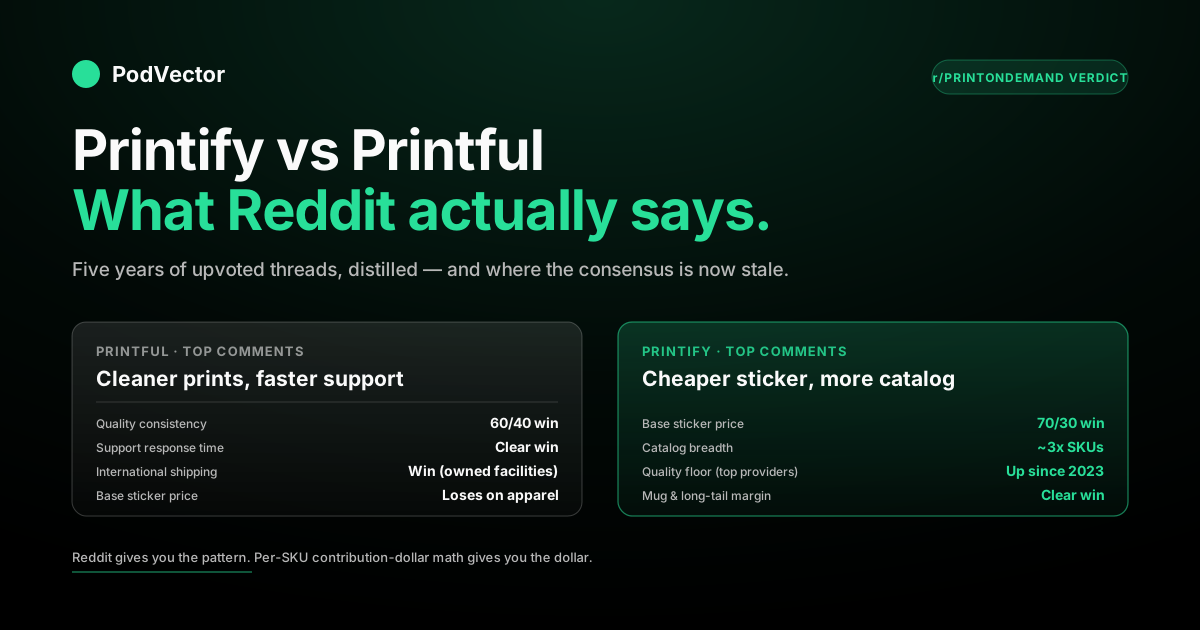
Quick Answer: Reddit's answer is: use Printful when quality consistency and support speed matter most; use Printify when catalog breadth and lower base cost matter most; and order samples before scaling either one. The r/printondemand consensus tilts toward Printful on quality and support, and toward Printify on price and catalog size. Most experienced sellers end up running both.
One thing Reddit threads largely haven't caught up on yet: Printful and Printify announced a merger in November 2024 and now operate under a shared parent company called Fyul — while still running as separate platforms with separate pricing, catalogs, and dashboards as of August 2026.
Below: what Reddit says by topic, where the consensus still holds in 2026, where it doesn't, and the per-SKU question no thread can answer for your store.
The Printful–Printify merger: what Reddit hasn't caught up on
This is the biggest context shift in POD since print-on-demand went mainstream — and most Reddit threads predate it or underweight it.
On November 5, 2024, Printful and Printify officially announced they would merge as equal partners, according to Design Musketeer's merger guide. The combined business now operates under a new parent brand called Fyul, with Printful's CEO leading and Printify's former CEO serving as President, according to Podbase.
What this means for sellers right now: as of August 2026, both platforms still run as completely separate brands — separate accounts, separate catalogs, separate pricing, separate dashboards, according to Design Musketeer. There is no forced migration and existing stores keep working exactly as before, according to the same source. Shopify's official comparison confirms: "Printful and Printify continue to operate as separate brands."
What this means for the Reddit debate long-term: the competitive tension that historically kept both platforms improving on price and quality now sits under one roof, according to Podbase. Sellers who lean entirely on one platform for competitive pricing have more reason than ever to watch both — and to consider whether their all-in strategy still makes sense as consolidation plays out.
For a full pricing breakdown that accounts for the post-merger landscape, see the Printify vs Printful prices comparison.
The r/printondemand consensus in 30 seconds
Threads on r/printondemand, r/Etsy, r/PrintOnDemand, and r/Printify form a fairly stable picture once you read past the loudest single comments. The same five points come up in almost every "Printify vs Printful?" post.
The five points Reddit actually agrees on
- Printful is more consistent. Owned facilities, tighter quality control, fewer "this looks nothing like the mockup" posts. According to Shopify, Printful "owns its entire fulfillment process" and "produces all Printful products at one of its five fulfillment centers."
- Printify is cheaper on the sticker. Sometimes much cheaper — especially on mugs, hoodies, and the long-tail catalog.
- Printify's quality is provider-dependent. A Monster Digital or Drive Fulfillment order looks different from a lower-tier provider. Reddit has been pricing this in for years.
- Printful's customer support is faster. Replacements within days, no questions on most defects. Printify's support has improved but is still routed through providers on some categories.
- Most experienced sellers run both. Printful for brand SKUs and embroidery, Printify for the margin SKUs and the long tail.
That last point is the one most "which is better" comparisons miss. The Reddit answer isn't binary — it's portfolio.
Why the consensus reads the way it does
Most of the upvoted threads are written by sellers running modest monthly volumes. At that scale, sample testing is cheap, switching providers is low-friction, and "test both" is the right answer.
The threads get noisier at higher volumes. At that point, defect rates, EU shipping economics, and per-SKU contribution margin start to dominate the decision — and those numbers are too store-specific for a Reddit thread to resolve.
Print quality on Reddit
Quality is the topic with the most-upvoted Reddit content, and the one with the clearest split.
The Printful-leans-better case
Most quality threads cite the same pattern: Printful's owned facilities produce more consistent prints across orders. According to Podbase, "Printful is consistent (standardized in-house equipment)." A second Bella+Canvas 3001 ordered six months later still looks like the first one.
Sellers running brand-led stores — boutique apparel, indie streetwear, custom merch for creators — lean hard toward Printful for this reason. The downside risk of a single washed-out shirt outweighs the per-unit savings on the rest of the catalog.
G2 reviewers confirm this read: according to G2, "Printful excels in providing a wide range of apparel options and consistent print quality."
The Printify-can-match case
Reddit's pro-Printify side leans on top-tier providers. Threads regularly call out Monster Digital, Drive Fulfillment, Swiftpod, and District Photo as producing prints that match or beat Printful on standard DTG apparel.
The catch: Printify quality is on you, not the platform. You have to know which provider to list through, sample-order before committing, and route around providers Reddit has flagged as inconsistent. According to Podbase, "Printify quality varies by partner."
What both sides agree on
Sample-order before listing. Both sides of the Reddit quality debate end at the same place: order one of each shirt you plan to sell, from each provider you might use, before you put the product live. The sample cost is the cheapest insurance policy in POD.
For the deeper quality breakdown that goes beyond Reddit anecdotes, see the full Printify vs Printful pricing and quality comparison.
Pricing on Reddit
Pricing is where Reddit's loudest pro-Printify arguments live, and where the threads are most often half-right.
What Reddit gets right on pricing
Base sticker price favors Printify on most apparel. The most-upvoted answers cite that a Bella+Canvas tee runs cheaper on Printify, and hoodies see a similar gap — but threads rarely run all-in math that includes shipping, branding fees, and defect reserves, which is where the comparison actually gets decided.
Reddit also catches that Printify Premium ($39/month) unlocks up to 20% off across the catalog. For an active store moving steady volume, it still pays for itself — but verify the breakeven against your own order count, not an old thread's assumptions.
For the detailed cost breakdown with the math the threads skip, see the Printify pricing full breakdown.
What Reddit gets wrong on pricing
The "Printify is cheaper" headline almost always stops at base cost. Threads rarely stack shipping, branding fees, defect rate, and subscription amortization into a single landed-unit-cost number — which is the comparison that actually decides margin.
On a US tee shipment with branding and a defect reserve, the two platforms can land much closer together than the base-cost gap implies. On an EU hoodie shipment without per-region Printify routing, Printful can be cheaper despite the higher sticker.
For the full cost-by-cost breakdown, see the Printful t-shirt cost full breakdown.
The subscription question Reddit underweights
Most Reddit pricing threads compare base costs and ignore the subscription discount math. That's a mistake.
Printful Growth ($24.99/month) cuts up to 33% off flagship SKUs and becomes free after a set annual sales milestone — a permanent break that Printify doesn't match. Printify Premium ($39/month) gives up to 20% off everything, no milestone required.
Which subscription wins depends on catalog mix. Apparel-heavy stores often save more on Printful Growth. Mixed-catalog stores often save more on Printify Premium. For the embroidery angle specifically, see the Printful embroidery t-shirt cost breakdown.
Customer service on Reddit
The customer-service threads are where Printful's lead is most consistent — and where the gap has narrowed least.
Printful: fast and uniform
The recurring Reddit pattern: a defect report opened in the morning gets a replacement order confirmed by end of day, often with a refund processed by the next business day. The seller never talks to the provider — Printful owns the relationship end to end.
According to G2 reviewers, Printful's "ability to handle seasonal spikes without issues is a significant advantage," with "orders processed smoothly" even during busy periods. Reddit threads from high-volume sellers cite this as the single biggest argument for Printful at scale — every minute spent on a support ticket is a minute not spent on ads, products, or content.
Printify: better than it was, still provider-routed
Printify's central support team is responsive on platform-level issues — account, billing, integration. Provider-specific issues (a specific shirt color, a specific shipping delay) often route through the provider's own support, which varies widely in speed.
The Reddit reads on this have softened over the last two years. Printify has invested in centralizing returns and reprints. But on a complex case, the experience is still more variable than Printful's.
The practical takeaway
For low-defect, US-only stores, the support gap rarely shows up. For high-volume stores, international stores, or any seller in an ad-spend-sensitive vertical, Printful's uniform support is worth real money in saved time and recovered customer LTV.
Product selection on Reddit
Catalog breadth is the topic where Printify wins most cleanly in Reddit threads, and the win is structural.
Printify: more of everything
According to Shopify, "Printify's product range is significantly wider, offering more than 1,300 items" — driven by a network of more than 100 third-party print providers across 12 countries. Each provider brings its own products: all-over-print bedding, photo books, custom puzzles, sublimated dresses, and a long tail of categories Printful doesn't stock.
For sellers in niches Printful underweights (home goods, kids' apparel, specialty accessories), Printify is the default choice on Reddit. The threads are unanimous on this.
Printful: tighter but deeper in core categories
According to Shopify, Printful's catalog holds around 388 products. They are deeply optimized within each category — premium fabrics, multiple printing methods (DTG, DTF, embroidery, sublimation, cut-and-sew), and tight quality control across every SKU.
For sellers focused on standard apparel with brand-led positioning, Reddit threads consistently rank Printful's curation as a feature, not a limit. Fewer SKUs to manage. Fewer provider-specific quirks to debug.
The "do you need 1,000 products?" question
Most successful POD stores live on a tight SKU set. The catalog-breadth advantage matters only if your strategy requires products Printful doesn't carry. Reddit veterans push back on new sellers chasing catalog size — the recommendation is to win on a tight catalog before broadening.
Shipping and fulfillment on Reddit
Shipping is the line that breaks most Reddit comparisons in half — because the answer depends on where your customers live.
US-only stores
Reddit threads on US-only stores call shipping a near-tie. Printful is slightly more predictable on production time. Printify ranges from equivalent speed on top providers to slower on cheaper ones.
The shipping cost gap on a standard US tee is small enough that it rarely swings a platform choice on its own.
For detailed shipping data, see Printful shipping rates, times, and costs — what to expect.
International stores — where the platforms diverge most
According to Shopify, Printify's print providers are "distributed across 12 countries in North America, South America, and Europe" — but international shipping quality depends entirely on whether you've listed the SKU through a regional provider. If you've only got a US provider listed, a Berlin order ships from the US — slow, expensive, and customs-exposed.
Printful's owned facilities auto-route international orders to the nearest location. EU shipping runs from Riga and Spain; AU and Japan facilities cover Asia-Pacific orders. No manual setup required — the routing is automatic.
Reddit veterans who run international stores well on Printify list every flagship SKU through US, EU, and AU providers in parallel, then let the platform route by destination. Done well, this matches Printful's shipping economics. Done lazily, it loses badly per international order.
Production time
Printful publishes production averages and consistently hits them. Printify's production time varies by provider. Reddit's read matches the documentation: Printful is more predictable; Printify can be faster on the right provider.
The "I use both" pattern Reddit converges on
The most useful single Reddit insight isn't a winner — it's the observation that most experienced sellers run both platforms in the same store.
How the dual-platform pattern works
The typical setup: Printful handles brand-critical SKUs — the headline tee, the signature hoodie, anything with embroidery or specialty fabric. Printify handles the margin SKUs and the long tail — mugs, accessories, all-over-print, regional shipping coverage.
Both platforms run inside Shopify without conflict. You pick which app fulfills each product when you list it. Customers never see the difference.
Why this pattern dominates above 500 orders/month
At low volume, the operational simplicity of one platform wins. Pick one, learn it, ship.
At higher volume, the per-SKU margin difference between platforms turns into real money. The dual-platform strategy is the angle most "Printify vs Printful Reddit" threads converge on — and most single-winner articles miss. The right question isn't which platform. It's which platform per SKU.
For the strategy layer on top of this decision, see PodVector's POD strategy hub.
Where Reddit's consensus has gone stale
A lot of the most-cited Reddit threads are two to four years old. The platforms have shifted since — and so has the market structure.
The merger changes the competitive context
This is the biggest staleness issue in 2026. As noted above, Printful and Printify are now operating under the same parent, Fyul, according to Podbase. Threads framing the two platforms as fierce independent rivals are describing a dynamic that no longer exists. According to Podbase, "the rivalry that kept prices and quality sharp now sits under one roof."
This doesn't change the practical day-to-day comparison — both platforms still operate separately as of August 2026, according to Design Musketeer. But it changes the long-term bet. Sellers who chose Printify primarily because it was the price-competitive alternative to Printful are now choosing one arm of the same company over another.
Printify's quality floor has moved up
The "Printify quality is hit-or-miss" line was true in 2021–2023 threads. Provider tiering and Printify's own quality programs have lifted the floor — bottom-tier providers still exist but are easier to filter out, and the top-tier providers are tighter than they were.
If your read on Printify is from a 2022 thread, sample-order before deciding. The floor isn't where it was.
Printify Premium pricing has moved up
Older Reddit threads quote Printify Premium at $24.99/month. It now runs $39/month for up to 20% off the catalog. The discount still pays off for high-volume stores, but the breakeven sits higher than the old threads assume. Verify it against your current order count, not a 2022 number.
Printful's international footprint has expanded
International shipping economics that looked marginal in 2022 threads are meaningfully better now, with facility expansions in Japan, EU/Spain, and Australia through 2024–2025. Older threads comparing Printful's EU shipping costs may understate today's advantage for EU-heavy stores.
Printful Growth's free milestone is newer than most threads
Printful Growth's annual sales milestone that unlocks free membership is recent enough that many Reddit threads predate it. For sellers crossing that threshold, this single change tilts the pricing math toward Printful in ways older threads don't reflect.
What Reddit can't answer for your store
Reddit is excellent at the broad-strokes picture. It's unreliable at the question that actually decides your margin.
The question Reddit can't resolve
"On my Bella+Canvas 3001 in heather grey, shipping to my top region, against my ad-blended customer acquisition cost — which supplier produces more contribution dollars per order?"
The answer is per-SKU. It changes by garment, region, season, and your specific cost structure. No thread aggregates this for you, because no thread has access to your data.
Why averages don't work here
Reddit averages are useful as a starting point. They're useless as a decision point.
The base-cost gap on a tee might look significant — but that gap moves once shipping, branding, and a defect reserve stack on. The hoodie gap might favor Printify — but only if you're using the right provider. The international shipping gap might favor Printful — unless you've set up regional providers on Printify, in which case it flips.
Every "answer" depends on variables only your data knows. The AI SEO and data strategy piece that feeds into this decision is worth understanding — see the POD seller's guide to AI strategy for ecommerce brands.
The architecture this actually needs
Closing the gap takes three pieces working together. Every order's supplier-charged cost has to flow into a single source of truth alongside revenue, ad cost, refunds, and processor fees. The math has to run per-SKU and per-supplier. The answer has to refresh fast enough to act on — switching a single SKU's supplier is high-leverage if the data is fresh, useless if it's a quarter old.
This is what PodVector built Victor to do. Victor is an AI employee — not a dashboard or analyst. He reads your live data from Shopify, Printful, Printify, Meta Ads, Google Ads, and Klaviyo, then proposes concrete moves: flag the hoodie SKU losing margin to the wrong EU provider, reprice a product to a target margin, shift the free-shipping threshold. Each proposed move comes with a rationale and expected effect; you approve or reject it before anything changes. The threads can tell you the broad pattern. Victor moves the dollar — with your approval before anything goes live.
Reading Reddit well
Treat Reddit threads as the field guide, not the answer key. Use them to learn what to test, which providers to avoid, which subscription math to verify, and which questions to bring to your own data. The veterans who post in r/printondemand are usually right about the patterns. Your store decides the specifics.
For the Meta ads side of scaling a POD store — the other variable Reddit threads rarely model — see scaling Facebook Ads on Shopify for print on demand.
For external context, the most-cited Reddit-roundup article is Inky Dollar's "What Does Reddit Say?" breakdown. It aggregates the same threads we've referenced and reaches the same "test both" verdict.
FAQs
Does Reddit prefer Printify or Printful?
Neither, consistently. The r/printondemand consensus tilts toward Printful on quality, consistency, and support, and toward Printify on price and catalog breadth. Most upvoted answers end with "test both" rather than declaring a single winner.
Did Printful and Printify actually merge?
Yes. According to Design Musketeer, Printful and Printify officially announced their merger on November 5, 2024 and now operate under a shared parent company called Fyul. As of August 2026, both brands still run as fully separate platforms — separate pricing, catalogs, and dashboards — with no forced migration for existing sellers.
Is Printify's quality actually as bad as Reddit threads say?
Not anymore on top-tier providers. The "Printify quality is inconsistent" line was accurate in 2021–2023 threads and is partially outdated in 2026. Top providers (Monster Digital, Drive Fulfillment, Swiftpod, District Photo) regularly match Printful on standard DTG apparel. The provider you pick decides this — not the platform.
Which platform does Reddit say is cheaper?
Printify, on base sticker price — consistently across threads. The gap exists before subscriptions are applied. Once shipping, branding fees, and defect rates stack on, the all-in cost gap often closes substantially. Reddit threads rarely run that full math.
Do most Reddit sellers actually use both?
Above roughly 500 orders/month, yes. The dominant Reddit pattern at scale is Printful for brand-critical SKUs and embroidery, Printify for margin SKUs and the long tail. Both apps run side-by-side inside Shopify with no conflict.
Which platform has better Reddit reviews on customer support?
Printful. The recurring Reddit pattern is defect replacements within one to two business days and uniform support across all SKUs. Printify's support has improved but is still routed through individual providers on some category-specific issues.
Has Printify Premium's price changed since older Reddit threads?
Yes. Older threads quote $24.99/month; Printify Premium now runs $39/month for up to 20% off the catalog. The discount still pays off for high-volume stores, but verify the breakeven against your current order count rather than an old thread's number.
Should I trust Reddit threads from 2022 on Printify vs Printful?
For broad patterns, yes. For specific numbers (defect rates, shipping times, subscription details) and for the competitive framing (they are now the same parent company), verify against current platform documentation. Both platforms have shifted meaningfully since 2022, and the merger is a structural change most older threads don't address at all.
Where does Reddit go wrong on the Printify vs Printful debate?
Threads stop at base cost and don't run all-in landed cost. They average across stores instead of resolving per-SKU. They rarely factor in the dollar value of saved support time at scale. And most critically in 2026: they treat the two platforms as independent competitors when both now belong to the same parent company.
Where's the full Printify vs Printful breakdown beyond Reddit?
The full pricing comparison lives at the Printify vs Printful prices comparison. For Printful-specific costs, see the Printful t-shirt cost breakdown and the Printful embroidery cost breakdown. For Printify's cost structure, see the Printify pricing full breakdown.
Reddit gives you the pattern. Victor makes the move.
Threads can tell you that Printful runs more consistently on EU shipping or that Printify can win on mug margin. They can't reprice your products to a target margin, shift your free-shipping threshold, or flag which SKU is bleeding contribution dollars to the wrong provider. Victor reads every order, supplier cost, shipping line, and refund from your Shopify, Printful, Printify, Meta Ads, Google Ads, and Klaviyo accounts — then proposes the move with a rationale and expected effect. You approve it; Victor executes it.
Try Victor free