
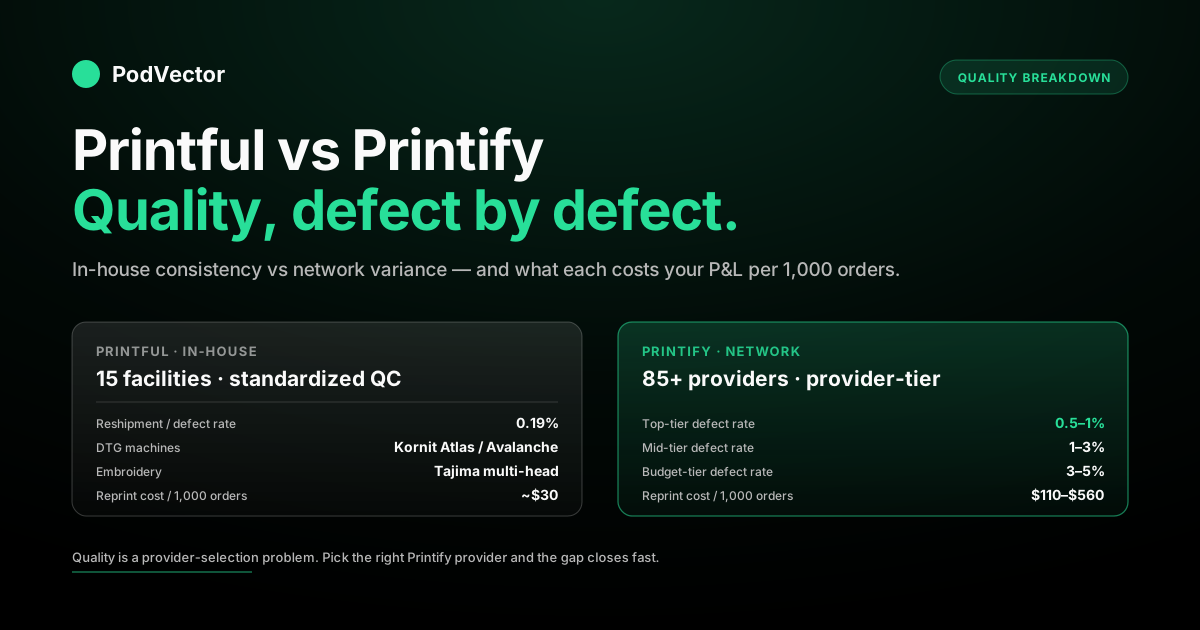
Quick Answer: On print quality consistency, Printful wins. In-house production on standardized machines (Kornit DTG, Takima embroidery) keeps Printful's reshipment rate near 0.19% versus a wider — and provider-dependent — band on Printify.
On peak quality, Printify can match or beat Printful — but only if you pick the right provider. Printify's network of 85+ print partners includes top-tier shops that print as well as anyone, plus budget shops that don't. Quality is a provider-selection problem, not a platform problem.
Below: the defect-rate math, the in-house vs network trade-off, what to test in samples, and the quality cost most comparison guides skip — what variance actually costs your margin.
Two quality models: in-house vs network
Printful and Printify produce different quality outcomes because they're built on different production models. Understand the model and the rest of the comparison falls out of it.
Printful runs an in-house model. Printful-owned facilities across four continents print every order using standardized equipment — Kornit DTG printers for direct-to-garment, Tajima machines for embroidery, Mimaki and Inkcups Helix for UV. Same printer, same calibration, same QC checklist on every order. Tight variance band, predictable output.
Printify runs a network model. Orders route to one of 85+ third-party print partners — Monster Digital, SwiftPOD, Dimona Tee, District Photo, and dozens more. Each provider runs their own printers, their own QC, their own production floor. Wide variance band: top providers print as well as Printful; budget providers don't.
This single architectural difference drives every quality outcome below. It's also why one-line "Printful is better quality" verdicts are wrong half the time. The right verdict depends on which Printify provider you'd be comparing against.
Defect rates: what each platform actually ships
Defect rate is the cleanest objective measure of quality, and the only one that hits your P&L directly. Here's what the public data says.
| Quality metric | Printful | Printify (top-tier providers) | Printify (budget providers) |
|---|---|---|---|
| Reshipment / defect rate | ~0.19% (platform-published) | ~0.5–1% (estimated, varies) | ~3–5% (anecdotal) |
| Production model | In-house, standardized | Third-party, vetted | Third-party, lower-cost |
| Color consistency batch-to-batch | High | High | Variable |
| Print fade after wash (10 cycles) | Minimal | Minimal | Visible on some |
| QC before shipment | Per-item visual inspection | Per-item or batch (varies) | Spot-check (varies) |
Two reads on this table. First, Printful's 0.19% reshipment rate is genuinely low — it puts Printful in the same band as direct-to-consumer apparel brands that print in-house. The standardized machines and standardized QC pay off. Note the asymmetry: Printify hasn't published an equivalent network-wide return figure, so every Printify number here is estimated from seller reports and provider Performance Scores, not a platform-published stat.
Second, Printify's range is the entire story. Top-tier Printify providers (Monster Digital, SwiftPOD, Dimona) consistently land in the 0.5–1% band — close enough to Printful that buyers wouldn't notice a difference. Budget Printify providers can run 3–5x that. The platform-level "Printify defect rate" averages these together, which is why no single number is honest.
Printify's Print Provider Performance Score is built to handle exactly this problem. Each provider has a published score on print quality, fulfillment time, and customer satisfaction. Sellers who pick on this score consistently land near Printful's defect rate. Sellers who pick on price alone don't.
For the broader Printful vs Printify trade-off across all axes, not just quality, see the full Printful vs Printify comparison.
Printful's quality model in detail
Printful's quality story is built on three things: the machines, the in-house QC process, and the controlled production floor.
The machines
Printful's DTG (direct-to-garment) printing runs on Kornit Atlas and Avalanche printers — industrial-grade, water-based-ink machines that produce soft-hand prints with tight color reproduction. Embroidery runs on Tajima multi-head machines (Takima is the same brand, occasionally misspelled), the standard across premium custom-apparel shops. UV printing on Mimaki and Inkcups Helix.
The reason this matters: across every Printful facility, Printful runs the same machines on the same calibrations. Your tee printed in Charlotte looks the same as your tee printed in Riga. Color profiles match. Print placement matches. There's no "this one Printful facility is worse than that one Printful facility" problem because the standardization is enforced at the equipment level.
QC process
Every Printful order goes through a per-item visual QC check before shipping. Misprints, color drift, off-center placement, fabric defects — all caught before the package leaves the facility. Anything that fails QC gets reprinted on Printful's cost, not yours. The 0.19% reshipment rate is the rate of defects that made it past QC and reached the customer.
What Printful's quality buys you
Brand consistency. If you're running paid social on a flagship product and need every order to look identical, Printful's variance band is narrow enough that it just works. You're not running A/B tests against your own production variance.
For more on Printful's full operational model — quality, fulfillment, and the cost picture together — see the complete Printful review.
Printify's quality model in detail
Printify isn't one quality story — it's 85+. Each print provider in Printify's network operates independently, with their own equipment, their own QC, and their own quality baseline.
The provider tiers
Printify's network sorts roughly into three tiers based on the Performance Score and seller experience:
- Top-tier (Premium-quality): Monster Digital, SwiftPOD, Dimona Tee, District Photo, MyLocker. These shops run industrial DTG and embroidery comparable to Printful's setup. Defect rates in the 0.5–1% range.
- Mid-tier (Reliable): Most of Printify's middle-volume providers. Defect rates 1–3%. Print quality is good but not flagship-tier on every garment.
- Budget-tier (Price-led): The cheapest providers in the network. Defect rates 3–5% based on seller reports. Lower base prices reflect lower overhead — sometimes including QC overhead.
The tier you end up on depends on which provider you select per SKU when you set up the listing. Printify defaults to one provider per product, but every popular SKU has 5–15 alternatives. The seller who reads this list and picks Monster Digital for tees ends up with very different quality than the seller who picks the cheapest available provider on autopilot.
Performance Score: the dashboard data
Inside the Printify dashboard, every provider has a Performance Score with sub-scores for print quality, fulfillment time, and overall satisfaction. Top providers run 9.5+ out of 10. Budget providers can dip below 8. The score isn't perfect — it lags real-world experience by weeks — but it's the cleanest signal Printify gives you before ordering samples.
What Printify's quality buys you
Optionality. The 85-provider network means you can match the provider to the SKU: a premium tee on Monster Digital, a budget mug on the cheapest available provider, a hoodie on whoever has the heaviest fleece. The trade-off is the work — every SKU is a separate provider-selection decision.
For Printify's full operational model and the cost angle, see the complete Printify guide.
Beyond print: blanks, packaging, branding consistency
Print quality is the headline, but POD quality has three more layers underneath. Each shifts the comparison in different directions.
Blank garment quality
Both platforms source the same blanks from the same wholesalers — Bella+Canvas, Gildan, AS Colour, Stanley/Stella, Comfort Colors. A Bella+Canvas 3001 from Printful is physically the same shirt as a Bella+Canvas 3001 from Printify (top-tier provider).
The difference shows up at the budget tier. Some of Printify's budget providers carry no-name or off-brand garments alongside the named ones. If you're listing the cheapest-priced t-shirt on a Printify provider without checking which blank it is, you can end up with a sub-spec garment that no buyer will repeat-purchase. Always read the blank SKU on the Printify product page, not just the price.
Packaging consistency
Printful ships every order in standardized polybag packaging with consistent labeling, regardless of which facility produced it. Predictable unboxing, predictable brand experience.
Printify's packaging varies by provider. Some providers use polybags. Some use kraft mailers. Some include their own marketing inserts. Some don't. If your brand is built on a specific unboxing experience, Printify's variance hurts. If you don't care about packaging, it's a non-issue.
Branded inside-collar labels
Printful supports inside- and outside-collar branding (custom labels, neck tags) at roughly $2.50/item across most apparel SKUs. Single point of contact, consistent execution.
Printify supports branded labels too — but only through a handful of providers (typically 4–6 across the network), and execution varies. A consistent inside-collar label across a multi-product Printify catalog requires aligning every provider's label spec, which is real work for a brand that scales beyond 5–10 SKUs.
For the deeper cost picture on these line items, see the complete guide to Printful costs and fees.
Sample testing: the only quality test that matters
Every quality verdict in this article — including the 0.19% defect rate, the in-house production model, the Performance Scores — describes averages. Your store doesn't sell averages. It sells specific SKUs, specific colors, specific designs, to specific customers. The only honest quality test is ordering a sample of the exact thing you'll list.
What to test on a sample
Six things, in order of how often they fail:
- Print color accuracy — does the printed color match the digital mockup, or is it 10% off?
- Print placement — is the design centered, sized correctly, placed where the mockup showed?
- Print durability — wash the sample 5–10 times. Does the print fade, crack, or peel?
- Fabric weight and feel — does the blank match what the spec sheet promised?
- Stitching and finish — collar, hem, seam quality. Cheap blanks fail here first.
- Packaging and unboxing — what your buyer sees first.
Sample-order economics
Printful gives a 20% sample discount on up to three products a month, with bonus samples unlocking at sales milestones ($100, $300, $500, $1,500). Printify charges full price for samples — no discount — but lets you order one sample per provider, which is the test that matters when comparing across the network.
A reasonable sample budget for a new POD store: $150–300 for the first month. Order the same flagship SKU from Printful and from 2–3 Printify providers. Wash all samples. Photograph them side by side. Pick the supplier with the best print + blank + finish at a price you can margin against. Repeat per flagship SKU.
This is how the sellers winning on quality actually do it. The "Printful is better" or "Printify is better" headline is a starting point — the per-SKU verdict comes from the samples on your desk.
The quality cost math comparison guides skip
Most quality articles stop at "Printful is more consistent." They don't translate consistency into dollars. Here's what variance actually costs your P&L.
Take a flagship tee at $14 landed cost (base + shipping). At Printful's 0.19% defect rate, your reprint cost is roughly $0.03 per order — a rounding error. At a top-tier Printify provider's 0.8% defect rate, it's about $0.11 per order. At a budget Printify provider's 4% defect rate, it's $0.56 per order — which can erase the entire base-cost saving you went to Printify for.
| Scenario | Defect rate | Reprint cost / order | Per 1,000 orders |
|---|---|---|---|
| Printful | 0.19% | ~$0.03 | ~$30 |
| Printify (top-tier provider) | 0.8% | ~$0.11 | ~$110 |
| Printify (mid-tier provider) | 2% | ~$0.28 | ~$280 |
| Printify (budget provider) | 4% | ~$0.56 | ~$560 |
The reprint cost is only the visible part. The invisible costs are bigger.
Refund and chargeback risk
A defect that ships triggers a refund or chargeback. The refund cost isn't just the product — it's the customer support time, the processor fee that doesn't refund, and the AOV you lost on a buyer who won't repeat.
Repeat-buyer impact
POD repeat-buyer rates run 8–18% across the category. A buyer who receives a defective product repeats at roughly half that rate. On a $35 AOV with 3 expected repeat orders over 18 months, a defect costs you ~$50 of LTV per affected order on top of the immediate refund. At a 4% defect rate across 1,000 orders, that's $2,000 of forward LTV gone.
Paid-social impact
If you're running Meta or TikTok ads, defect-driven refunds tank your conversion API signal. The pixel learns that low-quality buyers convert and optimizes toward them, which makes ROAS worse over the next four weeks. The cost of a bad provider on a paid-social store is structurally bigger than on an organic store.
Quality isn't a brand-vibes question. It's a P&L line. The platform you'd otherwise pick on price flips on quality cost faster than most sellers expect.
When Printful wins on quality
Printful is the better quality choice when consistency matters more than catalog breadth or unit price. The clearest scenarios:
Brand-first stores running paid ads
Defect rate compounds in paid social. Pixel signal degradation, refund cost, and lost LTV multiply. A 0.19% defect rate vs a 4% defect rate is the difference between a paid-social store that scales and one that stalls. If you're spending $5k+/month on Meta or TikTok, Printful's tighter variance pays for itself.
Embroidery and premium apparel
Embroidery is a precision craft and fewer Printify providers do it well. Printful's Tajima setup is reliable across thread color, stitch count, and placement. The cost difference for embroidery is small enough that consistency tends to win.
Multi-region brands
Printful's facility network (US, EU/Riga, AU, Mexico, Japan) prints the same flagship SKUs identically across regions. A buyer in Berlin gets the same hoodie as a buyer in Austin. Achieving that on Printify means aligning multiple regional providers' specs — possible but expensive in setup time.
Inside-collar branding and packaging consistency
If your brand is built on the unboxing experience or a custom collar tag across the catalog, Printful's single-vendor execution beats Printify's per-provider variance. The setup work just doesn't exist on Printful.
When Printify wins on quality
Printify wins on quality more often than the surface-level comparison suggests — but only with provider-aware setup. The scenarios:
Specific Printify providers genuinely beat Printful on specific SKUs
Monster Digital is widely considered the strongest DTG print quality in the Printify network and is competitive with — sometimes better than — Printful on specific tees. SwiftPOD prints bright colors well. Dimona Tee runs heavy garments cleanly. The "Printify quality is worse" narrative dissolves once you're actually picking the right provider.
Niche garments Printful doesn't carry
Printify's 900+ catalog includes premium garments — Stanley/Stella eco apparel, Lane Seven heavyweight tees, all-over-print sublimation pieces — that Printful doesn't carry. If your brand is built on a specific blank, Printify wins by default because there's no Printful comparison.
EU and AU local fulfillment via regional providers
Printify has top-tier providers in the EU (Print Logistic, Drukarnia) and AU (T-Pop) that produce strong quality with shorter local shipping than Printful's nearest facility for some routes. Match the provider to the geography.
High-margin SKUs where Printify's catalog savings fund better quality
On a SKU where Printify is $5 cheaper at base, you can spend that saving on a higher-tier Printify provider and still land cheaper than Printful — at comparable quality. Provider-aware Printify users get the cost saving and the quality without trading one for the other.
For the broader case for running Printify alongside or instead of Printful, see Printful alternatives: the complete comparison.
The quality question only your data can answer
Every quality verdict above — including the defect-rate tables, the provider-tier sorting, the scenario logic — gives a platform-level answer. Pick A here. Pick B there. The actual quality question your P&L runs on is per-SKU and per-provider.
On your Bella+Canvas 3001 in heather grey, printed via your chosen provider, shipping to your top customer region — what's your defect rate? What's your reprint cost as a percentage of revenue? Which SKU's margin would improve if you switched providers? None of the public quality articles answer these. They quote averages — 0.19% defect rate, 4% on budget providers, 0.5–1% on top-tier — and stop there. Your contribution dollars don't run on averages.
Closing the gap takes three pieces working together. Every order's supplier-charged cost, refund event, and reshipment has to land in one place alongside revenue, ad cost, and processor fees. The math has to run per-SKU and per-supplier so a tee that's profitable on Monster Digital and a hoodie that's profitable on Printful both surface clearly. And someone has to act on it fast enough to matter — switching a poorly-performing provider after one quarter of bad data is too slow.
That last piece is what PodVector AI built Victor to do. Victor is an AI employee that runs your POD back office: he watches per-order quality and cost across Shopify, Printful, Printify, Meta, and Google, then flags the tee whose defect rate is bleeding margin and tees up the provider switch, the listing update, or the ad-spend reallocation for your approval before he executes it. The answer isn't always Printful or always Printify — it's per-SKU, and Victor moves on it instead of leaving it in a report. A POD seller without per-provider quality data is guessing on the most expensive lever in the business.
For more on the underlying profitability picture per platform, see how to make money with Printful and Printful vs Printify pricing.
FAQs
Is Printful's quality really better than Printify's?
On average, yes. Printful's in-house, standardized production runs a tighter variance band than Printify's 85-provider network. The published reshipment rate (~0.19%) is genuinely low. But "average Printify" is the wrong comparison — Printify's top-tier providers (Monster Digital, SwiftPOD, Dimona Tee) match Printful on print quality. The verdict depends on which Printify provider you'd pick.
What's Printful's defect rate?
Roughly 0.19% reshipment rate per Printful's published number, with independent reviews citing similar figures (one tested 0.24% return rate due to quality issues). That's in the same band as direct-to-consumer apparel brands that print in-house.
What's Printify's defect rate?
It varies by provider. Top-tier providers run 0.5–1%. Mid-tier providers run 1–3%. Budget providers can run 3–5%. Printify publishes a Performance Score per provider — pick on that, not on price alone.
What machines does Printful use?
Kornit Atlas and Avalanche DTG printers for direct-to-garment, Tajima multi-head machines for embroidery, Mimaki and Inkcups Helix for UV. Standardized across all 15 facilities so a tee printed in Charlotte looks the same as one printed in Riga.
What's Printify's Print Provider Performance Score?
A 0–10 score per provider on print quality, fulfillment time, and customer satisfaction, visible inside the Printify dashboard. Top providers score 9.5+. The score lags real-world experience by weeks but it's the cleanest signal before ordering samples.
Should I order samples from both Printful and Printify?
Yes. Order the flagship SKU from Printful and from 2–3 Printify providers, wash them 5–10 times, compare side by side. Budget $150–300 for the first month. The per-SKU verdict you get from samples beats every published comparison, including this one.
Which Printify providers are best for print quality?
Monster Digital is widely considered the strongest DTG quality in the network. SwiftPOD is strong on bright colors. Dimona Tee runs heavyweight garments well. District Photo and MyLocker round out the top tier. Performance Scores in the 9.5+ range are a reliable filter.
Does Printful or Printify have better embroidery?
Printful, by a clear margin. Printful runs Tajima multi-head machines across all embroidery orders. Fewer Printify providers do embroidery well, and per-provider variance on stitch count and thread color is wider. If embroidery is core to your brand, Printful is the safer pick.
What about international quality — does it vary by Printful facility?
Minimal variance. Printful's facilities use the same Kornit machines and the same color profiles, so a tee printed at the Riga (EU) facility matches a tee printed in Charlotte (US). Printify's regional providers have their own quality bands — pick on Performance Score per region.
Does packaging quality differ between Printful and Printify?
Yes, meaningfully. Printful uses standardized polybag packaging across all facilities — predictable unboxing. Printify packaging varies by provider (polybag, kraft mailer, custom — depends on the partner). If unboxing is part of your brand, Printful is more reliable.
How does quality variance actually hit my P&L?
Three lines. Reprint cost (defect rate × landed cost — visible). Refund/chargeback cost (1.0–1.5x landed cost per refund — visible). Lost LTV from non-repeating buyers (~$50 per defective order on $35 AOV — invisible until you measure it). At a 4% defect rate across 1,000 orders, that's $560 in reprints plus $2,000+ in lost LTV.
Where can I see the full Printful vs Printify comparison beyond quality?
Quality is one of seven axes. The full breakdown — business model, catalog, pricing, fulfillment, integrations, branding — is in the full Printful vs Printify comparison. The Printful comparison cluster lives at the Printful comparison hub and the broader Printful topic at the Printful topic hub.
Let Victor run the provider call for you.
The right Printful vs Printify quality answer changes by garment, provider, and region — and it goes stale within weeks. Victor is an AI employee that tracks every order, reshipment, and refund per provider, then acts: when a provider's defect rate starts eating your hoodie margin, he surfaces the better supplier and queues the switch for your approval. Hand off the POD back office, keep the final say.
Try Victor freeFor external context, the Bootstrapping Ecommerce hands-on review covers similar ground with a heavier focus on shipping and customization. To go broader on Printful, see the complete Printful guide; for Printify, the complete Printify guide.