
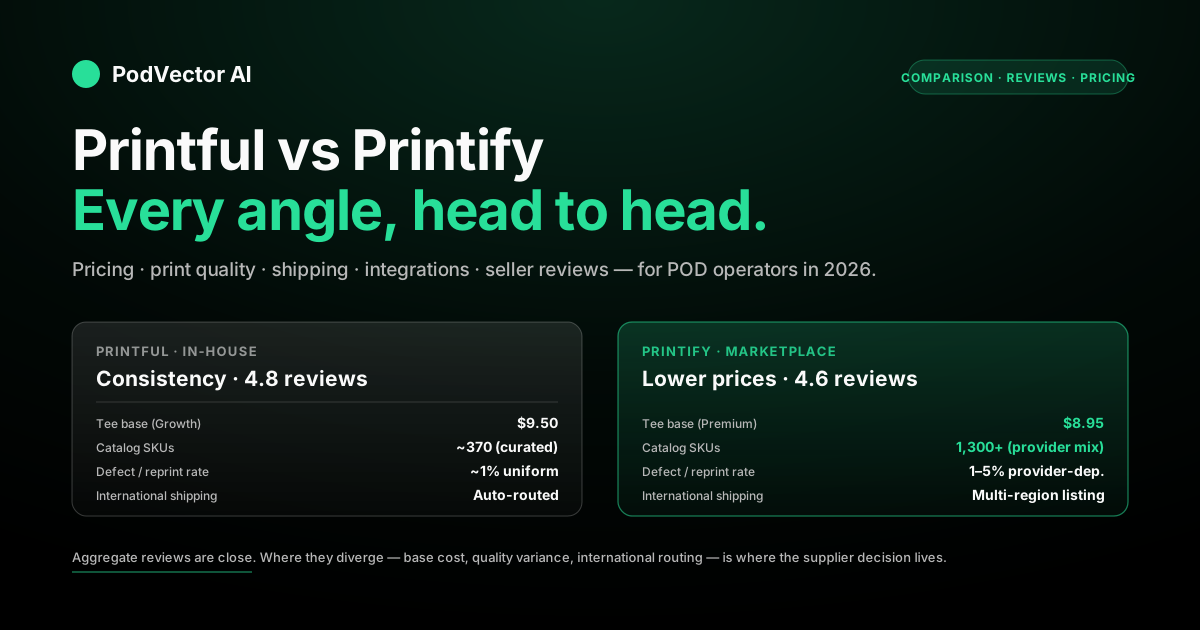
Quick Answer: Printify wins on raw base price across most product categories — but the gap has narrowed as Printful has trimmed costs across many SKUs. Printful wins on print consistency, sample-order economics, and international shipping out of the box. One important 2026 update: Printify raised its Premium plan from $29/mo to $39/mo as of February 17, 2026 (per Spocket's live platform check), which changes the break-even math for sellers considering Premium.
On reviews, both platforms sit at strong aggregate seller ratings. The complaints differ — Printful's center on higher base cost and slow international fulfillment on heavy garments; Printify's on quality variance between print providers.
The honest verdict for most POD sellers: Printify (with provider-selection discipline) for apparel-heavy, price-sensitive catalogs; Printful for embroidery, premium garments, and set-and-forget international shipping. Also worth noting: both brands now share a parent company (FYUL), so you're comparing two storefronts of one conglomerate — the operational differences remain real, but the competitive dynamic has shifted. The full breakdown follows.
The 30-second overview
Printful runs its own production facilities. You upload a design, Printful prints it, packs it, and ships it from one of its facilities in the US, Canada, Mexico, the EU, or Australia. One brand, one quality bar.
Printify is a marketplace. You upload a design, then pick a print provider from a network of dozens. The provider you choose decides your base price, your print quality, your shipping speed, and your defect rate. Different provider, different bar, for every SKU you list.
The headline tradeoff: Printify gives you cheaper unit prices and more catalog variety. Printful gives you consistency, sample economics, and frictionless international shipping. The right answer depends on whether your catalog rewards price or consistency — and on how much provider-selection work you are willing to do.
| At a glance | Printful | Printify |
|---|---|---|
| Business model | In-house production | Print-provider marketplace |
| Free plan | Yes | Yes |
| Flagship paid plan | Growth: $24.99/mo (waived above $12K annual sales) | Premium: $39/mo as of Feb 17, 2026 (annual plan unchanged) |
| Product discount on paid plan | Up to 33% (spend-tiered) | Flat 20% across most providers |
| Standard US production | 2–5 business days | 2–7 business days (varies by provider) |
| Sample-order discount | 25% off (Growth plan) | None |
| Parent company (post-merger) | FYUL | FYUL |
The FYUL merger: what it means for sellers
The most important context update for 2026: Printful and Printify merged into a single parent company — FYUL (with Snow Commerce) — announced in November 2024, according to Podbase's July 2026 analysis. Both brands continue to operate under their own names, with separate dashboards, pricing, subscriptions, and quality systems.
What this means practically: the competitive tension that once drove each platform to undercut the other on price or out-invest in quality now sits under one roof. The platforms remain operationally distinct, and the line-by-line economics still differ. But the landscape is different from what pre-merger comparisons described, and it's worth knowing before you pick.
The practical decision framework doesn't change: evaluate the two services on their actual current capabilities — base cost, quality, shipping, and support — not on brand competition that no longer exists in the same form.
Business model: in-house vs marketplace
This is the difference that drives every other number on the table.
Printful: vertical integration
According to EComposer's 2026 review, Printful owns and operates fulfillment centers in the United States, Canada, Mexico, Latvia, Spain, and the United Kingdom, enabling faster and more reliable shipping in North America and Europe. Every order routes to the closest facility automatically. The same print files produce the same garments anywhere on the network because the equipment, ink, and QA standard are set centrally.
The upside: predictable quality, predictable shipping, predictable margins. The downside: Printful's per-unit cost includes the overhead of running that owned network.
Printify: marketplace aggregation
Printify operates no facilities. As Merch Titans notes in their April 2026 comparison, Printify connects sellers to dozens of manufacturers worldwide, each with their own pricing, quality standards, and shipping times — lower costs but more variability. Providers include Monster Digital, SwiftPOD, Drive Fulfillment, T-Shirt and Sons, and many more.
The upside: you get competitive pricing on a wide range of SKUs, plus broad catalog depth. The downside: provider selection is your job. The Printify experience varies as much between providers as it does between platforms.
Pricing: plans, base costs, and the discount math
Pricing is the lens most sellers start with. Three layers matter: subscription plans, per-unit base cost by SKU, and shipping by region.
Subscription plans head to head
Both platforms offer a free plan that covers most early-stage sellers. The flagship paid tiers differ in price and structure — and one has changed significantly in 2026.
| Plan detail | Printful Growth | Printify Premium |
|---|---|---|
| Monthly cost | $24.99/mo | $39/mo (raised Feb 17, 2026, per Spocket) |
| Annual plan | ~$21.60/mo equivalent | Annual rate held steady (per Spocket) |
| Auto-waived threshold | Free above $12K annual sales | No auto-waive tier |
| Product discount | Up to 33% (spend-tiered) | Flat 20% across most providers |
| Sample discount | 25% off all samples | None |
The Printify Premium price increase to $39/mo (from the previous $29/mo) materially changes break-even math. At the higher price point, sellers need meaningfully more monthly order volume for the 20% discount to offset the subscription cost — check your own order volume before assuming Premium pays off on a monthly billing cycle. The annual plan may still be the better deal for established sellers.
Printful Growth's discount is higher but scales with spend — the headline 33% applies only to the highest-volume tier. The blended discount most Growth subscribers see across their full catalog is lower; verify against your specific SKU mix on Printful's live plan page. Printful Growth is also automatically waived once your store hits $12,000 in annual sales, per Spocket's platform check.
Printify Premium is flat 20% from the first order. No spend tiers, no minimums. Some providers exclude themselves from Premium discounts; the catalog filter shows which.
For the full Printful subscription math, see is Printful membership worth it.
Base product cost by category
Printify typically wins on raw base cost in most categories. Per Branvas's June 2026 analysis, because print providers compete within the Printify network, base costs are driven down, offering better profit margins — and upgrading to Printify Premium adds a further 20% discount on top of already-competitive provider prices.
However, exact per-SKU figures shift as platforms adjust pricing. The table below uses directional ranges rather than point-in-time numbers that go stale quickly. Always verify the live number for your exact SKU on each platform before committing.
| Category | Typical Printful position | Typical Printify position | Who usually wins |
|---|---|---|---|
| Standard tees (Bella+Canvas, Gildan) | Higher base cost | Lower base cost (provider-dependent) | Printify |
| Hoodies and sweatshirts | Higher base cost | Meaningfully lower at tier-1 providers | Printify |
| Drinkware and mugs | Mid-range | Lower at top providers | Printify |
| Embroidered apparel | Competitive — in-house embroidery | Variable by embroidery provider | Printful (often) |
| International shipping (total landed) | Auto-routed, predictable | Depends on multi-region setup | Printful (default setup) |
Three categories where Printful is competitive or wins on total cost: embroidered apparel (Printful's in-house embroidery undercuts many Printify embroidery providers), premium garment-dyed apparel, and total landed cost for international shipping where auto-routing matters.
For a detailed cost angle, see our Printful vs Printify cost breakdown and the Printful shipping fees full breakdown.
Reviews and print quality: what sellers actually report
Both platforms have strong aggregate seller ratings. The shape of the complaints is what matters when you're picking a platform.
Printful reviews — the recurring themes
Printful's reviews skew toward operational consistency. The phrases that show up repeatedly on Reddit and TrustPilot are "no surprises," "great packaging," and "shipping was when they said it would be."
According to Branvas's June 2026 analysis of Reddit's r/printondemand and r/Printful, sellers consistently praise Printful for its reliability — one seller specifically noted they wanted high-quality product and service because it brings back repeat customers. New sellers report tight print registration and accurate color reproduction on popular blanks.
The most common complaint: base price. According to Branvas, one Reddit user on r/printondemand lamented that Printful's prices are "20–30% more than Printify," leaving very thin margins even before ad spend and platform fees. The fix — the Growth plan — works for sellers above the auto-waive threshold, but the complaint pattern persists for sub-volume sellers.
Secondary complaint: international shipping cost on heavier garments. Auto-routing to EU or AU facilities solves the speed problem but the per-unit shipping cost on hoodies and sweatshirts can compress margins for sellers outside the US.
Printify reviews — the recurring themes
Printify's reviews skew toward variance. "Depends on the provider" shows up in nearly every long-form Reddit thread about Printify quality. Per Branvas's June 2026 analysis of r/printondemand, some sellers report Printify equivalents of the same blank as "thin and faded and brittle and cracked" compared to Printful — but this reflects lower-tier providers, not the platform uniformly.
Top-tier providers — Monster Digital, SwiftPOD, Drive Fulfillment — produce print quality that seller reviews describe as indistinguishable from Printful. Reviews from sellers running these providers exclusively cluster in the same operational-praise pattern as Printful reviews.
Mid-tier and lower-tier providers vary. Reviews from sellers who didn't sample-test providers before listing describe color shifts between orders, inconsistent print placement, and slower fulfillment than the catalog page advertises.
The most common Printify complaint isn't quality itself — it's the discovery process. Finding the right provider takes multiple sample orders per SKU, and Printify doesn't subsidize that cost the way Printful subsidizes its own sample cost (25% off on Growth).
The provider-quality matrix
For Printify sellers, the practical question is which providers to trust. The Reddit-and-TrustPilot consensus in 2026:
- Apparel — tier 1: Monster Digital, SwiftPOD, Drive Fulfillment, Underground Printing. Consistent quality, fast turnaround, low defect rate.
- Drinkware and accessories — tier 1: Duplium, District Photo, MWW. Print quality on mugs and posters comparable to Printful.
- All-over print — tier 1: Subliminator, Print Geek. Categories where Printful's catalog is thin; Printify leads by default.
- Tier 2 / variable: Multiple regional providers with selective strengths. Worth sample-ordering before listing at scale.
The for-sellers takeaway: if you commit to provider-selection discipline, Printify's quality reads as Printful's. If you skip that discipline, variance shows up in your reviews and your return rate.
Shipping speed and global fulfillment
Shipping is where Printful's owned-network model earns its price premium. Printify can match it, but only with extra setup.
Production time
According to EComposer's 2026 review, most Printful orders are fulfilled within 2–5 business days, with detailed shipping estimates and tracking provided. Printify production runs 2–7 business days, varying by provider. Tier-1 Printify providers (Monster Digital, SwiftPOD) hit 2–3 days reliably; lower-tier providers can stretch toward 7.
Shipping speed and international routing
For US domestic orders, both platforms ship via standard carriers at comparable speeds. The gap shows up internationally.
Printful auto-routes every order to the nearest facility. A US-listed item ordered by a German customer ships from Latvia or Spain, not Charlotte. Total transit to most of the EU is fast and predictable end-to-end.
Printify does not auto-route. The order ships from whichever provider you listed the SKU through. A US-only listing shipping to Germany routes internationally from the US — significantly slower and more expensive without multi-region setup.
The multi-region listing requirement
Done right, Printify can match Printful on international shipping cost by listing every SKU through providers in each major region (US, EU, UK, AU). Done with a single US-region listing, Printify shipping internationally is materially more expensive and slower than Printful's auto-routed equivalent.
The right Printify setup for a global catalog is multi-region listings — one listing per region per SKU. The right Printful setup is a single listing. That difference compounds across catalog size and is a real operational cost to factor in.
For more on Printful's shipping cost structure by region and product weight, see the Printful shipping fees full breakdown.
Product catalog and customization
Printify's marketplace structure covers a broad range of SKUs across providers. Printful's in-house catalog is curated and narrower — Spocket's live platform check noted Printful's free plan gives access to its full 545+ product catalog. Printify's catalog size varies by source cited, with Print It My Way's May 2026 review noting 900+ products across the network. Both numbers shift as platforms add and retire SKUs, so treat them as directional.
Where Printify's breadth matters
- All-over-print apparel. AOP tees, hoodies, leggings, and dresses — Printful's catalog is thin here. Printify's AOP providers (Subliminator, Print Geek) offer a full range.
- Home goods. Blankets, pillows, doormats, wall art at scale. Printful covers the basics; Printify covers the long tail.
- Niche apparel. Plus-size garments, kids' apparel, technical fabrics, retro-cut blanks. Printify's marketplace structure rewards niche SKUs that don't justify a Printful facility.
Where Printful's curation matters
- Embroidered apparel. Printful's in-house embroidery runs hat, polo, and jacket SKUs at quality most Printify embroidery providers can't consistently match. Base cost is also competitive in this category.
- Premium garment-dyed apparel. Comfort Colors, Independent Trading Co., Champion — Printful's curated supply chain on these blanks produces lower defect rates than comparable Printify providers at mid-tier and below.
For a complete look at what Printful's catalog and operations cover, see the complete Printful guide for POD sellers.
Customization and branding
Printful leads on branding options. Custom inside-neck labels, custom packing slips, branded inserts, woven labels — Printful's white-label service is the most comprehensive in the category, available on Growth and above.
Printify offers most of the same options, but provider-by-provider. Inside-neck labels are available on tier-1 providers like Monster Digital; less common on tier-2 providers. Branded packing slips are a platform-level feature on Printify Premium. Custom packaging inserts are not a standard Printify platform feature as of September 2026.
For a direct breakdown of how the two platforms differ beyond price, see the difference between Printful and Printify: the POD seller's guide.
Design tools and sustainability
Two tie-breakers the price tables miss: how fast you can build a listing, and whether your blanks read as eco-friendly to buyers who care.
Mockup and design tools
Both platforms ship a browser-based design studio: upload art, place it on a blank, generate mockups, push to your store. For most sellers they're close to even. As Print It My Way's May 2026 review notes, Printful's Design Maker and Printify's mockup generator are both merchant-side tools for setting up products — not for customer-facing personalization.
Printful's mockup generator is the more polished of the two — cleaner lifestyle mockups, an integrated design-service marketplace, and free stock graphics. Printify's studio is fast to learn and includes an AI image generator for quick concepts. Neither is a reason to switch platforms on its own.
Eco-friendly options
Both carry organic and recycled blanks — Bella+Canvas sustainable lines, Stanley/Stella organics, recycled-poly accessories. Printful publishes facility-level environmental reporting; Printify's sustainability profile varies by the provider you pick.
If "sustainable" is a selling point in your niche, both can supply it, but Printful gives you one consistent story while Printify requires you to vet each provider's blanks per SKU.
Integrations: where you can actually sell
Both platforms integrate with every major e-commerce channel a POD seller is likely to run. The list reads the same; the implementation details differ slightly.
| Channel | Printful | Printify |
|---|---|---|
| Shopify | Yes (native app) | Yes (native app) |
| Etsy | Yes | Yes |
| WooCommerce | Yes | Yes |
| Wix | Yes | Yes |
| BigCommerce | Yes | Yes |
| eBay | Yes | Yes |
| Amazon (Seller Central) | Yes | Yes |
| TikTok Shop | Yes | Yes |
| Squarespace | Yes | Yes |
| Walmart Marketplace | Yes | Yes |
The platform-parity reads as a tie. Friction differs in two places worth flagging.
Etsy: Both integrations push designs to Etsy listings. Printify requires choosing the print provider before the Etsy push, then re-pushing if you swap providers later — a workflow tax on multi-provider experimentation. For a step-by-step on Printify's Etsy setup, see the Printify–Etsy integration setup guide.
Shopify: Both integrations push to Shopify in roughly the same way. Printful supports more advanced features inside its Shopify embed (label customization, packaging customization) than Printify does. For multi-store Shopify operators this matters; for single-store sellers, both are fine.
Customer support
Printful runs 24/7 live chat plus email support. Seller reviews on Reddit and TrustPilot describe Printful support as responsive and willing to issue reprints quickly when documentation is provided.
Printify runs email and live chat support. Provider-level issues — quality defects, fulfillment delays — route through Printify support, which mediates with the underlying provider. The mediation step adds time to defect resolution compared with Printful's direct path.
For routine support — billing questions, integration setup — both platforms perform similarly. For defect resolution, Printful's single-facility model resolves faster. Printify's marketplace model adds a routing step that can extend resolution time.
Printful vs Printify pros and cons
Printful pros
- Predictable print quality across every SKU and every order.
- Auto-routed international shipping — set-and-forget for global catalogs.
- Strong branding options: custom labels, inserts, packing slips on Growth and above.
- Cheaper sample orders (25% off on Growth) — lets sellers iterate on quality cheaply.
- Single support path — faster defect resolution.
- Growth plan auto-waived above $12K annual sales.
- Etsy and Shopify integration friction is low.
Printful cons
- Higher base prices than Printify on most apparel and accessory SKUs.
- Narrower curated catalog vs Printify's marketplace breadth.
- Thin on all-over-print apparel.
- Free-tier sellers face margin compression on paid-social-driven stores.
- Growth plan discount scales with spend — full 33% only at the highest tier.
Printify pros
- Lowest base costs on most apparel and accessory SKUs at top-tier providers.
- Broader catalog — more SKUs than Printful's in-house catalog.
- Strong all-over-print catalog (Printful doesn't compete meaningfully).
- Flat 20% Premium discount applies from the first order.
- Multi-region listings can produce competitive international shipping costs.
- Tier-1 providers match Printful quality at lower base cost.
Printify cons
- Quality varies by provider — sample-order discipline is mandatory.
- No sample-order discount — testing providers costs full price.
- No auto-routing — international shipping requires multi-region listings.
- Defect resolution is slower (marketplace mediation step).
- Branding options are provider-dependent, not platform-level.
- Premium plan raised to $39/mo (monthly) as of February 2026 — higher break-even for monthly subscribers.
Who should choose which
Pick Printful if
- You sell embroidered apparel — hats, polos, jackets — as a meaningful share of catalog.
- You ship internationally and want set-and-forget routing without multi-region listing setup.
- You run paid social where reprint-rate variance hurts more than per-unit price.
- You iterate designs frequently and need cheap sample orders.
- You want consistent branding (labels, inserts, packaging) across every SKU.
- You don't have time to manage provider relationships.
Pick Printify if
- Your catalog is apparel-heavy with hoodies, all-over print, or non-Bella+Canvas blanks.
- You sell drinkware, phone cases, posters, totes, or home goods — categories where the price gap is widest.
- You have or will build provider-selection discipline (sample every provider before listing at scale).
- Your monthly volume justifies Premium's break-even at the new $39/mo rate.
- You sell primarily in one region and don't need international auto-routing.
- Margin compression on paid social is a bigger problem for you than quality variance.
Pick both — and split by SKU
The often-right answer for sellers running 20+ SKUs across multiple categories. As Merch Titans noted in their April 2026 comparison, the smarter play is using both strategically — Printful for embroidered, premium-blank, and international-heavy SKUs; Printify for standard apparel, all-over print, and price-sensitive categories. Both platforms integrate with the same Shopify, Etsy, and TikTok Shop stores — there is no platform lock-in preventing a split.
For a deeper look at how the cost split plays out SKU by SKU, see our Printful vs Printify cost comparison and the full guide to the difference between Printful and Printify.
The comparison that actually matters: your catalog
Every comparison above produces averages. Your real economics depend on your SKU mix, your top-customer regions, your channel fee structure, and your ad cost per order. Two POD stores running the exact same SKU in the same retail band can produce different supplier winners — because their customer region split, channel mix, and ad cost per order differ.
As printondemandbusiness.com's August 2026 analysis puts it, there is no honest universal winner on price or quality — the useful comparison is a quote for the same blank, size, color, print placement, destination, and shipping method, followed by sample orders from the facilities or providers you plan to use.
The right comparison runs per-SKU and per-region, against your actual order data. It means tracking every order's supplier-charged cost, shipping cost, and refund alongside revenue and ad spend in a single source of truth — then acting on it fast enough to matter, because switching a single SKU's supplier is high-leverage only if someone actually makes the change while the data is still fresh.
That is the job PodVector's AI employee Victor was built to do. Victor reads your live Shopify, Printful, Printify, Meta Ads, Google Ads, and Klaviyo data into a single warehouse, then proposes concrete moves — like flagging that a specific hoodie SKU's margin is being compressed by a given provider — and executes approved Shopify-side changes (repricing, collection updates, discount setup) once you give the go-ahead. Every material action waits on your approval before anything is touched. For more on how the platform works, see the PodVector overview for POD sellers.
For the full Printful operational picture, including sticker and label fulfillment costs, see the Printful sticker pricing full breakdown.
FAQs
Is Printful or Printify better for beginners?
Printful for sellers with no time to manage provider relationships. The single-facility model means one quality bar, one shipping setup, one support path. Printify is better for beginners who are budget-constrained and willing to sample-order multiple providers per SKU before listing. The right beginner answer depends on whether you have time or money to invest upfront.
Is Printify always cheaper than Printful?
On base product cost — usually yes, especially on standard apparel and accessories at top-tier providers. On all-in cost including shipping, samples, and potential defect rate, the gap narrows. On embroidered apparel and international shipping with lazy setup, Printful can be cheaper or comparable end-to-end. Always verify the live number for your specific SKU before assuming a winner.
Which has better reviews, Printful or Printify?
Both platforms have strong aggregate seller ratings. The complaints differ: Printful's center on base cost and international shipping costs for heavy garments; Printify's on quality variance between providers. Sellers who pick the right setup for their catalog tend to rate both platforms highly. The shape of the complaints — not the headline number — is what should guide your choice.
Can I use both Printful and Printify on the same Shopify store?
Yes. Both platforms install as separate Shopify apps with no exclusivity. Many multi-SKU stores route embroidery and premium garments to Printful while pushing standard apparel and accessories through Printify Premium. Order flow is independent — each platform fulfills its own SKUs.
Does Printify still offer Premium at $29/month?
No. According to Spocket's live platform check, Printify raised its Premium monthly price from $29 to $39 as of February 17, 2026. The annual plan rate held steady. If you've been budgeting around $29/mo, recalculate your break-even before subscribing or renewing monthly.
How long does shipping take with each platform?
Printful US production is 2–5 business days per EComposer's 2026 review, plus standard carrier transit. Printify US: 2–7 business days production (provider-dependent), plus transit. Internationally, Printful auto-routes to the nearest facility for fast, predictable transit to most major regions. Printify single-region international ships from the US and is significantly slower and more expensive; multi-region listings match Printful's speed.
Which has more product options?
Printify covers more SKUs across its provider network than Printful's in-house catalog. Printful's catalog, per Spocket's live check, covers 545+ products; Printify's network covers more, though exact counts vary by source and change frequently. Printify wins on breadth in apparel, all-over print, home goods, and niche categories. Printful wins on depth in embroidered and premium-blank apparel where curation matters more than breadth.
Are sample orders cheaper on Printful or Printify?
Per sample, Printful is cheaper — Growth plan members get 25% off samples plus free embroidery digitization on samples, per Spocket's platform check. Printify charges full base price plus full shipping on samples, with no discount tier. Per quality-confidence dollar, Printful is much cheaper because Printify's marketplace requires sample-ordering multiple providers per SKU before committing to a listing.
Does the Printful–Printify (FYUL) merger change which one I should pick?
Operationally, the platforms continue running separately under their own brand names, with separate dashboards, pricing, subscriptions, and quality systems, according to printondemandbusiness.com's August 2026 analysis. Pick based on current line-by-line economics. The merger does raise the case for piloting an independent third supplier (Gelato, Gooten, CustomCat) as a pricing-diversification hedge, since both major POD brands now share a parent.
Stop guessing which supplier wins on your catalog.
Printful wins on some SKUs. Printify wins on others. The answer changes by garment, region, channel, and season — and static comparison tables go stale within weeks. Victor, PodVector's AI employee, reads every order's supplier-charged cost, shipping line, and refund from your live Shopify, Printful, and Printify data, then proposes concrete Shopify-side moves — repricing, discount setup, collection updates — with an approval gate before anything is touched. Per-SKU supplier visibility, built for POD sellers on Shopify.
Try Victor freeFor a different angle on the same comparison, the 2026 Merch Titans comparison covers similar ground with a focus on catalog depth and workflow. To round out the Printful side, see is Printful membership worth it and the complete Printful guide for POD sellers. For a direct Etsy integration walkthrough on the Printify side, see the Printify–Etsy integration setup guide.