
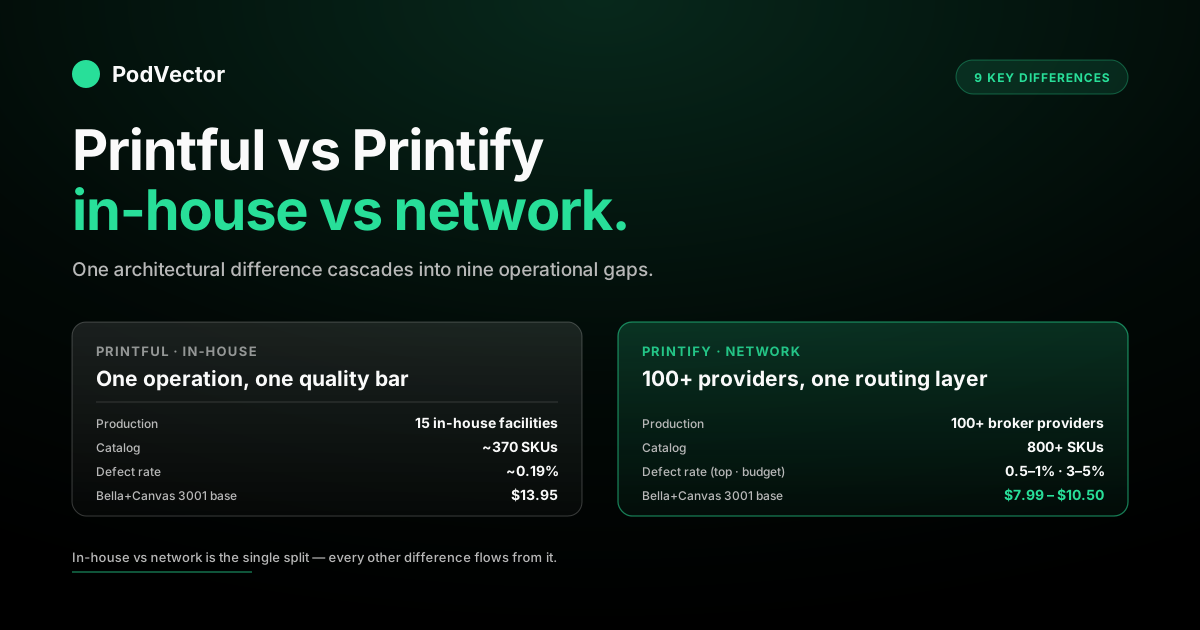
Quick Answer: Printify is best for POD sellers optimizing for lower base costs and broader catalog choice; Printful is best for sellers optimizing for predictable quality, branding, and simpler fulfillment. The single difference everything else flows from is structural — Printful is an in-house printer; Printify is a broker network of 100+ independent print providers. That one choice cascades into every operational gap between the platforms.
From the in-house vs network split flow nine concrete differences: production model, catalog size, pricing, quality consistency, integration mechanics, branding execution, shipping, customer support, and mockup tools.
Below: each difference unpacked with the actual numbers, an integration-mechanics deep dive most reviews skip, and the per-SKU framework that beats either-or platform picks.
The core difference: in-house vs network
Every Printful vs Printify difference downstream starts from the same upstream choice: who actually prints your shirt.
Printful owns 15 fulfillment facilities and prints orders in-house. Same machinery, same inks, same trained staff, same quality checks, same packaging stack. The platform is the printer.
Printify is a marketplace. It sits between you and 100+ independent print providers — Monster Digital, SwiftPOD, Dimona Tee, Print Geek, T-Shirt and Sons, dozens more. Each provider runs its own equipment, staffing, quality bar, and packaging. The platform is a routing layer, not a printer.
This single architectural difference explains why Printify is cheaper (it shops you across competing providers), why Printful is more consistent (one quality bar, not 100), why Printify has 1,300+ products (it adds providers' catalogs together) and why Printful has ~500 (one in-house catalog). Every operational gap traces back here.
One thing the architecture does not erase: the merger. Printful and Printify announced a merger in November 2024, and as of 2026 the two still run as separate platforms — separate catalogs, separate pricing, separate accounts, separate apps.
So every difference below is still live. Treat them as two distinct suppliers when you pick, because operationally that's exactly what they are.
All 9 differences at a glance
Before the deep dive, the headline numbers in one table:
| Difference | Printful | Printify |
|---|---|---|
| Production model | In-house, 15 facilities | Network, 100+ providers |
| Product catalog | ~500 SKUs | 1,300+ SKUs |
| Base cost (Bella+Canvas 3001 tee) | $13.95 | $7.99–$10.50 |
| Premium plan discount | Growth: up to 33% off products | Premium: up to 20% off products |
| Reshipment / defect rate | ~0.19% | 0.5–5% (provider-dependent) |
| Production time | 2–5 business days | 2–10 business days (provider-dependent) |
| Branded packaging | Standard across all facilities | Provider-dependent |
| Customer support | 24/7 platform-direct | Routes through provider |
| Etsy partnership | Third-party connector | Official Etsy badge |
Five differences favor Printful (consistency, branding, support, simplicity, international auto-routing). Four favor Printify (cost, catalog, redundancy, Etsy partnership). The rest of this guide unpacks each.
1. Production model
Printful runs its own facilities — Charlotte, Los Angeles, Dallas, Riga (Latvia), Mexico, Australia, Japan, plus partner extensions. Every order prints on Printful equipment, in Printful packaging, by Printful staff. There's one quality bar.
Printify routes orders to whichever provider you pinned the SKU to. That provider can be a 200-person shop in North Carolina (Monster Digital), a Latvian DTG operation (Print Logistic), a French eco-print provider (T-Pop), or any of ~100 others. Each runs its own quality bar.
The downstream effect: Printful's variance is narrow (one operation, one process). Printify's variance is wide (every provider is a different operation). On a single SKU shipped 1,000 times, Printful gives 1,000 near-identical units. Printify gives 1,000 units that look identical if you pinned to one provider — and a wider spread if your SKU floats across providers for redundancy.
2. Product catalog
Printful's catalog is ~500 SKUs across apparel, accessories, home goods, and a tight AOP (all-over-print) range. Tees, hoodies, sweatshirts, polos, hats, bags, mugs, posters, phone cases, blankets — the core POD bestsellers, plus a clean Stanley/Stella and Champion premium tier.
Printify's catalog is 1,300+ SKUs because it's the union of every provider's catalog. Same core categories, but the long tail goes deeper: AOP joggers and leggings (Subliminator), pet products, jewelry, drinkware variants, throw pillows, doormats, shower curtains, garden flags.
The catalog difference is more than 2x in raw count, but it's not 2x in practical impact. Both cover the bestselling 50 SKUs (the ones that move 80% of POD volume). The difference matters for niche stores: a yoga apparel brand, a pet merchandise shop, a home decor line. There the long tail decides which platform actually has the SKU you need.
3. Pricing
Printify wins this category every time, because the network model lets it shop you across providers competing on price. Printful's in-house cost structure has no equivalent lever.
The most-printed garment in POD — Bella+Canvas 3001 tee, white, size M, shipped to a US buyer — looks like this:
| Cost line | Printful | Printify (top-tier) | Printify (budget) |
|---|---|---|---|
| Base + 1-side print | $13.95 | $10.50 | $7.99 |
| Shipping (US, single tee) | $4.69 | $4.69 | $4.69 |
| Total fulfilled cost | $18.64 | $15.19 | $12.68 |
| Margin at $24 retail | $5.36 | $8.81 | $11.32 |
Per unit, Printify (top-tier) saves $3.45 against Printful. Printify (budget) saves $5.96. On 1,000 orders/month, that's $3,450–$5,960 of margin difference.
Premium plans narrow the gap but rarely erase it. Printful's Growth plan (free above $12k/yr in sales, otherwise $24.99/mo) takes up to 33% off product cost. Printify Premium ($29–39/mo) takes up to 20% off.
So Printful's plan discount is actually the bigger lever. But it starts from a higher base cost, so the net still favors Printify on budget and mid-tier providers — the discount closes the gap on top-tier providers without flipping it.
The honest pricing read: Printify wins for any margin-sensitive operator. Printful's base cost only earns its keep when the quality consistency or branded packaging directly funds the price gap. For the full pricing breakdown, see Printful vs Printify pricing; the underlying cost lines sit in the complete guide to Printful costs and fees.
4. Print quality consistency
The peak-quality difference between Printful and a top-tier Printify provider is small. On a good day, Monster Digital or SwiftPOD prints to a standard close to Printful. The real difference isn't peak — it's variance.
Printful's published reshipment rate is roughly 0.19%. Across 1,000 orders, that's about 2 defective items. The number reflects in-house quality control, standardized inks and presses, and a fixed list of approved blanks.
Printify's defect rate is provider-dependent:
- Top-tier providers (Monster Digital, SwiftPOD, Dimona Tee): 0.5–1% reshipment rate. ~5–10 defects per 1,000 orders.
- Mid-tier providers: 1–2% reshipment rate. ~10–20 per 1,000.
- Budget providers: 3–5% per seller-reported data. ~30–50 per 1,000.
Variance has compounding effects beyond the reprint. On Etsy, one defective shipment can trigger a 1- or 2-star review that drags shop rating for months. On paid-ad-driven Shopify, defects compound LTV erosion and refund rate against ROAS targets.
The Printify counter-move: pin flagship SKUs to top-tier providers and accept the slightly higher cost as defect insurance. That pulls the defect rate close to Printful's range while preserving most of the margin advantage. For the testing methodology and lab-test results, see Printful vs Printify quality.
5. Integration mechanics
Both platforms list Shopify, Etsy, WooCommerce, Amazon, eBay, Wix, Squarespace, BigCommerce, and TikTok Shop. The difference isn't which channels — it's how the integration mechanics behave when you actually push a product.
Shopify mechanics
Printful pushes one product per SKU. The mockup transfer is clean (1–4 mockups per SKU), inventory and pricing sync automatically, and orders flow back through a single webhook. Variants map cleanly to Shopify variants because there's one provider behind every variant.
Printify pushes one product per SKU per provider. If you keep a tee on three providers for redundancy, that's three Shopify products unless you manually consolidate. The push transfers more mockups by default (6–10 per provider), but a single Shopify product can't represent multi-provider inventory natively. Most sellers solve this by picking a primary provider per SKU and using secondaries as manual fallbacks.
Etsy mechanics
Printify holds the official Etsy partnership badge inside Etsy's seller-tools — meaningful for marketplace ranking signals. Printful is a long-standing third-party connector. Functionally both connectors push listings, sync orders, and update tracking.
The mechanics gap shows up on listing import. Printful's Etsy push transfers tags and SEO metadata cleanly. Printify's push often requires manual tag and title cleanup post-import, especially when the listing crosses providers.
For the deeper Etsy comparison, see Printful vs Printify for Etsy.
WooCommerce, Amazon, TikTok Shop
WooCommerce: both work cleanly. Printful's plugin handles bulk product creation slightly faster; Printify's handles per-provider routing once a product exists.
Amazon: both add seller-account requirements and a longer product-approval workflow. Walk through the setup before committing on either; both punish operational shortcuts.
TikTok Shop: both have integrations, both still maturing. Expect manual cleanup on either platform.
Order webhooks and data flow
Where the integration mechanics matter most for operators is the order webhook — the data flow from print provider back into your system of record.
Printful pushes one order event per shipment with consistent fields (cost, items, tracking, fulfillment timestamp) across every order regardless of which Printful facility handled it. Reconciliation is straightforward.
Printify pushes order events per provider, and the field consistency varies. A SwiftPOD order has slightly different cost-line metadata than a Monster Digital order. For a small catalog the variance doesn't matter. Above 50 SKUs, the per-provider variance starts to matter for clean per-SKU profitability tracking — the spreadsheet stops scaling. For the broader integrations matrix, see the complete guide to Printful integrations.
6. Branding execution
Printful runs the same branded packaging stack across all 15 facilities: inside-collar labels ($2.49/item), custom packing inserts, polybag printing, return address customization. Order from Charlotte or Riga or Tokyo and the unboxing looks identical.
Printify's branding execution depends entirely on the provider. Some providers offer inside-collar labels, others don't. Polybag inserts are inconsistent. Custom return labels work on some, not others. A brand-led shop running on Printify has to verify the branding stack provider-by-provider — and accept that switching providers later may break branding consistency.
The exception is marketplace selling. On Etsy or Amazon, the platform's brand absorbs most customer-facing presentation, so branded packaging matters less. For DTC Shopify shops where unboxing matters, the gap is real.
7. Shipping and production speed
Printful's median production runs 2–5 business days. The variance is narrow because production sits in Printful's facilities with consistent staffing and equipment. Auto-routing sends each order to the closest of 15 facilities for the buyer.
Printify's production depends on the provider:
- Top-tier (Monster Digital, SwiftPOD): 2–4 business days.
- Mid-tier: 3–7 business days.
- Budget: 5–10 business days, with reported peak-season outliers stretching to 12+.
For shipping rates, both auto-route to the closest qualifying facility. Printful's coverage (US, EU/Riga, Mexico, AU, Japan) is broader than Printify's regional providers but with fewer providers per region. Printify's network is denser in the US and EU and has stronger CA and AU coverage when you pin manually. For the full shipping breakdown, see the complete guide to Printful shipping.
8. Customer support flow
Printful runs 24/7 live chat, email, and dedicated merchant support. Reshipment claims resolve in 3–6 days on average. One support team handles every issue regardless of which facility produced the order.
Printify routes most support through the print provider. Platform support exists, but the substantive resolution often happens at the provider level. Reshipment turnaround averages 5–10 days. Quality varies — top-tier providers respond fast, budget providers can drag.
For high-volume Etsy shops where customer-message response time feeds Star Seller status, Printful's centralized support reduces operational risk. For lower-volume shops where occasional escalations don't break the workflow, the gap matters less.
9. Mockup and design tools
Printful's mockup generator runs ~2,550 scenes — flat-lays, lifestyle settings, nature backgrounds, office settings, model shots. Output styling is consistent across SKUs because every mockup runs through the same Printful pipeline.
Printify's mockup library is smaller per provider, but the cumulative library is larger because each provider runs its own photography. A single design renders 6–10 mockups by default vs Printful's 1–4. The trade-off: a SwiftPOD tee mockup looks different from a Monster Digital tee mockup. Visual brand consistency on a marketplace gets harder.
For design tools beyond mockups, both offer free design generators with text, clip art, and uploaded-asset support. Printful's editor is slightly more polished for brand-controlled output; Printify's broader template library covers more product categories.
Which difference should drive your pick?
Most "Printful vs Printify differences" guides list the differences and stop. The harder question is which difference should weigh heaviest for your shop:
If you're paid-ad-driven
Quality consistency and support response weigh heaviest. Defect-rate variance erodes ROAS through refunds, replacements, and churn. Printful's narrower variance protects ad spend. Pick Printful unless margin is so tight that the $3–6/unit cost gap funds your ad budget.
If you're margin-sensitive
Pricing and product range weigh heaviest. The $3.45–$5.96 per-unit gap on standard tees compounds fast at 500+ orders/month. Pick Printify and pin flagship SKUs to top-tier providers as defect insurance.
If you're brand-led DTC
Branding execution and unboxing consistency weigh heaviest. Printify's provider-dependent branding stack adds operational overhead a brand-led Shopify shop doesn't need. Pick Printful.
If you're niche or long-tail
Catalog size weighs heaviest. Printify's 800+ SKUs cover categories Printful doesn't (AOP joggers, home goods variants, pet products, niche drinkware). Pick Printify and live with the provider variance.
If you're at scale ($10k+/month)
Run both. Flagship products (the 5–15% of SKUs that drive 60–80% of revenue) deserve Printful's quality consistency. Long-tail and margin-optimized SKUs deserve Printify's cost flexibility. The dual-dashboard reconciliation work is real — but at scale the per-SKU optimization unlock outweighs the operational cost.
For broader supplier comparisons, the Printful alternatives roundup covers Gelato, Gooten, CustomCat, and Apliiq; the full Printful vs Printify comparison covers the same axes from a buyer's-shortlist angle. The Printful comparison hub indexes every Printful-vs-X review and the Printful topic hub covers everything Printful.
The per-SKU answer the differences can't give you
Every framework above gives a category-level answer. Pick Printful for quality, Printify for margin, both above $10k/month. But your P&L doesn't run on category averages — it runs on per-SKU contribution dollars.
On your top-selling tee, in your chosen blank and color, shipped from your chosen provider to your top buyer states, what's the real margin after fees, refunds, and the actual reprint rate from your last 90 days? Which 10 SKUs would clear $3+ more per order if you switched suppliers? Which Printify provider's Performance Score has slipped enough to move flagship listings off it?
None of the public Printful vs Printify difference guides answer these questions. They quote averages — $3–6 saved per shirt, 0.19% defect rate, 0.5–1% top-tier defect rate — and stop there. Margin runs on the specific SKU + provider + buyer-state + ad-channel combination that produced the order.
Closing this gap takes three pieces working together. Every order's supplier-charged cost, refund event, and reshipment has to land in a single source of truth alongside ad cost (Meta, Google, TikTok), processor fees, and customer LTV. The math has to run per-SKU and per-supplier so a tee profitable on Monster Digital and a hoodie profitable on Printful both surface clearly. The data has to refresh fast enough to act on — switching a provider 90 days late is too slow when review velocity drives marketplace ranking.
This is where PodVector AI runs Victor. A unified live data warehouse ingests Shopify, Printful, Printify, Meta, and Google per-order data — but the warehouse is the substrate, not the product. Victor is an AI employee that acts on it.
Ask "which SKU would improve margin if I switched from Printful to Printify?" and Victor doesn't just answer — it lines up the provider switch, the catalog update, and the ad-budget shift, then asks for your approval before executing each one. It runs the moves; you keep the veto.
For a three-way supplier view, see Printify vs Gelato vs Printful and the complete Printful guide.
FAQs
What is the main difference between Printful and Printify?
Printful is an in-house printer with 15 facilities; Printify is a broker network of 100+ independent print providers. Every other difference downstream — pricing, quality, catalog, branding, support — flows from this one architectural choice.
Which is cheaper, Printful or Printify?
Printify is cheaper across nearly every product. On a Bella+Canvas 3001 tee, Printify (top-tier) saves ~$3.45/unit vs Printful, and Printify (budget) saves ~$5.96/unit. The gap widens on hoodies and posters. Volume tiers narrow but don't close it.
Which has better print quality, Printful or Printify?
Printful is more consistent. Published reshipment rate is ~0.19% vs Printify's 0.5–1% on top-tier providers and 3–5% on budget providers. Printify can match Printful on a good day with a top-tier provider, but Printful's variance is narrower.
Which has more products, Printful or Printify?
Printify has 1,300+ SKUs vs Printful's ~500. The gap is biggest in long-tail categories: all-over-print apparel, home goods, pet products, niche drinkware. Both cover the bestselling 50 SKUs that move most POD volume.
Which has better integrations?
Printful supports more channels — roughly 21 integrations vs Printify's ~11. Both cover the ones that matter (Shopify, Etsy, WooCommerce, Amazon, eBay, TikTok Shop); Printful adds Wix, Squarespace, BigCommerce, Storenvy, Wish. Both now hold official Etsy integration status, and functionally both Etsy connectors work similarly.
Are Printful and Printify the same company now?
They share ownership — the two announced a merger in November 2024 — but they are not the same product. As of 2026 they still run as separate platforms with separate catalogs, pricing, accounts, and apps. For picking a supplier, treat them as two independent companies, because operationally they still are.
Which has better branding options?
Printful — by a clear margin. Branded packaging (inside-collar labels, packing inserts, polybag printing) runs consistently across all 15 facilities. Printify's branding execution depends on which provider produces the order, and consistency varies.
Which is faster, Printful or Printify?
Printful's median production is 2–5 business days. Printify ranges from 2–4 (top-tier providers) to 5–10 (budget providers). For consistent speed, Printful wins. For matched speed at lower cost, pin Printify SKUs to top-tier providers.
Can I use Printful and Printify together?
Yes — most established shops above $10k/month do. Run flagship SKUs on Printful for quality consistency; long-tail or margin-sensitive SKUs on Printify (top-tier providers). The hybrid splits the trade-off but adds dashboards and reconciliation work.
Which has better customer support?
Printful — 24/7 live chat with platform-direct support, claims resolve in 3–6 days. Printify routes support through the print provider, claims resolve in 5–10 days, and quality varies by provider.
Where can I find more on the Printful vs Printify comparison?
Deep dives on individual axes are at Printful vs Printify pricing, Printful vs Printify quality, and Printful vs Printify pros and cons. The Printful comparison hub indexes every Printful-vs-X review.
The differences tell you which platform fits the average shop. Your shop isn't average.
Public guides quote averages — $4 saved per shirt, 0.19% defect rate, 2–5 day production. Your P&L runs on the specific SKU + provider + buyer-state + ad-channel that produced the order. Victor is an AI employee that reads every Shopify, Printful, and Printify charge from one live data layer — then moves your flagship SKU to the cheaper provider, reprices the listing, and reallocates the ad spend, asking for your approval before each step. You run the shop; Victor runs the busywork.
Try Victor freeFor an external operator's perspective on the same comparison, the Bootstrapping Ecommerce hands-on review walks through both platforms with side-by-side product testing. To go broader, see the complete Printful guide and the complete Printful review.