
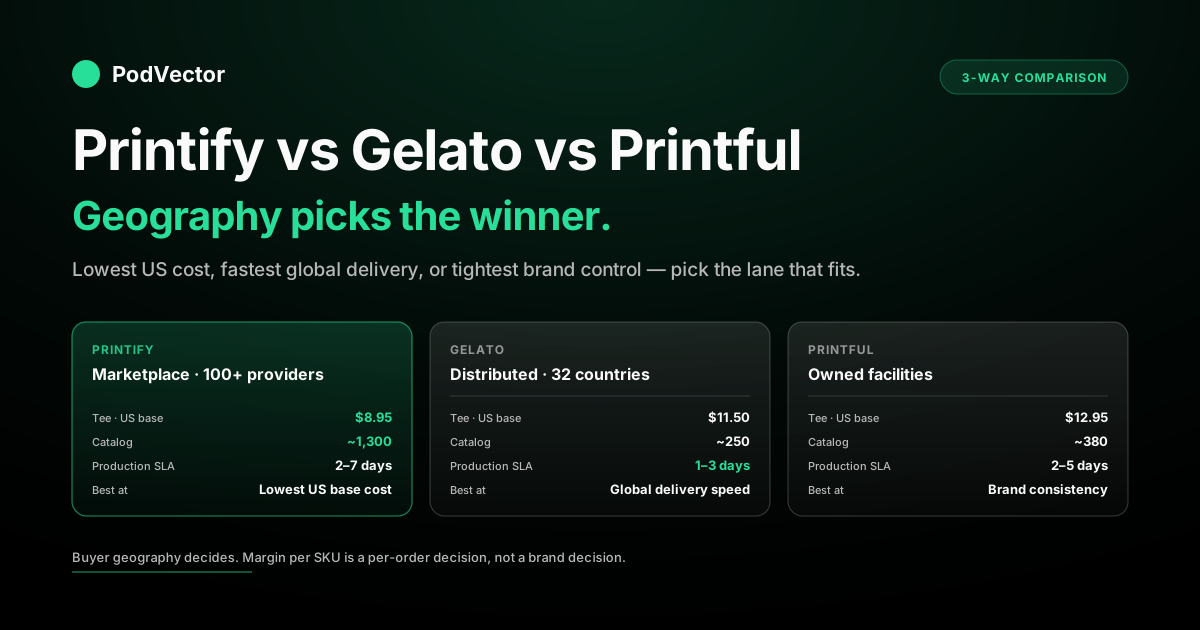
Quick Answer: Printify, Gelato, and Printful each win a different lane. Printify wins on lowest US base cost and the widest catalog (1,300+ products). Gelato wins on global delivery speed via local production in 32 countries. Printful wins on brand-consistent quality from owned facilities.
The right pick is a function of two inputs: where your buyers live and what you sell most. US-heavy apparel stores usually land on Printify for margin. EU, UK, AU, and JP stores usually land on Gelato for speed. Premium-positioned brands usually land on Printful for consistency.
Most established POD stores in 2026 don't pick one. They route SKUs to whichever supplier prices, prints, and ships them best. Below is the head-to-head across catalog, pricing, fulfillment, quality, and integrations — plus the question none of them answer for you: which one is actually more profitable for your catalog.
The 60-second verdict
Three suppliers, three architectural choices. Printify is a marketplace stitching 100+ third-party print providers together. Gelato is a distributed network of 130+ partner facilities in 32 countries with local-production routing. Printful runs its own factories in six countries.
That single architectural choice cascades into every other axis — unit cost, quality variance, shipping speed, catalog breadth, branding control, and risk profile. There is no "best" supplier in the abstract. There is a best supplier for your buyer geography, your product mix, and your margin tolerance.
The rest of this comparison unpacks each axis with current 2026 pricing, real fulfillment windows, and the trade-offs each platform's marketing pages don't volunteer.
Side-by-side comparison table
Each row gets a deeper look below. This is the at-a-glance version.
| Axis | Printify | Gelato | Printful |
|---|---|---|---|
| Model | Marketplace of 100+ providers | Distributed network, 130+ partners in 32 countries | Vertically integrated, owned facilities |
| Bella+Canvas 3001 tee, US base | $8.95 (Premium) / $10.95 (Free) | $11.50 | $12.95 |
| Subscription | Premium $24.99/mo, up to 20% off | Gelato+ $14.99/mo, ~10% off; Gold $99/mo, ~20% off | Growth $24.99/mo, up to 33% off |
| Catalog | ~1,300 products | ~250 products | ~380 products |
| Production SLA | 2–7 business days (varies by provider) | 1–3 business days | 2–5 business days |
| Local production coverage | US, EU, UK, AU, CN (varies by provider) | 32 countries; ~90% produced locally | US, EU, MX, CA, JP, AU |
| Best at | Lowest US base cost, widest catalog | Fastest global delivery, EU/AU/LATAM coverage | Brand consistency, premium apparel |
| Weakest at | Quality variance across providers | Catalog breadth, US base cost | Base cost on commodity SKUs |
Three different business models
The Printify model is a two-sided marketplace. Sellers pick a product, then pick which of multiple print providers fulfills it. The same Bella+Canvas tee might be available from a Florida shop, a Latvia shop, and a Shenzhen shop — different base costs, different ship rates, different quality.
That is Printify's superpower and its risk. You can hand-pick the cheapest provider for every SKU. You can also get burned when a top-rated provider ships a misregistered print, runs a 14-day backlog, or drops out of the network with three days notice.
The Gelato model is closer to a global logistics company. Gelato owns the order-routing layer and matches each order to the closest production partner that can hit quality and SLA targets. A buyer in Munich gets a tee printed in Berlin. A buyer in Sydney gets a tee printed in Sydney. The seller never picks the provider — Gelato does.
The Printful model is the most traditional. Printful owns and operates its facilities. The same printer, the same ink, the same QC team handles every order in a given region. Less choice, more consistency.
For a deeper look at how these three differ on raw mechanics, the Printify vs Printful difference guide covers the two-supplier face-off in more detail. The full library of three-way and head-to-head matchups lives on the Printful comparison hub, and broader supplier coverage lives on the Printful topic hub.
Catalog breadth and SKU coverage
Catalog size is where the gap is widest. Printify lists roughly 1,300 products across apparel, home, accessories, drinkware, wall art, pet, and a long tail of niche SKUs (hockey jerseys, hydration packs, prayer beads). Gelato lists roughly 250 products with a heavy weight on wall art, photo books, calendars, apparel basics, and stationery. Printful lists roughly 380 products, biased toward apparel and brand-owned in-house production.
What that means in practice:
- Printify wins if your store sells more than apparel — pet bowls, premium drinkware, leggings with all-over print, niche sports gear. The long tail is real.
- Gelato wins for wall art, photo books, calendars, and stationery — categories where local production cuts both ship time and damage rates.
- Printful sits in the middle on catalog count but wins on consistency within its catalog — embroidery, all-over print, and premium apparel are tightly controlled.
If your store currently sells fewer than 30 SKUs across one or two product categories, catalog size is not the deciding factor. If you are planning to expand into 5+ product categories or run aggressive seasonal lines, Printify's 1,300 SKU surface area is hard to match.
Pricing — subscriptions and per-product
All three have a free tier and at least one paid tier. The math gets interesting when you stack subscription cost against per-order discount.
Printify pricing
Free tier with no monthly fee. Premium at $24.99/month unlocks up to 20% off on most products. Enterprise is custom-quoted for stores doing 10,000+ orders/month.
The Premium tier breaks even fast if you are doing more than ~40 orders/month on Printify. Below that, stay on Free.
Gelato pricing
Free tier with no monthly fee. Gelato+ at $14.99/month unlocks ~10% off products plus discounted shipping. Gelato+ Gold at $99/month adds ~20% off plus advanced editing and brand tools.
Gelato+ has the lowest break-even of the three because the monthly fee is half of Printify Premium and Printful Growth. The Gold tier only makes sense at scale (300+ orders/month, plus you need the brand tooling).
Printful pricing
Free tier with no monthly fee. Growth at $24.99/month unlocks up to 33% off when you cross a certain monthly sales threshold (the discount scales with revenue). Business at $49.99/month adds higher discounts plus carrier-rate shipping.
Printful's Growth plan has the steepest discount ceiling of the three, but it kicks in only at higher monthly revenue. If you are doing fewer than $1,000/month in Printful orders, stay on Free.
Per-product cost example — Bella+Canvas 3001 tee, size M, white, US
- Printify Premium: $8.95 base + ~$4.49 shipping = ~$13.44 landed
- Gelato: $11.50 base + ~$4.69 shipping = ~$16.19 landed
- Printful: $12.95 base + ~$4.69 shipping = ~$17.64 landed
On a single tee, Printify Premium is $4 cheaper than Printful. Multiply by 1,000 tees and that is $4,000 in margin. For a deeper teardown of where that $4 actually comes from, the Printify vs Printful prices breakdown walks through the same SKU at every tier.
Catch: that $4 gap shrinks or inverts on premium tees, embroidery, all-over print, and most non-apparel SKUs. Printful is more competitive on its in-house-only product lines because no marketplace markup sits in the middle. Match the supplier to the product, not to the brand.
Shipping speed and global coverage
Shipping is where Gelato has its biggest moat. Gelato reports ~90% of orders produced and shipped from a facility in the same country as the buyer. Production windows are 1–3 business days and ground shipping is local-rate, not international-rate.
Printify's shipping speed is provider-dependent and varies widely. A US buyer ordering from a Florida-based Printify provider sees 3–5 day production plus 3–6 day ground shipping. A US buyer ordering from a Chinese Printify provider sees 5–7 day production plus 10–18 day air shipping.
Printful's owned facilities give it consistent production (2–5 business days) and the routing logic is automatic — a US order ships from the nearest US facility, an EU order from the EU. Outside its six production countries, Printful falls back to international ship rates.
If you want to compare the full pricing-versus-shipping trade across all three, the Printify vs Printful pricing comparison sister piece breaks down landed cost by destination.
Geography decides the winner
- US-only store: Printify and Printful are roughly tied on delivery speed (3–8 business days door-to-door). Printify usually wins on landed cost.
- EU / UK store: Gelato wins decisively. Local production cuts 7–14 days off the order-to-delivery window vs Printify (which often routes EU orders through US providers) and 2–5 days vs Printful (which routes EU orders through its Latvia and Spain facilities).
- AU, JP, LATAM store: Gelato wins on speed, often by 10+ days. Printful has Japan and Australia coverage but limited SKU availability there. Printify's options in these regions are thin.
Print quality and consistency
Quality is the trickiest axis to compare because Printify's marketplace structure produces a quality distribution, not a quality score. The best Printify providers (Monster Digital, SwiftPOD, Drive Fulfillment) rival Printful on print fidelity. The bottom-quartile providers ship work you would not put on a customer.
The practical implication: on Printify, the seller's job is to test 3–5 providers per SKU, pick the winner, and lock that provider into the listing. Sellers who skip that step inherit variance.
Gelato runs a more aggressive QC layer across its partner network. The seller never picks the partner, so variance hides behind the scenes. In return, Gelato's average print quality is reliable and the customer experience is consistent across countries.
Printful has the tightest quality control because it controls the entire stack — equipment, ink, operators, QC. The trade-off is cost. You pay for that consistency in the base price.
Integrations and store setup
All three integrate with Shopify, Etsy, WooCommerce, Wix, Squarespace, eBay, and TikTok Shop. The integrations are deep enough that day-one setup is roughly equivalent.
Where they differ is the bulk and automation tooling:
- Printify ships the best bulk product editor — change print files, descriptions, or pricing across hundreds of SKUs in minutes. Its API is mature and well-documented for stores that want to script their workflows.
- Gelato ships the strongest cross-region SKU management — one product, automatic local-production routing across 32 countries with no extra setup per region.
- Printful ships the deepest branding tools — branded inserts, custom packaging, neck labels, and pack-in flyers are first-class features, not add-ons.
None of the three publish APIs that let you do real revenue forecasting or per-supplier margin attribution. You either build that yourself in a spreadsheet or you hand it to an AI employee — more on that in the profitability section below.
The buyer-geography decision tree
Strip away every other variable and the supplier decision is mostly a function of buyer geography. This is the framework most experienced POD sellers use as a starting point.
- If 80%+ of your buyers are US: start with Printify on Premium. Lowest landed cost, biggest catalog, US-based providers ship inside the country. Add Printful only for the SKUs where you need brand-consistent quality (embroidery, premium apparel, branded packaging).
- If 80%+ of your buyers are EU / UK: start with Gelato. Local production wins on speed and avoids cross-border VAT and customs headaches. Add Printful as a fallback for SKUs Gelato doesn't carry.
- If your buyers are spread globally (under 60% in any single region): default to Gelato. Local production in 32 countries does the routing math for you. Layer Printify on for the long-tail SKUs Gelato doesn't carry.
- If you sell premium-positioned apparel with branded packaging: default to Printful. Pay the higher base cost for the consistency and brand control. Use Printify for unbranded basics that don't need the same standard.
The 80% rule is a heuristic, not a law. Once your second-most-common country accounts for 25–40% of orders, you are in multi-supplier territory and the decision tree branches.
Running two or three suppliers in parallel
Once you cross ~500 orders/month, single-supplier strategies start to leave money on the table. The supplier that wins on a tee doesn't win on a mug. The supplier that wins on US orders doesn't win on EU orders.
The pattern most established stores converge on:
- Apparel basics (tees, hoodies, sweatshirts): Printify for the lowest base cost, with hand-picked providers per SKU.
- Premium apparel and embroidery: Printful for consistency.
- Wall art, posters, photo books, calendars: Gelato for local production and damage-rate reduction.
- International orders (EU, UK, AU, JP): Gelato for speed, Printful as fallback.
The cost of running multi-supplier is operational, not financial. You are now reconciling three sets of fees, three sets of SLAs, three sets of product-cost increases, and three different fulfillment pipelines into one P&L. Most sellers cobble that together in spreadsheets and lose 2–3 hours a week to data wrangling.
For the deeper economics of running multiple POD suppliers without breaking your margins, the Printful cost full breakdown walks through how itemized supplier costs roll up into store-level P&L. The companion Printful canvas print pricing breakdown does the same exercise on the wall-art SKU where Gelato is most often a better fit.
The comparison none of them publish
Here is what every "Printify vs Gelato vs Printful" article skips. The supplier marketing pages tell you base cost. They don't tell you per-order profit on your actual mix of SKUs, sized, color, region, and ad-spend allocation.
The question that actually matters: "On the 47 SKUs I sold last month, which supplier would have netted me the most after ad spend, supplier fees, and shipping?"
That answer requires four data streams that don't naturally live in the same place:
- Itemized supplier costs per SKU (Printify or Printful)
- Shopify order data with line-item ship rates
- Meta and Google ad spend attributed to each order
- Refunds, chargebacks, and reprint costs
Pulling those into one P&L by hand is the 2–3 hours/week that most sellers either skip or hate. Skipping it is how you end up scaling a SKU that costs $4.20 to acquire and sells for $4.80 net.
This is the gap PodVector AI's AI employee agent, Victor, is built for. Victor connects to your Shopify store, your ad accounts, and your supplier cost data through a live data warehouse — one source of truth, refreshed continuously, queryable in plain English. Ask "which supplier is actually more profitable for my catalog?" and Victor runs the calculation across your real order history, not a generic price-list comparison.
The differentiator isn't just answers, it's actions. When Victor finds that you would have netted $1,800 more last month routing your hoodies through Provider X on Printify instead of Provider Y, he proposes the swap and (with your approval) executes it directly in your Shopify catalog. Three legs — the POD operator playbook baked into the agent, the live data layer underneath, and the action layer on top. Strip any one and you collapse into a competitor.
FAQs
Is Printify cheaper than Gelato and Printful?
On most US-based commodity apparel SKUs, yes. Printify Premium prices a Bella+Canvas 3001 tee around $8.95 base, Gelato around $11.50, Printful around $12.95. The gap narrows or inverts on premium apparel, embroidery, all-over print, and most wall art.
Which is fastest for delivery?
It depends on where your buyers live. Gelato is fastest globally because ~90% of orders are produced locally. Printful and Printify are competitive for US-only stores. Gelato wins decisively for EU, UK, AU, and JP buyers.
Can I use Printify, Gelato, and Printful at the same time?
Yes, and most stores past ~500 orders/month do. The integrations don't conflict — each plugs into Shopify, Etsy, or WooCommerce independently. The operational cost is reconciling three sets of fees and SLAs into one P&L, which is where stores either spreadsheet it or hand it to an AI employee.
What about the Printful and Printify merger — does that change anything?
Printful and Printify announced a merger in late 2024 but are still operating as independent platforms in 2026. Different catalogs, different pricing, different fulfillment networks. Treat them as two suppliers for decision-making until that changes. Other industry deep-dives like Print on Demand Business's 3-way comparison reach the same conclusion.
Which has the best Shopify integration?
All three have mature Shopify apps with similar feature coverage — auto-sync products, push orders, route fulfillment, and handle shipping notifications. Printify's bulk product editor is the most powerful for stores managing hundreds of SKUs. Gelato's cross-region routing is the cleanest for stores selling globally. Printful's branding tools are the deepest if you ship branded packaging.
Which is best for an Etsy seller?
For US-based Etsy sellers focused on apparel basics, Printify wins on margin. For Etsy sellers in the EU or UK, Gelato wins on delivery speed (which is a search-rank and review-rate factor on Etsy). Printful is best for Etsy sellers running embroidered or premium apparel where consistency matters more than base cost.
Which has the best print quality?
Printful is the most consistent because every order goes through its own facilities. Gelato is reliable across its partner network thanks to centralized QC. Printify has the highest ceiling on quality (top providers match Printful) and the highest floor variance (bottom providers ship work you wouldn't put on a customer). Test 3–5 Printify providers per SKU before committing.
Does Gelato have the same product variety as Printify?
No. Gelato lists roughly 250 products vs Printify's 1,300. Gelato is strongest on wall art, photo books, calendars, stationery, and apparel basics. If your store sells across 5+ product categories, Printify's catalog breadth is hard to match.
Which is best for beginners just starting POD?
For US beginners, start with Printify on the Free tier. Lowest unit cost, widest catalog, and you can test products without a monthly fee. For EU beginners, start with Gelato on the Free tier. For beginners targeting a premium brand from day one, Printful's consistency saves you from quality-driven refunds.
Stop guessing which supplier is more profitable for your catalog
The supplier marketing pages tell you base cost. They don't tell you per-order net after ad spend, shipping, refunds, and reprints. Victor — PodVector AI's AI employee agent for POD stores — connects your Shopify, your ad accounts, and your supplier cost data into one live data warehouse. Ask in plain English which supplier is actually more profitable for your catalog, and Victor proposes specific swaps and executes them in Shopify on your approval.
Try Victor free