
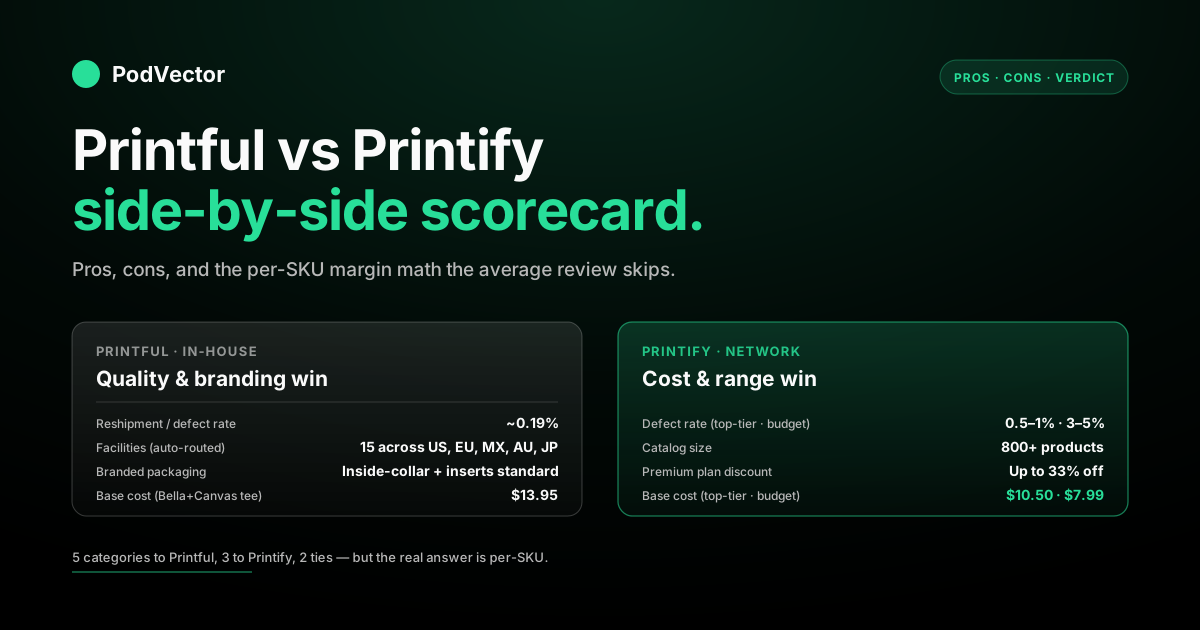
Quick Answer: Printful wins on quality, branding, and operational simplicity. In-house production, ~0.19% defect rate, consistent packaging, and a single dashboard make it the safer choice for brand-led shops and paid-ad operators.
Printify wins on cost flexibility and product range. A ~$3–6/unit base-cost advantage on standard apparel, a 1,300+ product catalog, and a multi-provider network give it the edge for margin-sensitive shops willing to do provider selection per SKU.
Below: a side-by-side pros/cons review on every category most operators care about, the itemized margin math that the average comparison post leaves out, and the per-SKU framework that beats either-or platform picks.
Quick verdict and at-a-glance winners
The ten public Printful vs Printify reviews land in roughly the same place. Printful is in-house, more polished, more expensive. Printify is a network, more flexible, cheaper. The trade-offs are real, but the winner depends on which axis you weight.
Here's a per-category verdict that compresses the rest of this review into a glance:
| Category | Winner | Why |
|---|---|---|
| Base price (per unit) | Printify | ~$3–6/unit cheaper on top-tier providers, more on budget tier |
| Print quality consistency | Printful | ~0.19% reshipment rate, in-house production controls variance |
| Product range | Printify | 1,300+ products vs Printful's ~470 |
| Branding execution | Printful | Inside-collar tags, branded inserts, consistent polybag packaging |
| Production speed | Tie (when pinning Printify top-tier) | Printful 2–5 days; Printify top-tier 2–4 days, budget 5–10 |
| Integrations | Tie | Both cover Shopify, Etsy, WooCommerce, Amazon, eBay natively |
| International fulfillment | Printful | Auto-routing to closest of 15 facilities (US, EU, MX, AU, JP) |
| Customer support | Printful | 24/7 live chat, faster claim resolution |
| Catalog flexibility | Printify | Per-SKU provider selection, regional cost optimization |
| Operational simplicity | Printful | Single vendor, single dashboard, single quality bar |
Five categories to Printful, three to Printify, two ties. But "winners" don't pay your bills — margin does. The next sections review each category with the actual numbers.
Printful pros and cons
Printful pros
- Best-in-class quality consistency. Published reshipment rate sits around 0.19% — comparable to in-house DTC apparel brands. Color match and print durability hold up across batches.
- In-house production at 15 facilities. US (Charlotte, LA, Dallas), EU (Riga), Mexico, Australia, Japan. Auto-routing sends each order to the closest facility for the buyer.
- Branded packaging out of the box. Inside-collar labels ($2.49/item), packing inserts, and polybag printing. Useful for brand-led Shopify shops where unboxing matters.
- 24/7 customer support. Live chat, email, and a helpful merchant support team that resolves claims faster than the Printify comparison.
- Single dashboard, single vendor. No provider selection per SKU. Faster onboarding, simpler reconciliation, fewer moving parts.
- Mature integrations. Shopify, Etsy, WooCommerce, Amazon, eBay, Wix, Squarespace, BigCommerce, Storenvy, Wish, TikTok Shop. The product-push flow is polished.
- Embroidery and DTG quality holds up. Embroidered hats, polos, and beanies print cleaner on Printful than on most Printify providers.
- Growth plan closes the price gap fast. Printful Growth ($24.99/month, and free for the year once you cross $12k in annual sales) now cuts up to 33% off product cost — a far bigger lever than the old volume tiers, and enough to undercut Printify Premium on many popular SKUs.
Printful cons
- Highest base costs in the category. $13.95+ for a Bella+Canvas 3001 tee, vs $7.99–$10.50 on Printify. The margin gap is the single biggest reason sellers switch off Printful.
- Smaller product catalog. ~470 SKUs total vs Printify's 1,300+. Underpowered for niche categories like all-over-print apparel, accessories, and home goods.
- No multi-provider redundancy. If Charlotte's queue is backed up, your order waits — there's no automatic re-route to a different supplier.
- Fewer per-unit levers than Printify's provider tiers. Optimization runs through the Growth plan's flat discount rather than per-SKU provider shopping, so the cheapest possible base cost on a given garment still sits with Printify's budget providers.
- Higher shipping costs on long-distance routes. Auto-routing helps, but Printful's USPS/UPS rates run a touch higher than the Printify provider average for the same destination.
Printify pros and cons
Printify pros
- Lowest base costs in the category. Budget providers hit $7.99 for tees that cost $13.95+ on Printful. Even top-tier providers undercut Printful by ~$3.50/unit.
- Largest product catalog. 1,300+ products spanning apparel, mugs, posters, tote bags, all-over-print, home goods, and accessories. Niche-store-friendly.
- Multi-provider redundancy. If Monster Digital's queue is backed up, you can re-route to SwiftPOD or Dimona Tee for the same SKU.
- Premium plan that pays back fast. $39/month (or ~$25/month billed annually) for up to 20% off product costs. On 100+ orders/month it pays for itself well inside the first month.
- Performance Score system. Each provider's quality, speed, and reliability scores are public. Sellers can pick the best provider per region and category.
- Strong international provider network. Print Logistic and Drukarnia (EU), T-Pop (FR/EU), Print Geek (CA), T-Shirt and Sons (UK). Cheaper and faster than Printful for European sellers willing to pin manually.
- Better mockup output by default. Each provider runs its own photography, so a single design renders 6–10 mockups vs Printful's 1–4.
Printify cons
- Variable print quality across the network. Top-tier providers run 0.5–1% defect rates. Budget providers can hit 3–5%. Quality is provider-dependent, not platform-dependent.
- Customer support routes through the provider. Reshipment claims take 5–10 days vs Printful's 3–6. Some providers are slower than others on response time.
- Branding execution depends on the provider. Branded labels work on some providers, not others. Polybag consistency varies. Inserts limited compared to Printful.
- Setup work scales with catalog size. Per-SKU provider selection, sample orders, and Performance Score monitoring all add hours that Printful doesn't require.
- Integration push transfers fewer mockups and tags by default. Etsy listings often need manual SEO cleanup after the import.
- Mockup style varies across providers. A SwiftPOD tee mockup looks different from a Monster Digital tee mockup. Consistent visual brand on a marketplace gets harder.
- Split shipments on multi-item orders. If a buyer orders two SKUs fulfilled by different providers, they ship in separate parcels and you're charged shipping twice — a margin leak Printful's single-vendor model avoids.
Pricing review
Pricing is where Printful loses and Printify wins, but the margin gap depends on which Printify provider you pin to.
Take a Bella+Canvas 3001 tee — the most-printed garment in POD — in white, size M, shipped to a US buyer:
| Cost line | Printful | Printify (top-tier) | Printify (budget) |
|---|---|---|---|
| Base + 1-side print | $13.95 | $10.50 | $7.99 |
| Shipping (US, single tee) | $4.69 | $4.69 | $4.69 |
| Total fulfilled cost | $18.64 | $15.19 | $12.68 |
| Margin at $24 retail (no shipping subsidy) | $5.36 | $8.81 | $11.32 |
The Printify (top-tier) advantage is $3.45 per unit. The Printify (budget) advantage is $5.96 per unit. On 1,000 orders a month, that's $3,450–$5,960 of margin difference.
Paid plans narrow the gap more than they used to. Printful's Growth plan ($24.99/month, free for the year once annual sales clear $12k) now shaves up to 33% off product cost; Printify Premium ($39/month, or ~$25 billed annually) shaves up to 20%. That flips the old read: on Bella+Canvas and Gildan staples, a Growth-plan Printful base can land within a dollar of — or under — top-tier Printify Premium, though Printify's budget providers still hold the absolute-cheapest floor.
The honest pricing read: Printify still wins for any operator chasing the lowest possible base cost, especially on the budget tier. But the Growth plan has closed enough of the gap that Printful's quality consistency and branding no longer cost as much premium as the raw catalog prices suggest. For the full pricing breakdown, see Printful vs Printify pricing; the underlying cost lines are in the complete guide to Printful costs and fees.
Print quality review
Reviews of Printful and Printify converge on the same finding: Printful prints more consistently. The quality gap isn't about peak quality — Printify's top-tier providers can match Printful on a good day. The gap is about variance.
Printful's published reshipment rate is around 0.19%. That number reflects in-house quality control, standardized inks and presses, and a fixed list of Bella+Canvas, Gildan, Stanley/Stella, and Champion blanks. Across 1,000 orders, you'd expect ~2 defective items.
Printify's defect rate is provider-dependent:
- Top-tier providers (Monster Digital, SwiftPOD, Dimona Tee): 0.5–1% reshipment rate. ~5–10 defective items per 1,000 orders.
- Mid-tier providers: 1–2% reshipment rate. ~10–20 per 1,000 orders.
- Budget providers: 3–5% per seller-reported data. ~30–50 per 1,000 orders.
The cost of variance isn't just reprints. On a marketplace like Etsy, a defective shipment risks a 1- or 2-star review that drags shop rating down for months. On paid-ad-driven Shopify, defects compound LTV erosion and refund rate. Quality variance has a multiplier effect that the per-unit base-cost saving doesn't always offset.
The Printify counter-move: pin to top-tier providers for flagship SKUs and accept the slightly higher cost as defect insurance. That pulls the defect rate close to Printful's range while preserving most of the margin advantage.
For a deeper review of quality testing methodology and lab-test results, see Printful vs Printify quality.
Product range review
Printify's catalog is roughly 2x Printful's. Both cover the core POD categories — tees, hoodies, mugs, posters, tote bags, hats — but the long tail diverges.
Where Printful wins on selection: embroidery (caps, beanies, polos with embroidered logos run cleaner), premium garments (Stanley/Stella, Champion), and accessories tied to Printful-specific blanks. Their AOP (all-over-print) offering is narrower than Printify's but more consistent.
Where Printify wins on selection: all-over-print apparel (joggers, leggings, AOP hoodies via providers like Subliminator), home goods (throw pillows, blankets, doormats, shower curtains), and niche categories like jewelry, drinkware variants, and pet products. The catalog edge widens beyond standard apparel.
For a niche-store strategy — yoga apparel, home decor brand, pet merchandise — Printify's catalog usually has the SKUs you need. For a brand built around premium tees and hoodies, Printful's tighter catalog isn't a constraint.
Integrations review
Both platforms have mature native integrations with the major channels:
- Shopify: both work cleanly. Printful's mockup transfer is slightly cleaner; Printify pushes more mockups but with more provider variation.
- Etsy: Printify holds the official partnership badge inside Etsy seller-tools. Printful is a long-standing third-party connector. Functionally close.
- WooCommerce: both well-supported.
- Amazon, eBay, TikTok Shop: both have integrations; review setup workflows before committing on Amazon — both add seller-account requirements.
- Wix, Squarespace, BigCommerce, Storenvy, Wish: Printful has slightly broader native support.
Where Printify's integration design adds friction: if a SKU lives on multiple Printify providers (which most should, for redundancy), the Etsy or Shopify push needs to be handled per provider. Printful's single-vendor model avoids this. For a deeper view of Printful's connector matrix, see the complete guide to Printful integrations.
Branding review
Printful wins this category clearly. The branded packaging stack — inside-collar labels, custom packing inserts, polybag printing, return address customization — works out of the box and runs consistently across all 15 facilities.
Printify's branding execution is provider-dependent. Some providers offer inside-collar labels, others don't. Polybag inserts are inconsistent. Custom return labels work on some providers, not others. A brand-led shop running on Printify spends time per provider getting the branding stack consistent.
The exception: marketplace shops (Etsy, Amazon) where the platform's brand absorbs most of the customer-facing presentation. On marketplaces, branded packaging matters less — see the discussion in Printful vs Printify for Etsy.
Production and shipping review
Printful's median production runs 2–5 business days. The variance is narrow because production sits in Printful's own facilities with consistent staffing and equipment.
Printify's production depends on the provider. Top-tier (Monster Digital, SwiftPOD) runs 2–4 days. Mid-tier 3–7. Budget 5–10, with reported outliers stretching to 12+ during peak season.
For shipping rates, both auto-route to the closest facility. Printful's coverage (US, EU/Riga, Mexico, AU, Japan) is broader than Printify's regional providers but with fewer providers per region. Printify's network is denser in the US and EU and has stronger CA and AU coverage when you pin manually.
For the full shipping breakdown, see the complete guide to Printful shipping.
Customer support review
Printful runs 24/7 live chat, email, and dedicated merchant support. Reviewers consistently rate response time as faster than Printify's. Reshipment claims resolve in 3–6 days on average.
Printify routes most support through the print provider. Platform support exists but the substantive resolution often happens at the provider level. Reshipment turnaround averages 5–10 days. Quality varies by provider — top-tier providers respond fast, budget providers can drag.
For high-volume Etsy shops where customer-message response time feeds Star Seller, Printful's support stack reduces operational risk. For lower-volume shops where occasional escalations don't break the workflow, the gap matters less.
The decision framework most reviews skip
Most Printful vs Printify reviews end with "pick A if you want quality, pick B if you want price." That's true at the category level. Below it, the framework most experienced sellers actually use:
Pick Printful if
- You're running paid social or paid search and need defect-rate consistency to protect ROAS.
- Your brand position depends on unboxing experience (DTC, gift markets, premium positioning).
- Your catalog skews toward embroidery, premium tees, or in-house-printed signature blanks.
- You sell internationally and want auto-routing without manual per-region setup.
- You'd rather spend time on marketing than on supplier management.
Pick Printify if
- Your margin tolerance is thin and the $3–6/unit advantage funds your ad spend.
- Your catalog skews wide (200+ SKUs) and selection matters more than uniformity.
- You're willing to do per-SKU provider selection, sample orders, and Performance Score monitoring.
- You sell in regions where Printify has strong local providers (US, UK, EU, AU, CA).
- You're comfortable trading operational simplicity for cost optimization.
Run both if
- You're above $10k/month gross and your catalog has both flagship and long-tail SKUs.
- Flagship products (5–15% of SKUs, 60–80% of revenue) deserve Printful's quality consistency.
- Long-tail SKUs (margin-optimized variants, regional editions, niche listings) deserve Printify's cost flexibility.
- You can absorb the dual-dashboard reconciliation work.
Most established POD shops at scale run a hybrid. The platform-level winner is rarely the right answer when your catalog is large enough to optimize per-SKU.
For a fuller broader comparison, see the full Printful vs Printify comparison; for alternative supplier comparisons, the Printful alternatives roundup covers Gelato, Gooten, CustomCat, and Apliiq. The Printful comparison hub indexes every Printful-vs-X review and the Printful topic hub covers everything Printful.
The per-SKU answer the comparison can't give you
Every framework above gives a category-level answer. Pick Printful for quality, Printify for margin, both above $10k/month. But your P&L doesn't run on category averages — it runs on per-SKU contribution dollars.
On your top-selling tee, in your chosen blank and color, shipped from your chosen provider to your top buyer states — what's the real margin after fees, after refunds, after the actual reprint rate from your last 90 days? Which 10 SKUs would clear $3+ more per order if you switched suppliers? Which Printify provider's Performance Score has slipped enough to move flagship listings off it?
None of the public Printful-vs-Printify reviews answer these questions. They quote averages — $4 saved per shirt, 0.19% defect rate, 0.5–1% top-tier defect rate — and stop there. Margin runs on the specific SKU + provider + buyer-state + ad-channel combination that produced the order.
Closing this gap takes three pieces working together. Every order's supplier-charged cost, refund event, and reshipment has to land in a single source of truth alongside ad cost (Meta, Google, TikTok), processor fees, and customer LTV. The math has to run per-SKU and per-supplier so a tee profitable on Monster Digital and a hoodie profitable on Printful both surface clearly. The data has to refresh fast enough to act on — switching a provider 90 days late is too slow when review velocity drives marketplace ranking.
This is the architecture PodVector AI built Victor on. A unified data warehouse ingests Shopify, Printful, Printify, Meta, and Google per-order data. You ask "which SKU would improve margin if I switched from Printful to Printify?" or "what's my real defect rate per provider this quarter?" in plain English and get the answer pulled from your live data.
For more on operating the profitability side, see how to make money with Printful and the complete Printful guide.
FAQs
Is Printful or Printify better overall?
Neither is universally better. Printful wins on quality consistency, branding execution, operational simplicity, and international auto-routing. Printify wins on base cost, product range, multi-provider redundancy, and regional cost optimization. The right pick depends on whether margin or quality consistency drives your P&L harder.
What are the main pros of Printful?
In-house production at 15 facilities, ~0.19% reshipment rate, branded packaging out of the box, 24/7 customer support, mature integrations with all major channels, and a single dashboard that simplifies operations. Strong embroidery and premium-blank catalog.
What are the main cons of Printful?
Highest catalog base costs in the category — roughly $3.50/unit more than top-tier Printify and $5.96/unit more than budget Printify on standard tees before discounts. Smaller catalog (~470 SKUs vs Printify's 1,300+), no multi-provider redundancy, and a single flat Growth-plan discount rather than per-SKU provider shopping. The Growth plan's up-to-33% cut does close much of the price gap on popular blanks.
What are the main pros of Printify?
Lowest base costs in the category, 1,300+ product catalog covering apparel, home goods, accessories, and AOP. Multi-provider redundancy, Performance Score system for provider comparison, $39/month Premium plan (or ~$25 billed annually) with up to 20% off, and strong international provider network.
What are the main cons of Printify?
Variable print quality (0.5–1% top-tier, 3–5% budget reshipment rates), customer support routes through the provider (5–10 day claim resolution), branding execution depends on the provider, and per-SKU provider selection adds setup work as the catalog grows.
Which is cheaper, Printful or Printify?
Printify is cheaper at catalog list price across nearly every product. On a Bella+Canvas 3001 tee, Printify (top-tier) saves ~$3.45/unit vs Printful, and Printify (budget) saves ~$5.96/unit. But Printful's Growth plan (up to 33% off, free after $12k/year in sales) now narrows or even reverses the gap against Printify Premium (up to 20% off) on popular blanks. Printify's budget providers still hold the absolute-lowest floor.
Which has better print quality, Printful or Printify?
Printful is more consistent. Published reshipment rate is ~0.19% vs Printify's 0.5–1% on top-tier providers and 3–5% on budget providers. Printify can match Printful on a good day with a top-tier provider, but Printful's variance is narrower.
Can I use Printful and Printify together?
Yes, and many established shops do. Run flagship SKUs on Printful for consistency, long-tail or margin-sensitive SKUs on Printify (top-tier providers). The hybrid splits the trade-off but adds dashboards and reconciliation work. It's a common move above $10k/month gross.
Which has better integrations?
Both cover Shopify, Etsy, WooCommerce, Amazon, eBay, and TikTok Shop natively. Printful has slightly broader native support (Wix, Squarespace, BigCommerce, Storenvy, Wish). Printify holds the official Etsy partnership badge inside Etsy seller-tools, but functionally both Etsy connectors work similarly.
Which is better for embroidery?
Printful. Embroidered hats, polos, and beanies print cleaner on Printful than on most Printify providers. Printify supports embroidery through specific providers but with more variance.
Which is better for international sellers?
Printful for ease — 15 facilities with auto-routing to the closest. Printify for cost — strong regional providers in the EU (Print Logistic, Drukarnia, T-Pop), UK (T-Shirt and Sons), CA (Print Geek), and AU when pinned manually. The choice depends on whether you want auto-routing or per-region cost optimization.
Where can I find more on the Printful vs Printify comparison?
The deep dives on individual axes are at Printful vs Printify pricing, Printful vs Printify quality, and Printful vs Printify for Etsy. The Printful comparison hub indexes every Printful-vs-X review.
Stop guessing which platform reviews better on your specific catalog.
Public reviews tell you the average. Your P&L runs on the specific SKU + provider + buyer-state + ad-channel that produced the order. Spreadsheet snapshots go stale by the next supplier-cost change. Victor pulls every Shopify, Printful, and Printify charge into one live data layer — then lets you ask "which provider had the best margin on tees last 90 days?" in plain English. POD-native profitability tracking, no spreadsheets.
Try Victor freeFor an external operator's perspective on the same comparison, the Bootstrapping Ecommerce hands-on review walks through both platforms with side-by-side product testing. To go broader, see the complete Printful guide and the complete Printful review.