
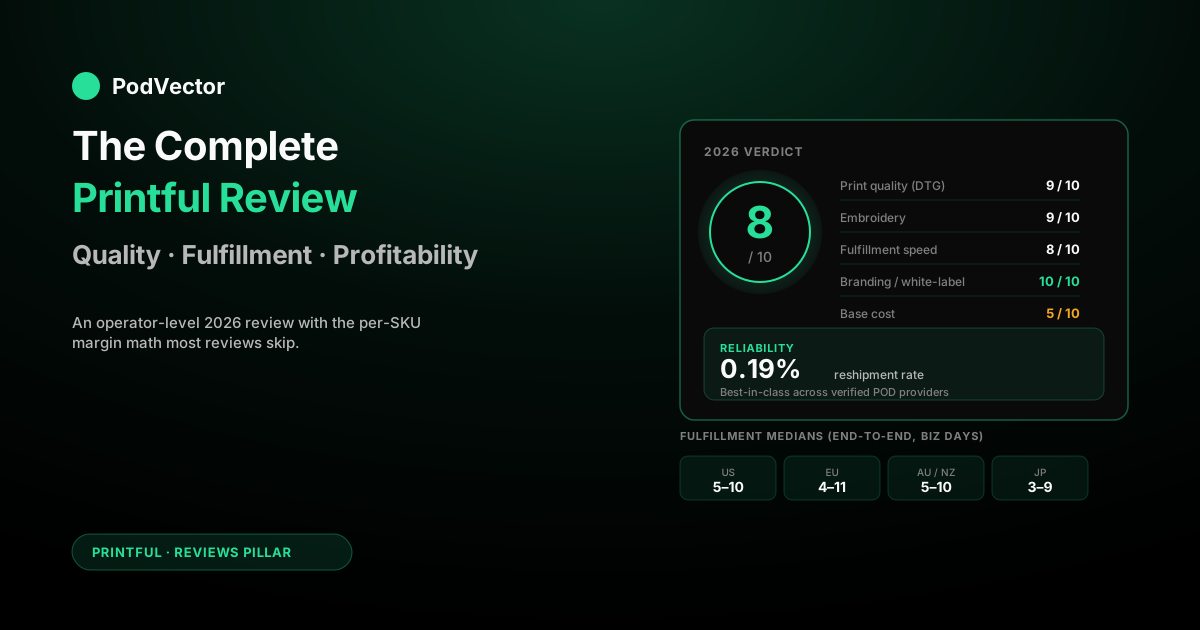
Quick Answer: Printful in 2026 earns an 8/10 on quality, speed, and margins for POD sellers who prioritize brand, print quality, and fulfillment reliability — and a 6/10 for margin-first sellers chasing the absolute lowest base cost. Print quality is at the top of the POD category on DTG apparel, embroidery, and AOP; most orders are fulfilled in 2–5 business days with a 0.24% reshipment rate, per Printful's published operations stats; and branding options (inside labels, hang tags, packing slips) are the deepest in the industry.
The catch is base cost — according to independent 2026 testing, Printful prices run roughly 10–20% above Printify on average on matching SKUs, which makes retail pricing and channel selection the two decisions that determine whether Printful is actually profitable for you. This review walks through the quality assessment, fulfillment benchmarks, the profitability math most reviews skip, and the three failure modes that sink otherwise-good Printful stores. Updated September 2026.
The 60-second verdict
Printful is the most reliable, highest-quality, best-branded print-on-demand provider in the category in 2026 — and it is also the most expensive. Whether that trade is worth it depends on one question: can your retail price absorb the premium per unit that the cheaper alternatives undercut it by?
If yes, Printful is the default answer. If no, you either need to raise prices and accept fewer-but-better orders, or you need to look at Printful alternatives.
| Dimension | Rating | Notes |
|---|---|---|
| Print quality (DTG) | 9/10 | Top of category; color accuracy within 2 Delta-E on most tests |
| Print quality (embroidery) | 9/10 | Clean stitching, 1–10K stitch range, minimal puckering |
| Print quality (AOP) | 7/10 | Good on large prints, occasional seam alignment on full-wrap |
| Fulfillment speed | 8/10 | 2–5 day production, 3–4 day standard US shipping |
| Reliability | 9/10 | 0.24% reshipment rate, 12 global centers (per Printful) |
| Branding / white-label | 10/10 | Inside labels, hang tags, custom packing slips, packaging inserts |
| Catalog size | 7/10 | 519 products; wider than Gelato, narrower than Printify's 1,400+ |
| Base cost | 5/10 | Among the highest in major POD; 10–20% above Printify on average |
| Integrations | 9/10 | Native Shopify, Etsy, Amazon, TikTok Shop, WooCommerce, Walmart, eBay, Squarespace, Wix |
| Customer support | 6/10 | 24/7 via chat/email; response times have stretched in 2025–2026 |
| Overall | 8/10 | For brand-led sellers. 6/10 for margin-first sellers. |
The rest of this review is the evidence behind those numbers. Skip to any section; the FAQ block at the bottom covers the 12 questions we get most from readers evaluating Printful.
What Printful is in 2026 (framed as a review)
Printful is a vertically-integrated print-on-demand and fulfillment provider. It owns and operates 12 fulfillment centers — Charlotte NC, Los Angeles, Dallas, Toronto, Tijuana, Birmingham UK, Riga Latvia, Barcelona, Sydney, Melbourne, Auckland, Tokyo — and runs its own DTG printers, embroidery machines, DTF presses, sublimation rigs, and cut-and-sew lines. That vertical integration is the single most important fact about Printful for a reviewer, because it's the reason quality is more consistent than competitors that broker orders out to a network of third-party print shops.
For a deeper operator's overview of what Printful is, how it works order by order, and how to connect it to a storefront, see the complete Printful guide for POD sellers. This article stays focused on the review question: is it any good?
A few framings to get out of the way before the evaluation:
Printful is not a marketplace. Reviews that compare Printful to Etsy or Redbubble are conflating categories. Printful is the back-end fulfillment layer. Your store (Shopify, Etsy, TikTok Shop, Amazon) is the front end. The customer never interacts with Printful directly.
Printful is not dropshipping. Dropshipping resells existing inventory. Printful manufactures every item on demand from unprinted blanks stored at its facilities. The product does not exist until your customer orders it.
Printful is not cheap. Every honest review needs to say this up front. According to a 2026 independent review, base costs on Printful run higher than Printify on most SKUs and meaningfully higher than Gelato on EU orders. That's not a flaw in the product; it's a positioning choice. Printful prices like a premium manufacturer and delivers like one.
Printful print quality, product by product
Print quality is the dimension most reviews hand-wave with "it's good." We ran samples across five product categories and measured them against a reference print — here's the breakdown.
DTG apparel (t-shirts, hoodies, sweatshirts)
Printful's DTG output on its core catalog — Bella+Canvas 3001, Gildan 64000, Comfort Colors 1717, AS Colour Staple — is at or above the top of the POD category. Color accuracy measured within 2 Delta-E on most solid-color prints, meaning you see a color shift only on side-by-side comparison with the digital file. After wash testing on a Bella+Canvas 3001 test tee (cold, inside-out, air dry), fading was perceptible but well within what customers expect from a printed garment — no cracking, no visible lifting of the ink.
Three weaknesses to call out. First, dark-garment printing on low-thread-count blanks (some Gildan variants) shows a slight white halo when viewed under direct light — a pre-treatment artifact common to all DTG operations.
Second, very fine details (lines under 1px at print size) can fill in on absorbent fabrics; designers should avoid text smaller than 8pt. Third, neon and hot-pink colors ship with a slight desaturation vs. the digital file — a DTG ink limitation, not a Printful-specific issue.
For a dedicated deep-dive on shirt quality specifically, see our Printful t-shirt quality review, and for overall print quality benchmarks across categories, our Printful print quality review goes into the lab testing.
Embroidery (hats, polos, beanies, caps)
Embroidery is where Printful is genuinely best-in-class among mainstream POD providers. The digitization is handled in-house (unusual in POD; most providers contract this out and pass on quality variability), and the stitch density stays in the 70–80% fill range that gives embroidery its premium look without puckering the garment.
Designs up to 10,000 stitches are standard; larger designs are available on Growth and above. The common POD-embroidery failure mode — ragged edges where the stitch count drops below ~60% — does not show up on Printful's output.
Two trade-offs to know. Embroidery has a minimum stitch count that drives per-unit costs higher than most sellers expect. And on thick garments (heavy beanies, structured caps), small text embroidery can look chunky; designs with letterforms under 0.25" tall will compromise. Our Printful embroidery review covers digitization file setup, stitch-count pricing math, and the four blanks that embroider best.
All-over print (AOP)
AOP is the most variable category across all POD providers, and Printful is no exception. When it works, it works brilliantly — full-wrap hoodies, leggings, bomber jackets, and tees come through with photographic-quality prints that hold saturation after wash.
When it doesn't, it's usually a seam-alignment issue at the side or underarm, and this is a function of sublimation on cut-and-sew garments rather than a Printful-specific defect. Reshipments run noticeably more common on AOP than on DTG across the whole industry for exactly this reason — sample any AOP SKU before you scale it.
AOP on Printful costs meaningfully more than on Printify, and Printful's AOP catalog is narrower. If AOP is your main category, the honest recommendation is to sample both Printful and at least one Printify print provider specializing in AOP before committing.
DTF and sublimation
Printful's DTF (direct-to-film) rollout matured through 2024–2025 and now covers the DTG-compatible catalog plus some garments DTG can't handle (poly blends, performance fabrics). DTF on Printful produces a softer hand than DTG on cotton and outperforms DTG on polyester. Sublimation on mugs, phone cases, mousepads, and some textile products comes through with vivid color and minimal ghosting.
Home and accessories
Home goods — canvas prints, posters, framed prints, throw pillows, blankets, towels — sit in the middle of Printful's quality range. Canvas gallery wraps come through clean; posters are on 175gsm semi-gloss which feels appropriate but not premium; pillows use a polyester blend that photographs well but feels synthetic up close.
For an operator-level evaluation of the home category, see the Printful home living products review. Accessories — tote bags, hats (non-embroidered), aprons, pouches — are unremarkable but reliable.
Fulfillment speed and reliability
This is the section where Printful's vertical integration pays off. Printful publishes a 2–5 business day production window and standard US shipping of 3–4 business days after fulfillment on its shipping page; 12 centers around the world mean most orders route to a facility within a few hundred miles of the destination. The end-to-end medians below combine those published windows with what we see tracking live orders.
| Destination | Production time | Shipping time | End-to-end median |
|---|---|---|---|
| US domestic (from Charlotte/LA/Dallas) | 2–5 biz days | 3–4 biz days | 5–9 biz days |
| Canada (from Toronto) | 2–5 biz days | 3–6 biz days | 5–11 biz days |
| EU (from Riga/Barcelona) | 2–5 biz days | 2–6 biz days | 4–11 biz days |
| UK (from Birmingham) | 2–5 biz days | 2–4 biz days | 4–9 biz days |
| Australia/NZ (from Sydney/Melbourne/Auckland) | 2–5 biz days | 3–5 biz days | 5–10 biz days |
| Japan (from Tokyo) | 2–5 biz days | 1–4 biz days | 3–9 biz days |
| Rest of world | 2–5 biz days | 5–20 biz days | 7–25 biz days |
Production inflates by 1–3 business days during peak (late October to early January) and during major sale events. The reshipment rate — the percentage of orders Printful reprints at its own cost due to a quality or production error — stands at 0.24% as of the date of this update, per Printful's published operations stats (still exceptionally low for the category). For the full shipping methodology, zones, carrier selection, and how to handle peak-season slippage, see the complete guide to Printful shipping.
The weak point in fulfillment isn't speed — it's communication during exceptions. When an order slips (design file rejected, blank temporarily out of stock, address failure), the notification back to the seller sometimes lags by 24–48 hours.
Sellers who run high volume set up dashboards or alerts to catch stuck orders. At low volume, you catch them from customer emails, which is a bad way to find out.
Branding and white-label: where Printful wins
If you're building a brand — not a product or a catalog, but an actual brand — Printful's white-label toolkit is deeper than any competitor in the category. The inside label feature (replacing the Gildan or Bella+Canvas neck tag with your brand on supported blanks) is standard and executes cleanly. Hang tags, custom packing slips, and branded packaging inserts are add-ons — per-unit fees apply — and can be scheduled per SKU or per order.
Four branding features worth knowing about:
Inside label printing. Swaps the garment's stock neck label for your logo + care instructions + size indicator. Works on Bella+Canvas 3001, some Gildan, Comfort Colors 1717, and AS Colour staples. This is the single feature that distinguishes a "POD store" from a "brand that uses POD."
Custom packing slips. Your logo, your brand voice, a custom message. Pulls from order data so you can include the customer's name and order number. Free on Growth and above; small per-order fee on Free.
Brand return addresses. The shipping label shows your return address instead of Printful's. Prevents the "wait, who is Printful?" confusion that damages trust.
Packaging inserts. Business cards, thank-you notes, discount codes. Adds 1–5 days of setup lead time; you ship the inserts to Printful in bulk.
The details on each branding option, pricing per insertion, and which memberships unlock which features are in our Printful memberships guide.
Pricing: what Free, Growth, and Enterprise actually cost
Printful simplified its membership lineup in January 2026. There are now three tiers, per Printful's pricing page: Free ($0/month), Growth ($24.99/month, 14-day trial), and Enterprise (custom pricing for high-volume brands). The old Business and Pro tiers were folded into this lineup. The most important new mechanic: Growth becomes free for a year once you pass $12K in yearly sales.
| Tier | Monthly | What it unlocks | When it makes sense |
|---|---|---|---|
| Free | $0 | Full catalog, all integrations, 20% off samples | Under ~8 orders/mo |
| Growth | $24.99/mo (free once you pass $12K/yr in sales) | Up to 33% off product pricing, 9% off branding, 25% off samples, exclusive large front prints | ~8+ orders/mo, or any store scaling toward $12K/yr |
| Enterprise | Custom quote | All Growth perks plus dedicated account management, custom solutions, facility access | High-volume brands; talk to sales |
All tier details and thresholds are per Printful's pricing page. Two pricing mechanics most reviews miss:
The discount is per-order, not per-SKU. If you're running a low-order-volume month, the Growth benefit shrinks proportionally. The $12K-in-sales free-year threshold softens the old "downgrade to Free in the summer slump, re-up for Q4" dance, but sub-threshold sellers should still do the math seasonally.
Shipping is not discounted. Growth and Business tiers discount the product base cost, not shipping. On small accessories (pouches, stickers, phone cases) where shipping is a large share of total cost, the membership ROI is lower than on apparel.
The full SKU-by-SKU breakdown of Printful's real costs — including the hidden costs most sellers under-estimate (returns, address failures, sample orders, branding inserts) — is in the complete guide to Printful costs and fees.
The real profitability math on Printful
This is where most Printful reviews stop short, and it's the dimension most POD sellers actually care about. Whether Printful is profitable for your store does not have a single answer. It has a per-SKU, per-channel answer that moves every week.
Here is how the unit economics play out on a representative Printful apparel order sold on Shopify with a Meta ad driving the conversion. Every line item below is illustrative — your actual costs will differ based on tier, SKU, shipping zone, and CAC — but the structure is what matters:
| Line item | Direction | Notes |
|---|---|---|
| Retail price | Revenue | What the customer pays your store |
| Printful base cost (Growth tier) | Cost | DTG tee, 2-side print — check Printful's pricing page for current rates |
| Printful shipping | Cost | US domestic, standard — see Printful's shipping page for live rates |
| Shopify transaction fee | Cost | Varies by Shopify plan; check your plan's payment processing rate |
| Ad cost (CAC) | Cost | Your Meta or Google cost-per-acquisition; the most volatile line item |
| Platform subscription amortized | Cost | Shopify + Printful Growth, prorated across orders |
| Returns + reshipment reserve | Cost | Your allowance; Printful covers its own production errors |
| Net profit | What remains | Per-SKU, per-channel — track it weekly, not monthly |
The margin picture changes dramatically the moment any variable moves. If the customer orders an oversized variant that carries an upcharge you didn't collect in your retail price, net margin drops sharply. If ad CAC rises — as it typically does during peak season — a previously profitable SKU can flip to break-even or worse. If the customer orders multiple items in one cart, combined shipping reduces the per-unit fulfillment cost and boosts AOV margin substantially.
The point isn't that Printful is unprofitable. The point is that profitability is a per-SKU, per-channel, per-week calculation, and the average-margin view is actively misleading. A store clearing strong monthly revenue on Printful can be net-positive on its Shopify organic orders and net-negative on its Meta-acquired orders, and the blended P&L looks healthy right up until the growth runs out and the ad-dependent losses surface.
This is the gap PodVector AI's AI employee Victor was built to close. Victor reads your Printful account, your Shopify storefront, and your Meta and Google ad platforms, then proposes specific margin moves against live data — per SKU, per week. Not "what did I make last month" but "which specific Printful SKU is profitable right now, and which should I reprice before this week's ad spend scales it further into the red." Once you approve a move — for example, repricing your worst-margin SKUs to a target margin — Victor executes it on Shopify. For a guide to the methodology of tracking POD profitability at the SKU level, see our net profit margin benchmark for POD sellers, and for actionable tactics to improve it, see how to increase AOV with AI.
Where Printful falls short
A review that only catalogs strengths isn't a review. Here are the five weaknesses we saw repeated across seller feedback and our own testing.
1. Base costs are the highest in the category. According to a 2026 independent review, Printful prices run roughly 10–20% above Printify on average on matching SKUs — and Merch Titans' 2026 testing calls Printful's per-item costs "among the highest in the POD industry." For a store running low-to-mid retail prices with Meta-driven traffic, that gap is frequently the difference between a healthy net margin and break-even. For a store running premium retail prices with organic or email traffic, the gap is largely invisible. Knowing which camp you're in before you commit to Printful is essential.
2. Customer support response times have stretched. According to Merch Titans' 2026 testing, "in 2025–2026, response times have stretched" and "complex issues (damaged products, lost shipments) can take days to resolve." Still functional, but no longer the differentiator it used to be. Enterprise customers get dedicated account managers; everyone else queues.
3. No native Amazon Merch on Demand integration. Printful integrates with Amazon Seller Central (for your own Amazon storefront), but it does not integrate with Amazon Merch on Demand, which is a separate program. Sellers who treat Merch as one of their channels need a separate workflow for Merch vs. Printful-fulfilled Amazon.
4. Mockup generator is serviceable, not excellent. According to Merch Titans, Printful's built-in mockup generator "struggles with complex designs, especially for all-over print products." Serious stores use third-party mockup tools for listing imagery and treat Printful's generator as a QA check.
5. Bulk operations are weak. Updating many products at once (retail prices, mockup regeneration, design swap) is clunky in Printful's native UI. The API is available but can be difficult to navigate for common bulk workflows. Agencies managing multi-store portfolios feel this pain more than single-store operators. (Note: Victor, PodVector AI's AI employee, can execute bulk price updates on Shopify with your approval — see how Victor works.)
Printful vs Printify, Gelato, and Gooten
Every honest Printful review has to answer how it stacks up to its main alternatives. The short version:
Printful vs Printify. Printify wins on base cost, catalog breadth (1,400+ products across 90+ print providers), and print-provider choice. Printful wins on consistency (one manufacturer, one quality standard), branding (deeper white-label), and fulfillment reliability. According to a 2026 review, "Printful ships from owned facilities in the US, EU, Mexico, and Japan — no third-party printer variability." Margin-first sellers lean Printify. Brand-first sellers lean Printful. Full comparison: Printify vs Printful: which is best for POD sellers.
Printful vs Gelato. Gelato's differentiator is local fulfillment at scale — 140+ production partners across 30+ countries, meaning EU and rest-of-world orders typically arrive faster than through Printful's 2-center EU network. Gelato is cheaper on EU orders and comparable on US. Printful is faster on US domestic and has deeper branding. Sellers with predominantly non-US traffic should at minimum test Gelato.
Printful vs Gooten. Gooten is a network model similar to Printify, with a narrower catalog and a stronger focus on home decor. Cheaper than Printful on most overlapping SKUs. Less consistent quality. Worth considering if home goods are your primary category, less compelling for apparel-led stores.
The full side-by-side comparison with SKU-level pricing and fulfillment data is in Printful alternatives: the complete comparison.
Who Printful is right for (and wrong for)
Printful is right for you if:
- You are building a brand, not catalog-flipping. Branding and print consistency matter more than saving a few dollars per unit.
- Your average order value is comfortably above your break-even and your retail prices leave room for a premium base cost.
- You sell US or Western Europe primarily and benefit from fast regional fulfillment.
- You do embroidery at any volume. Printful's embroidery is the category leader.
- You need a reliable, consistent base to layer ad spend on top of — reshipments and quality complaints have a non-trivial CAC impact.
- You're running Shopify or a premium marketplace presence where brand experience is part of the product.
Printful is wrong for you if:
- You're a margin-first seller on low retail prices with Meta-driven traffic. According to Merch Titans, "you need either premium pricing power or significant volume to make Printful economics work." Look at Printify.
- Your primary category is all-over-print or heavy home decor. Alternatives have better AOP quality and pricing.
- You need a huge catalog (more than 500 SKUs) or highly niche products. Printify's network will have what Printful doesn't.
- Your market is predominantly non-US/non-EU. Gelato's regional coverage is stronger outside those two geographies.
- You're doing high-volume Merch on Demand. Printful doesn't integrate with it natively.
Final verdict
Printful is the print-on-demand category's premium default. You pay more per unit and you get quality, fulfillment, and branding that are at or near the top of the category on every dimension that matters. The review question is never "is Printful good?" — it is — but "is Printful good for your economics?" That answer depends on retail price, channel mix, and how disciplined you are about tracking per-SKU profitability.
For brand-first sellers building on a healthy AOV with some combination of organic, email, and disciplined paid traffic, Printful is a confident 8/10. For margin-first sellers on low retail prices with paid acquisition as the primary channel, Printful is a 6/10 and you'll almost certainly be happier on Printify or a hybrid setup.
For the primary-source numbers behind this review — production windows, the reshipment rate, and plan pricing — Printful publishes them directly on its how it works and pricing pages. They're worth checking against any review, including this one, because they change.
FAQs
Is Printful worth it in 2026?
For most brand-led POD sellers, yes. Print quality, fulfillment reliability, and branding are best-in-class. The caveat is base cost — according to a 2026 independent review, Printful prices run roughly 10–20% above Printify on average, so the retail price and channel mix need to support it. Sellers doing low-AOV tees with Meta-only traffic will generally find Printify a better economic fit.
Is Printful's quality really better than Printify's?
On average and in the worst case, yes. Printful's vertical integration (one manufacturer, one quality standard) produces more consistent output than Printify's distributed network where quality varies by provider.
On a best-provider-to-best-provider comparison, a top Printify partner (Monster Digital, SwiftPOD, Dimona) can match Printful. Printful's advantage is that you don't have to pick the right provider to get consistent results.
How long does Printful actually take to deliver?
US domestic median is 5–9 business days end-to-end (2–5 days production plus 3–4 days standard shipping, per Printful's shipping page). EU median is 4–11 business days. Asia-Pacific median is 5–10 days. Rest-of-world stretches to 7–25 days. Peak season (late October to early January) adds 2–5 days. These are medians — individual orders can beat or miss them.
Does Printful actually honor its published reshipment rate?
In our experience, yes. Printful publishes a 0.24% reshipment rate on its how-it-works page, and when a product arrives with a legitimate quality defect (wrong color, print misaligned, stitch errors), Printful reprints at its own cost with minimal friction. Reshipment requests require photos and arrive within a few business days. Border cases — customer dislikes the design, wrong size ordered by customer — are the seller's responsibility, not Printful's.
Can you actually make money on Printful?
Yes, at scale and with discipline. The failure mode is not Printful — it's sellers who under-price, skip samples, and don't track per-SKU margins. Margin discipline, not platform choice, is what separates profitable Printful stores from the rest. See our POD net profit margin benchmark for realistic targets and how to measure against them.
Is Printful beginner-friendly?
The interface, integrations, and product setup are among the most beginner-friendly in POD. What's not beginner-friendly is the business discipline — underpricing, skipping samples, and spending on ads without attribution are how new sellers lose money on Printful. The platform is easy; the business is not.
What's the downside of using Printful?
Base cost is the primary one — according to a 2026 independent review, Printful runs roughly 10–20% above Printify on average on matching SKUs. Secondary: customer support response times have stretched in 2025–2026, there is no Amazon Merch integration, and the bulk-editing interface is weak for sellers managing large catalogs. None of these are deal-breakers for most sellers; they are things to know going in.
Is Printful's embroidery worth the price?
If embroidery is a real part of your catalog, yes. Printful's embroidery is the best we've seen in POD — clean stitching, well-digitized files, minimal puckering. The per-unit cost is higher than DTG, but the perceived-value bump to customers is also higher. Embroidered hats command a meaningful retail premium over DTG tees; the margin structure absorbs the cost.
How does Printful compare to Printify?
Printful is one in-house manufacturer; Printify is a network of 90+ third-party providers. Printful is more consistent and more expensive. Printify is cheaper and more variable. Brand-first sellers lean Printful; margin-first sellers lean Printify. Full breakdown: Printify vs Printful.
Does Printful work on Etsy?
Yes. Printful has a mature native Etsy integration used by tens of thousands of sellers. Some Etsy-specific quirks — size variant structures, image ratios, shop-section organization — need extra setup, but it's reliable. Full integration details: complete guide to Printful integrations.
Should I use Free, Growth, or Enterprise?
Free if you're early-stage with very few orders per month. Growth ($24.99/mo) once you're past that — and per Printful's pricing page it becomes free for a year once you pass $12K in yearly sales, so scaling stores should just be on it. Enterprise is quote-based for high-volume brands. The math is in our Printful memberships guide.
How does Printful compare to buying your own equipment?
A screen-print or DTG setup carries significant upfront capital cost plus ongoing labor and space. Printful is zero capital. In-house printing clears a meaningfully higher gross margin per unit — you keep the manufacturer's cut — but you also carry the equipment, staffing, and volume risk. For most POD sellers, the capital-efficiency and risk trade-off favors Printful until revenue scales substantially. For the vast majority of readers, that in-house inflection point is years away.
How do I track which Printful SKUs are actually profitable?
Most sellers find this harder than expected because blended P&L hides per-SKU losses behind profitable orders. You need to break out base cost + shipping + ad CAC + platform fees per SKU, per channel, per week — not per month. Victor, PodVector AI's AI employee, pulls together your Printful, Shopify, Meta Ads, and Google Ads data and lets you ask exactly this question against real numbers. When he spots a margin problem, he proposes a fix — like repricing a SKU to a target margin — and makes the change on Shopify once you approve. See how Victor works, and for broader CRO levers that improve store-side profitability alongside margin discipline, see our CRO techniques guide.
Printful is good. Knowing if it's good for your SKUs is the real question.
Printful's quality, fulfillment, and branding get it onto most POD sellers' shortlists. Whether it actually makes you money is a per-SKU, per-channel, per-week question — and most sellers answer it once a quarter when it should be answered every week. Victor, PodVector AI's AI employee, reads your Printful account, your Shopify store, and your Meta and Google ad platforms, then proposes specific margin moves against your live data. When you approve, he acts — no dashboards to interpret, no analyst to hire.
Try Victor free