
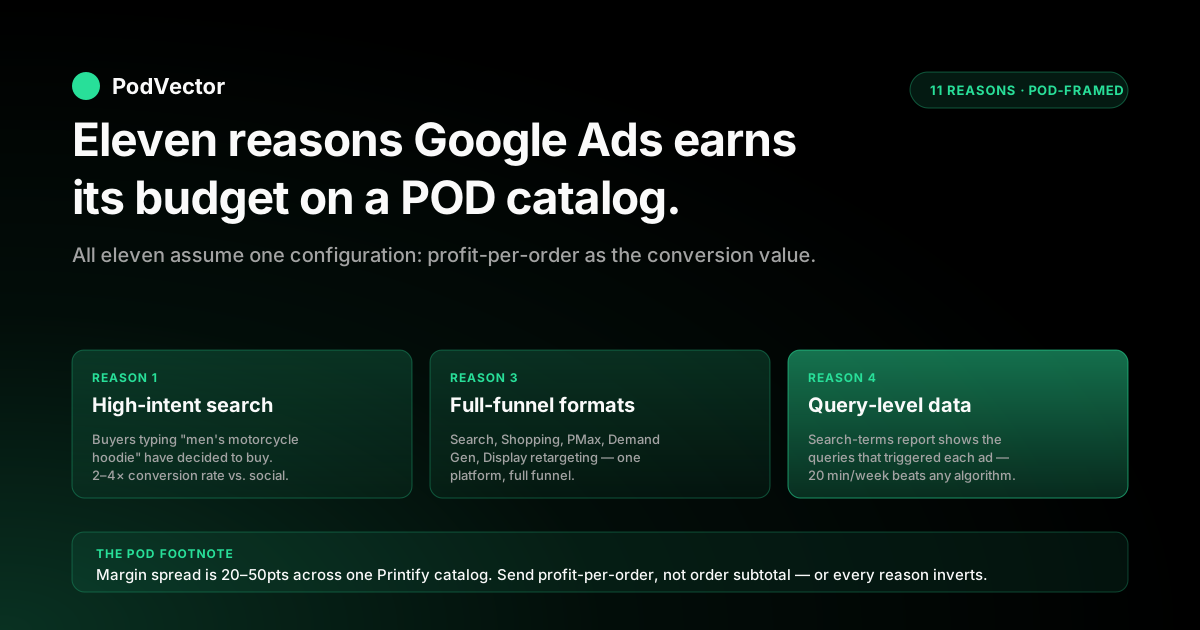
Quick Answer: Google Ads is worth running on a print-on-demand ecommerce store for eleven structural reasons — high-intent searcher demand, the largest paid auction on the open web, multiple full-funnel ad formats, transparent attribution, granular budget control, fast feedback loops, branded-search defense, mid-tail demand capture, retargeting reach, geographic targeting precision, and a learning compound that pays back over months. The footnote nobody else writes is that all eleven reasons assume you can compute profit-per-order net of Printify or Printful base cost, Shopify fees, payment processing, shipping, and refunds — without that, every "reason" below quietly inverts and Google Ads scales the lowest-margin SKUs in your catalog. This piece is the reasons list with the POD margin reality kept in frame.
Why this list is different
Searches for "reasons to use Google Ads for ecommerce" return three kinds of articles. Long ultimate guides like the excellent Store Growers piece bury the reasons inside 12,000 words of strategy.
Lighter guides like TCF's overview hit the reasons in passing. The closest match is the 12 Reasons piece from Do Dropshipping — which is solid, but written for general dropshipping, where margins are 30–50% and returns are negligible.
Print-on-demand operators on Shopify, Printify, and Printful sit on a different margin curve: 16–24% gross on hoodies, 55–70% on mugs, 35–45% on posters, with 4–8% return rates on apparel and no GTINs on most SKUs. Every "reason" below is true for a POD store, but every reason is also conditional on getting profit-per-order — not order subtotal — into the conversion event.
We list the reasons first, then explain the footnote that underwrites all of them. For the topic-level overview, see the Google Ads for POD topic hub; for everything strategy-related, the Google Ads strategy cluster index is the entry point, and the complete Google Ads playbook for POD sellers is the deep cluster hub.
1. High-intent search demand
The single biggest reason: a person typing "men's vintage motorcycle hoodie" into Google has already decided to buy something — they are price-comparing and looking for the right design. Meta and TikTok ads interrupt people scrolling for entertainment; Google Search Ads and Shopping Ads serve the buying intent at the moment it surfaces. For a POD catalog, the conversion-rate gap between "intent capture" and "interruption" is usually 2–4× in raw conversion rate, and the ROAS gap is wider because the click cost is offset by genuine purchase intent.
The practical implication for a POD operator: paid search works without a hot creative engine. Meta Ads requires constant new creative to keep performance up; Google Shopping serves your existing product photography against active searches and converts on the strength of the product, the price, and the design.
Stores with strong product photography and modest creative-iteration capacity usually get more out of Google than Meta — and stores with the opposite profile usually get the opposite result. The same intent dynamic plays out across the full Google ad types for POD sellers — Search, Shopping, and Performance Max all benefit from the high-intent baseline that pure social platforms cannot replicate.
2. The largest paid auction on the open web
Google handles roughly 8.5 billion searches per day, and Google's owned-and-operated network — Search, YouTube, Gmail, Maps, Discover, Display — reaches more than 90% of internet users globally. For a POD store, the practical version of this stat is that almost any niche has enough query volume on Google to fund a daily-budget Google Ads campaign. Even narrow niches — "dog dad mugs", "rustic farmhouse posters", "weightlifting hoodies" — typically clear 2,000–10,000 monthly searches, which is enough volume for a $20–30/day budget to find profitable pockets.
The flip side, which most listicles omit: the auction's depth means you are competing against advertisers willing to outbid you. POD apparel competes against Amazon, Etsy, and DTC brands that spend $50,000–500,000/month on Google Ads.
The volume is there; the cost-per-click reflects the fight. POD CPCs typically run $0.60–0.90 on apparel and $0.40–0.70 on home goods. That funds a healthy campaign at $1–2 AOV per click, but it punishes stores with sub-$20 AOV.
3. Full-funnel ad formats in one platform
Google Ads is unusual in being a single ad platform that covers every funnel stage from awareness to retargeting. Search Ads catch buying-intent demand; Shopping Ads serve the product feed against search queries; Performance Max blends placements across YouTube, Discover, Display, Gmail, and Maps; Demand Gen reaches mid-funnel discovery on YouTube and Discover; Display retargeting closes lapsed cart visitors. For a POD operator running a single store, this means one ads account covers the entire funnel without juggling four platform contracts.
For a POD catalog specifically, Shopping Ads usually do the heaviest lifting — they are the visual format and POD products convert on visual appeal. Performance Max becomes the right call once the store has 30+ trailing-30-day conversions; below that threshold, Standard Shopping is the better starting point because it learns faster on small data and is more transparent. The full campaign-type call by store stage is in the Google Ads for Shopify strategy piece and the Shopify Performance Max campaigns explained deep dive.
4. Transparent, query-level attribution
The Google Ads search-terms report shows you exactly which queries triggered which ads and which queries converted. For a POD operator, this is the single highest-leverage daily-rhythm artifact: 20 minutes a week of search-terms review beats any algorithmic optimization, because POD apparel ad spend leaks heavily on irrelevant queries (color names, broad-match cousins, generic graphics terms) until the negative-keyword list catches up.
The transparency is partial — Performance Max obscures placement-level attribution, and Smart Bidding masks the bid logic — but the query-level data is still richer than what Meta Ads, TikTok Ads, or Pinterest Ads expose. Combined with the conversion-tracking layer covered in our Set Up Google Ads conversions on Shopify piece and the complete Google Ads Shopify integration guide, you get a closer-to-real picture of which campaigns make or lose money than any other paid channel offers.
5. Granular budget and bid control
Google Ads runs on a pay-per-click model with daily budget caps you set, bid strategies you choose, and the ability to pause any campaign within seconds. For a bootstrapped POD operator running a $600–900/month total ad budget, this matters more than it sounds.
Television, podcast sponsorships, and most influencer deals lock you into multi-week commitments. Google Ads lets you start at $20/day, double on the campaigns that work, and zero out the ones that don't — within the same week.
The practical version for POD: set a campaign daily budget at $20–30/day to clear Smart Bidding's learning-phase floor (~30 conversions in trailing 30 days), then scale by 20% per week on profitable campaigns (Smart Bidding tolerates a ~20% change without resetting the learning clock). Below the $20/day floor the algorithm never exits learning; above the +20%/week ceiling it re-learns and costs spike for 7–14 days. The discipline is in the math, not in the platform.
6. Fast feedback loops
From campaign launch to first usable signal: 7–14 days for Smart Bidding to exit learning, 30–45 days to know whether the campaign is on a path to profitable, 60–90 days for confident scale-or-pause decisions. Compared to SEO (3–6 months to rank), email (weeks to build a meaningful list), or organic social (months of consistent posting), Google Ads gives you a verdict on a campaign hypothesis in under a month.
The catch is that "fast" only means fast if the conversion event is correctly configured. POD stores that send order subtotal as the conversion value get fast feedback on the wrong number — the algorithm scales toward whichever SKUs have the highest subtotal regardless of contribution margin.
Sending gross-profit-per-order as the conversion value flips the optimization signal to align with bank-account reality, which is the configuration covered in our Shopify Google Ads conversion strategy piece. Without that fix, the fast-feedback advantage is a fast-failure machine.
7. Branded-search defense
Once a POD store has any organic traction — featured in a Reddit thread, a TikTok with traction, an email list with 5,000 subscribers — Google searches for the store's brand name start happening. Branded-search ads convert at 8–15× the rate of non-branded keywords and the CPC is low because nobody else is bidding on your brand at scale. A small Branded Search campaign at $5–10/day captures the demand you already earned and prevents competitors from running ads against your brand name.
This is one of the highest-ROI campaign types in any ecommerce playbook, and it is genuinely free money once organic brand search volume exists. The check is Google Trends: if your store name shows positive search volume, the campaign serves; below that, the campaign serves zero impressions and is harmless but useless.
8. Mid-tail demand capture
POD niches live and die by mid-tail keywords: not "t-shirt" (too broad, no chance) and not "vintage 1972 Honda CB350 Custom Restoration t-shirt for left-handed mechanics" (too narrow, zero volume), but the middle band — "men's motorcycle hoodie", "dog dad coffee mug", "minimalist plant poster" — that has 2,000–20,000 searches per month and is winnable for a focused POD store. Google Search Ads and Shopping Ads are the only paid channel that captures mid-tail demand at scale.
Meta Ads target audiences ("people interested in motorcycles") rather than searches; the targeting is fuzzier and the conversion rate is lower. Google's keyword-and-feed match catches the operator's exact niche.
For POD stores with a genuine niche-and-audience fit, this is often where most of the revenue comes from. The keyword research that finds those mid-tail pockets is covered in our Google Ads keyword research for ecommerce piece.
9. Retargeting reach across the open web
Google's Display Network reaches roughly 90% of internet users; Performance Max layers retargeting across YouTube, Display, Gmail, and Discover automatically. For a POD store, retargeting catches the 96–98% of first-visit traffic that does not convert on the first session — and POD purchase decisions skew high-consideration on apparel ($35 hoodie ≠ impulse buy), which means retargeting frequently outperforms first-touch acquisition on ROAS.
The mechanic to get right: retargeting audiences must exclude existing customers, otherwise you pay to retarget people who already bought. The Google & YouTube Shopify app handles audience syncing if it is configured correctly; the manual setup is in the Connect Google Ads to Shopify setup guide. Retargeting also benefits more than any other ad type from sending profit-per-order as the conversion value, because the algorithm is the most aggressive on retargeting — sending the wrong value compounds quickly.
10. Geographic targeting precision
Google Ads lets you target by country, state, city, ZIP code, or custom radius — and exclude the same. For a POD store this matters in three ways: shipping economics differ by region (US/Canada vs. EU vs. AU vs. rest-of-world has different POD provider fees and transit times), tax compliance is per-state in the US, and conversion rates skew sharply by region for cultural-niche products. A "dog dad" hoodie converts heavily in the US South and Midwest and weakly in dense urban centers; a minimalist Scandinavian-design poster converts heavily in the EU and weakly elsewhere.
The practical move for a new POD store: start US-only (or your home country) for the first 60 days to keep the data clean, then expand to additional regions one at a time once the home-market campaign is profitable. Multi-region launches mix shipping costs, currency drift, and conversion rates in ways that make the data uninterpretable, and the unwind is painful.
11. A learning compound that pays back
This is the reason that does not show up in most listicles but matters most over the long arc. Google Ads is a skill that compounds: the keyword lists, negative-keyword lists, conversion infrastructure, audience seed data, attribution model, and Smart Bidding learning all get sharper month over month. A POD operator who runs Google Ads for 12 months ends up with a measurable advantage over the operator who is launching their first campaign in month 12 — same niche, same budget, very different outcomes.
The compound is real but it is not free. It costs the discipline of running campaigns on profit-per-order conversion values, posting refunds back as conversion adjustments, holding budgets steady through learning phases, and not chasing the dashboard's blended ROAS number when the underlying mix tells a different story.
Operators who treat Google Ads as a "set up once" channel never get the compound; operators who treat it as a weekly operating rhythm do. The mechanics of that rhythm are in our Google Ads strategy for ecommerce piece, and the POD-specific 90-day plan is in the Google Ads for your Shopify store playbook.
The POD footnote underneath every reason
Every reason above is true for any ecommerce store. Three POD-specific facts re-shape what "true" means in practice:
- Margin spread within one campaign is 20–50 percentage points. A $14 ceramic mug from Printify hits 60–70% gross margin. A $35 unisex hoodie from the same Printify catalog sits at 16–22%. Smart Bidding optimizes against whatever value you send. If subtotal is the value, the algorithm scales toward whichever SKUs have the highest subtotals — the hoodies — regardless of contribution margin. Sending gross-profit-per-order is non-optional.
- POD apparel returns 4–8% versus the 2–3% ecommerce baseline. If those refunds never get posted back as Google Ads conversion adjustments, Smart Bidding overbids for whichever audiences and SKUs return at the highest rates because the algorithm never sees the value reverse. This compounds quietly into a meaningful waste line.
- POD apparel SKUs do not have GTINs. Printify and Printful do not assign UPCs because the products are made to order. The fix is feed-level — set
identifier_exists: nofor affected SKUs — not product-level. Without it, Merchant Center quietly disapproves a fraction of your apparel SKUs and the campaign serves an incomplete catalog.
None of these facts make Google Ads wrong for a POD store. They mean the configuration that "works" for a single-margin dropshipping store is misconfigured for a POD catalog. For the deeper attribution layer underneath all of this, see our complete guide to Google Ads ROAS and attribution for POD; for the agency-or-DIY decision frame, see Google Ads services for POD: the complete buyer's guide.
When the reasons do not apply
The honest counter-listicle. Five POD scenarios where Google Ads is the wrong channel even after weighing the eleven reasons:
- Catalog under 20 SKUs. The product feed is too thin for Shopping or Performance Max to find pockets of demand. Build the catalog first.
- Render-only product photography across the whole catalog. Google Shopping is a visual auction. Mockups lose to lifestyle photography on click-through rate, and the algorithm interprets low CTR as low quality and serves you less. Photograph at least the top 20% of the catalog with humans wearing the products.
- Average order value under $20. POD CPCs run $0.60–0.90 and conversion rates run 1.5–2.5%, which is $24–60 per converted order in click cost alone. Sub-$20 AOV stores cannot fund the auction.
- Niche too small for paid search demand. Hyper-narrow niches with under ~1,000 monthly searches across all related keywords do better on organic SEO and email than on paid search.
- No pricing power against Amazon or Etsy. If your $35 t-shirt is competing against an identical-design $14 t-shirt on Amazon Prime, Google Shopping will surface both and the click goes to the cheaper option. Differentiate or skip the auction.
Outside of those five, Google Ads is the right channel for most POD stores — and the eleven reasons above stack into a paid-acquisition engine that compounds. For the launch sequence, the budget math, and the 90-day plan, the complete Google Ads playbook for POD sellers is the canonical version.
FAQs
Are Google Ads worth it for a small ecommerce store?
Yes, if you can sustain $600–900/month for at least 60 days, your catalog has 20+ SKUs with real product photography, your AOV is above $20, and you can compute profit-per-order net of POD base cost, fees, and refunds. Below those thresholds, the cash is better spent on catalog growth, photography, and email-list building until the thresholds are met.
What is the single most important reason to run Google Ads on a POD store?
High-intent search demand. People typing "men's motorcycle hoodie" into Google have decided to buy something — they are picking which design and which seller. Meta and TikTok ads interrupt scrolling; Google captures intent. For a catalog with strong product photography, the conversion-rate gap is usually 2–4× in favor of Google.
Why does Smart Bidding fail on POD stores even when ROAS looks fine?
Because the default conversion value sent to Google Ads is order subtotal, and POD margin spread within a single catalog is 20–50 percentage points. Smart Bidding scales toward the highest-subtotal SKUs — usually the lowest-margin hoodies — and the bank account shrinks while the dashboard shows a healthy revenue-ROAS. Sending gross-profit-per-order as the conversion value fixes the optimization signal.
How long until Google Ads pays back on a POD store?
14 days for Smart Bidding to exit learning, 30–45 days for a profitability verdict, 60–90 days before scaling. Anyone promising results in week one is selling something — the learning curve is mathematical and does not negotiate.
Should I use Google Ads or Meta Ads for my POD store?
Both, sequenced by capacity. Google Ads first if you have strong product photography and modest creative-iteration capacity (most POD stores).
Meta Ads first if you have a hot creative engine and an audience-fit niche better suited to interruption than intent (a minority of POD stores). Most operators eventually run both — Google for intent capture, Meta for awareness — but starting with both at once on a $600–900/month total budget splits the data too thin to learn from either.
Do I need a Shopify Plus plan to run Google Ads?
No. Any paid Shopify plan (Basic, Shopify, or Advanced) supports the Google & YouTube app that handles the integration. Trial stores cannot serve Google Ads traffic because the password gate blocks the landing page.
Why is my Google Ads ROAS reading 4.0x but my bank account is shrinking?
Because Google Ads ROAS uses order subtotal by default, and your weighted gross margin across the SKUs that converted is probably 18–25%. Profit-ROAS — revenue × gross margin ÷ ad spend — is the honest number. A 4.0x revenue-ROAS at 22% gross margin is a 0.88x profit-ROAS, which means you're losing $0.12 on every dollar spent.
The fastest way to know if your reasons are still reasons
The eleven reasons above hold for almost every POD store — but only if profit-per-order, returns-adjusted contribution margin, and CAC-by-price-band are visible to you weekly. Spreadsheet-stacking those numbers across Shopify, Printify or Printful, and Google Ads is what most operators give up on by month two. That is exactly where Victor comes in. Victor is the AI employee built specifically for POD sellers: it queries your live Shopify, Printify or Printful, and Google Ads data in a warehouse and answers "which campaigns are profitable, net of base cost, fees, shipping, and refunds, broken down by SKU and price band" in seconds. Victor answers your questions and acts on them — with your approval. And see the eleven reasons turned into one number.
Try Victor free