
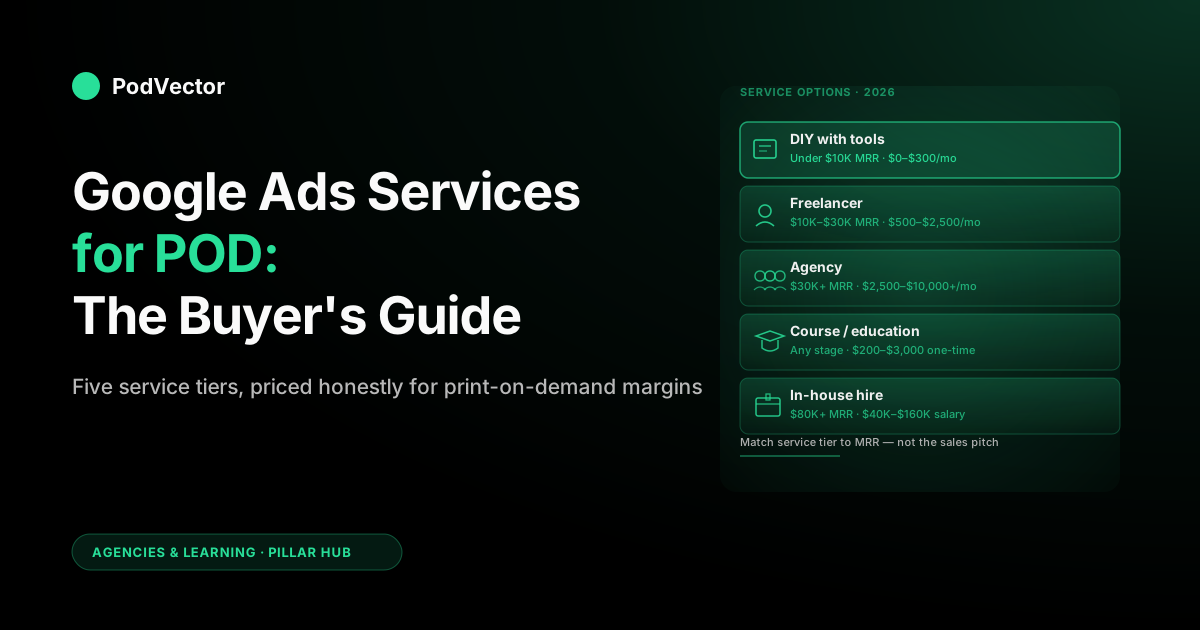
Quick Answer: Google Ads services for print-on-demand fall into five buckets — DIY with tools, freelancers, agencies, courses, and in-house hires — and the right one depends almost entirely on your MRR and your actual profit-per-order, not your revenue. Below $10K MRR, nearly every POD seller should stay DIY and invest in a $200–$800 course plus margin-tracking tooling.
Between $10K and $30K MRR, a specialist freelancer at $800–$2,500/month is the sweet spot. Above $30K MRR with confirmed unit economics, a POD-aware agency at $2,500–$6,000/month can pay for itself — but only about one in ten ecommerce agencies understands POD's supplier-cost structure well enough to deliver real ROAS instead of dashboard ROAS. This guide walks every option, the pricing models, the red flags, and the questions that separate the operators from the optimizers.
Why POD changes the Google Ads buyer math
Every generic "how to hire a Google Ads agency" article is written for one of two businesses: a brand with fixed COGS shipping from a warehouse, or a service company optimizing for lead volume. Print-on-demand is neither.
Your cost of goods is itemized per order, varies by product type, supplier, print method, size, color, and destination, and never appears in Google's interface. Your margin is 25–40% of revenue in a good month, not the 60–80% a DTC brand enjoys. And the people pitching you Google Ads services are almost always evaluating themselves against a dashboard ROAS number that, for POD, has very little to do with whether you actually made money.
Here is the concrete version. Most ecommerce agencies pitch case studies like "we took this brand from 2.1x to 4.3x ROAS." For a DTC brand with $8 COGS on a $30 product, 4.3x ROAS is roughly $23 contribution per $7 ad spend — call it $16 net.
Healthy. For a POD seller running the same campaign on a Printify hoodie with $18 supplier cost, $5.50 shipping, and $2 platform fee, a 4.3x reported ROAS delivers roughly $4.50 of contribution per $7 of ad spend — a 1.35x true ROAS, which means you paid Google to lose money slowly while the agency billed you retainer and kept the case study.
That arithmetic changes what "good service" looks like when you hire for Google Ads as a POD seller. It changes the pricing you can afford.
It changes the case studies you should trust. It changes the questions you ask before you sign.
Most of all, it changes who is actually qualified to run your account. The rest of this guide is built around those differences, and we'll come back to the margin math repeatedly because it's the hinge everything else swings on.
The 5 Google Ads service options
The Google Ads service market for POD sellers in 2026 contains five distinct buyer paths, each with a different cost structure, risk profile, and operator profile:
- DIY with tools — you run the account yourself, buying software to replace the expertise you don't have. $0–$300/month depending on stack.
- Freelancers — an independent specialist manages the account part-time on a retainer or project basis. $500–$2,500/month typical.
- Agencies — a team-based firm with dedicated account managers, creatives, and analysts. $1,500–$10,000+/month depending on tier.
- Courses and education — you buy knowledge instead of labor, then execute yourself. $200–$3,000 one-time or cohort-based.
- In-house hire — a part-time or full-time employee owns paid acquisition. $40K–$120K salary plus overhead.
Most POD sellers cycle through at least three of these as they grow, and the ones who scale past $50K MRR usually end up running a hybrid — a course for the operator's fluency, a freelancer or agency for execution, and tools that give the operator the numbers to hold whoever is running the account accountable. We'll walk each option with an honest assessment of when it fits and when it's wasted spend.
Option 1: DIY with tools
The default for most POD sellers under $10K MRR, and the option most underestimated by the advice ecosystem — because nobody in the Google Ads service industry makes money telling you to do it yourself. The math, however, is unambiguous.
A POD store doing $5,000 in monthly revenue with 30% margins generates $1,500 of contribution before ad spend. A $2,000/month agency retainer consumes 133% of that contribution before anyone has even bought an ad. You cannot hire your way out of the early stage; you can only educate and tool your way out.
What DIY actually costs
The real DIY stack in 2026 for a POD store looks roughly like this:
- Google Ads itself — free to open, you only pay for clicks
- Google Merchant Center — free
- Shopify's Google & YouTube channel app — free feed sync for most Shopify stores
- A conversion tracking tool that handles server-side tagging — typically free (GTM server-side container on Cloud Run costs $3–$8/month) or bundled with a tracking app at $20–$80/month
- A keyword research tool — Google Keyword Planner is free inside Ads, or Ahrefs/Semrush at $99–$199/month if you're doing SEO too
- A POD margin tracker — this is the one nobody tells you about. Shopify's native analytics doesn't reconcile Printify or Printful supplier costs against ad-attributed orders. Without this reconciliation, your DIY decisions are blind
Total out-of-pocket for a well-equipped DIY POD store is $50–$250/month, with most of that going to conversion tracking and margin reconciliation. Below $10K MRR, this stack beats a freelancer on cost and frequently beats an agency on outcomes, because you care about the account in a way no retained outsider does.
When DIY breaks
DIY breaks in three places, and they're predictable:
- You don't have time. A well-run POD Google Ads account takes 4–8 hours per week at the $20K MRR stage — asset group reviews, feed cleanup, negative keyword management, bid adjustments, creative refreshes. If your day job or the rest of the business is consuming your attention, campaigns drift and performance degrades quietly.
- You've maxed out the basic moves. If you've shipped PMax, Shopping, a branded Search campaign, basic exclusions, and decent creatives, the next gains require either audience-building infrastructure, a large creative-production pipeline, or statistically-significant multi-variant testing. Those are skill ceilings, not time ceilings.
- You can't trust your numbers. If the ROAS numbers Google shows disagree with the numbers you see in Shopify, and neither matches your bank account after supplier costs, no amount of tactical adjustment will make the campaign decisions reliable. The fix here is tooling, not people.
The third one is the one most POD sellers get wrong. They hire an agency to fix a measurement problem, which no agency can solve — they can only optimize against whatever numbers they see, and those numbers will still be wrong. (For the full treatment of why this is, see our complete guide to Google Ads ROAS and attribution for POD.)
Option 2: Freelancers
A freelancer is an independent Google Ads specialist who manages your account on a part-time retainer. Rates run $500–$2,500/month for typical POD accounts, with the low end buying you a few hours of weekly attention and the high end buying something close to what an agency account manager would deliver. For the $10K–$30K MRR band, freelancers are frequently the best fit — cheaper than agencies, more experienced than you in the platform, and economically aligned in a way team-based agencies aren't.
Where freelancers win
Three structural advantages:
- No agency overhead. The $1,500/month you pay a freelancer largely funds their time. The $4,000/month you pay an agency funds their time plus account management, sales, office, software, and margin. A good freelancer at $1,500/month frequently delivers more actual senior-practitioner time than a mid-tier agency at $4,000.
- Direct ownership. The person in your account is the person you hired, not a junior whose name isn't on the contract. If they're bad, you know immediately. If they're good, the value compounds.
- Flexibility in scope. Freelancers can do weird shaped work — a one-week feed audit, a 30-day PMax launch, a monthly review retainer with a 48-hour response SLA. Agencies mostly can't without a retainer uplift.
Where freelancers lose
- Bus factor of one. The freelancer gets sick, goes on vacation, takes on too many clients, or moves on. You have no redundancy. For a store where paid acquisition is 60% of revenue, this is non-trivial operational risk.
- Narrow skill set. Most freelancers are strong in one or two areas — usually PMax and Shopping — and weaker on feed optimization, creative production, landing-page CRO, or server-side tracking. An agency at least in theory has specialists for each.
- POD literacy is rare. Finding a Google Ads freelancer who has actually run a Printify or Printful store is unusual. Most come from DTC, SaaS, or local service backgrounds. Good ones learn quickly; mediocre ones treat POD like a generic ecommerce account and miss the margin-reconciliation problem entirely.
How to find one
In order of quality:
- Referrals from other POD operators in the same margin band (7-figure POD Slack groups, Merch by Amazon communities, Etsy-to-Shopify operator networks)
- LinkedIn searches filtered to "Google Ads" + "print on demand" with a minimum 5 years of recent experience
- Specialty marketplaces like Mayple's vetted ecommerce Google Ads list — note that most of their listings are agencies, not freelancers, but the evaluation rubric is useful either way
- General freelance platforms (Upwork, Fiverr Pro) — lowest signal-to-noise, avoid unless you have the time to interview heavily
Option 3: Agencies
A Google Ads agency is a team-based firm with specialists for each part of the funnel — account management, campaign ops, creative, feed management, analytics, sometimes landing-page CRO. Retainers run $1,500–$10,000+/month, and the market stratifies roughly into small specialty shops ($1,500–$3,500), mid-size ecommerce-focused agencies ($3,000–$6,000), and enterprise-scale agencies ($5,000–$10,000+).
Above $30K MRR with confirmed unit economics, an agency can be the right move. Below that, it's almost always premature.
When an agency is actually worth it
The case for an agency is strongest when three conditions are all true:
- Your monthly ad spend is large enough that optimization gains exceed the retainer. A 10% ROAS lift on $10K/month ad spend is $1,000/month. That doesn't justify a $3,000 retainer. The same lift on $50K/month ad spend is $5,000/month, which does.
- Your unit economics are confirmed. Agencies are optimizers, not validators. If your product-market fit or margin structure is still shifting, an agency will optimize toward whatever numbers they see, which may not be the numbers that matter. Confirm unit economics in a profitable DIY or freelancer phase first.
- You have ops capacity to be a good client. Agencies deliver best results when they have working analytics, a responsive client, a creative pipeline, and a feed that isn't constantly breaking. If you're still building that infrastructure, the agency's time is spent chasing your end of the process.
What you're actually buying
A typical mid-tier ecommerce Google Ads agency retainer covers:
- Weekly or biweekly account optimization (bid adjustments, negative keywords, asset group reviews)
- Monthly or quarterly strategy reviews
- Feed health monitoring and error resolution
- Ad creative refreshes (typically limited — 2–4 refreshes per month at mid-tier)
- Conversion tracking maintenance (often excludes initial setup — that's a project fee)
- Monthly reporting dashboards
What's usually extra: conversion tracking setup, feed rebuilds, landing-page CRO, YouTube/Demand Gen production, audit work on prior agencies' campaigns. ALM Corp's 2026 pricing breakdown has the most honest public analysis of scope-inclusions we've seen, and it's directionally accurate for the ecommerce segment.
Why most ecommerce agencies fail POD clients
This is the section of this guide nobody else writes, and it's the most important one. Most ecommerce Google Ads agencies operate from DTC-brand assumptions that break when applied to POD:
- They optimize toward reported ROAS. Reported ROAS for POD is a fiction — it doesn't net out Printify/Printful supplier cost, shipping, platform fees, or refunds. An agency optimizing toward 4x reported ROAS can drive your business toward 0.9x true ROAS without ever flagging the problem, because they never see supplier costs.
- They push Maximize Conversion Value bidding. For a DTC brand with fixed COGS, this bids toward revenue, which correlates with profit. For POD with variable supplier costs per SKU, this bids toward the highest-revenue-per-order products, which are often the worst-margin products (oversized hoodies, all-over-print items, premium substrates).
- They treat your feed as static. Good POD feed management means aggressively excluding thin-margin SKUs, prioritizing evergreen designs over trending ones, and aligning titles to niche-design search queries. Most ecommerce agencies don't touch the feed beyond basic error resolution.
- They don't reconcile to the P&L. The question "did last month's campaigns actually make money after all costs" is answered in your P&L, not Google Ads. Most agencies never see your P&L and don't ask to.
When you interview agencies, watch for whether they raise these issues before you do. The ones that do are the one-in-ten worth hiring. The ones that don't will happily bill you retainer for the duration of the engagement.
Agency alternatives ranked for POD
If you're set on an agency route, the three most defensible starting points for POD operators:
- POD-native agencies — rare, but they exist. Typically smaller shops that specialize in Shopify + Printify stacks. Often 50–100% more expensive per hour but dramatically faster to productive output. This is the highest-leverage option if you can find one.
- Specialist ecommerce agencies with willingness to learn — mid-tier shops with strong PMax and Shopping track records who are honest about not knowing POD specifics. Expect 60–90 days of ramp-up; require regular reconciliation calls against your P&L.
- Hourly consultants instead of retained agencies — for accounts below $30K/month spend, an ecommerce Google Ads consultant at $200–$400/hour for a monthly 4-hour review plus asynchronous Q&A often outperforms a $3,000/month retainer.
For direct comparison of specific agencies operating in the ecommerce space and how each one holds up under POD margin analysis, see our best Google Ads agency for ecommerce comparison.
Option 4: Courses and education
Courses are the most underrated category in the Google Ads service stack for POD operators, because the return on a $500 course can be the same as a $5,000/month agency retainer — if you actually do the work. For operators in the DIY band who have hit a skill ceiling, a good course is frequently the highest-ROI spend available.
What to look for in a course
Good Google Ads courses for POD operators share four characteristics:
- Recency. Google Ads changes faster than course content. Anything recorded before 2024 is dangerously stale — PMax mechanics, asset-group optimization, and the Shopping/PMax interplay have all shifted materially. Ask for the last recording date before buying.
- Operator instructor, not agency instructor. Instructors who run their own stores and have lived through the pain of margin compression teach different content than instructors selling agency services on the back of the course.
- Ecommerce-specific, ideally product-feed-heavy. General Google Ads courses don't cover Merchant Center, feed optimization, or Shopping specifics in the depth POD requires. You want at least 40% of the content to be ecommerce-specific.
- An active community. The static course content ages; the community doesn't. Courses with active Slack, Circle, or Discord communities are worth a significant premium because you can ask current questions and get current answers.
Typical pricing
- Self-paced video courses: $200–$800
- Cohort-based courses with live instruction: $800–$3,000
- Bootcamps / intensive programs: $1,500–$5,000
- 1-on-1 consulting packages sold as "courses": $2,000–$10,000
The sweet spot for most POD operators is the $500–$1,500 range — enough to get a serious instructor and active community, not enough to fund a bootcamp with content padding. For a specific comparison of well-known programs available to POD operators, see our forthcoming Google Ads for ecommerce course comparison.
Option 5: In-house hire
The last option and usually the last one you reach. Hiring an in-house Google Ads specialist makes sense for a narrow band of POD stores — generally those above $100K MRR with sustained growth and multiple concurrent ad channels (Google, Meta, TikTok) where the ops complexity justifies a full-time owner.
Cost structure
- Part-time specialist (15–25 hours/week): $30K–$70K annualized, usually a contractor
- Mid-level paid acquisition manager: $70K–$110K base, sometimes with small performance bonus
- Senior paid acquisition lead: $110K–$160K base plus equity/bonus
- Head of growth (Google is one channel of several): $130K–$200K+ plus equity
When in-house wins
In-house hires beat agencies on three dimensions when the business is large enough:
- Depth of context. A full-time employee who sits in your Slack, sees your P&L, and joins product conversations makes ad decisions informed by the whole business. An agency makes decisions informed by the ad account.
- Speed of iteration. "Let's test this tomorrow" is a sentence you can say to an employee. With an agency, it's usually a scope change that takes a week.
- Cumulative institutional knowledge. A year of agency work leaves you with campaign structure in Google Ads. A year of in-house work leaves you with that plus documented experiments, a running hypothesis backlog, and someone who knows your customers.
When in-house fails
- Too early. Hiring before product-market fit consumes a $60K–$100K salary on someone optimizing a channel that hasn't proven out yet.
- Narrow scope. A "Google Ads manager" hire at a $500K/year POD store is probably too narrow — they'll run out of Google Ads work and either start optimizing at the margins (which compounds less than acquiring new SKUs) or expand into other channels they're weaker in.
- Hiring wrong. The ecommerce paid-acquisition market in 2026 is full of candidates with strong DTC-brand experience and zero POD experience. Same failure mode as agencies, in an employee shape.
Pricing models decoded
Google Ads services are sold under one of four pricing structures. Each one has a different risk profile for the POD operator, and each one creates different agency behavior.
Flat monthly retainer
A fixed monthly fee regardless of ad spend. $1,500–$8,000/month is the typical POD-friendly range. The cleanest model from the operator side — predictable, easy to budget, and aligned with scope rather than spend.
When it fits: stable ad budgets, defined scope, mid-to-large POD accounts. Best for most POD buyers.
Risk: minimal on pricing; the only risk is scope creep ("that's outside retainer, it's a project fee") or agency disengagement after signing.
Percentage of ad spend
The agency bills 10–20% of monthly media spend as their fee. Popular with agencies because it scales their revenue with your growth; increasingly unpopular with operators because incentives are misaligned.
When it fits: rarely, for POD specifically. Only if the agency offers it at the low end (10%) with a minimum fee floor, and only if you have a strong reason to believe aligning their revenue to your spend won't push them toward spending more.
Risk: the agency is incentivized to push ad spend up. For POD with thin margins, this is dangerous — the agency earns more when you spend more, even when your true ROAS is barely above break-even.
Hybrid
A base retainer ($800–$2,500) plus a smaller percentage of ad spend (3–8%). Attempts to compromise between fixed and variable models.
When it fits: medium-sized accounts where the agency wants some upside if you scale dramatically, and the operator wants pricing predictability at current spend. Workable if the percentage is small and capped.
Risk: same directional incentive problem as pure percentage-of-spend, dampened by the base retainer.
Performance-based / commission-only
The agency bills a percentage of revenue or profit generated by ads. Extremely rare at agencies that are actually good; common at agencies that can't sell retainers. When it does exist legitimately, it's usually a commission on revenue above an agreed baseline.
When it fits: almost never for POD. Revenue-based commissions misalign against margin (as discussed above). Profit-based commissions require the agency to see your supplier costs, which few agencies are equipped to handle.
Risk: adverse selection. Agencies offering commission-only usually can't command retainers because their track record isn't strong enough. Treat aggressive commission-only pitches as a yellow flag unless the agency is POD-native and the structure is profit-based with transparent cost inputs.
Typical pricing by seller stage
What you should actually expect to pay at each POD seller stage, assuming you pick the right service tier for your size. These are 2026 market ranges based on consultative quotes from the ecommerce Google Ads service segment:
Stage 1: Below $5K MRR
Recommended spend on services: $0–$100/month. Stay DIY. Buy a $300–$800 course, not a service. If you spend money on ongoing services at this stage, you're subsidizing someone else's business with your own runway.
Stage 2: $5K–$10K MRR
Recommended spend on services: $100–$500/month. Tooling plus maybe a one-time $500–$1,500 audit from a specialist freelancer. Still DIY for execution. Invest in margin-tracking infrastructure — this is the stage where blind decisions start costing real money.
Stage 3: $10K–$30K MRR
Recommended spend on services: $500–$2,500/month. Specialist freelancer territory. This is the sweet spot for freelancer value — your account is large enough that optimization matters, small enough that agency overhead doesn't pay back. Expect to interview 6–10 freelancers before you find one who understands POD.
Stage 4: $30K–$80K MRR
Recommended spend on services: $2,500–$5,500/month. Small-to-mid specialist agency, or senior freelancer plus part-time specialist for feed and creative. Demand POD literacy as table stakes. If an agency can't speak fluently about Printify/Printful unit economics in the sales call, walk away.
Stage 5: $80K+ MRR
Recommended spend on services: $5,000–$15,000/month across agency and tooling, or $80K–$140K loaded cost for a competent in-house hire plus agency for specific functions (creative production, feed engineering, landing-page CRO). At this stage the conversation shifts from "who runs my Google Ads" to "how is paid acquisition built into the business," which is a different problem.
Red flags and fair-quote signals
The single hardest thing about buying Google Ads services is telling a real operator from a well-packaged sales process. The signals below, calibrated specifically for POD buyers:
Red flags
- "We guarantee X ROAS." Nobody can guarantee ROAS, especially not on an account they haven't seen. Agencies that lead with guarantees are selling confidence, not competence.
- No questions about your supplier costs in the sales process. If an agency is evaluating fit without asking about your Printify/Printful cost structure, they will optimize toward numbers that don't include it — which is the core POD problem.
- Case studies with no margin context. "We scaled this brand from $50K to $200K/month" tells you nothing unless you know what happened to contribution margin. Ask: "What was the true ROAS after COGS at the $200K stage?"
- Long minimum contracts. 12-month minimums were standard a decade ago; they're a red flag today. Six months is the longest reasonable initial commitment, and three months with a trial period is often better.
- Unclear scope inclusions. If the proposal doesn't specify exactly how many hours of account work, how many creative refreshes, and how many strategy calls per month, you're buying a promise, not a service.
- High turnover on the account. Ask who will actually run your account and how long they've been at the agency. If the sales rep can't name a specific account manager or the answer is "we assign based on bandwidth at onboarding," the agency is organized around the agency, not your account.
- Reluctance to reconcile against your P&L. A good partner wants to compare their reported ROAS against your actual bottom line every quarter. A bad one deflects ("we only look at the ad-platform numbers — your P&L is an internal matter"). The second response is a firing offense after six months regardless of initial performance.
Fair-quote signals
- Specific scope in writing with hours or deliverable counts. Not "we manage your account"; rather, "we provide 8 hours of weekly account work, 4 creative refreshes per month, 2 strategy calls per month, quarterly reconciliation against supplier-cost data."
- POD-specific questions in discovery. Questions like "what's your average supplier cost per SKU" and "how do you currently track refund rate against ad-attributed orders" signal a partner who's thought about POD mechanics.
- Willingness to share client contact info. Ideally two or three current clients you can talk to directly, not a curated reference page. If the agency won't share a single current POD client reference after 45 days of account history, their case studies may be manufactured.
- Transparent pricing logic. They can explain why their retainer is $X and not $X+$1,000 — tied to scope, team composition, or time commitment, not "that's our standard tier."
- A 60–90 day exit clause. Good agencies know the first 90 days is where fit is tested and don't lock you in. Bad ones are afraid of losing clients and price for it.
7 questions to ask before you sign
If you ask nothing else, ask these seven. The answers separate the agencies and freelancers who can run a POD account from the ones who will bill retainer while your profit-per-order silently collapses:
- "What does your reporting look like for a client whose product has variable supplier costs per order?" The correct answer involves some form of supplier-cost reconciliation, post-ad-platform analysis, or integration with the client's P&L. An answer of "we report Google Ads ROAS from the platform" is a disqualifying answer.
- "Walk me through how you'd structure a PMax launch for a store with 200 SKUs across 15 design niches." Good answers address asset group segmentation by margin or niche, exclusion of thin-margin SKUs, and brand-query exclusion at the campaign level. Bad answers describe "one PMax campaign with all products" and stop there.
- "What's your process for handling a disapproved trademark flag from Merchant Center?" POD-native answer: immediate feed exclusion of disputed SKUs while you work the appeal, with a process for preventing broader account scrutiny from repeat appeals. Non-POD answer: "we'd escalate to Google's support team" — fine, but doesn't protect the account in the interim.
- "How do you handle the divergence between Google-reported ROAS and actual profit after supplier costs?" Any answer other than a concrete one — a tool, a process, a reporting layer — means they haven't thought about it.
- "What's your minimum commitment, and what's the exit process?" 3–6 month minimum is fair. 12 months is a flag. "You can leave any time with 30 days notice" after the first 90 days is the operator-friendly standard.
- "Who exactly would be running my account day-to-day, and how long have they been at your firm?" You want a named human with at least 18 months tenure. If it's a junior with 6 months, the agency should have a named senior reviewing weekly — confirm that's true, and who.
- "Show me the last account you lost, and why." The answer tells you more about the agency than any case study can. "We've never lost an account" is probably false. "They grew past our service tier and hired in-house" is honest. "They wanted guarantees we couldn't make" is also honest. "I'm not comfortable sharing that" is fine, but move on.
The POD-specific evaluation checklist
Specific to POD, independent of service option (DIY tools, freelancer, agency, in-house). Before you commit monthly dollars to any Google Ads service arrangement, you should be able to check every box:
- You know your true blended margin per order, net of Printify/Printful supplier cost, shipping, platform fees, and refunds — not Shopify's "profit" number, which almost never nets supplier costs correctly
- You have a conversion-tracking setup that's surviving iOS privacy changes (server-side tagging, enhanced conversions, or a first-party tracking equivalent)
- You have a feed in Merchant Center that validates without policy errors and refreshes at least daily
- Your Shopify inventory is accurate enough that the feed doesn't try to sell out-of-stock products
- You have at least 30 conversions in the last 30 days (below that, most Google Ads tactical advice breaks down — the algorithms don't have enough data)
- You have a creative refresh pipeline that can produce new ad assets monthly, whether through you, a contractor, or generative tooling
- You have a monthly process for reconciling Google-reported revenue against actual shipped orders, because there's always a 3–15% gap and the direction of the gap matters
If more than two of these are missing, fix them before buying a higher-tier Google Ads service. No agency or freelancer can compensate for broken measurement, and most will happily optimize against broken numbers for the duration of the engagement.
Decision framework by MRR and margin
The clean version, mapped to what actually works for POD operators:
Below $5K MRR + any margin
DIY + one good course. Do not hire services. The math doesn't work at this stage; any services spend consumes runway that should go to product iteration and feed quality.
$5K–$10K MRR + <25% margin
Fix margin before buying services. Investigate product mix, supplier tier (Printify Premium vs. base), and SKU rationalization. Services cannot compensate for unit economics that don't work.
$5K–$10K MRR + 25%+ margin
DIY + a $500–$1,500 ecommerce-focused course + one-time freelancer audit ($500–$1,500). Invest in margin tracking tooling. Keep agency options open for Stage 3.
$10K–$30K MRR + 25%+ margin
Specialist freelancer at $1,000–$2,000/month. If you can find a POD-native one, pay up to $2,500. Continue investing in tooling — by this stage you need true-ROAS visibility, not just Google-reported ROAS.
$30K–$80K MRR + 30%+ margin
Small specialist agency ($2,500–$5,000) or senior freelancer + specialist (feed/creative). Require POD literacy in the sales process. Quarterly P&L reconciliation is mandatory, not optional.
$80K+ MRR + 30%+ margin
In-house hire or premium specialist agency. The decision is about which model gives you better iteration speed at your current team structure. Both can work; neither guarantees it.
The universal rule
Regardless of stage, the highest-ROI spend is always on measurement, not on labor. Knowing your true ROAS per campaign, asset group, and SKU is what lets you evaluate whether any labor — yours, a freelancer's, an agency's, an employee's — is delivering value.
Services without measurement is gambling with extra steps. For the detailed treatment of how POD measurement should work in practice, see the complete guide to Google Ads ROAS and attribution for POD and the companion complete Google Ads playbook for POD sellers.
FAQs
How much does a Google Ads agency cost for a POD store in 2026?
Realistic 2026 ranges for POD-appropriate agencies: small specialist shops $1,500–$3,500/month, mid-tier ecommerce agencies $3,000–$6,000/month, and premium or POD-native shops $4,500–$10,000+/month. Many POD stores under $30K MRR pay retainers that eat 100%+ of their contribution margin, which is the single most common mistake in POD paid-acquisition hiring. Match retainer to a maximum of 20% of monthly contribution margin as a ceiling.
Are Google Ads agencies worth it for small POD stores?
Usually no, below $30K MRR. The retainer math rarely works — a $3,000/month agency needs to lift your true ROAS by enough to cover $3,000/month plus some profit above what you could do yourself.
For a store spending $6,000/month on ads, that's a 50% lift, which is rare. Below $30K MRR, invest in tools, courses, and possibly a freelancer instead. Agencies become attractive once ad spend is high enough that single-digit-percentage improvements exceed the retainer.
What's the difference between a freelancer and an agency for Google Ads?
Freelancers are individual specialists managing your account part-time at $500–$2,500/month with no team support. Agencies are team-based firms with specialists for campaign ops, creative, analytics, and feed at $1,500–$10,000+/month.
Freelancers trade team breadth for direct ownership and lower cost; agencies trade higher cost for redundancy, specialist depth, and (in theory) proven process. For POD stores between $10K and $30K MRR, freelancers almost always win on value.
How do I find a Google Ads agency that actually understands POD?
Start with the POD operator networks (7-figure POD Slack groups, Shopify partner communities, Merch by Amazon forums). Ask for agency referrals specifically from stores at your MRR stage with your fulfillment provider.
Vet candidates with the 7 questions above; POD-native agencies will answer question 1 confidently, generic ecommerce agencies will deflect. Budget 3–5 discovery calls for every agency you sign. The fit rate is low.
Should I pay a percentage of ad spend or a flat retainer?
Flat retainer, in almost every case, for POD specifically. Percentage-of-spend misaligns incentives — the agency earns more when you spend more, regardless of whether your margin is healthy.
For POD with thin variable margins, that misalignment is genuinely dangerous. If the only option is percentage-of-spend, cap it at 10% with a minimum fee floor, and require quarterly reconciliation against your P&L.
What should I budget for Google Ads tools as a POD seller?
Typical POD-friendly tooling stack: $0–$30 for conversion tracking (free with server-side GTM, $20–$80/month with a third-party app), $0–$200 for keyword and competitive research (depending on whether you use Ahrefs/Semrush for SEO too), and $30–$120/month for margin-reconciliation tooling that nets Printify/Printful costs against ad-attributed orders. Total: $50–$350/month, with the margin reconciliation layer being the category most operators underinvest in.
How long should I give a new agency before evaluating?
90 days minimum, 120 days for complex setups. Google Ads algorithms need 14–30 days of data for initial learning; campaign-level tactics need another 30 days to settle; a full strategic cycle through test, learn, and scale is 60–90 days.
Evaluating an agency in the first 30 days is statistically premature. Evaluating past 120 days without clear KPI progress is tolerating underperformance. The honest window is 90–120 days — treat it as contractually bounded.
What should I ask for in the first 30 days of a new agency engagement?
A complete account audit with findings documented, a 90-day roadmap with named tests and hypothesized lift ranges, a shared reporting dashboard with daily data refresh, and a weekly standing call with your named account lead. If any of these aren't delivered in the first 30 days, the agency is not running the engagement with the structure a POD account deserves.
Can I learn Google Ads well enough to not need an agency at all?
Yes, up to a ceiling. A careful POD operator with a good course, 6–12 months of real account management, and solid margin tooling can run Google Ads well through $50K MRR.
Above that, the constraint is usually time — not skill — and hiring specialists (agency, freelancer, or employee) becomes an efficiency decision rather than a competence decision. The operators who understand the platform deeply also make better hiring and firing decisions when they do engage services.
How does Google Ads service selection interact with Meta Ads services?
Most POD stores that scale past $30K MRR end up running both Google and Meta Ads, and the service-hire decision compounds. An agency that handles both Google and Meta competently is rare and commands a premium.
A specialist-per-channel approach (different agency or freelancer per platform) is more common and usually cheaper, but requires you or a head-of-growth to coordinate cross-channel strategy. For the equivalent framework on the Meta side, see our upcoming Meta ads agencies and courses for POD complete guide.
What's the role of AI in Google Ads services in 2026?
Google's campaign-side AI — PMax, Smart Bidding, responsive search ads — is already running a large share of the tactical work, which means what you're buying from a service provider has shifted from "bid management" to "strategy, creative, feed, measurement, and exception handling." The leverage-shift for POD is that post-campaign analysis is where AI now delivers the highest return, specifically the layer that reconciles Google-reported performance against actual supplier-adjusted profit. That's the category we're in at PodVector AI — Victor looks at your Shopify, Printify, Printful, and Google Ads data together, so he can answer your questions in plain English. For the broader landscape of AI tools beyond Google Ads service, see our complete guide to AI tools for POD sellers.
Is it worth hiring a Google Ads agency just to set up conversion tracking?
Depends on what "set up" means. A one-time server-side tracking implementation with enhanced conversions is a legitimate $1,500–$4,500 project and a reasonable thing to pay for if you can't do it yourself.
An ongoing retainer "for tracking" is almost never a good buy — once tracking is built, maintenance is a few hours a month of work at most. Pay project fees for implementation; don't pay retainers for tracking alone.
Before you hire, see what your Google Ads are actually making you
Every Google Ads service pitch starts with the platform's reported ROAS. For POD sellers, that number is missing supplier cost, shipping, refunds, and platform fees — which is why the 4x ROAS case studies agencies show you don't always translate to profitable months. PodVector AI's AI employee, Victor, sees all of your Shopify, Printify, Printful, and Google Ads data together and answers questions like "what did my Google Ads campaigns actually make this month after all costs" in plain English. Walk into every agency interview with your real numbers. And stop evaluating service proposals against the wrong baseline.
Try Victor free