
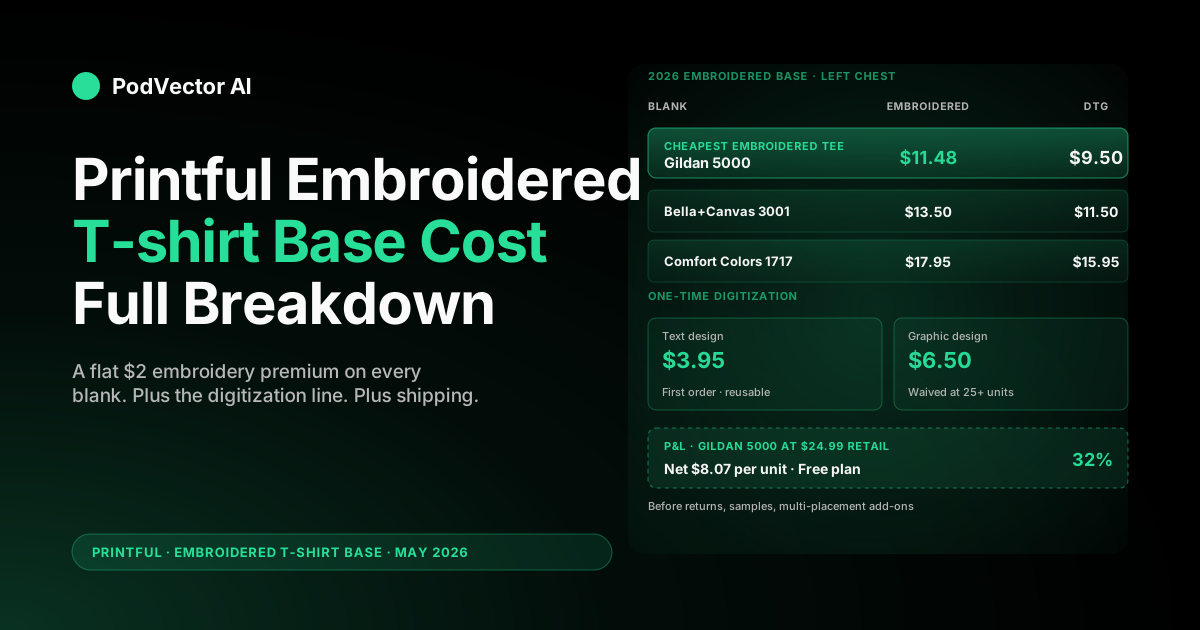
Quick Answer: A Printful embroidered t-shirt starts at $11.48 on a Gildan 5000 — roughly $2 more than the same blank with DTG print. Bella+Canvas 3001 embroidered runs $13.50, and Comfort Colors 1717 embroidered lands near $17.95.
That base is only the first line. Add a one-time digitization fee of $3.95–$6.50, U.S. shipping that starts at $3.99 for the first tee plus $2.00 per additional unit, and a transaction fee on the retail side, and a $24.99 embroidered tee actually nets $3–$6 per unit on the Free plan.
This breakdown walks the embroidered base cost by brand, the digitization line you'll pay once per design, the Growth-plan discount you'll see on the invoice, and the three places embroidered-tee margin leaks even after you pick the "right" blank.
Embroidered t-shirt base cost by brand
Printful charges per blank plus one embroidery placement included in the base. Different blanks land at different prices because the underlying garment cost shifts.
Here are the embroidered base costs POD sellers see most often in 2026, before any plan discount.
| Blank (left chest embroidery) | Embroidered base | Same blank, DTG | Embroidery premium |
|---|---|---|---|
| Gildan 5000 (heavy cotton) | $11.48 | $9.50 | +$1.98 |
| Gildan 64000 (softstyle) | $12.95 | $10.95 | +$2.00 |
| Bella+Canvas 3001 | $13.50 | $11.50 | +$2.00 |
| Comfort Colors 1717 | $17.95 | $15.95 | +$2.00 |
| AS Colour 5050 staple | $15.50 | $13.50 | +$2.00 |
The embroidery premium is almost flat at ~$2.00 per shirt regardless of which blank you pick. That's the decoration cost, not the blank cost — and it's the line you can't escape by switching brands.
What does shift between brands is the base garment. A Gildan 5000 saves you $6.47 per shirt versus a Comfort Colors 1717, before any embroidery work happens. Margin-pressed sellers default to Gildan 5000 or 64000 for embroidered drops because that $6 sits on every unit.
Why embroidered tees cost more than DTG tees
Direct-to-garment (DTG) printing sprays ink directly onto the fabric. The cost driver is ink coverage and substrate primer — relatively cheap inputs.
Embroidery threads a design through the fabric using a multi-needle machine running pre-programmed stitch paths. The cost drivers are stitch count, thread color changes, and machine time per garment.
For a typical left-chest design at ~3.5 inches wide, the machine spends 60–90 seconds per shirt versus a few seconds for DTG. That extra fulfillment time is what Printful prices into the embroidered base.
Two consequences for POD sellers. First, designs with low stitch density (text logos, simple icons) cost Printful the same to fulfill as dense designs — but you pay the same flat embroidery premium either way. Second, larger placements (center chest, large front, sleeve) carry an additional $2.95 add-on each, because each one adds machine time.
The digitization fee: $3.95 or $6.50, once
Before Printful's machines can embroider your design, the artwork has to be converted into a stitch file (.DST format). That's the digitization step, and it's a real one-time cost regardless of which embroidered SKU you sell.
| Design type | Digitization fee | When you pay |
|---|---|---|
| Text-only (Text Tool) | $3.95 | First order with the design |
| Standard graphic design | $6.50 | First order with the design |
| Bulk order (25+ embroidered units) | $0 (waived) | If 25+ units ship in one order |
The digitization fee is one-time per design per embroidery type. Once a design is digitized for chest embroidery on a t-shirt, you can reuse the same file on subsequent tee orders without paying again.
What you cannot do is reuse a t-shirt's digitized file on a hat without an adjustment. Hat embroidery and apparel embroidery use different placement specs, so moving a design from one to the other triggers a $2.95 adjustment fee.
The practical implication for embroidered tee margin: digitization is a sunk fixed cost, and the per-unit cost recovery depends on how many shirts you actually sell with that design. Ten sales amortizes $6.50 to $0.65 per shirt. Two sales amortizes it to $3.25 per shirt — enough to flip a design from profitable to red.
The full per-unit cost stack
Every embroidered Printful tee order is built from the same five lines. Skip any of them when you're modeling margin and the number on your spreadsheet won't match the number in your Stripe deposits.
| Line | What it covers | Typical 2026 cost |
|---|---|---|
| 1. Embroidered base | Blank tee + one embroidery placement | $11.48–$17.95 |
| 2. Digitization (amortized) | One-time stitch file conversion | $0.10–$3.25 per unit |
| 3. Extra placements | Each additional embroidery spot | +$2.95 each |
| 4. Shipping (first item, U.S.) | To customer | $3.99 + $2.00/additional unit |
| 5. Transaction fee | Payment processor on retail | ~2.9% + $0.30 of order total |
The non-obvious line is digitization amortization. POD sellers running cost spreadsheets in Google Sheets often book digitization as a one-time expense and then "forget" it on per-SKU margin. That's fine for end-of-month P&L. It's wrong when you're deciding which embroidered design to scale on ads.
The fix is to model digitization as a unit cost based on conservative volume. If your typical embroidered design sells 15 units lifetime, book $6.50 / 15 = $0.43 per unit as the digitization line. Adjust monthly as real sales data lands.
Growth plan discount on embroidered tees
Printful's Growth plan ($24.99/month, or free once you hit $12,000/year in sales) gives you up to 33% off product pricing. The catch on embroidered tees: the discount is meaningfully thinner than what Growth gives on plain DTG apparel.
On a Gildan 5000 with DTG, Growth typically nets you 20–25% off the $9.50 base. On the same blank with embroidery, the discount lands closer to 13–17% off the $11.48 base. Embroidery is Printful's higher-margin decoration method, and they hold more of that margin even on subscribers.
| Embroidered SKU | Free plan | Growth plan (effective) | Per-unit savings |
|---|---|---|---|
| Gildan 5000 embroidered | $11.48 | $9.79 | $1.69 |
| Bella+Canvas 3001 embroidered | $13.50 | $11.62 | $1.88 |
| Comfort Colors 1717 embroidered | $17.95 | $15.45 | $2.50 |
The Growth subscription pays back at roughly 15 embroidered tees per month on the Gildan 5000, or 10–12 on the higher-priced blanks. If your embroidered-tee SKUs aren't doing that volume yet, Free is the right plan and the discount math doesn't apply.
For a deeper look at when each Printful subscription tier breaks even, see the Printful Pro membership cost breakdown, the August 2024 Pro pricing snapshot, and the current Pro tier walkthrough.
Margin math at $24.99, $29.99, $34.99
Here's what an embroidered Gildan 5000 nets you at three common retail price points on the Free plan. Assume left-chest embroidery only, U.S. shipping baked into the retail price, ~$0.43/unit digitization amortization, and 2.9% + $0.30 in payment fees.
| Retail | Base | Digitization | Shipping | Payment fee | Net profit | Margin % |
|---|---|---|---|---|---|---|
| $24.99 | $11.48 | $0.43 | $3.99 | $1.02 | $8.07 | 32% |
| $29.99 | $11.48 | $0.43 | $3.99 | $1.17 | $12.92 | 43% |
| $34.99 | $11.48 | $0.43 | $3.99 | $1.31 | $17.78 | 51% |
The cliff is between $24.99 and $29.99. A $5 retail bump moves margin from 32% to 43% because the cost base is fixed — every extra dollar drops mostly to profit.
The trap is the inverse. Discount that $24.99 tee to $19.99 in a Black Friday push and you're at 16% margin before ad spend. Two embroidered tees at $19.99 on $8 ad CAC and you're losing money on the second unit.
When embroidered tees actually beat DTG
The +$2 embroidery premium is a margin tax. It's worth paying when one of three things is true.
Perceived value justifies a higher retail. Customers will pay $5–$10 more for an embroidered tee versus a DTG tee on the same blank. A Gildan 5000 that retails at $24.99 with DTG can land at $29.99 or $34.99 embroidered — and the extra retail more than covers the $2 cost premium plus digitization.
The design is text or a simple logo. Stitch-friendly designs (logos, monograms, club names, family reunions) read as "embroidered" instantly, which is the entire point. Complex multicolor illustrations don't translate as well to stitches and don't unlock the perceived-value premium.
You're targeting a customer that prefers it. Corporate apparel, hospitality, country club merch, and event tees all skew embroidered by default. If that's your audience, DTG isn't an option you're declining — it's an option that's already off the table.
If none of the three apply, the +$2 premium is just a cost. DTG on the same blank gets you a bigger margin and the same printed result.
Three places embroidered-tee margin leaks
Sellers who model embroidered tees on the five-line stack still underperform their spreadsheet, and the gap almost always comes from one of these three lines.
1. Returns on embroidered SKUs. Printful's embroidered products are non-returnable except for defects. That sounds protective, but in practice it means customer-driven returns (wrong size, didn't fit, didn't like the color) come out of your retail margin, not Printful's. Budget 2–4% of embroidered-tee revenue as a returns reserve and book it as a per-unit cost.
2. Multi-placement orders. Each extra embroidery placement past the first adds $2.95 per shirt. A front-chest plus sleeve order on a Gildan 5000 isn't $11.48 — it's $14.43. Sellers running multi-placement embroidery as a premium SKU sometimes forget to raise retail proportionally and watch margin compress.
3. Sample orders. Embroidered samples cost the same as retail orders minus a small Growth-plan sample discount. If you sample three brands and four colors before launching an embroidered SKU, you've spent $130–$180 on samples that have to be amortized against future sales. Sellers who skip the sample step usually pay it back later in customer complaints about thread color rendering.
The pattern across all three is the same: embroidered-tee margin isn't bad, it's just less forgiving. Costs you can absorb on a DTG tee (one return, one extra placement, one off-base sample order) move embroidered margin from healthy to thin.
Tracking real per-SKU embroidered margin
Knowing what your embroidered tees should net is one problem. Knowing what they actually net — by SKU, by month, after returns and digitization amortization and refunded orders — is the harder one.
Most POD sellers do this in a spreadsheet that lags real numbers by 2–4 weeks. Printful's invoice CSV tells you what you paid for fulfillment, but it doesn't reconcile against the Shopify order it belongs to. Shopify's order data doesn't know what Printful charged you. Sample orders look the same as customer orders in the data.
The result is that "per-SKU embroidered margin" lives in a half-built spreadsheet that gets a fresh update once a quarter. By the time it shows you that the Bella+Canvas embroidered tee is netting $4.20 instead of $7.50, you've already spent a month buying Meta traffic to it.
PodVector AI's Victor closes that gap. Victor keeps track of your Shopify orders, Printful invoices, Meta and Google ad spend, and website traffic, and lines them all up for each product. You can ask Victor questions like "which embroidered SKUs dropped below 25% margin this month after fulfillment?" or "what did digitization actually cost me last quarter?" and get an answer drawn from your live data, not a stale spreadsheet.
Victor goes further than dashboards: when he spots an embroidered SKU underwater, he can propose a specific Shopify action (raise retail by $3, create a BXGY discount, hide the SKU from a collection) and execute it on your approval. The execution is logged with a full audit trail.
For more on the per-line cost math behind every Printful product, see the full Costs and Charges cluster or the broader Printful topic hub. For shipping cost detail that compounds against the embroidered base — particularly outside the U.S. — read up on Printful live shipping rates on WooCommerce and the Printful shipping countries list.
Printful's own custom embroidered shirts page lists the live base prices by blank if you want to confirm a specific SKU before you sample.
FAQs
How much does a Printful embroidered t-shirt cost?
The cheapest embroidered tee on Printful is a Gildan 5000 at $11.48 (left-chest embroidery, Free plan). Bella+Canvas 3001 runs $13.50, AS Colour 5050 runs $15.50, and Comfort Colors 1717 lands at $17.95. Add a one-time digitization fee of $3.95 (text) or $6.50 (graphic) to your first order with each design.
Is embroidery more expensive than DTG on Printful?
Yes, by roughly $2.00 per shirt on the same blank. A Gildan 5000 is $9.50 DTG and $11.48 embroidered. The premium is consistent across brands because it reflects machine time per garment, not the blank itself.
Do I have to pay the digitization fee on every order?
No. Digitization is one-time per design per embroidery type. Once Printful digitizes your design for t-shirt chest embroidery, you can reuse the file on subsequent orders without paying again. Moving the same design to hats or large-front placement may trigger a $2.95 adjustment fee.
Can I get the digitization fee waived?
Yes — if you place a single order for 25 or more embroidered units, digitization is free on all designs in that order. This works best for bulk corporate, team, or event orders where you're shipping in one go.
What's the cheapest embroidered tee on Printful?
The Gildan 5000 at $11.48 on the Free plan. If you have Growth, the effective cost drops to roughly $9.79. The Gildan 64000 softstyle at $12.95 is also widely used for embroidered drops that target a slightly more premium feel.
Does the Growth plan discount embroidered tees as much as DTG tees?
No. Growth typically gives you 20–25% off plain DTG apparel but only 13–17% off the equivalent embroidered base. Embroidery is Printful's higher-margin decoration method, and they hold more of that margin even on subscribers.
How much do extra embroidery placements cost?
Each additional placement past the first costs $2.95 per shirt per placement. A front-chest plus sleeve order on a Gildan 5000 is $11.48 + $2.95 = $14.43 per unit.
Are embroidered tees returnable on Printful?
Only for defects or printing errors. Customer-driven returns (wrong size, didn't like the color, didn't fit) come out of your retail margin. Most POD sellers reserve 2–4% of embroidered-tee revenue against returns.
Stop modeling embroidered-tee margin in a spreadsheet
Printful's invoice tells you what fulfillment cost. Shopify's order tells you what the customer paid. Neither reconciles to per-SKU embroidered margin after digitization, returns, and ad spend.
Victor reads your live Shopify, Printful, Meta, and Google data, answers questions like "which embroidered SKUs dropped below 25% margin this month?", and proposes specific Shopify price or discount changes you can approve in one click.
Try Victor free