
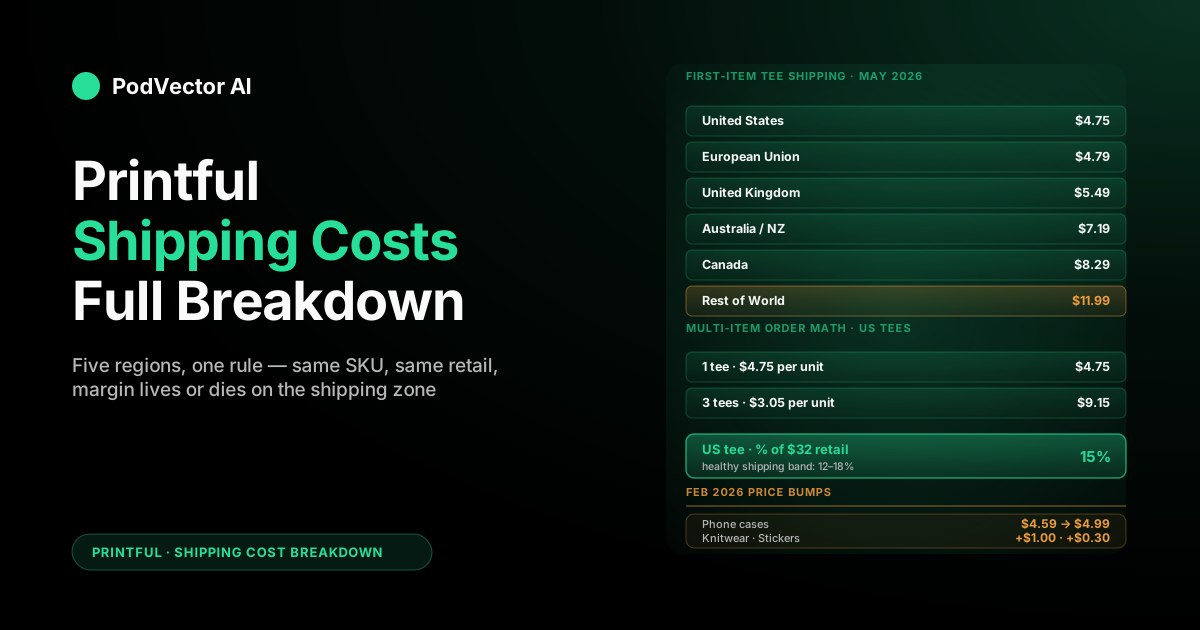
Quick Answer: Printful charges flat-rate shipping by product category and destination region. In the US in 2026, a tee ships for $4.75 first / +$2.20 each additional, a hoodie for $8.49 first / +$2.50 each additional, and a mug ships individually at $4.99.
The headline number isn't the problem. What kills POD margin is the multi-SKU order math, the February 2026 increases on knitwear and accessories, and the international rate jump that turns a healthy US tee into a break-even AU tee.
This guide walks every shipping line for 2026, runs landed-cost math on three real SKUs, and shows the per-SKU view that tells you which orders are actually profitable to ship.
How Printful charges shipping
Printful uses flat-rate shipping. The cost is set per product category, per destination region, and follows a simple formula: a "first item" charge plus a smaller "each additional item" charge for matching items in the same package.
Three things drive your shipping line:
- Product category — tees ship cheaper than hoodies, hoodies ship cheaper than mugs by weight (mugs are heavy), posters and stickers have their own rate sheets.
- Destination region — five buckets: US, Canada, EU, Australia/NZ, Rest of World. Rates roughly 1.3–2.5× the US rate as you move outward.
- Order composition — same-category items share the additional-item rate. Mixed-category orders get split into multiple packages with separate first-item charges each.
That last point is the one most POD operators miss. A customer ordering a tee + a mug doesn't pay one shipping line — they pay two first-item charges, because mugs ship in their own packaging.
US shipping rates by product category
These are the May 2026 US rates, post the February price update. Cross-reference against Printful's live shipping page before locking pricing — the rate sheet moves every few months on accessories.
| Product category | First item | Each additional |
|---|---|---|
| T-shirts (DTG, all-over print) | $4.75 | +$2.20 |
| Sweatshirts and hoodies | $8.49 | +$2.50 |
| Knitwear (knitted sweaters, beanies) | $11.49 | +$2.95 |
| Hats and embroidered headwear | $4.49 | +$1.75 |
| Mugs (ship individually) | $4.99 | n/a |
| Posters and wall art | $5.49 | +$1.95 |
| Phone cases | $4.99 | +$1.50 |
| Stickers, postcards, patches | $4.29 | +$1.25 |
| Tote bags and backpacks | $4.99 | +$2.20 |
| Jewelry | Free worldwide | — |
A few category notes worth saving to a sticky note. Mugs and posters always ship as individual packages, so a 2-mug order pays $4.99 × 2, not one first-item charge plus an additional. Jewelry ships free worldwide — useful when bundling a $25 necklace into a higher-AOV order.
Hats are the cheapest apparel-category shipping line at $4.49 first item. That makes them the easiest SKU to position as a free-shipping tripwire — more on that below.
International shipping rates by region
The same product category costs more to ship as you move out from the US. Here's the May 2026 rate matrix for the most-shipped POD SKU (a single Bella+Canvas 3001 tee):
| Region | First item | Each additional |
|---|---|---|
| US | $4.75 | +$2.20 |
| Canada | $8.29 | +$1.95 |
| EU | $4.79 | +$1.45 |
| UK | $5.49 | +$1.75 |
| Australia / NZ | $7.19 | +$1.30 |
| Rest of World | $11.99 | +$6.00 |
The region that wrecks POD margin is Rest of World. A $25 tee shipping for $11.99 means shipping is 48% of retail before any product cost. If you sell internationally on a flat retail price, you're cross-subsidizing those orders from your US sales.
The fix is region-specific pricing in your store, or a higher international SKU price. Most POD operators don't bother and quietly lose 30–40% margin on every international order.
The February 2026 shipping price changes
Printful rolled out a targeted shipping rate update on February 26, 2026. If you priced your store before that date, your margin model is stale on three categories.
The increases that matter for most POD stores:
- Stickers, postcards, patches (US): $3.99 → $4.29 first item.
- Phone case shipping (US): $4.59 → $4.99 first item.
- Knitted product shipping (global): $10.49 → $11.49 first item.
- Apparel shipping to Australia/NZ: AUD $9.80 → AUD $10.49 first item.
- Hat shipping to Canada: CAD $8.95 → CAD $9.75 first item.
None of these is large in isolation. A 30-cent bump on a sticker order is barely noticeable. But on a 200-order month with a sticker SKU running 60 orders, that's $18 of margin gone — and you didn't get a heads-up unless you happened to read the merchant update email.
This is the case for re-running landed cost on every SKU at least quarterly. The Printful invoice doesn't tell you "your category 4 shipping went up" — it just shows the new line, and your margin shrinks until you notice.
Multi-item order math (and why it matters)
The first-item-plus-additional pattern means shipping cost per unit drops sharply as basket size grows. This is the single biggest lever you have on the shipping line.
Worked example, US tees:
- 1 tee: $4.75 shipping ($4.75 per unit)
- 2 tees: $4.75 + $2.20 = $6.95 ($3.48 per unit)
- 3 tees: $4.75 + $4.40 = $9.15 ($3.05 per unit)
- 5 tees: $4.75 + $8.80 = $13.55 ($2.71 per unit)
A 3-tee order saves $1.70 per unit on shipping vs. three separate 1-tee orders. On a $32 retail tee, that's an extra 5.3 percentage points of margin captured purely on packing.
Same math on hoodies is tighter, since the additional-item rate is closer to the first-item rate ($2.50 vs $8.49). But a 2-hoodie order still saves $5.99 in shipping vs. two singles.
The store-side levers that pay back here: bundle promotions ("buy 2 tees, get $5 off"), free-shipping thresholds set just above your average order value, and "complete the look" cross-sells on the cart page. All three nudge AOV up the curve where shipping cost per unit drops.
Shipping cost as a percentage of retail
The number that matters more than the absolute shipping line is shipping as a percentage of retail. This is what tells you whether a SKU is structurally healthy or whether it's a margin trap.
| SKU | Retail | US shipping (first item) | Shipping as % of retail |
|---|---|---|---|
| $15 sticker | $15 | $4.29 | 29% |
| $32 tee | $32 | $4.75 | 15% |
| $25 mug | $25 | $4.99 | 20% |
| $48 hoodie | $48 | $8.49 | 18% |
| $22 phone case | $22 | $4.99 | 23% |
| $60 knitted sweater | $60 | $11.49 | 19% |
The healthy band is 12–18%. Anything above 22% is a SKU that's hard to make work — you either need to push retail price up or stop running paid traffic to it, because the shipping line alone eats the margin a Meta CPM gives you.
Stickers at 29% of retail are the classic POD trap. They look like easy product lines, but on a $15 retail price the shipping line plus product cost plus payment processing leaves almost no room. Most sticker SKUs only work as add-on items to push a tee or hoodie order above a free-shipping threshold.
Live rates vs flat rates in your store
Printful supports two ways to surface shipping cost to your customer at checkout: live rates pulled from Printful's API in real time, or flat rates you set yourself in your store config.
Live rates (Printful Shipping API)
Available on Shopify, WooCommerce, and a handful of other platforms. The customer sees the actual Printful shipping cost at checkout, calculated against their address.
Pros: zero margin leak from over- or under-charging. Cons: rates can be unpredictable for the customer, especially on multi-SKU baskets, and high international rates can spike cart abandonment.
Flat rates (you pick the number)
You set a single shipping rate in your store ("$5 US shipping, $12 international") regardless of basket composition. Predictable for the customer. Predictable margin pain for you when a 4-tee order ships for $13.55 and you only collected $5.
Most POD operators settle on a hybrid: flat-rate domestic with a free-shipping threshold around $40–$50, live rates for international, or international shipping disabled entirely on lower-margin SKUs.
Free shipping: when to absorb, when to pass through
Free shipping isn't actually free — it's just a marketing decision about which line of your P&L absorbs the cost. The question is whether the conversion lift from "free shipping" beats the margin hit from absorbing the shipping line.
Three patterns work for POD:
Threshold free shipping. "Free shipping over $50." Pushes AOV up the curve where multi-item shipping math gets cheap. Standard play and it works, but only if your threshold is set 15–25% above your current AOV. Set it at AOV and you give away shipping on orders that would have happened anyway.
Built-in free shipping. Bake $5 into every retail price and call it free shipping. Works on Shopify if your category competitors do the same. Hurts on Etsy where Etsy boosts free-shipping listings in search ranking but you also pay the marketplace fee on the inflated price.
Promotional free shipping. Time-boxed campaigns ("free shipping this weekend") to drive sample order conversions or clear seasonal inventory. Lowest-margin pattern but the highest immediate conversion lift.
The number to watch is contribution margin per order, not gross margin per SKU. A free-shipping campaign that drops gross margin from 47% to 39% but lifts conversion rate from 1.4% to 2.1% is a clear win — the per-order dollar contribution is higher even at the lower margin percentage.
Three landed-cost examples
Headline rates are useful only if you carry the math through to landed cost per order. Three examples on common SKU + region combinations, Printful Growth plan.
Example 1: 1 Bella+Canvas 3001 tee, US, Shopify, $32 retail
- Product base (Growth): $9.05
- US shipping (first item): $4.75
- Inside-tag branding: $0.90
- Payment processing (2.9% + $0.30): $1.23
- Return reserve (1.5% of $32): $0.48
- Landed cost: $16.41
- Gross margin: $15.59 (49%)
Strong margin on a single tee at $32 retail. Add a $4 Meta CAC and you're at $11.59 contribution (36%) — still healthy.
Example 2: 3 tees in one order, EU, Shopify, $32 retail each
- Product base × 3 (Growth): $27.15
- EU shipping (first $4.79 + 2 × $1.45): $7.69
- Inside-tag branding × 3: $2.70
- Payment processing on $96 order: $3.08
- Return reserve (1.5% of $96): $1.44
- Landed cost: $42.06
- Gross margin: $53.94 (56%)
Multi-item orders are where margin actually breathes. Shipping per unit dropped from $4.79 to $2.56. A free-shipping threshold at $80 captures this kind of order without giving up the margin on solo $32 sales.
Example 3: 1 Gildan 18500 hoodie, Australia, Etsy, $48 retail
- Product base (Growth): $19.45
- Australia shipping (first item, hoodie): $14.99
- Inside-tag branding: $0.90
- Etsy fees (~9.5% blended): $4.56
- Etsy Ads share (assume 6%): $2.88
- Return reserve (3% of $48 hoodie): $1.44
- Landed cost: $44.22
- Gross margin: $3.78 (8%)
This is the international-margin trap in one row. Same SKU, same retail price, sold to Australia instead of the US — gross margin collapses from 26% to 8%. One return on this order moves it negative for the month. Either price up Australian retail by $8–$10 or block international shipping on Etsy listings for this SKU.
How to lower your Printful shipping cost
Four levers, in order of impact:
1. Push for multi-item baskets. Bundle promos, threshold free shipping, "complete the look" cross-sells. The first-item-plus-additional math means a 3-tee order ships at $3.05 per unit vs $4.75 for a solo tee — that's a 36% reduction in shipping cost per unit.
2. Region-specific pricing. If you sell internationally, your retail price needs a regional uplift. A $32 US tee should be $36–$38 in Australia and $42+ in Rest of World. Most POD storefronts support this through Shopify Markets or WooCommerce multi-currency.
3. Drop SKUs where shipping eats more than 22% of retail. Or repackage them as add-on items only — visible at cart, not at storefront. Stickers, low-AOV phone cases, and single mugs are the usual suspects.
4. Switch off Rest of World. If less than 5% of orders come from Rest of World and they all run negative margin, just disable that region in your shipping zones. You're not losing customers, you're losing losses.
Tracking shipping cost per SKU
The hard part of running Printful at scale isn't reading the shipping line on a single invoice. It's seeing shipping cost flow through to per-SKU and per-region margin every day, and noticing when a SKU has quietly flipped from profitable to negative because of a regional rate change or a basket-mix shift.
Static dashboards struggle here. The inputs change every order — destination region, basket composition, product category mix. A rate update like the February 2026 accessories bump doesn't show up cleanly until you re-run a quarterly margin spreadsheet. By then you've shipped 200 orders at the new rate without adjusting retail.
This is the gap PodVector AI is built to close. Victor looks at your Shopify and Printful orders together, so he sees the full cost of every order (product + shipping + branding + processing + return reserve). You can ask him things like "which SKUs dropped below my 30% margin floor this month after the shipping update?" Then he proposes a specific action — a price change on the affected SKU, a free-shipping threshold lift, or disabling a region — that you approve before it runs.
That combination — POD playbook plus live data plus the ability to act — is what turns shipping cost from a quarterly spreadsheet exercise into something you adjust in real time.
FAQs
How much does Printful shipping cost in the US?
In May 2026, US shipping is $4.75 first item / +$2.20 additional for tees, $8.49 / +$2.50 for hoodies, $4.99 individual for mugs, $4.49 / +$1.75 for hats, and $4.29 / +$1.25 for stickers. Rates updated in February 2026 on phone cases, knitwear, and accessories — re-check before locking pricing.
Does Printful offer free shipping?
No, Printful charges shipping on every order except jewelry (free worldwide). What "free shipping" means in POD is that you absorb the shipping line into your retail price or hit a store-side threshold to wave it. Either way, the shipping cost still gets paid — it's just on your P&L instead of your customer's invoice.
How is Printful shipping calculated for multi-item orders?
Same-category items in one order share the additional-item rate. A 3-tee order to the US is $4.75 first + ($2.20 × 2) = $9.15. Mixed-category orders (a tee + a mug) get split into two packages with separate first-item charges each — that's the most common math mistake new POD sellers make on bundle promotions.
How much is Printful shipping to Europe?
EU shipping is $4.79 first item / +$1.45 additional for tees, $6.99 / +$2.40 for hoodies. Slightly cheaper additional-item rates than the US, which makes EU multi-item orders more margin-friendly. UK is now a separate zone post-Brexit at $5.49 first item.
Can I see Printful shipping rates before publishing a product?
Yes, on the Printful product page or via the dedicated shipping rate calculator at printful.com/shipping. The calculator lets you pick destination country and basket composition to see exact rates. Use it before pricing any SKU you intend to sell internationally.
What's the cheapest Printful shipping option?
Hats at $4.49 first item / +$1.75 additional are the cheapest apparel category. Stickers and patches at $4.29 first item are cheaper still but ship in their own envelopes — they don't share rates with apparel orders. Jewelry ships free worldwide.
How long does Printful shipping take?
US shipping is typically 3–5 business days for standard, 1–3 for express, on top of Printful's 2–4 day fulfillment window. Total order-to-doorstep is usually 5–9 business days for US. International is 5–10 business days for shipping plus the same fulfillment window. Our full breakdown of integration cost covers the platform-side timing too.
Is Printful shipping cheaper than Printify?
It depends on the SKU. Printful's US tee shipping ($4.75 first item) is competitive with Printify's lowest-cost provider. Where Printful tends to win is international rates, since Printful operates fulfillment centers in the EU, Australia, and Canada — orders route to the nearest one and ship locally. Printify's international shipping varies wildly by print provider. Full comparison in our what's better, Printful or Printify guide.
Can I pass Printful shipping costs directly to my customer?
Yes, by enabling live shipping rates via the Printful API on Shopify or WooCommerce. The customer sees the exact Printful shipping cost at checkout. Most POD operators run a hybrid: flat domestic shipping plus a free-shipping threshold, live rates for international.
Do shipping costs count toward Printful's free shipping promotions?
Printful occasionally runs merchant-side promotions like free shipping over a basket threshold to merchants on the Growth or Business plan. These are time-boxed and rarely cover international. Don't build a margin model assuming they'll persist — they're a margin bonus when they hit, not a baseline.
How do I lower Printful shipping costs without hurting conversion?
Push for multi-item baskets through bundle promos and free-shipping thresholds set 15–25% above your AOV. The first-item-plus-additional math means a 3-tee order ships at $3.05 per unit vs $4.75 for a solo tee. That's 36% lower per-unit shipping captured on the same delivery, and the threshold itself usually lifts conversion via "free shipping" labeling.
What's the best way to track Printful shipping costs over time?
The Printful invoice covers their direct charges. To see the real picture, you need your Shopify orders lined up with those Printful costs, so you can see shipping cost per SKU, per region, per week. Victor does this for you automatically, so you catch rate updates and margin drift before they show up in a quarterly P&L review. Our Printful mug base cost breakdown walks the same per-SKU framing for mugs specifically, and the broader Printful hoodie production cost breakdown covers hoodies. For the full Printful cost stack, see our Printful costs and charges hub; for everything Printful, the Printful topic hub is the index.
Should I sell internationally on Printful?
Only if your retail price has a regional uplift built in. A $32 US tee selling for $32 in Australia ships at $7.19 vs $4.75 — same product cost, much thinner margin, and one return moves the order negative for the month. Either price up by $4–$10 per region or block Rest of World shipping on lower-margin SKUs. Compare against Printify's regional fulfillment in our which is better, Printful or Printify breakdown.
Stop guessing which orders ship at a loss
Shipping is the second-largest line on your Printful invoice. It's also the line that moves under you — regional rate updates, basket-mix shifts, the February 2026 accessories bump — and most POD operators only catch the drift when quarterly margin reports come in.
Victor watches every shipping line per order, per SKU, per region, in real time. He flags margin leaks (the Australia hoodie that just went 8%, the sticker SKU that stopped paying for itself), proposes the specific fix, and executes it on your approval. And see your real per-order shipping margin in 60 seconds.
Try Victor free