
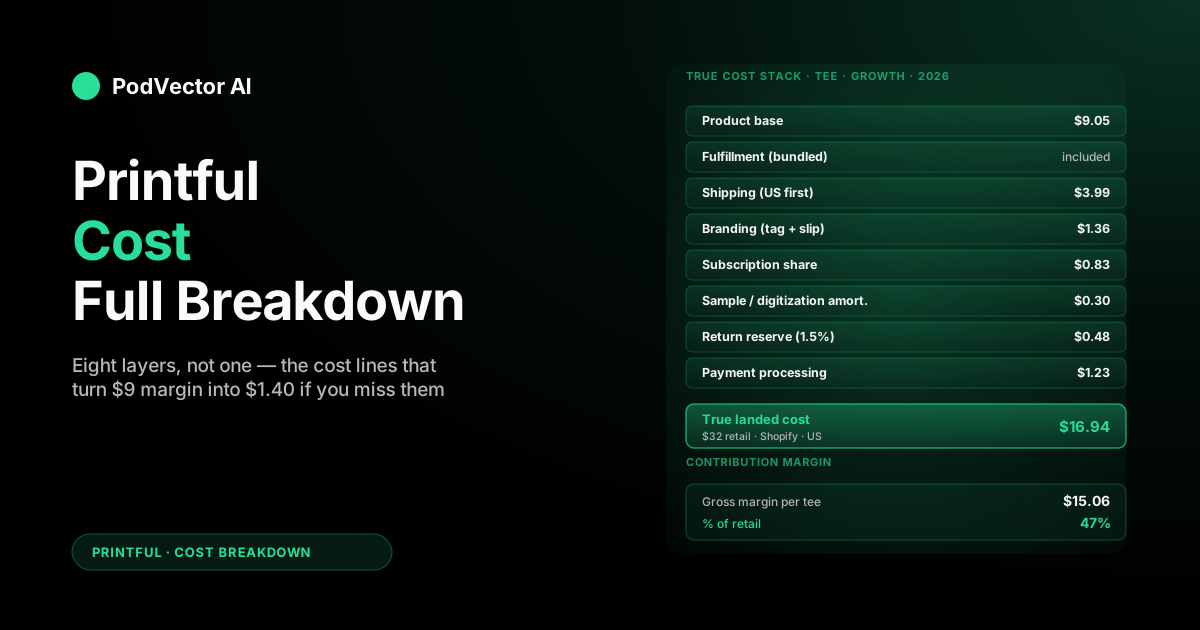
Quick Answer: Your real Printful cost on a sold tee in 2026 is roughly $17.50–$20.00 in the US — not the $12.95 catalog price. That's product base ($12.95) + DTG fulfillment (already included) + shipping (~$3.99) + payment processing (~$1.25) + a pro-rated share of subscription, sample, and return overhead.
The list-price line on Printful is the easy part. The line that breaks POD margins is the operational stack underneath it: returns, address corrections, sample orders, digitization, and the Growth or Business subscription you pay every month whether you sell one tee or a thousand.
This guide walks every cost layer with 2026 numbers, builds the real landed cost on three example SKUs, and shows the monthly worksheet that tells you whether you're actually profitable.
The full Printful cost stack
Most "Printful cost" content stops at the catalog price. That's how POD sellers end up writing $9 margin into the spreadsheet and seeing $1.40 land in the bank.
The real stack has eight layers. Three are on the Printful invoice. Three are hidden in the order details. Two are downstream costs that scale linearly with every Printful order you ship.
| Layer | Where it shows up | Typical 2026 size |
|---|---|---|
| Product base | Printful invoice | $7.95–$45 per unit |
| Print fulfillment | Bundled into base | Included (extra placements $2–$6) |
| Shipping | Printful invoice | $3.99–$12.99 per order |
| Branding | Printful invoice (per unit) | $0.99–$2.49 per item |
| Subscription | Monthly Printful charge | $0 / $24.99 / $49.99 per month |
| Samples & digitization | Quarterly Printful charges | $30–$300 per cycle |
| Returns & address fixes | Variable Printful charges | 1–4% of order volume |
| Payment & marketplace fees | Shopify, Etsy, Stripe | 3–15% of retail |
The stack matters because every layer except the first is variable on dimensions you control — order size, market, shipping zone, branding adds, return rate, sales channel. A 6% gross-margin store and a 32% gross-margin store can both run identical Printful catalogs. The difference is how they manage the stack.
Product base costs (what you actually pay per unit)
Product base cost is the largest single line. For an apparel-led POD store, it's usually 55–70% of the true landed cost. Printful's 2026 catalog prices for the most-shipped SKUs:
| Product | Free plan | Growth plan | Category |
|---|---|---|---|
| Bella+Canvas 3001 tee | $12.95 | ~$9.05 | DTG apparel |
| Gildan 18500 hoodie | $26.95 | ~$19.45 | DTG apparel |
| 11oz ceramic mug | $7.95 | ~$5.95 | Drinkware |
| Embroidered cap | $14.50 | ~$10.95 | Embroidery |
| All-over print tee | $21.95 | ~$15.95 | Sublimation |
| Tote bag | $10.50 | ~$7.85 | Accessories |
Two things are usually missed when reading this table. First, the Growth-plan price is what most active stores actually pay — the $24.99 fee is structurally negligible against the discount once you ship more than ~25 units a month. Second, Printful applied a 0.4–2.4% across-the-board increase in February 2026 on apparel, so the historical numbers in older blog posts are slightly low.
If you sell across multiple categories, the per-SKU base spread (and how each SKU's fulfillment method affects margin) matters more than the headline plan choice. We cover the full plan and product breakdown in our Printful pricing breakdown.
Fulfillment costs (and why they look "free")
Printful bundles printing into the base price, which is why their pricing pages don't list a separate fulfillment fee like Printify does. That doesn't mean fulfillment is free — it means the fulfillment cost is baked into a higher base price.
The split looks roughly like this on a Bella+Canvas 3001:
- Blank apparel: ~$3.50
- DTG print: ~$5.50
- Handling, QA, pack: ~$3.95
- Total catalog price: $12.95
You only see the bundled price, which makes apples-to-apples comparison with Printify (which surfaces a separate ~$3.50 fulfillment fee on top of a ~$4.50 blank) hard at a glance. The trick: compare landed cost on a real SKU, not headline base price. Our Printify and Printful guide walks the per-SKU comparison.
Extra placements are not bundled. Adding a back print to a front-print tee runs $5.95. Adding a sleeve print runs $2.95. Embroidery placements add $3.50–$7.95 depending on stitch count. These add up fast on multi-placement designs and need to be in your retail math.
Shipping costs by zone and product
Shipping is zone-flat by product category, not weight-based. That's a meaningful simplification — you can predict shipping cost from the SKU alone, which makes free-shipping retail pricing tractable.
| Product | US first | US add'l | Canada first | UK first | EU first |
|---|---|---|---|---|---|
| Tee | $3.99 | $1.25 | $5.99 | $3.99 | $4.99 |
| Hoodie | $5.49 | $1.50 | $7.99 | $5.99 | $6.99 |
| Mug | $4.99 | $2.30 | $6.99 | $3.99 | $4.99 |
| Embroidered cap | $4.69 | $1.25 | $6.99 | $4.99 | $5.99 |
| Tote bag | $3.99 | $1.25 | $5.99 | $3.99 | $4.99 |
Two operator notes on shipping. First, the "first / add'l" structure rewards multi-item orders — your fulfillment cost per unit drops sharply on a two-tee order vs. a one-tee order. Second, the US and EU shipping is meaningfully cheaper than Printify's average for the same SKU, which is part of why Printful tends to win on stores selling to global markets even when the base price is higher.
If you're considering offering free shipping as a retail strategy, the math is in our Printful free shipping breakdown and the delivery-time tradeoffs are covered in our free shipping delivery time estimates.
Branding costs: labels, pack-ins, packaging
Branding is where small POD stores either build a defensible product or quietly leak margin. The 2026 per-unit branding cost stack:
| Branding option | Free plan | Growth (9% off) | What it does |
|---|---|---|---|
| Inside neck label print | $0.99 | ~$0.90 | Replaces blank manufacturer tag |
| Outside woven label | $2.49 | ~$2.27 | Hem or sleeve woven tag |
| Hang tag | $1.20 | ~$1.09 | String-attached card |
| Custom packing slip | $0.50 | ~$0.46 | Branded paper insert |
| Pack-in (sticker, card) | $0.25–$1.50 | ~9% off | Custom physical insert |
| Custom mailer (bag) | $1.99 | ~$1.81 | Branded poly mailer |
The realistic branding spend on a tee is $1–$3 per unit depending on stack. Most stores skip the woven label and ship inside-tag plus packing slip for ~$1.49 per unit on Free or ~$1.36 on Growth.
The Business plan ($49.99/mo) discounts branding deeper at 13% off, which pencils out around 800 branded units a year. Below that, Growth wins.
Subscription cost (Growth and Business)
The subscription line is the cost line that confuses most new POD sellers, because it shows up before you've sold anything.
| Plan | Monthly | Annual | Effective break-even (units/mo) |
|---|---|---|---|
| Free | $0 | $0 | — |
| Growth | $24.99 | $239.88 | ~9 tees |
| Business | $49.99 | $479.88 | ~120 branded units |
"Break-even" here means the unit volume where the discount savings cover the subscription. For Growth, the Bella+Canvas tee saves $3.90 per unit on the catalog price. Nine tees a month covers the $24.99 fee.
If you're already at 30+ units a month, Growth is structurally free. The signal that you've outgrown Growth and should look at Business is when you're shipping enough branded units that the 13% branding discount (vs. 9%) pays for itself — usually 800+ units a year on a branded SKU mix.
Two other subscription notes. Growth becomes free automatically when your annual sales clear $12,000. Business doesn't have a free tier — you keep paying $49.99/mo at all volumes.
Hidden costs: returns, samples, digitization, address fixes
These are the lines that don't show up on a "what does Printful cost?" headline but absolutely show up on your bank statement.
Samples
Every serious POD seller orders samples — to QA print quality before going live, to shoot product photography, to test new SKUs. Printful's sample order discount is 20% on Free, 25% on Growth.
A typical month-one sample budget for a 10-SKU launch is $250–$400. Most stores then run a $50–$150 sample line every quarter to test new SKUs or recheck quality after Printful product updates. Budget ~$30–$50/month amortized.
Embroidery digitization
If you sell embroidered products, every design needs to be digitized — converted into a stitch file. Printful charges $2.95–$6.50 per design, one-time. Growth includes free digitization for samples but not production orders. Plan ~$50 in digitization for a 10-design embroidery launch.
Returns
Printful's return policy on customer fault (wrong size, changed mind) is no refund — you eat the cost. On Printful fault (misprint, defect, wrong product), Printful re-ships free.
The practical return rate on Printful orders runs 1.5–4% of order volume, with apparel sized into the higher end. Half that is Printful's fault and re-shipped free. The other half is customer fault and lands on you as a refund — usually full retail back to the customer, with the original Printful cost still paid.
On a 200-order month at 2% customer-fault returns, that's ~2 orders × ~$25 retail = $50 in absorbed returns. Budget 1–2% of revenue as "return reserve."
Address corrections and reships
When a customer types their address wrong and the package gets bounced, Printful charges a reship fee — usually the original shipping line plus a small handling charge, around $6.99–$9.99 per incident on US tees, more for hoodies and international.
This runs 0.3–0.8% of order volume depending on how clean your address validation is on the storefront. Cheap relative to returns but predictable.
Downstream costs that ride on Printful orders
The last two layers aren't Printful charges, but they scale with every Printful order — which means they belong in your "true cost of running on Printful" model.
Payment processing
Shopify Payments, Stripe, PayPal all run roughly 2.9% + $0.30 per transaction. On a $35 sold tee, that's $1.32. On a $65 hoodie, $2.19. On lower-AOV orders, the $0.30 fixed component is meaningful.
Marketplace fees
If you sell on Etsy, the fee stack is $0.20 listing + 6.5% transaction + 3% + $0.25 payment processing + ~12% Etsy Ads (if running). Total Etsy take is typically 9–22% of retail.
If you sell on Amazon Merch on Demand, you're on Amazon's royalty model, not Printful — different stack entirely. On your own Shopify store you skip the marketplace fee but pick up Shopify's $39/month base plus 2.9% + $0.30.
These aren't Printful's fees. But they're the reason "$9 margin per tee" on a spreadsheet becomes "$3 margin per tee" on the actual P&L.
True landed cost: three worked examples
Headline numbers stop being useful at this point. Three worked examples on common SKUs, Growth plan, US shipping:
Example 1: Bella+Canvas 3001 tee, Shopify, $32 retail
- Product base (Growth): $9.05
- Shipping (US first): $3.99
- Inside-tag branding: $0.90
- Packing slip: $0.46
- Payment processing (2.9% + $0.30): $1.23
- Return reserve (1.5% of $32): $0.48
- Subscription share (1/30 of $24.99 on a 30-tee month): $0.83
- True landed cost: $16.94
- Gross margin: $15.06 (47%)
Strong margin. But this assumes you find the buyer organically. Add a $4 CAC from a Meta ad and you're at $11.06 contribution margin (35%) — still healthy, but closer to the "decent POD store" band than the screenshot-perfect one.
Example 2: Gildan 18500 hoodie, Etsy, $48 retail
- Product base (Growth): $19.45
- Shipping (US first): $5.49
- Inside-tag branding: $0.90
- Etsy listing + transaction + processing (~9.5%): $4.56
- Etsy Ads share (assume 6% blended): $2.88
- Return reserve (3% of $48 for hoodies): $1.44
- Subscription share: $0.83
- True landed cost: $35.55
- Gross margin: $12.45 (26%)
Etsy compresses margin meaningfully. Same product on Shopify with the same $48 retail and a $4 Meta CAC would net ~$15.75 (33%).
Example 3: 11oz ceramic mug, Shopify, $19 retail
- Product base (Growth): $5.95
- Shipping (US first): $4.99
- Packing slip: $0.46
- Payment processing: $0.85
- Return reserve (1.5%): $0.29
- Subscription share: $0.83
- True landed cost: $13.37
- Gross margin: $5.63 (30%)
Mugs look great on paper but the absolute dollar margin is small — $5.63 means you need 5–6× the unit volume of tees to net the same monthly contribution. Mug stores live or die on order volume, not unit margin.
Monthly cost worksheet
The single most useful exercise for any POD seller running Printful is a monthly cost worksheet. The structure:
| Cost line | How to calculate | Example: 150-order month |
|---|---|---|
| Product base × units | Sum from Printful invoice | $1,575 |
| Shipping × orders | Sum from Printful invoice | $680 |
| Branding × units | Per-unit add × units | $135 |
| Subscription | Flat monthly | $24.99 |
| Samples & digitization | Quarterly amortized | $45 |
| Returns reserve | 1.5–3% of revenue | $120 |
| Payment processing | ~2.9% + $0.30 × orders | $190 |
| Marketplace / platform fees | 9–15% × revenue (Etsy) or $39 (Shopify) | $39 (Shopify) |
| Total monthly Printful-driven cost | $2,808.99 |
If your revenue on that 150-order month was $4,800 ($32 AOV × 150 orders), your gross contribution margin is $1,991 — about 41%. Below 30% in this model is the warning band; above 45% you're probably under-pricing or under-branding.
How to lower your Printful cost
Four levers, in approximate order of impact:
1. Move to Growth. If you ship more than ~10 tees a month, the Growth discount math wins. The 33% category discount on apparel structurally lowers your per-unit cost by $2–$5 across the most-shipped SKUs.
2. Cluster orders. A two-tee order has half the per-unit shipping cost of two one-tee orders. Bundle discounts at the storefront level pay back through fulfillment savings, not just AOV lift.
3. Audit which SKUs flip negative. Most stores have 1–3 SKUs that quietly lose money — high return rate, high shipping cost, low retail. Pull six months of data and rank SKUs by contribution margin. Kill the bottom 10%.
4. Right-size branding. The full branding stack costs $3–$5 per unit. Most stores don't need outside woven labels or custom mailers — inside-tag + packing slip ($1.36 on Growth) carries 80% of the brand perception at 30% of the cost.
Tracking Printful cost in real time
The hard part of running Printful at scale isn't reading any single invoice. It's seeing the full cost stack — Printful invoice plus shipping plus branding plus payment processing plus return reserve — flow through to per-SKU and per-order margin every day, and noticing when a SKU has quietly flipped from profitable to negative.
Static dashboards struggle here because the inputs change every order. A 0.4% Printful price increase on a specific apparel category, a new shipping rate to the UK, a customer-fault return rate that drifted from 1.5% to 3.2% — none of those show up cleanly on a Shopify analytics screen.
This is the gap PodVector AI is built to close. Victor connects directly to your Shopify and Printful order data. He sees every cost on every order, including hidden fees like return reserve and address-correction charges, and can answer questions like "which SKUs dropped below my 30% margin floor this month, and why?" Then he suggests a fix, like a price change or a discount for a clearance SKU, that you approve before anything runs.
That combination — POD playbook + live data + ability to act — is what turns "Printful cost" from a quarterly spreadsheet exercise into a daily operating habit.
FAQs
How much does Printful really cost per month for a small POD store?
A small POD store shipping 30–60 orders a month typically pays Printful directly $400–$1,800 (product base + shipping + branding + $24.99 Growth subscription), plus another $80–$300 in downstream costs (payment processing, returns, samples). Total Printful-driven monthly cost is usually 55–70% of revenue at the small-store stage.
Is the Printful Growth plan worth the $24.99/month?
For any store shipping 10+ apparel units a month, yes. The Growth discount saves roughly $3.90 per Bella+Canvas tee and similar dollar amounts on hoodies, mugs, and embroidery. Nine tees a month covers the subscription. The plan also becomes free at $12,000/year in sales.
Does Printful charge fulfillment fees on top of product price?
No separate fulfillment fee. Printful bundles printing, handling, and QA into the catalog base price. That's different from Printify, which surfaces a separate fulfillment fee. When comparing the two, always compare landed cost on a specific SKU rather than headline base prices. Our Printful fulfillment fees breakdown covers this in detail.
How much does Printful shipping cost?
US shipping is $3.99 first item / $1.25 additional for tees, $5.49 first / $1.50 additional for hoodies, $4.99 first / $2.30 additional for mugs. International is roughly 1.3–1.8× the US rate. Shipping is zone-flat by product category, which makes it predictable for retail-pricing math.
What hidden costs should I budget for on Printful?
Four lines that aren't on the catalog page. Samples ($30–$50/month amortized), embroidery digitization (one-time $2.95–$6.50 per design), returns reserve (1.5–3% of revenue, with apparel toward the high end), and address-correction reships ($6.99–$9.99 per incident, 0.3–0.8% of order volume). Budget ~2–4% of revenue total.
Does Printful charge for samples?
Yes. You pay catalog price minus 20% (Free) or 25% (Growth) on sample orders, plus normal shipping. There's no separate "sample fee." Most POD stores spend $250–$400 on a launch sample run and $30–$50/month amortized after that.
Is Printful more expensive than Printify?
On most apparel SKUs, yes — the Bella+Canvas 3001 lands at $9.05 on Printful Growth vs. ~$8.45 on Printify Premium for a roughly equivalent print quality, and the gap is wider on hoodies. Where Printful wins back is shipping (cheaper outside the US), branding (more granular options), and fulfillment speed (averaging 2–4 days vs. Printify's 3–6 day spread depending on print provider). Full comparison in our Printful vs Printify guide.
What's the cheapest way to start on Printful?
Free plan, one product category, US-only shipping, no branding adds, Shopify as the storefront. That keeps your fixed cost at $0/month Printful + $39/month Shopify and your per-order cost at base + shipping + payment processing only. Move to Growth once you're consistently shipping 10+ units a month.
How do I track all my Printful costs in one place?
The Printful invoice covers their direct charges. Add Shopify payment processing and your branding cost per unit, and you have the full picture. Most POD store owners only check this in a spreadsheet once a quarter. Victor pulls all these numbers together for you automatically, so you can check your real costs every day instead of waiting three months.
Does Printful charge for returns?
Yes for customer-fault returns (wrong size, changed mind) — you eat the original cost. No for Printful-fault returns (misprint, defect, wrong item shipped) — Printful re-ships free. Average customer-fault return rate runs 1.5–3% of order volume on apparel. Budget that as a "return reserve" line in your monthly worksheet.
Stop reading Printful invoices line by line
POD operators don't lose money on the $12.95 base price. They lose money on the seven other layers of the cost stack — returns, address fixes, sample cycles, shipping zone mix, branding overshoot, and the SKUs that quietly flipped negative two months ago.
Victor connects to your Shopify and Printful data and watches every cost on every product, every day. He flags margin leaks, suggests the fix, like a price change or a discount, and makes the change once you approve it. And see your real Printful cost per order in 60 seconds.
Try Victor free