
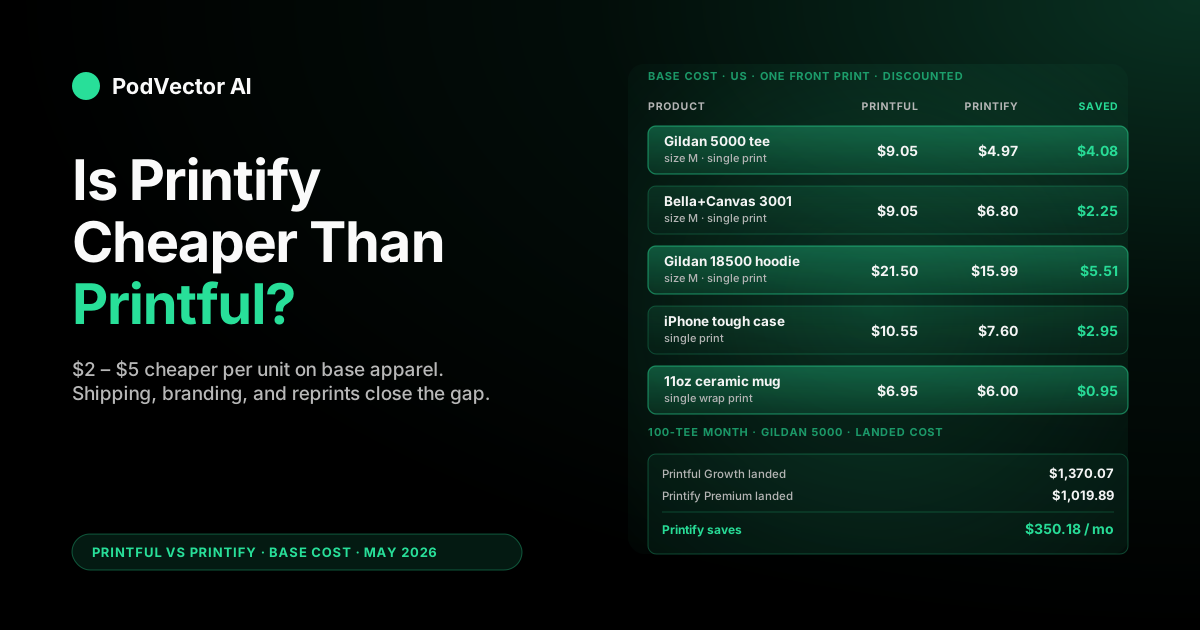
Quick Answer: Yes — for base product cost on most apparel, Printify is roughly $2–$5 cheaper per unit than Printful in May 2026. A Gildan 5000 tee runs about $6.21 on Printify versus $12.95 on Printful's Free plan; with discounts the gap narrows to roughly $4.97 vs $9.05.
"Cheaper" is not the same as "more profitable," though. Printful bundles handling, often ships faster from US/EU hubs, and includes free branding tiers that Printify charges for. After shipping, fulfillment fees, and reprint rates, the per-unit gap on apparel typically settles at $1.50–$3 in Printify's favor.
Phone cases, mugs, and some all-over-print items can flip the answer the other way depending on the print provider you select. This guide walks the actual line items, then shows the conditions where Printful is the cheaper choice.
The short answer with real numbers
Printify is cheaper than Printful on base apparel cost. That's the answer most operators are looking for, and the catalog data is consistent across every comparison published in 2026.
On a standard Gildan 5000 tee in size M, US fulfillment, single-side print:
- Printful Free: $12.95 base
- Printful Growth ($24.99/mo): $9.05 base (~30% off)
- Printify Free: ~$6.21 base (provider-dependent)
- Printify Premium ($29/mo, $24.99/mo annual): ~$4.97 base (20% off across providers)
That's a base cost gap of roughly $4 per shirt at the discounted tiers. Multiply across a 100-tee month and Printify saves you about $400 in unit cost before any other line item is touched.
The catch: those numbers are the easy half of the calculation. Shipping, fulfillment fees, and reprint rates can shift the real per-shirt landed cost by another $1–$3 in either direction. The next sections walk those lines.
Base product cost: side-by-side, May 2026
Here is the apples-to-apples comparison on the SKUs that drive 80% of POD apparel volume. All prices are May 2026 catalog, US fulfillment, size M (or equivalent base), single-side DTG print:
| Product | Printful Free | Printful Growth | Printify Free | Printify Premium | Printify advantage |
|---|---|---|---|---|---|
| Gildan 5000 tee | $12.95 | $9.05 | $6.21 | $4.97 | ~$4.08 |
| Bella+Canvas 3001 tee | $12.95 | $9.05 | ~$8.50 | ~$6.80 | ~$2.25 |
| Gildan 18000 sweatshirt | $22.95 | $16.95 | ~$14.50 | ~$11.60 | ~$5.35 |
| Gildan 18500 hoodie | $28.95 | $21.50 | ~$19.99 | ~$15.99 | ~$5.51 |
| Phone case (iPhone tough) | $13.50 | $10.55 | ~$9.50 | ~$7.60 | ~$2.95 |
| 11oz ceramic mug | $8.50 | $6.95 | ~$7.50 | ~$6.00 | ~$0.95 |
| Wall poster (12×18) | $13.50 | $10.55 | ~$9.99 | ~$7.99 | ~$2.56 |
A few notes on what these numbers mean in practice.
Printify's prices are ranges because the catalog is a marketplace — different print providers (Monster Digital, SwiftPOD, Print Geek, Sensaria, MyLocker, etc.) quote different bases for the same blank. The numbers above are the median provider for each SKU.
Printful's prices are single numbers because the catalog is one in-house fulfiller. What you see is what you pay, plan-adjusted.
The Printify Premium discount is a flat 20% across all providers. Printful's Growth discount varies by SKU and tops out around 33%, with bigger discounts on tees (~30%) than on accessories (~20–25%).
Why the gap exists in the first place
The price difference is not random. It traces back to the two companies' opposite business models.
Printful is vertically integrated. They own the printing equipment, lease the warehouses, employ the operators, and run the customer service. That gives them tight quality control and predictable turnaround — and a cost structure that has to recover all of those fixed costs through the per-order base price.
Printify is a marketplace aggregator. They don't print anything themselves. They route orders to a network of independent print providers who compete for volume on price. The provider eats the margin pressure; Printify takes a small platform cut.
That's why a Gildan 5000 from a Printify provider in the Midwest can clear at $6.21 while the same blank from Printful's Charlotte facility lists at $12.95. The Printify provider only has to cover their own printing and fulfillment overhead — they don't have to fund Printful's design tools, branded packaging program, or 24/7 chat support.
Both models are valid. They just produce different cost curves. If your store optimizes for unit cost above all else, Printify wins. If your store needs predictable quality across every order regardless of provider, Printful's vertical model is what that buys you.
Printful Growth vs Printify Premium: how the math changes
The base-cost numbers above already factor in each platform's main paid plan. It's worth understanding what those subscriptions actually cost and where the break-even sits.
Printful Growth: $24.99/month. Up to 33% off product base, 9% off branding add-ons (custom tags, packaging inserts), 25% off sample orders. Auto-waives at $12,000 in trailing 12-month sales.
Printify Premium: $29/month month-to-month, or $24.99/month billed annually ($299.88/year). Flat 20% off across all providers' base prices. Up to 10 stores per account. No sales-volume waiver.
For a store doing 30+ tees a month, both plans pay for themselves inside a week. The Growth plan's $12k auto-waive is the bigger structural win — once you're past validation, the discount becomes free.
The Premium plan does not have that escape hatch. You pay $300/year forever, regardless of revenue. On a 1,000-unit-per-year store at $4 per-unit savings, that's $4,000 saved minus $300 in plan fee — still a strong ROI, but not the "free money" the Growth plan becomes at scale.
For a deeper look at how the Printful subscription math compounds across the catalog, see the Printful fulfillment fees breakdown.
Shipping: the line item that decides ties
Base cost is the headline. Shipping is what often closes the gap.
Printful publishes flat shipping rates that are consistent across SKUs and regions. For a US-fulfilled tee, the first item is $3.99 and each additional is $1.25. For a hoodie or sweatshirt, the first item is $4.99.
Printify's shipping is provider-by-provider. Two examples for the same Gildan 5000 to a US address:
- Monster Digital (Florida): $4.59 first / $2.49 each additional
- SwiftPOD (Nevada): $4.49 first / $2.69 each additional
- Print Geek (Canada): $5.99 first / $3.49 each additional (cross-border surcharge)
For US-only single-tee orders, Printful's $3.99 typically beats Printify by $0.50–$2 per shipment. That recovers $0.50–$2 of the base-cost gap.
For multi-item orders, the math holds — Printful's $1.25 additional-item rate is very competitive. For international orders shipping out of a US provider, Printify's cross-border surcharges can erode the entire base-cost advantage.
This is why "cheaper" is order-mix dependent. A store doing 80% single-tee US orders sees a smaller real gap than a store doing multi-item EU orders. For the full picture on Printful shipping mechanics, the Printful free-shipping breakdown walks the threshold math, and the $500 free-shipping tier piece covers the bulk-order side.
Fulfillment, branding, and the hidden fees
Three more line items shift the real comparison.
Branding inserts. Printful's Growth plan includes free inside-label printing and discounted packaging inserts. Printify charges $0.50–$1.50 per item for any branding through providers that offer it (most don't). If branded packaging matters to your niche, Printful's bundle is hard to match on Printify.
Sample orders. Printful Growth members get 25% off samples. Printify Premium has no sample-specific discount — you pay catalog price. For a store running two new designs a month, that's roughly $15–$30/month in extra sample cost on Printify.
Reprints and address corrections. Both platforms offer reprints on print errors at no charge. The catch is reprint rates differ. Printful's published reprint rate is ~2%; Printify's varies by provider, with the better providers (Monster Digital, SwiftPOD) at ~2.5% and the budget providers as high as 6%. On 100 tees a month at a $9 cost, the difference between 2% and 6% reprints is $36/month in absorbed cost.
Address corrections cost roughly $0.40–$0.60 per occurrence on both platforms. About 2–4% of POD orders carry an address-correction fee; this hits both platforms equally.
When Printful is actually cheaper
The base-cost answer is "Printify, almost always." But there are real scenarios where Printful comes out ahead on total landed cost. Don't gloss over them.
1. International EU orders. Printful's Latvia and Spain facilities fulfill EU orders without cross-border duties or extra shipping legs. Printify's EU coverage is thinner, and several providers ship from the US into the EU with surcharges and customs delays that erase the base-cost gap.
2. Branded packaging-heavy stores. If your brand requires custom inside labels, packing slips, and printed thank-you cards on every order, Printful's Growth bundle is roughly $2 cheaper per order than buying the same options on Printify (where most providers don't offer them at all).
3. Quality-critical niches. Printful's reprint rate is consistent at ~2% across all SKUs. On Printify, it's provider-dependent. If you're in a gift or premium-positioning niche where a single bad print can trigger a chargeback that costs more than 50 saved unit-cost dollars, Printful's predictability is the cheaper choice on a risk-adjusted basis.
4. Mug and small-format-print SKUs. Printful's $6.95 mug on Growth is competitive with the median Printify mug at $6–$7.50. The base-cost gap on mugs is too small to overcome shipping/branding differences.
5. Sample-heavy testing workflows. A store launching 4+ new designs a month spends meaningful sample budget. Growth's 25% sample discount adds up; Printify Premium has no equivalent.
Total landed cost: a 100-order month modeled out
Theory is fine. Here's the modeled month for a US-focused store doing 100 single-tee orders on Gildan 5000 size M.
| Line item | Printful Growth | Printify Premium (Monster Digital) |
|---|---|---|
| Base × 100 | $905.00 | $497.00 |
| Shipping × 100 | $399.00 | $459.00 |
| Address corrections (3%) | $15.00 | $15.00 |
| Reprints absorbed (2% / 2.5%) | $26.08 | $23.90 |
| Plan fee (monthly) | $24.99 (free at $12k/yr) | $24.99 (annual billed) |
| Monthly fulfillment cost | $1,370.07 | $1,019.89 |
| Per-tee landed cost | $13.70 | $10.20 |
Printify wins by $350.18/month, or $3.50 per tee, on this volume profile. At $24.95 retail and 7% Shopify+payment fees, that's the difference between a 36% gross margin (Printify) and a 22% gross margin (Printful) — a meaningful gap on ad-driven stores.
Now run the same modeling exercise with branded inside labels (Printful: free; Printify: $1/order surcharge from one of the few providers that supports it):
- Printful: $1,370.07 (no change — branding is included)
- Printify: $1,019.89 + $100 in branding fees = $1,119.89
Printify still wins by $250/month — but the gap closed by 30% on branded orders. For a brand-heavy store, that gap continues to close as you add more branding line items.
Which is cheaper for your catalog
The honest answer depends on five variables that are different for every store:
- Order mix. Heavy on single-tee US orders? Printify's base-cost win compounds. Heavy on multi-item EU orders? Printful's shipping recovers the gap.
- SKU mix. Heavy on Gildan tees and hoodies? Printify wins by $4–$6 per unit. Heavy on mugs and small-format prints? The gap shrinks to under $1.
- Branding requirements. Branded inserts on every order? Printful's Growth bundle competes hard. Plain shipping bag? Printify wins clean.
- Volume. Above $12k/year? Printful's Growth fee waives, sweetening the comparison. Below it? You're paying $300/year on either platform.
- Quality tolerance. A 4% reprint variance is fine on a $15 tee. It's not fine on a $40 hoodie in a gift niche.
The cleanest decision rule: if you're under 200 orders/month and your catalog is >70% standard apparel, default to Printify Premium. If you're over 200 orders/month with branded packaging or EU exposure, model both — the answer is closer than the base-cost numbers suggest.
For the broader margin picture on either platform, see how to make money with Printful step-by-step and the Printful phone-case profit margin breakdown. The cluster-level Printful Costs & Charges hub covers the rest of the line items, and the Printful topic hub is the entry point for the full Printful library.
Tracking the real cost difference across your orders
Catalog comparisons get you in the right ballpark. They don't tell you what your store is actually paying.
The store-level cost reality drifts from the catalog every week. New SKUs land at different sizes. Reprint rates spike on a bad batch. A holiday surge tilts your order mix toward multi-item shipments. The "$10.20 per tee" number from the modeling table above might be $11.40 next month and $9.80 the one after.
Most POD stores don't notice until quarter-end. They quote Printify as $4 cheaper in their pricing model, then discover the actual landed delta was $1.80 because their order mix shifted toward branded orders where the Printful gap had narrowed.
Two structural fixes solve this.
First: itemize fulfillment cost at the order line, not the SKU. A SKU-level cost in a spreadsheet won't capture size upcharges, multi-item shipping math, or per-provider reprint variance. The data has to come from the actual invoice CSV, joined to the actual order.
Second: keep that join live. A monthly export-and-pivot workflow misses fast-moving cost drift. By the time you notice the per-tee cost moved $1.20, you've already underpriced 800 orders.
PodVector AI's Victor agent looks at your Shopify orders, your Printful and Printify invoices, your shipping costs, and your payment fees all together. You can ask Victor questions like "what was my real per-unit cost on Printful vs Printify orders last month, broken down by product?" — and get a fresh answer built from this week's invoices, not an old number frozen at month-end.
Victor can also propose specific Shopify actions in response to what the data shows. Migrate a SKU to the cheaper platform on a 30-day test. Bump retail on the SKUs where Printful's reprint advantage justifies the higher cost. Create a free-shipping threshold to bundle multi-item orders into the Printful additional-item rate. Each proposal is executable on your approval with a full audit trail. The combination of POD-specific playbook, live store data, and the ability to act on it is what we mean by intelligent agentic ecommerce ops for POD.
For an outside read on the Printful vs Printify pricing question, the Merch Titans full comparison is a useful complement — they walk the per-shirt math from a different angle.
FAQs
Is Printify always cheaper than Printful?
For base apparel cost: yes, almost always — typically $2–$5 cheaper per unit at discounted tiers. For total landed cost (base + shipping + branding + reprints): usually still cheaper, but the gap narrows to $1.50–$3 per unit. For specific scenarios — EU fulfillment, branded packaging, mug-heavy catalogs, gift niches with quality risk — Printful can come out ahead.
How much cheaper is a Gildan 5000 tee on Printify?
About $4 cheaper per shirt at the discounted tier: $4.97 on Printify Premium versus $9.05 on Printful Growth. After shipping and reprints, the real gap is about $3.50/shirt on a US-only single-tee order profile.
Does Printify Premium pay for itself?
Premium is $29/month month-to-month or $24.99/month annual. At a $4 average per-unit saving, break-even is roughly 7 units/month. Any active store clears that. The annual billing saves $48/year over month-to-month if you're committing.
Does Printful Growth pay for itself faster than Premium?
Growth is $24.99/month with the same ~7-unit break-even on tees. The structural difference: Growth auto-waives at $12k trailing annual sales, so once you cross that bar the discount becomes free. Printify Premium has no equivalent waiver — you pay forever.
Why are Printify's prices listed as ranges?
Printify is a marketplace. The same Gildan 5000 quotes differently from Monster Digital, SwiftPOD, Print Geek, and the other providers — typically a $1–$2 spread on the same SKU. You pick the provider per product. The numbers in this guide use the median provider; the cheapest provider can shave another 10–15%.
Is shipping cheaper on Printful or Printify?
Slightly cheaper on Printful for US single-item orders ($3.99 first item vs Printify's $4.49–$5.99 depending on provider). Multi-item orders are competitive on both. International from US providers favors Printful's overseas hubs over Printify's cross-border surcharges.
What about quality — is the cheaper Printify print actually as good?
Provider-dependent. The top Printify providers (Monster Digital, SwiftPOD, Sensaria) hit print quality on par with Printful. The budget providers run higher reprint rates (4–6% vs Printful's ~2%). If you go Printify, sample 2–3 providers per blank and pin to the best one — don't auto-route.
Can I use both Printify and Printful in the same Shopify store?
Yes. Many POD stores run both: Printful for branded SKUs and EU orders, Printify for high-volume US apparel. Shopify handles multi-fulfiller routing natively. The complexity is on the cost-tracking side — you now need to reconcile two invoice formats against one order stream.
Does the Printful "Free shipping over $500" deal change the comparison?
For most POD stores, no — typical orders are well under $500. For wholesale or bulk-order stores, the free-shipping tier can flip a multi-item order calculation in Printful's favor. The Printful $500 free-shipping breakdown walks when this triggers.
If Printify is cheaper, why does anyone use Printful?
Three reasons that hold up: predictable quality across orders (one fulfiller, one standard), better integrated branding (free inside labels on Growth), and stronger international fulfillment. Brands building a long-term retention story often pay the Printful premium for the consistency. Hit-driven stores chasing margin on viral designs lean Printify.
Stop modeling cost in a spreadsheet
Printify is $4 cheaper per tee. Until shipping shifts the order mix. Until reprints spike on one provider. Until you add branded packaging.
PodVector AI's Victor agent looks at your Shopify orders, your Printful and Printify invoices, and your payment fees together. He tells you which products would cost you less on the other platform — and suggests changes to make in Shopify (new prices, free-shipping thresholds, buy-one-get-one discounts, moving products between collections). Nothing happens until you approve it.
Try Victor free