
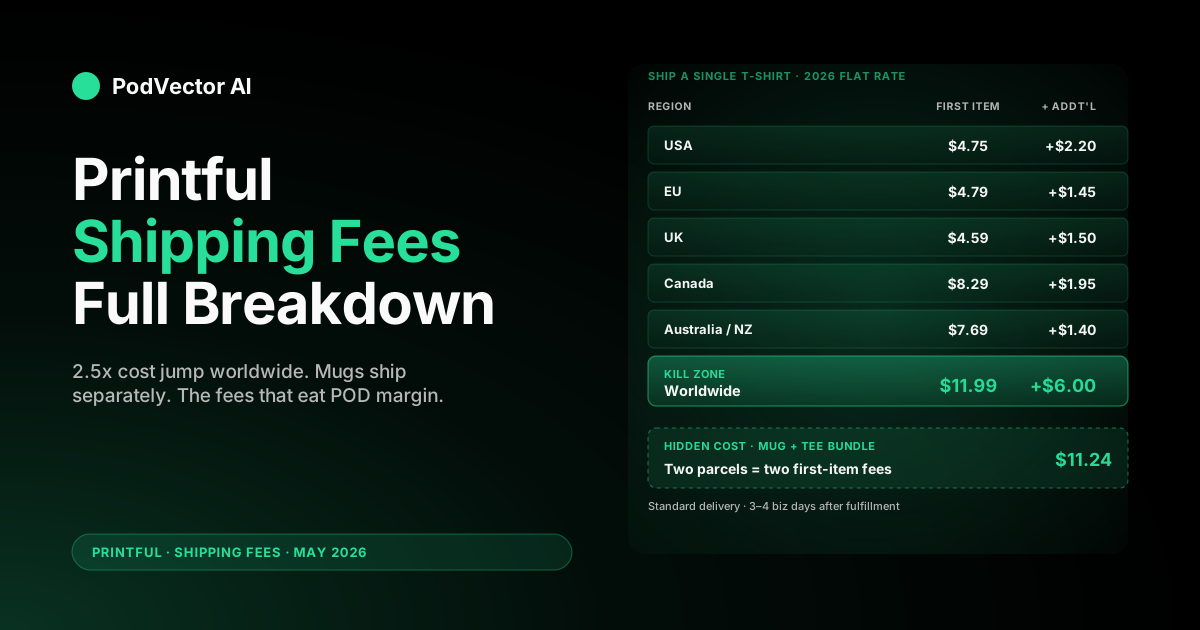
Quick Answer: Printful charges flat regional shipping fees per product category. A single US t-shirt ships for $4.75 with each additional t-shirt adding $2.20 — but mugs, posters, and canvas always ship separately, stacking fees on multi-product orders.
Most POD sellers underestimate shipping's margin impact. Across a typical store, shipping fees plus fulfillment compress gross margin by 4–11% of revenue depending on region mix.
How Printful Charges for Shipping
Printful bills shipping as a flat fee tied to product category and destination region. The fee covers the carrier rate plus pick-and-pack labor — there's no separate handling charge bolted on.
Every order ships from the Printful fulfillment center closest to your customer. For US orders that usually means Charlotte, North Carolina, or Tijuana, Mexico. For EU orders it's Riga, Latvia, or Birmingham, UK.
The fee structure is "first item + each additional item." A single-tee order pays the first-item rate. Add a second tee in the same order and you pay first-item plus one additional-item rate.
That math only holds for items that ship together. Mugs, posters, canvas prints, and a handful of other categories always ship in separate parcels — even when the customer orders them with apparel. We'll come back to that.
US Shipping Fees by Product
Here are the current Printful flat-rate shipping fees for the contiguous US, by product category.
| Product | First item | Each additional |
|---|---|---|
| T-shirts | $4.75 | +$2.20 |
| Hoodies & sweatshirts | $8.49 | +$2.50 |
| Embroidered hats | $4.49 | +$2.00 |
| All-over-print apparel | $4.49 | +$2.00 |
| Tote bags | $4.49 | +$2.00 |
| Leggings | $4.49 | +$2.00 |
| Mugs (ships separately) | $6.49 | +$3.50 |
| Posters (ships separately) | $5.99 | +$2.50 |
| Framed posters (ships separately) | $10.49 | +$4.50 |
| Canvas (ships separately) | $9.99 | +$3.99 |
| Phone cases | $2.89 | +$1.40 |
| Backpacks | $10.49 | +$4.50 |
Rates can shift quarterly. Always pull the current number from the Printful shipping calculator before you set retail prices.
Regional Shipping Fee Comparison
Region drives a big chunk of the shipping fee. Here's the same single t-shirt shipped to six different regions.
| Region | First t-shirt | Each additional |
|---|---|---|
| USA | $4.75 | +$2.20 |
| EU | $4.79 | +$1.45 |
| UK | $4.59 | +$1.50 |
| Canada | $8.29 | +$1.95 |
| Australia & New Zealand | $7.69 | +$1.40 |
| Worldwide (rest of world) | $11.99 | +$6.00 |
Two takeaways from the table. First, US, EU, and UK rates land within twenty cents of each other on the first item — the same store can quote consistent pricing across those three regions without sweating it.
Second, Canada and Worldwide rates jump. A worldwide t-shirt costs $11.99 to ship versus $4.75 in the US — a 2.5x multiplier. If you sell internationally and use one flat retail price, plan your margin around the higher rate or geo-route to a regional fulfillment center.
Hoodies hit harder. A worldwide hoodie ships for $16.99 vs $8.49 in the US. Multi-region stores need a clear rule on whether international customers pay the full delta or you absorb it.
Flat Rates vs Live Rates
Printful offers two ways to charge your customer for shipping.
Flat rates are the default. Your storefront pulls Printful's flat regional rate and shows that to the customer at checkout. Simple, predictable, and works for any store.
Live rates calculate shipping in real time at checkout based on fulfillment center location, customer address, order weight, and carrier availability. They give the customer a precise quote and let you pick a carrier service tier.
Live rates need a paid Printful plan or a supported integration (Shopify, WooCommerce, or BigCommerce on most plans). For sub-$1k/month stores the marginal accuracy rarely beats the simplicity of flat rates. For mid-six-figure stores, live rates can shave 3–7% off shipping overcharges that flat rates bake in.
Either way, the fee Printful bills you is the same — flat or live just changes what your customer sees at checkout.
The Hidden Cost: Separately Shipped Items
This is where margins disappear on multi-product orders.
Mugs, posters, canvas, framed prints, mouse pads, beach towels, and a handful of other items always ship in their own parcel. Even when the customer orders a mug plus a t-shirt together, you pay two first-item shipping fees.
Worked example. Customer buys a US t-shirt ($4.75 ship) and a US mug ($6.49 ship) in the same checkout. Your total Printful shipping cost is $11.24 — not the $4.75 + $3.50 you might assume if you treated the mug as an "additional item."
The damage compounds. A customer buying a tee, a mug, and a poster gets billed three first-item fees: $4.75 + $6.49 + $5.99 = $17.23 shipping on a three-item order.
If you bundle apparel with mugs in promo campaigns, model the real cost. We see POD operators lose 8–15 points of margin on bundle orders that looked profitable in a spreadsheet but ignored separate-parcel fees.
Express and Premium Shipping
Printful offers express shipping in addition to the standard option.
Standard domestic (US, Canada): 3–4 business days after fulfillment. This is what the flat rate tables above quote.
Express domestic (US, Canada): 1–3 business days after fulfillment. Roughly 2–3x the standard fee depending on product and route.
International express: 1–3 business days after fulfillment. Available for most product categories.
Add fulfillment time of 2–5 business days on top of the shipping window. A "standard" US order from order to doorstep takes 5–9 business days total.
Express is rarely worth it on cost-sensitive POD orders. Reserve it for high-AOV gift bundles where the customer signals urgency, or for replacement orders fixing a delivery miss.
Margin Impact: Real Examples
Shipping fees only matter relative to your retail price and product cost. Three worked examples.
Example 1: Single US t-shirt sold at $24.99.
Retail $24.99. Product cost (Bella Canvas 3001, DTG print) ≈ $11.50. Shipping fee $4.75. Gross margin = $24.99 − $11.50 − $4.75 = $8.74. That's a 35% gross margin — healthy for POD if your ad CPA is below $5.
Example 2: Two-tee bundle sold at $44.99.
Retail $44.99. Product cost 2 × $11.50 = $23. Shipping = $4.75 + $2.20 = $6.95. Gross margin = $44.99 − $23 − $6.95 = $15.04 (33%). The additional-item rate keeps bundles profitable.
Example 3: T-shirt + mug bundle sold at $34.99.
Retail $34.99. Product cost $11.50 (tee) + $7.95 (mug) = $19.45. Shipping = $4.75 + $6.49 = $11.24. Gross margin = $34.99 − $19.45 − $11.24 = $4.30 (12%). The separate mug parcel eats half the bundle margin.
This is exactly the kind of cost cascade that hides in static spreadsheets. POD operators running Victor see every SKU's true post-shipping margin — Victor flags bundles whose shipping math kills profit before the campaign hits scale.
Strategies to Manage Shipping Fees
Bake shipping into retail price. Free shipping converts 20–30% better than charged shipping on most POD stores. The trade-off is you absorb the regional delta on international orders.
Set a free-shipping threshold. $35 or $50 thresholds nudge AOV up and let the additional-item rate work in your favor. A two-tee order shares a single base fee.
Geo-route fulfillment. If you sell heavily in the EU, ensure your products are flagged for Printful's Riga or Birmingham centers. Worldwide rates are the kill zone — keep customers on a regional center whenever possible.
Pull mugs and posters out of apparel bundles. Sell them as standalone offers or as upsells, not bundled add-ons. The separate-parcel fee eats too much margin in a low-AOV cross-sell.
Track shipping as a % of revenue per SKU. Store owners who use Victor see this in one place instead of digging through weekly spreadsheets. That makes it easy to catch shipping-fee creep before it eats your profit. SKUs that drift above 12% shipping-to-revenue ratio usually need a price hike or a category swap.
FAQs
How much does Printful shipping cost in the US?
A single US t-shirt ships for $4.75, with each additional t-shirt in the same order adding $2.20. Hoodies are $8.49 first / $2.50 additional. Hats and all-over-print apparel are $4.49 / $2.00. Mugs ship separately at $6.49 each.
Does Printful charge for shipping if items ship from the same warehouse?
Yes. Even when products fulfill from the same Printful facility, every item pays at least an "additional item" fee, and items in separate-shipping categories (mugs, posters, canvas, frames) pay a full first-item fee per parcel.
Are Printful shipping rates negotiable?
No. Flat rates are fixed by region and product category. Volume discounts apply through Printful's Growth plan, which reduces product base costs (not shipping fees) by up to 20%.
Why does Printful shipping seem expensive compared to USPS?
Printful's flat rate includes the carrier rate plus pick-and-pack labor, packaging materials, and the warehouse's negotiated service-level terms. A raw USPS commercial label is cheaper but doesn't include any of those operational costs.
Does Printful offer free shipping?
Not to sellers. Printful always charges sellers a shipping fee per order. You can offer free shipping to your customers by absorbing the fee into your retail price.
How long does Printful shipping take?
Standard US domestic shipping is 3–4 business days after fulfillment. Fulfillment itself takes 2–5 business days, so total order-to-doorstep time runs 5–9 business days. Express options exist for 1–3 business day shipping at roughly 2–3x the standard fee.
What products always ship separately on Printful?
Mugs, posters, framed prints, canvas, mouse pads, beach towels, and backpacks each ship in their own parcel even when ordered with apparel. Plan bundle margins around multiple first-item shipping fees.
Should I use flat rates or live rates?
Most sub-$10k/month POD stores should use flat rates for simplicity. Once you cross mid-six-figures annual revenue, live rates can recover 3–7% of shipping overcharges baked into flat-rate quoting.
Stop guessing which SKUs lose money to shipping fees
Printful shipping fees don't show up in your Shopify dashboard. They hide inside fulfillment line items, separately shipped parcels, and regional rate jumps — until your "profitable" bundle quietly burns 15 points of margin.
Victor looks at your itemized Printful costs together with your retail prices and ad spend. Ask "which SKUs drop below 25% margin after shipping?" and you get a real answer right away — no spreadsheet to reconcile by hand.
Try Victor freeRelated reading: our full Printful pricing breakdown, the Printful vs Printify t-shirt base cost comparison, the 2026 Printful t-shirt base cost reference, and the costs and charges hub. For platform-level comparisons see Is Printify or Printful better and Printful or Printify: the POD seller's guide. Browse all Printful articles, or check the authoritative Printful shipping rates page for current numbers.