
Quick Answer: No. Printful's "product price" covers the blank product plus one design placement. Shipping is a separate line item, charged to you the seller at fulfillment time — not to your customer.
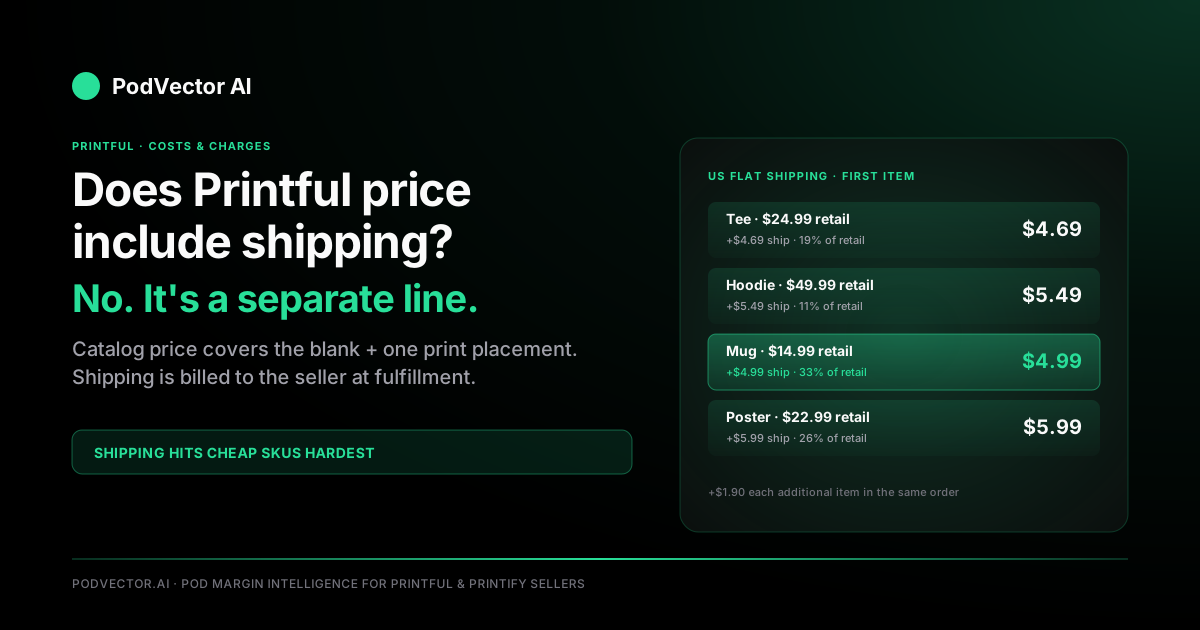
Shipping rates are flat by region and product type. A single US tee runs $4.69 to ship; each additional tee in the same order is roughly $1.90. A US hoodie is $5.49 first / $1.90 each additional. International rates run 2–3x those numbers.
This breakdown shows what's actually inside Printful's base price, every shipping line they add on top, the per-SKU dollar impact, and the three pricing strategies POD operators use to keep shipping from quietly eating their margin.
The short answer (and why it matters)
No. Printful does not bundle shipping into its product prices. The number you see in Printful's catalog covers the blank product plus standard customization (one design, one placement). Shipping is calculated separately at order time and billed to your Printful account.
This is the answer Printful's own help center gives, and it's the answer every third-party pricing roundup confirms. The "is shipping included" question gets searched 3,000+ times a month not because the answer is unclear — but because POD sellers find out the wrong way. They price a tee at $24.99, watch the order ship, then notice their actual margin was $5 instead of the $10 they planned for.
The shipping line is what closes that gap. And on cheap SKUs, shipping can be a bigger share of cost than the printed product itself.
For Printful's official phrasing of this and current shipping price tables, see their shipping pricing help article. The rest of this guide unpacks what that means for your store specifically.
What Printful's "product price" actually covers
The price you see when you browse Printful's catalog is the cost to manufacture and customize one unit. Inside that single line:
- The blank product — the unprinted Bella+Canvas tee, Gildan hoodie, Stanley mug, etc.
- One design placement — front print, back print, sleeve embroidery, whichever you specify when you create the product.
- The print or embroidery itself — DTG ink, DTF transfer, embroidery thread, vinyl, however the SKU is decorated.
- Standard tagging and bagging — the default neck label and poly bag the item ships in.
That's the full scope. Outside the product price, Printful charges separately for:
- Shipping — flat rates per product per destination region, billed at fulfillment.
- Additional design placements — a back print on a tee that already has a front print is its own line, $3.95–$5.95 typically.
- Branding add-ons — inside labels ($2.49), packing slips, packaging inserts, branded bags.
- Sample orders — discounted to ~50% retail but not free.
- Taxes and VAT — pass-through where applicable based on fulfillment location.
The rule of thumb that catches most new POD operators: the catalog price is the floor of what Printful will charge you for that order, not the ceiling. Almost every order ships with at least one extra line beyond the catalog number — usually shipping, often shipping plus branding.
For a deeper look at every individual fee Printful levies on POD sellers, the full Printful fees breakdown covers the rest of the line items. This article focuses on shipping specifically because shipping is the largest non-product cost on most POD orders.
How Printful charges shipping
Printful uses two shipping models, and you choose which one your store uses.
Flat rates (the default)
Printful publishes a fixed shipping price per product per region. Every order pays the same shipping line, regardless of distance within that region. Predictable, easy to model in your retail price.
The flat rates as of 2026 (US-to-US, by product family):
| Product family | First item | Each additional item | Typical retail price | Shipping as % of cost |
|---|---|---|---|---|
| T-shirts | $4.69 | $1.90 | $24.99 | 19% of retail on a single tee |
| All-over print tees | $6.50 | $3.00 | $32.99 | 20% of retail |
| Hoodies / sweatshirts | $5.49 | $1.90 | $49.99 | 11% of retail |
| Mugs (11oz) | $4.99 | $2.50 | $14.99 | 33% of retail on a single mug |
| Posters | $5.99 | $2.50 | $22.99 | 26% of retail |
| Phone cases | $3.99 | $2.00 | $24.99 | 16% of retail |
| Embroidered hats | $5.49 | $1.90 | $26.99 | 20% of retail |
Notice the pattern. Shipping as a percentage of retail is worst on the cheapest SKUs. A single mug pays a third of its retail price in shipping alone. A hoodie pays only 11% — because the hoodie's retail is high enough to dilute the line.
This is why apparel is the standard POD entry product. The shipping math is more forgiving than mugs or stickers.
Live rates
The alternative is live carrier rates, calculated at checkout based on the customer's actual address, the fulfillment center routing the order, and the package weight. The customer sees the real number and pays it. Your store doesn't have to guess.
Live rates work best for stores with international customers — the spread between "shipping a tee to Ohio" and "shipping a tee to Sydney" is real, and a flat rate either over-charges Ohio or under-charges Sydney.
The trade-off: live rates make checkout less predictable. Some customers see a $3.99 number, some see $14.99. Conversion can wobble at the higher end.
Most POD operators run flat rates US-only and live rates internationally. That keeps the domestic price predictable while letting the cross-border math sort itself.
Three worked examples — product to your door
Catalog price plus shipping plus any add-ons. Here's what the actual Printful charge looks like for three common SKUs, US fulfillment, no branding, no Growth subscription:
Example 1: One Bella+Canvas 3001 tee
- Catalog price (front DTG print): $9.50
- Shipping (US flat): $4.69
- Printful charges you: $14.19
- If you retail at $24.99: gross margin $10.80 (43%)
Example 2: One Gildan 18500 hoodie
- Catalog price (front DTG print): $24.50
- Shipping (US flat): $5.49
- Printful charges you: $29.99
- If you retail at $49.99: gross margin $20.00 (40%)
Example 3: One 11oz ceramic mug
- Catalog price (full wrap print): $7.95
- Shipping (US flat): $4.99
- Printful charges you: $12.94
- If you retail at $14.99: gross margin $2.05 (14%)
The mug is the cautionary tale. On paper, $14.99 retail minus $7.95 catalog looks like $7.04 of margin — almost 50%. After shipping, the actual margin is $2.05 and the percentage drops to 14%. One return, one chargeback, one design tweak that costs you a sample order, and that mug is unprofitable for the month.
This is the gap between "Printful's price" and "what Printful actually charges per sale." It's also why mugs and stickers tend to bleed margin on POD storefronts that price them like apparel.
The POD margin trap operators fall into
The trap looks like this. You set up a Printful store. You browse the catalog and see a tee at $9.50, a hoodie at $24.50. You mark them up 2.5x — $24, $60. You ship a few orders. The Printful invoice comes back higher than you expected.
You check your math. You realize the shipping line wasn't in the spreadsheet. You go back to the storefront, raise prices, and the next order has a 30% lower conversion rate. Now you're losing on volume what you gained on margin.
This loop runs for nearly every new POD operator. The fix isn't complicated, but it has to happen before the storefront launches, not after the first invoice. Three things make the difference:
One: always model the full per-order Printful cost — catalog + shipping + branding — before setting retail. Never the catalog number alone.
Two: price by SKU, not by product family. A tee with a back print plus a sleeve label has a meaningfully different cost from a plain front-print tee. Same MSRP guarantees the second one is unprofitable.
Three: price by destination if you ship internationally. A US tee at $24.99 might be 43% margin. The same tee shipped to Australia at $24.99 is roughly break-even after the Sydney shipping line.
The platforms that compete with Printful on shipping economics are worth a separate look — the Printful features and pricing breakdown compares Printful's shipping line to Printify's and Gelato's on like-for-like SKUs.
Three ways to handle shipping in your retail price
There are exactly three honest approaches. Pick one and apply it consistently.
Strategy 1: Pass shipping through to the customer
You charge the catalog markup at retail and bill shipping as a separate line at checkout. Customer sees "Tee $24.99 + $4.99 shipping." Your margin is clean and predictable. Your conversion takes a small hit because some customers bail at the shipping reveal.
Best for: stores selling expensive SKUs (hoodies, AOP tees, posters) where the shipping line is a small fraction of the order. Worst for: cheap SKUs where the shipping is half the order total.
Strategy 2: Bake shipping into the retail price (free shipping)
You set retail to "true cost + shipping + margin." Customer sees "Tee $29.99, free shipping." Your conversion is higher because nobody bails at the shipping line. Your margin per unit is identical to Strategy 1; the trick is that the customer perceives the higher price as the trade for free shipping.
Best for: stores where you've A/B tested and confirmed the higher sticker price doesn't reduce conversion more than the shipping line did. Most US POD storefronts end up here.
Strategy 3: Hybrid — free shipping over a threshold
You charge shipping on single-item orders but waive it above a basket size — typically two items or $50. This nudges customers toward multi-item carts, which (as the next section shows) is where Printful's shipping economics actually become favorable.
Best for: stores with a real catalog (8+ SKUs) and customers who'd plausibly buy two items at once. Pointless for stores with 3 SKUs and no cross-sell.
The wrong move is doing all three across different products without writing it down. That's how operators end up with one SKU at 43% margin and another at -2% and not realizing until the quarter closes.
Where shipping economics flip: multi-item orders
Single-item orders are where Printful's shipping line hits hardest. Multi-item orders are where it gets cheap fast.
Consider a customer who buys two tees instead of one. Shipping was $4.69 first item, $1.90 second item — total $6.59. Per-tee shipping just dropped from $4.69 to $3.30. Buy three tees? Per-unit shipping is now $2.83.
The same effect holds across product families. One tee + one mug ships for $4.69 (the tee, since it's the higher base) + $1.90 (the mug) = $6.59 total. That's $1.90 in marginal shipping for a $7.95 mug — a much friendlier ratio than the $4.99 the mug pays alone.
This is the math that makes upsell mechanics matter on a POD storefront. Every additional item in the cart increases gross profit by the full marketing margin minus only $1.90 of shipping. The mug that was unprofitable as a standalone is fine as the second item in a tee order.
It's also why POD sellers who run "buy 2, get free shipping" or "spend $50, get free shipping" promos see real profit lifts even though the promo looks like a shipping cost giveaway. The math compounds the right way.
International shipping is a different beast
The flat-rate table above is US-to-US. Crossing borders changes the numbers materially.
A tee that costs $4.69 to ship inside the US costs roughly $9.99 to ship to the UK, $11.99 to Australia, $13.49 to most of Asia. Shipping to India, the Middle East, and parts of Africa can run $15 or more on a single tee.
Mugs and breakable items have it worse — heavier package, fragile-handling surcharges, customs forms. The same 11oz mug that ships US-to-US for $4.99 can cost $19+ to land in Australia. That's more than the customer's retail price on most storefronts.
The two practical options for international:
Geo-block to fulfillable destinations — limit your storefront to regions where the shipping math works. Most US POD storefronts run US-only or US/CA/UK only for this reason.
Use live rates internationally — let the customer see the real shipping price at checkout. Your conversion drops on far-flung orders, but you're not silently losing money on the ones that come through.
For a region-by-region view of Printful's actual delivery times and shipping costs, see the US shipping time and cost breakdown and the worldwide shipping breakdown. The international numbers are where most "I thought my margins were fine" stories come from.
Tracking shipping as a margin line, not an afterthought
The cleanest way to know whether shipping is eating your margin is to track shipping cost per SKU sold, not as a single monthly aggregate.
The aggregate view tells you "I spent $1,200 on shipping last month." That's an operating cost, not a decision input. The per-SKU view tells you "the mug SKU pays 31% of its retail in shipping; the hoodie SKU pays 11%" — which is the input you actually need to reprice.
Printful's order export gives you the raw data. Each row has the SKU, the shipping line, the catalog cost, and the destination. Pivoting that file by SKU and computing shipping-as-percent-of-retail is a 20-minute spreadsheet exercise, and the result is the single most useful pricing input on a POD storefront.
The harder version of this: doing it monthly, on every SKU, while your catalog grows from 10 to 80 to 300 products. That's where the spreadsheet model breaks. Catalog prices drift, shipping rates change, and the version you built in month one is wrong by month four.
The next-level move is feeding the Printful order export into a single source of truth alongside your storefront sales data, then having an AI employee answer "which SKUs lost money to shipping last month?" on demand. But the spreadsheet version is plenty for the first few months — what matters is doing the per-SKU math at all.
One related question many POD sellers raise alongside shipping costs: how Etsy's own fees stack on top of Printful's shipping line for cross-listed SKUs. The Printful + Etsy integration fees breakdown covers that combined cost stack.
For the broader Printful knowledge base — pricing, shipping, integrations, and SKU-level cost analysis — the Printful topic hub has the complete map. The full Printful costs and charges hub covers every line item Printful will ever bill you for.
FAQs
Does Printful's product price include shipping?
No. Printful's catalog price covers the blank product plus standard customization (one design placement). Shipping is a separate line, charged to your account at fulfillment, not bundled into the product price.
How much does Printful charge for shipping?
US flat rates start at $3.99–$5.99 for the first item depending on product family, plus $1.90–$3.00 for each additional item in the same order. Internationally, shipping runs 2–3x the US rate. The exact number depends on product type, destination, and whether you use flat or live rates.
Does Printful charge me or my customer for shipping?
Printful charges you the seller. What you charge your customer is a separate decision — you can pass it through, bake it into your retail price, or run free-shipping thresholds. Printful only invoices the wholesale shipping line to your account.
Can I get free shipping on Printful?
No. Even on the Growth subscription ($24.99/month), shipping rates are unchanged. Some competitors — most notably Gelato+ — bundle shipping discounts into their paid plans, but Printful does not.
Why is Printful shipping so expensive on cheap items?
Shipping is roughly fixed by package size and weight, not by the price of what's inside. So a $7.95 mug pays the same $4.99 shipping a $30 mug would — meaning the percentage hit is much worse on cheap SKUs. This is why most POD operators avoid pricing single-mug SKUs and lean toward apparel or multi-item bundles.
Does Printful Growth include shipping discounts?
No. The Growth subscription discounts product prices (up to 33% off premium products) but not shipping. If shipping is the line eating your margin, the subscription doesn't help. You'd need to switch suppliers, bundle SKUs into multi-item orders, or move to a competitor with shipping-tier perks.
Is shipping included in Printful samples?
No. Sample orders get a discount on the catalog product price (around 20% off plus the standard Growth discount on top), but shipping is billed at the same rate as a normal order. A single tee sample to your address still costs $4.69 to ship in the US.
How do I see Printful shipping costs before placing an order?
Printful's published shipping rates page lists every rate by product family and region. Inside your dashboard, the cart preview shows the exact shipping line for any draft order before you confirm. There's no estimation step — the number you see is the number you pay.
Can I use my own shipping carrier with Printful?
No. Printful fulfills and ships from its own network using its own carrier contracts (USPS, UPS, DHL, etc., depending on origin and destination). You don't get to substitute a custom carrier or use your own shipping account.
Does shipping cost affect my POD profit margin?
Yes — meaningfully. Shipping is typically the second-largest cost line on a POD order after the product itself. On cheap SKUs (mugs, stickers, posters), shipping can be 25–35% of retail and is often what separates a profitable storefront from a break-even one.
Stop guessing where shipping is eating your POD margin
Shipping is the line item POD sellers most often miss when they price a SKU. The catalog number looks fine. The actual invoice doesn't. The gap shows up in your margin three months later, on the SKUs you can't easily identify because they're buried in a 200-row Printful order export.
Victor looks at your Printful orders and your store sales together. He checks each product and works out how much shipping eats into its price. Then he can answer questions like "which products are losing money to shipping this month?" in plain English. And see exactly which products are quietly bleeding margin to shipping.
Try Victor free