
Quick Answer: Printful sample cost is the standard catalog price of a product, minus a 20% sampling discount, plus shipping and any premium print add-ons. A $12.95 Bella + Canvas 3001 tee samples at $10.36 before shipping.
Across a year, a typical POD operator launching 5–10 new SKUs a month spends $600–$2,400 on sampling. That's a real operating line — not a freebie, and not COGS.
The cost worth tracking isn't per-sample. It's "sample cost per launched SKU" — your total sampling spend divided by the products you actually kept live. Anything you sampled and killed saved you future losses.
What "Printful sample cost" actually means
The phrase gets used three different ways, and the math is different for each.
The narrow version is the price tag on one sample order — the discounted product line plus the shipping line. Our sibling breakdown on Printful sample order cost walks through that single-transaction view in detail.
The broader version is the operating line you carry every month: total spending on sampling as an ongoing cost of running a POD store. That's the version this article covers.
The third version — the one most operators ignore — is the opportunity-adjusted cost: what does it cost you to not sample, in chargebacks and refunds and dead SKUs that never sold because the color came in wrong? We get to that one too.
The four cost lines you pay on every sample
A Printful sample order is built from four line items. Three you see on the invoice. The fourth is the one that catches people.
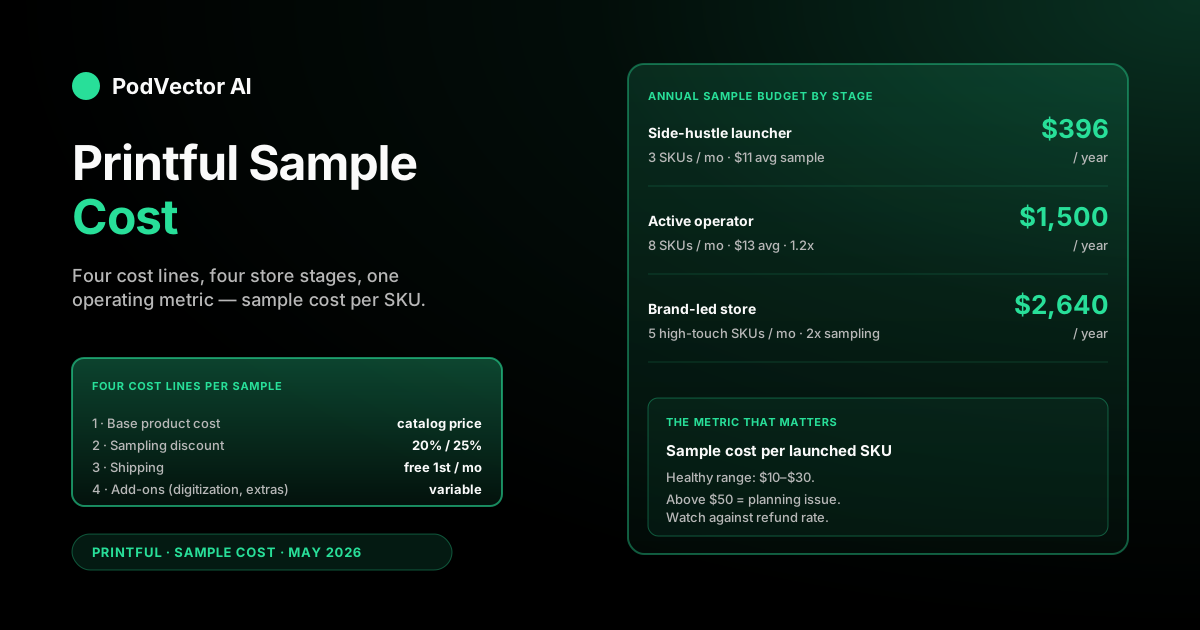
1. Base product cost. The same fulfillment price you'd pay if a customer ordered the item — listed as "your cost" on the product page. This is the input to every other number.
2. Sampling discount. 20% off the base cost on the free plan, 25% off on Printful Growth. Applied to product line items only, not to shipping or to premium services.
3. Shipping. Standard Printful rates for your destination. The first qualifying sample order each calendar month gets free domestic shipping in your account's primary fulfillment region. Every run after that pays the normal rate.
4. Add-ons and premium print fees. Embroidery digitization, extra print locations, sleeve prints, inside labels, and custom packaging all carry their own line items. Some of those line items get the sampling discount; some don't. The catch: digitization (normally up to $6.50) is free on samples for Growth members but not for free-plan accounts.
The headline formula is simple: (base cost × discount factor) + shipping + paid add-ons. The trap is forgetting that "paid add-ons" exists at all.
The 20% vs 25% discount tiers
There are two sampling discounts on Printful, and the math on which one is cheaper depends entirely on how often you sample.
Free plan: 20% off samples. Available to every account, no membership required. One sample order per month at the base tier, more as your fulfilled sales clear thresholds.
Printful Growth: 25% off samples plus free digitization. $24.99 per month membership. Unlocks three sample orders per month plus deeper discounts on base costs across the catalog. Free becomes free once your trailing-12-month Printful sales cross $12,000.
The break-even depends on how much you're sampling, not just whether Growth is "cheaper." A simple way to think about it: Growth adds 5 percentage points of discount to your sample budget plus eliminates digitization fees. If your monthly sample spend is $250 of product cost, the extra 5% is worth $12.50 in sample savings — call it $18 with one digitization waiver. The $24.99 membership only pays for itself in samples when you're spending $400+ a month on sampling alone.
That math changes when you factor Growth's other benefits — deeper base-cost discounts on every fulfilled customer order, free transaction-fee waivers, and so on. We cover the full membership math in our Printful product pricing breakdown.
Building a monthly sample budget
Most POD stores under-budget for samples in their first year because they think of samples as one-off events. They're not. Samples are a function of your launch cadence.
The formula is (SKUs launched per month) × (samples per SKU) × (average sample cost). Sample-per-SKU is usually 1 if you're disciplined, 1.5–2 if you're not.
Worked examples at common store stages:
- Side-hustle launcher (3 SKUs/month, $11 avg sample, 1 sample each): $33/month, $396/year.
- Active operator (8 SKUs/month, $13 avg sample, 1.2 samples each): $125/month, $1,500/year.
- Aggressive launcher (15 SKUs/month, $14 avg sample, 1.5 samples each): $315/month, $3,780/year.
- Brand-led store (5 high-touch SKUs/month, $22 avg sample with multi-location prints, 2 samples each): $220/month, $2,640/year.
Notice the brand-led store spends more per sample than the aggressive launcher does per SKU — premium print options and higher-end blanks (hoodies, embroidered caps, all-over-prints) shift the math. The right budget number for you depends on what you sell, not just how often you launch.
Hidden costs most operators miss
The invoice line is the visible part. These are the parts that sneak up.
Color rerun samples. About 1 in 8 first-print samples comes in noticeably off from the mockup — that's a normal DTG variance, not a defect. If your design only works on a specific shade, you'll re-sample. Budget for a ~12% rerun rate on color-sensitive designs.
Multi-region samples. If you sell into multiple regions and Printful fulfills out of different facilities by destination (US, EU, Mexico, etc.), each region's print may look slightly different. Sampling one product across two regions doubles the sample cost for that SKU. Most operators don't do this — and don't realize the EU print can drift from the US print on the same design.
Customs and import VAT. If your account's primary region differs from where you receive samples, you may pay customs duty and import VAT on top of shipping. A US-based account sampling to a European address has paid this lesson at least once.
Content production time. The sample arrives, gets photographed, and then sits in a drawer. The hours spent shooting and editing are real cost. They don't show on the invoice but they show on your effective hourly rate.
Return shipping. If a sample arrives damaged or printed off-spec, Printful's resolution path is typically a reprint at no charge — not a refund of the original. That's good policy, but it means your "wasted" sample stays in your possession (and your sample spend stays out).
The cost of skipping samples
Sample math looks expensive in isolation. It stops looking expensive the first time you ship 200 customer orders of a tee whose neckline pulls weird after the first wash and you have to refund them.
Skipping samples has three real costs.
Refund rate. POD stores that don't sample typically run a 4–7% refund rate on physical product issues. Stores that sample every new SKU run 1–2%. On a store doing $5,000/month in sales, that's $150–$250 a month in refunds you didn't have to issue — far more than a $33–$125 monthly sample budget.
Chargebacks. A small fraction of refund-eligible customers go straight to chargeback. Each chargeback is $15–$25 in fees plus the refund itself, plus a hit to your processor reputation. Once you cross a chargeback rate threshold, your payment provider can withhold reserves or shut you down.
Ad creative quality. The samples you don't order are also the product photos you don't shoot. Stock mockups are fine for testing, but stores that win on creative testing are running real-product photos and short videos. Sample spend doubles as content spend.
The honest comparison isn't "sample spend vs no sample spend." It's "sample spend vs sample spend plus refund spend plus chargeback fees plus lower-converting ad creative." Skipping samples is rarely the cheaper path once you do the full math.
Tracking sample cost per launched SKU
The metric that matters isn't sample cost in aggregate — it's sample cost per SKU that actually shipped to your store and sold.
Sample-cost-per-launched-SKU = total sample spend ÷ count of SKUs you sampled and then kept live. A healthy number is in the $10–$30 range. If you're above $50, you're sampling things you're not committing to launch, which is a planning problem, not a spending problem.
The flip side: a low sample-cost-per-launched-SKU doesn't always mean good discipline. It can also mean you're not sampling enough — you're committing SKUs you haven't seen, and your refund rate will tell you about it later.
The right way to monitor this is a simple ratio against your refund line. If sample-cost-per-launched-SKU goes down while refund rate goes up, you're cutting samples too aggressively. If both go down together, you're getting more efficient at choosing what to sample.
This kind of cross-line analysis is exactly what static dashboards are bad at. A sample-spend chart and a refund-rate chart on different tabs don't tell you they're correlated. You have to compute the ratio by hand, every month, against the right SKU cohort — and most operators don't.
Printful sample cost vs Printify
If you're comparing the two big POD networks on samples specifically, the cost shapes are different.
Printful samples come at a flat 20% off (25% on Growth) with a structured monthly allowance. The discount applies cleanly across the catalog. Shipping has a free-first-of-month perk in your home region.
Printify samples come at a flat 20% off (30% off on Printify Premium, where eligible) but with a different print-provider structure. Because Printify routes to a network of fulfillment partners, your sample comes from whichever provider you selected for that product — and the quality variance between providers means you should be sampling each provider, not just each design. That can multiply sample spend on a single product if you're testing across providers.
For the head-to-head on the platforms more broadly, see our coverage of Printful vs Printify for POD sellers and the analysis of the Printful-Printify merger and what it means for your costs. The cluster hub at Printful costs and charges indexes the rest of the cost coverage, and the broader Printful topic hub sits above that.
For external context on how broader Printful pricing fits together, Bootstrapping Ecommerce's Printful pricing breakdown covers the full plan stack including bulk-order math, which adjacent to sample-order math is worth reading.
FAQs
How much does a Printful sample cost on average?
For a typical apparel sample (t-shirt, hoodie, sweatshirt), expect $10–$25 per item after the 20% sampling discount, plus shipping if it's not your first sample of the month. Premium blanks, embroidery, and multi-location prints push the upper end higher.
What's the difference between sample cost and sample order cost?
Sample cost is the broader operating line — what samples cost you across a month or year as you launch SKUs. Sample order cost is the line item on a single transaction. See our sample order cost breakdown for the per-transaction math.
Does Printful Growth actually save money on samples?
Only if you sample more than ~$400/month in product cost. Below that threshold, the extra 5% discount and free digitization don't cover the $24.99 membership. Growth's other benefits (deeper base-cost discounts on fulfilled orders, free transaction fees) often justify it, but not sampling alone.
How do I budget for samples in year one?
Multiply your planned monthly SKU launches by your average sample price (~$13 for apparel) by 1.2 for color-rerun overhead. A store launching 8 SKUs/month should plan around $125/month, or $1,500/year.
Is Printful sample cost tax-deductible?
In most jurisdictions, yes — sample orders qualify as a business expense under product development, marketing, or QC. Talk to your accountant about which category fits your bookkeeping. Don't classify samples as COGS; they're not inventory.
What's the cheapest Printful product to sample?
Posters and stickers are the cheapest sample categories — $4–$7 after discount. They're useful for testing your designer's color profiles and your packaging slip, even if those products aren't your main catalog.
Do I have to sample every new product I launch?
You don't have to. Stores that don't sample run 4–7% refund rates on physical product issues, versus 1–2% for stores that do. The math usually favors sampling once you cross ~$3,000/month in sales.
Can I claim a refund on a Printful sample that came in wrong?
Printful's standard resolution path on misprints or damaged samples is a reprint at no charge, not a cash refund. You keep the original. Document the issue with photos when you file the support ticket.
Stop guessing whether your sample spend is paying off
Sample cost only matters in context. The question isn't "what does one sample cost" — it's "did sampling this SKU prevent enough refunds to be worth it, and which SKUs are we under-sampling?"
Victor connects to your Printful account and keeps track of every sample, fulfillment, and refund. Ask him things like "which SKUs launched without a sample are running above 3% refund rate this quarter?" and he answers in plain English. He's an AI employee who knows your numbers — not a dashboard you have to interpret.
Try Victor free