
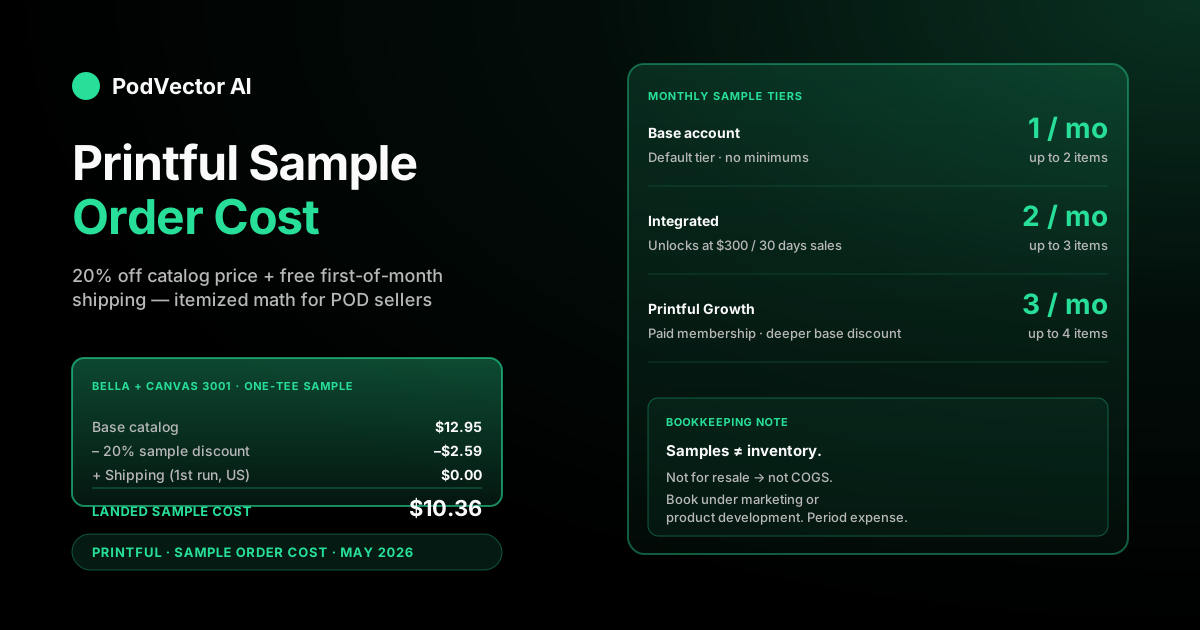
Quick Answer: A Printful sample order costs your product's standard catalog price minus a 20% discount, plus shipping. Free domestic US shipping is included on the first eligible sample run each month.
A Bella + Canvas 3001 tee that lists at $12.95 in the Printful catalog costs $10.36 as a sample. The monthly sample allowance scales with your last 30 days of sales: 1 order at the base tier, 2 orders past $300 in fulfilled revenue, 3 orders on Printful Growth.
Sample orders are operating expense, not inventory. They never resell, so they hit your P&L the month you order them — which matters for how you model true POD margin.
What is a Printful sample order?
A sample order is a discounted run of your own products that Printful fulfills the same way they'd fulfill a paying customer's order. Same blank, same printer, same packaging — you just pay less and the order ships to you instead of a buyer.
The whole point is quality control before you launch. You see the print color in person, you feel the blank, you read your own packing slip. The discount makes that affordable enough to do regularly as you add new SKUs.
Two things to know up front. Sample orders cannot be resold. And the catalog you can sample from is the same catalog you sell from — there's no separate "samples menu."
The itemized cost of a sample order
The math is short. Every line on a sample order is built from the same three numbers:
- Base product cost: the standard fulfillment price for the product, in the size and color you ordered. This is the same number that appears in your Printful product page under "your cost."
- 20% sample discount: applied to the base product cost. Not applied to shipping or to any add-ons like extra printed locations beyond the standard one.
- Shipping: charged at standard Printful rates for your destination. The first eligible sample run each month gets free domestic US shipping; runs after that get charged at the normal rate.
That's it. There is no flat sample fee, no markup, no minimum order value. The formula is (base cost × 0.80) + shipping per item, summed across the order.
If you have multiple extra print locations on a product — sleeve print, inside label, second-side back print — those line items also get the 20% discount. The discount applies to the whole product line, not just the blank.
Monthly sample limits and how to unlock more
Printful caps how many discounted samples you can pull each month, and the cap scales with how much business you're already doing on the platform. The tiers as of 2026 work like this:
- Base tier (default account): 1 sample order per month, up to 2 items per order.
- Integrated tier ($300+ in fulfilled sales in the last 30 days): 2 sample orders per month, up to 3 items per order.
- Printful Growth (paid membership): 3 sample orders per month, up to 4 items per order, plus a deeper discount on the underlying base cost.
The 30-day sales window resets every month, so a slow month can quietly drop you back to the base tier. That's a real planning issue if you stage four sample runs around a Q4 launch and discover in November that October revenue tipped you under threshold.
The framed posters and canvas prints have separate, tighter rules — they're sample-eligible only in the 8×10 and 12×12 sizes, with their own monthly counter. If you sell wall art at larger sizes, you'll be ordering those at full price.
Worked examples: tee, hoodie, mug, poster
Cost only really lands when you see it on real SKUs. Here's the math on four common starter samples, using 2026 catalog prices for a US fulfillment region. Round-trip times and exact prices shift, so use these as a model, not a quote.
Bella + Canvas 3001 unisex tee
Base fulfillment cost: $12.95. Standard DTG print, one location, one color. Sample price: $10.36. Shipping if it's your first sample of the month and you're in the US: $0. Total landed cost for one tee: $10.36.
Order the same shirt as your second sample run that month and shipping comes back at the standard rate — about $4.69 for a single tee to a US address. New total: $15.05.
Gildan 18500 unisex hoodie
Base fulfillment cost: $25.45. One DTG print location, front. Sample price: $20.36. First-of-month shipping: $0. Landed cost: $20.36.
Add a second print location on the back ($5.95 base, $4.76 after discount) and the same hoodie comes in at $25.12.
11oz white ceramic mug
Base fulfillment cost: $7.95. Sublimation print, wraparound. Sample price: $6.36. Shipping is heavier on mugs because of breakage packaging — $5.49 to a US address. Even on the first-of-month free-shipping run, the standard rate applies to the second item if your "order" combines a tee plus a mug, because shipping is charged at the order level.
One mug alone, free shipping run: $6.36. One mug alone, second run of the month: $11.85.
Enhanced matte paper poster, 8×10
Base fulfillment cost: $5.95. Sample price: $4.76. First-of-month shipping: $0. Landed cost: $4.76.
Posters are cheap enough that pairing one with a tee in the same sample order is a low-cost way to use your monthly slot well — you get two product reviews against one shipping charge.
Shipping rules and the free-shipping fine print
The "free shipping on samples" line in Printful's marketing is real, but narrow. It applies to:
- Your first qualifying sample order in a given month.
- Standard shipping (not express).
- Destinations inside the country where your account's primary fulfillment region is set.
If you ship a sample to a different country than your account is set up for, you pay international shipping rates. If you upgrade to express, you pay the express upcharge. If you're on the integrated or Growth tier and pull a second sample run that month, that run pays standard shipping.
None of these conditions are deal-breakers. They just mean your "free" sample isn't always free in practice, and you should put the shipping line back into the math when you're planning more than one run.
How to book sample cost on your P&L
This is where most POD operators leave money on the table without realizing it. Sample orders are not inventory. You cannot resell them, you cannot capitalize them as cost of goods sold, and treating them as COGS distorts every margin number you compute downstream.
Book sample orders as a marketing or R&D operating expense in the period you ordered them. The defensible bucket is "product development" or "sampling and QC." Some operators lump them under marketing because the photo assets coming out of those samples drive ad creative — that's also fine, as long as you're consistent.
What matters is that your COGS line stays tied to fulfilled customer orders only. Mixing samples into COGS makes your apparent gross margin look worse than it is, which leads to bad pricing decisions and bad ad-spend decisions.
For a deeper view of how this affects your overall numbers, see our breakdown of Printful profit margin math and the related piece on how operating costs distort reported margins.
What samples do to your true margin
Sample cost is small per unit but the cumulative drag is real. A store launching ten new SKUs a month at $15 effective sample cost is spending $1,800 a year on sampling — and that's before factoring runs you take a second time because the first print came in off-color.
The way to keep this honest is to track sample cost as its own P&L line, watched per launched SKU. The metric you want is "sample cost per SKU launched" — total sampling spend divided by the count of products you actually ended up keeping live in your store. Anything you sampled and killed is not a wasted dollar; it's a saved one. But anything you sampled and shipped to production without reviewing is at risk.
This is also where pricing-model context matters. Your sample cost behaves differently if you're on a paid Printful plan (cheaper base, more sample slots) versus a no-monthly-fee setup. For the full picture, see our breakdowns of the Printful pricing model, the monthly-fee tiers, and the no-monthly-fee path. The cluster hub at Printful costs and charges indexes the rest, and the broader Printful coverage sits above that.
Five mistakes that waste your sample budget
1. Sampling the same blank in three colors
If you've already sampled a Bella + Canvas 3001 in white, you don't need to sample it in black, heather, and navy just to confirm the blank. Sample one blank per product family and trust the rest.
2. Sampling at the end of the month instead of the start
Your monthly sample slot resets on a calendar boundary. If you stage a launch for the first week of the month, order the sample on the first day — that gives you the full month of "free shipping run" inside the launch window, and a second slot if you need a reprint.
3. Ignoring the shipping line on multi-item orders
Three samples in one order share one shipping charge. Three samples spread across three months pay three shipping charges. If you can batch, batch.
4. Not using samples for content
The samples that pile up unused in a drawer were free product photography you didn't shoot. Build the content shoot into the same week the sample arrives. If you don't have a photographer, your phone in window light is fine.
5. Treating samples as COGS
See the bookkeeping section above. This single misclassification is the most common reason POD operators think their margins are worse than they actually are.
FAQs
How much is a Printful sample order?
A Printful sample order costs the standard catalog price of each item minus a 20% discount, plus shipping. A $12.95 Bella + Canvas 3001 tee samples at $10.36 before shipping. First sample of the month gets free standard shipping in your primary fulfillment region.
Is shipping really free on Printful samples?
Free standard shipping applies to your first sample order each calendar month, shipped to a domestic address in your account's primary fulfillment region. Express upgrades, international addresses, and second-of-month sample runs are charged at the normal rate.
How many sample orders can I place per month?
One on the base tier, two on the integrated tier (unlocked at $300 in fulfilled sales over the prior 30 days), three on Printful Growth. Each order is capped at 2, 3, or 4 items respectively.
Can I resell Printful sample orders?
No. Sample orders are explicitly not for resale. They're for quality assurance, content creation, and personal use only.
Do sample orders count toward my fulfilled sales total?
No. Sample orders don't count toward the $300 rolling-30-day threshold that unlocks the integrated tier. Only fulfilled customer orders do.
Should I book a sample order as inventory or expense?
Expense. Sample orders cannot be resold and have no future revenue attached, so they fail the inventory definition under standard accounting practice. Book them under marketing, product development, or a "sampling and QC" line — not COGS.
Does the 20% sample discount apply to shipping?
No. The discount is only on the product line items. Shipping is charged at the standard rate, with the free-first-of-month exception described above.
Can I sample a product I haven't added to my store yet?
Yes. The sample catalog is the same as the production catalog, so you can pull a sample of any product even before you've created the storefront listing. This is the right way to vet a blank before committing to a launch.
Stop guessing what each Printful order is actually costing you
Sample math is the easy part. The hard part is keeping every Printful fulfillment fee, shipping line, and discount tier mapped against the right SKU on your P&L — every day, not once a quarter.
Victor connects to your Printful account and keeps track of your fulfillment costs for you. Just ask him things like "which products dropped below margin after the last fulfillment price update?" and he'll answer in plain English. He's an AI employee who knows your numbers, not a static dashboard you have to figure out yourself.
Try Victor free